30-Second Summary
BASHO emails are highly personalized cold emails aimed at connecting with high-ticket decision-makers & stakeholders.
They work because they’re built on deep research, tailored messaging, and a clear CTA.
I’ve shared a step-by-step process on how to write a Basho email, along with some useful templates.
You’ve found an amazing prospect.
They’re a decision-maker with the authority (and budget) to say YES!
All you have to do is reach out to them.
But if you send them a generic cold email, chances are it’ll get ignored, and thus your shot at connecting with them.
That’s where BASHO emails come in.
It is a highly personalized version of cold emailing that’s being used by top sales and marketing professionals to convert high-quality leads into prospects.
And in this blog, I will share everything, including:
- What does Basho email stand for
- How to write them effectively
- Common mistakes to avoid.
Along with some templates to help you get started.
Let’s Start!
BASHO Email: Table of Contents
What is a BASHO Email? (Definition + Why It Works)
Basho emails are highly personalized & targeted messages sent to capture the attention of high-quality prospects (especially decision makers) and cue them to take the next step towards your sales process.
Jeff Hoffman developed this B2B sales strategy for the Basho brand as part of their sales training program.
It takes a quality-over-quantity approach, where you start by doing in-depth research about your prospects, such as their role, company, challenges, and goals.
While Basho strategy is time-intensive and requires you to limit your resources to a few prospects, it can deliver higher response rates (Almost 50-60% in my testing!) if done well.
That’s why it’s a great approach to get high-ticket clients.

When Should You Use Basho Email?
You can use BASHO emails when other outreach methods are ineffective in establishing a strong relationship with the decision makers.
Moreover, there are also situations where Basho can do better when compared to other approaches, like:
- When you want to reach out to the high-level decision-makers
(C-suite executives and other key stakeholders). - To propose your offering based on the potential client’s needs.
- For building a relationship with high-value leads.
- When targeting niche markets where tailored approaches work better
- To follow up and re-engage an old prospect
Ultimately, it is best for situations where you are ready to invest time and resources to acquire high-ticket leads.
What Makes a BASHO Email Different From a Generic Cold Email?
A BASHO email is technically a cold email, but it has some features that set it apart.
Compared to generic cold emails that follow a templated and high-volume approach, Basho emails are highly personalized, thoroughly researched, and focused on high-value decision makers and stakeholders.
So if your email could be sent to 100 people and still make sense, it’s not a BASHO email.
To help you better, I’ve compared both in this table:
| Feature | BASHO Email | Generic Cold Email |
|---|---|---|
| Personalization | Highly personalized based on the recipient | Follows a broad, one-size-fits-all template |
| Research | In-depth research into the person and company | Only minimal research is done |
| Target Audience | Decision-makers and high-value leads | Mass audience, often poorly targeted |
| Content | Tailored to the recipient’s needs and context | Usually has a generic pitch |
| Response Rate | 50 - 60% (Based on my testing) | Around 5 - 10% |
| Relationship Building | Builds trust and connection | Less effective in establishing a connection, and is often considered as spam (if not done well). |
So yeah, while Basho is very similar to cold emailing, it is far more effective in getting a high response rate and in establishing a better relationship with the decision makers.
They do take more time and effort, but that’s exactly why they work.
Also read: How to Write Cold Emails That Actually Get Replies!
How to Write a BASHO Email (Step-by-Step)
If you have written a cold email before, then writing a Basho email is not that hard.
But there are still some things to keep in mind before you start sending Basho emails.
And I’ve shared a detailed step-by-step process:
- Identify High-Value Prospects
- Do Thorough Research to Learn About the Prospect and Their Pain Points
- Write a Catchy Subject Line
- Hook Them With Your Greeting and Opening Line
- Keep Your Content Personalized
- End With a Clear Call-to-Action
1. Identify High-Value Prospects
Basho email requires you to invest your time and effort.
To make your efforts count, focus only on building a high-quality lead list.
But what makes a prospect high-value?
- They have decision-making power (or strong influence) over the company you are approaching
- They are in search of a strong solution to their problems.
- They have the budget and are ready to invest in the right solution.
Now ,to start building your lead list, you need to first set your Ideal Customer Profile (ICP) and Buyer Persona.
This makes it easy to filter out low-quality leads.
Next, you need to choose a B2B data provider.
I would always recommend going with the one that offers a large, accurate database.
For me, Saleshandy Lead Finder works the best, as it has over 700M+ B2B contacts with an impressive 95% accuracy!
What stood out to me was how easy it is to find stakeholders using just a prompt, thanks to their AI-powered search.
Also read: What Is Lead Prospecting? How It Works/
2. Do Thorough Research to Learn About the Prospect and Their Pain Points
Once you have your lead list, it’s time to start researching your prospects.
When I say research, it should be Thorough Research!
Also read: Best company research tools!
These are the things that I make sure to research about my prospects before writing a Basho email:
- Company’s goals, size, and recent updates
- The prospect’s role, responsibilities, and KPIs
- The tools or platforms they’re currently using
- Current trends in the industry
- Public posts shared by the brand or key stakeholders
Once this research is in place, you’ll have everything you need to write a message that actually gets noticed.
3. Write a Catchy Subject Line
Now we are off to start writing our Basho email.
And we will start with the subject line.
Your subject line should have the right hook to grab your recipients’ attention among many other emails in their inbox.
Since you have already done the research,
it will be easier to know what their interests are and write accordingly.
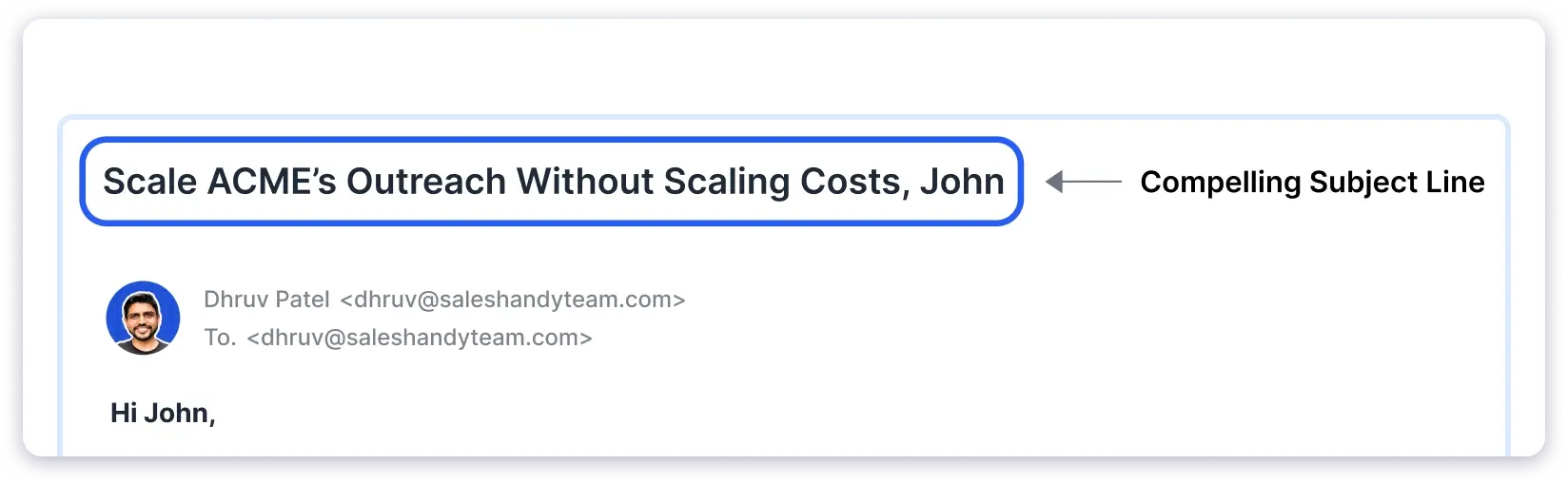
Along with that, make sure to add personalization elements like addressing the recipient by their name, role, or company.
Lastly, keep it short and AVOID SPAM WORDS!
Want ideas for subject lines? Then check this out: 200+ examples for cold email subject lines!
4. Hook Them With Your Greeting and Opening Line
Subject lines are just part of the first impression.
In order to impress your recipients and earn that click with your Basho email, you need a good greeting and opening line.
And personalization matters a lot here, too.
Because it shows that you’ve done your homework when it comes to researching your prospects.
This increases their trust and the chances of them opening.
Now, when it comes to the greeting lines, you can consider these examples:

But if you are still unsure about what to choose, you can always go with Hi {{First Name}}.
As for the opening line, here are some things to keep in mind:
- Refer to their recent posts or achievements
- Tell them why you are writing this Boasho email and how it might help them.
- Try to match the tone preferred by their regular communication.
(You will get an idea of it at the research stage itself.) - Always A/B test your opening lines and see what works the best.
And lastly, make sure to keep your opening line short and on point.
Once you’ve hooked your recipients, it’s time to move on to the core of your message:
The body of your Basho email.
5. Keep Your Content Personalized
Here’s where all that research finally pays off.
As I’ve shared multiple times, the core of a BASHO email is personalization.
That means your recipient should feel like the message was written just for them, with the goal of helping them solve a specific problem or achieve something important.
This should be seen in your email content too.

This is the part where they truly decide whether to reply to your proposal or not.
Now, I know that writing a personalized, compelling message is not easy.
That’s why I use this checklist when writing the main content of my BASHO emails:
- Address the pain point of the recipient by showing you understand them.
- Offer a clear solution and explain how you and your offering can be useful to them.
- Mention how you’ve helped competitors/similar companies, if any.
- Don’t use generic salesy words/ phrases in your message.
- Mention mutual connections or interests, if any.
And make sure your message sounds human.
You don’t want to be another one of those generic emails that your recipient ignores every day, right?
Lastly, try to keep your message short and to the point. Ideally, I try to keep mine under 300 words.
By doing all this, I’ll be able to show why they should consider my offer, and thus increase the chances of getting a reply.
6. End With a Clear Call-to-Action
While we are past the main content, that doesn’t mean the closing lines of your email are not important.
This is where you add your CTA, as it instructs your recipients about what to do next.
So if done right, your CTA’s can play a major role in increasing your reply and conversion rates.

Here’s what I make sure of when writing CTAs:
- Be clear and on point by sharing what you want them to do next
- I make sure to keep my CTAs short and easy to read.
- Try mentioning the value they will be getting.
- Provide Specific Options (If Applicable).
That said, I always recommend sticking to just one CTA, at most two. As more CTAs can confuse your recipients and might even sound.
Also, avoid vague or generic lines that sound like pressure. Basho emails should feel like a conversation, not a demand.
BASHO Email Examples
I’ve shown you how to write Basho emails. Now let me show you some templates based on that.
You can always use these, but make sure to customize them based on the prospect:
- Achievement-Based BASHO Email (Initial Contact)
- Pain Point Resolver Template
- Follow-Up After a Networking Event
- Mutual Connection Template
- Industry Insight/Trend Sharing
1. Achievement-Based BASHO Email (Initial Contact)
Congrats on the {{Milestone}}, {{First Name}}! Some thoughts on {{Relevant Area}}
Hi {{Recipient's Name}},
I recently came across {{specific achievement}} and wanted to congratulate you on {{the achievement}}.
Based on this achievement and your focus on {{specific area related to their achievement}}, I believe {{Your Product/Service}} could significantly benefit {{Company Name}} by helping in {{benefit or solution}}.
For instance, we've helped companies like {{competitor/similar company}} achieve {{achievements}} by {{feature or aspect of your solution}}.
It is possible to explore how a solution might be valuable to {{Company Name}}'s.
Would you be open to a quick {{number}} minute call next week to discuss this further?
Looking forward to hearing from you!
Best regards,
{{Your Full Name}}
{{Your Job Title}}
{{Your Company}}
2. Pain Point Resolver Template
Solving {{Specific Pain Point}} for {{Company Name}}
Hi {{First Name}},
Research on {{Company Name}} suggests potential challenges related to {{pain point or challenge}}.
At {{Your Company}}, businesses like yours are assisted in overcoming {{Pain Point}} by {{solution}}.
Companies like {{similar client/company}} have achieved {{quantifiable results}} in tackling similar issues.
The approach can significantly remove the hurdles you're facing.
Would you be open to a quick {{number}} minute call next week to explore implementing this solution for your specific needs?
Looking forward to your thoughts,
Best,
{{Your Name}}
{{Your Title}}
{{Your Company}}
3. Follow-Up After a Networking Event
Great connecting at {{Event Name, First Name}}!
Hi {{First Name}},
It was a pleasure meeting you at {{Event Name}} on {{Date of event}}.
The conversation about {{specific topic you discussed}} was enjoyable.
Considering our discussion, there could be synergy between {{Your Company}} and {{Their Company}}.
Perhaps potential collaboration opportunities around {{specific idea}} could be explored.
Would you be open to a meeting to discuss {{related topic}}?
Looking forward to staying in touch!
Best regards,
{{Your Name}}
{{Your Title}}
{{Your Company}}
{{Your LinkedIn Profile}}
4. Mutual Connection Template
{{Mutual Connection's Name}} recommended reaching out
Hi {{First Name}},
I was speaking with {{Mutual Contact’s Name}}, and they mentioned you might be the right person to connect with regarding {{specific topic or problem area}}.
They spoke highly of your work at {{Company Name}}, especially {{specific project, initiative, or achievement you know about them}}.
At {{Your Company}}, we’ve helped {{similar companies / relevant clients}} {{similar results achieved}}, and I thought it might be valuable to share some ideas tailored to {{their company’s goal or challenge}}.
Would you be open to a quick {{timeframe}} conversation sometime next week to see if it’s worth exploring?
Best,
{{Your Name}}
{{Your Title}}
{{Your Company}}
{{Your LinkedIn Profile}}
5. Industry Insight/Trend Sharing
Have you seen this {{Trend/Insight}} in {{Industry}}?
Hi {{First Name}},
I came across {{specific data point, news article, or industry report}} about {{trend or shift in their industry}} and immediately thought of the work you’re leading at {{Company Name}}.
With {{brief impact of trend}}, I imagine you’re already thinking about ways to {{goal or challenge}}.
At {{Your Company}}, we’ve been helping {{similar companies or clients}} {{mention the achievements}} in response to this exact shift, for example, {{brief client success story or statistic}}.
Would you be open to a quick conversation to compare notes on how leaders in {{their industry}} are adapting?
I can share a few approaches that might be relevant for {{Company Name}}.
Best,
{{Your Name}}
{{Your Name}}
Also read: 15 Best Cold Email Templates
How to Follow Up After Sending a BASHO Email
Even after sending your Basho mail, the process doesn’t end there.
Because you also need to have a strategic and respectful follow-up.
As it’s easy for your recipient to miss your email, or they may not have connected with the message.
Follow-up emails help to address this exact issue!
A thoughtful, well-written follow-up message can help restart the conversation.
So, here is my simple 4-step follow-up plan:
- Wait 2–3 business days before sending the first follow-up.
- Politely remind them of the initial email.
- Try giving new information, something that offers value (blog posts, industry news, or even case studies).
- Keep each follow-up under 100 words and make sure it has a single, clear CTA.
Also read: Best Email Follow-Up Software to Get More Replies
Example Mini Follow-Up Sequence
Now, let me show you a small follow-up sequence.
Here, I’m only adding two follow-up emails and then moving forward with a breakup.
You are always free to adjust the frequency as per your requirements.
Follow-Up 1 (Day 3 – Soft Reminder)
Just following up, {{First Name}}
Hi {{First Name}},
I wanted to check in to see if you had a chance to read my last email about {{topic}}.
If it’s relevant, I can send you a short case study showing how we helped {{similar company}} achieve {{result}}.
Would you like me to share it?
Best
{{Your Name}}
Follow-Up 2 (Day 7 – Value Add)
Quick resource for {{Company Name}}
Hi {{First Name}},
I came across this {{article/report/tool}} and thought of you because it touches on {{specific challenge they face}}.
It might give you a few quick wins while tackling {{pain point}}.
Happy to also share how we’re solving this for similar companies if you’d like.
Best
{{Your Name}}
Breakup Email (Day 14)
Should I close your file, {{First Name}}?
Hi {{First Name}},
I haven’t heard back after my previous emails, so I’m assuming this isn’t a priority right now.
If I’m wrong, just reply “Yes” and I’ll send over the details.
Otherwise, I’ll close my file and won’t reach out again.
Thanks for your time,
{{Your Name}}
Common Mistakes to Avoid When Writing and Sending Basho Email
There are certain mistakes that can be easily made when sending Basho emails, and can affect your entire efforts.
In my research, I was able to find some common ones, which many marketers (including me) have made.
In order to avoid that, I decided to list them here:
- Sending emails without doing proper research or personalization
- Writing clickbait or misleading subject lines
- Ignoring the prospect’s pain points or what they actually care about
- Making the email too long, unclear, or hard to read
- Forgetting to add a clear CTA that tells them what to do next
- Not following up at all (or doing it poorly)
I hope you’ll ensure that similar mistakes don’t happen in your Basho campaigns.
Before You Start Sending Basho Emails…
Alright, so I’ve walked you through the whole process of sending a BASHO email step by step.
I’ve even shared some useful templates, as well as some common mistakes to avoid.
So, you are all set to launch your BASHO campaign, right?
Well, you just need to figure out one more thing: how you’re going to send them.
Yes… But have you decided how you will be sending these emails?
Sure, you can always manually carry out the entire process, but once you run multiple campaigns (let’s say more than 5), it will be hard to keep track of them all.
Personally, I use a cold email tool like Saleshandy to send my BASHO emails.
To improve email deliverability, always check your setup. If needed, change VPN location to match your target audience’s country. This makes your emails appear more local and helps reduce spam issues.
Its AI Sequence Copilot actually understands your goals, offer, and audience to build targeted sequences.
This helps to reduce human errors as well as get detailed analytics of your campaigns.
It’s suited for both small and large-scale campaigns, and has always been reliable for me with high deliverability rates.
Either way, I highly recommend using a tool. It’ll save time, improve performance, and let you focus on writing great emails.
Good luck with your BASHO campaigns!
BASHO Email: FAQs
1. What is the difference between Basho and cold email?
Basho emails are a type of cold email, but are highly personalized and require in-depth research to tailor the message specifically to the recipient’s needs and interests. Meanwhile, generic cold emails are sent to a broader audience, usually with a templated format with minimal personalization.
While Bhasho emails aim for deeper engagement and higher response rates, cold emails aim for lead generation or sales.
2. Is Basho Email Relevant in 2025?
Yes, Basho emails are still highly relevant and practical in 2025, particularly in the B2B space. Mainly because it helps your emails stand out from the saturated inboxes of generic emails, Basho mails are also best in reply and conversion rates, as well as in establishing a connection with the prospects.
3. Can BASHO emails be automated?
Yes, Basho emails can be automated, but with the right tool. Since Basho email requires deep personalization, your tool should have the feature to send hyper-personalized Basho emails.
4. What does Basho mean in sales?
In sales, Basho is usually referred to as the sales strategy developed by Jeff Hoffman. While the entire strategy is not well-known, Basho emails, which are part of this strategy, are widely used in the B2B space in reaching out to decision-makers / high-value prospects.
5. What does Basho email stand for?
Basho email got its name from the company Basho Technologies, where the creator of this strategy, Jeff Hoffman, was working. The company got its name from the Japanese poet Matsuo Bashō.
6. Can I use AI to write Basho emails?
Yes, you can always use AI to write Basho emails, but I won’t suggest that. Because Basho’s email’s main feature is its human side, and how much effort you have taken to understand the prospect’s requirements. However, you can always use the help of AI to gather and process the data for your research, or even create variants of your email.
 Dhruv Patel