


Lusha is one of the most popular B2B contact data tools on the market.
But when it comes to understanding how much does Lusha costs, the pricing gets confusing fast.
It gives you five plan tiers, a credit system where phone numbers cost 5x more than emails, per-seat charges, and billing conditions that change your real cost depending on how you prospect.
I broke down every Lusha pricing plan and did the full math.
This covers what each tier actually costs, how the credit system affects your real cost per contact, hidden charges most reviews skip, and who each plan fits.
Lusha Pricing- TOC
- Lusha Pricing at a Glance (TL;DR)
- Lusha Pricing Plans: Complete Breakdown (2026)
- How Lusha Credits Actually Work
- Per-Credit Cost Analysis: Which Lusha Plan Gives the Best Value?
- Should You Upgrade From Lusha Pro to Premium?
- Hidden Costs and Limitations Worth Knowing
- Who Should Pick Which Lusha Plan?
- Choose a Better and Cost-Effective Alternative to Lusha
- Frequently Asked Questions About Lusha Pricing
Lusha Pricing at a Glance (TL;DR)
Before the full Lusha pricing breakdown, here is the short version.
- Lusha pricing fits solo users and small teams (1-5 people) who primarily need email data. If your team is scaling, prospecting via phone, or needs consistent access without credit rationing, evaluating structurally different alternatives is worth the time.
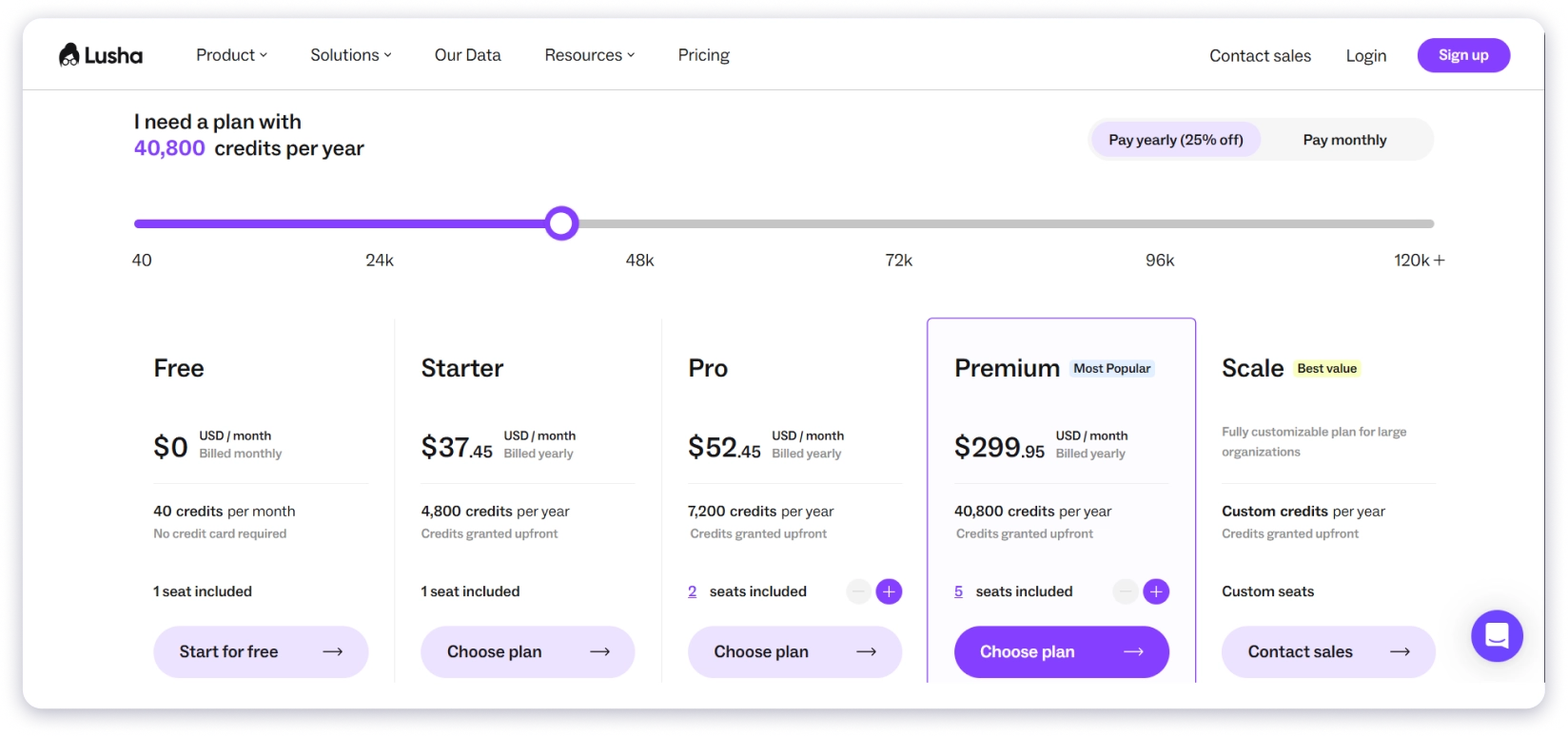
- Lusha has five pricing plans: Free ($0), Starter ($37.45/mo), Pro ($52.45/mo), Premium ($299.95/mo), and Scale (custom). All prices are monthly equivalents on annual billing.
- The credit system is the real pricing lever. 1 credit reveals a verified email. 5 credits reveal a phone number. So the headline credit number can be misleading depending on how your team prospects.
- Per-credit Lusha cost ranges from ~$0.094 on Starter to roughly $0.04 on Scale. Pro is marginally cheaper per credit than Premium, which most buyers do not expect.
- Annual plans deliver all credits upfront, but unused credits reset at year-end with no rollover. Monthly plans cost 25-35% more but allow credit rollover up to 2x the monthly cap.
Lusha Pricing Plans: Complete Breakdown (2026)
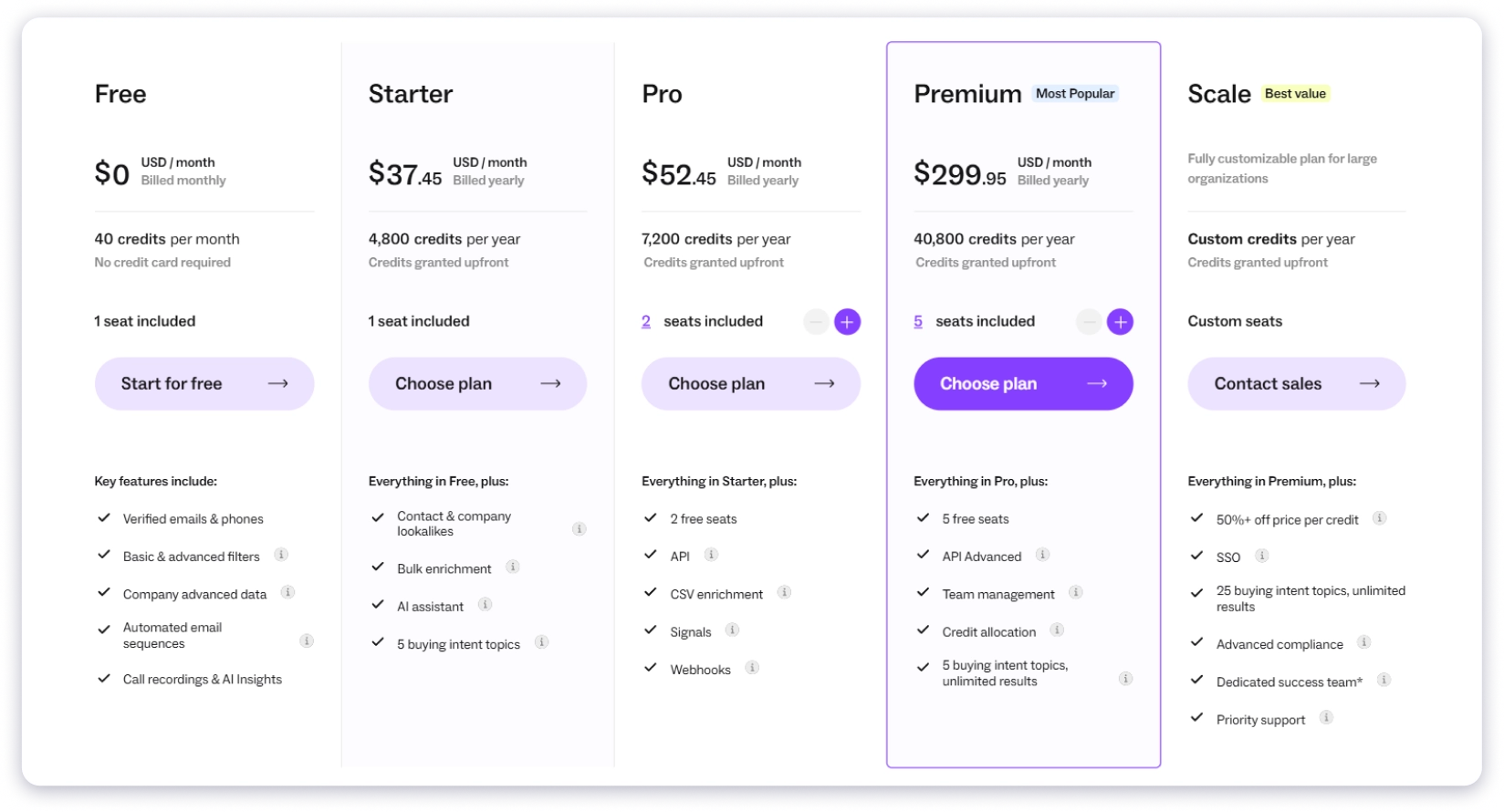
Here is what each Lusha pricing plan costs, includes, and gates, pulled directly from lusha.com/pricing as of May 2026.
| Features | Free | Starter | Pro | Premium | Scale |
|---|---|---|---|---|---|
| Price (annual billing) | $0/mo | $37.45/mo | $52.45/mo | $299.95/mo | Custom |
| Annual Total | $0 | ~$449/yr | ~$629/yr | ~$3,599/yr | Custom |
| Credits / Year | ~480 (40/mo) | 4,800 | 7,200 | 40,800 | Custom |
| Seats Included | 1 | 1 | 2 | 5 | Custom |
| API Access | No | No | Yes | Yes (Advanced) | Yes |
| Buying Intent | No | 5 topics (limited) | — | 5 topics (unlimited) | 25 topics |
| Bulk Enrichment | — | Yes | CSV enrichment | CSV enrichment | CSV enrichment |
| Team Credit Allocation | No | No | No | Yes | Yes |
| SSO | No | No | No | No | Yes |
| Dedicated Success Team | No | No | No | No | Yes |
Those credit numbers look reasonable at first glance.
But before getting into the credit math, here is what each Lusha pricing plan actually includes, what it misses, and who it fits.
The table above gives you a quick comparison, but the numbers alone do not tell you what each Lusha pricing plan actually feels like to use.
Feature access, credit limits, and seat restrictions hit differently depending on your team size and how you prospect.
Here is what each plan includes, who it fits, and where it falls short.
1. Free Plan ($0/Month)
Solo reps or founders who want to test Lusha’s data quality on a handful of contacts before committing to a paid plan.
The first tier in Lusha pricing is the Free plan.
It costs nothing to start and does not require a credit card, which makes it the easiest way to test whether Lusha’s data covers your target market.
What it includes:
- 40 credits per month for a single user
- Browser extension for LinkedIn and web prospecting
- Verified email addresses and phone numbers
- Basic and advanced search filters
- Company advanced data
- Automated email sequences
- Call recordings with AI insights
What it does not include:
- API access
- Bulk enrichment
- Contact and company lookalikes
- Buying intent data
- CRM integrations beyond basic export
- Team collaboration or additional seats
- At 40 credits per month, you can reveal 40 emails or just 8 phone numbers. That is enough for spot-checking, not for building pipeline.
2. Starter Plan ($37.45/Month, Annual Billing)
Individual reps doing low-to-moderate volume email prospecting who need more credits than the free tier and want access to lookalike targeting and basic intent signals.
Starter is the first paid tier in Lusha pricing and the entry point for reps who need more than 40 credits per month.
It adds lookalike targeting and basic intent signals on top of everything in the Free plan.
What it includes:
- Everything in the Free plan
- 4,800 credits per year, granted upfront on annual plans
- 1 seat included
- Contact and company lookalikes
- Bulk enrichment
- AI assistant
- 5 buying intent topics with limited results
What it does not include:
- API access
- CSV enrichment
- Webhooks or signals
- Additional team seats (only 1 seat included)
- Buying intent with unlimited results
- If you need programmatic data access or have more than one person on the team, Starter will not be enough.
3. Pro Plan ($52.45/Month, Annual Billing)
Small teams of 2-3 reps who need API access for CRM enrichment workflows and want the best per-credit value across all paid tiers ($0.087 per credit versus $0.088 on Premium).
Pro is where Lusha pricing starts supporting small teams.
It is the first plan with API access and a second seat included, making it the go-to tier for teams that need programmatic enrichment alongside manual prospecting.
What it includes:
- Everything in Starter
- 7,200 credits per year
- 2 seats included
- API access
- CSV enrichment
- Signals
- Webhooks
This is the first Lusha pricing plan that supports a small team and gives access to programmatic enrichment.
What it does not include:
- Advanced API with higher rate limits
- Team credit allocation
- Buying intent with unlimited results
- SSO
- Dedicated success team
- More than 2 seats. Teams of 3+ people on Pro would need to upgrade to Premium or contact Sales.
4. Premium Plan ($299.95/Month, Annual Billing)
Mid-size teams of 4-5 reps running high-volume campaigns who need team-level credit management and deeper intent data. At roughly $60 per user per month across 5 seats, the per-user Lusha cost is reasonable if the team actually uses the full credit pool.
Premium is Lusha’s mid-to-high tier and the plan they mark as “Most Popular” on their pricing page.
It is a significant jump from Pro in both price and capacity, designed for teams that need centralized credit management and deeper intent data.
What it includes:
- Everything in Pro
- 40,800 credits per year
- 5 seats included
- Advanced API with higher rate limits
- Team management with group controls
- Centralized credit allocation across team members
- 5 buying intent topics with unlimited results
Lusha marks this as their “Most Popular” plan.
What it does not include:
- SSO
- 25 buying intent topics (limited to 5)
- Dedicated success team
- Priority support
- Advanced compliance features
- Per-credit discounts beyond the standard rate
- The $247.50 per month jump from Pro makes this a significant commitment for teams that may not need the full 40,800 credits.
5. Scale Plan (Custom Pricing)
Large teams of 6+ users with enterprise requirements like SSO, compliance controls, and dedicated support. Also, the only option for any team that needs more than 5 seats.
Scale is Lusha’s enterprise tier and the only option for teams that need more than 5 seats, SSO, or custom credit volumes. It is also the only plan where Lusha offers per-credit discounts, but the pricing is not published anywhere on the website.
What it includes:
- Everything in Premium
- 50%+ off per credit compared to Premium rates
- Custom credit allocation and seat count
- SSO
- 25 buying intent topics with unlimited results
- Advanced compliance
- Dedicated customer success team
- Priority support
What it does not include:
- Published pricing. You must contact Lusha Sales for a quote.
- Disclosed minimum commitments
- Published required contract length
- Transparency on base seat counts or credit floors
- This lack of pricing visibility makes it hard to evaluate Scale against competitors without going through a full sales process.
Now that the plan details are clear, the next layer to understand is how Lusha credits pricing actually works, because the same plan can give you very different contact volumes depending on your outreach method.
How Lusha Credits Actually Work
Understanding Lusha credits pricing is essential because the credit system is what determines your actual cost per contact, not the plan price alone.
- Revealing a verified email address costs 1 credit.
- Revealing a phone number costs 5 credits.
That 5x difference changes the Lusha pricing math significantly.
Here is what each plan’s credit allocation actually translates to in real contacts:
| Plan | Credits / Year | Email-Only Reveals | Phone-Only Reveals | Mixed (50/50) |
|---|---|---|---|---|
| Free | ~480 | 480 | 96 | ~160 |
| Starter | 4,800 | 4,800 | 960 | ~1,600 |
| Pro | 7,200 | 7,200 | 1,440 | ~2,400 |
| Premium | 40,800 | 40,800 | 8,160 | ~13,600 |
To put the Premium tier in perspective: a team doing phone-only prospecting gets approximately 8,160 contacts from a plan that costs $3,599 per year.
That works out to roughly $0.44 per phone number.
A rep who reveals both email and phone for every contact burns 6 credits per person.
That cuts the effective contact volume by about 83% compared to email-only usage.
On the Pro plan, that means roughly 1,200 fully enriched contacts per year instead of 7,200 email-only reveals.
This is the single biggest factor that most Lusha pricing reviews underreport.
The plan that looks affordable for email prospecting becomes expensive fast when phone numbers enter the equation.
SDR teams that rely on cold calling should calculate their actual Lusha cost per contact based on their email-to-phone ratio, not the headline credit number.
Knowing what credits actually buy, the next question is which Lusha pricing plan gives the best value per credit.
The answer is not as obvious as picking the biggest tier.
Per-Credit Cost Analysis: Which Lusha Plan Gives the Best Value?
When you break each Lusha pricing plan down to cost per credit, the value differences across tiers are smaller than most buyers expect.
| Plan | Annual Cost | Credits | Cost Per Credit | Cost Per Email | Cost Per Phone |
|---|---|---|---|---|---|
| Free | $0 | ~480 | $0.00 | $0.00 | $0.00 |
| Starter | ~$449 | 4,800 | ~$0.094 | ~$0.094 | ~$0.47 |
| Pro | ~$629 | 7,200 | ~$0.087 | ~$0.087 | ~$0.44 |
| Premium | ~$3,599 | 40,800 | ~$0.088 | ~$0.088 | ~$0.44 |
| Scale | Custom | Custom | ~$0.04+ | — | — |
- Pro is actually marginally cheaper per credit ($0.087) than Premium ($0.088).
The difference is small, but it means Premium’s value is not about credit efficiency. It is about volume, included seats (5 versus 2), and access to team management features like credit allocation. - Premium and Pro Lusha pricing per user per month may look different at $299.95 versus $52.45, but the per-contact cost is nearly identical.
So if you are comparing these two tiers purely on data cost, the per-credit value is almost the same. - Scale claims 50%+ off per credit compared to Premium, which would put it around $0.04 per credit or lower.
However, Lusha does not publish the minimum commitment, number of seats, or contract terms required to access Scale pricing. You have to talk to their sales team to get a quote.
If Pro and Premium are almost identical on per-credit cost, the real question becomes whether upgrading from Pro to Premium makes sense for your team size and feature needs.
Should You Upgrade From Lusha Pro to Premium?
Pro Lusha pricing is $52.45 per month. Premium Lusha pricing is $299.95 per month.
That is a $247.50 per month jump, nearly 6x the price.
- What You Get for the Price Jump
- When Premium Makes Sense
- When Stacking Pro Seats Is Cheaper
- The Real Deciding Factor
1. What You Get for the Price Jump
For that increase, you get approximately 5.6x more credits (7,200 to 40,800), three additional seats (2 to 5), team credit allocation controls, buying intent with unlimited results, and Advanced API access.
2. When Premium Makes Sense
If your team has 4-5 reps running high-volume campaigns, Premium’s credit pool and team management features can justify the Lusha cost. You are paying roughly $60 per user per month for 5 seats with 40,800 credits to distribute across the team.
3 .When Stacking Pro Seats Is Cheaper
But if your team is 2-3 people, the Lusha pricing per user math shifts. Two Pro seats cost $104.90 per month total and give you 14,400 credits per year across 2 users.
One Premium plan costs $299.95 per month for 40,800 credits. If your team needs fewer than 15,000 credits annually, two Pro seats save roughly $195 per month.
The Real Deciding Factor
The deciding factor is not just credits. It is whether you need the team management features that Premium gates: centralized credit allocation, advanced usage analytics, and buying intent with unlimited results.
If those features are necessary for how your team operates, Premium is the only path. If they are not, stacking Pro seats is more cost-efficient for smaller teams.
Beyond plan selection, there is another decision that affects total Lusha cost: whether to go with annual or monthly billing.
The tradeoff is not just about the discount.
Hidden Costs and Limitations Worth Knowing
Lusha’s published pricing covers the subscription cost.
But several factors affect what you actually pay over time, and they are not always obvious from the Lusha pricing page alone.
- Renewal Price Increases
- Feature Gating Across Tiers
- Credit Expiration
- Auto-Renewal and Contract Lock-In
Let’s get into the details!
1. Renewal Price Increases
Multiple G2 reviews and third-party sources report annual renewal increases in the range of 8-15%.
Lusha does not publish renewal pricing terms publicly, which means the year-two Lusha cost can be meaningfully higher than what you paid at sign-up.
One G2 reviewer specifically described discovering unexpected costs after not reading the terms carefully enough before committing.
2. Feature Gating Across Tiers
Several high-value features in Lusha pricing plans are only available on specific tiers. Lusha API pricing starts at the Pro level, with Advanced API reserved for Premium and above.
Buying intent data is limited on Starter, and only Premium and Scale get unlimited results. SSO is available exclusively on Scale.
Per-user credit limits for managers are also Scale-only. And any team with more than 5 users has no self-serve upgrade option and must go through Lusha Sales.
3. Credit expiration
Annual plan credits that go unused at the end of the billing cycle are forfeited entirely.
There is no partial refund and no carryover to the next cycle.
This makes accurate usage forecasting important before choosing an annual commitment, especially for teams with inconsistent prospecting volume.
4. Auto-Renewal and Contract Lock-In
All Lusha plans renew automatically. Cancellation is available through Account Settings, but it only takes effect at the end of the current billing cycle.
For annual subscribers, Lusha’s terms state that the customer is obligated to fulfill the entire payment amount for the term. Canceling mid-cycle does not result in a prorated refund.
With all of the Lusha pricing details, credit mechanics, and hidden costs laid out, the practical question is: which plan actually fits your situation?
Who Should Pick Which Lusha Plan?
Instead of listing Lusha pricing plan features again, here is a practical recommendation based on team size and prospecting style.
| If You Are… | Best Lusha Plan | Why |
|---|---|---|
| Solo SDR or founder testing data quality | Free | The Lusha free plan gives 40 credits/month for spot-checks and data quality testing, not pipeline building. |
| Individual rep doing email-only outreach | Starter | 4,800 credits/year covers roughly 400 emails per month at a reasonable Lusha cost. |
| Small team (2-3 reps), email + some phone | Pro | 7,200 credits, 2 included seats, API access. Best per-credit value across all paid Lusha pricing tiers. |
| Mid-size team (4-5 reps), high volume | Premium | 40,800 credits, 5 seats, team credit allocation, buying intent. Worth it only if you need both volume and management features. |
| Large team (6+), enterprise requirements | Scale | Custom credits, SSO, priority support, dedicated success team. Must negotiate Lusha pricing directly with Sales. |
- Teams of 2-3 people who do not need centralized credit allocation or advanced usage analytics should consider running two Pro seats at $104.90/month total instead of one Premium plan at $299.95/month. The credit pool is smaller, but the savings are significant when your team does not need 40,000+ credits annually.
- Phone-heavy prospecting changes the math entirely. Multiply your expected monthly contact volume by 5 when estimating credit needs. The Lusha pricing plan that looks sufficient for email-only outreach can fall short within weeks once phone reveals are part of the workflow.
- Once your team crosses 5 seats or needs pricing that does not scale per user, Lusha’s per-seat model starts working against you. That is where platforms with a fundamentally different pricing structure become worth evaluating.
For teams that hit the ceiling on Lusha’s credit limits or per-seat costs, here is how a structurally different approach to B2B data and outreach works.
Choose a Better and Cost-Effective Alternative to Lusha
Lusha’s credit-based, per-seat pricing model works for small teams with predictable email prospecting.
But three things start creating friction as teams grow: per-user costs multiply with every new rep, phone reveals drain credits 5x faster than emails, and credit caps can stall prospecting mid-month with no way to continue until the next billing cycle.
- 852M+ Verified Contacts, 42M+ Companies
- No Per-Seat Pricing
- No 5x Phone Credit Penalty
- Built-In Outreach Workflow
- 7-Day Free Trial With 50 Credits
- No Renewal Surprises
Saleshandy Lead Finder is built on a different structure that removes those friction points.
1. 852M+ Verified Contacts, 42M+ Companies
Lusha’s database covers 280M+ contacts. Saleshandy’s database is 3x larger, with 75+ search filters for targeting by role, industry, company size, technology, revenue, and location.
The larger database means fewer gaps in coverage, especially for niche verticals and international markets.
2. No Per-Seat Pricing
Every Saleshandy plan includes unlimited team members. Adding a fifth, tenth, or twentieth SDR does not add another per-user cost.
On Lusha, every additional seat increases the monthly bill, making Lusha pricing per user a scaling bottleneck for growing teams.
3. No 5x Phone Credit Penalty
Saleshandy credits work the same regardless of whether you are revealing an email or a phone number.
There is no separate multiplier that punishes phone-heavy outreach teams the way Lusha credits pricing does.
4. Built-In Outreach Workflow
After finding contacts, you can run cold email sequences, make cold calls through a built-in dialer with local presence dialing, and add LinkedIn steps, all from the same platform. Lusha is a contact data tool.
Saleshandy covers the full outbound workflow from prospecting through reply management.
5. 7-Day Free Trial With 50 Credits
No credit card required. That is enough to test data quality, run searches across filters, and evaluate the platform before committing to a paid plan.
6. No Renewal Surprises
Saleshandy’s pricing is published, plans start at $25/month for outreach and $49/month for Lead Finder, and there are no widely reported annual price hikes in user reviews.
Compared to Lusha pricing where 8-15% annual renewal increases are commonly flagged, that predictability matters for budget planning.
Lusha is a solid option for individual reps and small teams that primarily need email data through a browser extension.
For teams that need a larger database, predictable costs at scale, and an outbound workflow beyond just contact reveals, Saleshandy is worth comparing side by side.
Frequently Asked Questions About Lusha Pricing
1. How Much Does Lusha Cost per Month?
Lusha pricing per month depends on the plan and billing cycle.
On annual billing, the Free plan costs $0, Starter costs $37.45 per user, Pro costs $52.45 per user, and the Premium costs $299.95 per user. Scale pricing is custom and requires contacting Lusha Sales directly.
If you choose monthly billing, Lusha pricing per month is roughly 25-35% higher than the annual rate.
How much does Lusha cost for a full team depends on the number of seats: each plan includes a fixed number, and additional users require upgrading tiers.
2. Does Lusha Have a Free Plan?
Yes. The Lusha free plan includes 40 credits per month for a single user. It provides access to the browser extension, verified emails and phone numbers, basic and advanced filters, automated email sequences, and company data.
The Lusha free plan does not include API access, bulk enrichment, CRM integrations beyond basic export, or team collaboration features.
It is practical for testing data quality on a handful of contacts, but not for running outbound prospecting at any meaningful scale.
3. How Do Lusha Credits Work?
Lusha credits pricing works on a per-action model. Revealing a verified email address costs 1 credit.
Revealing a phone number costs 5 credits. This means the same plan gives you very different contact volumes depending on your outreach method.
On annual Lusha pricing plans, all credits are granted upfront at the start of the billing cycle.
Unused credits reset at year-end with no rollover. On monthly plans, unused Lusha credits roll over to the following month, up to a cap of 2x your monthly credit allocation.
4. Is Lusha Pricing Per User?
Yes. Every Lusha pricing plan is charged per seat. The Free and Starter plans include 1 seat each. Pro includes 2 seats. Premium includes 5 seats. Scale allows custom seat counts negotiated through Lusha Sales.
Lusha pricing per user means total cost scales directly with team size. If your team has more than 5 people, there is no self-serve option to add seats.
You need to contact Lusha Sales for a Scale plan quote, and the pricing terms for that tier are not published.
5. Does Lusha Offer API Access?
Lusha API pricing starts at the Pro plan ($52.45/mo on annual billing). Premium offers an Advanced API tier with higher rate limits and additional capabilities. Free and Starter plans do not include any API access at all.
Webhooks and MCP integrations are also available starting at Pro.
If your workflow depends on programmatic enrichment or automated CRM syncing through the API, you will need at least a Pro subscription as part of your Lusha pricing plan.
6. Is There a Cheaper Alternative to Lusha With More Contacts?
Saleshandy Lead Finder offers access to 852M+ verified contacts, which is roughly 3x the size of Lusha’s database. Lead Finder plans start at $49/month with a 7-day free trial and 50 free credits.
Unlike Lusha pricing, Saleshandy does not charge per seat and does not apply a 5x credit multiplier for phone number reveals.
It also includes cold email sequences, a built-in dialer, and LinkedIn outreach steps in the same platform.
For teams where Lusha costs scale too fast per user or per phone reveal, Saleshandy offers a structurally different model worth evaluating.


 Dhruv Patel