![AI vs Human Cold Emails: 12K Cold Email Test Results [2026]](https://www.saleshandy.com/blog/wp-content/uploads/2026/06/Which-Cold-Emails-Get-More-Replies_-AI-or-Human_.webp)

So, Dhruv, who’s winning the cold email race in 2026: AI or humans?
I get asked this a lot. My answer is always the same: neither.
And that’s not just an opinion. It’s what the data showed us.
I tested 12,000 cold emails across three campaigns:
- 5,000 emails written entirely by ChatGPT and Claude
- 2,000 emails written manually by SDRs
- 5,000 emails researched, brainstormed, and drafted with AI, then refined by humans
The ICP, offer, and sending infrastructure stayed the same across all three campaigns.
The only thing we changed was how the email was written.
And the results were not what most people expected.
In this article, I’ll show you how we ran the test, what worked, what failed, and the AI email personalization framework you can use to write cold emails that get better replies in 2026.
Let’s get into the findings.
AI vs Human Cold Emails – TOC
TL;DR: AI vs Human-Written Cold Emails: Who’s Winning in 2026?
| Metric | AI-Only [5K] | Human-Only [2K] | Hybrid: AI + Human [5K] |
|---|---|---|---|
| Reply Rate | 4.1% (~205 replies) | 10.4% (~208 replies) | 14.7% (~735 replies) |
| Positive Reply Rate | 1.4% (~70 positive replies) | 4.2% (~84 positive replies) | 7.3% (~365 positive replies) |
| Meetings Booked | 0.7% (~35 meetings) | 2.2% (~44 meetings) | 3.2% (~160 meetings) |
| Spam Flag Rate | 7.8% | 2.9% | 3.1% |
| Email Creation Speed | 2-3 days, 1 person | ~1 week, 5 SDRs | ~3 days, 1 SDR |
| Response Quality | Shallow, generic | Substantive, contextual | Highly substantive |
| Personalization Depth | Pattern-based | Unique but hard to scale | Unique and scalable |
| Cost of This Test | ~$200 | ~$8-9K | ~$4K |
| Best For | High-volume outreach, ACV below $15K | Enterprise, ACV $50K+ | Mid-market, SMB, and scalable outbound teams |
How We Tested AI vs Human Cold Emails Across 12,000 Sends
We pulled 12,000 prospects from Saleshandy Lead Finder using identical ICP filters:
- Title: VP of Sales, Head of Sales
- Industry: B2B SaaS
- Company size: 50-200 employees
- Geography: United States
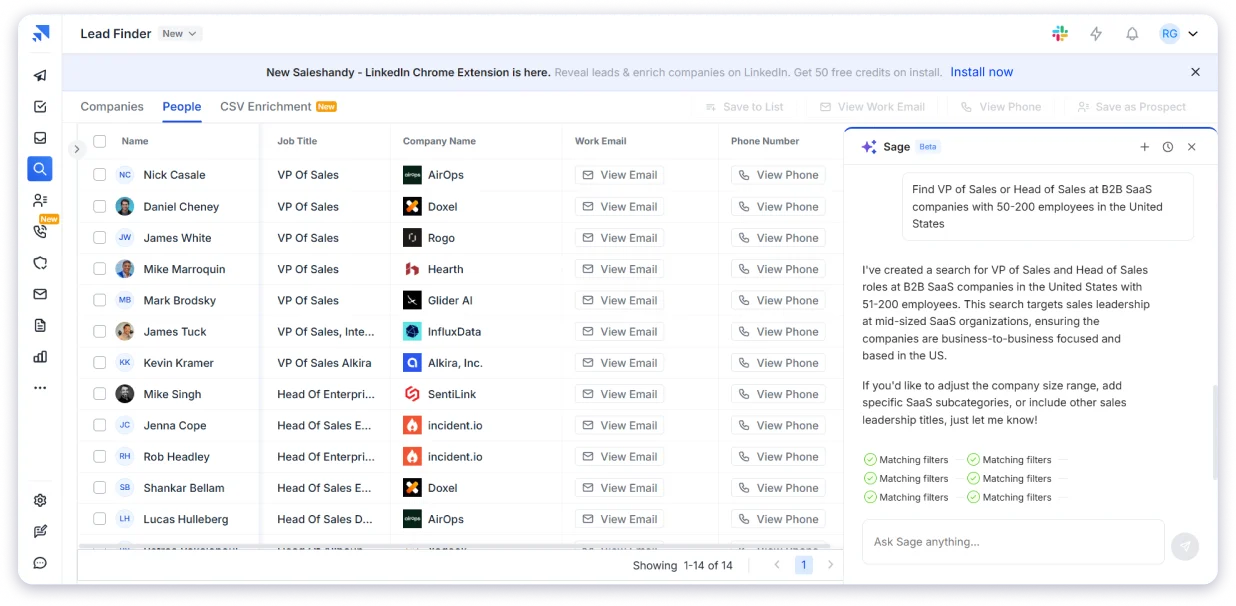
We picked this ICP on purpose. Because they are one of our ideal target audiences.
Then we randomly split the 12K into three non-overlapping groups.
We ran all three campaigns simultaneously under the same conditions:
- 12 warmed-up sending domains
- Sending limit: 50 emails/account/day
- Follow-up duration: 3-day gaps between emails
The only thing that changed across the three campaigns was how we wrote and strategized the emails.
Also, each campaign had its own set of sending domains and secondary email accounts.
Why? Because if one campaign hurt the domain’s reputation, it could have negatively impacted the results for the other two.
Key Learning
Always keep your test groups on a separate sending email infrastructure.
Campaign 1: AI-Only Setup
Since this is an AI-only campaign, we follow a simple rule:
AI handles everything from research to writing, and humans only step in to set up the campaign.
- Setup time: 2–3 days
- Prospects: 5,000
- Team: 1 person
- SDR involvement: For setup purposes only
Step 1: Mapped Out the Buyer Persona with ChatGPT
Before writing a single email, we wanted to know exactly who we were writing to.
We fed our ICP into ChatGPT: VP of Sales and Head of Sales at B2B SaaS companies with 50-200 employees in the United States.
Then we asked it to map out the buyer persona for us:
In under 30 seconds, ChatGPT returned a sharp persona profile: pain points, priorities, and the kind of language this buyer responds to.
This is exactly the kind of work AI is built for. I think no human can map a buyer persona that fast.
Step 2: Gave ChatGPT the Pain Points and Asked for Cold Emails
Once we had the persona, we fed it back into ChatGPT with a writing prompt:
Within minutes, we had a full sequence ready. We did the same exercise with Claude and Gemini to keep the data clean across all three LLMs.
But Something my team and I noticed immediately (and it’s the part the LLM vendors don’t talk about) is that every AI tool sounds monotonously the same.
They all produced emails that were technically correct and strategically sound. And that’s the problem with AI cold email writing tools currently.
It’s 2026, and recipients are not dumb. They will have seen these patterns gazillion times because their inboxes are full of emails that sound exactly like this.
Hot Takeaway
The AI voice has effectively become the voice of spam, even when the email itself isn’t spam.
Step 3:Craft the Email and Launch the Campaign
Once the sequence was ready, we pulled 5,000 verified prospects from Saleshandy Lead Finder, loaded them in, and hit launch.
The sequences ran on the same email infrastructure across all three campaigns.
Also, we didn’t tweak anything in the AI-generated copy. Because we wanted to see what unedited AI emails do when they’re sent the same way any team would send them.
Then we waited.
Pro Tip
You can also use Saleshandy’s MCP / CLI to send campaigns directly from any LLM (ChatGPT, Claude, Gemini). It skips the copy-paste workflow entirely and builds the sequence inline in your Saleshandy account in one shot.
Step 4: What the Numbers Told Us
To track results, we didn’t need a separate dashboard.
Saleshandy’s native Sequence Analytics tracks opens, replies, click-throughs, bounces, unsubscribes, and step-by-step performance in real time. We checked it once a day.
Here’s what we saw across 5,000 emails:
- Reply rate: 4.1% (~205 replies)
- Positive reply rate: 1.4% (~70 positive)
- Meetings booked: 0.7% (~35)
- Final spam flag rate: 7.8%
- Bounce rate: settled at 1.2% by the end of the campaign
When we ran the replies through Saleshandy’s AI Reply Categorization, the picture got clearer:
Campaign 2: Human-Only Setup
- Setup time: ~1 week
- Prospects: 2000
- Team: 5 SDRs
- Workflow: Sequences built in Saleshandy. Every email is researched and written by humans.
Step 1: Researched Each Prospect Manually
This step is about understanding the prospect’s world deeply enough to write something they’d actually want to read.
We split the 2000 prospects across five SDRs (400 per rep). They started researching every detail manually, without using AI or Saleshandy’s prospect enrichment tool.
Each SDR spent most of their research time on:
- Recent LinkedIn activity: What the prospect posted, commented on, or engaged with in the last 30 days
- Company announcements (via their website or press releases): Funding rounds, hiring, leadership changes, and new product launches
- Recent podcast appearances, or industry mentions (via Google News and LinkedIn)
Across 500 prospects per rep, three patterns showed up almost similarly:
Pattern 1: Most VPs were talking about “outbound is broken”
Roughly 40% of the prospects had either posted about or engaged with content on the state of outbound in 2026 due to AI noise, declining reply rates, and SDR burnout. This was the strongest hook our SDRs could pull on.
Pattern 2: A clear funding-to-pain timeline
Companies that had recently raised Series A or B (within 3-6 months) were almost always hiring SDRs and stress-testing their outbound infrastructure at the same time. (Perfect timing for an outreach play around scaling outbound.)
Pattern 3: Tech stack signals
A surprising number of VPs were publicly venting about specific tools: Outbound CRMs, tools that were broken, sequencers that drifted, enrichment platforms that returned outdated data.
Naming the actual pain (without naming the tool directly) became a reliable opener.
Step 2: Strategized Email Copies Backed by Research
With those three patterns identified, each SDR followed a simple writing strategy:
- Opener: A specific reference to the prospect’s recent activity, pain point, question they’re asking on LinkedIn, or company moment
- Middle: A one-line observation tying their situation (outbound broken, post-funding scaling, tech-stack pain, or any relevant event)
- CTA: A soft question, not a calendar link. Something like “worth a quick look at how teams your size are handling this?”
- Length: 75-100 words
Yes, the emails weren’t over-polished; they had small imperfections. But those imperfections are exactly what make personalized cold emails feel human. And AI still can’t replicate it.
Step 3: Sent Those Email Sequences
Once the emails were written, the SDRs loaded their sequences into Saleshandy and launched.
One interesting thing we noticed was that Saleshandy Spam Checker flagged a much lower percentage of these emails compared to Campaign 1.
It was somewhere around 4-5%. So the deliverability picture was healthier from the start.
Step 4: Why the Results Surprised Us
Across 2,000 emails sent over the campaign window, here’s what came back:
- Reply rate: 10.4% (~208 replies)
- Positive reply rate: 4.2% (~84)
- Meetings booked: 2.2% (~44)
And here’s how the replies actually broke down:
Campaign 3: Hybrid Setup (The Approach We Actually Recommend and Use)
- Setup time: ~3 days
- Prospects: 5,000
- Team: 1 SDR
After running Campaigns 1 and 2 back to back, one thing became obvious to me: AI is brilliant at fast-tracking the research, and humans are brilliant at using that research to write copy that actually lands.
So we built this campaign around that exact division of labor.
AI does the research, and humans write the emails. That’s what AI email personalization actually looks like.
And it’s the approach we run at Saleshandy every single day.
Step 1: AI Does the Research at Two Levels: ICP and Prospect
In Campaign 2, our SDRs spent a full week on research alone. In Campaign 1, ChatGPT did the research in seconds but only at a shallow ICP level.
For this hybrid campaign, we wanted both the depth of human research and the speed of AI at each stage.
So we ran Saleshandy AI Prospect Enrichment at two layers:
Layer 1: The ICP-level brief
We fed our ICP (VP of Sales / Head of Sales, B2B SaaS, 50-200 employees, US) into AI Prospect Enrichment.
Then we asked it to surface patterns across the ICP segment, like common pain points by team size, tech stack frustrations, recent industry shifts, and what they’re publicly complaining about.
AI returned a sharp, multi-source summary in 30 minutes.
Layer 2: The prospect-level research card
For each of the 5,000 prospects, AI Prospect Enrichment then pulled the individual context, like:
- recent LinkedIn posts,
- funding moves,
- leadership changes,
- podcast appearances,
- tech stack signals
The same work that took our SDRs approx 30 minutes per prospect in Campaign 2 happened in seconds, at scale, for the entire list.
Now the SDR could focus on the only thing AI can’t do well: writing.
Step 2: Strategized the Cold Email Copy & Launched the Campaign
As the research was ready, the SDR strategized every email from scratch, from choosing the hook, the framing, to the angle that would resonate most with each prospect based on what the research card surfaced.
The SDR opened the research card, read it like a human to actually understand a person’s situation, then wrote the email from scratch.
The interpretive layer by reacting to what the prospect had posted, agreeing with one specific point, and connecting it to a real pain that stayed with the recipient.
The SDR also added one layer of hyper-personalization that turned good emails into high-performing ones: a location-based P.S. under the CTA.
Using the prospect’s city or recent location from the research card, the SDR dropped in a casual one-liner like:
“P.S. How’s the Denver winter treating you? I lived in LoHi for a year and still miss the Linger rooftop.”
This pushed our cold email response rate even higher. Because it’s a small detail, yet it creates a big impact. It tells the prospect a human wrote this specifically for them.
The merge tag automatically pulls in the prospect’s location and a popular local spot, then creates a personalized line that feels like it was written specifically for them.
Once the sequences were ready, the SDR loaded them into Saleshandy and hit launch using the same infrastructure as Campaigns 1 and 2.
Step 3: The Results Were Impressive
Across the 5,000 emails, the campaign came back like this:
- Reply rate: 14.7% (~735 replies)
- Positive reply rate: 7.3% (~365)
- Meetings booked: 3.2% (~160)
- Spam flag rate: 3.1%
The hybrid model produced almost 3.6x the reply rate of AI-only and 1.4x the reply rate of human-only.
Positive replies came in at roughly 5x the AI-only campaign and 1.7x the human-only campaign. Meetings booked tripled.
The reply quality matched the human-only campaign on every dimension that mattered:
So, Who Won This Cold Email Race?
The answer is: No one! Neither pure AI nor pure human campaigns.
It’s actually the hybrid approach is the one that wins. And it didn’t just win; it dominated.
- Reply rate: 14.7% (vs 4.1% AI-only, 10.4% human-only)
- Positive replies: 7.3% (5x more than AI-only)
- Cost: ~$4K (vs ~$8-9K for human-only)
The lesson isn’t “AI is great” or “humans are still essential.” It’s that the two work best when they stop competing and start collaborating.
AI does what it’s good at: Deep research, surfacing prospect context, and follow-up consistency.
Humans do what they’re good at: Specificity, judgment, and writing the kind of draft that makes a cold email feel like it came from a person.
That’s the model we run at Saleshandy. And it’s the model I’d recommend to any sales team using AI for cold email outreach in 2026.
If you want to run this yourself, start a free Saleshandy trial.
Use Lead Finder to pull verified prospects; AI Prospect Enrichment surfaces the pain points, AI Sequence CoPilot drafts the sequences, A-Z Testing optimizes subject lines, and Bounce Guard and Spam Checker protect your deliverability.
This means, basically, you get everything you need to run your next successful cold email campaign. So, why wait? Sign up Now.
FAQs: AI Vs Human-Written Cold Emails
1. Can AI write cold emails as effectively as humans?
For first drafts, yes. For the version that actually gets sent, not really. Our 12K test showed AI alone hit a 4.1% reply rate while humans hit 10.4%. Humans won decisively on both volume and quality.
2. Which gets better reply rates: AI or human-written emails?
Humans win head-to-head, but it’s tighter than people think. In our test, AI got 4.1% replies, and humans got 10.4%, a 6-point gap. The real winner was hybrid (AI + human review), which hit 14.7%.
3. Does AI email personalization actually work?
Yes. But only when AI handles research, not writing. AI is great at scanning LinkedIn, news, and tech stack to surface hooks. It’s bad at turning those hooks into emails that sound human. Give AI the research job, keep the writing job with a human, and personalization actually scales.
4. How can AI improve reply rates without hurting quality or deliverability?
Let AI handle research and drafts, then have a human refine before sending. Always run a spam check first. In our test, AI-generated emails got flagged at 7.8% spam rate vs 2.9% for human-written emails. Keep emails under 75 words, rotate sender accounts, cap sends at 50/account/day, and warm your domains for 4-6 weeks before launching. That combination protects deliverability while AI handles the speed.
5. What parts of AI cold email outreach should AI own?
Research, first drafts, subject line variants, follow-up scheduling, and reply sorting. These are pattern-heavy tasks where AI is faster and more consistent than any human. Anything requiring judgment, tone, strategy, objection handling, and final review stays with humans.
6. Can recipients detect AI-generated emails?
Less often than senders think, but the real risk isn’t detection. Recipients correctly identify AI in fewer than half the cases. The bigger problem is spam filters: AI-only emails got flagged at 7.8% in our test vs 2.9% for human-written. Inbox providers detect AI patterns even when humans don’t.
7. Will AI kill cold email?
No. AI kills bad cold email. The generic blasts that were already dying will die faster. But cold email itself is getting sharper because AI handles the grunt work and lets humans focus on the parts that actually matter. The teams using AI well are sending fewer emails, not more, and getting better results.
 Anil Salvi