

Recently funded startups are some of the highest-intent outbound prospects for sales teams.
Because they are actively hiring, expanding teams, and are usually more open to trying new tools and services.
However, the real challenge is not finding funded startups. It is reaching out to them while they are looking for solutions, with accurate contact data you can actually use.
The market is full of startup databases that can show you who raised funding, how much they raised, and what the company does. But when it comes to actually reaching decision-makers, the contact information is often incomplete or outdated.
And that creates a major problem for outbound teams. By the time reps verify contacts, clean lists, and fix bounced emails, the outreach window is already shrinking, and competitors may have already reached those accounts first.
That is why I am going to share the 8 best startup databases to see which ones actually help outbound teams find and reach funded companies faster.
Let’s get into it!
Best Startup Databases to Find Funded Companies – TOC
TL;DR: Best Startup Databases at a Glance
1. Saleshandy: Best for sales teams that want 92% verified contact data of startup decision-makers from an 852M+ database across global industries.
2. Crunchbase: Best for startup funding intelligence and company discovery. 4M+ company profiles with full funding round history and AI-powered growth predictions.
3. Apollo.io: Best for combining contact data with buying intent signals. 230M+ contacts with 7-step email verification and technographic filtering.
| Database | Best For | Verified Contacts | Data Freshness | Starting Price |
|---|---|---|---|---|
| Saleshandy | Verified startup contacts at scale | 852M+ (real-time verified) | Real-time at point of request | $49/mo |
| Apollo.io | Contact data + intent signals | 230M+ (97% accuracy) | Continuous monitoring | Free / $49/mo |
| ZoomInfo | Enterprise-grade contact intelligence | 500M+ (200M+ emails, 135M+ phones) | 300+ researchers, continuous | $15K+/yr |
| Crunchbase | Funding intelligence + company discovery | Limited, unverified | Funding events added as announced | Free / $29/mo |
| Tracxn | Taxonomy-based startup discovery | Limited | Daily additions from 3K+ feeds | Free / Premium |
| Clay | Data orchestration + multi-source enrichment | Via 150+ providers | Depends on connected providers | Free / $185/mo |
| Wellfound | Free startup discovery directory | None | Founder-maintained, real-time hiring signals | Free |
| YC Directory | Curated high-signal startup list | None | Updated after each YC batch | Free |
How I Evaluated These Startup Databases
Not every startup database is built for the same user. Some are designed for investors running due diligence. Others are built for sales teams that need verified contacts fast.
I compared each platform specifically through the lens of a sales team prospecting into recently funded startups. Here are the five criteria I used.
- Funding Data Accuracy and Freshness
How quickly does the platform reflect a new funding round after it is announced? A startup database that updates monthly kills the timing advantage. The best platforms pull from SEC filings and press releases within days, not weeks. For sales teams, the difference between 7-day-old data and 60-day-old data is the difference between reaching a company mid-evaluation and reaching them after they have already picked a vendor.
- Depth of Company and Investor Information
Some platforms give you a funding total and a website link. Others give you round size, lead investors, founding date, headcount growth, and technology stack. That depth determines how well you can prioritize. A startup that raised $8M with a16z leading tells you something very different than one that raised $800K from an unknown angel.
- Search Filters and Segmentation
Filtering by “startup” and “Series A” is table stakes. The better B2B data providers let you narrow by round size, funding date range, headcount growth rate, industry sub-category, and technology stack. That is what separates 2,000 loosely relevant companies from 80 high-signal prospects worth contacting.
- Ease of Use and Workflow Speed
How many steps does it take to go from search criteria to a campaign-ready contact list? Every CSV export, tool switch, and manual cleanup step adds friction. For teams building 3 to 5 prospect lists per week, that friction compounds fast.
- Pricing and Value for Sales Teams
Enterprise platforms charge $25,000 to $60,000 per year. That makes sense for VC firms managing billion-dollar portfolios. For a sales team building outreach lists, the ROI math does not work. I evaluated each platform on whether the pricing aligns with how sales teams actually use the data.
Two Types of Startup Databases You Need to Know First
Before I get into individual platforms, there is one thing I want to clarify because I see outbound teams make this mistake all the time.
The startup database market splits into two distinct categories, and choosing the wrong one can easily lead to wasted time, poor tooling decisions, and unnecessary spending.
1. Contact-first data platforms
They are built around one goal: getting you a verified email and a direct phone number for a specific person at a specific company. You search, you filter by funding stage or job title, and the platform hands you a deliverable contact your outbound team can actually send to.
2. Company intelligence platforms
It solve a different problem entirely. They track funding rounds, investor names, sector classifications, and growth signals across millions of startups. They are research tools that help you figure out which funded companies are worth going after. But they do not give you the contact data to actually reach anyone.
| Category | Platforms | What Outbound Teams Get |
|---|---|---|
| Contact-first | Saleshandy, Apollo, ZoomInfo, Clay | Verified emails, phone numbers, and job titles for direct outreach |
| Company intelligence | Crunchbase, Tracxn, Wellfound, YC Directory | Funding data, investor details, and sector insights for target identification |
Most outbound teams end up needing one from each category. Searching a database of startups for the right funded company and then pulling verified contacts from a startup company database to actually reach decision-makers are two separate steps, and they rarely live inside one tool.
For a broader comparison of contact-first platforms beyond startup databases, see our guide to the best B2B contact databases.
With that context, here is how each platform actually performs for outbound teams going after funded startups.
8 Best Startup Databases to Find Funded Companies
Here is a quick look at the 8 startup databases I reviewed, what each one does best, and which part of the outbound workflow it covers.
1. Saleshandy
If reaching funded startup decision-makers with verified contact data is the reason you are here, Saleshandy is built for exactly that workflow.
It’s lead finder is a contact-first startup database with 852M+ verified contacts across 42M+ company profiles. The focus is simple: give you a usable email and phone number for a specific person at a specific company, without additional enrichment steps.
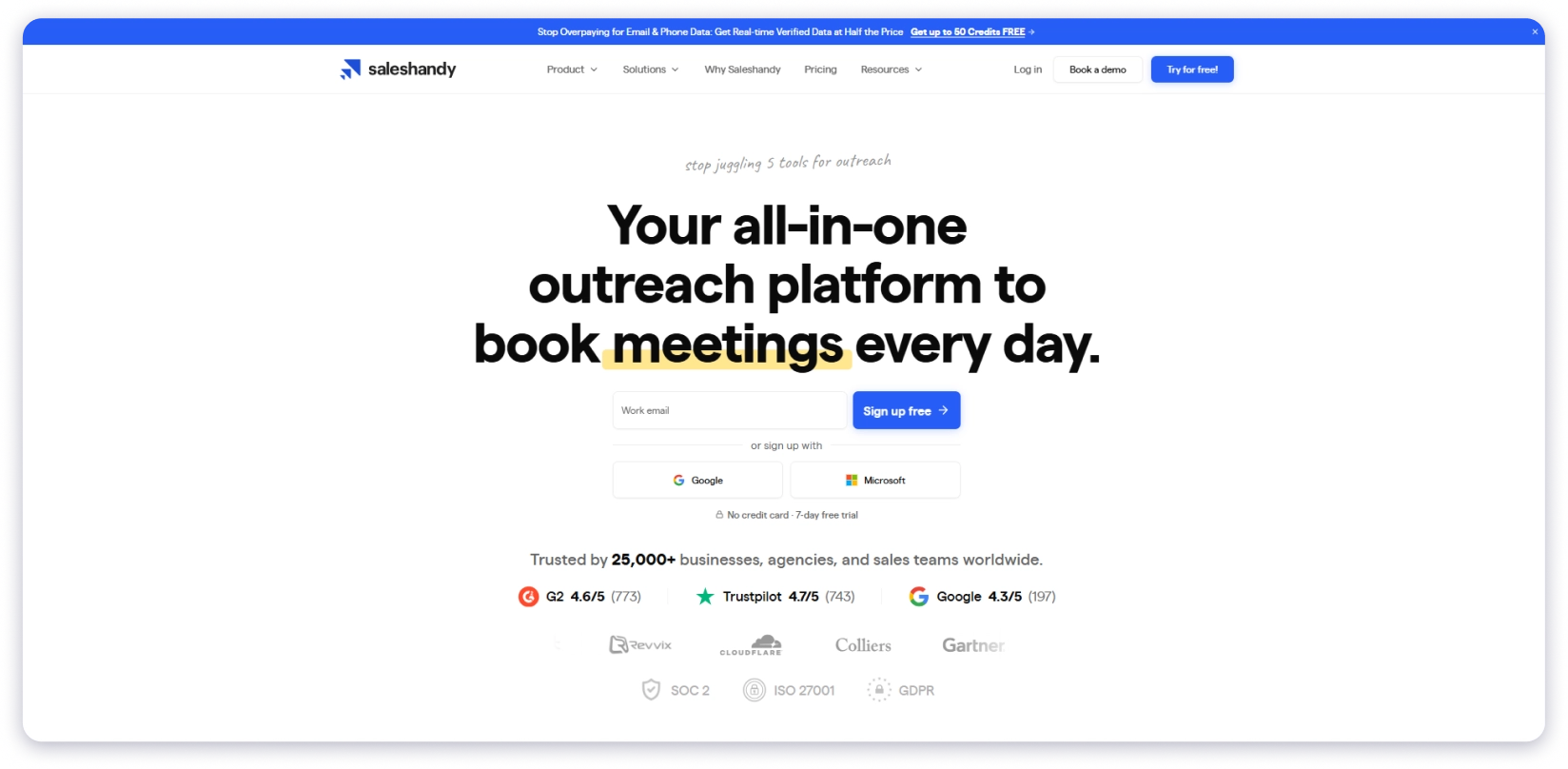
What I found different about this platform is the verification approach. Each contact is validated in real time through multiple data providers, and if a contact cannot be verified, it is not charged. That means you only pay for usable data.
The search system supports 75+ filters, which makes it easy to narrow down funded startup prospects by:
- Funding stage (Seed to Series C+)
- Company size and employee count
- Industry and vertical
- Job title and seniority
- Geography
- Tech stack
There is also an AI search feature that supports natural-language queries. For example, I searched “CTOs at Series A FinTech startups in the US with 10-50 employees” and it returned a highly targeted list of verified contacts in seconds.
Each result includes verified emails, phone numbers, LinkedIn URLs, job titles, and company details, allowing immediate outreach without additional cleanup or verification.
The key difference here is workflow speed. Instead of exporting data and validating contacts elsewhere, you get outreach-ready information directly from the platform.
✅ Pros
- High data reliability due to multi-source verification
- Strong filtering for funded startup targeting
- Includes technographic and firmographic signals for better targeting
- Useful for fast list building without external tools
❌ Cons
- 7-day free trial
Pricing
- Lead Finder: starts at $49/month (2,500 credits/month)
2. Apollo.io:
Most startup databases tell you who works at a company. This is why Apollo is next on my list. It goes a step further by telling you which companies are actively researching specific topics right now.
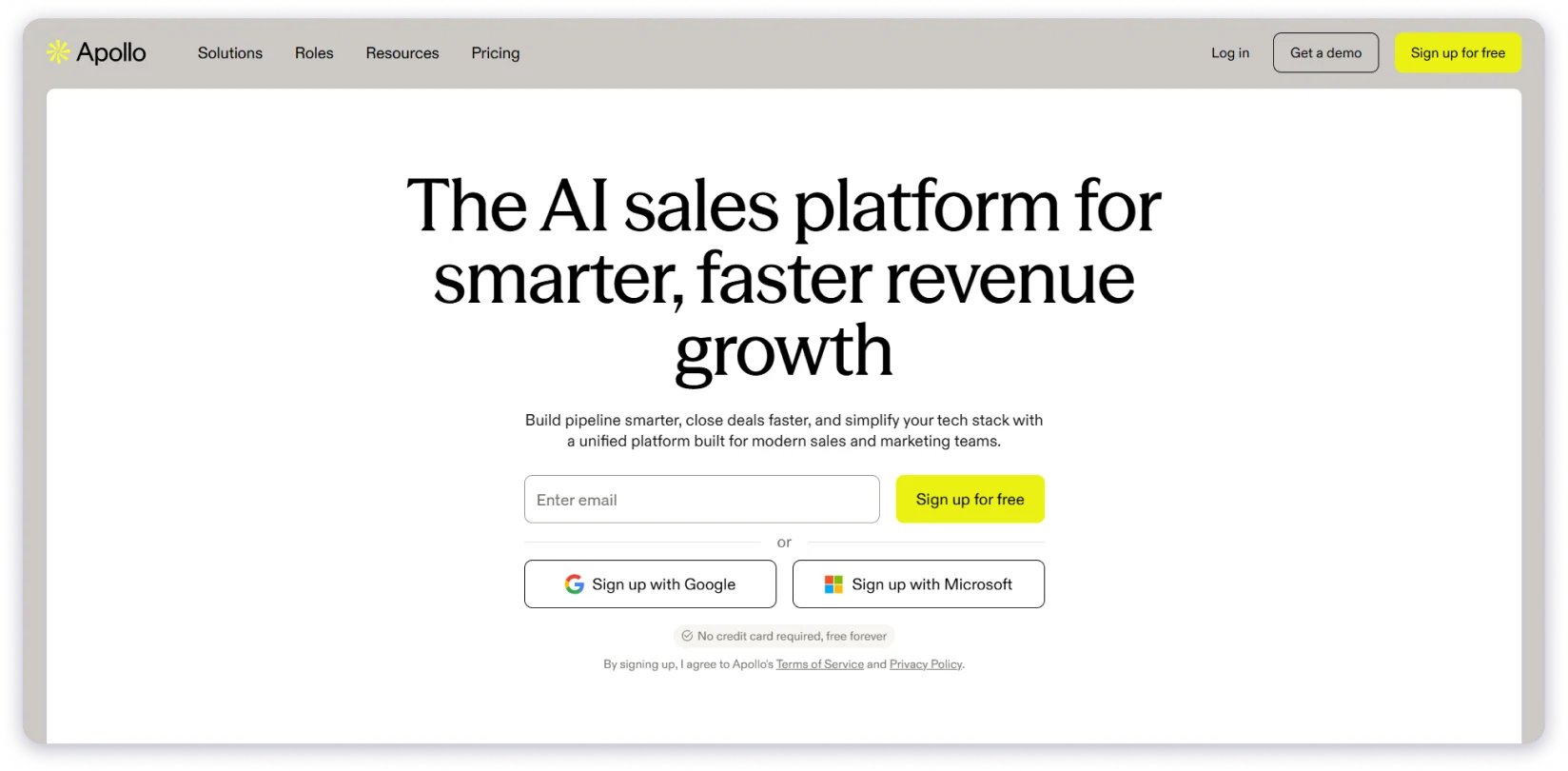
The platform covers 230M+ contacts across 30M+ companies.
One thing I noticed is that phone numbers cost 8 credits per reveal compared to 1 credit per email. That is worth knowing before you budget for phone-heavy outreach.
Beyond basic contacts, the platform gives you:
- Buying intent signals (1 to 12 topics, depending on plan) based on content consumption across B2B publisher networks
- Technology stack data showing what tools a company already uses
- Lookalike company search, where you input one company and find similar ones
- An AI research agent that pulls contextual notes on individual contacts from public data
Funding stage filtering is available from Seed through Series C+. But the platform does not provide investor names, cap tables, or exact funding amounts.
For outbound teams, Apollo is a strong pick when you want to prioritize which funded startups to reach first. The intent signals tell you who is actively looking for solutions, so your outreach lands at the right moment.
✅ Pros
- Buying intent signals help prioritize which funded accounts to contact first
- Technographic data shows what tools target companies already use
- Lookalike search makes it easy to find companies similar to your best customers
- AI research agent generates useful contextual notes for personalization
- Generous free tier for testing (900 credits/year)
❌ Cons
- Per-seat pricing adds up quickly for growing outbound teams
- Phone credits at 8x the email cost can drain budgets fast
- Intent data only available on higher-tier plans
Pricing
- Free tier: 900 credits/year (about 75/month, email only)
- Basic: $49/seat/mo for 30,000 credits/year (annual billing)
- Professional: $79/seat/mo for 48,000 credits/year (annual billing)
- Per-seat pricing, so costs multiply with every team member
3. ZoomInfo:
ZoomInfo is one of the most well-known B2B contact intelligence platforms in the market. It has a large verified database and a well-documented verification process.
The numbers speak for themselves:
- 500M+ total contacts
- 200M+ verified emails
- 135M+ verified phone numbers
- 100M+ company profiles
- 300+ human researchers continuously updating records
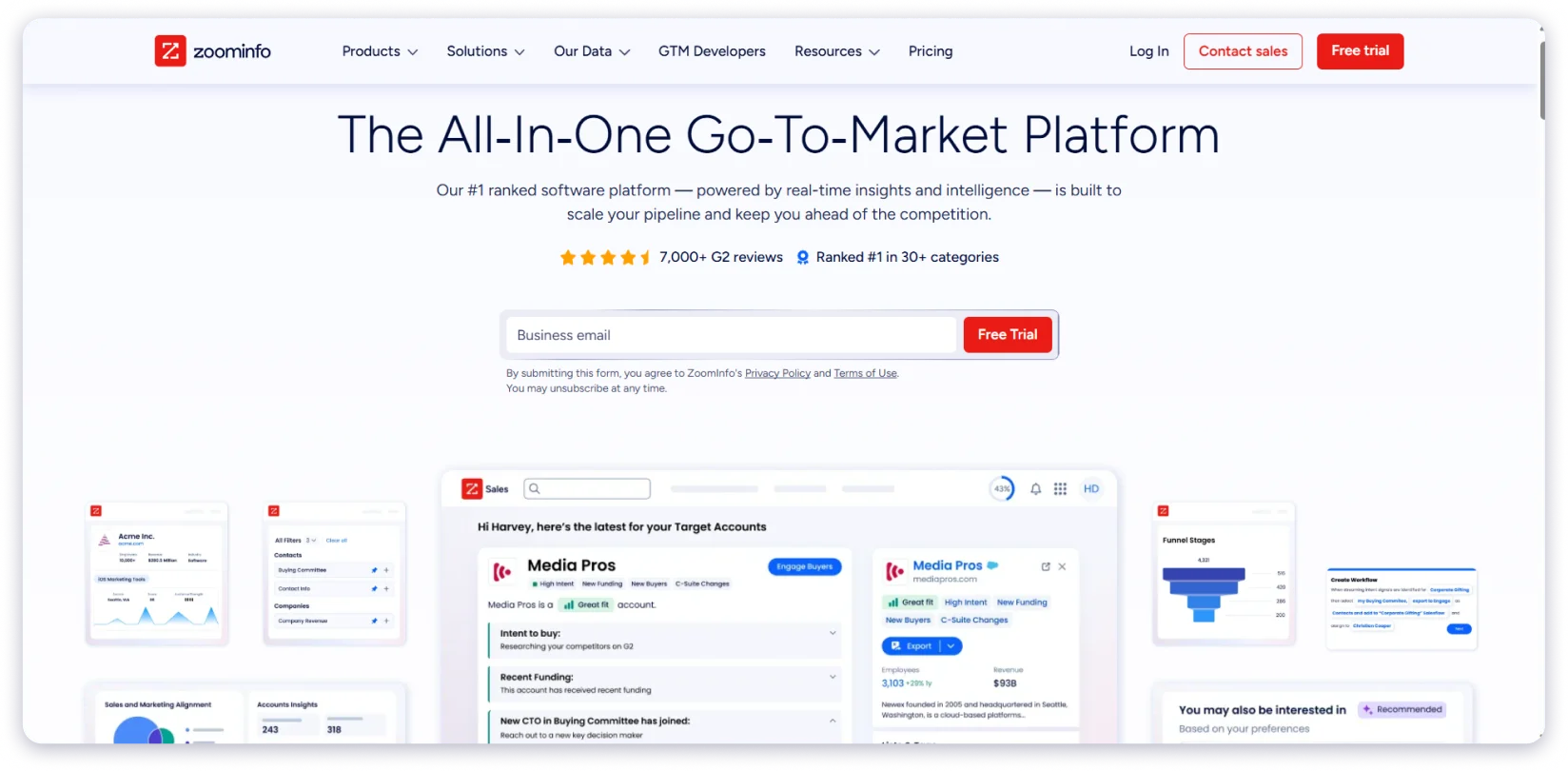
What sets it apart is the intelligence layer on top of raw contact data.
Scoops surfaces real-time company events like new hires, leadership changes, and funding announcements. WebSights identifies companies visiting your website by matching 210M+ IP-to-organization pairings. Org charts map reporting relationships so outbound reps can see buying committees before reaching out.
The platform holds ISO 27001, ISO 27701, SOC 2 Type II, GDPR, and CCPA compliance certifications.
For outbound teams with enterprise budgets, ZoomInfo gives you a wide contact dataset with strong intelligence features built on top. The Scoops feature is especially useful for timing outreach around company events like new funding rounds.
✅ Pros
- Large verified contact database (500M+ contacts, 200M+ emails)
- 300+ human researchers plus AI signals for continuous data freshness
- Scoops, WebSights, and org charts add useful intelligence layers for enterprise teams
- Enterprise-grade compliance certifications
❌ Cons
- Complex platform with a steep learning curve
- Built for enterprise workflows
Pricing
- Enterprise contracted with no public pricing
- Free trial available via their website
4. Crunchbase:
When it comes to identifying which startups just raised money, Crunchbase is one of the most widely used platforms for funding intelligence. It is often the first place outbound teams go to build their target company list.
The platform tracks 4M+ company profiles and 797,000+ individual funding rounds.
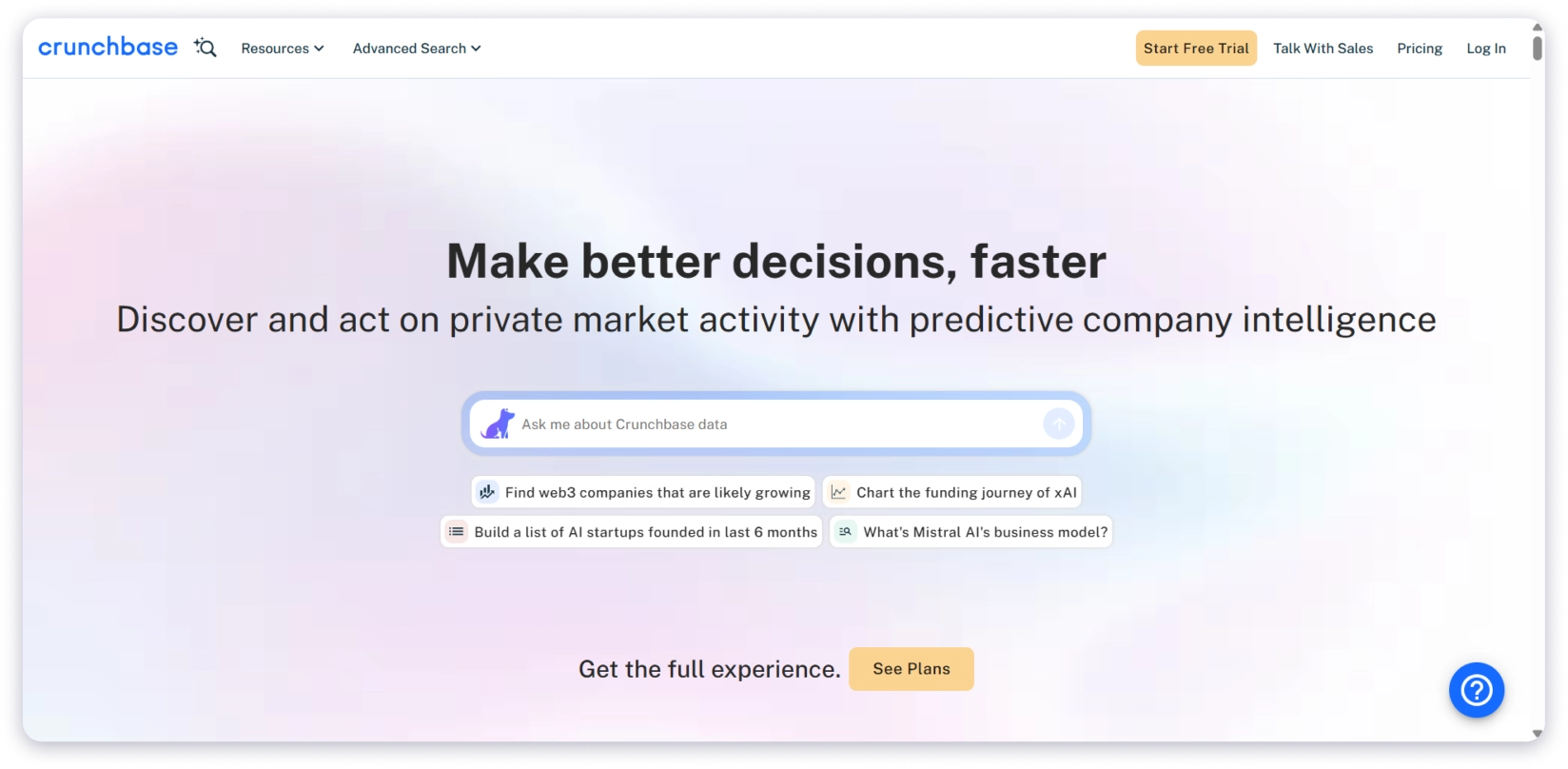
The most useful feature I found is the Funding Rounds search. You can filter by funding type and announcement date to get a live, updated list of recently funded startup companies.
Setting “Funding Type = Series A” and “Announced Date = last 90 days” instantly shows you every startup that raised a Series A in the past three months.
Crunchbase has also added AI-powered predictions, generating roughly 100,000 predictions per month covering:
- Funding probability
- Growth trajectory
- Acquisition likelihood
- IPO chances
- Closure risk and layoff signals
The dataset powers Yahoo Finance, MarketWatch, and J.P. Morgan’s Fusion platform. That tells you something about the institutional confidence behind the company funding data.
Here is the important part for outbound teams, though.
Crunchbase is not a contact database. It has some contact data on higher tiers, but emails and phone numbers are not verified at the individual level. You can find which funded startups to go after, but you cannot reach the decision-makers directly from this platform. You will need a separate contact-first startup database for that step.
✅ Pros
- Large startup funding database (4M+ companies, 797K+ rounds)
- Full funding history with investor names and round details
- AI-powered predictions on funding probability, growth, and acquisition risk
- Funding Rounds search makes it easy to find recently funded companies in minutes
❌ Cons
- Contact data is limited and not verified at the email or phone level
- Not useful for outbound outreach without a separate contact platform
- Some profiles rely on community contributions that may be outdated
Pricing
- Free tier for basic company browsing with limited results
- Starter: approximately $29/mo
- Pro: approximately $49/mo (full search, exports, AI predictions, contact access)
- Enterprise: custom pricing with API and bulk exports
5. Tracxn:
Most startup databases organize companies by funding events. Tracxn organizes them by what they actually do.
That is why it made this list.
The platform has 55,300+ taxonomy categories covering specific business models and technology verticals. I could see every company globally operating in a niche like “Quick Commerce” or “Agentic AI,” ranked by a proprietary quality score.
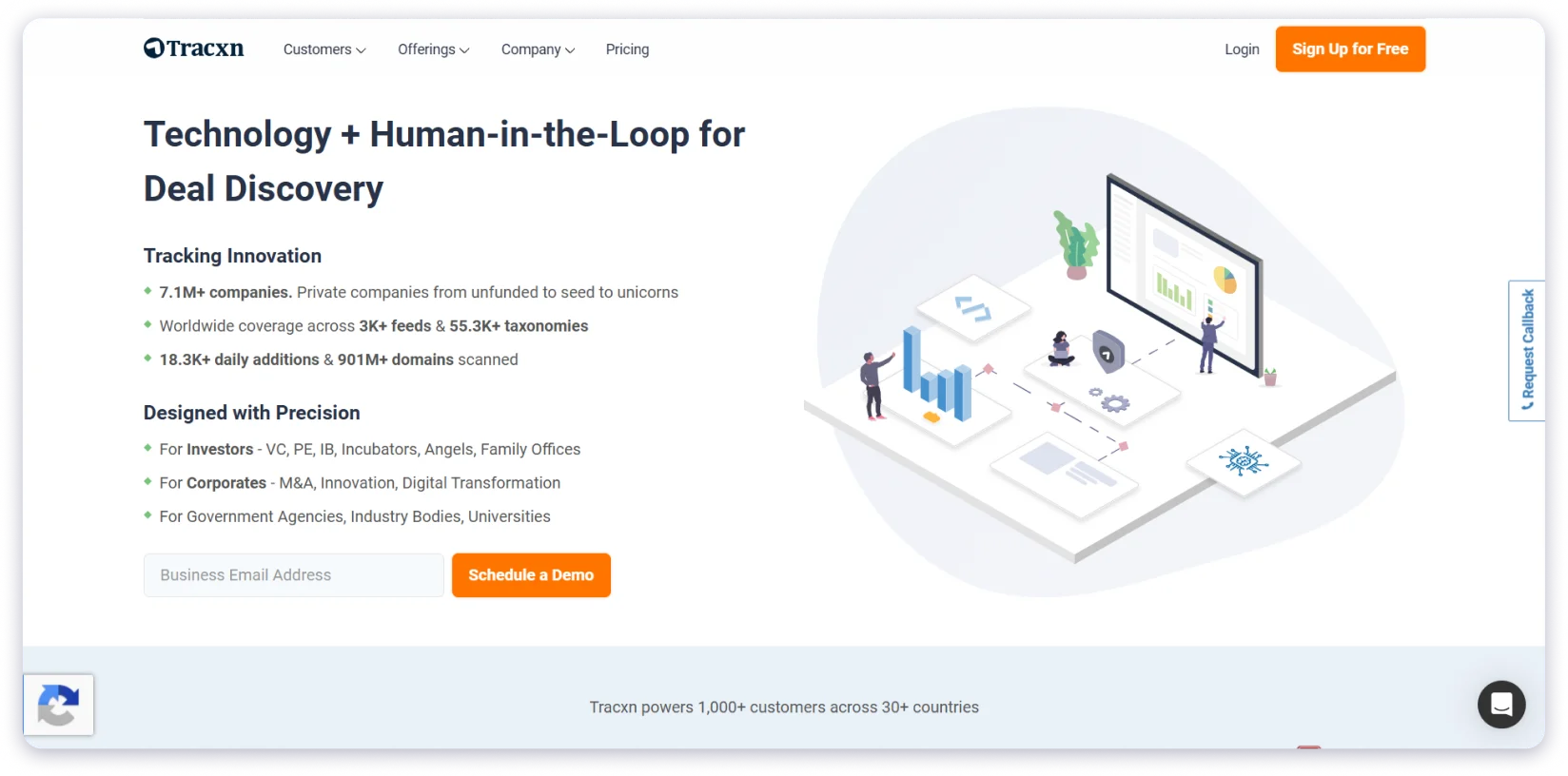
It tracks 7.1M+ companies, 1.6M+ funding rounds, and 291K+ investor profiles. As a startup funding database, the coverage is especially strong in India, Southeast Asia, and emerging markets where other platforms have gaps.
What sets each company profile apart is the depth:
- Cap tables available for 38,500+ companies
- Revenue and financial data covering 69,400+ companies
- Employee count trends over time, not just a snapshot
- Automatically generated competitor landscapes
- Full funding history with all investors identified
- Real-time funding, M&A, and IPO alerts
The platform monitors 3,000+ data feeds and adds 18,300+ new companies daily.
For outbound teams, Tracxn is a powerful discovery layer if you sell into specific verticals. It helps you find every relevant funded startup in a space. But like Crunchbase, it does not give you verified contact data. You will need a contact-first platform to pull emails and phone numbers for the people you want to reach.
✅ Pros
- 55,300+ taxonomy categories for detailed startup classification
- Deepest coverage in India, Southeast Asia, and emerging markets
- Cap table data for 38,500+ companies and financials for 69,400+ companies
- Automatically generated competitor landscapes for every tracked company
❌ Cons
- No verified email or phone database
- Premium pricing is not publicly listed
- Cannot be used for outbound outreach directly
Pricing
- Lite: Free with strict usage limits
- Premium: Contact sales for team plans, CRM access, and API
- Data Solutions: Volume-based pricing for API and bulk data exports
6. Clay:
Clay does not have its own startup database. That is exactly why it is on this list.
It connects to 150+ data providers and lets you build custom enrichment workflows with AI-powered fallback logic. If one provider cannot find a contact, the system automatically tries the next one until it gets a verified result.
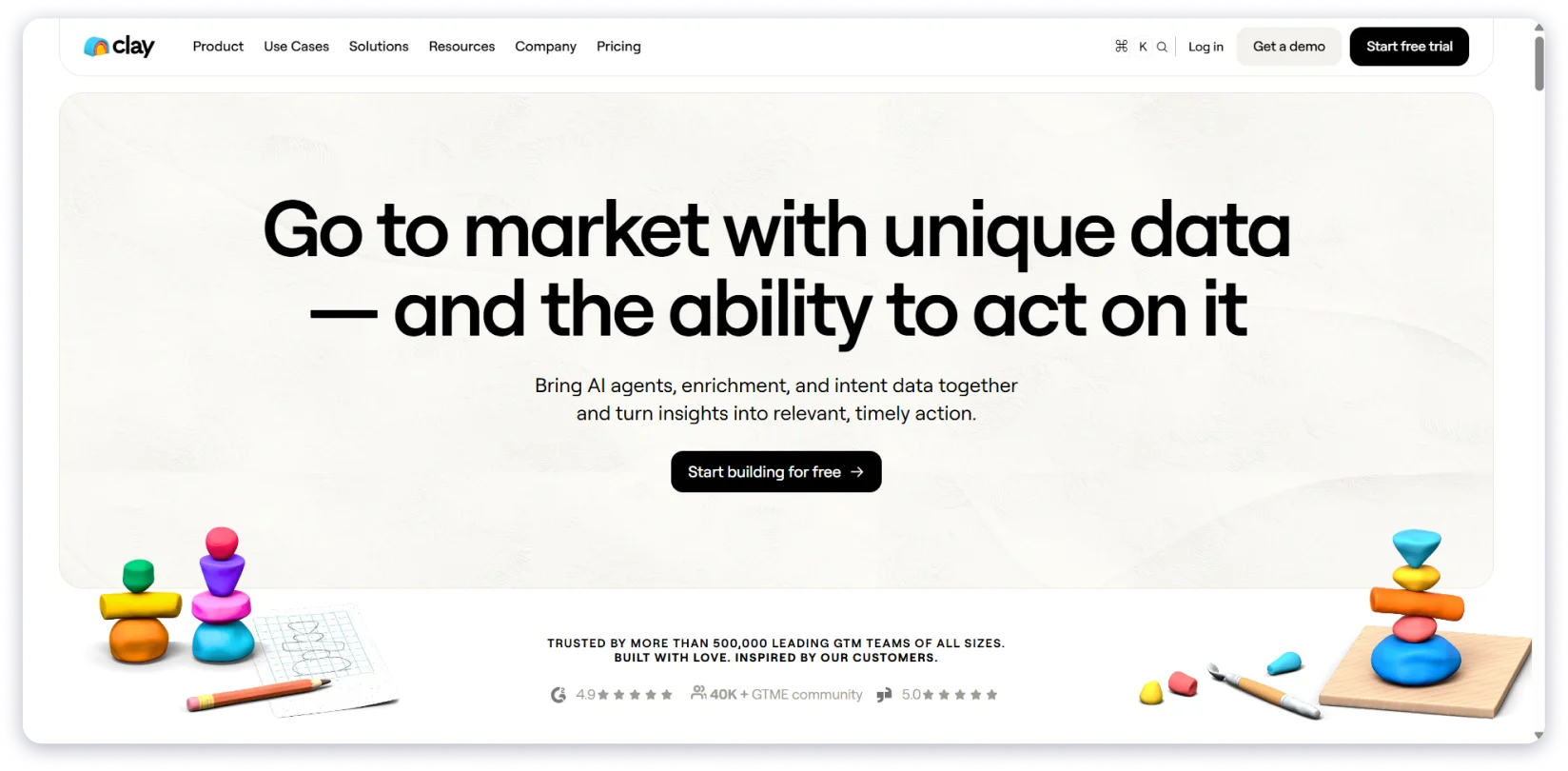
You bring in a list of company names, domains, or people. The platform cascades across its provider network to find verified emails, phones, funding data, and any custom research fields you define.
The Claygent AI agent adds another layer. It scrapes websites, reads press releases, and fills in data points that standard databases do not carry.
Companies like Anthropic, OpenAI, Rippling, and Intercom use the platform based on published case studies. OpenAI improved its enrichment coverage from the low 40% range to the high 80% range after switching to this multi-provider waterfall approach.
The interface is spreadsheet-style. Each row is a company or person. Each column is a data field you define. This gives you maximum flexibility but requires technical setup.
For outbound teams, Clay is a strong option if you already have a target company list and want to enrich it with verified contacts from multiple sources at once. The trade-off is real, though. If your team just wants to search and export contacts immediately, this is not the right starting point.
✅ Pros
- Connects to 150+ data providers with intelligent waterfall fallback
- Claygent AI agent can research custom data fields no standard database covers
- Most flexible enrichment platform for teams that want full control
- No charge for unverified results
❌ Cons
- Requires real technical setup and workflow configuration
- Only as good as its connected providers
- Starting price of $185/mo is higher than simpler alternatives
- Not a point-and-click tool
Pricing
- Free: 100 data credits and 500 actions/mo
- Launch: $185/mo for 2,500 credits
- Growth: $495/mo for 6,000 credits
- Enterprise: custom pricing
- Unused credits roll over up to 2x the monthly balance
7. Wellfound:
Not every startup database needs to cost money.
Wellfound (formerly AngelList Talent) is a free startup directory maintained by founders themselves. The data quality is surprisingly high because founders have a direct reason to keep their profiles accurate. They use the platform to hire.
The directory showed 10,798+ active startups when I checked.
Each company card gives you useful signals at a glance:
- Stage badge (Early Stage, Scale Stage, Series A/B/C)
- Valuation tier where founders choose to disclose
- Employee count and headquarters
- “Actively Hiring” badge as a real-time activity signal
- Culture ratings and a “Top Investors” badge
- Website URL and industry tags
The “Actively Hiring” filter is especially useful for outbound teams.
Companies that are actively recruiting are also actively spending on tools and services. That hiring signal doubles as a buying signal.
But here is the limitation I noticed. Wellfound has no contact data of any kind. No emails, no phone numbers, no founder LinkedIn links. It is a discovery starting point, not an outreach tool. You will need a separate platform to find and verify the decision-makers at the companies you discover here.
✅ Pros
- Entirely free with no login required
- Founder-maintained profiles mean high accuracy on the fields shown
- “Actively Hiring” filter is a strong buying signal for outbound teams
- Clean interface with useful at-a-glance company cards
❌ Cons
- No contact data of any kind
- No exact funding amounts or detailed investor information
- Cannot be used for outreach directly
Pricing
- Completely free to browse
- No login or account required
8. Y Combinator Companies Directory
Y Combinator companies directory’s quality beats quantity when outbound teams are building prospect lists.
Every single company in this startup directory passed a 1.5% acceptance rate. That level of curation is more rigorous than any scoring algorithm.
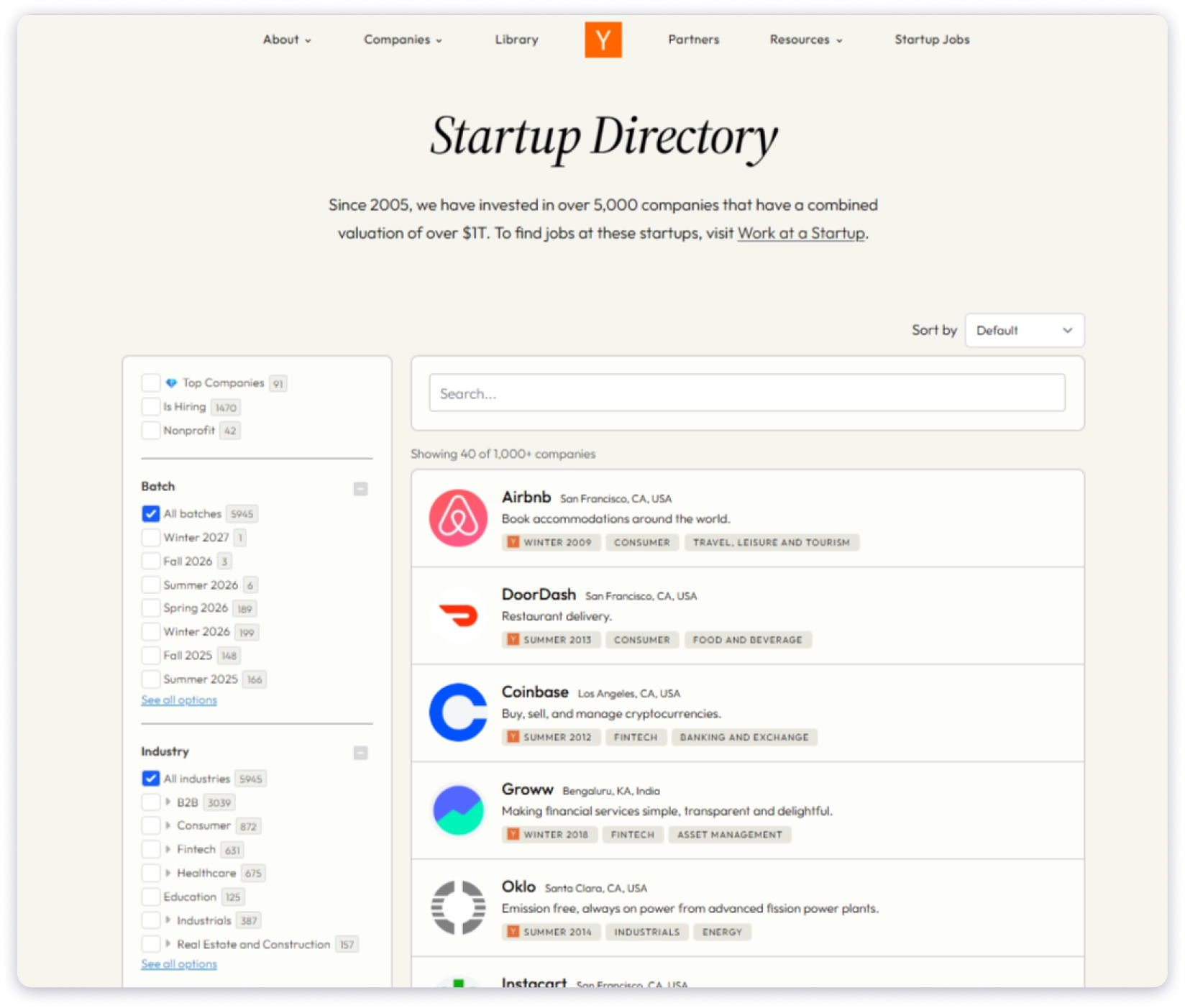
The 5,947 companies funded since 2005 have a combined valuation exceeding $1 trillion.
The directory gives you a clean set of filters:
- Batch (Spring 2026: 190 companies, Winter 2026: 200)
- Industry (B2B: 3,040, Fintech: 631, Healthcare: 676)
- Hiring status (1,474 companies actively hiring)
- “Top Companies” filter showing just 91 of the highest-signal startups
Individual company pages show founder names (often with LinkedIn profiles), employee count ranges, open job listings, and website links.
For outbound teams focused on AI, SaaS, and FinTech, this startup directory offers one of the most curated lists of startup companies available.
The trade-off is clear. Only YC-funded companies are included, which is a tiny fraction of all startups. No contact data, no funding amounts, and no post-YC funding history. Use this as a curated starting point for your target account list, then pull contacts from a separate platform.
✅ Pros
- Every company passed a 1.5% acceptance rate
- Combined portfolio valuation exceeds $1 trillion
- Clean filters by batch, industry, hiring status, and quality tier
- Founder names and LinkedIn profiles are often available
❌ Cons
- Only YC-funded companies
- No verified contact data for outbound outreach
- No exact funding amounts
Pricing
- 100% free
- No login or account required
Final Verdict: Which Is the Best Startup Database?
Here is what it comes down to after comparing all 8 platforms.
Most startup databases will give you company profiles, funding history, and investor names. That is great for research.
But when you actually need to reach someone at that company, you are stuck exporting data, switching to an enrichment tool, verifying emails separately, and then loading everything into your outreach platform.
By the time you send the first email, the moment has passed.
Saleshandy Lead Finder is the one tool on this list where that problem disappears. You search for funded startups, pull verified contacts in real time, and start outreach from the same place. 852M+ contacts, 75+ filters, real-time verification, built-in sequences. Everything happens in one workflow.
That is the real difference. Not just having the data, but being able to act on it fast enough to actually land in someone’s inbox while the funding is still fresh and the budget is still open.
Once you have your verified contacts, pair them with the right cold email software and start sending while the funding is still fresh.
Frequently Asked Questions
1. What Is a Startup Database?
A startup database is a platform that collects and organizes data on startup companies. This typically includes founding details, funding history, investor names, employee count, and industry classification. Some platforms also provide verified contact data for founders and decision-makers, while others focus strictly on company-level intelligence.
2. Which Startup Database Has the Most Verified Contact Data?
ZoomInfo has the largest verified contact database at 500M+ contacts, 200M+ emails, and 135M+ phones. For cost-efficient verified contacts specifically on startup founders, Saleshandy Lead Finder covers 852M+ contacts with real-time verification across 9 data providers, starting at $49/mo.
3. Is Crunchbase Free to Use?
Crunchbase offers a free tier for basic company browsing with limited results. The Starter plan starts at approximately $29/mo and the Pro plan at approximately $49/mo, which adds advanced search filters, CSV exports, AI-powered predictions, and expanded contact data access.
4. What Is the Best Free Startup Database?
For company discovery, the Y Combinator Companies Directory (5,947 curated startups, completely free) and Wellfound (10,798+ active startups, free browsing) are the strongest free options. For contact data, Apollo offers 900 free credits per year and Saleshandy offers 50 free credits with no card required.
5. How Do I Find Recently Funded Startups?
The fastest way is to use Crunchbase’s Funding Rounds search and filter by funding type and announcement date. Tracxn also tracks 1.6M+ funding rounds with real-time alerts. For verified contacts at recently funded startups, filter by funding stage in a contact-first startup database and export decision-maker emails directly.
6. Can I Get Verified Emails for Startup Founders?
Yes. Contact-first platforms like Saleshandy, Apollo, and ZoomInfo provide verified work emails for startup founders and executives. Saleshandy specifically uses a 9-provider waterfall enrichment model with real-time verification at the point of export. Company intelligence platforms like Crunchbase and Tracxn have limited contact data that is not individually verified.

 Dhruv Patel
