


If you execute account-based marketing (ABM) or revenue operations at a B2B company, you have likely bumped into Demandbase as one of the category heavyweights.
Plenty of enterprise demand gen leads swear by its account-based DSP advertising, and RevOps managers rely on its third-party intent data to prioritize target accounts.
But when you look past the vendor pitch decks, the actual financial investment and operational friction tell a very distinct story.
Annual contract commitments regularly start at $40,000 to $68,500+, initial onboarding requires weeks of technical setup across your CRM and MAP, and smaller sales teams often find themselves paying for massive platform capabilities they never fully adopt.
To find out if it is actually worth your budget in 2026, I spent two full weeks analyzing Demandbase.
I evaluated its account identification pipelines, tested how its intent scoring surfaces buying groups, and analyzed real user feedback across G2, Capterra, and Trustpilot.
Here is my honest breakdown of where Demandbase delivers real enterprise ROI, where its platform falls short, and what you should consider instead.
Demandbase Review – TOC
- TL;DR: Demandbase Review At a Glance
- What Is Demandbase and Who Is It For?
- Demandbase Features in 2026 (Detailed Explanation)
- Demandbase Pricing Plans Explained
- Pros and Cons of Demandbase
- Demandbase vs Saleshandy: Which is Better & Why
- Final Verdict: Is Demandbase Worth It in 2026?
- FAQs on Demandbase Review
TL;DR: Demandbase Review At a Glance
Need a quick verdict before deciding whether to book a sales demo?
Here’s the short version:
| Buying Criteria | Features |
|---|---|
| What is Demandbase | An enterprise account-based go-to-market (GTM) platform combining intent data, programmatic advertising, website personalization, and sales intelligence. |
| Founded | 2005. HQ in San Francisco, CA. |
| Database Size | $500B+ monthly B2B intent signals, web-wide B2B activity, and global company profiles. |
| Accuracy Claim | Multi-source intent aggregation, SOC 2 Type II, GDPR, and CCPA-compliant data foundation. |
| Top Features |
|
| Pricing (2026) | Custom enterprise quotes starting at ~$40,000 – $68,500+/year (scaled by target account volume, seats, and media spend). |
| Free Trial | No free trial available (sales-led demo only). |
| G2 Rating | 4.4/5 (2,020+ reviews) |
| Trustpilot Rating | 3.8/5 (Mixed reviews around setup complexity and contract terms) |
| Compliance | SOC 2 Type II, GDPR, CCPA certified |
| My Verdict | Category-leading ABX platform for mid-market and enterprise teams targeting multi-figure deals. However, it requires dedicated RevOps management, and Saleshandy delivers a faster, direct cold email engine with 1,500 free credits every month on the $34 Starter plan. |
What Is Demandbase and Who Is It For?
Demandbase is an account-based go-to-market platform designed for B2B revenue teams.
Unlike traditional lead-centric platforms that evaluate individual leads, Demandbase evaluates entire accounts and buying groups.
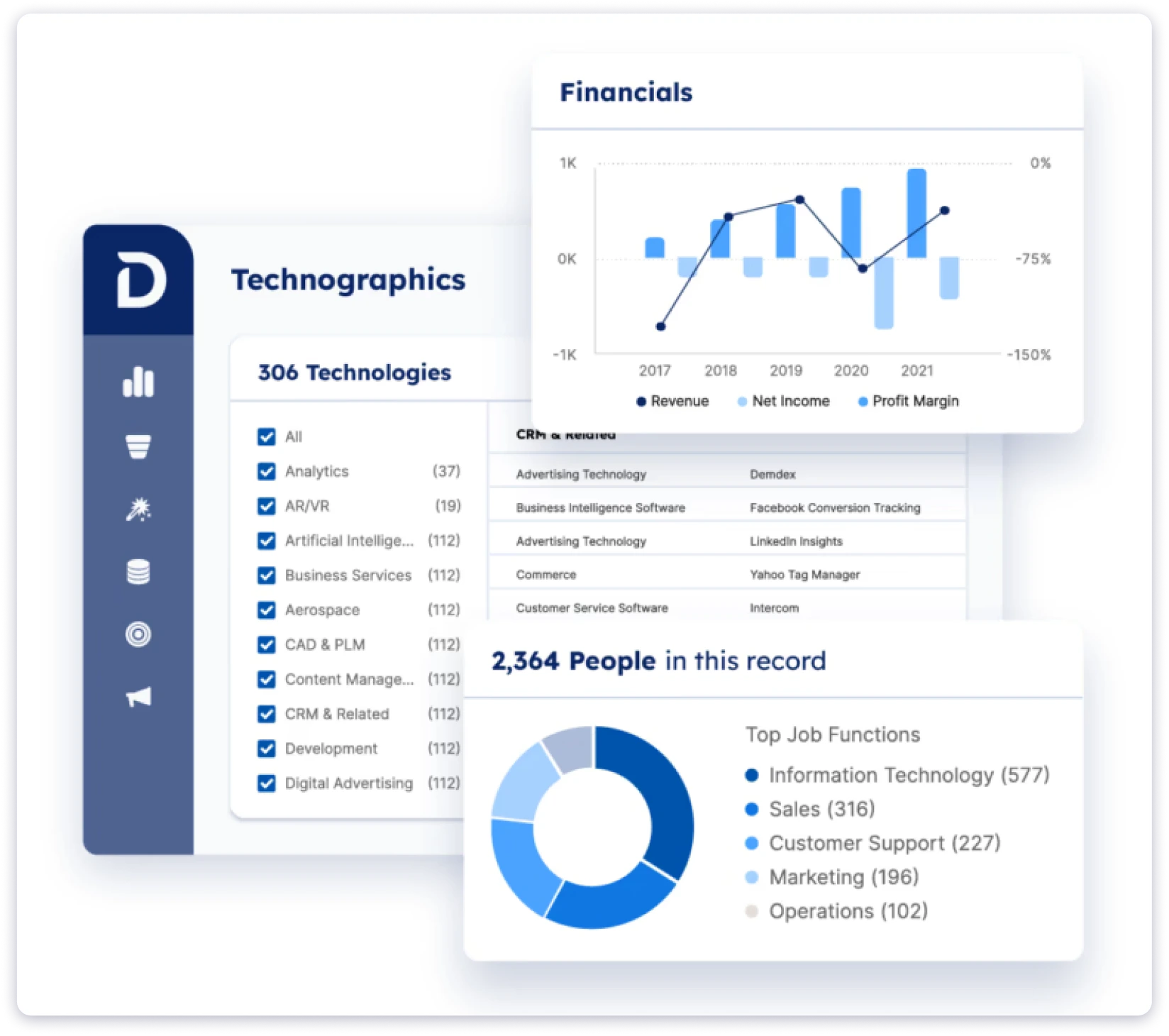
In enterprise sales, purchasing decisions are made by committees of 6 to 10 stakeholders. Demandbase unifies your data sources to show you which target companies are actively in-market, who belongs to the buying committee, and how to engage them across advertising, web, and sales channels.
As a verified user shared on G2, “I’ve used Demandbase at a few companies I’ve worked at, and it has truly transformed our account-based marketing efforts. The platform’s robust targeting capabilities and AI-powered insights have enabled us to pinpoint high-value prospects with unprecedented accuracy.”
At its core, Demandbase combines Account Intelligence, Intent Signals, Programmatic Advertising (DSP), Website Personalization, Forms Enrichment, and Sales Enablement into a single system.
Who It Is For:
- Enterprise & Mid-Market ABM Teams: Companies targeting named account lists with deal sizes over $50,000 ACV where surrounding buying committees with display ads and intent triggers is critical.
- Aligned Revenue Operations & Marketing Teams: Organizations with dedicated ops managers who can configure account scoring, maintain CRM integrations, and orchestrate automated plays.
- Multi-Touch B2B Marketers: Teams that need to combine programmatic ad impressions, personalized landing pages, and sales alerts under one roof.
Who It Is NOT For:
- Early-Stage Startups & SMBs: Lacks entry-level pricing tiers; minimum software investments are prohibitive for smaller budgets.
- Pure Outbound Sales Teams: Requires a separate dedicated sales engagement platform for multi-mailbox cold email warm-up, inbox rotation, and deliverability monitoring.
- High-Volume Cold Emailers: Demandbase does not offer cold email deliverability infrastructure like domain warm-up or inbox placement testing.
- Teams Without Technical RevOps Support: Setting up account scoring and multi-object CRM rules requires ongoing technical administration.
Demandbase Features in 2026 (Detailed Explanation)
I spent two weeks analyzing the platform end-to-end.
Here is how its core capabilities break down in practice, with real user feedback woven in where it fits.
1. Account & Buying Group Intelligence + Intent
Demandbase collects first-party (your site traffic), second-party (partner activity), and third-party (web-wide keyword searches) intent signals.
It surfaces dark funnel web visits and groups engagement at the buying-committee level.
A verified reviewer noted on G2 that “Intent data is spot on, helped in making new pipelines. New AI layer is designed to connect signals and buying groups, helping to prioritize accounts. Chat for sales is also good.”
The intent tracking highlights when a target account starts researching your competitors.
However, web deanonymization operates primarily at the company level, meaning you know Acme Corp is on your pricing page, but you still need to verify which specific executive was browsing.
2. Native B2B Advertising (DSP)
Demandbase includes a native B2B Demand-Side Platform (DSP) built specifically for account-based display ads.
You can allocate media dollars directly toward verified target account IP addresses and specific buying roles.
This prevents ad budget waste on generic consumers.
The trade-off is that specialized B2B ad inventory carries higher CPMs compared to self-serve ad networks, requiring dedicated ad spend management.
3. Website Personalization & Form Enrichment
When a target account visits your site, Demandbase Personalization dynamically customizes headers, banners, and case studies to match their vertical.
Simultaneously, the form enrichment module appends firmographic attributes behind the scenes.
This allows you to ask for just a work email on landing pages while automatically populating company revenue, location, and employee size inside your CRM.
4. Sales Intelligence Cloud & Browser Extension
Demandbase One for Sales provides a browser extension and CRM overlay inside Salesforce, LinkedIn, and Outreach.
Sales reps receive real-time alerts when target accounts show intent spikes or visit key website pages.
Commenting on usability, a G2 reviewer mentioned, “I find Demandbase One’s interface very intuitive. It doesn’t require extensive training to get started, making it accessible and user-friendly for individuals without needing to dedicate significant time to learning the platform.”
Putting key account insights inside the daily workflow saves reps from manually digging through separate analytics reports.
5. Search / Selector Engine & Data Foundation
Outside of LinkedIn and web tracking, Demandbase uses a segmentation engine called the Selector.
You can filter accounts by technographics, firmographics, intent scores, and CRM activity stages.
In terms of alignment and account management, a G2 reviewer shared that “It’s easy to forecast with, and it’s straightforward to set up as well. The account view is mostly useful, and it helped marketing and sales be much better aligned.”
The data foundation maintains clean records across your connected tools, though custom multi-object queries inside the Selector engine can take time to master.
6. Agentbase AI & Workflow Automation
Demandbase integrates Agentbase AI to summarize complex account activity and trigger automated next steps across connected channels.
However, AI capabilities vary by use case.
As a verified user pointed out on G2, “The AI feels hit or miss. Accuracy is only average, consistency is lower, and it’s not always easy to catch and correct mistakes. It also doesn’t explain why it produced a specific result very well, and overall I don’t trust the AI capabilities that much.”
7. Integrations & API
Demandbase features pre-built bi-directional integrations with Salesforce, HubSpot, Marketo, Pardot, and LinkedIn.
It pulls activity in, runs account scoring, and pushes dynamic audiences back out to campaign destinations.
However, technical setup is involved.
A verified G2 reviewer highlighted that “The initial setup for Demandbase One is quite complicated and requires a dedicated team to manage all the necessary technical integrations. This complexity can be challenging for those without technical expertise.”
A Quick Note on Ratings
Demandbase holds a 4.4 / 5 rating on G2 across 2,000+ reviews, reflecting strong satisfaction among enterprise RevOps teams.
On Trustpilot, ratings lean closer to 3.8 / 5, with feedback primarily focusing on steep annual contract commitments, implementation timelines, and the need for dedicated admin resources.
Demandbase Pricing Plans Explained
Demandbase does not offer published, self-serve monthly pricing. All packages are delivered via sales-led custom enterprise contracts.
| Pricing Element | Industry Standard / Range | What You Get |
|---|---|---|
| Base Platform Fee | ~$40,000 – $50,000 / year | Core Demandbase One platform, intent data, and standard CRM/MAP connectors. |
| Mid-Tier Scale (Vendr) | ~$68,500 / year (Median contract) | Expanded account tiers, additional seat licenses, and deeper data enrichment. |
| Enterprise Scale | $100,000+ / year | High account volume, global coverage, custom API access, and dedicated TAM. |
| Ad Spend Minimums | Variable (e.g., $1,000 – $5,000+/mo) | Dedicated budget reserved for programmatic display ad campaigns on their DSP. |
Realities of Demandbase Pricing
- Annual Commitments Only: Unlike lightweight SaaS tools that offer flexible monthly plans, Demandbase requires annual contracts.
- Resource Thresholds: As one detailed G2 review stated, “It’s have 50+ sales reps, clean CRM, dedicated admin and $50k+ annual budget. If you’re under 200 employees, have messy data or no one to own it full time. Their alternative look at 6sense for easier UX or Roll Works for SMB-friendly ABM. If you have the resources, it’s a game changer.”
- Total Cost of Ownership: Beyond the base software license, teams must factor in dedicated ad budgets, implementation support, and internal RevOps maintenance hours.
Pros and Cons of Demandbase
Here are some of the pros and cons that you should be aware of before making a decision.
Pros
- Complete All-in-One ABX: Unifies intent tracking, programmatic display ads, web personalization, and sales alerts into one platform.
- Multi-Source Intent Signals: Captures first-, second-, and third-party behaviour to highlight dark funnel activity.
- Direct Sales Context: Browser extensions push account engagement directly into LinkedIn, Salesforce, and Outreach.
- Form Enrichment: Shortens landing page forms while maintaining complete firmographic data inside your CRM.
- Enterprise Security: Full SOC 2 Type II, GDPR, and CCPA compliance.
Cons
- High Annual Baseline: Custom contracts starting around $40k–$68k/year create a steep barrier to entry.
- Complex Implementation: Initial configuration requires 2 to 6 weeks alongside dedicated RevOps management.
- Account vs. Person Identification: Web visits highlight company traffic, requiring sales reps to identify individual buyers manually.
- No Cold Email Infrastructure: Lacks built-in domain warm-up, inbox rotation, or deliverability tools for direct outbound campaigns.
Demandbase vs Saleshandy: Which is Better & Why?
If your revenue goals require both account intelligence and high-volume outbound email, understanding the operational differences between Demandbase and Saleshandy is essential.
Saleshandy covers the outbound execution end of the revenue workflow. Here is how the two compare in 2026:
| Criteria | Demandbase | Saleshandy |
|---|---|---|
| Category & Focus | Enterprise ABM & B2B Ad Tech | Cold Email Automation, Deliverability & Lead Finder |
| Target Audience | Enterprise RevOps, Demand Gen & ABM Managers | SDRs, Outbound Teams, Growth Agencies & Founders |
| Starting Price | ~$40,000 / year (Annual enterprise contract) | $34 / month (Billed annually on Starter plan) |
| Free Credits Included | None (Sales demo required) | 1,500 Lead Finder credits/mo on Starter plan |
| Primary Channels | Programmatic display ads, IP targeting & site personalization | Multi-mailbox cold email sequences & automated sender rotation |
| Database & Data | 3rd-party intent aggregation & web traffic deanonymization | 852M+ verified B2B contacts, 42M+ companies |
| Email Deliverability | N/A (Focuses on ad impressions and site visits) | Built-in email warm-up, inbox placement monitoring & domain health checks |
| Sending Accounts / Seats | Per-seat licensing + usage tiers | Unlimited sending accounts and seats on higher tiers |
| Agency Portal | Single-organization workspace model | Native Agency Portal with client management & view-only modes |
| Setup & Onboarding | Complex: Takes 2–6 weeks with dedicated RevOps support | Instant: Launch high-deliverability sequences in <24 hours |
The Core Difference
- Choose Demandbase if you sell high-value enterprise deals ($50k+ ACV), have a dedicated RevOps manager, and want to surround target accounts with display ads, site personalization, and intent tracking.
- Choose Saleshandy if your primary channel is direct cold email outreach, and you need to scale campaigns across multiple mailboxes with high inbox deliverability without paying enterprise platform contracts.
Final Verdict: Is Demandbase Worth It in 2026?
After evaluating the platform end-to-end, here is the bottom line:
Demandbase is worth the investment if you are an enterprise or mid-market B2B company targeting named accounts with six-figure contract values.
Its combination of intent data, programmatic advertising, website personalization, and sales overlays provides an account-based foundation that aligns marketing and sales teams.
As a verified G2 user concluded, “Overall, Demandbase One has not only boosted our pipeline quality but also increased conversion rates, making our ABM efforts more efficient and effective.”
However, if your GTM motion relies on direct outbound cold email, or if you lack dedicated RevOps bandwidth to manage custom account scoring, Demandbase will feel heavy and expensive.
If your primary goal is to find verified decision-maker emails, maintain 99% inbox deliverability, and run multi-mailbox outbound sequences, Saleshandy delivers a direct, high-ROI solution at a fraction of the cost.
You can start testing with 50 free credits today.
FAQs on Demandbase Review
1. Is Demandbase legit?
Yes, Demandbase is a SOC 2-compliant B2B platform founded in 2006. It holds a 4.4 / 5 rating on G2 across more than 2,000 customer reviews and is widely used by enterprise GTM teams.
2. How much does Demandbase cost in 2026?
Demandbase uses custom sales-led pricing. Baseline enterprise contracts typically range from $40,000 to $68,500+ per year, depending on target account volume, seat counts, data modules, and dedicated ad spend commitments.
3. How accurate is Demandbase’s intent data?
Demandbase aggregates first-party site traffic, second-party data, and third-party web-wide keyword searches across $500B+ monthly B2B activity.
While intent signals accurately identify company-level research trends, identifying individual visitors still requires manual sales verification.
4. Does Demandbase have a free trial?
No. Demandbase does not offer a self-serve free trial. Access is provided through guided sales demos and custom enterprise contracts.
5. Does Demandbase have a cold email tool?
No. Demandbase provides sales intelligence, engagement alerts, and ad orchestration, but it does not include cold email deliverability infrastructure like automated inbox warm-up, sender rotation, or inbox placement testing.
6. Does Demandbase work for SMBs or agencies?
Demandbase is engineered primarily for mid-market and enterprise organizations with 50+ sales reps and dedicated RevOps teams. For SMBs, agencies, or fast-growing outbound teams, lightweight platforms like Saleshandy offer better speed-to-value.
7. What is the best Demandbase alternative?
For enterprise teams seeking alternative ABM platforms, 6sense and ZoomInfo Marketing are top competitors. For teams seeking a direct lead generation and cold email outreach engine, Saleshandy is the strongest alternative.


 Hemanshu Mistry

 Anil Salvi