

On average, only 2–3% of cold calls turn into booked meetings.
But that does not mean cold calling is dead. It means the first few seconds of your call matter a lot.
If your opener sounds generic, the prospect tunes out. If your pitch feels too scripted, they cut the call short.
And if you do not know how to handle objections, even a good conversation can go nowhere.
That’s where a good cold calling script helps.
Not the kind that makes you sound robotic, but the kind that gives you a clear structure so you can start strong, stay natural, and adapt based on how the prospect responds.
Over time, I built a simple way to write cold call scripts that work in real conversations.
In this guide, I’ll walk you through that approach and share 20+ cold calling scripts you can use for different sales situations.
Let’s get into it.
TL;DR: The Formula for High-Converting Cold Calling Scripts
Short on time? Steal this simple 7-step formula behind every high-performing cold call:
-
1
Build a signal-based call list: Do not call random prospects. Focus on buying signals like funding, hiring, leadership changes, or tech shifts so you are talking to people who actually have a reason to care.
-
2
Do quick research: Spend 2 to 3 minutes finding one relevant insight per prospect so your opener feels personal and intentional instead of generic.
-
3
Write a clear opener: Say who you are, why you are calling, and why it matters to them in a simple, direct way that earns attention.
-
4
Ask open-ended questions: Get the prospect talking with questions that cannot be answered with a simple yes or no, so you can understand their situation.
-
5
Deliver a value hook: Connect their challenge to a clear outcome you have delivered for similar customers so the value is immediately obvious.
-
6
Prepare for objections: Acknowledge pushback, clarify what they actually mean, and respond with a question instead of trying to argue.
-
7
Close for the next step: Ask for a specific time for a short follow-up call and give two options to make it easy for them to say yes.
Quick takeaway: Every strong cold call comes down to three things: clarity in your structure, confidence in your flow, and control through questions. Master these, and your scripts will actually start booking meetings.
How to Write a High-Converting Cold Call Script in 7 Steps
A cold calling script is only as good as the preparation behind it. Before you copy any template below, you need to understand how to build one from scratch so you can adapt it to your product, your prospect, and your style.
Here are the 7 steps to create a cold call script that actually books meetings.
Step 1: Build a Signal-Based Prospect List
Most reps start cold calling by exporting a random list and dialing from the top. That burns through prospects fast and converts almost nothing.
The better approach is to build a list based on buying signals. These are triggers that tell you someone is more likely to care about what you are selling right now:
- Recent funding rounds or acquisitions
- Hiring surges, especially in sales or growth roles
- Leadership changes
- Tech stack shifts
- Company size or revenue growth patterns
Not everyone on your list deserves a call. Signals help you find the ones who do.
The other piece that matters is phone number quality. Calling a verified direct dial versus a company switchboard is the difference between a real conversation and a voicemail tree.
How To Build Your Cold Calling List Using Saleshandy
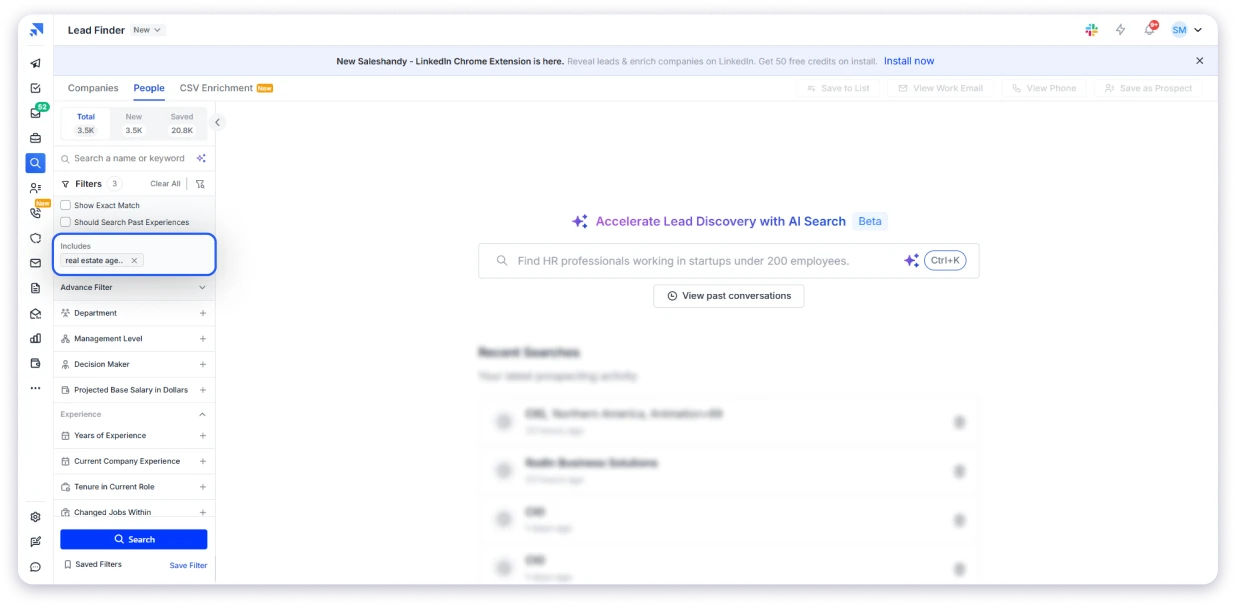
For example, if you are a real estate agent looking for homeowners considering selling in your area, here is how you would do it:
Step 1: Log in to Saleshandy, open Lead Finder, and set the job title to “Property Owner” or “Real Estate Agent.” Pick your target city or zip code and narrow it down to your local market.
Step 2: Filter by buying signals like recent property acquisitions, company ownership changes, or investment activity. This removes contacts who are not in the market and keeps only prospects who are likely to be thinking about buying or selling right now.
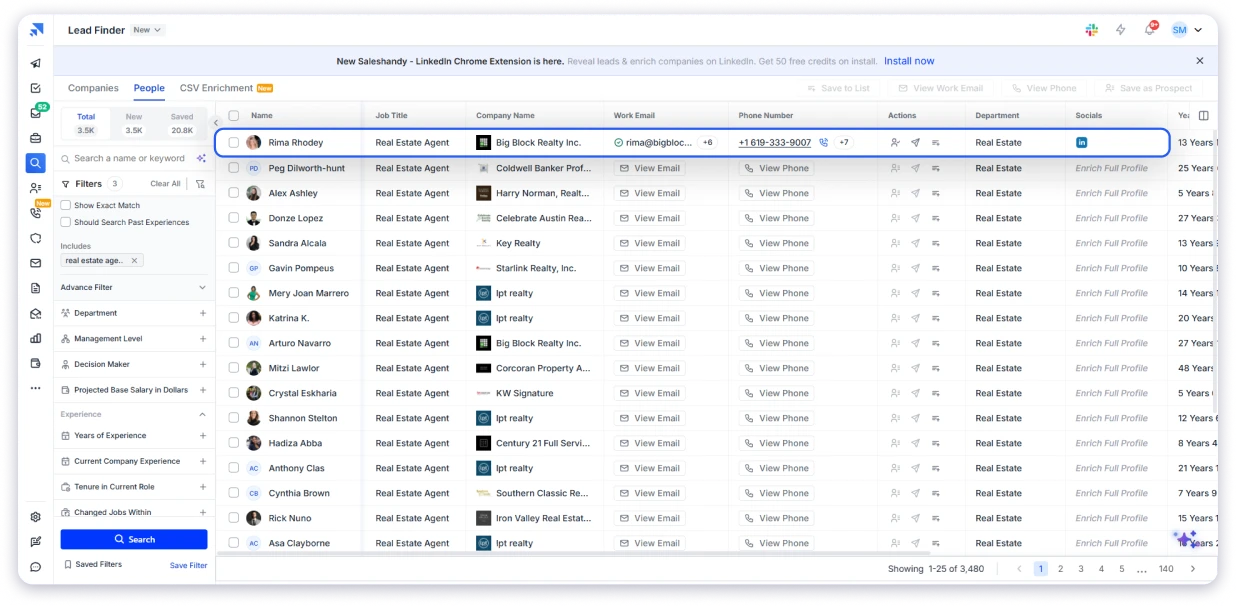
Step 3: Review the results, check for verified phone numbers, and export the list to CSV or push them directly into a Saleshandy outreach sequence with one click.
Each contact comes with phone number, email, and location details, so you can personalize your opener with neighborhood-specific market data before you dial.
Instead of cold calling random homeowners from a purchased list, you start every session with people who actually have a reason to talk.
That is the difference between blind cold calling and targeted calling.
Step 2: Research Each Prospect Before You Dial
You do not need a 20-minute deep dive. If your list is already enriched, you have the role, company, and contact details.
Two to three minutes is enough to find one detail that makes your opener feel personal.
Look for one relevant insight: a recent company announcement, a job change, a LinkedIn post, or a shift in their tech stack. Something that gives your opening line a reason to exist beyond “I am calling from XYZ.“
That single detail is the difference between “we help companies like yours” and “I saw you just opened a second office in Austin.” One sounds like a cold read. The other sounds like you called on purpose.
Step 3: Write Your Opening Script
Your prospect has limited time and even less patience for a long introduction. Your opener should be short, clear, and easy to follow.
In 2 to 3 sentences, you need to cover three things: who you are, where you are calling from, and why this matters to them.
Most reps get the first two right but miss the third. They introduce themselves and the company, but do not give a reason for the prospect to stay on the line.
The key is simple. Lead with a problem they recognize, not a product they have never heard of.
Here is an example:
“Hi [Name], this is David from Total Business Solutions. I am calling because managing payroll manually usually takes a lot of time for finance teams. We have helped companies like yours reduce payroll effort and cut costs through automation. I wanted to see if this is something worth a quick conversation.”
Notice what this does. It states who you are, connects to a real problem, hints at a result, and asks for a small next step. All in under 15 seconds!
Step 4: Ask Open-Ended Questions
After your opener lands, stop pitching and start asking. One or two open-ended questions are enough to get the prospect talking about their actual situation.
The reason this matters is simple. The more they talk, the more you learn about their problems. And the more they talk, the more invested they become in the conversation. Your job at this point is to listen, not sell.
Here are some questions that work well in most cold calls:
- “How are you currently handling [problem your product solves]?”
- “What is the biggest challenge you are facing with [relevant area] right now?”
- “What have you tried so far, and how is it working?”
❌ Yes-or-No Question
“Are you happy with your current solution?”
Gets a one-word answer and an awkward silence.
✅ Open-Ended Question
“What do you wish your current solution did better?”
Gets a real conversation and a reason to keep talking.
Step 5: Write Your Value Pitch
Now that the prospect has shared their problem, connect it to a result you can deliver.
This is not a product walkthrough. It is one to two sentences that link their pain to your outcome.
Focus on what changes for them, not what your product does.
Use social proof whenever you can.
A specific client result or a pattern you have seen across similar companies is more convincing than any feature description.
Example Value Pitch
“That is exactly what we have been hearing from other IT project managers. Two of our clients in your space were spending 10+ hours a week on manual budget tracking before switching to our platform. Within the first month, they cut that in half.”
Keep it short. You are not closing the deal on this call. You are giving them just enough reason to say yes to 15 minutes next week.
Step 6: Prepare for Objections
Every cold call hits pushback. If you are not prepared for it, you will fumble and lose the prospect.
Before you dial, write down the three to four objections you hear most often and prepare a response for each one. The most common ones:
“I am busy right now.”
Agree and offer two times to call back.
“Totally fair. The reason I called is [value hook]. Would later today or tomorrow morning work better?”
“Just send me an email.”
Ask one question before you hang up.
“Happy to. So I send something useful, can I ask how you are handling [area] right now?”
“We already use someone for that.”
Do not attack the competitor. Ask about the gap.
“That makes sense. Just out of curiosity, what do you like most about what you are using now?”
“I am not interested.”
Separate a real no from a timing no.
“Understood. Is that because you have it fully handled, or just because it is not a priority right now?”
Your response to each should follow the same pattern: acknowledge what they said, clarify the real concern behind it, and redirect the conversation.
For example, when a prospect says, “we already use someone for that,” do not attack the competitor. Instead, try:
“That makes sense. A lot of our current clients were using a similar solution before they came to us. Just out of curiosity, what do you like most about what you are using now?”
That one question keeps the conversation going and often reveals the gap you need.
Step 7: Write Your Closing Script
The close is not a hard sell. It is a clear, specific ask for the next step.
Most reps make the mistake of ending the call with something vague like “I will send you some information” or “Let me know if you are interested.” That goes nowhere.
Instead, ask for a specific time:
“I think it would be worth a quick 15-minute call to walk you through how this works. Would Tuesday or Thursday afternoon be better for you?”
Give two options. Make it easy to say yes.
Prepare two responses. If they say yes, confirm the time, tell them you will send a calendar invite, and thank them. If they say no, thank them for their time and ask if it would be okay to follow up in a few months.
“No problem at all. Would it be okay if I check back in with you in a couple of months to see if anything has changed?”
Either way, end the call politely. How you close the conversation matters even when the answer is no. Today’s “no” can become next quarter’s meeting.
Those seven steps are the three C’s of cold calling in practice:
- Confidence (you have a plan)
- Clarity (one goal, one ask)
- Control (you steer with questions)
Keep them in mind and every script below will land better.
20+ Cold Call Script Templates for Common Situations
There are many ways to write cold call scripts, but the best ones are simple and sound like a normal conversation.
You can use them across different industries like B2B, SaaS, real estate, car sales, insurance, or recruitment. The details change, but the goal stays the same.
You want to build trust quickly, get interest, and move the call to the next step.
A good script does not sound scripted. It feels natural, helps you handle objections as they come up, and turns cold calls into real conversations and real opportunities.
Cold Call Scripts for New Prospects
These scripts are for the most common cold calling situation. You are reaching out to someone who has never heard of you. The only goal is to earn enough attention to start a real conversation.
Script #1
The B2B Introduction Script
This is your standard first-touch script for calling a business prospect. It covers who you are, why you are calling, and a reason for them to stay on the line. Simple, direct, and easy to adapt to any product or service.
“Hi [Name], this is [Your Name] from [Company]. I will be quick. We work with [role] teams that are dealing with [problem], and we have helped companies like [similar company] [specific result].
I wanted to ask, how are you handling [problem] today?
[Listen.]
That is exactly the kind of thing we help with. Would you be open to 15 minutes on Tuesday to see if there is a fit?”
Script #2
The Permission-Based Opener
This script works by handing the prospect control right away. Asking for permission lowers their guard and makes them more willing to listen. It works especially well with senior decision-makers who get sales calls all day.
“Hi [Name], this is [Your Name] from [Company]. I know you were not expecting my call. Did I catch you at a bad time?
[If they give you a moment.]
Great, I will keep it short. We help [role] with [problem], and most of the teams we talk to say [common pain point]. I had a quick question about how you are handling that today.”
Script #3
The Pattern Interrupt Script
Most cold callers try to disguise the call with small talk or a fake reason. This script does the opposite. Naming the cold call out loud catches the prospect off guard and often buys you more time than a polished pitch would.
“Hi [Name], this is [Your Name]. I am going to level with you, this is a cold call. You can hang up, or you can give me 30 seconds to tell you why I called. Fair?
[Pause.]
We help [role] at companies like yours [specific result]. I am not sure if it is relevant for you, but I thought it was worth a quick call to find out. What does your [relevant area] look like right now?”
Script #4
The Personalized Cold Call Script
Personalization turns a cold call into a warm one. When you mention something specific about their company, it signals that you did your homework and this is not a random dial. Even one detail can change the entire tone of the call.
“Hi [Name], this is [Your Name] from [Company]. Before I get into why I am calling, I noticed [specific observation, e.g., you just launched a new product line / your team posted three open roles in sales]. That is usually a sign that [related problem] is getting harder to manage.
We help teams in your space [specific result]. Is that something you are thinking about right now, or is it not on your radar?”
Script #5
The Elevator Pitch Script
Sometimes you have less than 20 seconds before the prospect decides to hang up. This script cuts everything to the essentials. Short hook, quick value line, and an easy out that keeps them listening.
“Hi [Name], this is [Your Name] from [Company]. [Solving problem] is what we do best. I can explain in 60 seconds how we help teams like yours [result]. If it is not relevant, I will hang up and never call again. Fair enough?”
Cold Call Scripts for Warm Leads and Follow-Ups
Not every cold call is fully cold. Sometimes you are following up on an earlier attempt, re-engaging a prospect who went quiet, or calling someone who was referred to you. These scripts build on existing context instead of starting from zero.
Script #6
The Referral Script
A referral is the strongest opening you can have on a cold call. When someone the prospect trusts gives you their name, say it immediately. Borrowed credibility does the heavy lifting for you.
“Hi [Name], this is [Your Name] from [Company]. [Mutual Contact] suggested I reach out to you. They have been getting [result] with us and thought it could be relevant for your team too.
I do not want to take up your time if it is not a fit. Is now an okay moment for one quick question?”
Script #7
Following Up After an Initial Email
If you sent an email first, this call builds on that context. Most prospects never saw your email, so the call is not pushy. It is a second chance to start the conversation.
“Hi [Name], this is [Your Name] from [Company]. I sent you a quick note last [day] about [topic]. I know inboxes get buried, so I figured a quick call might be easier.
Do you have a minute, or should I try you again later this week?”
Script #8
Follow-Up Call After No Answer
Most prospects will not pick up on the first try. This script is for your second or third attempt. Reference the earlier touch so it does not sound like you are reading the same pitch again.
“Hi [Name], this is [Your Name] from [Company]. We have been playing a bit of phone tag. I will keep it brief. Last time I reached out about [value hook]. Is [problem] something you are working on this quarter, or is it on the back burner?”
Script #9
Re-Engaging a Lead That Went Cold
Some prospects showed interest early but stopped responding. This script reopens the door without sounding desperate. Acknowledge the gap and give them a fresh reason to re-engage.
“Hi [Name], this is [Your Name] from [Company]. We spoke a couple of months ago about [topic], and I wanted to check in. A lot has changed since then, and I thought it might be worth a fresh look. Is this still on your radar, or has the situation shifted?”
Cold Call Scripts for Gatekeepers and Voicemails
Most calls do not reach the decision-maker on the first try. You either get a gatekeeper or a voicemail. These scripts help you get through or leave a message that actually gets remembered.
Script #10
Getting Past the Gatekeeper
Gatekeepers are trained to screen sales calls. Tricks and fake familiarity rarely work. Being direct, polite, and asking for help gets you through far more often.
“Hi, my name is [Your Name] from [Company]. I am hoping you can help me. I need to reach [Prospect Name] about [topic]. Would you be able to connect me, or could you let them know I called? I am happy to leave my number if that is easier.”
Script #11
When the Gatekeeper Says to Email Instead
Sometimes the gatekeeper will not transfer you and asks you to send an email instead. This response keeps you in the conversation without being pushy.
“I completely understand. So I send something relevant and not just a generic pitch. Could you tell me who handles [area] on the team? That way I can make sure it reaches the right person. And what would be the best email to use?”
Script #12
First Attempt Voicemail
Most cold calls end in voicemail. Keep it under 20 seconds, mention one specific reason for calling, and give them a reason to remember your name when you call again.
“Hi [Name], this is [Your Name] from [Company]. I had a quick idea about [problem] for your team and did not want to email it cold. I will try you again on [day], or you can reach me at [number].”
Script #13
The Breakup Voicemail
This is your final attempt. When you stop chasing, prospects who were ignoring you often respond. Removing the pressure is what makes this one work.
“Hi [Name], [Your Name] from [Company]. I have left a couple of messages and do not want to crowd your inbox. I am going to step back on my end, but if [problem] comes back up, my number is [number]. Happy to help whenever the timing is right.”
Cold Call Scripts for Industry-Specific Situations
The structure of a good cold call stays the same across industries. What changes is the problem, the hook, and the ask. Here is how the script shifts for six industries that depend heavily on the phone.
Script #14
SaaS Cold Call Script to Book a Product Demo
Software buyers respond to specifics. Mention a trigger, name a peer company, and ask for a short demo. Vague product descriptions get you nowhere in SaaS sales.
“Hi [Name], this is [Your Name] from [Company]. I will be straight with you, this is a cold call. We help [SaaS role, e.g., RevOps teams] cut the time they spend on [manual task]. I saw [trigger, e.g., you are hiring three new SDRs], which usually means [problem] is getting harder to manage.
How is your team handling that today?
[Listen.]
Worth a 15-minute demo so you can see it on your own data? Tuesday or Thursday?”
Script #15
Real Estate Cold Call Script to Land a Listing Appointment
Homeowners care about what their property is worth, not about your agency. Lead with local market value and use the free analysis to get your foot in the door.
“Hi, is this [Name]? This is [Your Name] with [Agency]. I have been helping homeowners around [neighborhood] understand what their place is worth in today’s market. Have you given any thought to selling in the next six to twelve months?
[If open.]
I would be glad to put together a free market analysis for your street. Would Tuesday or Thursday work for a quick walkthrough?”
Script #16
FSBO and Wholesale Cold Call Script
For-sale-by-owner sellers chose to skip agents for a reason. Acknowledge that immediately. The “not an agent, I buy direct” line separates you from every other call they are getting that day.
“Hi [Name], I noticed your property at [address area] is listed for sale by owner. I am [Your Name], a local investor, not an agent. I buy homes directly, often for cash, and can close fast without commissions. Out of curiosity, what is your timeline for selling?”
Script #17
Car Sales Cold Call Script
Past inquiries are gold in dealership sales. Referencing the earlier visit makes this feel like a follow-up, not a cold call. A time-bound offer gives them a reason to come back now instead of “sometime.”
“Hi [Name], this is [Your Name] over at [Dealership]. You looked at the [model] with us a little while back. The reason I am calling is we just got some new inventory and incentives on that exact model this month. Are you still in the market, or did you already sort something out?”
Script #18
Insurance Cold Call Script to Book a Policy Review
Most people set their policy once and never look at it again. The two fears that get them to agree to a free review: overpaying for coverage they do not need, and being underinsured on coverage they do.
“Hi [Name], this is [Your Name] from [Company]. I will keep it short. We help families make sure they are not overpaying or underinsured on coverage they set up years ago. When was the last time someone actually reviewed your policy?
[Listen.]
A quick review is free and usually turns up either savings or a gap worth knowing about. Would later this week work?”
Script #19
Agency Cold Call Script for SMMA and SEO
Agency cold calls live or die on the first observation. One specific detail about their website, their ads, or their rankings proves you actually looked before you dialed. That is what separates you from every other agency pitch they have heard this week.
“Hi [Name], this is [Your Name] from [Agency]. Cold call, I will be quick. I looked at [their website or ranking] before calling, and I noticed [specific gap, e.g., your top competitors are outranking you for your main keyword]. We help [their type of business] fix exactly that and turn it into [result]. Is growing [channel] something you are focused on right now?”
Cold Call Scripts for Handling Objections
You will hear these four objections on almost every call. The pattern for handling all of them is the same: acknowledge what they said, clarify the real concern behind it, and redirect without arguing. Arguing closes doors. Curiosity keeps them open.
Script #20
When They Say “I Am Busy Right Now”
This is almost always a reflex, not a real rejection. Agree with them, deliver your value in one sentence, and offer two times to call back.
“Totally fair, and I will be quick. The reason I called is [one-sentence value hook]. Would it be better if I tried to get back to you later today or tomorrow morning?”
Script #21
When They Say “Just Send Me an Email”
Most of the time, this is a polite way to end the call. One question keeps the conversation alive and tells you whether there is any real interest behind it.
“Happy to. So I send something useful instead of generic, can I ask one quick question about how you are handling [area] right now?”
Script #22
When They Say “We Already Use Someone”
Do not attack the competitor. Ask about the gap. Every solution has one, and that gap is your opening for the next conversation.
“That makes sense. Most of the people I talk to already have something in place. Out of curiosity, what is the one thing you wish your current setup did better?”
Best Practices to Write Cold Call Scripts
A script gets you in the door. These four habits get you the meeting.
1. Research Before You Dial
The biggest difference between a call that books a meeting and one that gets hung up on is preparation. Two to three minutes of research before you dial changes everything.
Check their LinkedIn for a recent post, a job change, or a new responsibility. Look at the company page for funding news, product launches, or open roles. Find one detail you can mention in your opening line so the call feels intentional, not random.
Reps who research before calling consistently outperform those who do not. It is not about knowing everything about the prospect. It is about knowing one thing that makes your opener specific.
2. Sound Like a Human, Not a Script
The fastest way to lose a prospect is to sound like you are reading off a page. Monotone delivery, robotic phrasing, and rehearsed pauses all signal “sales call” within the first five seconds.
The fix is simple. Internalize the structure, not the words. Know your six beats (opener, reason, discovery, value, objection, close) and let the phrasing come naturally. Slow down your first two sentences. Use their name. React to what they actually say instead of jumping to the next bullet point.
A good cold call should feel like the start of a conversation, not the middle of a pitch.
3. Listen More Than You Talk
Most reps spend too much time talking and not enough time listening. The best cold callers follow the 60/40 rule. The prospect talks 60% of the time. You talk 40%.
Ask one open-ended question and then stop. Let them finish. Do not interrupt with your pitch the moment they mention a keyword you recognize. The more they talk, the more they invest in the conversation, and the more you learn about what actually matters to them.
Silence after your question is not awkward. It is a signal that you are listening, and that alone sets you apart from every other rep who called them today.
4. Use Multi-Channel Outreach
Cold calling works best when it is not the only thing you are doing. The reps booking the most meetings combine calls with email, LinkedIn, and follow-up sequences so prospects hear from them across multiple channels.
The challenge is keeping all of that organized without switching between five different tools.
Saleshandy solves that by connecting the entire workflow in one place. Start with Lead Finder to build a targeted list with verified direct dials. Push those contacts into the built-in CRM to track your pipeline and manage follow-ups. Then use the Saleshandy Dialer with local presence dialing to make your calls from a number prospects actually pick up.
After each call, AI call summaries give you an instant breakdown of what was said, so you can review which lines worked, tighten your script, and go into the next call sharper than the last.
Instead of juggling separate tools for prospecting, calling, emailing, and tracking, you run the entire outreach loop from one screen.
Turn These Scripts Into Booked Meetings
Cold calling is not about luck. It is a skill. And like any skill, it gets better with structure, repetition, and honest feedback.
You do not need to be a natural on the phone. You do not need a perfect voice or a killer pitch. You need a script that gives you the right words at the right moment and the discipline to keep dialing after the first few hangups.
The reps who book the most meetings are not the most talented. They are the most prepared. When most sellers hide behind automated sequences and generic follow-ups, a well-timed, well-researched cold call still opens doors that email never will.
It is direct. It is human. It proves you are willing to do what most reps will not. It starts real conversations, not inbox threads that go nowhere.
You have the framework. You have 20+ scripts for every situation you will face. You have word-for-word responses for every objection that used to stop you cold. Now put them to work:
- Pick the script that matches your next call.
- Fill in the brackets with your prospect’s details.
- Set a 60-minute call block on your calendar today.
- Dial and let the script do the heavy lifting.
Want to take it further? Start a free trial of Saleshandy and build a multichannel sequence that pairs your cold calls with automated email and LinkedIn follow-ups, so every call has context, every follow-up is on time, and no prospect falls through the cracks.
Frequently Asked Questions About Cold Call Scripts
1. What are the 3 C’s of cold calling?
The 3 C’s are confidence, clarity, and control. Confidence means sounding sure while speaking. Clarity means your message should be simple and easy to understand. Control means guiding the conversation by asking the right questions instead of just talking.
2. What is a good cold call script?
A good cold call script is a structured guide, not something you read word-for-word. It should include a strong opener, a clear reason for calling, a short value statement, a question to engage the prospect, handling for common objections, and a clear request for a follow-up meeting.
3. How long should a cold call script be?
A cold call script should be short and focused. Your first pitch should be delivered in under one minute. The goal is not to explain everything about your product but to get the prospect interested enough to continue the conversation.
4. Should I sound scripted or conversational when cold calling?
You should always sound conversational. The script is only a guide to keep you on track. The best cold callers sound natural because they understand the flow of the conversation instead of reading lines.
5. How do I practice cold call scripts effectively?
You can practice by role-playing with a colleague, recording your calls, and reviewing them afterward. Listening to your own calls helps you notice mistakes like talking too much, using filler words, or missing chances to ask good questions. Regular review improves performance faster than just making more calls.

 Dhruv Patel