

So, Amplemarket doesn’t quite live up to its amply marketed promises?
And that’s why you’re here, right?
No worries. I felt the same way when I dug into the problems one of our prospects was facing.
She switched to Saleshandy because she couldn’t even test that tool before appearing on a demo call.
Amplemarket locked her into a full year at $600 a month for two seats 😱, with no monthly option and no real trial. That’s enterprise money for what was, honestly, a modest sending need.
But she’s far from alone. Users report the same friction all over Reddit and G2:
- A steep learning curve that eats days before you send a thing.
- Live sequences that feel rigid to edit, with cloning and automation glitches.
- International data that turns patchy the moment you leave the US.
- Credits that drain faster than you planned for.
- A laggy dialer and WhatsApp steps that still feel half-built.
So to untangle this giant headache, I logged into the 7 best Amplemarket alternatives and put each one through its paces. By the end of this blog, you’ll know exactly which one fits your team.
Leave your worries at the door, and let’s find your outbound a better home.
TOC – Best Amplemarket Alternatives
TL;DR: 7 Best Amplemarket Alternatives for Outreach in 2026
Short on time? Here’s where I landed after the testing.
- Best overall value: Saleshandy for accurate data and multichannel sequencing in one place, starting at $34/mo. No per-seat pricing.
- Best budget database + sequencing: Apollo.io. A huge contact database with built-in sequences and a free tier to start.
- Best for high-volume cold email only: Instantly. Unlimited inboxes and warm-up, priced by volume, not by head.
- Best budget option for agencies: Smartlead. Unlimited client accounts and sender rotation built for agencies sending at scale.
- Best for personalized multichannel: Lemlist. Custom images, landing pages, and LinkedIn steps baked into every sequence.
- Best for enterprise revenue teams: Outreach. Deep forecasting, pipeline management, and sales execution for large orgs.
- Best for CRM-connected workflows: Salesloft. Tight Salesforce integration with conversation intelligence and deal tracking.
How I Picked These 7 Amplemarket Alternatives
Before we dive into the best alternatives to Amplemarket, let me clarify one important thing.
I didn’t rank these by marketing pages. I ran each one through the following checklist.
- Data accuracy: Do the emails bounce? Is the phone data real?
- Deliverability: Is warm-up built in, or another bill?
- Pricing honesty: Can I see a number without a sales call?
- Multichannel: Email only, or LinkedIn and calls too?
- Scaling: Does the price explode when I add people or clients?
- Contract terms: Monthly freedom, or annual handcuffs?
Every tool below earned its spot on at least a few of these.
So, are you ready?
Let’s get into it.
7 Best Amplemarket Alternatives in 2026 (In-Depth Review)
I tested 7 Amplemarket alternatives to see how they compare across prospecting, outreach, automation, pricing, and scalability.
Here are the tools that can help you find the right fit for your sales workflow in 2026.
1. Saleshandy: Best All-In-One Alternative With No Per-Seat Pricing
⭐ G2 Rating: 4.6/5 (819+ reviews)
The main reasons sales and outbound teams choose Saleshandy over Amplemarket come down to four things: pricing sanity, accurate data, stronger multichannel outbound features, and scalability without the premium overhead.
It covers the full outbound workflow in one place.
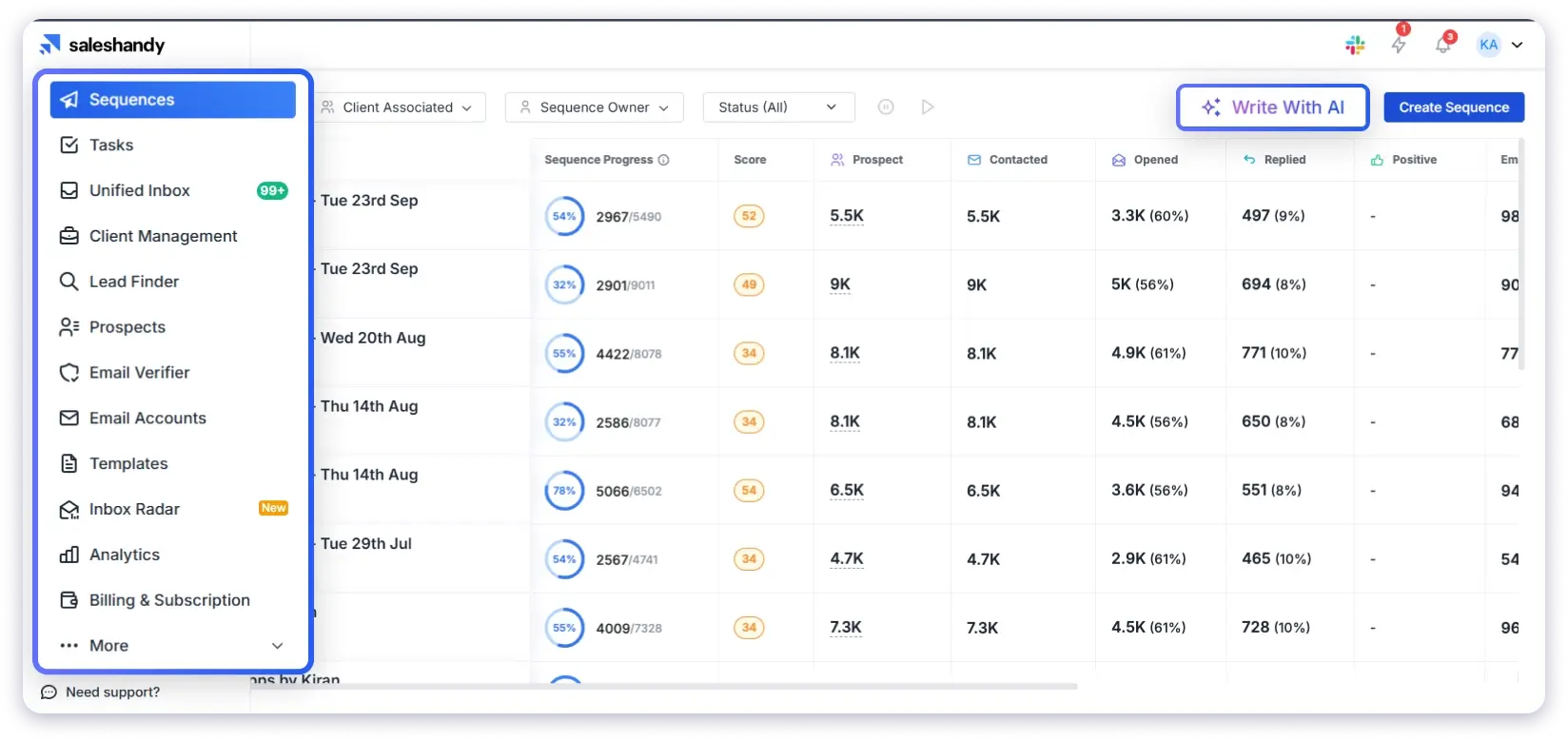
You can find leads, build sequences across email, calls, LinkedIn, and WhatsApp, monitor deliverability, and manage replies.
So, you don’t need to stitch three tools together to get a working pipeline.
Pros:
- No per-seat pricing. Add people without watching the invoice climb.
- Built-in warm-up and deliverability tools on every plan.
- 852M+ contact database with pay-only-for-verified credits.
- MCP and CLI integration to run Saleshandy through Claude or ChatGPT.
Cons:
- They give a 7-day free trial and 50 free leads, which is enough to test the platform properly. But a few users mentioned the trial window could be longer.
What Amplemarket Gaps Saleshandy Fills:
Amplemarket users rarely knock the vision; they actually knock the friction.
Here’s what shows up again and again in reviews, and how Saleshandy answers each one.
1. The price and the lock-in:
Amplemarket starts at $600/month with mandatory annual billing. That is a minimum commitment of $7,200/year for 2 users. No free plan. The 14-day trial requires scheduling a demo first.
Saleshandy starts at $34/mo, offers monthly billing, a 7-day free trial with no demo required, and no credit card needed.
2. Steep learning curve:
On G2, Amplemarket reviewers cite a steep learning curve 32 times, with a typical one-month implementation window for larger teams.
Saleshandy’s most praised trait on G2 is the opposite: ease of use. It is its single most cited positive.
3. Deliverability issues at scale:
The most consistent Amplemarket complaint is emails landing in spam after scaling sequences.
Saleshandy bakes warm-up, sender rotation, email ramp-up, and Inbox Radar placement monitoring into the core workflow. You do not bolt it on later. It is there from day one.
4. Data that bounces:
Reviewers flag weaker non-US data, with 53 explicit G2 call-outs and one user reporting 65% bounce rates on non-US contacts.
Saleshandy verifies at the point of reveal and only charges you for verified data. Misses cost you nothing.
Key Outreach Features You Won’t Find in Amplemarket:
- Unlimited email accounts on every plan. Sender rotation scales freely with no inbox cap.
- No per-seat pricing.
- Pay-per-verified-data credits. You only pay for a verified email.
- Native MCP and CLI. So, you can connect ChatGPT, Claude, or Gemini to Saleshandy through MCP, plus a full command-line interface, on every plan. Amplemarket connects through API and Zapier, but does not offer this kind of native AI control.
Pricing:
- Starter is $34/mo on annual billing.
- Pro is $76/mo.
- Scale is $149/mo with unlimited users.
Every plan includes unlimited inboxes and unlimited warm-up. There is a 7-day free trial with no credit card required.
My Honest Take:
If you liked Amplemarket’s all-in-one idea but not its bill, this is the switch that makes more sense.
You get the multichannel outbound workflow without an annual commitment. For most teams under 50 people, that trade is a no-brainer.
2. Apollo.io: Best Budget-Friendly Database With Built-In Sequencing
⭐ G2 Rating: 4.7/5 (9,829+ reviews)
When it comes to top Amplemarket competitors, Apollo.io is the tool most people try first. And it is easy to see why.
You get a 240M+ contact database, email sequencing, a built-in dialer, and intent signals in one login.
There’s a free-forever tier that actually lets you test the database before you pay. And no demo required like Amplemarket, or no “talk to sales” wall.
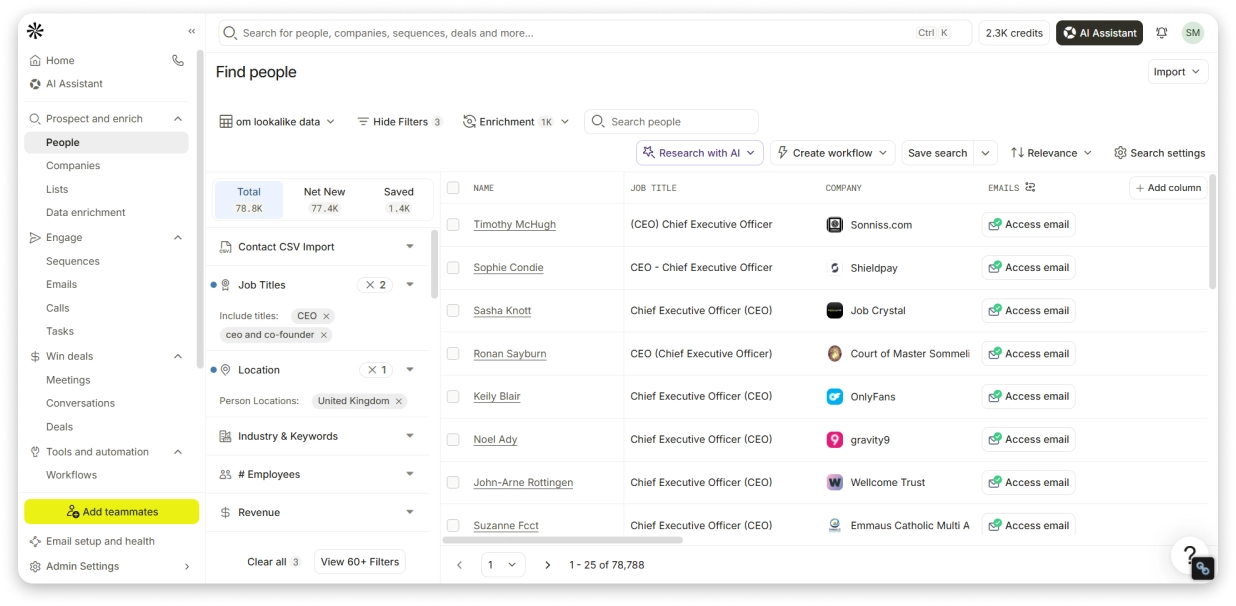
For teams that need data and outreach in one place without writing a five-figure check, Apollo is the cheapest serious entry point on this list after Saleshandy.
Where it sits below Saleshandy: per-seat pricing adds up fast as your team grows, credits expire monthly with no rollover, and Apollo shut down its built-in warm-up in 2024. The replacement paces sending but doesn’t rebuild sender reputation. If deliverability matters to you, you will need a separate tool for that.
Pros:
- A free plan that actually lets you test the database.
- 240M+ contacts and 30M+ companies with strong filters.
- Transparent, published pricing you can read without a demo.
- A real developer stack: REST API, CLI, and a native MCP server.
Cons:
- Per-seat pricing multiplies with every head, and credits burn fast with no rollover.
- Apollo shut down its built-in warm-up in 2024. The replacement only paces sending; it does not rebuild sender reputation.
- Data is strong in the US but thinner abroad, with reported bounce rates of 15 to 35% by region.
What Amplemarket Gaps Apollo Fills:
Amplemarket hides its price and points you to outbound. Apollo does neither.
- Price on the page: Paid plans start at $49/user/mo annually, with a free-forever tier. Amplemarket starts at $600/mo, annual only, with no free version.
- A bigger and more accurate database. Apollo lists 240M+ contacts against Amplemarket’s roughly 200M to 300M profiles.
Key Outreach Features You Won’t Find in Amplemarket:
- A free forever plan to test data quality before you pay.
- A built-in dialer with call recording on higher tiers.
- A native MCP server and CLI to wire Apollo data straight into Claude or your own AI agents. Amplemarket exposes a REST API, not a native MCP.
Pricing:
- Basic is $49/user/mo; Professional is $79
- Organization is $119 with a three-seat minimum, all on annual billing.
Monthly billing costs more, credit overages run about $0.20 each with no rollover, and phone pulls drain credits fast.
My Honest Take:
If your job is finding contacts and running email sequences on a budget, Apollo is hard to beat after Saleshandy.
It’s also the most developer-friendly pick here, thanks to that native MCP.
Just remember it’s a data engine first, not a deliverability one. Pair it with warm-up and inbox monitoring, or your reply rates will quietly slide.
Worth Reading: Not happy with Apollo? Check out the best Apollo alternatives NOW.
3. Instantly: Best for High-Volume Cold Email Infrastructure
⭐ G2 Rating: 4.8/5 (4,157+ reviews)
If your entire outbound strategy lives and dies by cold email volume, Instantly is purpose-built for that job.
It does one thing really well: send cold email at scale without torching your domains.
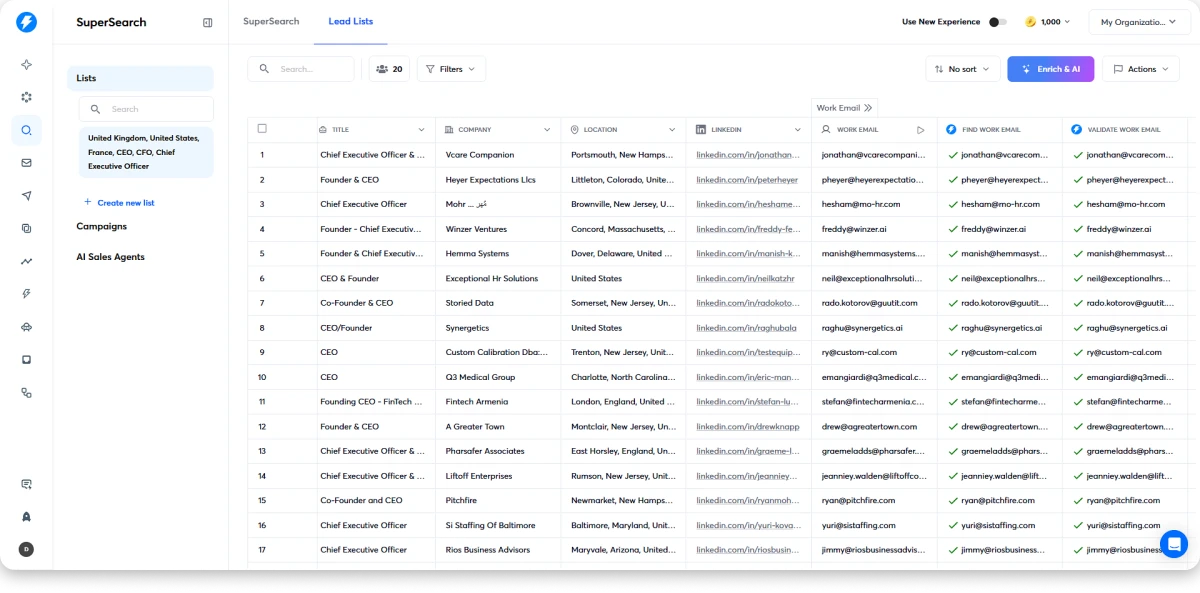
Every plan ships with unlimited email accounts and unlimited warm-up baked in, no add-on fees for inboxes. That alone is what pulls teams away from Amplemarket, where deliverability complaints start piling up the moment you scale sequences.
But here’s the part most people miss. Instantly isn’t one product. It is three. The cold email tool, the lead database, and the CRM are billed separately. What looks like $30/mo on the pricing page can quietly become $90 to $130/mo 😱😱 once you need all three pieces working together.
If cold email automation is your whole game and you already have a separate data source and CRM, Instantly is your lane. If you need prospecting, calling, and email in one place, you will end up bolting on tools that Saleshandy and Apollo already include.
Pros:
- Unlimited email accounts and unlimited warm-up on every plan.
- Priced by volume, not per seat. Adding SDRs doesn’t move the bill.
- A well-regarded warm-up network that keeps new domains healthy.
Cons:
- The $47 headline covers sending only. Leads and CRM are separate subscriptions, so the real stack often runs $150 to $275+/mo.
- The Growth plan can’t even reply to leads. Unibox starts on Hypergrowth, so you upgrade fast.
- Email-only at heart. No native dialer or LinkedIn steps like Amplemarket runs.
What Amplemarket Gaps Instantly Fills:
Amplemarket bundles everything and bills you per seat. Instantly does the opposite.
- Volume, not seats: Every plan includes unlimited inboxes and unlimited users. A 10-person team pays what a solo sender does.
- Pay for what you send: Instantly’s modular tiers let you buy sending, data, or CRM on their own, instead of one $600 all-in contract.
- A trial you can actually start: Instantly gives a 14-day free trial with no card. Amplemarket makes you sit through a demo first.
Key Outreach Features You Won’t Find in Amplemarket:
- Unlimited inboxes with no per-seat penalty, built for sender rotation at scale.
- Unlimited native warm-up built into every sending plan, not a separate bill.
- A volume-based model that scales with emails sent, not heads hired.
Pricing:
- Outreach: Starts at $37.60/month (annual billing) or $47/month monthly.
- Lead Database: Separate Instantly Credits subscription starts at $37.60/month (annual billing) or $47/month monthly.
- Bundles: Starter $85/month, Scale $175/month, Agency $500/month (annual billing). Includes outreach + leads + additional features.
- Free Trial: 14 days, no credit card required.
Note: The $37.60 plan only covers sending. Lead database, CRM, Unibox, and AI Reply Agent require higher-tier plans.
My Honest Take:
If you already have your lists and just need a sending machine that won’t wreck your domains, Instantly and Saleshandy both are excellent choices.
They’re the cleanest high-volume cold email tool on this list.
Walk in clear-eyed, though. That $47 sticker is the appetizer, not the meal, once you stack on data, a CRM, and inboxes. For pure, focused sending at scale, few do it better.
Worth Reading: Not happy with Instantly? Check out the best Instantly alternatives NOW.
4. Smartlead: Best Budget Option for Agencies Sending at Scale
⭐ G2 Rating: 4.6/5 (447)
Teams pick Smartlead over Amplemarket for one reason: it treats high-volume sending as the product, not a feature bolted onto a bigger suite.
You get unlimited mailbox rotation on every plan. Plus, true multi-tenant architecture so agencies can isolate client campaigns, sending infrastructure, and analytics cleanly. Warm-up and deliverability built into the core, not sold as an add-on.
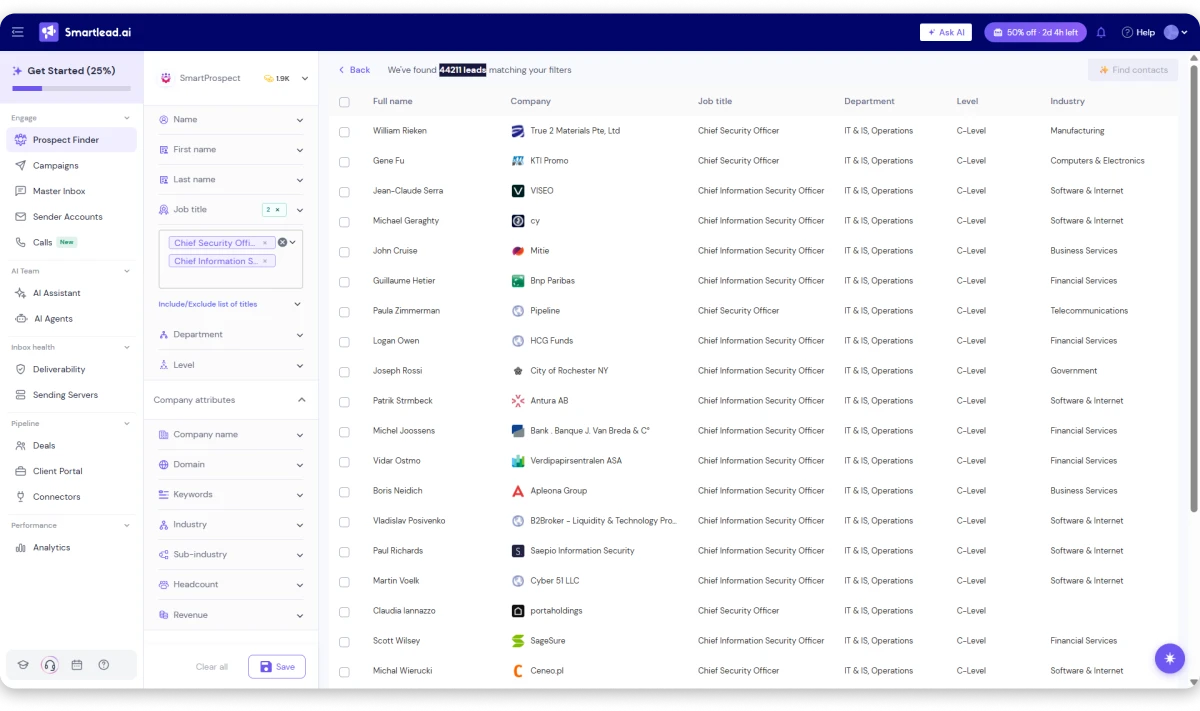
All starting at $39/mo flat, not per seat.
When you are running 20 clients with 5 inboxes each, Amplemarket’s $600/mo per-seat model breaks the math. Smartlead does not.
The trade-off is scope. There is no built-in contact database, no dialer, and no LinkedIn automation. White-labeling costs $29 extra per client per month, and add-ons can push a real agency bill to 3 to 5 times the base price.
Pros:
- Flat-rate pricing starting at $39/mo, no per-seat fees, or credit-based surprises.
- Unlimited mailboxes, unlimited warm-up, and white-label client workspaces.
- SmartSenders lets you buy domains and mailboxes inside the dashboard. No registrar, no DNS wrestling.
Cons:
- Add-ons stack up, white-label is $29 per client, SmartInfra dedicated servers cost extra, and verification is a separate line item.
- Support quality is inconsistent, as per 19 G2 reviews.
What Amplemarket Gaps Smartlead Fills:
Amplemarket is built for in-house sales orgs. Smartlead is built for agencies running campaigns across dozens of client accounts. That’s a structural difference, not a feature difference.
- Flat-rate vs. credit-based: Amplemarket runs on a credit system where validation and data lookups add variable costs as you scale. Smartlead’s tiers are flat. You know the bill before you send.
- Client isolation by design: Smartlead’s white-label workspaces keep deliverability metrics, campaigns, and configurations cleanly separated per client. Amplemarket splits things across account views, not isolated workspaces.
- Infrastructure you own: SmartSenders lets you provision domains and mailboxes inside the platform. SmartInfra gives you dedicated servers with your own IP blocks. Most tools, Amplemarket included, sit you on shared infrastructure.
Key Outreach Features You Won’t Find in Amplemarket:
- White-label client dashboards with isolated deliverability per client, built for agencies from the ground up.
- SmartSenders to buy and configure email infrastructure without leaving the platform.
- An API-first architecture with full webhook access. Agencies build custom data loops and proprietary dashboards on top of Smartlead’s engine.
Pricing:
- Basic is $39/mo, Pro is $94/mo, and Custom starts at $174/mo.
- Annual billing saves roughly 17%.
- White-label runs $29 per client (first client free on Pro).
- Budget for SmartInfra and verification if you need dedicated servers and clean lists.
My Honest Take:
For agencies watching every dollar per client, Smartlead earns its spot. The infrastructure depth is real.
SmartSenders and SmartInfra are genuinely useful, and the API-first build means you can mold it to your stack instead of the other way around.
Need better Smartlead options? Check out this best Smartlead alternatives guide.
5. Lemlist: Best for Personalized Multichannel Campaigns
⭐ G2 Rating: 4.6/5 (2,243+ reviews)
Where Amplemarket sells an all-in-one suite at enterprise pricing, Lemlist sells creative control at a fraction of the cost.
With Lemlist, you can add custom images, dynamic landing pages, personalized video variables, and multi-channel sequences that make every cold email look handcrafted.
No other tool on this list lets you personalize at this depth without a design team.
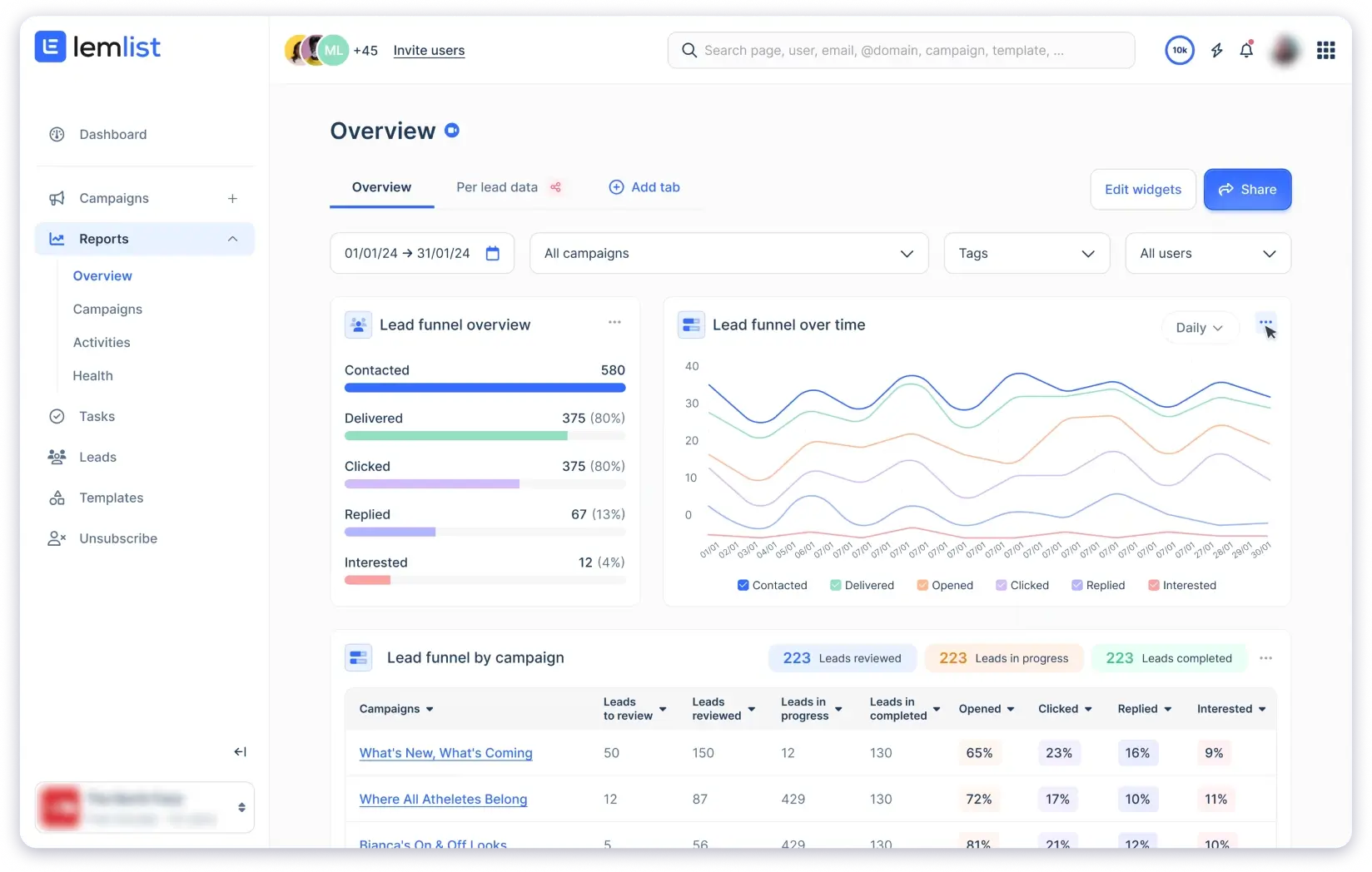
It also gives you unusual AI flexibility. You can pick your AI provider per column (OpenAI, Claude, or Perplexity), write custom prompts, and chain enrichment pipelines directly inside the lead table before a single email goes out.
The trade-off: Lemlist’s built-in database is smaller than Apollo or Saleshandy, and it doesn’t offer a dialer or native calling.
Pros:
- Deep visual personalization (custom images, videos, landing pages) that no other tool on this list matches.
- Multi-language AI that works across international markets. Amplemarket’s Duo AI is English-only.
Cons:
- LinkedIn, calls, and WhatsApp sit behind the Multichannel plan at $87/user/mo. The Email plan doesn’t include them.
- Lead data enrichment is a separate subscription starting at $75/mo on top of the engagement plan.
What Amplemarket Gaps Lemlist Fills:
- You can actually try Lemlist before committing: Lemlist offers a 14-day free trial with no credit card. Amplemarket requires a demo before you touch anything.
- Multi-language AI: Amplemarket’s Duo AI generates sequences in English only. If you sell into DACH, Nordics, Latin America, or APAC, that’s a hard wall. Lemlist’s AI works across languages.
- A bigger lead pool: 650M+ verified contacts against Amplemarket’s roughly 200M to 300M profiles, with waterfall enrichment across 5 to 7 data sources built into the dashboard.
Key Outreach Features You Won’t Find in Amplemarket:
- Dynamic image and landing page personalization generated per prospect, not just text merge fields.
- Lemwarm, a peer-to-peer warm-up network of 10,000+ real users that builds sender reputation through community-based inbox interactions. Amplemarket bundles a domain health tool, not this.
- Multi-language AI sequences for teams selling outside English-speaking markets.
Pricing:
- Email Plan: $55/month (annual billing) or $69/month monthly. Includes unlimited users, 50,000 emails/month, warm-up, and outreach features.
- Multichannel Plan: $87/user/month (annual billing) or $109/user/month monthly. Adds LinkedIn automation, calling, and multichannel outreach.
- Enterprise: Custom pricing with a minimum of 5 users.
My Honest Take:
If your outreach lives and dies on standing out, not just showing up, Lemlist is worth every penny.
The visual personalization is genuinely hard to replicate, and the multi-language AI solves a problem Amplemarket hasn’t even touched.
Still not happy with Lemlist? Check out these best Lemlist alternatives in 2026.
6. Outreach: Best for Enterprise Revenue Teams
⭐ G2 Rating: 4.3/5 (3,619+ reviews)
Amplemarket bundles everything into one platform for mid-market teams. Whereas Outreach unbundles it for enterprises that already have a stack and need an execution engine to sit on top.
The difference is structural. Outreach handles massive sequence libraries with deep rulesets, granular admin permissions, and governance controls that large sales orgs require. It plugs into whatever data provider the enterprise already uses, whether that is ZoomInfo or LinkedIn Sales Navigator.
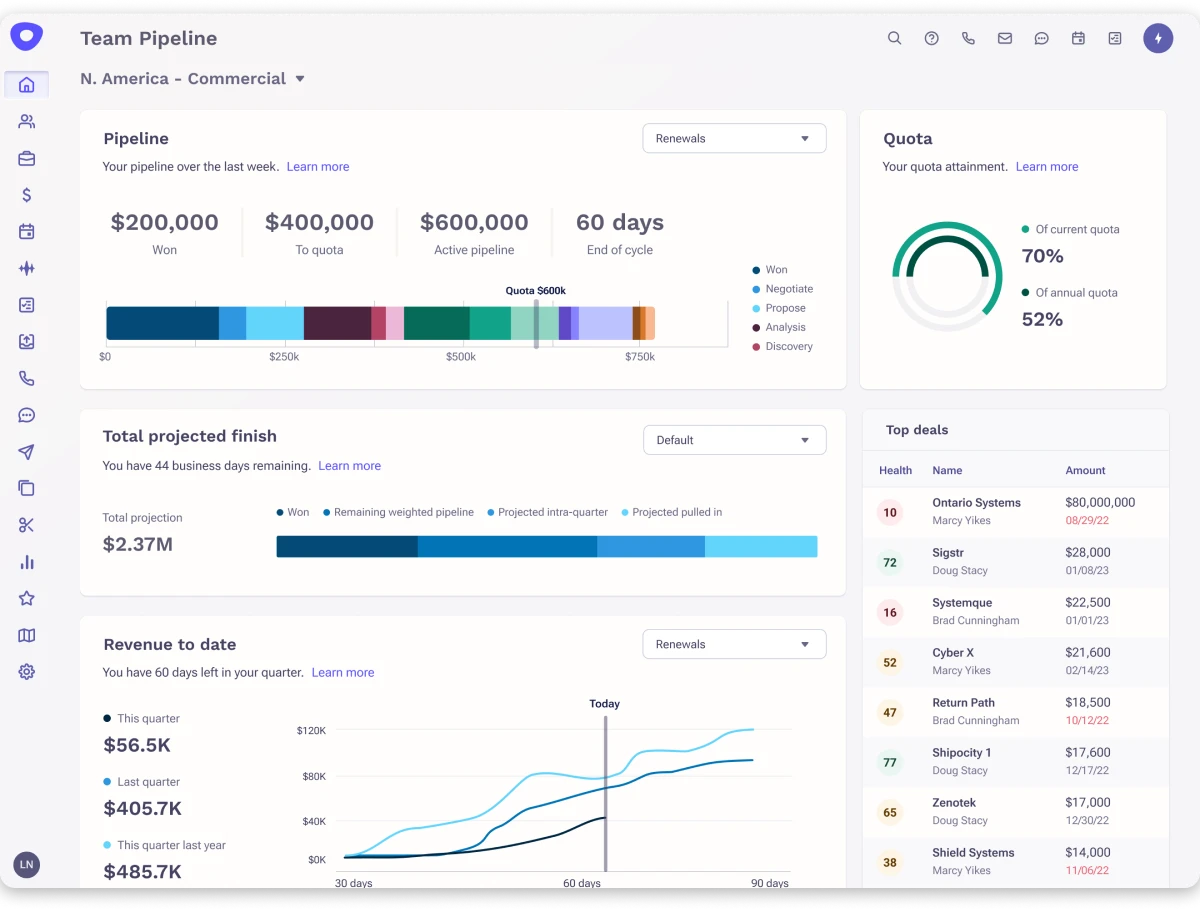
It also adds a layer Amplemarket doesn’t even touch: deal intelligence. You get Pipeline forecasting, real-time call coaching through Kaia, and revenue analytics built for VP-level visibility.
The only trade-off I found was no built-in contact database. And pricing starts around $100/user/mo, and it requires a sales conversation to buy.
Pros:
- Autonomous AI agents (Omni, Research, Deal, Meeting Prep) that handle workflows independently, not just assist.
- Kaia delivers live call coaching with real-time transcription, sentiment analysis, and action items during the meeting, not after.
- Predictive forecasting built on historical CRM deal data, pipeline signals, and buyer engagement patterns.
Cons:
- No published pricing at any tier. Seat-based fees plus consumption-based AI credits mean the real bill depends on usage.
- No native contact database. You bring your own data (ZoomInfo, Apollo, etc.) or pay for a separate provider.
- No built-in email warm-up or inbox placement tools.
What Amplemarket Gaps Outreach Fills:
Amplemarket is strong at the top of the funnel. Outreach picks up where sequencing ends.
- Forecasting that Amplemarket doesn’t do: Outreach uses ML models on your CRM history to generate probability-weighted forecasts. Managers spot at-risk deals in real time and course-correct. Amplemarket doesn’t touch revenue forecasting.
- Live conversation intelligence vs. basic VoIP: Kaia runs real-time coaching during calls: content cards, transcription, sentiment, action items. Amplemarket logs calls. It doesn’t coach through them.
- Autonomous agents vs. a copilot: Outreach’s Amplify packages ship agents that independently research accounts, prep meetings, and update pipeline. Amplemarket’s Duo waits for you to click. That’s a fundamentally different level of automation.
Key Outreach Features You Won’t Find in Amplemarket:
- Predictive deal health scoring that flags at-risk opportunities and recommends next steps.
- Outreach MCP (Server and Client) on every Amplify package, for teams connecting AI assistants to pipeline data.
Pricing:
All plans are quote-based with per-seat pricing plus consumption-based AI credits on top.
My Honest Take:
If you’re a large team that needs pipeline visibility, forecasting, and live coaching across the deal cycle, Outreach earns its keep.
7. Salesloft: Best for CRM-Connected Revenue Workflows
⭐ G2 Rating: 4.5/5 (9,876+ reviews)
Where Outreach is the execution engine, Salesloft is the process engine.
Teams pick it over Amplemarket when structured deal management and sales methodology matter more than built-in data.
Its Rhythm engine surfaces data-driven next steps based on buyer signals, so reps are not guessing what to do next. It supports enterprise frameworks like MEDDPICC out of the box, with pipeline forecasting and deal tracking that plug directly into Salesforce.
For large orgs that already have a data provider and need strict cadence automation, standardized workflows, and governance controls across 50+ reps, Salesloft fits that mold cleanly.
Pros:
- Rhythm AI analyzes live CRM signals and surfaces a prioritized action list for each rep, so they take the right step at the right time.
- Native conversation intelligence (Kaia) with live coaching, AI transcription, and structured team management.
- Deep MEDDPICC framework support built into deal management. Pipeline reviews stop being guesswork.
Cons:
- No published pricing.
- No native contact database. You bring your own data provider and pay for it separately.
- No built-in email warm-up or inbox placement at any tier.
What Amplemarket Gaps Salesloft Fills:
- The full revenue cycle, not just cold outbound: Amplemarket handles the top of the funnel. Salesloft covers SDR sequencing, AE deal management, and CS renewals in one workflow. When deals stall mid-pipeline, Amplemarket has no answer. Salesloft does.
- Rhythm AI vs. autonomous agents: Amplemarket’s Duo tries to automate the human out of the loop. Rhythm does the opposite. It reads bidirectional CRM data in real time and tells the rep exactly which deal needs attention and what to do next. For complex, high-touch enterprise sales, that’s the smarter bet.
Key Outreach Features You Won’t Find in Amplemarket:
- Rhythm AI and Plays that prioritize rep actions based on live deal signals, not just sequence automation.
- Native MEDDPICC deal tracking for pipeline reviews that run on frameworks, not feelings.
- Full-cycle orchestration across SDR, AE, and CS motions in one platform.
- Best-of-breed integration philosophy. Enterprise teams choose their own compliance-certified data provider and connect it to Salesloft’s execution engine, rather than depending on a single bundled database.
Pricing:
Quote-based pricing, so you need to contact sales for custom pricing.
My Honest Take:
Salesloft shines for CRM-anchored revenue teams that live in deal cycles, not just cadences. Rhythm is a genuinely different approach to AI: it makes reps smarter instead of trying to replace them.
But if your problem is finding prospects and sending cold email, Salesloft is the wrong tool for the job. It doesn’t find leads, it doesn’t warm up inboxes, and it doesn’t come cheap. Right platform, wrong job if you just need outbound.
Worth Reading: Not sold on Salesloft? Check out these Salesloft alternatives for 2026.
Decision Time: Which Amplemarket Alternative Should You Choose?
To make it fair, you need to check who actually wins against the limitations that made you leave Amplemarket in the first place.
The biggest limitation is hefty pricing. In that case, Saleshandy stands out as the most budget-friendly option in this list.
Plus, Saleshandy doesn’t follow per-seat pricing, which makes it easier for growing global teams to scale.
Need a larger and more accurate database? Saleshandy gives you 98% data accuracy, real-time verification, 75+ data filters, and access to 852M+ B2B contacts.
So far, Saleshandy is the only one that tackles the full set: affordable prospecting, deeper enrichment, reliable data, and built-in cold email infrastructure, all under one roof.
Still, don’t take my word for it. Try it yourself.
Claim Your 50 FREE Leads & 7-day FREE Trial NOW!
FAQs Outbound Teams Often Ask Me About Amplemarket Alternatives
1. What Is the Cheapest Amplemarket Alternative?
If you want highly accurate data and sending under one bill, Saleshandy starts at $34/mo. It includes Lead Finder credits, sequences, and warm-up, and no separate subscriptions. Apollo’s free tier is the cheapest way to test a database before paying. For pure sending without built-in data, Instantly ($37.60/mo annual) and Smartlead ($39/mo) are the leanest options.
2. Which Amplemarket Alternative Is Best for Agencies?
Saleshandy and Smartlead lead here. Saleshandy gives you unlimited email accounts, unlimited users, and unlimited clients with no per-seat fees on Scale. Smartlead adds white-label client workspaces at $29 per client.
3. Does Amplemarket Have a Free Trial?
Not in the usual self-serve sense. Amplemarket is sales-led and annual-only, so you sit through a demo before you touch anything. Saleshandy, Apollo, Instantly, and Lemlist all let you start free right away, no sales call required.
4. Which Amplemarket Alternative Has the Best Deliverability?
Tools with built-in warm-up win here. Saleshandy bakes in Inbox Radar, sender rotation, and email ramp-up across every plan. Instantly and Smartlead include unlimited warm-up too. Outreach and Salesloft don’t offer warm-up at any tier.
5. Can I Use Amplemarket Alternatives Without an Annual Contract?
Yes. Saleshandy, Apollo, Instantly, Smartlead, and Lemlist all offer monthly billing. Amplemarket, Outreach, and Salesloft lock you into annual contracts.
6. Which Alternative to Amplemarket Has the Largest B2B Contact Database?
Saleshandy’s 852M+ contacts is the largest on this list. Lemlist claims 650M+, Apollo sits above 275M+. Bigger isn’t everything, though. Verified accuracy matters more than raw count, and Saleshandy only charges you for verified results.
7. What Amplemarket Features Am I Losing if I Switch?
Mainly the Duo AI copilot’s autonomy and native WhatsApp steps inside one cadence. You may also lose some bundled contact-level buying signals. That said, most alternatives now match the core prospecting, sequencing, and deliverability jobs that made you consider Amplemarket in the first place.