
If you’re comparing Apollo pricing right now, the plans probably look simple at first glance.
Four tiers. Starting at free. Paid plans from $49 to $119 per user per month (billed annually).
But here’s what the pricing page won’t tell you upfront.
Apollo.io pricing is credit-driven, not just subscription-based.
So your final bill depends on how fast your team burns through those credits.
I went through every Apollo.io pricing plan, calculated the real costs, and mapped where charges quietly add up.
This breakdown covers all four Apollo pricing plans in 2026: Free, Basic, Professional, and Organization.
So you know what you’re actually paying for before you commit.
If you’re specifically checking Apollo intent topics pricing, Apollo AI pricing, or how Apollo API pricing works, all three are covered inside.
Apollo Pricing – TOC
- TL;DR: $49 Vs. $34
- What Does $49/Mo Get You in Apollo?
- How Much Does Apollo.io Cost? (Quick Overview)
- Apollo.io Pricing Plans Full Breakdown
- How Apollo’s Credit System Actually Works
- What Apollo Pricing Plan Is Best for Your Company?
- Apollo Pricing 2025 vs 2026: What Changed
- Is Apollo.io Pricing Worth It in 2026?
- Don’t Overpay, Get More Features at $34/Mo
- FAQs About Apollo Pricing
TL;DR: $49 Vs. $34
Apollo Basic costs $49/user/month (billed annually). Saleshandy Starter costs $34/month flat.
On paper, they look close, but in practice, they behave very differently.
| Based On | Apollo Basic: $49/user/mo | Saleshandy Starter: $34/mo |
|---|---|---|
| Contact Database | 240M+ contacts, 30M+ companies (US-centric) | 852M+ contacts, 42M+ companies (global) |
| Credits Included | 2,500/month, 30,000/year | 1,500/month, 18,000/year |
| Credit Rollover | ❌ Expires at end of cycle | ✅ 50% rolls to next month |
| Phone Reveal Cost | 8 credits (~3,750 phones/year) | 6 credits (bundled) |
| Auto-Refund on Invalid Data | ❌ | ✅ |
| Real-Time Verification | Waterfall (batch) | Real-time before reveal |
| Daily Send Cap | 250 emails/user/day | No daily cap (6,000/month) |
| Mailboxes Per User | 1 | Multiple |
| US Dialer | ✅ (credits apply) | ❌ (not core) |
| Billing Model | Per seat (+$49 each) | Flat rate |
| Team of 5 Yearly Cost | $2,940 | $912 on Pro (10 seats included) |
What Does $49/Mo Get You in Apollo?
Before I break down every Apollo pricing plan in detail, here’s a quick side-by-side look. Both of these plans cost exactly $49/month, but what you get for that price is very different.
This table should give you a useful reference point as you read through the rest of this breakdown.


How Much Does Apollo.io Cost? (Quick Overview)
Before diving into the details, here’s a quick look at all four Apollo.io pricing plans side by side.
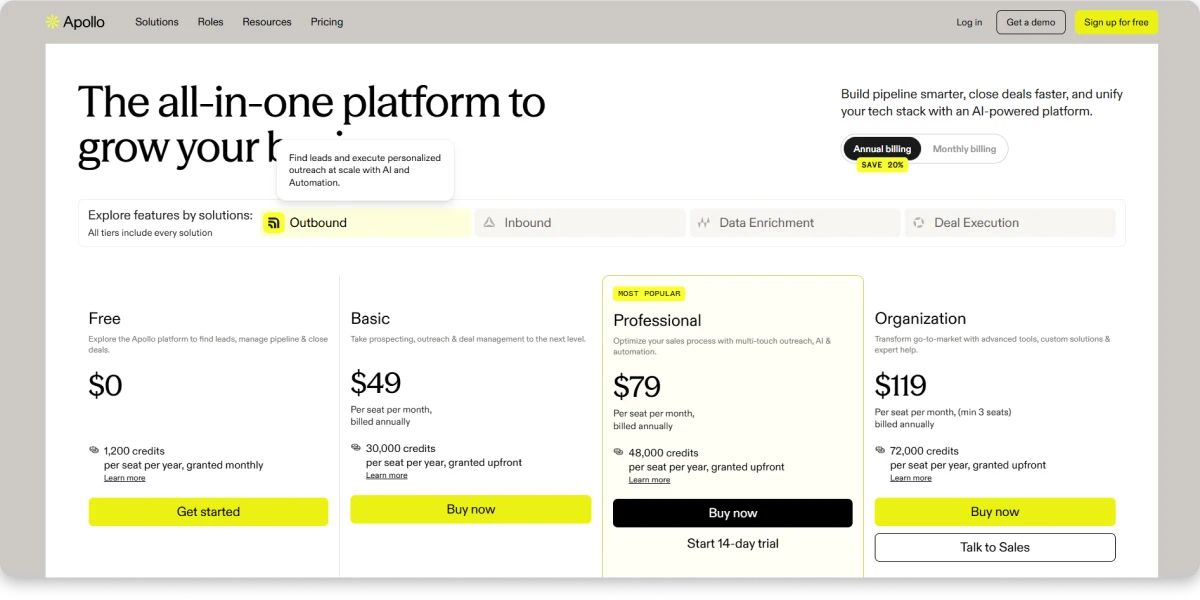
| Plan | Monthly Billing | Annual Billing | Credits Included | Best For |
|---|---|---|---|---|
| Free | $0 | $0 | 1200 credits/seat/year (granted monthly) | Testing the platform |
| Basic | $59/user/mo | $49/user/mo | 30,000 credits/seat/year (granted upfront) | Small teams starting outbound |
| Professional | $99/user/mo | $79/user/mo | 48,000 credits/seat/year (granted upfront) | Mid size teams with US calling needs |
| Organization | $149/user/mo | $119/user/mo | 72,000 credits/seat/year (granted upfront) | Large teams needing global dialing + SSO |
Apollo markets a flat 20% annual discount (Basic actually saves 17%; Pro and Org save 20%).
Organization is an annual contract only.
That said, Apollo’s real cost isn’t just the subscription; it’s the credit consumption underneath.
Let me walk you through each plan, so you know exactly what you’re getting.
Apollo.io Pricing Plans Full Breakdown
1. Free Plan
Apollo’s free plan gives you basic access to their contact database. It works well enough to explore the interface and test a handful of searches.
✅ What You Get:
- 1,200 credits per year, granted monthly (100 credits/month)
- 2 active sequences with a 250 emails/day cap
- Basic filters, AI Assistant (5-chat limit), and the Chrome extension
- 1 intent topic (out of Apollo’s full “6 intent topics” pool)
- Website Visitors: identify 20 companies/month
- Call recording (150 mins)
- 6 meeting events per user
All credits: email reveals, phone reveals, exports, AI research drawn from the same unified pool.
❌ Where It Falls Short:
With only 100 credits per month, you can reveal 100 emails or just 12 phone numbers (phone reveals cost 8 credits each).
On top of that, there’s no CRM integration, no advanced filters, no dialer access and a record-selection limit of 25, so saving 10,000 leads takes 400 clicks.
My take: If you just want to see how Apollo’s database looks before paying, the free plan does the job. But don’t expect to run actual outbound from it.
2. Basic Plan: $49/user/mo (Annual)
This is where most small teams start with Apollo. The Basic plan gives you a bigger credit pool and unlocks CRM integrations with Salesforce and HubSpot.

✅ What You Get:
Basic includes everything in Free, plus:
- 30,000 credits per seat per year (~2,500/month), granted upfront
- Advanced filters (technographic, job postings, funding, revenue)
- Waterfall enrichment and job change tracking
- All 6 intent topics and intent filters (up from 1 on Free)
- CRM integrations (Salesforce, HubSpot) with automated CRM enrichment
- Unlimited email sequences (still capped at 250 sends/day per user)
- Website Visitors: 100 companies/month (up from 20)
- AI Assistant (currently “Introductory Free”), AI Research, AI Lead Scoring
- US Dialer access (credits apply)
❌Where It Falls Short:
There’s US Dialer access available on this plan (credits apply).
Also, 30,000 credits per year sounds generous until you do the math. Each phone number reveal costs 8 credits.
So your entire annual credit pool only gives you about 3,750 phone numbers.
That’s roughly 312 per month for your whole team, not per user.
Two more ceilings hit early on Basic. First, credits don’t roll over and whatever’s left at the end of your cycle expires.
Second, daily sends are capped at 250 emails per user (same as Free), and you’re limited to 1 mailbox per user.
Any team running multiple sender identities or real outbound volume outgrows this tier within weeks.
My take: The Basic plan works well for email-first teams that don’t need calling features. But if you rely heavily on phone number reveals, the 30,000 yearly credits per seat can run out faster depending on your prospecting volume.
3. Professional Plan: $79/user/mo (Annual)
This is Apollo’s most popular plan, and for good reason. It unlocks the US dialer, unlimited sequences, and A/B testing for email campaigns.
✅ What You Get:
Professional includes everything in Basic, plus:
- 48,000 credits per seat per year (~4,000/month)
- Built-in US dialer with call recording + AI Call Insights (4,000 minutes)
- Unlimited daily email sends (the 250/day cap is gone)
- Unlimited Gmail/Microsoft mailboxes + 5 SMTP mailboxes per user
- A/Z testing on sequences
- Agentic Loops, which is Apollo’s autonomous multi-step research agent
- 800,000 AI-written words per month per seat
- 500 automated workflows per team
- Unlimited meeting events and inbound routers
- Projects (BETA)
❌ Where It Falls Short:
The dialer only supports US and Canadian phone numbers. If you’re reaching out to prospects in Europe, APAC, or LATAM, you’ll have no calling capability on this plan.
Beyond that, 48,000 annual credits per seat works out to 4,000 credits per month per rep.
If a rep reveals 20 phone numbers per day, that’s 160 credits daily on phone reveals alone, so a single rep’s monthly credit pool covers about 25 business days of that pace, with nothing left for email reveals or exports
There’s also no SSO, no advanced security configurations, and no custom permission profiles at this tier.
My take: For US-based teams that combine email outreach with calling, the Professional plan is the most practical Apollo plan. Please map out your credit usage before you commit, as overages can add up quickly.
Quick math for a 5-person team on Professional:
5 users × $79/mo = $395/month = $4,740/year and that’s before any credit top-ups.
4. Organization Plan: $119/user/mo (Annual) Minimum 3 Users
This is Apollo’s enterprise-grade plan.
It gives you the highest credit limits, international dialing (available through Advanced Dialer add-on), SSO, and custom reporting.
✅ What You Get:
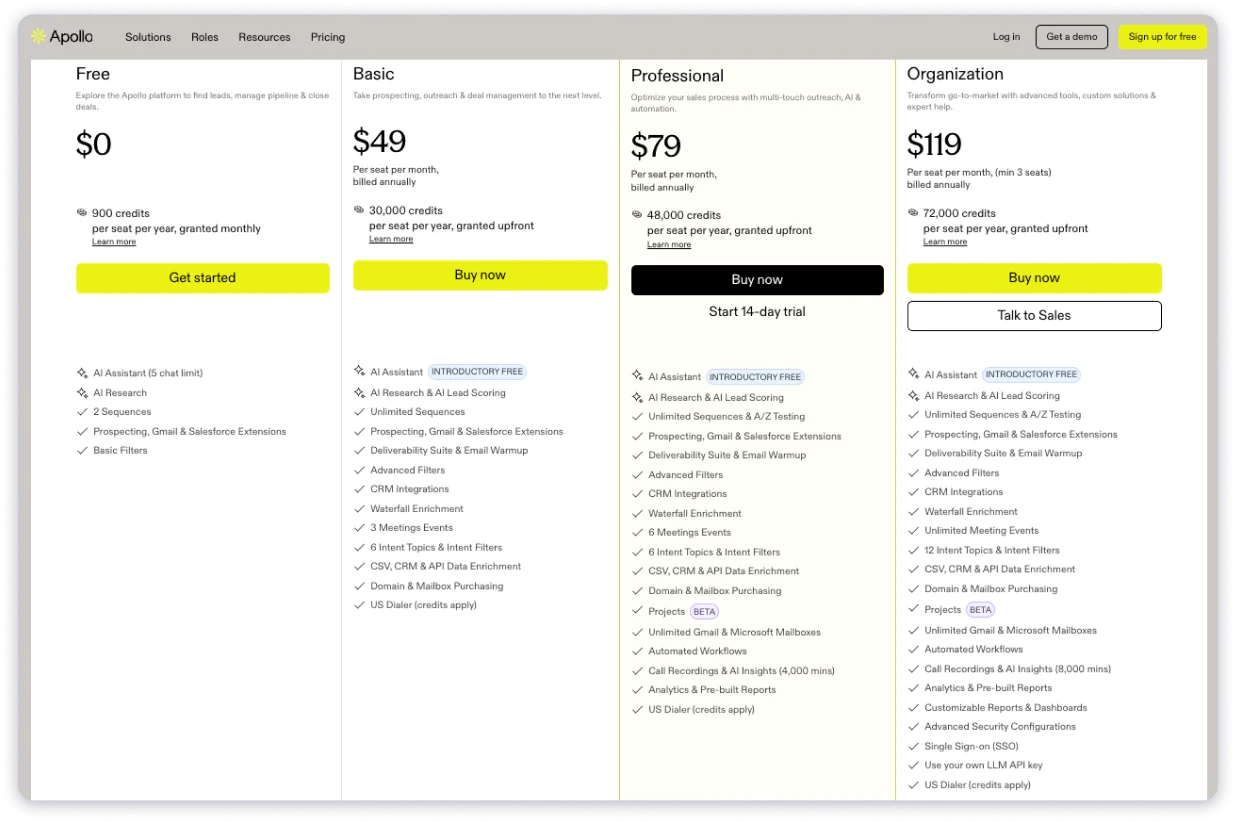
Organization includes everything in Professional, plus:
- 72,000 credits per seat per year (~6,000/month)
- Call recording with AI Insights bumped to 8,000 minutes
- 12 intent topics (double Basic/Pro’s 6) with advanced intent filters
- SSO, IP whitelisting, advanced security configurations
- Custom reports, dashboards, and permission profiles
- 15 SMTP mailboxes per user (up from 5)
- 1,000,000 AI-writing words per month per seat
- Option to use your own LLM API key
- Dedicated GTM Engineer (minimum contract value required)
- Advanced Dialer add-on — $119/team/month, annual-only unlocks international dialling, Parallel Dialer, Power Dialer
❌ Where It Falls Short:
The 3-user minimum means your entry price is $357/month or $4,284/year, even if only one person actively uses it.
Even at this tier, credits are still limited.
You get 72,000 credits per year per seat (6,000 credits/month per seat). For large teams running multi-channel campaigns across regions, that number can still get tight.
And seat reductions aren’t allowed mid-contract either. If your team shrinks from 10 to 6, you keep paying for 10 until renewal.
My take: The Organization plan makes sense for enterprise teams with strict security requirements and global outreach needs. But the price commitment is significant: 3 seats (minimum) = $4,284/year, and adding the Advanced Dialer for international calling pushes that to $5,712/year before a single credit top-up.
How Apollo’s Credit System Actually Works
This is the part of Apollo.io pricing that catches most buyers off guard. The subscription fee is just your entry ticket.
The credit system is what controls how much you can actually do inside the platform.
Here’s how credits get consumed:
| Action | Credit Cost |
|---|---|
| Reveal a verified email | 1 credit |
| Reveal a phone number | 8 credits |
| Export a contact (CSV, CRM sync) | 1 credit (unified pool, no separate “export credits” anymore) |
| AI research per run | 1 credit |
| US Dialer | 1 credit per 30 seconds (30-sec minimum per connected call) |
| International Dialer | Varies by region (requires Advanced Dialer add-on) |
Now, let’s do some math that actually matters.
On the Basic plan (30,000 credits/seat/year):
- If you only reveal emails → you get 30,000 email addresses per year
- If you only reveal phone numbers → you get just 3,750 per year (30,000 ÷ 8)
- In practice, most teams do a mix and every CSV/CRM export also costs 1 credit from the same pool. So the usable number falls somewhere in between, and any team leaning on Apollo credits for exports drains the pool faster than the “30,000” headline suggests.
On the Professional plan (48,000 credits/seat/year)):
- Emails only → 48,000 per year
- Phone numbers only → 6,000 per year
- For a team of 5, that’s just 1,200 phone numbers per year per rep
The biggest catch with Apollo pricing?
Credits do not roll over.
Whatever credits remain at the end of your billing cycle simply expire. There are no refunds, no extensions, and no exceptions.
So if your team has a slow quarter and doesn’t use all credits, that value is lost. And if you hit a busy quarter and run out early, you’ll need to buy more at overage rates.
The Inbound Add-On Costs $119/mo Extra
If you want to scale your inbound lead capture beyond the basics, you’ll need a separate $119/month add-on. Here’s what it unlocks:
| Feature | Without Add-On | With Add-On ($119/mo) |
|---|---|---|
| Website Visitor ID | 100 companies/month | 50,000 companies/month |
| Form Enrichment | 10 contacts/month | 5,000 contacts/month |
| Form Builder & Visitor Contact ID | Not included | Included |
| Website Visitor – Contact (US Only) | Not included | Up to 10,000 contacts/month |
| Domain Tracking | Not included | Up to 100 domains |
Per-Seat Pricing Multiplies Fast
Unlike flat-rate tools, Apollo charges per seat. So costs scale linearly as your team grows.
- 5 users on Professional = $395/mo = $4,740/year
- 10 users on Professional = $790/mo = $9,480/year
- 10 users on Organization = $1,190/mo = $14,280/year
These are purely subscription costs — before additional add-ons like Advanced Dialer or Inbound.
What Apollo Pricing Plan Is Best for Your Company?
The “right” Apollo.io pricing plan depends on your team size, outreach style, and how predictable you need your costs to be. Here’s a practical guide:
- Solo founder or freelancer testing outbound → The Free plan is fine for exploring the interface. But you’ll likely outgrow it within the first week of serious prospecting.
- Small team (2–5 people), email-first outreach → The Basic plan at $49/seat/mo (billed annually) covers your needs if you don’t require cold calling. Just keep a close eye on credit usage 30,000 credits per seat per year goes faster than most teams expect.
- Enterprise team with global calling + compliance → Organization at $119/seat/mo (billed annually). Plan for the 3-user minimum ($4,284/year floor) and Advanced Dialer add-on ($119/team/month billed annually) for international dialing features.
- High-volume outbound team or agency → This is where Apollo’s per-seat pricing becomes a real challenge. If you have 10+ reps or manage outreach for multiple clients, the costs multiply with every seat. A flat-rate alternative with no per-seat charges would save you thousands annually.
A Quick Note on Apollo Intent Topics Pricing
Apollo’s intent data is one of the most-searched pieces of its pricing — and one of the most gated. Here’s how the six intent topics break down across plans:
- Free: 1 intent topic (enough to test, not enough to prospect)
- Basic ($49): All 6 intent topics + intent filters (this is the entry point for real intent-based prospecting)
- Professional ($79): Same 6 intent topics as Basic
- Organization ($119): 12 intent topics + advanced intent filters
If you’re paying specifically for intent data, Basic is the cheapest tier that unlocks the full set of 6.
The jump to 12 topics only happens at Organization a $70/seat/mo delta.
For most mid-market teams, the 6 topics on Basic or Pro are enough; the 12-topic Organization tier only pays back if you’re running highly-segmented, multi-intent campaigns across regions.
Apollo Pricing 2025 vs 2026: What Changed
If you first evaluated Apollo in 2025 and are re-checking pricing now, the sticker prices look identical.
Basic is still $49/user/mo, Professional $79, Organization $119, all billed annually.
What actually shifted this year is what those seats include, how credits work, and how far Apollo has pushed into AI.
Here’s the side-by-side.
| Changes On | Apollo Pricing 2025 | Apollo Pricing 2026 |
|---|---|---|
| Free plan credits | 900/seat/year (75/month) | 1,200/seat/year (100/month) |
| Basic / Pro / Org base price | $49 / $79 / $119 per seat/mo (annual) | Unchanged |
| Credit system | Separate pools (general credits, mobile credits, export credits) | Unified single credit pool every action (email, phone, export, AI) draws from one bucket |
| AI Assistant | Beta, limited access | “Introductory Free” on all paid plans (Assistant + Research + Lead Scoring) |
| Autonomous prospecting | Not available | Agentic Loops added on Professional & Organization |
| Sequence testing | A/B testing (2 variants) | A/Z testing (up to 26 variants) on Pro & Org |
| Mailboxes per user (Pro) | Unlimited Gmail/Microsoft | Unlimited Gmail/Microsoft + 5 SMTP |
| Database size claim | 210M+ contacts | 240M+ contacts, 30M+ companies |
| Inbound add-on | Pricing varied ($99–$149) | $119/team/mo, annual-only (fixed) |
| Organization billing | Monthly OR annual | Annual-only, 3-seat minimum |
| Intent topics on Basic | 6 topics | Unchanged (6 topics) |
| Intent topics on Organization | 12 topics | Unchanged (12 topics + advanced intent filters) |
| Call recording (Pro / Org) | 4,000 / 8,000 mins | Unchanged |
Is Apollo.io Pricing Worth It in 2026?
After breaking down every plan, add-on, and credit charge, here’s my honest take.
What Apollo does well:
- Large contact database with 210M+ B2B contacts and solid company-level data
- All-in-one platform which gives prospecting, sequences, dialer, and CRM in one place
- Built-in AI features for email writing, call analysis, and research
- Free plan available to test before committing
- Strong CRM integrations with Salesforce and HubSpot
Where Apollo falls short:
- Credits expire every billing cycle no rollover means wasted budget during slow periods
- Per-seat pricing makes scaling expensive for growing teams
- International dialer is available through the Advanced Dialer add-on ($119/team/month billed annually).
- G2 reviews indicate email bounce rates of 15–20% on certain segments, which can hurt your email deliverability
- The credit system creates anxiety — reps start rationing actions mid-month instead of prospecting freely
- Apollo adds data from users’ CRMs to supplement their database, which raises data privacy concerns for some teams
Bottom line: Apollo.io is a solid platform for US-focused teams with moderate prospecting volume.
The all-in-one approach saves you from juggling multiple tools.
But once your team grows beyond 5 users, or your outreach spans multiple regions, the costs start climbing.
Credit overages, per-seat charges, and add-ons can push your real cost to 2–3x the advertised price.
If predictable pricing without credit anxiety matters to you, it’s worth comparing what you’d pay on Apollo versus what a flat-rate platform offers at the same price point.
Don’t Overpay, Get More Features at $34/Mo
Apollo Basic costs $49 per user per month. Here’s what $34 flat gets you on Saleshandy instead, and why teams looking for the best Apollo alternative in 2026 keep landing here:
- 852M+ B2B contact database that’s broader than Apollo’s 240M+, with much stronger coverage in EMEA and APAC
- 18,000 lead credits per year (1,500/month) with 50% rollover; your unused credits don’t just vanish
- Flat pricing, not per seat: Starter is a single seat, Pro covers 10 users at $76 total, Scale is unlimited users at $149
- Real-time data verification before you reveal a lead, not delayed batch cleaning after the fact
- Auto-refund on invalid data if a contact turns out to be bad, you get your credits back
- Waterfall enrichment pulling verified data from multiple providers for higher accuracy
- 75+ advanced search filters including buying signals, tech stack, funding data, and company news
- AI-powered lead search: describe your ideal prospect in plain English and get matched results instantly
FAQs About Apollo Pricing
1. Does Apollo.io Offer a Free Plan?
Yes. Apollo’s free plan gives you 1,200 credits per seat per year, granted monthly (100/month). You also get AI Assistant (5-chat limit), 1 intent topic, and 2 active sequences. It’s useful for testing, but not practical for running real outbound campaigns.
2. How Does Apollo’s Credit System Work?
Apollo uses credits as a currency for core actions inside the platform. Revealing an email costs 1 credit. Revealing a phone number costs 8 credits. Exporting a contact to your CRM uses 1 export credit. Every plan includes a fixed credit allocation, and credits expire at the end of each billing cycle without rollover.
3. Can You Carry Over Unused Apollo Credits?
No. Apollo credits do not roll over to the next billing cycle. Any credits left unused at the end of your cycle expire without refund or extension. This means you need to plan usage carefully or risk losing the value you’ve already paid for.
4. What Apollo Pricing Plan Is Best for My Company?
It depends on your outreach volume and team size.
Email-only teams can start with Basic ($49/seat/mo billed annually). Teams that need a US dialer should look at Professional ($79/seat/mo billed annually). Enterprise teams with global calling needs will need Organization ($119/seat/mo billed annually, minimum 3 seats).
For high-volume teams or agencies, it’s worth comparing with apollo.io alternatives that don’t charge per seat.
5. How Does Lusha’s Pricing Compare to Apollo?
Lusha starts lower than Apollo. Lusha Starter is $37.45/month for a single seat, while Apollo Basic is $49/user/month billed annually.
The main difference is flexibility. Lusha offers monthly billing without requiring an annual commitment, while Apollo gives you a 20% discount for annual billing but locks you into a longer contract.
Both include email sequencing Lusha has Engage on every plan including Free, though it only supports Gmail and Outlook and caps out at 1,000 emails a day. Apollo’s sequencer is deeper, with A/B testing and multichannel steps on higher tiers.
But if you want prospecting and outreach in one platform, Apollo offers more features per dollar.
6. How Much Does Apollo Charge for Intent Topics?
If you’re looking into Apollo intent topics pricing, here’s how it breaks down by plan tier.
The Free plan includes just 1 intent topic. Basic gives you 6 intent topics. Professional unlocks 6 intent topics.
And the Organization plan includes 12 intent topics with advanced intent filters.
If intent-based prospecting is important to your workflow, you’ll need at least the Basic plan to get meaningful coverage.
7. What Is the Best Alternative to Apollo.io in 2026?
Saleshandy is a strong Apollo.io alternative for teams that want predictable pricing without credit anxiety.
It offers an 852M+ B2B contact database with 70+ search filters, 18,000 lead credits/year (1,500/month) with 50% rollover, unlimited team members, real-time verification, and auto-refund on invalid data all starting at $34/month billed annually with no per-seat charges.
8 · How Much Does Apollo AI Cost?
Apollo’s AI features AI Assistant, AI Research, AI Lead Scoring, and Agentic Loops are currently free on every paid plan under an “Introductory Free” flag.
Free plan users get AI Assistant with a 5-chat limit. Apollo hasn’t announced when AI features will move to paid pricing, but they’ve signalled it on the pricing page and expect this to become a line item in the next 12 months.
9 · How Much Does Apollo API Access Cost?
API access is included on every Apollo paid plan starting at Basic ($49/user/mo).
Higher-volume API usage runs on Apollo’s Custom (Enterprise) plan with a bespoke contract, as Apollo doesn’t publish per-request rates.
Every API call that pulls contact data (email reveal = 1 credit, phone reveal = 8 credits) draws from your seat’s credit pool, so the “hidden” cost of the API is really the credit consumption underneath it.
10 · Is Apollo Organization Available on Monthly Billing?
No, Organization is an annual contract only, minimum 3 seats. Entry cost is $4,284/year ($119/seat/mo × 3 × 12), and adding the Advanced Dialer for international calling pushes it to $5,712/year.

 Dhruv Patel