
So, if you are thinking that cold emailing is just another word for spamming, you are not alone- but again, you are not wrong.
When done right, cold emailing is one of the most powerful strategies for building real business relationships.
I am confidently saying this because I have used it to connect with decision-makers, land high-value clients, and grow my business from scratch.
What’s the key?
Simple – understanding what differentiates a well-crafted cold email from SPAM.
And, this is exactly what my blog is all about.
I have even added readymade cold email templates to help you understand what a perfectly crafted cold email looks like.
So, get ready, let’s get your cold emails opened and not land as SPAM anymore.
Cold Email vs Spam – Table of Contents
TL;DR – Cold Email vs Spam
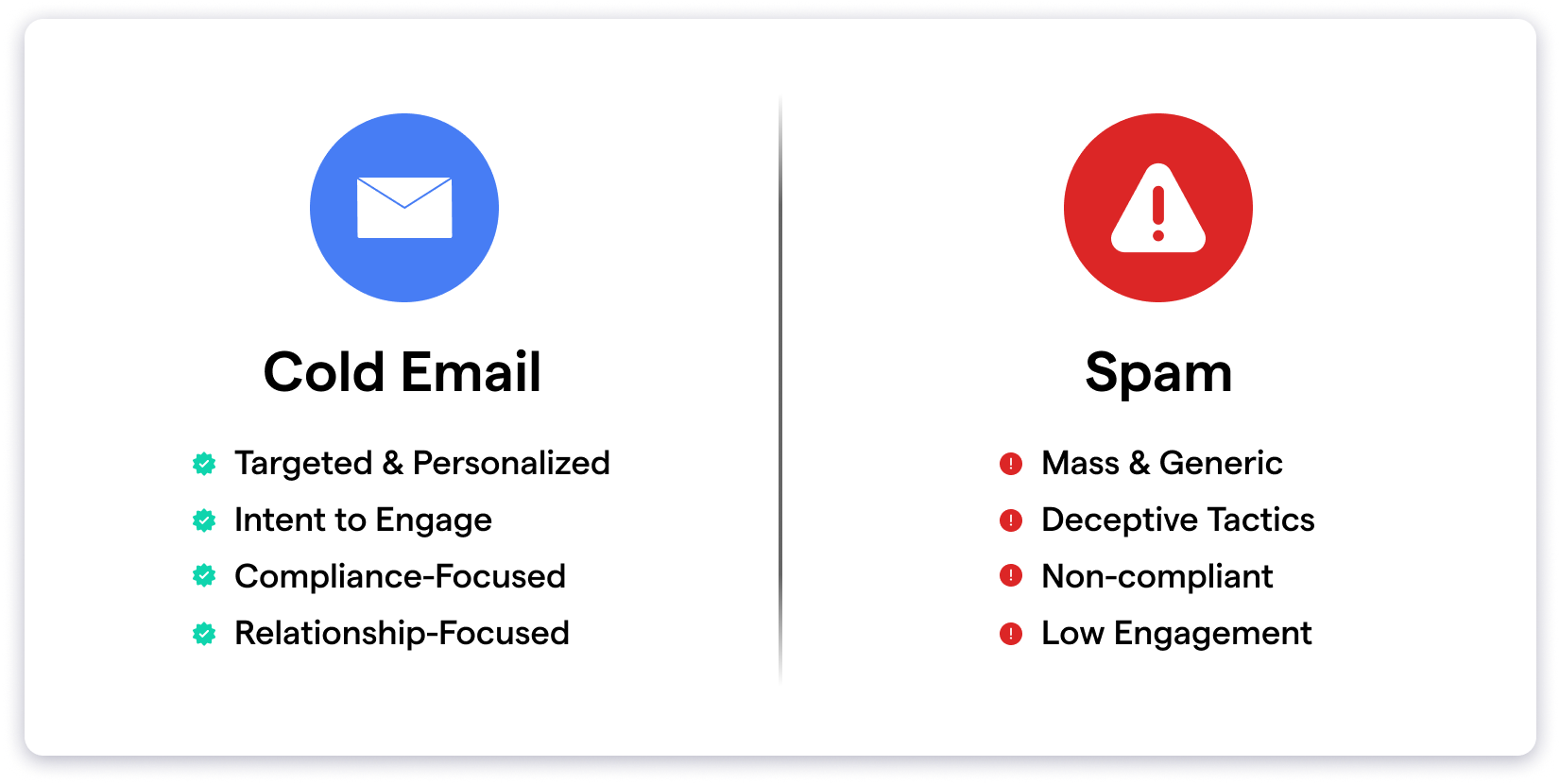
Cold emails are targeted, personalized emails sent to individuals for a specific purpose without prior consent but with relevance.
On the other hand, spam emails are unsolicited bulk emails sent to large groups, often irrelevant, annoying, or harmful, with no personalization or consent.
While cold emailing is one of the best outreach strategies for businesses, to land in the recipient’s inbox, you need to follow the rules and best practices.
Most of these troubles can be handled by cold emailing software, which will ensure that your cold emails comply with all the rules and practices and help them land in the inbox.
These tools also offer a variety of personalization and other useful features, thus making cold emailing easy.
What Is Cold Emailing? How Is It Different From Spam?
A cold email is sent to someone you don’t know with the goal of creating a connection.
These emails are tailored to the recipient and always offer value.
While spam emails are also sent from people you don’t know, the similarities mostly end there.
Spam emails are sent in bulk with the only goal being to benefit from you by selling illegal or useless products, phishing for information, or spreading malware.
Most of the time, spam messages annoy the recipients and offer no value.
Below, I have shared why you should not consider cold emails as spam.👇
Reasons Why Cold Email Is Not Spam
- Intention: Cold emails are aimed to benefit both you and the recipient.
- Personalization: These messages are tailored for the recipient. You will use their names and refer to details regarding them or their business to present your offering.
- Straightforwardness: You will be honest and upfront about the reasons for reaching out and what you have to offer.
- Follows Rules: Cold emailing is done by following the rules and the best practices.
Is Cold Emailing Legal?
Yes, cold emailing is legal as long as you follow the rules and regulations of the region. So what are these rules you ask?
I’ll share some of the popular laws from some well-known regions:
- United States (USA): The CAN-SPAM act allows cold emailing if it includes accurate sender info, identifies itself as an ad, and offers an opt-out option.
- Europe (EU): The GDPR law requires explicit consent, a legitimate basis for processing personal data, a clear opt-out option, and adherence to data security principles.
- United Kingdom (UK): UK GDPR and PECR mandate consent for individuals (with exceptions for pre-existing relationships), while B2B cold emailing is more lenient but must comply with data protection laws.
- Canada: CASL requires explicit consent, accurate sender information, and an unsubscribe option.
In addition, there are laws in many regions, so check that before you send cold emails.
Best Practices to Keep Cold Emails Out of the Spam Folder
A successful cold email campaign is the result of many right steps. If you take one wrong step, it can increase your chances of encountering spam.
So, along with following the laws, you need to follow some practices to land in the recipient’s inbox.

Don’t worry; I have mentioned everything you need to know below 👇
- Verify Your Lead List
- Technical Setup
- Prepare Your Email Content
- Follow Compliances With Regional Laws
- Optimize Your Campaign
- Use Email Outreach Tools
1. Verify Your Lead List
When buying the database for your lead list, only buy it from a legitimate and trustworthy source.
While selecting a source, make sure the data is collected through legal and ethical means and protected against issues like data poisoning, which can introduce inaccurate or manipulated information into your lead lists.
This will not only help you comply with anti-spam laws but also improve your email deliverability rate.
Once you access the data, verify it to ensure its accuracy.
After all this, categorize the leads. I usually categorize them based on the chances of reply and conversion.
Lastly, make sure to update your lead list based on your campaigns. Some might show interest, and some might not.
Your lead list should be optimized accordingly, as it will give you a better idea of what kinds of leads are best suited for your campaigns or the brand in general.
Also read: Lead Generation Guide
2. Technical Setup
After setting up your lead list, it’s time to start sending, right?
Mmm nope.
Just like checking your car before a journey, you need to ensure your emails are correct in the technical aspects.
Let me summarize them here:
- Email Authentication: Setting up email authentication mechanisms like SPF, DKIM, and DMARC increases the trust factor of your domains and helps with deliverability.
- Warm Up Your Email Accounts: Warm up your email accounts before using them. This will help build your email sender reputation.
- Email Account Rotation: Use multiple email accounts and domains for your campaigns. With that, even if one email account or domain gets affected, by the time you fix it.
- Use a Dedicated IP Address: Using a dedicated IP address for your emails is good for keeping your sender’s reputation in check, as it makes your emails look unique.
- Set Up an Unsubscribe Link: Adding an unsubscribe button and respecting it will ensure that your campaigns comply with the popular cold email laws and best practices. These links will give you a better picture of the performance of your campaigns.
Taking such measures will not only show your commitment to security but also increase the trustworthiness of the search filters and the recipients.
3. Prepare Your Email Content
Now that the leads are ready and the emails are warmed up, it’s time to prepare your content.
To craft effective emails, start by understanding your audience through Ideal Customer Profiles (ICPs) and buyer personas.
Now, when it comes to content, always remember that the recipients are busy, so your email should be catchy and offer value to them, making it worth their time.
So, start with a triggering yet honest subject line that piques interest without misleading.
Now, when it comes to the email content, address them by their name and focus on their professional needs.
Clearly mention why you are reaching out, and when it comes to pitching your product or service, place it as a solution to their requirements or needs.
Your goal should be to provide them with maximum value.
They should not feel like they have wasted their time; instead, they should be interested in replying and continuing the conversation.
This will be only possible if you have done your research properly.
Also, do not use spammy words in your emails—that’s a direct ticket to the spam folder.
You can always use AI, but make sure to add a personalized touch.
Actually, I would only suggest manually sending cold emails if it’s only for one or two leads.
If you don’t want to leave that manual touch, I would suggest using software like Saleshandy, which offers an AI variant feature that will create multiple variants of your initial email.
The biggest benefit is that it will be unique and still have a personalized touch.
Also, here’s a quick tip: Make sure your sender name is easily recognizable and consistent. Recipients are more likely to open emails from a familiar name. This consistency helps build trust.
Continue to offer value even for your follow-up emails.
4. Follow Compliance With Regional Laws
Before you finally decide to start your cold email campaign, ensure you follow all the laws and regulations.
The laws can change based on the region, so make sure you double-check.
This headache can be easily avoided if you are using cold email software, as it will help you compose emails complying with the laws and practices.
Note: We are not a legal firm to give you any legal advice. We are just sharing the legalities of each region and what you need to keep in mind.
5. Optimize Your Campaign
Once you start running your campaigns, it’s not time to take a rest! Then you need to observe each part of your campaign and observe its performance and output.
This includes email deliverability, bounce rates, reply rates, and others. Based on that, you need to optimize your campaign.
While you are tracking metrics, make sure to keep an eye on spam complaints, as if they get high, that will harm your sender reputation.
6. Use Email Outreach Tools
Now, managing everything in your email campaign manually will be a big burden. You will be spending all your time surrounding your cold email campaign rather than writing and approaching.
Time is precious, hence, I would suggest going with an email outreach tool. Most of these tools come with features such as AI, automation, and even detailed analytics.
I have tested many email outreach tools on the market, and I prefer Saleshandy the most.
Why? Here are some of my favorite reasons:
- Create automated Multi-Step Sequences
- Comes with many Personalization Features, including spintax, merge tags, variable merge tags, and even custom tags.
- Ensures high email deliverability rates by following the rules and regulations.
- Get detailed analytics and reports for further optimization.
I would recommend reading our saleshandy review to make a better decision.
Best Cold Email Templates to Avoid the Spam Folder
Let me show you some examples of cold emails that have helped me reach the recipient’s inbox instead of the spam folder.
You can even try these templates in your next campaign.
First cold email
{{First Name}}, quick question about {{Company Name}}
Hey {{First Name}},
I noticed that {{Company Name}} is {{specific observation about their business}}. A lot of {{industry/niche}} companies struggle with {{pain point}}, and it can be frustrating when {{agitate the problem briefly}}.
We help businesses like yours by {{solution in one sentence}}. For example, {{similar company}} saw {{specific result}} after implementing this.
Would it be worth a quick 10-minute chat to see if this could work for you too?
Let me know what works for you!
Best,
{{Your Name}}
{{Your Company}}
{{Your Contact Info}}
First Follow-Up Email
{{First Name}}, quick question about {{Company Name}}
Hey {{First Name}},
I noticed that {{Company Name}} is {{specific observation about their business}}. A lot of {{industry/niche}} companies struggle with {{pain point}}, and it can be frustrating when {{agitate the problem briefly}}.
We help businesses like yours by {{solution in one sentence}}. For example, {{similar company}} saw {{specific result}} after implementing this.
Would it be worth a quick 10-minute chat to see if this could work for you too?
Let me know what works for you!
Best,
{{Your Name}}
{{Your Company}}
{{Your Contact Info}}
Also read: High-Converting B2B Cold Email Templates
2nd Follow-Up Email
Hey {{First Name}},
I know things get busy, so I wanted to check in one last time.If {{pain point}} is still a challenge, I’d love to share how we helped {{similar company}} achieve {{specific result}} with {{your solution}}.
If not, no worries—I’ll close your file for now.Let me know either way.
Happy to reconnect whenever it makes sense!
Best,{{Your Name}}
{{Your Company}}
{{Your Contact Info}}
Break Up Email
Closing your file, {{First Name}}
Hey {{First Name}},
I’ve tried reaching out a few times but haven’t heard back—totally understand if now isn’t the right time.Before I close your file, I just wanted to check: Is {{solving pain point}} still something you’re looking to tackle?
If so, happy to share a quick idea that helped {{similar company}} achieve {{specific result}}.
If not, no worries—I’ll step back for now. Either way, wishing you continued success!
Best,{{Your Name}}
{{Your Company}}
{{Your Contact Info}}
Also read: How to Write a Sales Breakup Email?
Cold Emailing: Is It Still a Great Strategy in 2025?
Yes, cold emailing is still one of the best outreach strategies that you can try. However, with the change in trends and the introduction of new laws and practices, it can be challenging to keep track of all of them and make your cold emails satisfy all of them.
In this case, I would suggest cold emailing only with a cold outreach platform. These platforms offer many other useful features in addition to sending cold emails.
Now, even with the platform, I recommend that your intention should be to establish a relationship with your customer and not only with sales intention.
For a quick hack, think to yourself: If you were in the recipient’s place, would you be interested in checking this email out?
Have a clear purpose for your emails, and always ensure that you provide the right value. Once you start respecting the laws and best practices, your emails will land in the right place.
Cold Email vs Spam: FAQs
1. What is the difference between direct emailing and spam?
Direct emailing (or cold emailing) is targeted and personalized to specific recipients, while spam is unsolicited, bulk, and irrelevant.
2. Is it true or false that the majority of emails are spam emails?
Unfortunately, the statement is true. Studies show that most emails sent globally are spam. However, well-executed cold emails don’t fall into this category.
3. How many cold emails should I send per lead?
Send 3-5 emails per lead over a few weeks, each adding value or trying a new angle, if no response is received.
4. Why do people say that cold emails can end up in spam?
Cold emails can land in spam due to poor sender reputation, unverified lists, spammy content, technical issues, recipient disengagement, or legal non-compliance. Because of this, many assume or worry that their cold emails can end up in the spam folder.