

Finding import export companies is the easy part.
A quick Google search gives you hundreds of company names in minutes.
The hard part?
Getting verified emails and phone numbers of the people who actually make decisions at those companies.
The problem is, most free resources in this space only give you half the picture.
- Trade directories list companies but hide individual contacts behind paywalls.
- Government databases show shipment data but no emails.
- LinkedIn shows you the person but not their contact details.
I have put together this guide after testing different methods for building import export prospect lists from scratch.
These are 5 ways that actually give you usable contact information, ranked by speed and data quality, so you can pick what fits your workflow.
Find Contacts of Import Export Companies – TOC
TL;DR: Find Contact Details of Import Export Companies
Here’s the short version if you don’t want to scroll through the entire guide.
1. The B2B Data Provider Tool: The fastest method. Search by industry, job title, and location to get verified emails and phone numbers instantly.
2. Government Trade Databases: ITA (trade.gov) and UN COMTRADE are great for identifying active importers and exporters.
3. LinkedIn Search: It helps you find the exact person you want to reach, but you’ll need a separate tool to get their email.
4. B2B Trade Directories: Kompass and Alibaba list thousands of companies, but most contacts are generic (info@, sales@).
5. Google Search Operators: Surface emails from company websites, but it’s manual, slow, and inconsistent.
5 Best Ways to Find Verified Contact Details of Import Export Companies
There are thousands of websites online which are giving contacts details of import and export companies, but how do we know whom to trust?
Here are some of the best ways to get contacts.
- Use a B2B Data Provider Tool (Most Recommended)
- Search Government Trade Databases and Customs Records
- Find Decision-Makers on LinkedIn Using Job Title and Industry Filters
- Browse B2B Trade Directories and Marketplace Listings
- Use Google Search Operators to Surface Contact Pages and Emails
1. Use a B2B Data Provider Tool (Most Recommended)
A B2B data provider is a searchable database of verified business contacts.
It is the fastest method to pull verified contacts.
Instead of visiting directories one by one or guessing email formats, you search a single database and get decision-maker emails and phone numbers in seconds.
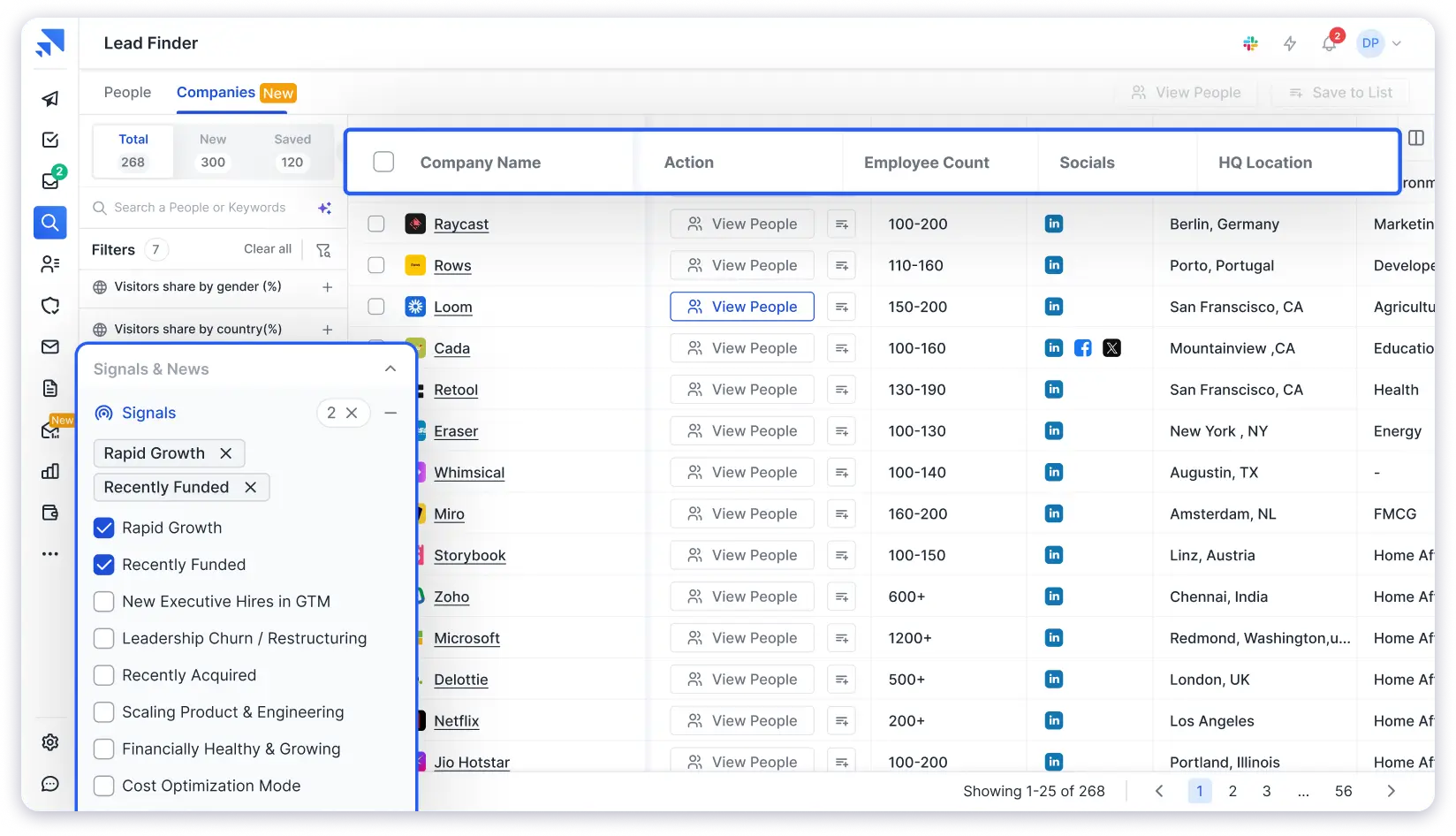
How to Do It:
- Sign up for a B2B data provider tool like Saleshandy Lead Finder.
- Search by industry keywords: “import,” “export,” “international trade,” “logistics,” “customs brokerage”.
- Apply filters to narrow results: job title (export manager, procurement head), seniority, geography, and company size.
- Review the results and reveal verified email addresses and phone numbers.
- Export the list or add contacts directly to a cold email sequence.
Saleshandy’s database covers 800M+ B2B contacts across 60M+ companies with 75+ advanced search filters.
You can also skip the manual filter setup and use AI Lead Search.
Just type something like “Find export managers at trading companies in the US with 50 to 200 employees“, and the AI sets the filters for you.
You will get 50 Free Credits to begin with, and then later you can subscribe to the plans as per your convenience.
This method is safer and more recommended than the rest, as it gives the most accurate and real-time verified contacts.
Pros
- Fastest method out of all five.
- Gives decision-maker level contacts (not generic info@ addresses).
- Emails are verified in real time.
- Filters let you target by country, role, company size, and industry.
Cons
- Free credits are limited.
- Paid plan needed for high-volume list building.
Also, Check out: 5 Best Import Export Data Providers in 2026.
2. Search Government Trade Databases and Customs Records
Every country’s customs authority records import-export transactions.
Many of these databases are publicly accessible and free.
The data is based on real shipments, not estimates, so the companies you find here are confirmed active traders.
According to the WTO, global trade in goods and services reached $34.65 trillion in 2025.
With that volume of cross-border activity, government databases contain millions of records on active importers and exporters.
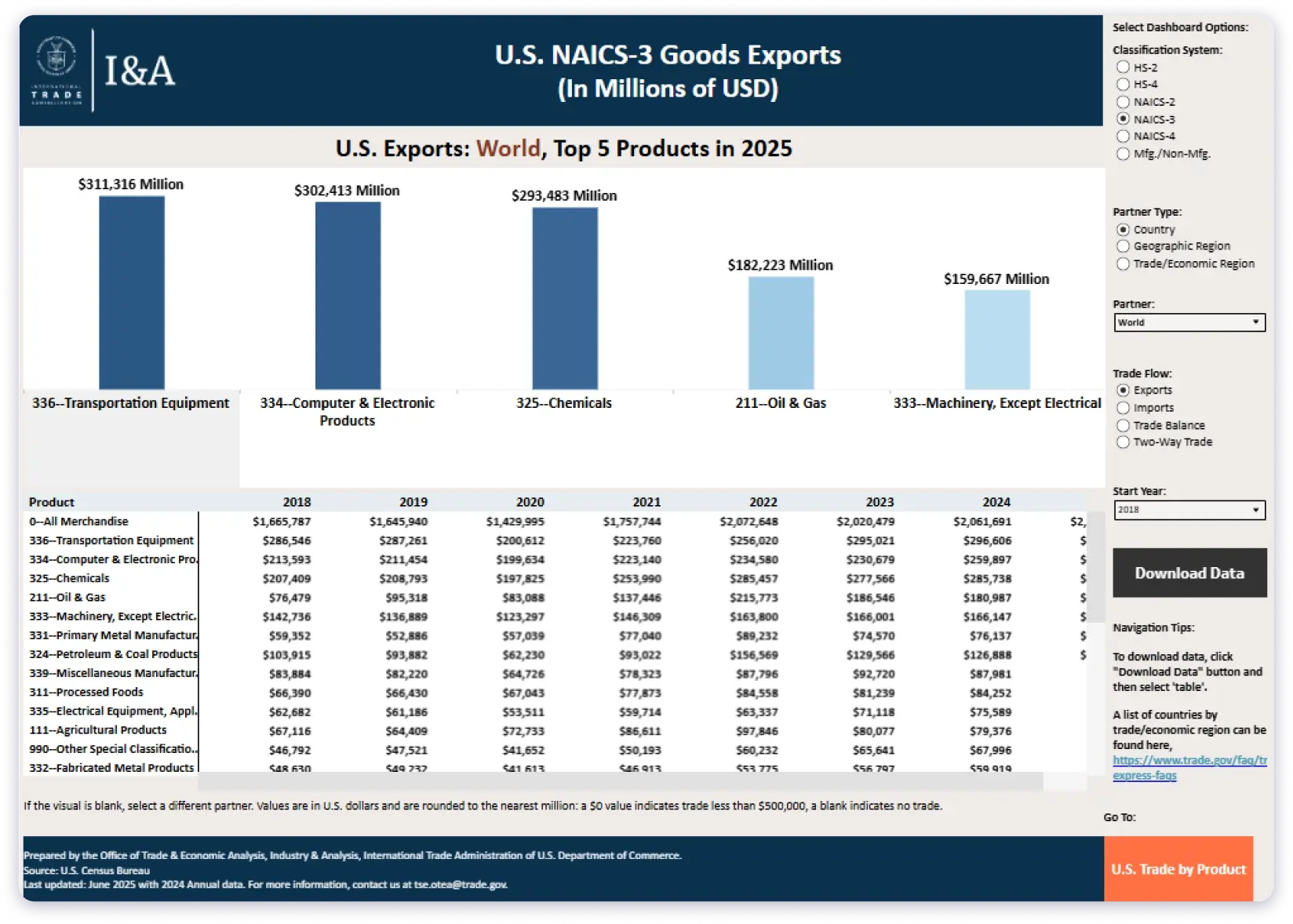
How to Do It:
- ITA U.S. Exporters Database (trade.gov): Profiles of U.S. importing and exporting companies with trade activity data.
- ImportInfo.com: Free searchable directory of U.S. importers and their suppliers, based on customs filings.
- UN COMTRADE: Covers 200+ countries. Search by product, country, or HS code.
- Zauba (India): Indian import-export transaction data with company names and shipment details.
Search by product category, HS code, or company name.
Collect company names, shipment volumes, and trade routes.
Pros
- 100% free to access.
- Based on real customs-filed transaction data.
- Great for confirming which companies are actively importing or exporting.
Cons
- Gives company-level data only, no direct emails or phone numbers.
- Requires a second step to find individual contact details.
- Interfaces are often outdated and hard to navigate.
3. Find Decision-Makers on LinkedIn Using Job Title and Industry Filters
LinkedIn has over 1 billion members globally.
Most procurement managers, export directors, and trade operations heads at import export companies have active profiles.
That makes it one of the best free platforms for finding the exact person you want to reach.
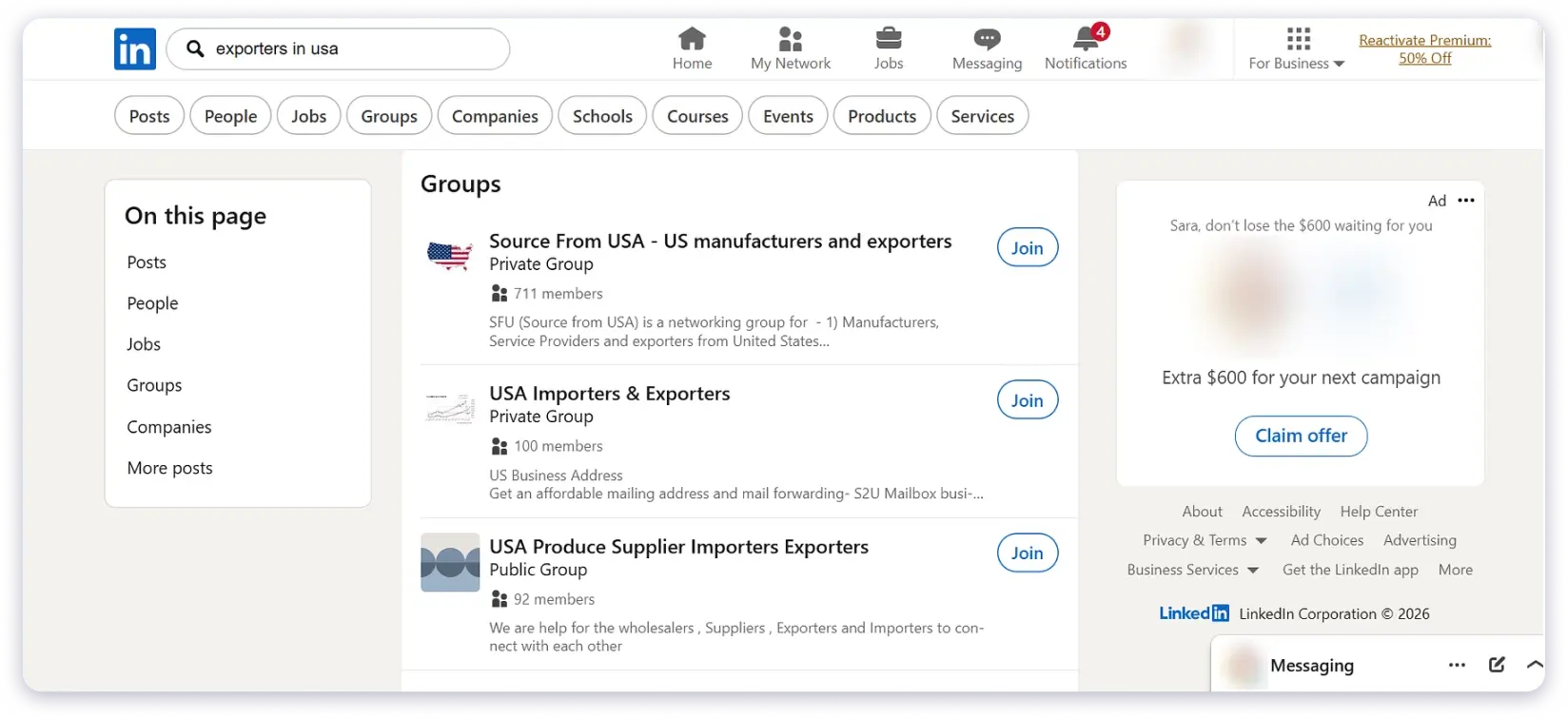
How to Do It:
- Use LinkedIn’s free search bar with job title + industry keywords like “Export Manager” + “import export“, “Procurement Head” + “international trade” or “Trade Director” + “logistics“.
- Filter by location, current company, and industry.
- Browse results, identify matching profiles, and note down names and companies.
- For deeper filtering, try LinkedIn Sales Navigator’s 30-day free trial (seniority, headcount, years in role filters).
LinkedIn doesn’t show email addresses on most profiles.
The Contact Info section sometimes has them, but most people keep it private.
Here’s a detailed walkthrough on how to find emails.
Pros
- You can see the actual person: role, seniority, company, activity.
- Good for highly targeted, one-by-one outreach.
Cons
- Free search has limited filters and result caps.
- Email and phone are not directly visible on most profiles.
- Sales Navigator is paid after the 30-day trial.
- Slow and manual if you’re building large lists.
4. Browse B2B Trade Directories and Marketplace Listings
Online trade directories and B2B marketplaces list thousands of import export companies with basic company profiles and contact information.
They’ve been around for decades and cover most regions and industries.
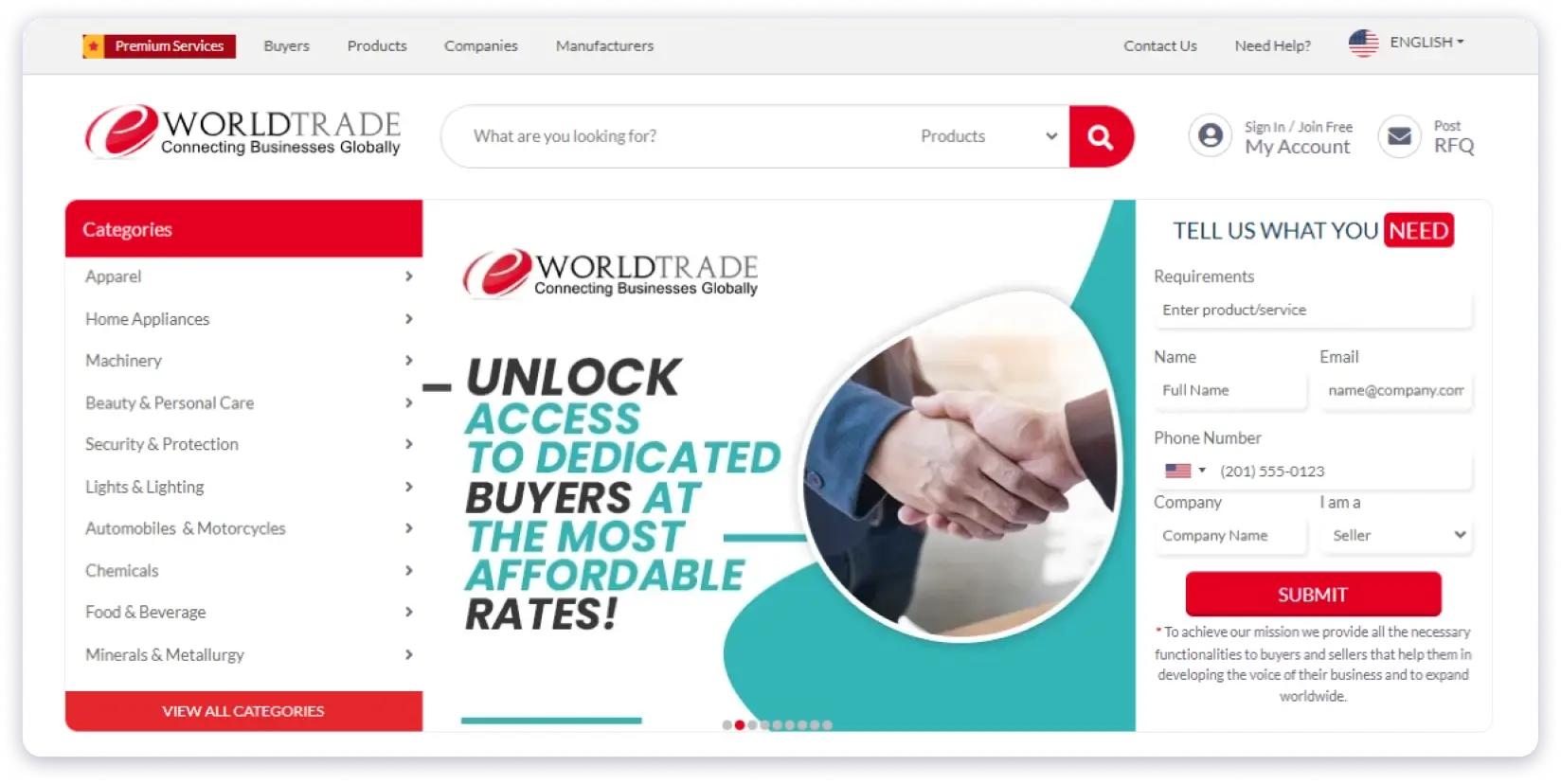
How to Do It:
- Kompass: Global business directory covering 70+ countries. Listings include addresses and sometimes direct phone numbers.
- Alibaba Supplier Directory: Millions of export companies with contact forms and occasionally direct emails.
- TradeAtlas: 20M+ importers globally with limited free search access.
- ThomasNet: U.S.-focused industrial supplier directory with detailed company profiles.
- ExportHub / Global Trade Plaza: Smaller, niche-focused directories for specific regions.
Search by product category, country, or company type.
Collect company names, websites, and whatever contact info is listed.
The main problem: most directory listings give you info@company.com or sales@company.com, not the direct email of the export director or procurement manager.
Directories work best as a discovery step.
Find the companies, then run them through a lead finder tool to get decision-maker contacts.
Pros
- Free access for basic listings.
- Wide global coverage across industries and regions.
- Useful for company discovery and initial research.
Cons
- Contact details are usually generic, not decision-maker specific.
- Data accuracy varies widely across platforms.
- Many directories push you toward paid plans for full access.
5. Use Google Search Operators to Surface Contact Pages and Emails
Google’s advanced search operators help you find contact pages, staff directories, and email patterns directly from import export company websites.
It takes more effort, but it’s completely free and surprisingly effective for niche targeting.
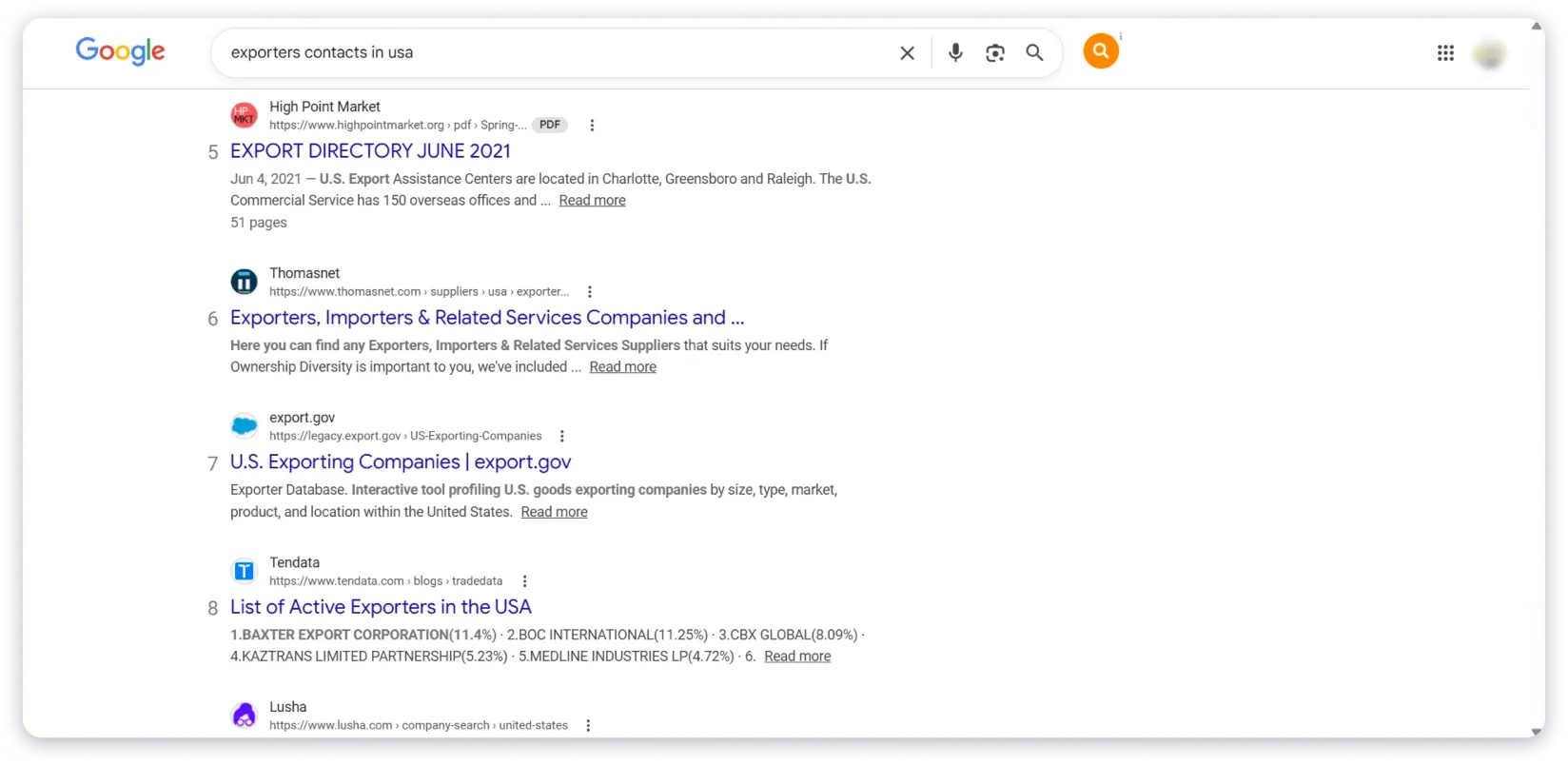
How to Do It:
You can try these search strings:
- “import export” + “contact us” + “@gmail.com” OR “@yahoo.com” — finds smaller firms with personal business emails.
- site:linkedin.com “export manager” + “import” + “email” — surfaces LinkedIn profiles with listed emails.
- “import export company” + “director” + “email” + [city name] — narrows results by geography.
- “@companyname.com” + “manager” OR “director” — once you know the domain, this finds specific email addresses indexed online.
Another useful technique: if you find one email from a company, say, john.smith@tradecompany.com, you can assume the pattern is firstname.lastname@domain.com and apply it to other employees.
Then, verify those emails with an email verification tool before reaching out.
Pros
- Completely free, no tool required.
- Effective for niche or region-specific targeting.
- Helps you discover email patterns for entire companies.
Cons
- Very time-consuming and manual.
- Results are hit-or-miss.
- No built-in verification, so some emails will be invalid.
- Doesn’t scale for large prospect lists.
Which Method Gets You the Best Results? (Quick Comparison)
Here is a quick comparison between five proven ways to find contacts for import and export companies.
| Criteria | B2B Data Provider Tool | Govt Databases | Trade Directories | Google Operators | |
|---|---|---|---|---|---|
| Speed | Fast | Slow | Medium | Medium | Slowest |
| Contact type | Decision-maker emails + phones | Company-level only | Names + roles (emails via extension) | Generic emails (info@, sales@) | Mixed |
| Data accuracy | High (real-time verified) | High (customs-based) | Medium | Low to medium | Low (unverified) |
| Effort | Low | High | Medium | Medium | High |
| Cost | Free to start (50 credits) | Free | Free (Navigator is paid after trial) | Free (premium is paid) | Free |
Your Prospect List Is Only as Good as Your Contact Data
Let me be direct, the biggest time sink in prospecting import export companies isn’t finding the companies.
It’s finding the right person at those companies and making sure their contact info is actually valid.
A list full of generic info@ emails and unverified phone numbers wastes your time and hurts your sender reputation.
Industry benchmarks show email bounce rates above 2% start damaging deliverability, and lists built from scraped directories often hit 10% to 15%.
The approach that works best is a simple two-step workflow:
- Discover companies using government trade databases or B2B directories.
- Find decision-maker contacts at those companies using a B2B lead finder or LinkedIn.
If you want the fastest path from “I need import export contacts” to “I’m sending outreach,”
Saleshandy Lead Finder is where I’d start. 800M+ contacts, 75+ filters for precise targeting, real-time verification so you’re not wasting credits on bad data.
The contacts are out there. You just need the right method to find them.
Also read: How to Find Importers in the USA (Step-by-Step Guide).
FAQs on Import Export Companies
1. What is the fastest way to find contact details of import export companies for free?
A B2B lead finder tool with industry filters is the fastest option.
You search by keywords like “import export,” apply filters for job title and location, and get verified emails and phone numbers instantly.
2. Can I find phone numbers of import export company decision-makers for free?
Yes, B2B lead finder tools often include direct phone numbers alongside emails. LinkedIn profiles sometimes list phone numbers in the Contact Info section.
Government databases and trade directories, however, rarely give you phone numbers of specific people. For both emails and phone numbers in one search, a B2B database is your most reliable option.
3. Are government trade databases like ITA and customs records free to access?
Yes. The ITA U.S. Exporters Database (trade.gov), UN COMTRADE, and ImportInfo.com are all free.
They provide company-level trade data based on actual customs filings.
Keep in mind, these sources give you company names and shipment details, not individual contact information.
4. What filters should I use in a B2B database to find import export companies?
Start with industry keywords: “import,” “export,” “international trade,” “customs,” “logistics.” Then narrow by job title (export manager, procurement director, trade operations head), geography, and company size.
If the tool supports SIC or NAICS codes, use wholesale trade codes to target specific import-export verticals.
5. How do I verify if an email address is valid before sending cold outreach?
Run every email through a verification tool before adding it to your outreach list. Saleshandy’s built-in Email Verifier checks whether an email is active and deliverable in real time.
This prevents high bounce rates, which can damage your sender’s reputation and push future emails to spam.
 Anil Salvi