
If you’re checking Hunter.io pricing plans, you’re probably trying to figure out a few things:
- How much does Hunter.io really cost once you start using credits regularly?
- Which plan gives you enough searches, verifications, and sending capacity?
- Does Hunter still make sense when you need to scale cold emails?
Hunter.io pricing looks simple at first. But what you actually pay depends on more than the plan you choose.
Credits, connected email accounts, extra credit packs, managed inboxes, and deliverability add-ons can all increase your total cost.
So I broke down Hunter.io pricing in 2026, including plans, credits, limits, and additional costs.
I’ll also compare Hunter with alternatives like Saleshandy, so you can decide which option fits your outreach budget and workflow better.
Read on for the full Hunter.io pricing breakdown.
Hunter.io Pricing – TOC
TL;DR: Quick 30-Second Review of Hunter.io Pricing 2026
Short on time? Here’s a quick breakdown of Hunter.io pricing in 2026, including plan costs, credits, key limits, and who each plan fits best.
| Plan | Price (Annual) | Credits | Sending Inboxes | Recipients/Sequence | Team Members | Best For |
|---|---|---|---|---|---|---|
| Free | $0 | 50/month | 1 connected account | 500 | Unlimited (view-only) | Solo users testing Hunter |
| Starter | $34/mo ($408/yr) | 2,000/mo equivalent | 3 connected accounts | 2,500 | Unlimited | Freelancers, recruiters, small teams |
| Growth | $104/mo ($1,248/yr) | 10,000/mo equivalent | 10 connected accounts | 5,000 | Unlimited | Growing sales teams |
| Scale | $209/mo ($2,508/yr) | 25,000/mo equivalent | 20 connected accounts | 15,000 | Unlimited | High-volume teams, agencies |
| Enterprise | Custom | Custom | Custom | Custom | Unlimited | Large organizations |
⚠️ Keep in mind: With Hunter.io, the plan price is not always your full cost. Extra credits, additional connected inboxes, managed mailboxes, domains, and deliverability add-ons can increase your costs as your outreach scales.
How Much Does Hunter.io Cost in 2026? A Complete Pricing Breakdown
Hunter.io offers several pricing options depending on how you plan to use the platform. Whether you’re looking for verified email addresses, managing outbound campaigns, or integrating contact data into your existing systems, understanding the pricing structure can help you choose the right plan.
Before comparing individual plans, it’s important to understand that Hunter has two distinct pricing models.
- All-in-One Outreach Plans: Designed for teams that want to manage prospecting, email verification, Discover, Signals, and Sequences within Hunter.
- Data Platform Plans: Built for businesses that need API access and bulk-data workflows, with separate Search and Verification credits.
Hunter offers a 30% discount on annual billing across its paid All-in-One plans. Growth is highlighted as the “Best value” option.
Enterprise pricing is customized to each customer’s requirements.
The credit system also differs between these two models.
All-in-One plans use a shared credit pool, whereas Data Platform plans maintain separate Search and Verification credit balances.
When evaluating Hunter.io pricing, I look beyond the advertised monthly cost.
Credit allowances, connected inboxes, sequence limits, add-ons, and the cost of scaling outreach all affect what you’ll actually pay.
Let’s break down each plan, its key limitations, and the costs to consider before subscribing.
1. Hunter Free Plan ($0/Month)
Hunter’s Free plan is designed for users who want to test the platform before committing to a paid subscription.
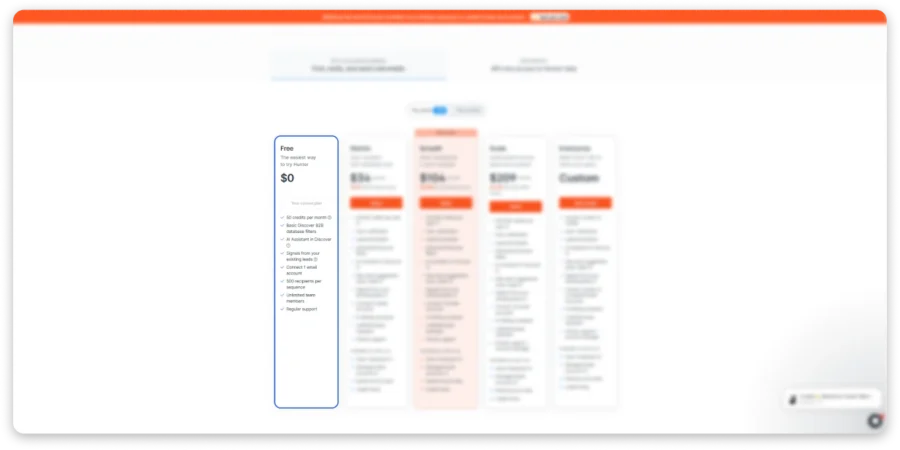
It includes 50 credits per month, one connected email account, and support for up to 500 recipients per sequence.
What to Consider
The biggest limitation is the monthly credit allowance. Email Finder consumes one credit per successful result, while email verification uses 0.5 credit per result.
As a result, even moderate prospecting activity can quickly exhaust your free credits.
The Free plan also limits access to Discover, Signals, and outreach features. You won’t get auto-verification, lead enrichment, advanced Discover filters, the AI Writing Assistant, or priority support.
What Does the Free Plan Actually Give You?
- Monthly allowance: 50 credits
- Annual allowance: 600 credits
- Maximum verification volume: Up to 100 email verifications per month if all credits are used exclusively for verification
💡 My Take
I’d recommend the Free plan if you want to evaluate Hunter’s data quality, explore its interface, or test a basic prospecting workflow. It’s useful for occasional lookups, but the 50-credit monthly allowance quickly becomes restrictive once outbound prospecting becomes a regular activity.
2. Hunter Starter Plan ($34/Month)
The Starter plan is Hunter’s entry-level paid option, making it a practical upgrade for freelancers, recruiters, and small teams that need more consistent access to prospecting data.
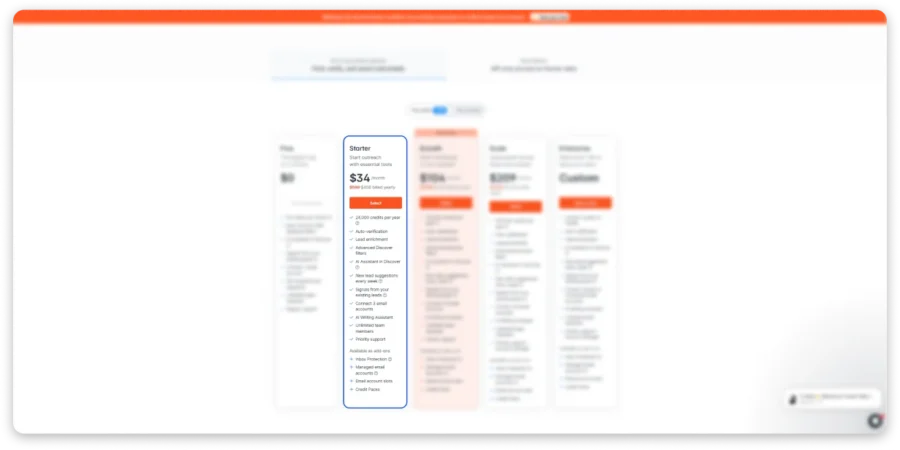
It includes 2,000 monthly-equivalent credits, three connected email accounts, and up to 2,500 recipients per sequence.
What to Consider
The three-inbox limit is one of the first things to evaluate.
If your outreach setup requires additional sending accounts, Hunter charges $10 per month for each extra account.
Inbox Protection, which adds inbox warm-up and related protection features, is also priced separately.
At the stated annual-billing rate of $6 per account per month, protecting all three included inboxes adds $18 per month to your effective cost.
What Will Starter Cost You?
| Cost component | Monthly billing | Annual billing |
|---|---|---|
| Base plan | $49/month | $34/month |
| Annual subscription cost | $588/year | $408/year |
| Inbox Protection for 3 accounts | $18/month | $18/month |
| Total with Inbox Protection | $67/month | $52/month |
| Effective annual total | $804/year | $624/year |
Annual billing saves $180 per year on the base subscription. With Inbox Protection included for all three accounts, the effective annual cost becomes $624, before any additional inboxes or credit top-ups.
💡 My Take
I’d consider Starter for freelancers, recruiters, solo SDRs, and small teams running moderate-volume email prospecting. The 24,000 annual-equivalent credits provide more flexibility than the Free plan, but the three-inbox limit and separate Inbox Protection costs are worth factoring into your budget if you expect to expand your outreach.
3. Hunter Growth Plan ($104/Month)
Hunter Growth is marked as the “Best value” option on its pricing page.
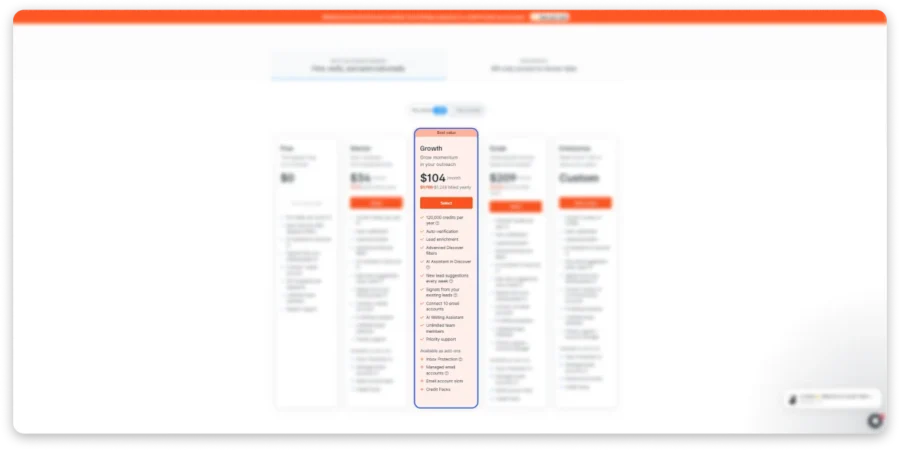
It increases the monthly-equivalent credit allowance from 2,000 to 10,000 and raises the connected inbox limit from three to 10.
For teams that have outgrown Starter, Growth offers a substantial increase in prospecting and sending capacity.
What to Consider
The main advantage of Growth is its additional capacity. You get more credits, more connected inboxes, and a higher sequence-recipient limit, making it better suited to teams running regular outbound campaigns.
However, additional costs can add up if you need more than 10 connected email accounts.
For example, a team using 15 inboxes would need to pay for five additional accounts at $10 per month each. Inbox Protection for all 15 accounts would add another $90 per month at the stated annual-billing rate.
What Will Growth Cost You?
| Cost component | Monthly billing | Annual billing |
|---|---|---|
| Base plan | $149/month | $104/month |
| Annual subscription cost | $1,788/year | $1,248/year |
| Savings with annual billing | — | $540/year |
For a team using 15 inboxes with Inbox Protection on every account:
- Growth subscription: $104/month
- Five additional inboxes: $50/month
- Inbox Protection for 15 accounts: $90/month
- Total: $244/month, or $2,928/year
These figures assume annual billing for the base plan and Inbox Protection, with additional inboxes charged at the stated monthly rate. They exclude credit top-ups.
💡 My Take
I’d recommend Growth for small outbound teams that need more prospecting volume and sending capacity than Starter can provide. The base subscription offers a meaningful capacity upgrade, but calculate your total inbox and deliverability-related costs before choosing it. If your team plans to use more than 10 sender accounts, the advertised $104 monthly price won’t reflect your full operating cost.

Find Verified Leads and Launch Outreach Under One Roof for $34
Find verified contacts, run campaigns, and manage outreach without paying for multiple platforms.
Start Your FREE Trial →No Credit Card Needed.
4. Hunter Scale Plan ($209/Month)
Scale is Hunter’s highest self-service All-in-One plan.
It’s designed for teams that need greater prospecting volume, more sending accounts, and the capacity to manage larger outreach campaigns.
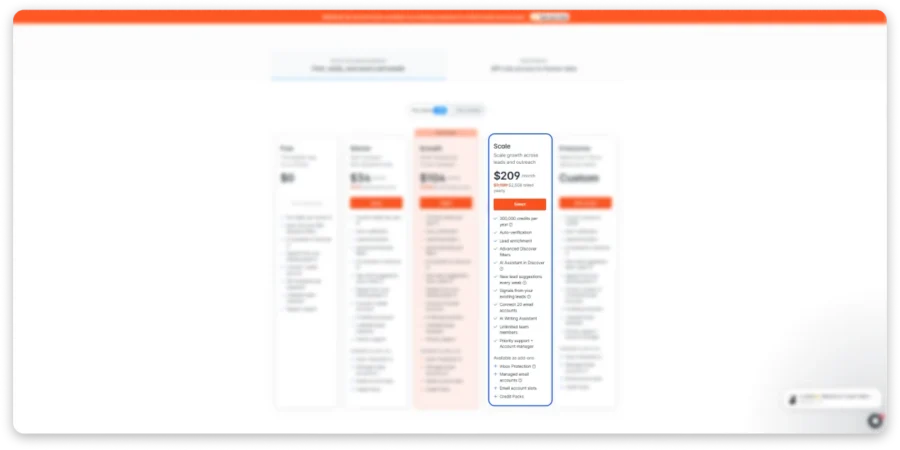
The plan includes 25,000 monthly-equivalent credits, 20 connected email accounts, and up to 15,000 recipients per sequence.
It also includes a dedicated account manager.
What to Consider
Scale provides more room to grow, but the upgrade is primarily about capacity: more credits, more inboxes, larger sequences, and additional account support.
This makes it a stronger fit for established outbound teams and agencies managing multiple campaigns.
However, even Scale’s 20-inbox allowance may not be enough for larger operations.
A team using 30 connected email accounts, for example, would need to pay for 10 additional inboxes.
What Will Scale Cost You?
| Cost component | Monthly billing | Annual billing |
|---|---|---|
| Base plan | $299/month | $209/month |
| Annual subscription cost | $3,588/year | $2,508/year |
| Savings with annual billing | — | $1,080/year |
For a team using 30 inboxes with Inbox Protection on every account:
- Scale subscription: $209/month
- Ten additional inboxes: $100/month
- Inbox Protection for 30 accounts: $180/month
- Total: $489/month, or $5,868/year
💡 My Take
I’d consider Scale if your team consistently needs high prospecting volume, larger sequences, and more sender accounts. At this level, it’s important to compare the total annual cost rather than focusing on the $209 headline price. Additional inboxes and Inbox Protection can become a significant part of the budget, especially for agencies and teams running multiple outbound campaigns.
5. Hunter Enterprise Plan (Custom Pricing)
Hunter Enterprise is designed for organizations that have outgrown the limits of the Scale plan or need a more customized setup.
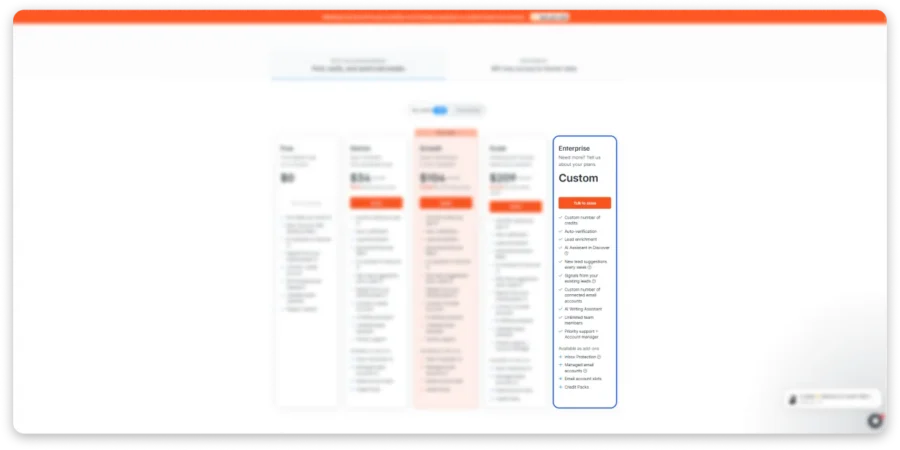
Unlike the self-service plans, Enterprise doesn’t have a publicly listed monthly or annual price.
What to Consider
The main trade-off is limited pricing transparency. Depending on your requirements, Hunter can tailor credit volume, connected email accounts, sequence limits, and support arrangements.
💡 My Take
I’d consider Enterprise only when Scale no longer covers your data or sending needs. Before signing, I would confirm credits, connected inboxes, renewal terms, add-on pricing, and any usage limits in writing so you can compare the quote properly against other platforms.
6. Hunter Data Platform Pricing
Hunter’s Data Platform is separate from its All-in-One plans.
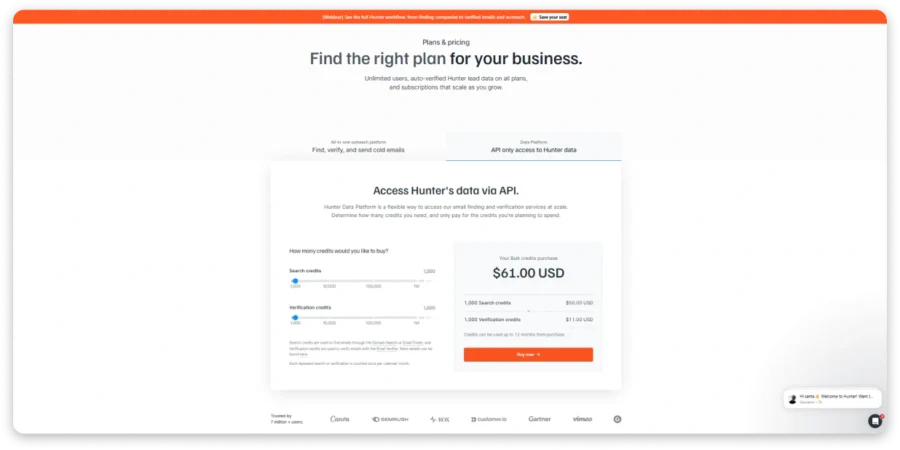
It’s designed for businesses that want to access Hunter’s contact data through APIs and bulk-data workflows rather than manage prospecting and outreach primarily through the web application.
What Does the Data Platform Include?
- Domain Search
- Multi-Domain Search
- Email Finder
- Email Verifier
- Email Enrichment
- Company Enrichment
- Combined Enrichment
- Discover
- Lead and company management
What to Consider
API rate limits are an important consideration when planning large-scale integrations.
| API feature | Requests per second |
|---|---|
| Domain Search, Email Finder, and Enrichment | 15 |
| Email Verifier | 10 |
| Discover | 5 |
💡 My Take
I’d choose Hunter Data Platform when contact data is primarily an input to another system or automated workflow. If your team wants to find prospects, verify emails, and run sequences directly within Hunter, the All-in-One plans are generally easier to manage.
What Hunter Really Costs Based on Use Case (3 Real-World Scenarios)
Hunter.io pricing does not charge per seat, so team size alone does not decide your bill.
Your Hunter.io pricing mainly depends on how many contacts you find and verify, plus how many sending inboxes you need.
To make that easier to picture, I modeled three simple outbound setups below.
For comparison, I’m assuming each contact needs 1 Email Finder credit plus 0.5 Verification credit.
| Use Case | Monthly Volume | Estimated Credits | Likely Plan | Annual Cost |
|---|---|---|---|---|
| Solo founder | 1,000 contacts | ~1,500/month | Starter | $408/year |
| Growing sales team | 5,000 contacts | ~7,500/month | Growth | $1,248/year |
| High-volume team | 15,000 contacts | ~22,500/month | Scale | $2,508/year |
Scenario 1: Solo Founder
If you find and verify around 1,000 contacts per month, you would use roughly 1,500 credits.
Hunter Starter gives you the equivalent of 2,000 credits monthly, so it should cover this workflow.
You also get 3 connected email accounts, which works for a small sending setup.
Therefore, estimated cost: $408/year.
Scenario 2: Growing Sales Team
At 5,000 contacts per month, usage rises to roughly 7,500 credits. Starter would no longer be enough, so Growth becomes the more practical option.
Growth includes 120,000 annual credits and 10 connected email accounts.
That’s make estimated cost: $1,248/year.
Scenario 3: High-Volume Outbound Team
At 15,000 contacts per month, finding and verifying could use about 22,500 credits monthly.
That puts you close to Hunter Scale, which includes 300,000 annual credits and 20 connected email accounts.
Your estimated cost: $2,508/year.
Editor’s Note: Hunter pricing gets more expensive as your data and inbox requirements grow, not simply because you add teammates. Since Hunter includes unlimited users, a 10-person team can still use one plan. But higher contact volume or extra inboxes can push you into a higher tier.
What Are Hunter.io’s Add-On Costs?
Hunter’s base plans cover core prospecting and email outreach. But your final cost can increase once you add more inboxes, need deliverability support, or run out of credits.
These are the main add-on costs I’d watch.
1. Extra Email Account Slots
Each paid Hunter plan includes a fixed number of connected email accounts:
- Starter: 3 accounts
- Growth: 10 accounts
- Scale: 20 accounts
If you need more, Hunter charges $10/month per additional account. This matters if you scale outreach by spreading volume across multiple inboxes.
Pro Tip: Count how many sending accounts you actually need before choosing a plan. Extra inbox fees can make a higher plan cheaper than stacking add-ons.
2. Managed Email Accounts
Hunter also lets you buy managed sending accounts directly through the platform.
These accounts come pre-configured with SPF, DKIM, and DMARC, so you do not need to set everything up yourself.
Managed accounts start at $6/month per inbox. That can save setup time, but the cost grows quickly if you need 10, 20, or more senders.
3. Inbox Protection
Inbox Protection is Hunter’s deliverability add-on for warming and protecting sending accounts. It costs:
- $7.50/month per account on monthly billing
- $6/month per account on annual billing
So if you protect 10 inboxes on annual billing, that adds $60/month, or $720/year, on top of your Hunter subscription.
Pro Tip: If deliverability support is important to your workflow, include Inbox Protection when comparing Hunter with platforms that bundle warm-up.
4. Extra Credit Packs
If you run out of credits, you do not always need to upgrade immediately. You can buy extra credit packs:
| Plan | Pack Price | Credits | Cost per Credit |
|---|---|---|---|
| Starter | $10 | 100 | $0.100 |
| Growth | $10 | 300 | $0.033 |
| Scale | $10 | 500 | $0.020 |
These packs expire after 3 months. Hunter also supports automatic credit purchases, but I’d set a spending limit first. If you keep buying top-ups every month, compare that cost with the next plan. Upgrading can become cheaper than repeatedly buying extra credits.
Best Alternative to Hunter Pricing: Saleshandy
Hunter.io pricing plans work well if your main goal is finding and verifying professional emails.
But once you need more sending inboxes, warm-up, or broader outreach, costs can start stacking up.
Saleshandy takes a different approach to Hunter.io pricing.
At $34/month billed annually, Saleshandy Starter costs the same as Hunter Starter. But you get unlimited connected email accounts instead of three included inboxes.
You also get access to Saleshandy’s 852M+ contact database across 42M+ companies, along with email outreach, sender rotation, warm-up, and deliverability tools in one platform.
That means you can move from finding prospects to contacting them without adding separate sending infrastructure.
Here’s how both entry plans compare:
| Feature | Hunter Starter | Saleshandy Starter ⭐ Best Pick |
|---|---|---|
| Starting price | $34/mo annually | $34/mo annually |
| Contact database | 150M+ professional emails | 852M+ contacts, 42M+ companies |
| Credits | 2,000/month equivalent | 1,500/month |
| Email verification | Pattern-based, single provider | Real-time verification across 9 data vendors |
| Credit rollover | ❌ No monthly rollover | ✅ 50% rolls over |
| Connected email accounts | 3 | Unlimited |
| Extra inbox cost | $10/month per additional account | No extra inbox fee |
| Team members | Unlimited | 1 user |
| Sender rotation | Limited by connected inboxes | Up to 10 senders |
| Built-In Warm-Up | ❌ Add-on ($6–$7.50/account/mo) | ✅ Included free, unlimited |
| Enrichment | Email and company via API | Waterfall across 9 vendors with auto-refund |
| MCP / CLI | MCP available | MCP available |
| Inbox placement testing | Separate add-on | Inbox Radar available |
| Phone numbers | Not core prospect data | Available for 6 credits |
Hunter can be a good fit if you mainly need reliable email data and basic sequencing.
Saleshandy makes more sense when you want to find prospects, connect more sending accounts, warm them up, and run outreach without adding separate inbox fees.
If you want more options, you can also check our guide to Hunter.io alternatives for a broader comparison of prospecting and outreach platforms.
Is Hunter.io Worth the Price in 2026?
I’ve already broken down Hunter.io pricing across every plan, credit tier, and add-on. But pricing tables only tell part of the story.
To understand whether Hunter is worth the cost, I reviewed recent feedback on G2 and Trustpilot. Here are the issues users mention most often.
1. Credits Feel Limiting as Usage Scales
Hunter’s credit system works well for light prospecting. But as usage grows, some users say credits run out faster than expected, and costs rise quickly.
User Feedback:
“The credit system can feel limiting… pricing can become expensive as usage scales.”
“50 credits in the plan, they need to increase to a minimum… would help startups like us.”
Why This Matters: If you prospect at higher volume, Starter’s 2,000 monthly-equivalent credits may feel restrictive. Credit usage can add up quickly when you combine email finding, verification, and domain searches.
2. Verification Can Get Expensive at Scale
Hunter uses credits for both email finding and verification. Some users who mainly need verification say this feels expensive compared with dedicated verification tools.
User Feedback:
“Way too expensive to use at scale for email verification. $49 for 1,000 verifications, $149 for 10,000 — vs Bouncer’s $35 for 5,000 and $60 for 10,000. Like 5x more expensive.”
Why This Matters: If verification is your main use case, compare Hunter with standalone tools before choosing a plan. You may end up paying for broader prospecting features you do not need.
3. Add-On Costs Can Increase Total Spend
Some users say extra costs were not obvious at first, especially around Inbox Protection and managed mailboxes.
User Feedback:
“Just found that they have a hidden fee… $6 per mailbox for Inbox Protection warm-up. That pushed my costs up about 50% for a 3-email setup.”
Why This Matters: Inbox Protection is billed separately. At $6 to $7.50 per mailbox per month, teams running several inboxes can add meaningful cost on top of the base plan.
4. Billing and Refund Friction Comes Up in Reviews
Some Trustpilot reviews mention issues around auto-renewals, unused credits, and refund requests after cancellation.
User Feedback:
“Charged on auto-renewal, refund initially refused, only reversed after the review was posted publicly.”
“Paid $150 for a 3-month plan, cancelled before using all credits, and Hunter forfeited the unused balance rather than reinstating it.”
Why This Matters: If you are testing Hunter short-term, review renewal and cancellation terms first. Set a reminder before renewal, so unused credits or auto-renewal charges do not catch you off guard.
5. One User Reported Charges on Unknown Verifications
Hunter says “Unknown” verification results should not consume credits. However, at least one reviewer reported a different experience.
User Feedback:
“Read the fine print. I was charged per verification attempt even on unknown results, despite messaging that says otherwise.”
Why This Matters: Hunter’s official pricing says unknown verification results are free. If your account shows otherwise, check usage records and contact support with screenshots or billing details.
Final Verdict
Choosing Hunter.io comes down to whether you need a focused email finding tool or a broader outbound platform.
Hunter.io works well for finding and verifying professional emails. Pricing is public, credit usage is easy to understand, and basic email sequences are included.
But as outreach scales, costs can increase.
You may need to pay extra for additional sending inboxes, Inbox Protection, and credit top-ups. Hunter also lacks built-in phone data, broader multichannel outreach, and a unified inbox for managing replies.
If you want prospecting and outreach in one place, Saleshandy offers an 852M+ contact database, unlimited connected email accounts, automated warm-up with TrulyInbox, and multichannel outreach without stacking multiple add-ons.
Hunter.io Pricing FAQs
1. Is Hunter.io free?
Yes. The Hunter.io free plan is permanent with no time limit. You get 50 credits per month, 1 connected email account, and up to 500 recipients per sequence. It works for testing the platform, but regular prospecting will likely require a paid plan.
2. How much does Hunter.io cost per month?
Hunter.io starts at $49/month for Starter, $149/month for Growth, and $299/month for Scale. Annual billing lowers those to $34, $104, and $209 per month. Enterprise pricing is custom, while add-ons like extra inboxes and Inbox Protection cost extra.
3. Do Hunter credits roll over?
Monthly Hunter.io credits do not roll over and reset at the end of each billing cycle. Annual plans work differently because Hunter gives you the full yearly allowance upfront. You can use those credits throughout the 12-month term, while separately purchased credit packs expire after 3 months.
4. Is there a per-user fee?
No. Hunter.io includes unlimited team members across its plans, so there is no separate per-seat charge. Everyone shares the same credit pool. Your total cost mainly increases when you need more credits, more connected email accounts, or paid add-ons.
5. What is the Data Platform, and do I need it?
Hunter’s Data Platform is built for teams that mainly need API access, bulk email finding, or verification. You buy Search and Verification credits based on usage. If you need Discover, Sequences, and the standard web app, the regular outreach plans are the better fit.
6. What are the best Hunter.io alternatives?
Saleshandy is a strong alternative if you want prospecting and outreach in one platform. It includes 852M+ contacts, 75+ filters, automated sequences, built-in warm-up, and unlimited connected email accounts. Apollo.io and Snov.io are also worth considering for broader sales prospecting workflows.

 Anil Salvi