Most “Saleshandy and Mailchimp” comparisons treat this like a feature-by-feature showdown.
It’s not.
After working with both, one thing becomes clear fast:
They solve completely different problems.
Saleshandy is built for cold outreach.
Mailchimp is built for email marketing.
Yes, both send emails. That’s where the similarity ends.
The confusion comes from the category.
Both sit under “email software,” and both offer automation, analytics, and contact management.
But the moment you try to use one for the other’s job, things start to break.
This guide cuts through that confusion.
You’ll see what each tool is actually built for, how they perform in real use, and which one makes sense for your workflow.
TL;DR: Saleshandy vs Mailchimp at a Glance
| Based On | Saleshandy | Mailchimp |
|---|---|---|
| Built for | B2B cold outreach & lead generation | Email marketing to opted-in subscribers |
| Sending style | 1:1 personalized outbound | 1:many broadcast campaigns |
| Lead database | 852M+ verified B2B contacts | None |
| Cold outreach allowed | ✅ Core use case | ❌ Violates Mailchimp ToS |
| Email sequences | ✅ Unlimited + conditional logic | ⚠️ Subscriber nurture journeys only |
| Built-in CRM | ✅ Free Kanban pipeline | ❌ Needs external integration |
| Email warmup | ✅ Via TrulyInbox | ❌ Not applicable |
| Starting price | $34/month (annual) | $13/month (500 contacts) |
| Free trial | 7 days + 50 free credits | Free plan (250 contacts, 500 sends/month) |
| Best for | SDRs, founders, outbound agencies | Newsletters, ecommerce, brand marketers |
Why Do People Compare These Two in the First Place?
It’s a fair question.
Search “email software for B2B,” and both tools show up.
That creates confusion worth clearing up early.
Cold email and email marketing are not the same.
Cold Email = Outbound Sales
- You identify prospects who fit your ICP
- Reach out to people who have never heard of you
- Aim to start conversations and book meetings
- Every send is a new relationship attempt
- Deliverability matters at the individual inbox level
Email Marketing = Relationship Management
- Contacts have opted in, purchased, or subscribed
- You nurture an existing relationship at scale
- Campaigns are sent to segmented audiences
Using Mailchimp for cold email is not just ineffective.
It is explicitly prohibited by their Acceptable Use Policy.
Teams risk account suspension, loss of data, and sending reputation.
On the flip side, using Saleshandy for a 20,000-subscriber newsletter is a mismatch.
It is built for precision outreach, not broadcast campaigns.
Once you understand this, the comparison becomes much simpler.
Saleshandy vs Mailchimp: Honest Comparison of Features and Pricing
Let’s compare both tools based on the different features and pricing they offer, and understand which tool works best for you.
- Saleshandy vs Mailchimp: Finding and Building a Prospect List
- Saleshandy vs Mailchimp: Email Sequences and Follow-Up Logic
- Saleshandy vs Mailchimp: Email Deliverability
- Saleshandy vs Mailchimp: CRM and Prospect Management
- Saleshandy vs Mailchimp: Email Design and Visual Templates
- Saleshandy vs Mailchimp: Agencies and Multi-Client Management
- Saleshandy vs Mailchimp: Pricing and Real Cost
1. Saleshandy vs Mailchimp: Finding and Building a Prospect List
This is the first hard line. It’s not close.
Saleshandy
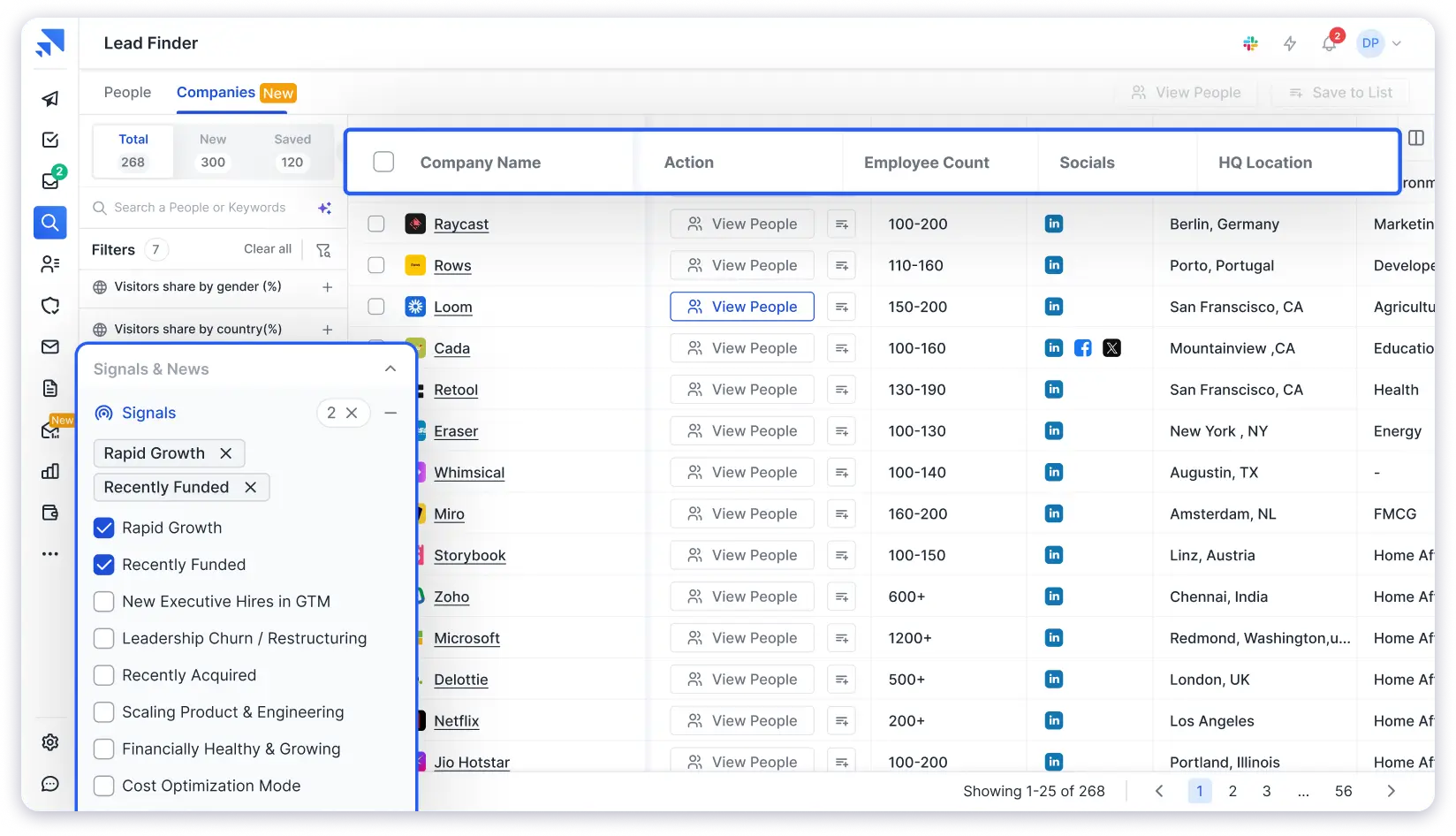
It has a built-in Lead Finder with 852M+ verified B2B contacts across 42M+ companies.
You can filter by job title, seniority, company size, industry, tech stack, geography, revenue, and funding stage in one place.
There’s also an AI search. Describe your ideal prospect, and it builds the list for you.
Every contact is verified in real time at export.
You are not pulling a stale list. The data is checked right before you send.
You also get 50 free credits to test it.
Mailchimp
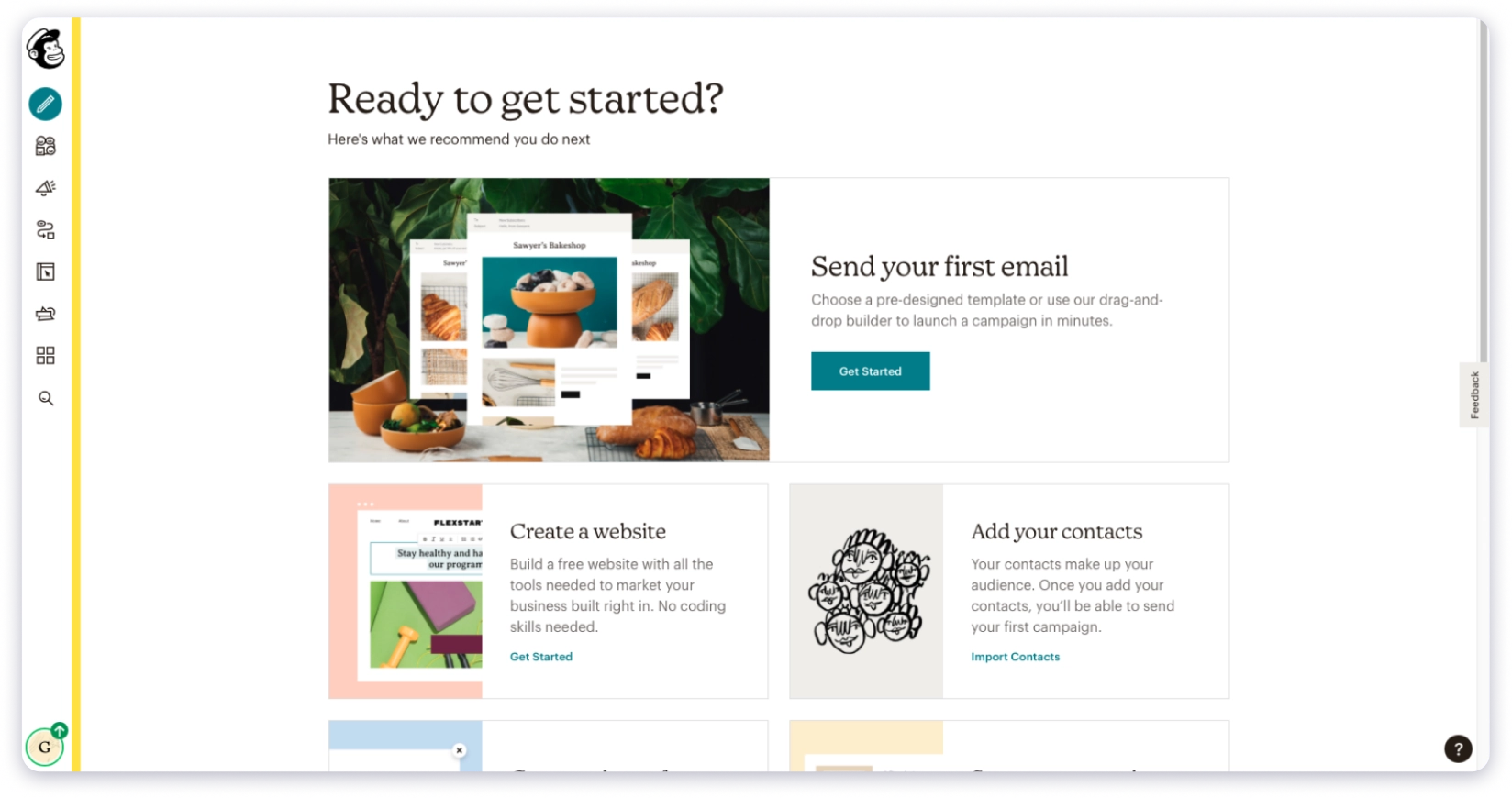
It has no prospecting capability. It is built for audiences you already own.
That is intentional. Mailchimp assumes inbound.
Saleshandy helps you build a pipeline from scratch.
For outbound-driven B2B teams, this is where everything starts.
2. Saleshandy vs Mailchimp: Email Sequences and Follow-Up Logic
Both tools automate emails. The logic is very different.
Saleshandy

This has sequences built around prospect behaviour.
You can create conditional paths based on opens, clicks, or no response.
If someone replies, the sequence pauses automatically, so no follow-ups go out after a response.
You also get A/B testing with up to 26 variants across subject lines and bodies.
This goes beyond basic A/B testing and helps you find what actually drives replies.
The goal is simple. Make outreach feel like real conversations at scale.
Mailchimp
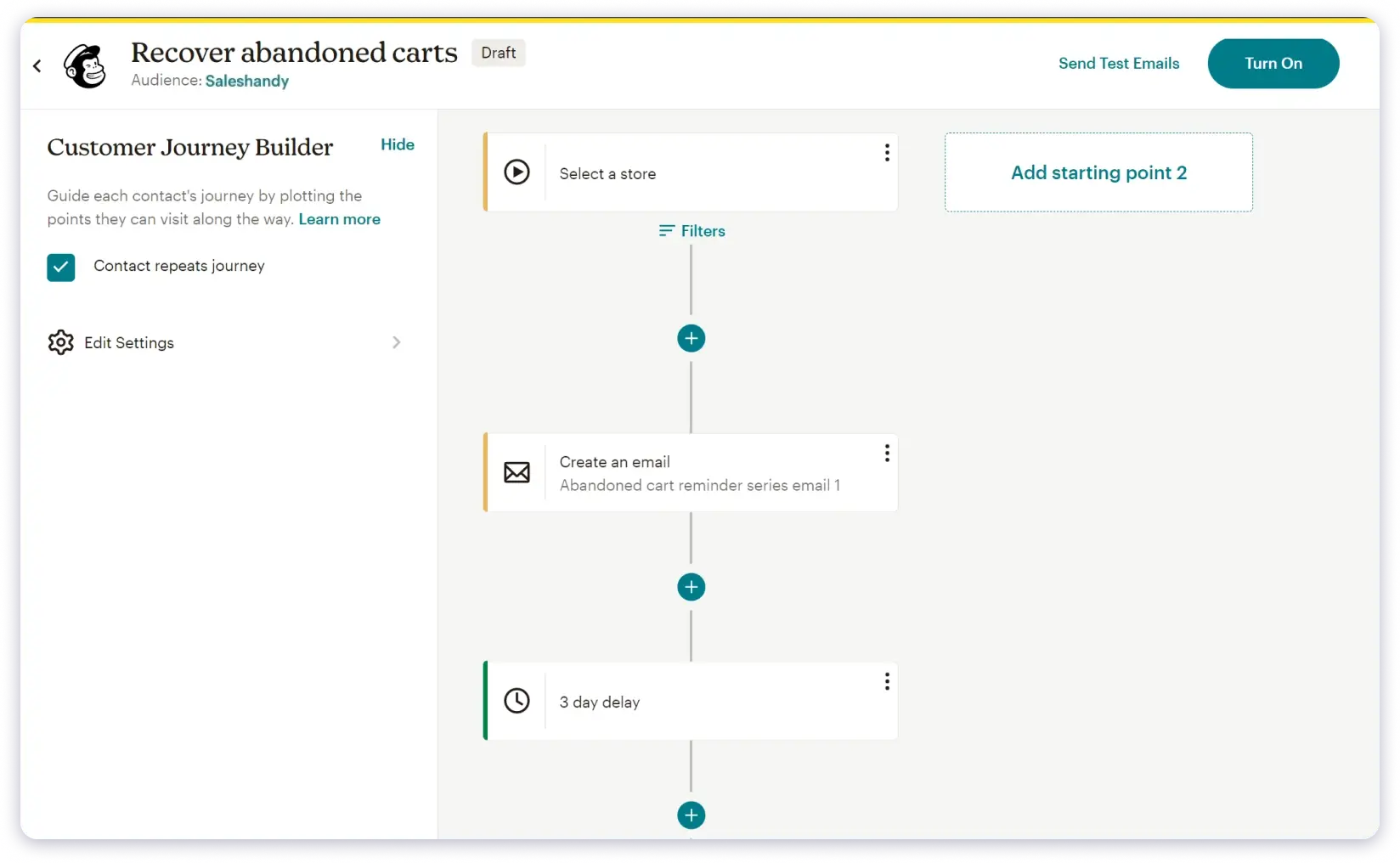
Automation is built for subscriber journeys.
- A user joins and gets a welcome series.
- Clicks a page and gets a follow-up.
- Inactive users get a re-engagement email.
It works well for marketing funnels, but not for outbound sales conversations with new prospects.
The mental model is different.
Saleshandy thinks: “What did this specific prospect do, and what should happen next?”
Mailchimp thinks: “What segment does this subscriber belong to, and what campaign applies to that group?”
Neither is wrong. They’re just answering different questions.
3. Saleshandy vs Mailchimp: Email Deliverability
For cold email, deliverability isn’t a feature, but it’s the foundation.
If your emails don’t land in primary inboxes, nothing else matters.
Saleshandy
It integrates with TrulyInbox for warmup, uses sender rotation to distribute volume, and flags risky setups with Sequence Score.
It also monitors bounces with Bounce Guard to protect your domain.
In practice, landing in primary vs spam usually comes down to proper warmup and rotation.
These aren’t optional, but they directly impact whether your emails get seen.
Mailchimp
Gives strong deliverability for opt-in marketing emails.
Its infrastructure is built for broadcast campaigns, not outbound prospecting.
And more importantly, sending cold emails through Mailchimp violates their policy.
Accounts can get suspended, along with your contact lists and sending history.
So while both handle deliverability well in their own context, only one is built to protect cold outreach at scale.
4. Saleshandy vs Mailchimp: CRM and Prospect Management
This is where the gap between the two tools is most visible in day-to-day use.
Saleshandy

It has CRM included free with every plan.
It’s a Kanban pipeline where prospects move through stages, and each card shows the full activity timeline, including emails, opens, clicks, replies, notes, and tasks.
So when a prospect replies, you have full context instantly. No tab-switching or inbox digging.
You can also send 1:1 emails, create follow-up tasks, and tag prospects.
Built for execution, not just storage.
Mailchimp
Offers contact profiles and segmentation, but no native CRM.
There’s no pipeline, deal stages, or sales activity timeline.
To get that, you’ll need tools like HubSpot or Salesforce, adding setup and cost.
For outbound teams, that’s extra overhead.
For email marketers, it’s expected.
5. Saleshandy vs Mailchimp: Email Design and Visual Templates
This is one area where Mailchimp clearly has the edge.
Saleshandy
It is built for a different use case. It’s intentionally text-first.
There’s no visual builder or heavy HTML styling, and that’s by design.
In cold outreach, overly designed emails often work against you. Logos, banners, and multiple CTAs signal “marketing email” instantly, which lowers open and reply rates.
Plain-text emails feel more like 1:1 communication, which helps them land better and get responses.
So, while Mailchimp is better for design-heavy campaigns.
Saleshandy focuses on what actually drives replies in cold email: simple, human-looking messages.
Mailchimp
Offers a polished drag-and-drop builder, a large library of HTML templates, and full control over branding.
You can design newsletters, promotions, and campaign-style emails without touching code, and they look exactly how you want them to.
6. Saleshandy vs Mailchimp: Agencies and Multi-Client Management
Saleshandy
It is built for agencies.
Manage unlimited client accounts at no extra cost.
Add white-labeling so everything reflects your brand, not Saleshandy’s.
Control access with role-based permissions. Keep each client fully isolated with separate sending infrastructure and sequences.
And the biggest win pricing stays predictable.
No per-seat or per-contact creep.
As you onboard more clients, your costs don’t scale with them.
Which is exactly what you need when you’re running outbound for 10, 20, or more clients at once.
Mailchimp
It has a Partner Program, but it isn’t built around the agency use case the way Saleshandy is.
No white-label. Pricing scales by contact count per account.
Managing multiple client pipelines with the kind of separation and control agencies actually need isn’t what Mailchimp was designed to handle.
7. Saleshandy vs Mailchimp: Pricing and Real Cost
At a glance, Mailchimp looks more affordable. When you map costs against actual use cases, that picture shifts.
Saleshandy

They charge a flat $34/month on the annual Outreach Starter plan.
That covers unlimited email accounts, unlimited sequences, 1,500 Lead Finder credits a month, and the built-in CRM.
The price doesn’t scale with contact volume.
Whether you’re running sequences to 500 prospects or 50,000, you are paying the same base rate.
Mailchimp
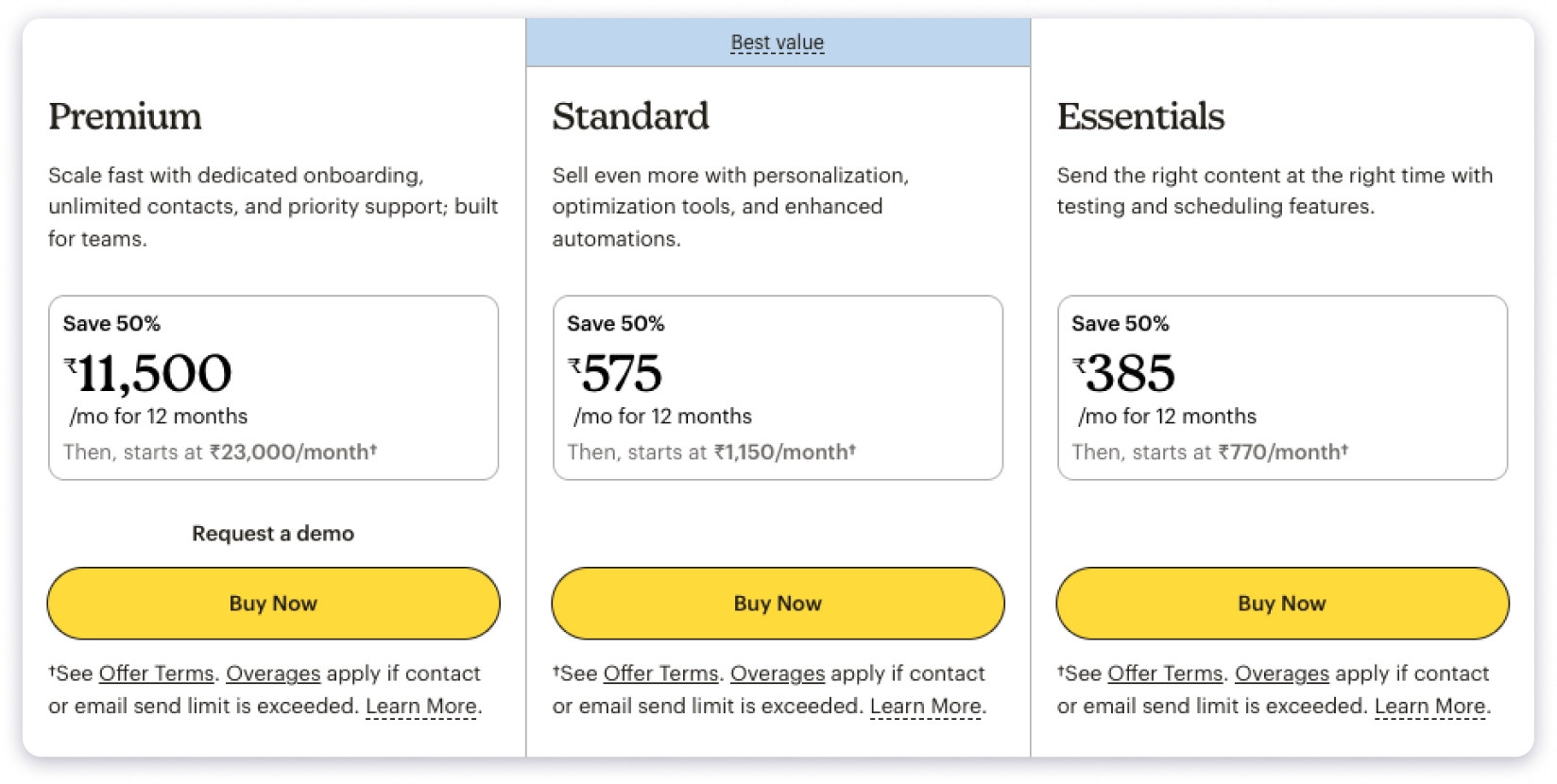
It is priced by contact count, and it climbs faster than most people expect.
The Essentials plan starts at $13/month for 500 contacts.
At 5,000 contacts, you’re closer to $75/month.
At 50,000, you’re looking at $350/month or more.
There have also been multiple price increases since Intuit acquired Mailchimp in 2021.
One thing that catches people off guard: Mailchimp charges for unsubscribed contacts.
If someone opts out, they still count toward your billing tier unless you manually archive them.
The free plan, which used to allow 500 contacts and 1,000 sends per month, was cut to 250 contacts and 500 sends in early 2026.
Honest Take:
For cold outbound at any meaningful volume, Saleshandy’s flat-rate model is significantly more predictable.
For opt-in email marketing with a large, growing subscriber base, Mailchimp’s contact-based model is the industry standard.
Just watch the costs as your list scales.
Saleshandy vs Mailchimp: Which One Should You Choose?
After feature and price comparison, let’s take a dig into who these tools are made for.
When Should You Use Saleshandy?
Saleshandy is the right choice if your primary goal is outbound, specifically if you need to reach people who don’t know you yet.
- For SDRs running sequences who need clear visibility into who to follow up with and why.
- For founders doing early-stage outreach before they have a sales team.
- For lead gen agencies managing cold campaigns across multiple clients.
- For any B2B team that wants prospecting, sequencing, deliverability, and CRM in one platform without stitching four tools together.
If your pipeline starts with finding the right person and sending them a cold email, Saleshandy is built around that exact motion.
When Should You Use Mailchimp?
Mailchimp is the right choice when you’re communicating with people who already know you.
- For SaaS companies, sending product updates to their user base.
- For e-commerce brands running promotional campaigns and post-purchase sequences.
- For content businesses managing newsletter audiences at scale.
- For any marketing team that needs polished, branded email design with robust segmentation across a large opted-in list.
If your email workflow starts with an audience that raised their hand, Mailchimp is built for that.
Can You Actually Use Both?
Yes, and for many B2B companies, this is the right setup.
Saleshandy handles the top-of-funnel work: finding net-new prospects, running cold outreach, and booking the first meeting.
Once someone converts, becomes a customer, signs up for your product, or subscribes to your content.
Mailchimp takes over: onboarding emails, newsletters, lifecycle campaigns, promotional sends.
They serve different stages of the same funnel.
The mistake is trying to make one tool do both jobs.
Final Verdict on Saleshandy vs Mailchimp
This isn’t a close comparison, because they are not really competing.
The search for “Saleshandy vs Mailchimp” is really a search for: which category of email tool do I actually need?
And the answer depends entirely on who you’re trying to reach.
If you’re trying to reach people who’ve never heard of you, to build a pipeline from scratch, book meetings through cold outreach.
And manage those conversations through to a reply, Mailchimp isn’t just the wrong option.
It’s the wrong category, and using it for that purpose puts your account and your domain reputation at risk.
If you’re trying to reach people who already know you, to nurture and retain them.
And convert an opted-in audience. Saleshandy isn’t designed for that workflow, and you’d be underusing what it’s actually built for.
Pick the tool that matches the job.
Most B2B companies eventually need both, just for different stages of the same funnel.
FAQs on Saleshandy vs Mailchimp
1. Can I use Mailchimp for cold email outreach?
No. Mailchimp’s Acceptable Use Policy prohibits emailing people who haven’t opted in. Using it for cold outreach risks account suspension and domain damage.
Cold email requires a tool built specifically for outbound.
2. Is Saleshandy better than Mailchimp for B2B lead generation?
Yes, for outbound lead generation. Saleshandy includes a Lead Finder with 852M+ verified B2B contacts, 75+ search filters, AI-powered prospect search, and real-time email verification. Mailchimp has no prospecting capability.
3. How does Saleshandy pricing compare to Mailchimp?
Saleshandy starts at $34/month (annual) with flat-rate pricing — no increase as contacts grow. Mailchimp starts at $13/month for 500 contacts and scales by list size. It also charges for unsubscribed contacts, which adds up on larger lists.
4. What’s the difference between cold email and email marketing?
Cold email is outbound 1:1 messages to prospects who haven’t heard of you, aimed at starting a sales conversation.
Email marketing is a permission-based campaign sent to subscribers who opted in. Different infrastructure, different legal requirements, different tools.
5. Does Saleshandy have a free trial?
Yes. Saleshandy offers a 7-day free trial with no credit card required, plus 50 free credits to test the Lead Finder before committing to a paid plan.
6. What happened to Mailchimp’s free plan?
In early 2026, Mailchimp cut its free plan from 500 contacts/1,000 sends to 250 contacts/500 sends per month. Most active users will need a paid plan to run any meaningful email program.