
Deciding between Cognism Vs. ZoomInfo for your B2B data needs.
You’re comparing two big names in B2B data…
- Both are rated 4.5/5 on G2.
- Both cost five figures a year.
On paper, they look like two peas in a pod. They both offer contact data, intent signals, and CRM integrations.
But here’s what nobody tells you upfront: Cognism focuses on European data coverage and phone-verified mobile numbers. ZoomInfo offers broader US coverage and a larger sales intelligence suite. And sadly, neither offers a complete outreach workflow out of the box.
Cognism has no native outreach at all. ZoomInfo has Engage, a built-in dialer and email tool, but most teams still layer Salesloft or Outreach on top for full sequencing.
So, which one is worth your money?
I dug into their features, pricing, G2 reviews, and Reddit discussions to compare:
- Data accuracy and regional coverage
- Pricing and hidden costs
- Intent data, integrations, and outreach features
- Real user complaints and limitations
- Which tool fits your sales team best
I’ll also cover a third option if you want prospecting and outreach under one roof.
Let’s compare both tools and find the right fit for your outbound needs.
For those short on time, here’s the 30-second version:
Cognism vs ZoomInfo- TOC
TL;DR: Cognism vs ZoomInfo: Quick Side-by-Side Overview
| Criteria | Cognism | ZoomInfo |
|---|---|---|
| G2 Rating | 4.5/5 (1,381+ reviews) | 4.5/5 (9,226+ reviews) |
| Database Size | 400M+ contacts, 110M+ companies | 500M+ contacts, 135M+ direct dials |
| Best Region | Europe & UK | North America |
| Pricing Model | Credit-based, custom quotes | Credit-based + per-seat, custom quotes |
| Phone Verification | Diamond Data® (human-verified) | Automated + community-contributed |
| Intent Data | Bombora (12 topics, 11,000+ library) | Proprietary + Bombora (4,500+ topics, person-level) |
| Compliance | ISO 27001, ISO 27701, SOC 2 Type II, GDPR | SOC 2 Type II, ISO 27001, ISO 27701, GDPR, TRUSTe |
| DNC Screening | 11–16 global lists (varies by page) | Not specified on visited pages |
| Native Outreach | No | Engage (built-in dialer + email, lighter-weight than dedicated SEPs) |
| Chrome Extension | Yes | Yes |
| Free Trial | No (free data sample only) | ZoomInfo Lite (7-day free trial) |
Both tools score identically on G2. But once you look past the rating, they serve very different buyers.
Let me show you where each one actually wins.
Cognism vs ZoomInfo Data Quality: Who Has Better Coverage?
It’s pretty clear: Data quality is the reason you’re buying either of these tools.
It’s also the #1 complaint users have about both of them. So let’s break it down by what matters most: which region you’re selling into.
European Data: Where Cognism Has the Edge
If your team sells into Europe, this is where the conversation gets short.
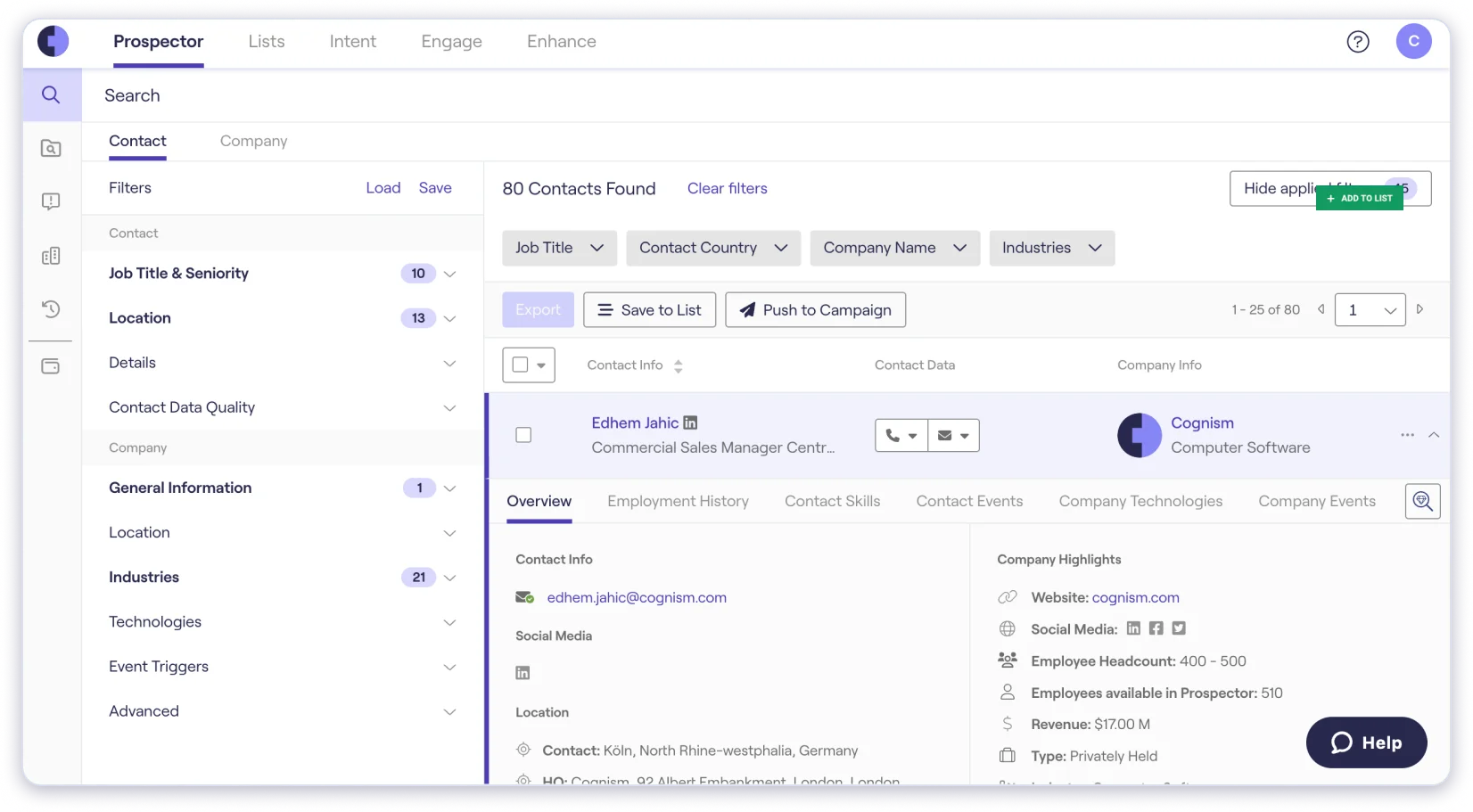
Cognism positions itself as “Europe’s most trusted B2B data” and, based on what I’ve seen, that’s not empty marketing.
They claim 98% accuracy on phone-verified European mobile numbers. Their Diamond Data® feature uses a dedicated human research team to manually verify direct dials, primarily for European contacts.
Users back this up.
One G2 reviewer, Maxime S., put it clearly: “The Chrome extension is a game changer for pulling direct dials straight from LinkedIn Sales Navigator when prospecting UK and European accounts. Our connection rates are noticeably higher than when we used ZoomInfo.”
A Cognism user directly compared their European connect rates against ZoomInfo’s and found Cognism better.
Worth Reading: 6 Best Europe Email Database Providers for B2B Prospecting in 2027
ZoomInfo’s Strength is North American Data
Flip the map, and the story reverses.
ZoomInfo’s regional breakdown tells the story in numbers: 79.6M+ companies and 157.8M+ contacts in North America. Compare that to their European coverage: 20.5M+ companies and 66M+ contacts. The US data runs nearly 4x deeper.
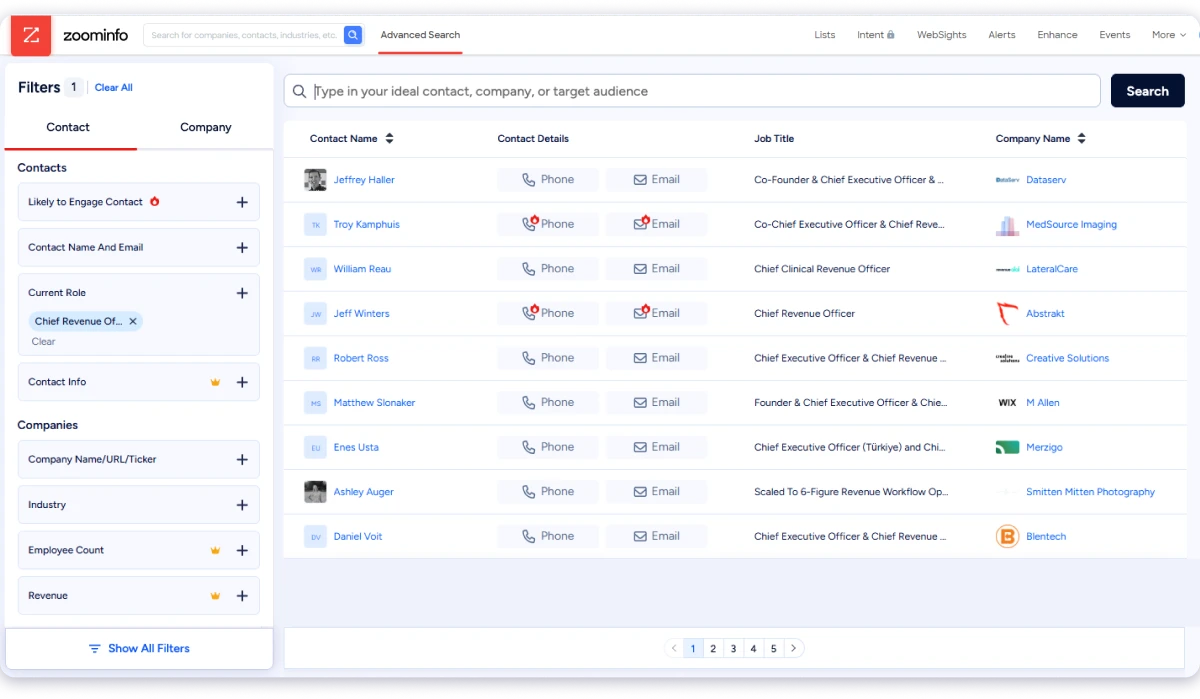
ZoomInfo also brings features Cognism doesn’t match for US-focused teams.
Org charts, reporting structures, and company hierarchy mapping are more developed.
If you’re running account-based outreach and need to map out who reports to whom at a 5,000-person enterprise, ZoomInfo gives you that picture.
APAC and Rest of World: Neither Wins Cleanly
Here’s a bitter pill to swallow.
Neither vendor will volunteer on their pricing call: both tools struggle outside their home regions.
Cognism’s Maxime S. noted: “Coverage thins out noticeably outside Europe. Searching for contacts in APAC or more niche industries yields way fewer verified phone numbers.”
On the ZoomInfo side, a verified enterprise user flagged the same problem from the other direction: “I find that some company and contact details can be outdated or missing, especially data for Asia and Europe.”
If your primary market is Asia-Pacific, neither platform is going to give you the coverage depth you need. That’s a gap worth knowing before you sign an annual contract.
What Users Actually Complain About (Both Tools)
Honestly, it’s ironic.
Data quality is the #1 G2 complaint for both Cognism and ZoomInfo. Yep, not pricing, not support, not even missing features, but Data is the main problem.
Top 5 Cognism Cons on G2 (by mention count):
- Inaccurate Data (99)
- Incorrect Numbers (62)
- Outdated Contacts (58)
- Incorrect Information (57)
- Missing Information (55)
That’s 331 user reviews combined bad data quality mentions across 1,381 reviews.
Not happy with data accuracy? Explore these Cognism Alternatives for more reliable prospecting.
Top 5 ZoomInfo Cons on G2 (by mention count):
- Inaccurate Data (232)
- Outdated Data (232)
- Outdated Contacts (215)
- Data Inaccuracy (188)
- Outdated Information (172)
That’s 1,039 user reviews combined, with poor data quality mentions across 9,226 reviews.
One Cognism user, Melanie W. (3.5/5), described the issue precisely: “Some email addresses appear to be generated intuitively based on patterns rather than verified, which can result in bounced emails.”
On ZoomInfo’s side, Dina O. (2.5/5) raised a similar concern: “Contact records can occasionally be outdated, such as missed job transitions or delayed updates for people who have left a company, leading to email bounces.”
The takeaway?
Every B2B data platform has accuracy issues. The question isn’t whether the data will be perfect. It won’t be. The question is whether the data is good enough in the region where you actually sell.
Tired of outdated contacts and inaccurate data? Check out these ZoomInfo Alternatives worth considering.
Head-to-Head Features Comparison: What Each Platform Can (and Can’t) Do
Now it’s time to see where Cognism and ZoomInfo shine, fall short, and differ.
1. Prospecting and Search
Both platforms offer advanced search with firmographic, technographic, and signal-based filters.
Cognism’s newer AI features include AI Search (natural-language queries, claimed “up to 74% quicker”), Smart Personas (pre-built targeting templates), and Cognism Research (instant account summaries before a first touch).
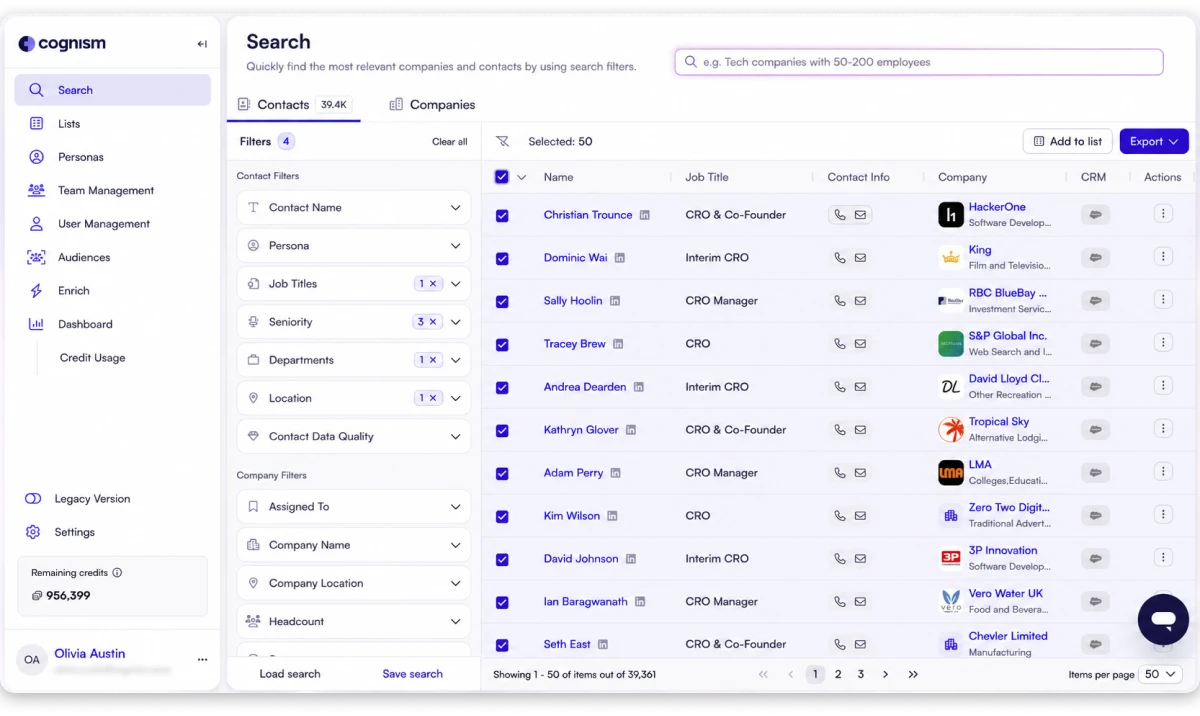
These are useful for speed, especially if your team is building lists across European markets.
ZoomInfo counters with deeper account intelligence. Org charts, reporting structures, company hierarchy mapping, and a Copilot AI assistant that prioritizes accounts, drafts personalized emails, flags re-engagement signals, and automates CRM updates.
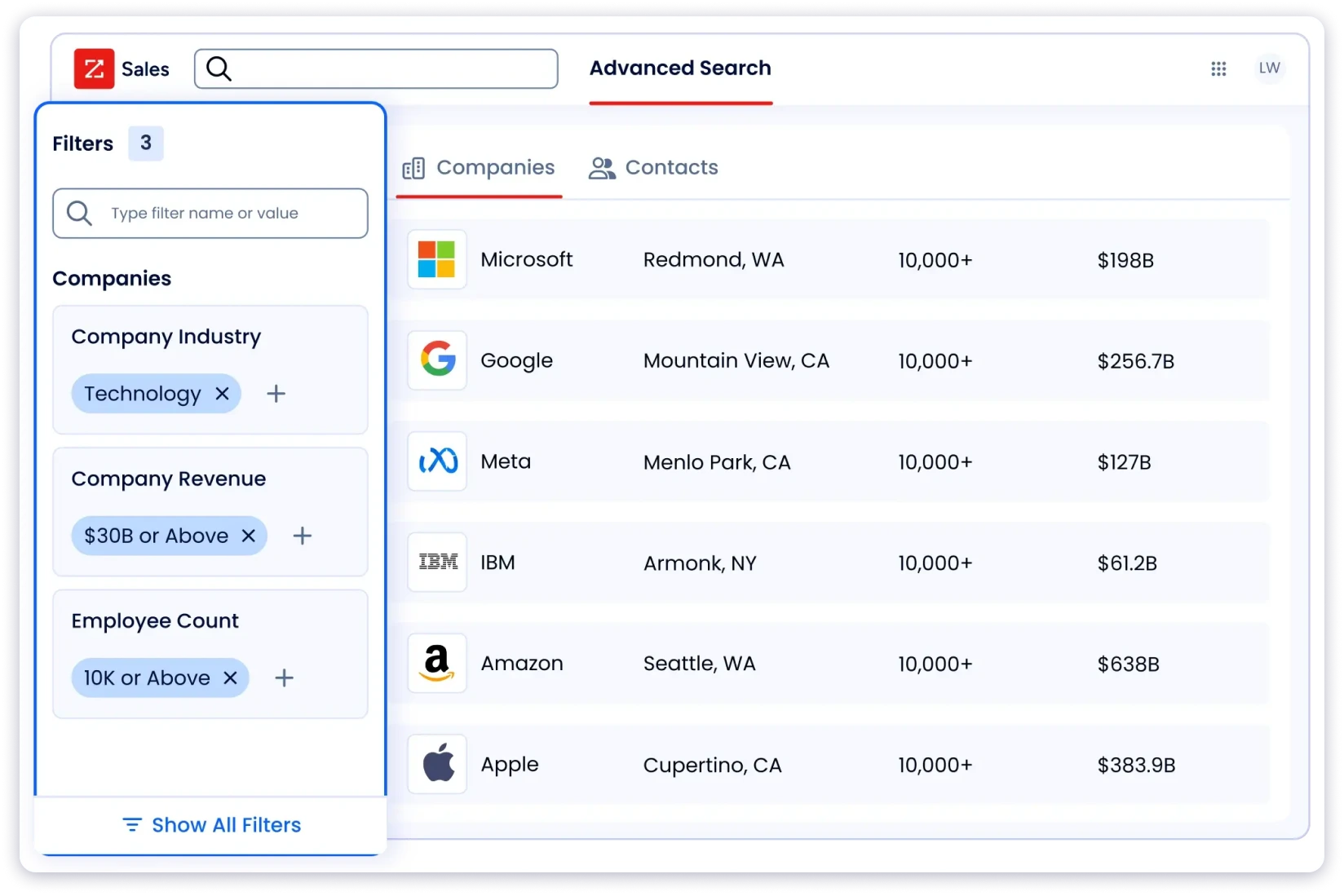
Plus, the GTM Workspace adds a live signal feed (up to 1,000 daily signals across 15+ types), AI Chat for account briefs, and real-time Salesforce sync.
💡 My Honest Take:
If you need speed and European precision: Cognism. If you need depth and account intelligence: ZoomInfo.
Want 98% accuracy and real-time verified global leads as per your ICP in under 30 seconds? Then Saleshandy is the match made in heaven. Try it and get 50 FREE lead credits NOW.
2. Phone Verification and Direct Dials
This is where ZoomInfo and Cognism use genuinely different approaches, and it matters more than most comparison articles let on.
Cognism’s Diamond Data® relies on a human research team that manually verifies direct dials.
It’s expensive to scale, which is why Cognism’s mobile database is smaller (100M mobiles vs ZoomInfo’s 135M+ direct dials). But the verified numbers, especially for European decision-makers, tend to have higher connect rates.
ZoomInfo uses automated verification through its FuZIon data collection system: web crawling (10M+ pages per day), AI/ML verification including SMTP-level validation, and a contributory network of business professionals, plus 300+ human researchers.
The scale is larger, but verification is primarily machine-driven.
The trade-off is the oldest one in data: quality vs quantity.
Cognism gives you fewer numbers that connect more often. ZoomInfo gives you more numbers across a broader geography. Which one matters more depends on whether you’d rather call 50 people and reach 40, or call 100 and reach 30.
3. Intent Data
ZoomInfo wins this category clearly. I’ll give credit where it’s due.
ZoomInfo tracks 4,500+ intent topics with 85M+ weekly signals across 1.2M+ monitored accounts. Their proprietary network uses 210 million IP-to-org pairings and over 6 trillion keyword-to-device pairings monthly. More importantly, they’ve shipped Person-Level Intent, which identifies the specific individual showing research activity, not just the company.
Cognism uses Bombora Company Surge® data. Admins can select up to 12 topics from an 11,000+ library. It’s company-level intent only. No person-level resolution. And it’s available only on the Pro plan.
If intent data drives your prospecting strategy, this is ZoomInfo’s game to lose.
4. CRM and Integrations
Both tools integrate with Salesforce and HubSpot.
Cognism adds Pipedrive, Salesloft, Outreach, and Zapier, plus a new MCP connector for AI assistants.
ZoomInfo has a deeper marketplace with 193 integrations spanning telephony, cloud data warehouses (Snowflake, Databricks), marketing automation (Marketo, Eloqua), conversation intelligence (Gong), and a bi-directional CRM sync through GTM Workspace.
💡 My Honest Take:
ZoomInfo’s integration ecosystem is broader. Cognism’s is more targeted toward the European sales engagement stack.
Cognism vs ZoomInfo Pricing: How Much Do They Really Cost in 2027?
Good luck finding a straight answer from either vendor. Because both hide their pricing behind “Talk to sales” buttons.
But here’s what I was able to piece together.
Cognism Pricing: Plans and Costs
Cognism offers two plans:
- Standard (core prospecting, 5 seats included)
- Pro (adds Diamond Data® on-demand verification, intent data prioritization, and enhanced dashboards; 5 seats included).
CRM Enrichment is a separate add-on.
Here’s the catch: there is no published price. Every CTA says “Talk to sales” or “Get tailored pricing.”
Based on buyer-reported data from third-party sources, a 5-seat package typically runs $22,500 to $37,500 per year. That’s buyer-reported, not officially published, so treat it as a range rather than a guarantee.
On G2, Cognism’s perceived cost sits at $$$$$ (the highest tier on G2’s pricing scale). Their average discount is 15%.
Pricing complaints come most often from smaller teams. Troy D. (4/5, Small-Business) put it bluntly: “The price is pretty high compared to some competitors. Pricing is a particular challenge for a small team like ours, making it very expensive.”
One credit equals one revealed contact. No charge to re-view a previously revealed contact. The same credit pool is shared across the platform, browser extension, CRM Enrichment, API, and MCP.
Worth Exploring: Cognism Pricing in 2027: Plans, Hidden Costs & What You’ll Actually Pay
ZoomInfo Pricing: Plans and Costs
ZoomInfo is also fully gated behind sales.
Every pricing CTA reads “Get Pricing” or “Get a demo.” The platform uses a consumption-credit model plus per-seat licensing. Your cost depends on features, number of seats, credit volume, add-ons, and integrations.
Third-party sources report three tiers:
- Professional (~$14,995/year)
- Advanced (~$24,995/year)
- Elite (~$39,995/year)
All annual contracts.
One thing ZoomInfo does offer that Cognism doesn’t: ZoomInfo Lite, a free plan with no credit card required. It’s limited, but it exists. They also offer a standard 7-day free trial of the full platform.
Credit limits are a recurring complaint.
Yeswanth R. (4/5, Small-Biz) said: “The credit limits can feel restrictive, and I have to prioritize which contacts to reveal, which slows down account mapping for clients with large teams.”
Before You Commit: How Much Does ZoomInfo Really Cost? (Full Pricing Guide)
⚠️ Keep in Mind:
Both vendors have database size inconsistencies on their own websites. Cognism claims 400M+ contacts on one page and 100M mobile numbers on another, without reconciling the two figures. ZoomInfo’s homepage says 500M+ contacts, but the Sales product page says 420M+ contacts and 174M+ verified emails. Neither explains the discrepancy. We’re flagging it because no other comparison article does.
The Cost Nobody Talks About: You Still Need More Than Just Data
Here’s the part that every Cognism vs ZoomInfo comparison article glosses over: buying a data platform is only half the outbound equation.
Cognism has no native outreach at all. It has no email sequences, dialer, warm-up, or deliverability monitoring.
So, if you buy Cognism, you’re also buying Salesloft or Outreach for sequences, a warm-up tool to protect sender reputation, and possibly a separate inbox placement monitor. That’s two to three additional subscriptions on top of your data contract.
ZoomInfo is in a slightly different position. It does include Engage, a built-in sales engagement module with a dialer and email sequencing for multi-touch cadences. So you’re not starting from zero on outreach.
But here’s the nuance most buyers miss: when I tried to visit Engage’s dedicated feature page during research, it redirected to a Salesloft co-marketing page rather than a standalone product page.
The Sales product page mentions “a direct phone dialer and email tool,” but the full depth of that native capability, particularly around warm-up, deliverability monitoring, and multichannel sequencing, couldn’t be independently verified at the level you’d get from a dedicated platform.
That’s likely why most sales teams still pair ZoomInfo’s data with a separate outreach tool. You get some native outreach, but not a complete stack. No warm-up. No inbox placement testing. No sender rotation across unlimited accounts.
💡 My Honest Take:
The real cost comparison isn’t just “Cognism vs ZoomInfo.” For Cognism, it’s data platform + full outreach tool + warm-up tool. For ZoomInfo, it’s data platform + potentially a more capable outreach tool + warm-up. Either way, you’re managing multiple contracts and dashboards to get cold email sequences running properly.
So, What Do Real Users Say? Cognism vs ZoomInfo G2 Reviews
These numbers tell a story that marketing pages won’t.
| Criteria | Cognism | ZoomInfo |
|---|---|---|
| Overall Rating | 4.5/5 | 4.5/5 |
| Total Reviews | 1,381 | 9,226 |
| 5-Star Reviews | 989 (71.6%) | 6,588 (71.4%) |
| 1-Star Reviews | 9 (0.7%) | 160 (1.7%) |
Both tools have nearly identical 5-star percentages.
But ZoomInfo’s 1-star count is worth noting: 160 reviews (1.7%) vs Cognism’s 9 (0.7%). That’s not a huge percentage, but it’s a longer tail of strongly negative experiences.
- What Cognism users praise most: Ease of Use (216 mentions) and Contact Information quality (193)
- What ZoomInfo users praise most: Contact Information (413 mentions), Ease of Use (403), and Features like bulk download (334)
I noticed a similar pattern on both sides. Users love the data when it works, and the platforms are genuinely easy to use. Where the reviews diverge is in the complaints, and specifically, in what kind of data each tool fails on.
One more thing the reviews reveal that neither vendor’s sales team will mention: users on both platforms consistently describe exporting contacts to a separate outreach tool. Cognism has no native outreach at all. ZoomInfo has Engage for basic sequencing and dialing, but users still describe layering dedicated outreach tools on top for more advanced workflows.
When to Choose Cognism or ZoomInfo (and When Neither Fits)
Both are well-rated platforms with genuine strengths.
The right pick depends on where you sell, what you already have in your stack, and how much of the outbound workflow you want under one roof.
Cognism Is the Better Pick If…
- Your primary market is Europe or the UK, and accurate European mobile data is a hard requirement for your prospecting
- GDPR compliance and DNC screening are non-negotiable. Cognism holds ISO 27001, ISO 27701, and SOC 2 Type II certifications, with DNC screening across multiple global lists
- You need phone-verified direct dials to European decision-makers. Diamond Data® uses a human research team to manually verify mobile numbers, and G2 users confirm higher connect rates on European contacts
- You already run Salesloft or Outreach and just need a reliable data layer feeding into your existing outreach stack
- Your team is mid-market or enterprise with budget for $22K+ per year on data (buyer-reported range: $22,500–$37,500/year for a 5-seat package)
ZoomInfo Is the Better Pick If…
- Your primary market is North America, and you need the deepest US contact and company database available (79.6M+ companies, 157.8M+ contacts in NA alone)
- Account intelligence matters to your sales process, including org charts, reporting structures, and company hierarchy mapping
- Intent data is a core part of your GTM strategy. ZoomInfo tracks 4,500+ topics with 85M+ weekly signals, and its Person-Level Intent identifies the specific individual researching your category, not just the company
- You’re an enterprise sales org with a budget for $15K–$40K per year and a separate outreach stack already in place or planned
When Neither Cognism Nor ZoomInfo Is the Right Fit
Both are strong platforms. But they share blind spots that matter:
- You sell globally, not just one region. Cognism is Europe-first. ZoomInfo is US-first. Neither covers both regions equally well, and both are weaker in APAC.
- Five-figure annual contracts don’t fit your budget. Both start at $15K–$22K+ per year for data alone, before outreach tools.
- You want data and outreach in one platform. Cognism has no native outreach. ZoomInfo has Engage for basic sequencing and dialing, but most teams still add a dedicated tool on top for warm-up and deliverability.
- Multichannel outreach matters. Neither runs LinkedIn automation, WhatsApp, or coordinated multichannel sequences natively.
- You want transparent pricing and a real free trial. Cognism doesn’t publish prices or offer a trial (only a data sample). ZoomInfo has a limited free plan (ZoomInfo Lite), but full platform pricing is gated behind sales.
If two or more of these describe your situation, a platform that combines prospecting and outreach in one workflow is worth evaluating.
Need Accurate B2B Data and Outreach Together? Consider Saleshandy
Both Cognism and ZoomInfo solve the data problem well. But neither solves the outreach execution.
You still need a sending platform, a warm-up tool, deliverability monitoring, and a dialer. That’s three to four separate contracts, three to four dashboards, three to four invoices.
Saleshandy combines B2B data and outreach execution in one platform. 852M+ verified contacts with waterfall enrichment across 9 data providers.
Plus automated sequences, built-in warm-up, Inbox Radar for deliverability monitoring, an AI dialer, and multichannel workflows across email, calls, LinkedIn, and WhatsApp.
Here’s a quick comparison:
| Feature | Cognism | ZoomInfo | Saleshandy |
|---|---|---|---|
| Starting Price | ~$22,500/yr (buyer-reported) | ~$14,995/yr (third-party reported) | $408/yr ($34/mo) |
| Database | 400M+ contacts | 500M+ contacts | 852M+ contacts (Bigger than both) |
| Pricing Model | Credit-based, custom | Credit + per-seat, custom | All-in, transparent |
| Published Prices | No | No | Yes, on pricing page |
| Email Sequences | No | Engage (add-on, unclear scope) | Yes, unlimited |
| Email Warm-Up | No | No | Yes, unlimited, free |
| Deliverability Monitoring | No | No | Yes (Inbox Radar) |
| Built-In Dialer | No | Mentioned but unverified standalone | Yes (from $23/mo) |
| Users Included | 5 seats | Varies by plan | 1 (Starter) / 10 (Pro) / Unlimited (Scale) |
| Per-Seat Pricing | Included in plan | Yes | No |
| Free Trial | No | ZoomInfo Lite (limited free plan) | 7 days, 50 FREE credits, no card |
| Lead Credits Included | Credit-based (shared pool) | Credit-based (capped) | 1,500–8,000/mo free on all plans |
Saleshandy won’t match Cognism’s European phone verification depth or ZoomInfo’s org chart intelligence. It doesn’t claim to.
What it does is eliminate the two or three additional tools you’d need alongside either platform.
So, if you want verified data, sequences, warm-up, deliverability, and dialer on one plan without a $15K+ annual commitment, consider Saleshandy today. Sign up NOW and claim your FREE Lead Finding Credits.
FAQs About Cognism vs ZoomInfo
1. Is Cognism better than ZoomInfo?
Neither is universally better. Cognism wins for European data quality, phone-verified mobile numbers via Diamond Data®, and GDPR compliance. ZoomInfo wins for US data depth, org charts, and intent data (4,500+ topics with person-level resolution). Both are rated 4.5/5 on G2. Your region and workflow determine which is the right pick. If you need data plus outreach in one platform, both require a separate tool.
2. How do Cognism and ZoomInfo compare on pricing?
Both are enterprise-priced and hide costs behind sales calls. Cognism doesn’t publish prices at all. Buyer-reported pricing puts a 5-seat package at $22,500–$37,500 per year. ZoomInfo’s tiers reportedly start at ~$14,995/year (Professional). Both use credit-based models and require annual contracts. Neither includes outreach execution in the base price, so budget for a separate sending tool on top.
3. Which tool has better data accuracy?
Data accuracy is the #1 G2 complaint for both. Cognism has 331 combined data quality complaint mentions across 1,381 reviews. ZoomInfo has 1,039 across 9,226 reviews. Both struggle with stale contacts and job-change lag. The real difference is regional: Cognism’s data is more accurate in Europe; ZoomInfo’s is more accurate in the US. Both are weaker in APAC.
4. Does Cognism or ZoomInfo include outreach features?
Cognism does not include email sequencing, a dialer, email warm-up, or deliverability monitoring. You need a separate outreach tool. ZoomInfo includes Engage, a built-in dialer and email tool for multi-touch cadences. It provides basic outreach capability, but it’s generally considered lighter-weight than dedicated platforms like Outreach.io or Salesloft. Many teams still pair ZoomInfo with a dedicated sales engagement platform for full multichannel sequencing, warm-up, and deliverability monitoring.
5. Which is better for European sales teams?
Cognism. Multiple G2 reviewers confirm stronger European mobile data and GDPR compliance. ZoomInfo users explicitly flag weaker EU data: “The data is less complete and accurate in Europe than it is in the USA.”
6. Which is better for SDRs?
It depends on territory. US-focused SDRs get more value from ZoomInfo’s deeper North American database and org charts. EU-focused SDRs benefit from Cognism’s Diamond Data® verified mobiles. SDRs who want data and sequences in one tool without managing multiple platforms should consider alternatives with built-in outreach, like Saleshandy’s Lead Finder (with 1,500 free credits on the Starter plan).
7. Is there a cheaper alternative to both Cognism and ZoomInfo?
Yes. Saleshandy includes 852M+ verified contacts via waterfall enrichment, email sequences, built-in warm-up, Inbox Radar, and a dialer. It doesn’t match Cognism’s European phone verification depth or ZoomInfo’s org chart data, but it covers the full outbound sales workflow at a fraction of the cost, with a 7-day free trial and 50 free credits.
8. Can I try Cognism or ZoomInfo for free?
Cognism does not offer a free trial. They provide a free data sample and an interactive demo. ZoomInfo offers ZoomInfo Lite, a permanent free plan with no credit card required (limited functionality). They also offer a standard free trial of the full platform and free developer access through GTM.AI. Saleshandy offers a 7-day free trial with 50 free credits and no credit card required on every plan.

 Pritesh