


You need data to run your business.
Understandable!
But that does not mean you should be spending thousands of dollars every month on a platform that gives you outdated contact data.
That is exactly why so many teams are now looking for ZoomInfo alternatives.
One G2 reviewer put it bluntly:
“The contacts largely go to receptionists and not the advertised contacts. Our own agency has over 8-year-old out-of-date information on ZoomInfo.”
And honestly, that is the biggest frustration I kept seeing again and again while researching this blog.
Teams are paying enterprise-level prices while still spending hours verifying contacts, replacing bounced emails, and manually cleaning bad data.
So if you are looking for a data provider that gives you more accurate contact data at a reasonable price, or you are simply tired of paying premium pricing for inconsistent data quality to ZoomInfo, this blog is for you.
And no, I did not just copy a list of tools from G2 rankings.
I actually did the homework and explored ZoomInfo’s pricing and features myself.
I went through G2 reviews and checked Reddit threads where SDRs, founders, and agencies openly discuss which tools actually work in day-to-day prospecting.
Here is what I found:
ZoomInfo is still a strong platform for large enterprises running account-based sales motions, especially in North America.
But for startups, agencies, and mid-market teams, the cost-to-value ratio has become harder to justify.
That is why this list is not just about “popular alternatives.”
All the 14 ZoomInfo alternatives here earned their place based on pricing, data quality, usability, and real-world feedback.
And for each one, I will break down who it is best for, where it falls short, and what it would realistically cost your team.
Let’s get into it!
ZoomInfo Alternatives – TOC
TL;DR- ZoomInfo Competitors at a Glance
14 Best ZoomInfo Competitors and Alternatives
Here is the in-depth review of 14 best ZoomInfo alternatives

1. Saleshandy
Saleshandy is the #1 ZoomInfo alternative on this list for two specific reasons.
First, the data is verified in real time.
When you reveal a contact, Saleshandy runs data like emails, phone numbers etc, through waterfall enrichment across multiple data providers.
If the email does not verify, you do not get charged.
That is fundamentally different from ZoomInfo, where you pay for the credit whether the data is good or not.
Second, the database is larger than ZoomInfo.
You get 852M+ verified B2B contacts across 42M+ companies, whereas ZoomInfo offers around 260M contacts.
But size alone is not the point.
What actually matters is that Saleshandy gives you 75+ advanced data points to filter and target your leads, including:
And at its core, Saleshandy is an all-in-one cold outreach platform.
- Firmographics
- Technographics
- Hiring signals
- Funding data
- Buying signals
- Revenue filters
These are the same categories of intelligence ZoomInfo charges enterprises heavily for, while Saleshandy offers them at a fraction of the cost.

Which means once you have your data, you do not need to leave the platform to act on it.
Saleshandy already has multichannel outreach built in.
With ZoomInfo, you get the contacts first, and then you still need additional tools like Outreach or Salesloft, CRM integrations, and multiple subscriptions just to start running campaigns.
And that is where the costs start adding up quickly.
ZoomInfo itself starts at around $14,995/year, while engagement tools, intent data, and conversation intelligence often cost extra.
Now, to be fair, large enterprises usually do not mind paying enterprise-level pricing. But when you are investing that much money, the data quality also needs to justify the cost consistently.
That is where many teams seem frustrated.
Because if contacts are outdated, route to receptionists, or still need manual verification, the value equation starts breaking pretty fast.
With Saleshandy, the entire workflow from finding a lead to booking a meeting lives in one platform.
I also like that Saleshandy does not charge per user.
That single detail changes the economics for any growing team.
How Saleshandy Differs From ZoomInfo
The result?
You spend less on buying tools, avoid paying for unusable data, and manage your outreach from one platform instead of stitching together multiple tools.
Pros
- 852M+ contacts across 42M+ companies (3x ZoomInfo’s database)
- 75+ advanced filters with the same depth as enterprise tools
- Real-time waterfall enrichment (you do not pay for bad data)
- 50% credit rollover every billing cycle
- Multichannel outreach built in (email, calls, LinkedIn)
- AI Lead Finder that builds lists from plain English prompts
- No per-user pricing
Cons
- Only gives 50 credits during the free trial
Pricing
- Starter at $34/month (annual) with 18,000 credits/year.
- Pro at $76/month (annual) with 48,000 credits/year.
- Scale at $149/month (annual) with 96,000 credits/year.
- 7-day free trial, no credit card required.
Both plans include 50% credit rollover and real-time verification.
7-day free trial with 50 free credits.
What This Looks Like for a 5-Person SDR Team
Saleshandy starts at $34 per month (billed annually).
That includes 1,500 Lead Finder credits/month, 6,000 emails/month, unlimited email accounts, and CRM, all in one plan.
For a 5-person team, it’s still $34/month total (1 user on Starter) or $76/month on Pro for 10 users.
The same team on ZoomInfo?
Minimum $14,995 per year for data alone, plus $1,000+ per month for Outreach or Salesloft, plus separate CRM costs.
Even with both Saleshandy plans combined, you save over $13,000 annually and keep everything inside one platform instead of managing three separate subscriptions.
2. Apollo.io
The next ZoomInfo competitor on my list is Apollo.io.
It is probably the most recognized alternative in the market, and it tries to be your database, outreach tool, and CRM in one platform. For many teams, it actually pulls that off.
The 210M+ database is solid for US prospecting, the sequences work, and the buying intent signals help you prioritize active accounts.
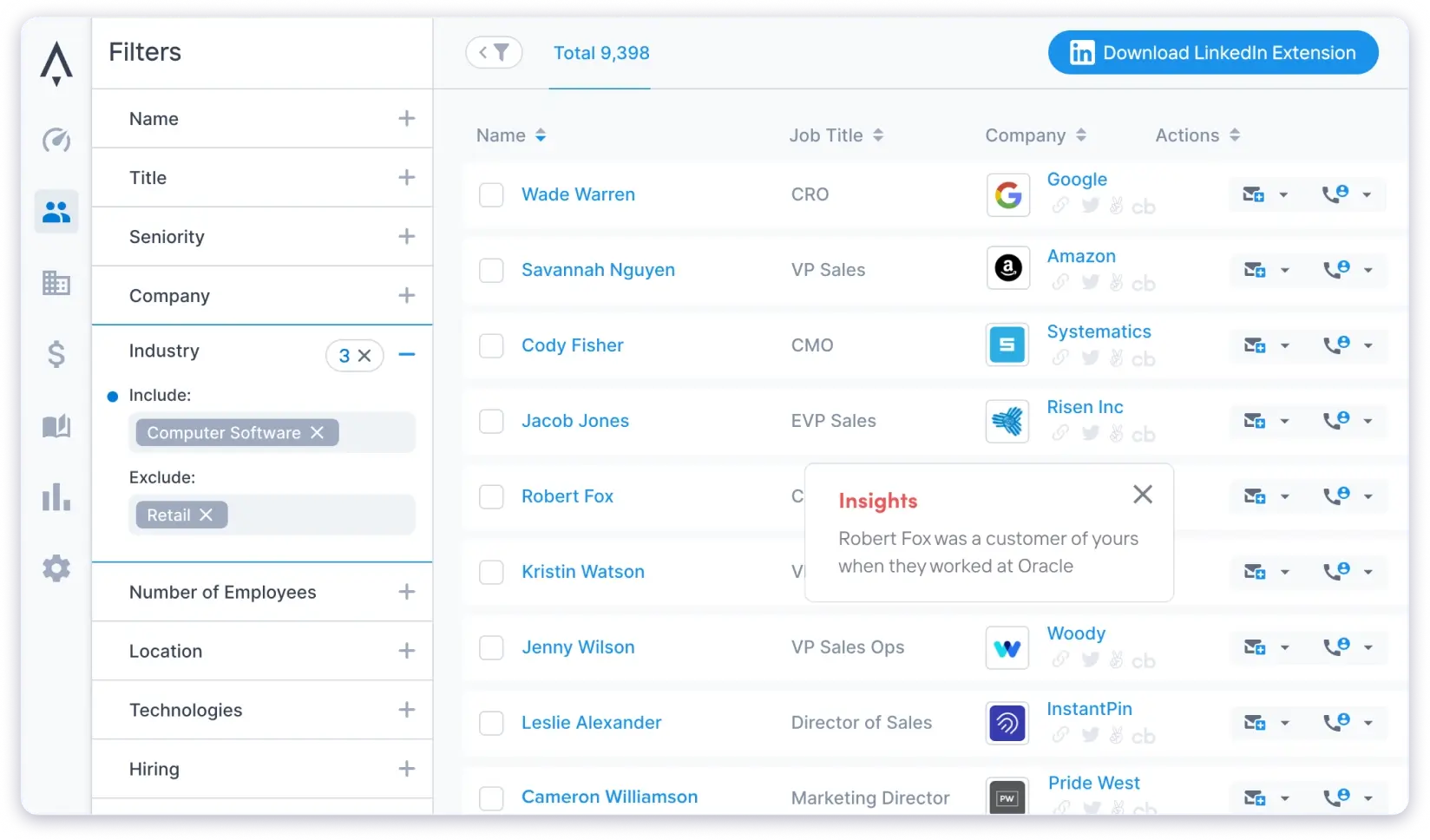
What I did not like is the credit system. It looks simple on the surface but gets complicated fast.
Mobile lookups cost 8 credits each, enrichment burns through credits faster than most teams expect, and credits expire with no rollover.
How Apollo Differs From ZoomInfo
Apollo bundles data, outreach, and CRM at a price you can see upfront. ZoomInfo makes you sit through a sales call before you even know what you are paying.
The tradeoff: Apollo’s database is smaller, phone accuracy gets mixed G2 reviews outside North America, and per-user pricing adds up fast.
Pros
- All-in-one platform (data + outreach + CRM)
- Buying intent signals and job change alerts
- Free plan with 100 credits per month
- Built-in email sequences, LinkedIn tasks, and dialer on higher plans
- Chrome extension for LinkedIn prospecting
Cons
- Credit system is confusing with variable costs per reveal
- Database significantly smaller than Saleshandy (210M vs 852M+)
- Phone number accuracy mixed outside North America
- Per-user pricing adds up fast past 5 seats
- Dialer and intent locked behind higher-tier plans
- Credits expire with no rollover
Pricing
- Free: 900 credits/seat/year (granted monthly)
- Basic: $49/seat/mo (annual). 30,000 credits/seat/year granted upfront
- Professional: $79/seat/mo (annual). 48,000 credits/seat/year granted upfront
- Organization: $119/seat/mo (annual, min 3 seats). 72,000 credits/seat/year granted upfront
For a deeper look, check this Apollo.io review.
Or see Apollo.io alternatives.
What This Looks Like for a 5-Person SDR Team
Basic at $49/seat means $245 per month ($2,940 per year). Each seat gets 30,000 credits per year granted upfront.
That sounds generous until you realize mobile lookups and exports consume credits differently.
Per-seat pricing adds up fast.
3. Cognism
Another solid ZoomInfo competitor. If your prospecting focus is Europe and cold calling is core to your playbook, Cognism is hard to beat.
Their Diamond Data (manually phone-verified mobile numbers with a claimed 87% connect rate) is something no other tool on this list matches.
I noticed the biggest difference in EMEA contact quality. ZoomInfo’s European data has gaps. Cognism was built for that market from day one.
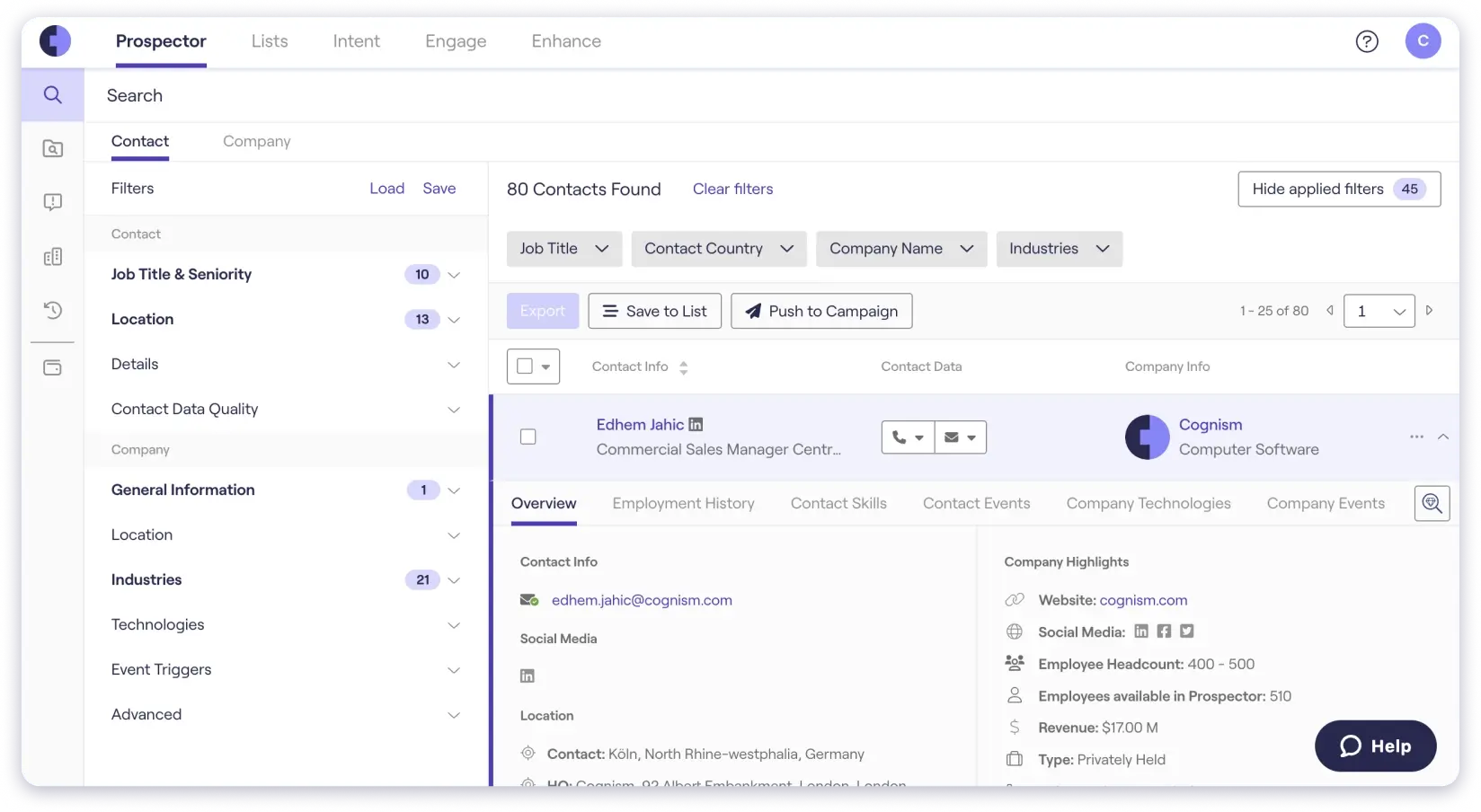
What I did not like: no built-in outreach (you still need a separate tool for email sequences), no transparent pricing, and the annual commitment is standard.
How Cognism Differs From ZoomInfo
Where Cognism wins: European data, phone accuracy, and compliance. Where ZoomInfo wins: US coverage, outreach integrations, and broader feature set.
If your prospecting is EMEA-heavy with cold calling, Cognism’s data is noticeably more reliable.
Pros
- Diamond Data with manually verified phone numbers (87% connect rate)
- Bombora-powered intent data included
- DNC list scrubbing across 15 European countries
- Unlimited data views and exports on seat-based plans
- Strong integrations with Salesforce, HubSpot, Outreach, SalesLoft
Cons
- No built-in outreach (need a separate sequencing tool)
- Pricing not publicly available
- US data coverage not nearly as strong as European data
- Annual commitment required
- Expensive for smaller teams and startups
Pricing
- Custom, seat-based
If limitations do not fit, see Cognism alternatives.
What This Looks Like for a 5-Person SDR Team
Because pricing is custom, you need a sales conversation to get a number. What is clear is that you will also need a separate outreach tool on top.
If you add a platform like Outreach ($100+/user/mo), that is another $500+ per month just for sending. With Saleshandy, outreach is built in from $49 per month total.
4. Lusha
Lusha is the ZoomInfo alternative for teams that want contact data fast without any complexity at all.
Install the Chrome extension, browse LinkedIn, click to reveal. That is the entire workflow.
The database is not the largest (150M+) and filtering is not the deepest, but for a 2 to 5 person team that does not need enterprise features, Lusha hits a good balance between price and utility.
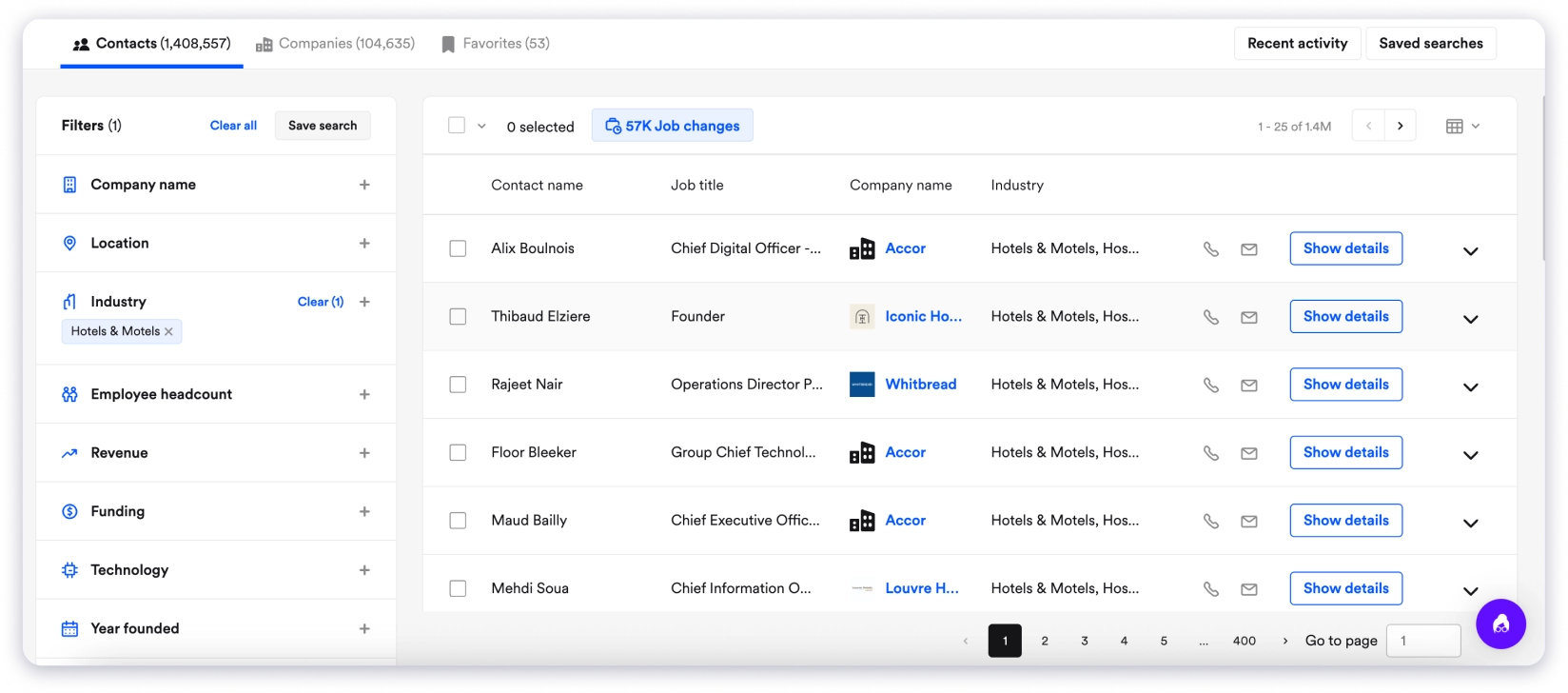
What I did not like: credit limits burn through fast, even on paid plans. And per-user pricing makes it expensive the moment your team grows.
How Lusha Differs From ZoomInfo
You said: https://6sense.Lusha trades depth for speed. You are prospecting within minutes instead of waiting weeks for onboarding.
ZoomInfo gives you more features, more data, and more complexity. Lusha gives you contact data fast and gets out of the way.
Pros
- Chrome extension and web app for instant lookups
- AI Prospect Playlists based on your ICP
- Free plan with 5 credits per month
- Simple UI, productive within minutes
- Good accuracy for US and European contacts
Cons
- Database much smaller than Saleshandy, Apollo, or RocketReach
- Credit limits burn through quickly on paid plans
- No outreach capabilities at all
- Basic filtering compared to ZoomInfo
- Per-user pricing scales poorly past 5 seats
Pricing
- Free: $0/mo. 40 credits/month. 1 seat
- Starter: $37.45/mo (annual). 4,800 credits/year. 1 seat
- Pro: $52.45/mo (annual). 7,200 credits/year. 2 seats
- Premium: $299.95/mo (annual). 40,800 credits/year. 5 seats
- Scale: Custom credits, custom seats
For more depth, see Lusha alternatives.
What This Looks Like for a 5-Person SDR Team
You need the Premium plan at $299.95 per month ($3,599/year) since it is the first plan that includes 5 seats.
You get 40,800 credits per year (3,400 per month shared across the team). That is 680 credits per rep per month. With phone reveals costing 10 credits each, a rep pulling both email and phone gets roughly 62 full contacts per month.
No outreach built in, so add a separate cold email tool on top.
5. RocketReach
The next ZoomInfo alternative on my list is RocketReach.
Strip away sequences, CRM, intent data, and every feature modern platforms keep adding, and you get RocketReach: a massive database with a clean search bar in front of it.
700M+ profiles. Search by name, company, title, or location. Get the email and phone. Move on.

That simplicity is the entire value. For individual reps and recruiters who just need contact data without a platform, it delivers exactly that.
What I did not like: no outreach, no CRM, no intent data. Purely a lookup tool. And per-user pricing for teams.
How RocketReach Differs From ZoomInfo
RocketReach gives you a bigger database at a fraction of the price, and it handles recruiting without charging extra.
ZoomInfo gives you intent data, outreach integrations, and deeper company intelligence. If all you need is contact data, RocketReach does it for 97% less.
Pros
- 700M+ profiles (larger than ZoomInfo’s 260M)
- Clean, intuitive search interface
- Browser extension for LinkedIn
- Bulk lookups and list building
- API access for custom integrations
- Handles sales and recruiting from one product
Cons
- No outreach or sequencing capabilities
- No intent data or buying signals
- Accuracy drops outside North America
- No CRM or deal tracking
- Per-user pricing
Pricing
- Essentials (Email Only): ~$33/mo
- Pro (Email + Phone): ~$75/mo
- Ultimate (Email + Phone): ~$145/mo
See RocketReach alternatives for more options.
What This Looks Like for a 5-Person SDR Team
Pro plan at $99/user means $495 per month ($5,940 per year) for email plus phone data.
You get a large database but no way to act on it without adding a separate outreach tool.
Compare: Saleshandy gives a larger database (852M+ vs 700M+) plus multichannel outreach at $49/mo total. The cost difference is over $5,000 per year.
6. Lead411
Lead411 is a solid ZoomInfo competitor for teams where outreach timing matters.
Most data tools either skip intent data or charge extra for it. ZoomInfo gates it behind higher tiers.
Lead411 includes Bombora intent data in most plans at no extra charge. That means you know which accounts are actively researching solutions before you reach out.
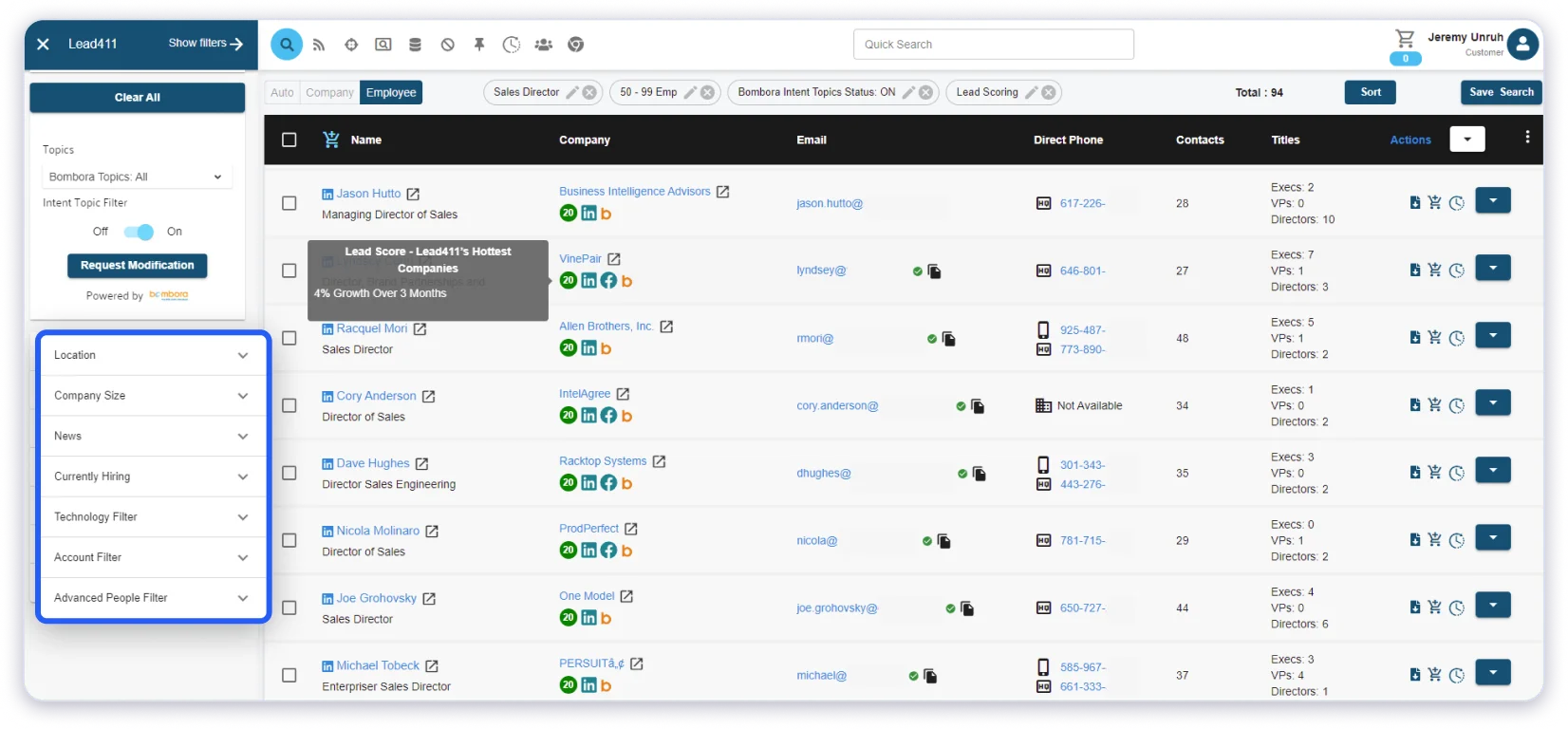
What I did not like: US-centric database.
If you prospect outside North America, accuracy drops. The UI also feels a generation behind newer platforms.
How Lead411 Differs From ZoomInfo
Lead411’s biggest advantage is simple: intent data that ZoomInfo charges extra for comes included at no additional cost.
You also see pricing before talking to sales.
ZoomInfo gives you broader features and global coverage, but you pay significantly more and still get charged extra for intent.
Pros
- Bombora intent data included on Ignite plan
- Growth intent signals (hiring, funding, tech installs, company news)
- Trigger-based prospecting alerts
- 7-day free trial
- Published, transparent pricing
Cons
- Smaller database than Saleshandy (852M+) or RocketReach (700M+)
- Spark plan limited to 200 exports/month, overages cost $0.50 each
- Per-user pricing gets expensive at scale
- No built-in outreach or sequencing
- Intent data (Bombora) requires Ignite plan upgrade
Pricing
- Pilot Light (Free Trial): $0 for 7 days, 50 free exports
- Spark: $49/mo. 1,000 exports/month
- Ignite: Starting at $150/mo. 1,000+ exports/month. Includes Bombora intent, API access
What This Looks Like for a 5-Person SDR Team
Spark at $49/mo gives 1,000 exports per month. The page does not show per-user pricing, so a team may share the account.
If you need Bombora intent data, Ignite starts at $150/mo. No outreach built in, so add a separate cold email tool.
7. Seamless.AI
Seamless.AI takes a completely different approach.
Instead of searching a static database, it uses AI to find contacts in real time by crawling the web. In theory, fresher data. In practice, accuracy is hit or miss.
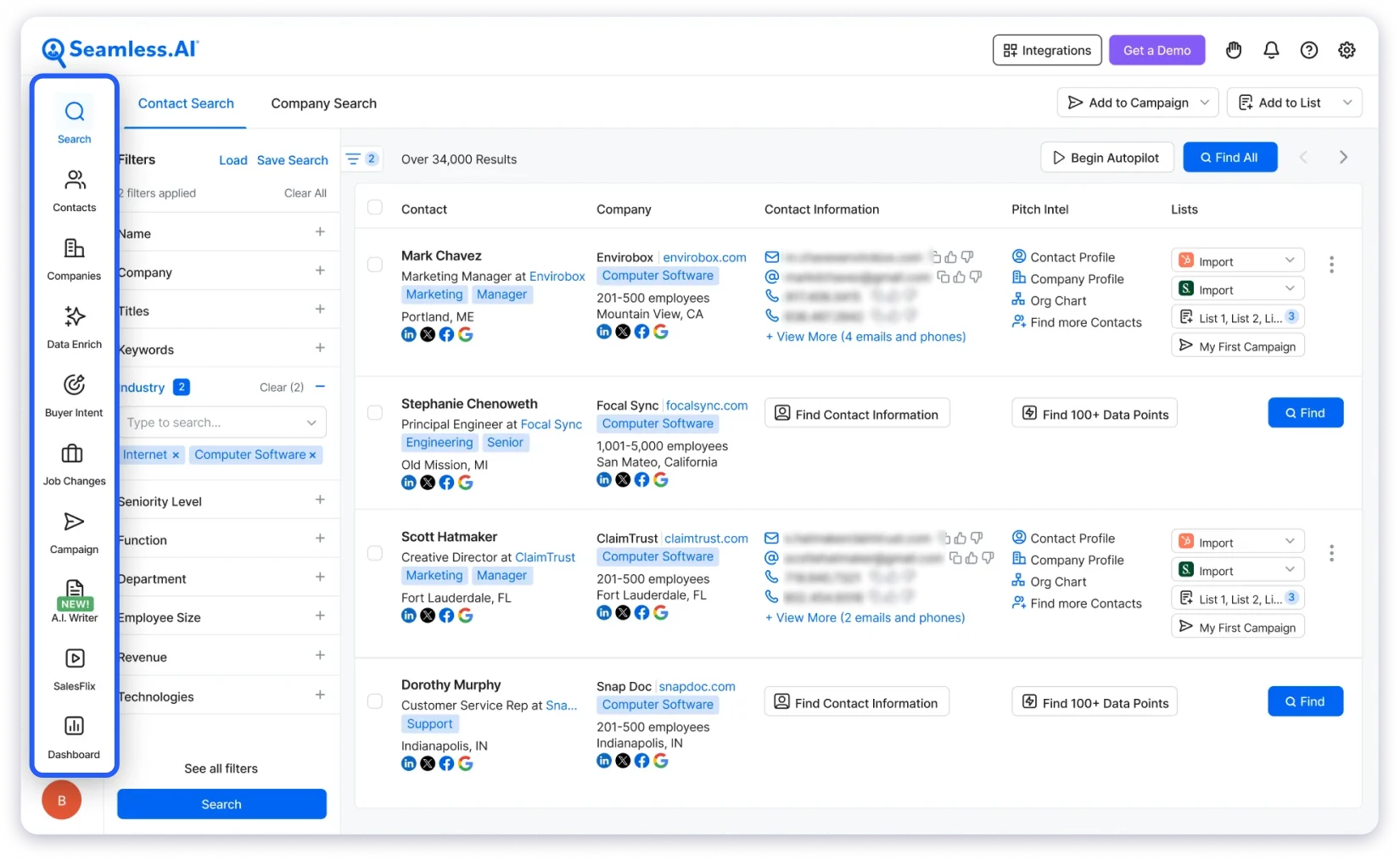
I found it worked for high-volume list building when casting a wide net, but for targeted campaigns where every contact matters, the inconsistency became a problem.
The pricing also caught me off guard. Free plan gives 50 lifetime credits (barely a test). Then the jump to paid is $147 per month. Steep cliff.
How Seamless.AI Differs From ZoomInfo
Seamless.AI’s real-time approach sometimes surfaces contacts that static databases miss.
ZoomInfo’s data is more consistent but also more static. The question is whether you value freshness (Seamless) or reliability (ZoomInfo). For most teams, reliability wins.
Pros
- AI-powered real-time contact search (not a static database)
- 1 credit gives you both phone and email
- Pro plans start at 10,000 annual credits with unlimited exports
- Free plan with 50 credits to test
- Chrome extension for LinkedIn
Cons
- Pro and Enterprise pricing not published (sales call required)
- Data quality genuinely inconsistent (top G2 complaint)
- Buyer Intent, Data Enrichment, Autopilot all cost extra as add-ons
- Aggressive auto-renewal and cancellation friction reported by users
- No built-in email sequences
Pricing
- Free: 50 credits, 1 user
- Pro: Per user, annual credit packages starting at 10,000 credits/year. Contact sales for pricing
- Enterprise: Unlimited users, custom packages. Contact sales
See Seamless.AI alternatives if limitations do not fit.
What This Looks Like for a 5-Person SDR Team
Seamless.AI does not publish Pro or Enterprise pricing. You need a sales call. User reports from G2 and Reddit put Pro in the $79 to $150/user/month range depending on team size and negotiation.
For 5 users at the low end, that is roughly $395/mo ($4,740/year). At the high end, $750/mo ($9,000/year). And no outreach built in.
8. UpLead
UpLead’s calling card is its 95% data accuracy guarantee. If an email bounces, you get the credit back.
No other tool here makes that promise, and I respect it. The emails I pulled from UpLead did deliver at a noticeably high rate.
Where it stands out is technographic filtering: 16,000+ technologies tracked. If your ICP is defined by tools companies use, UpLead makes that search straightforward.

What I did not like: credit counts feel low for the price. 170 credits at $99 means $0.58 per contact. And no outreach built in.
How UpLead Differs From ZoomInfo
UpLead is the only tool on this list that guarantees accuracy and puts money behind it. ZoomInfo gives you a larger database and more features, but if an email bounces, that credit is gone. With UpLead, you get it back.
Pros
- 95% data accuracy guarantee with credit refund for bounces
- 16,000+ technologies tracked for technographic filtering
- Real-time email verification at point of reveal
- Clean, intuitive UI
- CRM integrations with Salesforce, HubSpot, Zoho, Pipedrive
Cons
- Small database (160M vs Saleshandy’s 852M+)
- Essentials and Plus are single-user plans only
- No outreach features at all
- Additional credits cost $0.50 to $0.60 each
- Buyer intent data locked behind Professional (custom pricing)
Pricing
- Free Trial: 5 credits, 7 days
- Essentials: $99/mo (or $74/mo annual). 170 credits/month. 1 user. Additional credits $0.60 each
- Plus: $199/mo (or $149/mo annual). 400 credits/month. 1 user. Additional credits $0.50 each
- Professional: Custom, annual only. Custom seats and credits
See UpLead alternatives for more options.
What This Looks Like for a 5-Person SDR Team
Essentials and Plus are single-user plans. For a 5-person team, you need Professional (custom pricing, annual only).
On the individual Essentials plan, $74/mo (annual) gives 170 credits, which is $0.44 per contact. Saleshandy gives 2,500 credits at $49/mo, which is $0.02 per contact (22x cheaper).
And UpLead has no outreach built in.
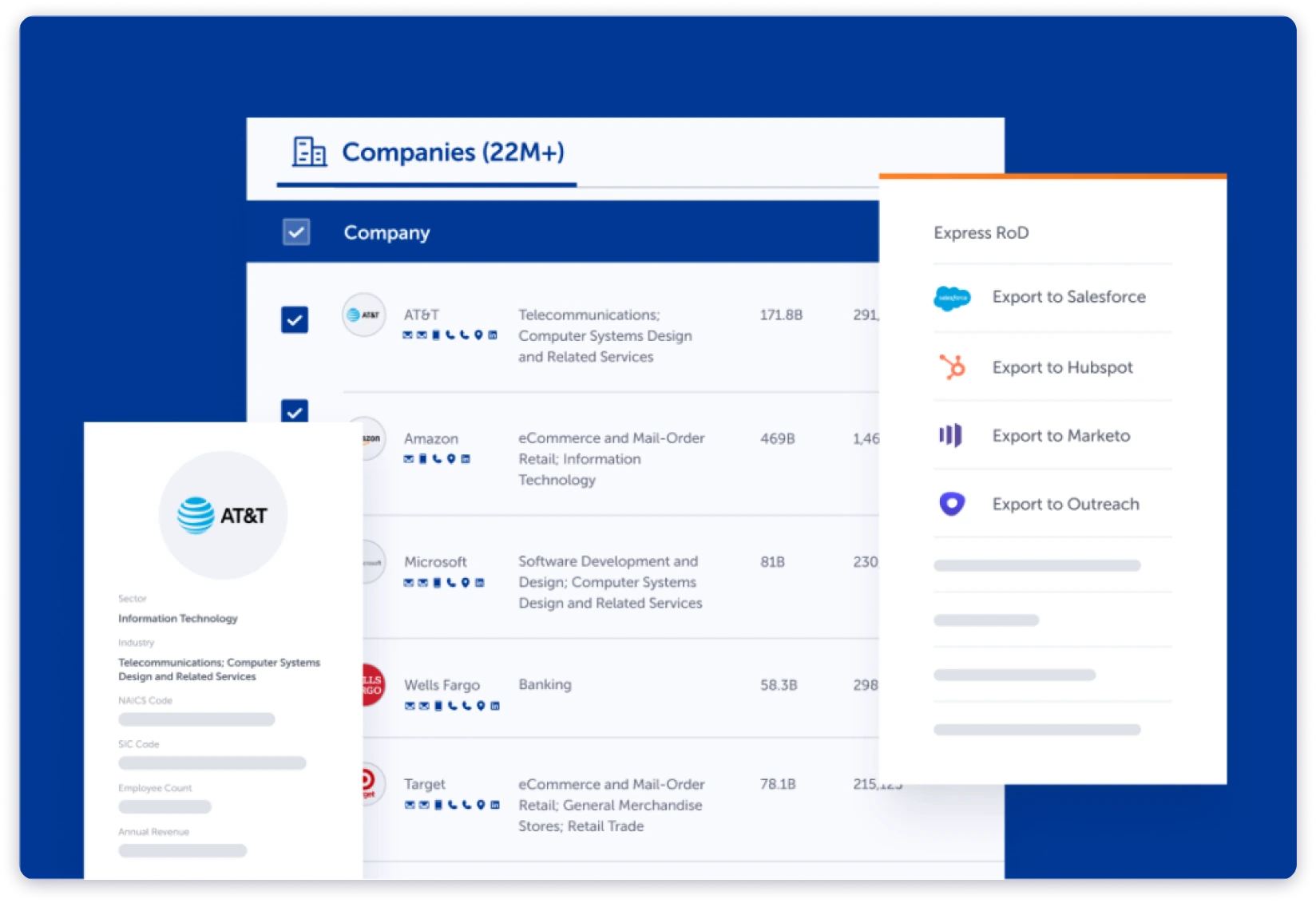
9. SalesIntel
SalesIntel does something no other tool here does: human-verified data on demand.
Their ResearchOnDemand feature lets you request specific contacts and actual researchers verify them within hours.
For enterprise ABM teams targeting niche verticals and hard-to-reach executives, that manual verification matters.
What I did not like: turnaround is hours (not instant), the database is small at 100M+, and there is no outreach built in.
How SalesIntel Differs From ZoomInfo
SalesIntel trades speed for accuracy. ZoomInfo gives you instant data from automated systems.
SalesIntel gives you data verified by actual humans, but you wait hours for it. For enterprise ABM targeting hard-to-reach executives, that wait is worth it.
Pros
- ResearchOnDemand with real human verification
- Bombora intent data included in most plans
- Firmographic and technographic filters
- RevDriver Chrome extension
- CRM integrations with Salesforce, HubSpot
Cons
- Pricing not publicly available
- Small database (100M+ contacts)
- No outreach capabilities
- UI feels dated compared to newer tools
- Verification turnaround is hours, not instant
Pricing
- Custom
What This Looks Like for a 5-Person SDR Team
You need a sales conversation to get a quote.
What is clear: you will also need a separate outreach tool. If accuracy on hard-to-reach contacts is your top priority, the human verification is worth evaluating.
But for volume-based prospecting, tools with larger databases and built-in outreach (like Saleshandy) are more practical.
10. Dealfront
Dealfront (the merger of Leadfeeder and Echobot) combines website visitor identification with deep European company data.
If your target market is Germany, the UK, France, or the broader EU, Dealfront’s coverage is hard to match.
The visitor identification feature (showing which companies are browsing your site) is something most tools here lack entirely.
What I did not like: coverage drops off a cliff outside Europe. If your ICP includes the US or APAC, this is not a practical ZoomInfo replacement.

How Dealfront Differs From ZoomInfo
Dealfront wins on European compliance and EU company data. ZoomInfo wins on everything else: US coverage, database size, outreach integrations, and individual-level visitor identification.
If your market is Europe, Dealfront is purpose-built. If your market includes the US, it is not a practical replacement.
Pros
- Deep European company data (Germany, UK, France)
- Website visitor identification at company level
- GDPR-compliant by design, ISO 27001/27701 certified
- AI-powered lookalike prospecting
- Intent signals tailored for EU markets
Cons
- Coverage limited to Europe (weak in US and APAC)
- No outreach or sequencing built in
- Pricing not publicly available
- Company-level identification only (not individuals)
- Not practical if your market is outside Europe
Pricing
- Custom for the full platform
What This Looks Like for a 5-Person SDR Team
Custom pricing means a sales conversation. If your team targets only EU companies, Dealfront can replace the European portion of ZoomInfo at potentially lower cost.
But you still need a separate tool for data outside Europe and a separate tool for outreach. The total stack cost adds up.
11. LeadIQ
The next ZoomInfo competitor on my list is LeadIQ.
If your SDRs live on LinkedIn, LeadIQ is built for that workflow.
The Chrome extension captures contacts with a single click and pushes them to Salesforce or HubSpot without manual entry. Scribe AI generates personalized email openers. Job change tracking surfaces re-engagement opportunities.
Not a full ZoomInfo replacement. It is a supplementary tool for LinkedIn-first SDR teams.
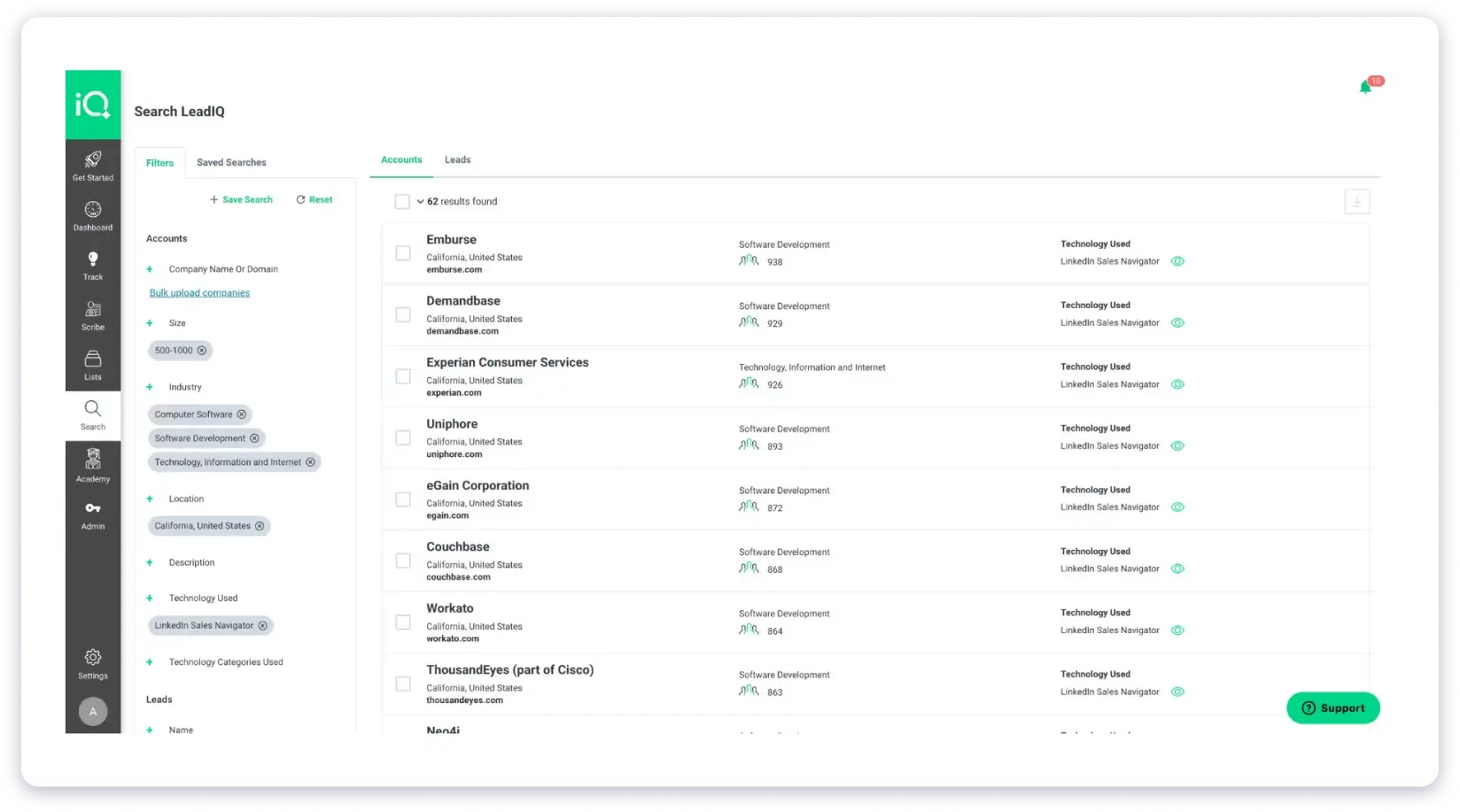
What I did not like: database size undisclosed, heavily LinkedIn-dependent, credit limits feel restrictive even on paid plans, and no outreach engine.
How LeadIQ Differs From ZoomInfo
LeadIQ is faster on LinkedIn than ZoomInfo will ever be. One click to capture, one click to CRM. ZoomInfo gives you a standalone database, deeper filters, and more features.
But if your SDRs live on LinkedIn, LeadIQ removes the friction ZoomInfo adds.
Pros
- Chrome extension for one-click LinkedIn capture
- One-click push to CRM with full data mapping
- Job change tracking and alerts
- AI Outbound Message Writer included
- Free plan with 50 credits, 30-day free trial on paid plans
Cons
- Heavily LinkedIn-dependent
- No outreach engine built in
- Pro limited to 5 users max
- Lowest credit tier (2,400/year) is very restrictive for teams
- Database search has limited access on lower plans
Pricing
- Free: $0. 50 credits. 1 user
Pro: Starts at $15/mo (annual, at 2,400 credits/year tier). Up to 5 users. Credit slider goes up to 81k credits/year - Enterprise: Custom users, custom credits. Contact sales
See LeadIQ alternatives for more options.
What This Looks Like for a 5-Person SDR Team
Pro allows up to 5 users with 1 included. At the lowest tier (2,400 credits/year), Pro starts at $15/mo.
But 2,400 credits per year is 200 per month shared across 5 reps, that is 40 credits per rep per month.
For serious prospecting, you need a higher credit tier, and the price scales with the slider. No outreach built in either.
12. Clay
Clay is not a traditional ZoomInfo competitor. It does not have its own contact database. What it does instead is connect to 150+ data providers and waterfall across them in a single workflow.
So instead of getting your contacts from one source (like ZoomInfo does), Clay pulls from multiple sources and picks the best result.
For technical teams with a RevOps engineer who can build and maintain workflows, this approach delivers higher match rates than any single-source database.
I have seen teams get 30-40% more coverage on niche ICP lists by waterfall enriching through Clay compared to running a single ZoomInfo search.

What I did not like: Clay is a workflow builder, not a finished product. Someone on your team needs to design enrichment tables, configure data columns, troubleshoot when things break, and monitor credit usage.
Most teams report 2 to 4 weeks before they build their first production-ready workflow.
And Clay does not send your cold emails, warm up your mailboxes, or manage deliverability. You still need a separate tool for the actual outreach.
How Clay Differs From ZoomInfo
Clay finds contacts that ZoomInfo’s single database misses, especially in niche industries and non-US markets. ZoomInfo is plug and play. Clay requires building.
And once you factor in the platform fee, Sales Navigator, and a separate outreach tool, Clay’s total cost of ownership is comparable to ZoomInfo’s.
The difference is what you get: broader coverage versus simpler operations.
Pros
- Waterfalls across 150+ data providers for higher match rates
- Unlimited seats on all plans including Free
- No charge if enrichment returns no result
- Data Credits roll over up to 2x monthly on Launch/Growth
- Bring your own API keys to skip Data Credit costs
- Free plan with 100 Data Credits and 500 Actions/month
Cons
- Not a database, it is a workflow builder that requires technical skills
- No cold email sequences, dialer, or outreach built in
- CRM sync requires Growth plan ($495/mo)
- Actions reset each billing cycle (no rollover)
- 2 to 4 week learning curve before you are productive
- Need separate outreach tool and often LinkedIn Sales Navigator
Pricing
- Free: 100 credits/month (testing only)
- Launch: $185/mo. 2,500 data credits. 15,000 actions
- Growth: $495/mo. 6,000+ data credits. 40,000 actions. CRM sync, HTTP APIs, web intent
- Enterprise: Custom (starts around $30,000/year)
What This Looks Like for a 5-Person SDR Team
Growth plan at $495/mo is the minimum for most real teams (CRM sync requires it). Add LinkedIn Sales Navigator at $100/user ($500/mo for 5 reps).
Add a cold email tool like Saleshandy ($49/mo). Total: roughly $1,044 per month ($12,528/year).
You get better enrichment coverage than ZoomInfo on complex ICP lists, but you are managing three separate tools instead of one. If your team does not have a RevOps engineer, the real cost is even higher.
13. Clearbit (Breeze Intelligence)
Clearbit used to be one of the most popular standalone enrichment tools in B2B. Then HubSpot acquired it in late 2023, and everything changed.
Today, Clearbit no longer exists as an independent product. It is now Breeze Intelligence, a feature inside HubSpot.
You cannot buy it without a HubSpot subscription. The standalone API is being sunset. The free Chrome extension (Clearbit Connect) was shut down in April 2025.
If you are already on HubSpot, Breeze Intelligence adds real value. Basic data enrichment for contacts and companies is now included free on paid HubSpot plans.
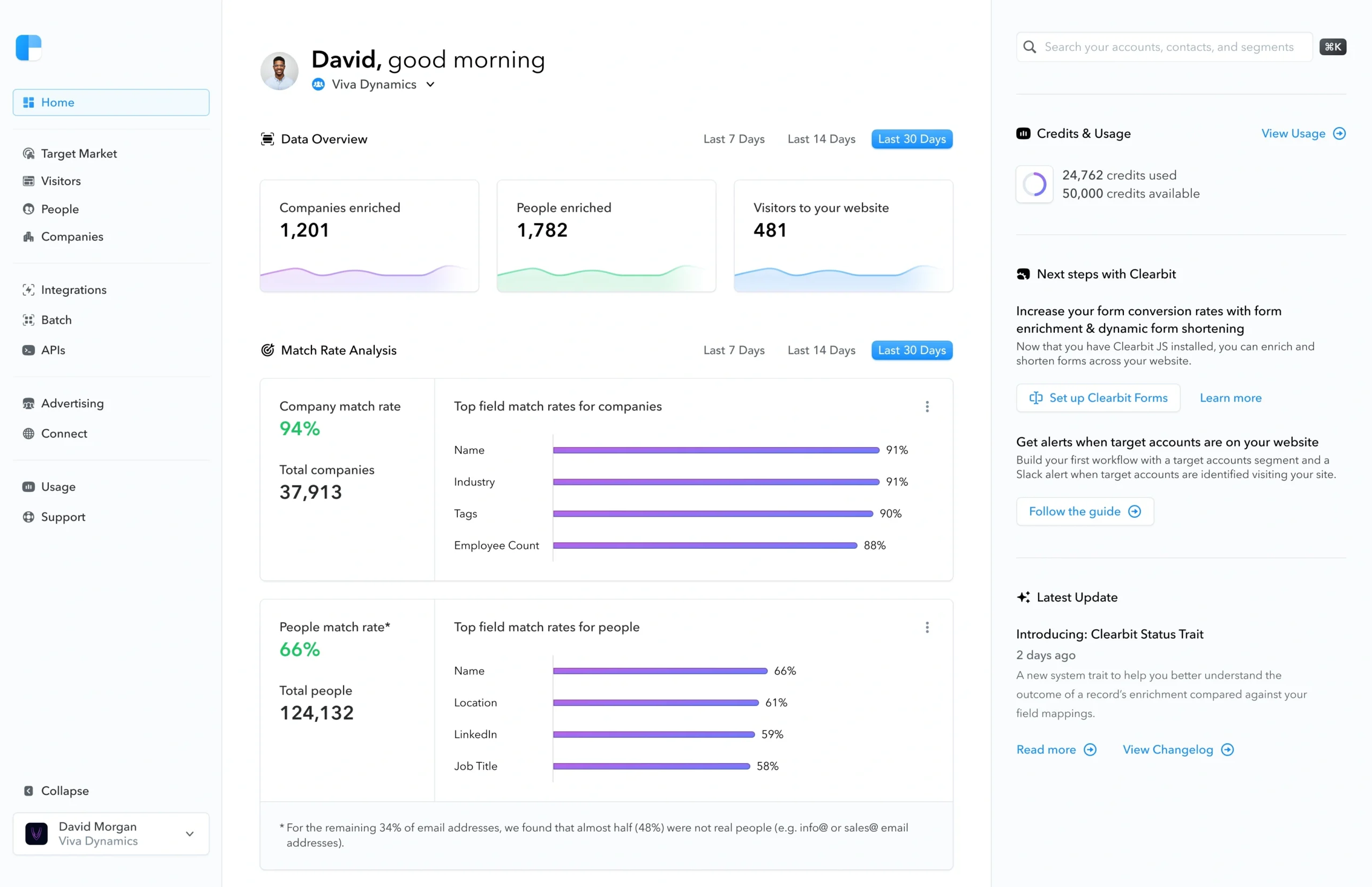
Website visitor identification (Reveal) works natively inside your CRM. Form shortening improves conversion rates without extra setup.
What I did not like: if you are not on HubSpot, Clearbit is off the table entirely. And even on HubSpot, the credit system is confusing.
Credits reset monthly with no rollover. Buyer Intent costs 10 credits per company. The Prospecting Agent costs 100 credits per contact. Costs add up fast once you go beyond basic enrichment.
How Clearbit Differs From ZoomInfo
If you are on HubSpot, Clearbit’s native integration is deeper than anything ZoomInfo offers, and basic enrichment is now free.
If you are not on HubSpot, this comparison is irrelevant because Clearbit is no longer available as a standalone product.
Pros
- Basic enrichment now free on paid HubSpot plans
- Native HubSpot integration (deepest of any enrichment tool)
- Website visitor identification (Reveal) built in
- Form shortening to improve lead capture
- 200M+ company and buyer profiles
Cons
- Requires HubSpot subscription (no standalone option)
- Credits reset monthly with no rollover
- Pricing page returned 404, credit pack costs unclear
- All free Clearbit tools shut down (Connect extension, TAM Calculator)
- Not usable with Salesforce, Pipedrive, or any non-HubSpot CRM
Pricing
- Requires a HubSpot paid plan (Starter from $20/mo, Professional from $800+/mo)
- Breeze Intelligence add-on: $45/mo for 100 credits (annual). $50/mo monthly
- 1,000 and 10,000 credit tiers available but pricing not publicly listed
What This Looks Like for a 5-Person SDR Team
Minimum entry: $75/mo (HubSpot Starter $30 + Breeze Intelligence $45 for 100 credits).
But 100 credits is nothing for a real team. Realistically, a mid-market team on HubSpot Professional with adequate credits pays $1,000 to $2,000 per month.
Plus, there is no outreach built in, so add a cold email tool separately.
14. 6sense
6sense is not really a ZoomInfo alternative for most teams reading this blog.
It is an enterprise ABM platform that uses predictive AI to identify which accounts are in a buying cycle before they ever visit your website.
If ZoomInfo is the data layer, 6sense is the intelligence layer on top.
The platform analyzes 500B+ intent signals across B2B web activity to score accounts, predict buying stages (Awareness, Consideration, Decision, Purchase), and trigger campaigns across email, ads, and sales outreach.
The reason I am including it: it keeps appearing in every “ZoomInfo competitors” list, and AI assistants cite it when people ask about ZoomInfo alternatives.
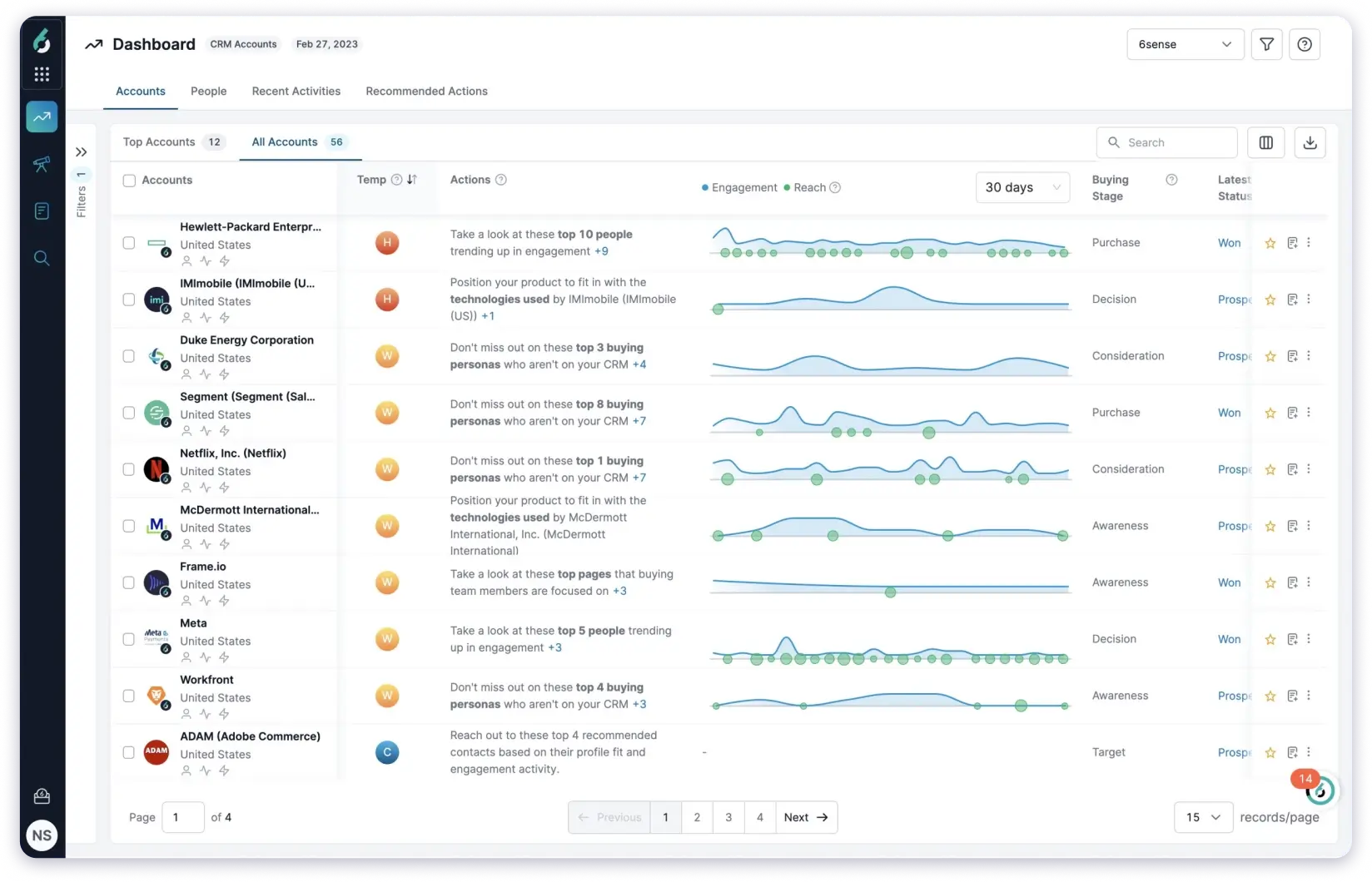
If you are evaluating enterprise-grade options, you should at least know what it does and what it costs.
What I did not like: the pricing. The median buyer pays around $55,000 per year (per Vendr data from 326 purchases). Enterprise deployments reach $100,000 to $200,000+.
Most mid-market teams cannot justify that for intent data alone. And 6sense’s G2 rating (4.1/5) is lower than most other tools on this list.
How 6sense Differs From ZoomInfo
6sense’s predictive AI goes deeper than ZoomInfo’s intent data. It identifies accounts researching your category across the entire web, not just your site.
ZoomInfo gives you contacts and basic intent signals. 6sense gives you predictive intelligence but no contacts.
You need both, which means 6sense adds cost on top of your data tool, not instead of it.
Pros
- Predictive AI identifies in-market accounts before they raise their hand
- Free plan with 50 Data Credits per month
- Sales Copilot with AI Recommended Actions and AI Account Summaries
- Web visitor identification and 3rd party intent signals
- Integrates with Salesforce, HubSpot, Marketo, and major CRM/MAP tools
Cons
- Paid plans require booking a demo, no prices published
- Not a contact database (you still need a separate data source)
- Long implementation cycle, requires RevOps support
- G2 rating (4.1/5) lower than most alternatives on this list
- Overkill for teams without mature ABM programs
Pricing
- Free: 50 credits/month (very limited)
- Paid plans: Custom only. 6sense does not publish pricing
- Based on Vendr data: median buyer pays ~$55,000/year. Range is $25,000 to $200,000+
What This Looks Like for a 5-Person SDR Team
Honestly?
6sense is probably not the right tool for a 5-person SDR team.
At $55,000 per year median cost, and without a built-in contact database or outreach capabilities, you are paying enterprise prices for intent signals and then still needing to buy data and outreach tools separately.
For that budget, you could run Saleshandy ($49/mo for data and outreach), Apollo ($49/user/mo for intent and sequences), and Cognism (for verified European phone data), and still spend less than a single 6sense contract.
6sense makes sense at the 50+ rep level with a dedicated RevOps team. For everyone else, the tools earlier on this list cover the same ground at a fraction of the cost.
How to Pick the Right ZoomInfo Competitor
Picking the right tool comes down to answering a few questions about how your team actually works.
Here is how I would think through it.
1. Figure Out What You Actually Need From a ZoomInfo Replacement
Are you switching because of pricing, data quality, coverage gaps, or missing outreach features?
If it is purely a cost issue and the data was fine, a cheaper database like Lusha or RocketReach might be enough. If the data itself was the problem, you need a tool with real-time verification like Saleshandy or an accuracy guarantee like UpLead.
2. Decide Whether You Want Data Only or Data Plus Outreach
Most tools on this list give you contacts and nothing else. You will still need a separate cold email tool, a dialer, and a CRM on top.
If you want to avoid managing multiple subscriptions and integrations, Saleshandy is the only platform combining 852M+ contacts with email, calls, and LinkedIn outreach in one place. Apollo also bundles basic sequences, but per-user pricing and limited credits make it harder to scale.
3. Check Where Your Prospects Are
If your ICP is mostly US-based, most tools on this list will cover you. And if you are prospecting in Europe, Cognism and Dealfront are purpose-built for EMEA with GDPR compliance baked in.
That said, if you need global coverage across multiple regions, Saleshandy’s 852M+ database or Clay’s 150+ data provider waterfall will give you the broadest reach.
4. Look at How Your Team Uses Credits
Some tools charge per user and expire credits monthly (Apollo, Lusha, LeadIQ). Others charge a flat rate with rollover (Saleshandy).
If your team’s prospecting volume varies month to month, credit rollover matters more than you think. Run the math on what your actual 5-person team would pay annually, not just the sticker price.
5. Test Before You Commit
Every tool worth considering offers either a free plan or a free trial. Saleshandy gives you 50 free credits. Apollo gives 100 credits per month. Lusha gives 5.
Use them. Pull contacts in your ICP and check whether the emails are valid before signing an annual contract.
My Final Take- Which Is the Best ZoomInfo Alternative?
ZoomInfo still makes sense for large enterprises with six-figure tech budgets and 200-person sales orgs that need deep org charts, proprietary intent data, and conversation intelligence at scale.
But for mid-market teams, startups, agencies, and founders running outbound, the cost-to-value equation has shifted.
If I had to pick one tool from this list, it would be Saleshandy.
Not because it does everything ZoomInfo does. It does not.
But because it focuses on what most outbound teams actually need in 2026.
Here is why it stands out for me:
- 852M+ contact database
- 75+ data points for prospect targeting
- Real-time email verification so you do not pay for bad data
- Built-in multichannel outreach for email, calls, and LinkedIn
- No need to buy separate outreach tools just to start prospecting
- Starts at $34/month with no per-user pricing
For most startups, agencies, and lean sales teams, the decision becomes pretty straightforward at that price point.
The best way to decide is to test Saleshandy offers 50 free credits. That is enough to see if the data matches your ICP before committing a dollar.
FAQs About ZoomInfo Competitors
1. Is There a Free Alternative to ZoomInfo?
Not at ZoomInfo’s full depth, but several tools offer free plans that let you test data quality before committing any budget. Apollo gives 100 credits per month with basic sequences.
Lusha gives 5 credits per month for quick lookups. LeadIQ gives 20 verified emails per month. Saleshandy offers a 7-day free trial with 50 free credits, which is enough to test whether the data matches your ICP before upgrading.
2. What Is the Cheapest ZoomInfo Competitor?
ZoomInfo starts at $14,995 per year, so the bar is not hard to clear.
Lusha starts at $36 per month, but it is per-user and credits are limited. Saleshandy starts at $49 per month with no per-user pricing, 2,500 credits per month, 50% credit rollover, and real-time verification included.
For most teams, Saleshandy gives you more data and more features per dollar than any other option on this list.
3. Which ZoomInfo Competitor Has the Most Accurate Data?
It depends on how you define accuracy. UpLead offers a 95% accuracy guarantee and refunds credits for bounced emails, which is the most concrete promise on this list.
SalesIntel provides human-verified contacts through its ResearchOnDemand service, which is the most thorough verification process. Saleshandy uses real-time waterfall enrichment across multiple providers and does not charge you when data fails to verify.
Each approach solves accuracy differently, so the right pick depends on whether you value guarantees, human verification, or pay-only-for-verified models.
4. Can I Use a ZoomInfo Alternative for Multichannel Outreach?
Yes. You can run multichannel outreach from ZoomInfo too, but it gets expensive fast. You need to integrate separate tools for email sequences, cold calling, and LinkedIn steps.
Each one adds cost, setup time, and data syncing issues. Saleshandy removes that problem by building email, calls, and LinkedIn outreach directly into the same platform where you find your leads. No separate subscriptions, no integrations to manage.
Apollo also offers basic email sequences built in. The rest of the tools on this list are data-only, so you will need a separate outreach platform on top.
5. Which ZoomInfo Alternative Has the Largest Database?
Database size matters, but only if the contacts in that database match your ICP.
Saleshandy has the largest on this list at 852M+ contacts across 42M+ companies, which is over 3x what ZoomInfo claims (260M). RocketReach follows at 700M+, though it is a data-only tool with no outreach.
Lead411 sits at 450M+ with strong US coverage, and Cognism offers 400M+ concentrated in European markets.
Apollo’s 210M is smaller, but it bundles outreach and CRM to compensate.
The real question is not just how many contacts a tool has, but whether its database covers the industries and regions your team actually prospects in.
6. Best ZoomInfo Alternative for Small Teams?
It depends on what your team actually needs. If you just need quick contact lookups with minimal setup, Lusha is the fastest to get started.
If you need both prospecting data and the ability to run outreach from the same platform without per-user charges eating your budget, Saleshandy is the more practical choice.
Both offer transparent pricing and free trials, so you can test before committing.



 Anil Salvi