

50% of your outreach success depends on one thing: the quality of your prospecting.
That’s exactly what sales prospecting tools are built to solve. They help you find the right prospects, verify their contact details, and in many cases, reach out to them directly from the same platform.
But the sales prospecting tools market is crowded. Every tool claims the largest database, the most accurate data, and the smartest AI features.
But not all of them back it up.
In this blog, you’ll find a curated list of the 11 best sales prospecting tools for 2026.
For each tool, I’ve covered what it actually does well, where it falls short, how much it costs, and what type of team it’s best suited for.
By the end, you’ll know exactly which tool fits your prospecting workflow and budget
Sales Prospecting Tools – TOC
TL;DR: Which Sales Prospecting Tool Should You Pick?
Not every tool fits every team. Here’s how to pick based on what you actually need:
| Your Priority | Best Tool | Why |
|---|---|---|
| AI-powered prospecting + cold email outreach | Saleshandy Lead Finder | 800M+ database, AI lead search, 75+ filters, built-in cold email sequencing, and outreach CRM starting at $25/mo |
| Large database + multi-channel sequencing | Apollo.io | 275M+ contacts with email, phone, and LinkedIn steps in one sequence builder |
| Enterprise-grade data + intent signals | ZoomInfo | 260M+ profiles, 1B+ monthly buying signals, 90%+ data accuracy backed by 300+ human researchers |
| European market + GDPR compliance | Cognism | Phone-verified mobile numbers in EMEA, built for cold calling teams selling into the EU |
| Quick contact lookups with zero setup | Lusha | Chrome extension that reveals emails and phone numbers in one click from LinkedIn |
| Data enrichment from 75+ sources | Clay | Takes your existing list and layers on firmographic, technographic, and intent data from multiple providers |
| Relationship-based social selling | LinkedIn Sales Navigator | Advanced filters + warm introduction paths through existing network connections |
| CRM with built-in prospecting features | HubSpot Sales Hub | Free CRM with email tracking, automation, and pipeline management |
| Simple pipeline + lightweight prospecting | Pipedrive | Visual pipeline with LeadBooster for basic prospecting |
| High-volume cold email deliverability | Instantly | Unlimited sending accounts, auto warm-up, sender rotation built for agencies and scale |
| Cold email personalization | Lemlist | Advanced personalization with images, videos, and dynamic content |
If you’re short on time: Saleshandy Lead Finder has the largest database on this list at 800M+ contacts with real-time verified data.
Test it against your ICP with 50 free Lead Finder credits.
11 Best Sales Prospecting Tools for 2026
Each of these 11 sales prospecting tools solves a different part of the prospecting problem.
I’ve grouped them by what they’re strongest at — finding contacts, enriching data, social selling, CRM, or cold email — so you don’t waste time reading about tools that aren’t relevant to you.
Best All-in-One Sales Prospecting and Outreach Tools
These sales prospecting tools combine contact databases with built-in outreach capabilities.
You find prospects and reach out to them from the same platform, instead of juggling separate tools for data and email.
1. Saleshandy Lead Finder — Best AI-Powered Sales Prospecting Tool
Best for ⭐
SMBs, startups, solopreneurs, and agencies that want AI-powered prospecting and cold email outreach in one platform.
G2 Rating
4.6/5
The #1 sales prospecting tool on my list is Saleshandy Lead Finder, and it’s #1 for two core reasons:
- It has the largest B2B database on this list at 800M+ contacts. That’s 3x Apollo’s 275M+ and 8x Lusha’s 100M+. When you’re targeting niche segments, database size is the difference between finding 10 prospects and finding 200.
- Every contact goes through waterfall enrichment in real time. That means the email and phone number you see have been cross-verified across multiple data providers before they reach you. Not scraped once and stored for months.
On top of that, you get 75+ advanced search filters, AI-powered lead search that takes plain English prompts, and built-in buying signals to prioritize prospects who are actively hiring, recently funded, or showing purchase intent.
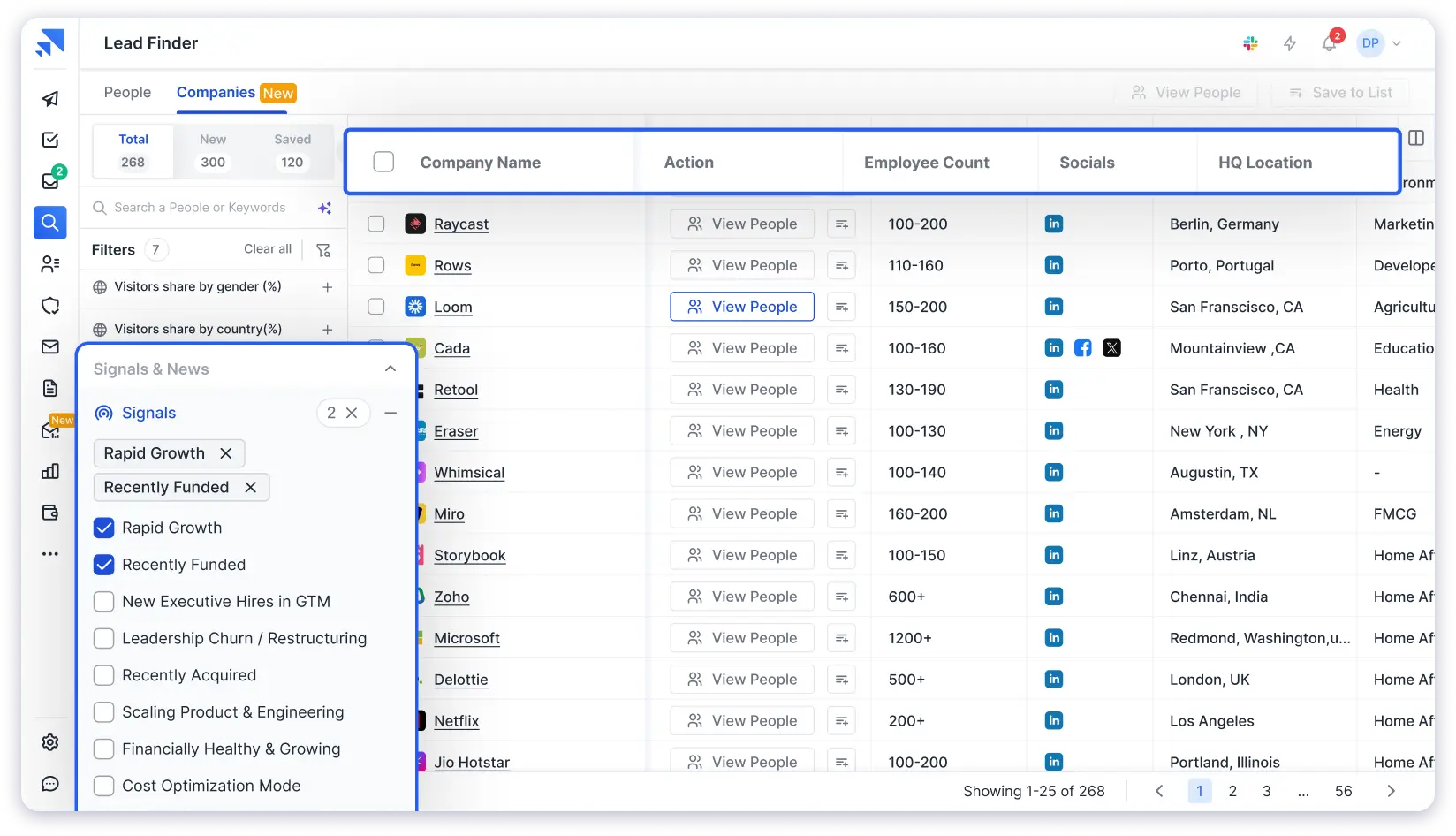
Here’s how you actually build a targeted list in Saleshandy Lead Finder:
Step 1: Define your target using filters or AI search
You can either set filters manually (job title, seniority, company size, revenue, industry, location, tech stack, funding stage) or type a natural language prompt like “find CTOs at fintech startups in London with 20-100 employees.”
The AI translates your description into a filtered search and returns matching, verified contacts.
Step 2: Review and refine your results
The results show you each prospect’s name, job title, company, verified email, phone number, and company details.
You can add or remove filters to widen or narrow the list until it matches your ICP exactly.
Step 3: Save prospects and start outreach
Once your list is ready, you can save prospects directly into your Saleshandy account.
From there, you can add them to a cold email sequence, send 1:1 emails, or track them in the Saleshandy CRM pipeline. No CSV exports to another tool. No re-importing contacts. Everything stays connected.
Saleshandy also gives you AI Sequence Copilot for building personalized outreach, A-Z variant testing, sender rotation, and a full deliverability suite with warm-up, bounce detection, and inbox placement testing.
These aren’t the reason it’s #1 on this list, but they mean you go from “finding a lead” to “emailing them” without leaving the platform.
Pricing
- Outreach plans start at $25/mo (annual).
- Lead Finder starts at $49/mo with 30,000 credits/year.
- 7-day free trial with 50 free Lead Finder credits, no credit card required.
Limitations
- Free trial limited to 50 credits
- Requires paid plan for scale
2. Apollo.io — Best Sales Prospecting Tool for Multi-Channel Sequencing
Best for ⭐
Teams that want a large database with multi-channel sequencing.
G2 Rating
4.7/5
The next sales prospecting tool on this list is Apollo.io. It’s probably the most talked-about prospecting platform right now, and for good reason.
The database covers 275M+ contacts with 65+ filters, and you can build multi-step sequences that include email, LinkedIn, and phone touchpoints.
The contact data is solid for US-based prospects. Accuracy drops noticeably for EMEA and APAC regions, which is worth knowing if your ICP isn’t purely North American.
The Chrome extension works well for prospecting directly from LinkedIn. And the intent data (powered by Bombora integration) helps surface accounts that are actively researching solutions in your category.
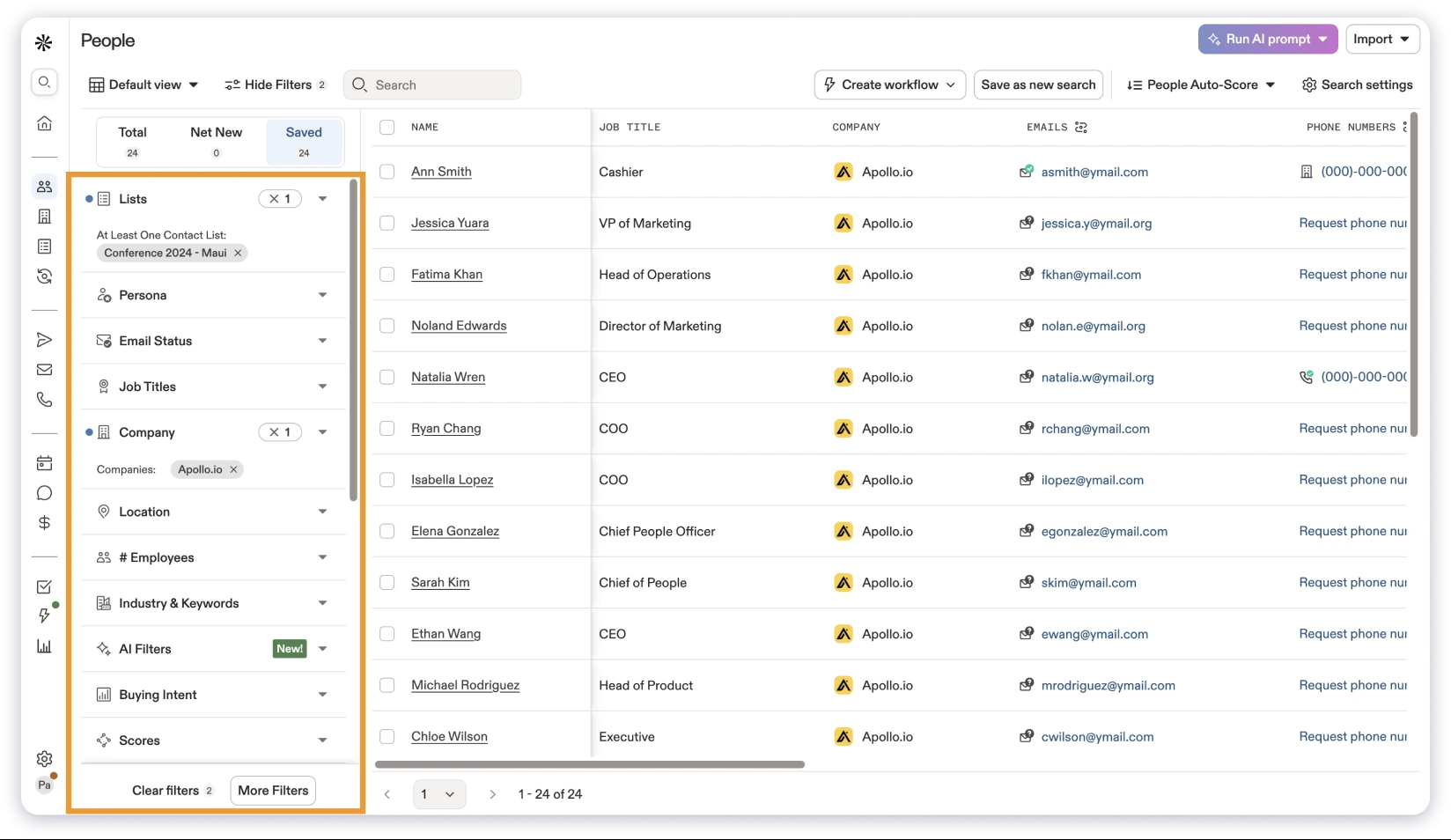
The catch is the credit system.
The Basic plan gives you 900 credits per year, which sounds decent until you realize that revealing an email costs 1 credit and a phone number costs 5-8 credits.
At 6 credits per fully enriched contact, 900 credits covers about 150 contacts for the entire year.
Credits don’t roll over, so anything unused at the end of your billing cycle disappears.
I’ve covered Apollo’s limitations in more detail in my Apollo.io alternatives blog, including how the credit economics compare against other tools at scale.
Pricing
- Free plan available.
- Basic starts at $49/user/mo (annual).
- Professional at $79/user/mo.
- Organization at $119/user/mo.
- Per-user pricing means costs scale linearly with team size.
Limitations
- Data accuracy drops outside North America
- Credit system limits scale
- Costs increase quickly with team size
Best B2B Data and Sales Intelligence Prospecting Tools
These sales prospecting tools focus on providing accurate contact data, intent signals, and company intelligence. They’re built for teams that prioritize data quality and buyer signal tracking over outreach automation.
3. ZoomInfo — Best Enterprise Sales Prospecting Tool
Best for ⭐
Enterprise teams needing premium data and intent signals.
G2 Rating
4.4/5
Another sales prospecting tool that’s been a market leader for years is ZoomInfo.
The database covers 260M+ professional profiles and 100M+ company records, with data accuracy that consistently benchmarks above 90%.
Their team includes 300+ human researchers who manually verify contact information, which is why the data quality stays high.
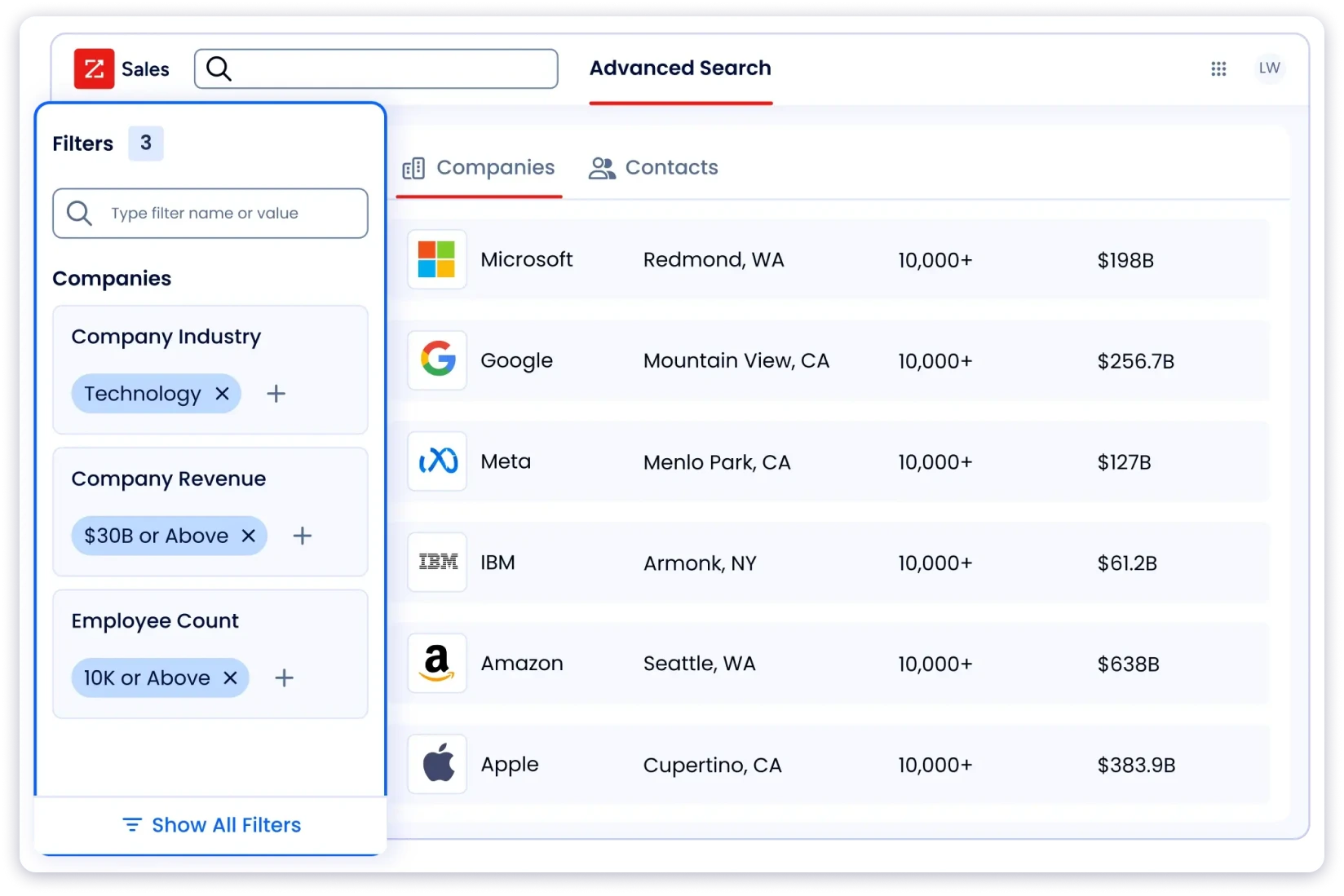
The platform’s real strength is intent data. ZoomInfo processes over 1 billion buying signals monthly to identify accounts that are actively researching solutions in your category.
For enterprise teams running account-based sales motions, this kind of signal intelligence can meaningfully shorten sales cycles.
But the pricing reflects that premium positioning.
ZoomInfo’s entry point is around $14,995/year for 3 seats, and most mid-market teams end up spending $25,000-$50,000+ annually once you factor in add-ons and seat expansion.
If you’re a startup or SMB, this is likely out of budget. I’ve written about more affordable options in my ZoomInfo alternatives breakdown.
Pricing
- Custom enterprise pricing. Minimum ~$14,995/year for 3 seats.
- Annual contracts required.
Limitations
- Expensive annual contracts
- Complex UI for new users
- No built-in outreach
4. Cognism — Best Sales Prospecting Tool for European Markets
Best for ⭐
Teams targeting European markets with compliant data.
G2 Rating
4.6/5
The next sales prospecting tool worth considering is Cognism, which carved out a strong position by focusing on what other databases struggle with: accurate European contact data with proper compliance.
Their Diamond Data product provides phone-verified mobile numbers in key EMEA markets, which makes them a go-to for teams that rely on cold calling in Europe.
The platform includes firmographic filters, technographic data, and intent signals powered by Bombora.
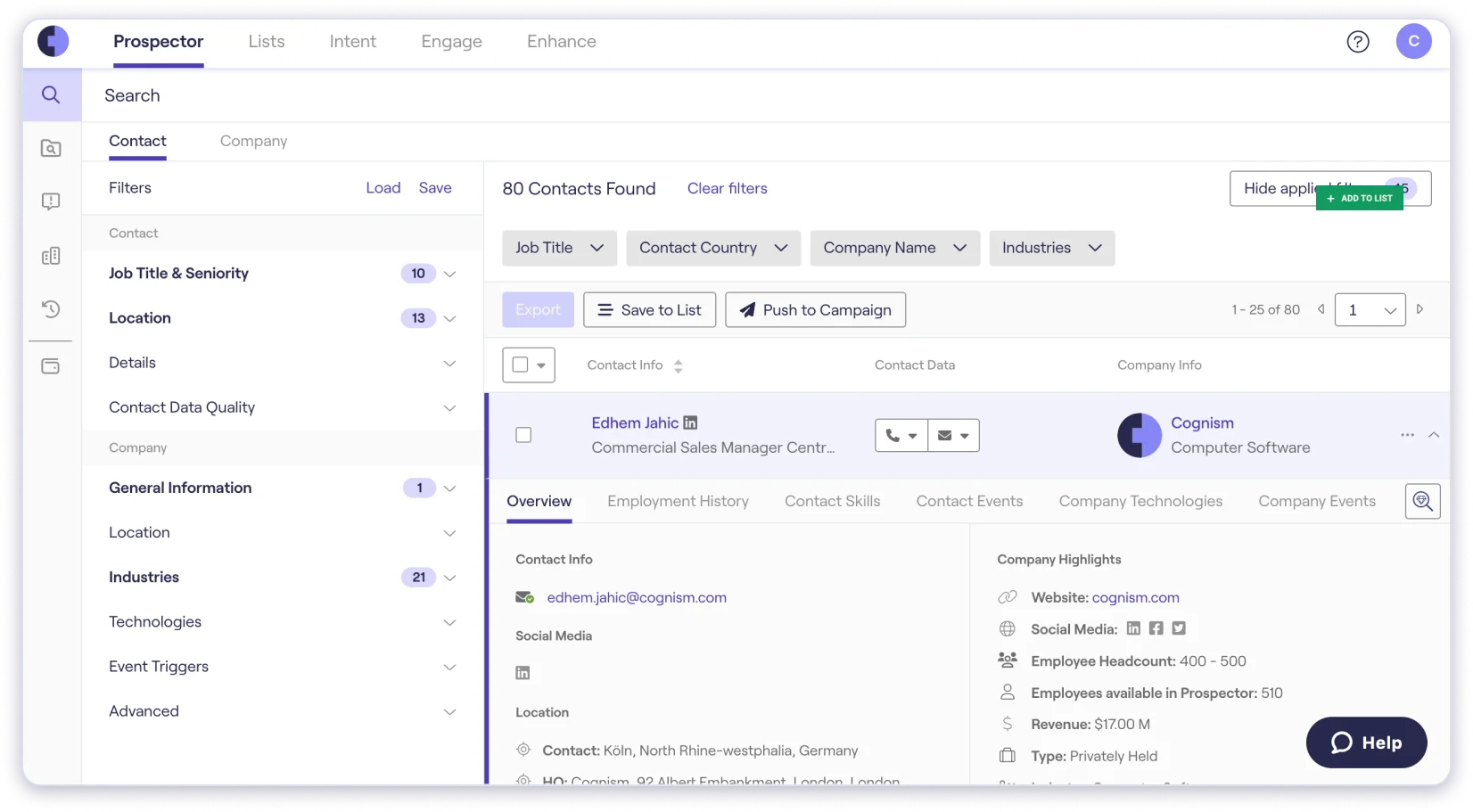
The data is particularly strong for UK, DACH, and Nordic regions. If your ICP is heavily European, Cognism covers gaps that Apollo and even ZoomInfo can’t fill reliably.
The trade-off is that their database is smaller than the all-in-one platforms, and they don’t offer built-in outreach capabilities.
You’ll need a separate tool for email sequencing and campaign management. I’ve explored more options in this space in my Cognism alternatives blog.
Pricing
Custom pricing only. No public pricing page. Expect enterprise-level investment similar to ZoomInfo.
Limitations
- No built-in outreach features
- Smaller database vs competitors
- No transparent pricing
5. Lusha — Best Sales Prospecting Tool for Quick Contact Lookups
Best for ⭐
Individual reps and small teams doing quick contact lookups.
G2 Rating
4.3/5
Another sales prospecting tool that’s popular with individual reps is Lusha.
It’s the fastest way to grab a phone number or email address while browsing LinkedIn.
The Chrome extension works smoothly, and you can reveal contact details in one click without leaving the prospect’s profile.
The database covers 100M+ contacts with up to 20 data points per lead. Data quality is strongest for North American prospects.
The AI prospecting feature lets you search using text prompts like “find marketing directors at SaaS companies in Boston,” which speeds up list building.

Lusha also keeps your prospect lists updated automatically, adding new contacts that match your saved search criteria as they enter the market. That’s a nice touch for teams running ongoing prospecting campaigns.
Where Lusha falls short is outreach.
The platform has basic automation features, but they’re not strong enough to manage a full prospecting-to-sales workflow. You’ll need a separate tool for email sequencing.
Pricing
- Free plan available with limited credits.
- Paid plans start at $49/user/mo.
Limitations
- Limited outreach capabilities
- Smaller database vs competitors
- Credit limits restrict scaling
Best Data Enrichment Sales Prospecting Tool
Not every team needs a new database. Some already have a prospect list but the data is incomplete, outdated, or missing key fields like tech stack, funding stage, or direct phone numbers. This sales prospecting tool fills those gaps by pulling data from multiple providers into one place.
6. Clay — Best Sales Prospecting Tool for Data Enrichment
Best for ⭐
RevOps teams needing deep data enrichment and automation workflows.
G2 Rating
4.8/5
The next sales prospecting tool on this list takes a completely different approach. Clay doesn’t give you a database to search.
Instead, it takes your existing prospect list and enriches it by pulling data from 75+ different sources.

You can combine firmographic data from one provider, technographic data from another, and intent signals from a third, all within Clay’s spreadsheet-like interface.
The custom lead scoring is where Clay gets interesting.
You can build scoring criteria that factor in tech stack, employee count, department structure, and even whether a company has specific roles (like ML engineers).
Once you’ve built a list manually, Clay can automatically generate “lookalike” lists that match your original ICP criteria.
The learning curve is real, though. Setting up Clay takes longer than actually prospecting with it, at least for the first few weeks.
Some teams bring in a dedicated GTM engineer just to configure it properly. If you’re looking for something you can start using in 10 minutes, Clay isn’t it.
Pricing
- Free plan with 100 credits/month.
- Paid plans start at $124/mo (Starter) with higher tiers at $249/mo and $499/mo.
Limitations
- Steep learning curve
- No built-in outreach
- Costs scale with usage
Best Social Selling Prospecting Tool
Not all prospecting happens through cold email. Some deals start with a LinkedIn connection, a comment on a post, or a warm intro through a mutual contact.
This sales prospecting tool is built for teams that sell through relationships, not cold outreach volume.
Best for ⭐
Social selling and relationship-based prospecting.
G2 Rating
4.3/5
Another sales prospecting tool that needs no introduction is LinkedIn Sales Navigator.
It’s still the most powerful tool for relationship-based B2B prospecting.
The advanced search filters go beyond basic LinkedIn (seniority level, company headcount growth, recent job changes), and saved searches automatically surface new prospects matching your criteria.
The real value is behavioral intelligence. You can see what your prospects are posting, commenting on, and sharing.
That kind of insight lets you craft genuinely personalized outreach instead of generic “I noticed your company is growing” messages.
TeamLink shows you which colleagues in your org already have connections to your target prospects, making warm introductions possible at scale.

For enterprise sales where deals are won through multi-threading and internal champions, this feature alone justifies the cost.
The biggest limitation is well known: Sales Navigator doesn’t give you email addresses or phone numbers.
You’ll need a separate tool to find email addresses for the prospects you identify.
Pricing
- Starts around $99/mo for individual plans.
- Team and Enterprise plans with additional features at higher tiers.
Limitations
- No email or phone data
- No outreach automation
- Requires additional tools
Best CRMs with Sales Prospecting Capabilities
These sales prospecting tools are CRM-first platforms that have added prospecting features.
They work best when you need pipeline management alongside basic contact discovery.
8. HubSpot Sales Hub — Best Free CRM with Prospecting Features
Best for ⭐
Teams needing a CRM with basic prospecting features.
G2 Rating
4.4/5
The next sales prospecting tool is HubSpot Sales Hub.
HubSpot’s free CRM is genuinely useful, and the Sales Hub adds features like email tracking, meeting scheduling, and basic sales automation on top of it.
For teams that are already in the HubSpot ecosystem (using their marketing or service tools), adding Sales Hub keeps everything in one platform.
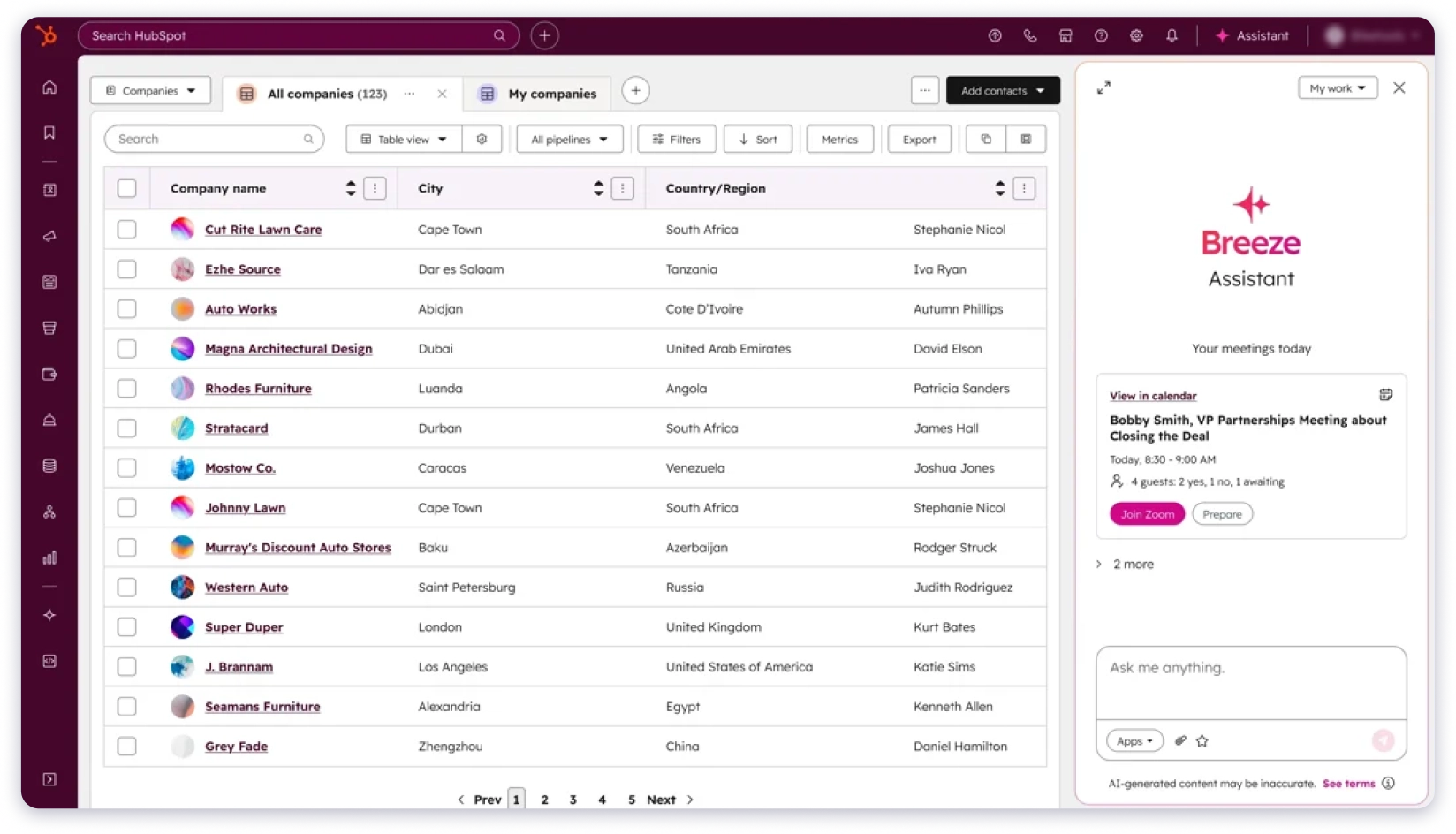
The prospecting capabilities are more limited compared to dedicated data tools.
HubSpot doesn’t provide a built-in contact database like Apollo or Saleshandy. Instead, it helps you manage and engage with contacts you’ve already sourced from elsewhere.
Where HubSpot shines is in the marketing-to-sales handoff. If your team generates a lot of inbound leads, HubSpot’s lead scoring, nurture workflows, and deal tracking are among the best in class.
Pricing
- Free CRM available.
- Sales Hub Starter at $20/mo.
- Professional at $100/mo/seat.
- Enterprise at $150/mo/seat.
Limitations
- No built-in contact database
- Advanced features locked in higher plans
- Not ideal for outbound prospecting
9. Pipedrive — Best Visual Pipeline for Small Sales Teams
Best for ⭐
Small teams needing visual pipeline management.
G2 Rating
4.3/5
Another sales prospecting tool geared toward smaller teams is Pipedrive.
It does one thing really well: visual pipeline management.
The drag-and-drop Kanban board makes it easy to see where every deal stands, and the interface is clean enough that reps actually use it daily (unlike some CRMs that become data graveyards).
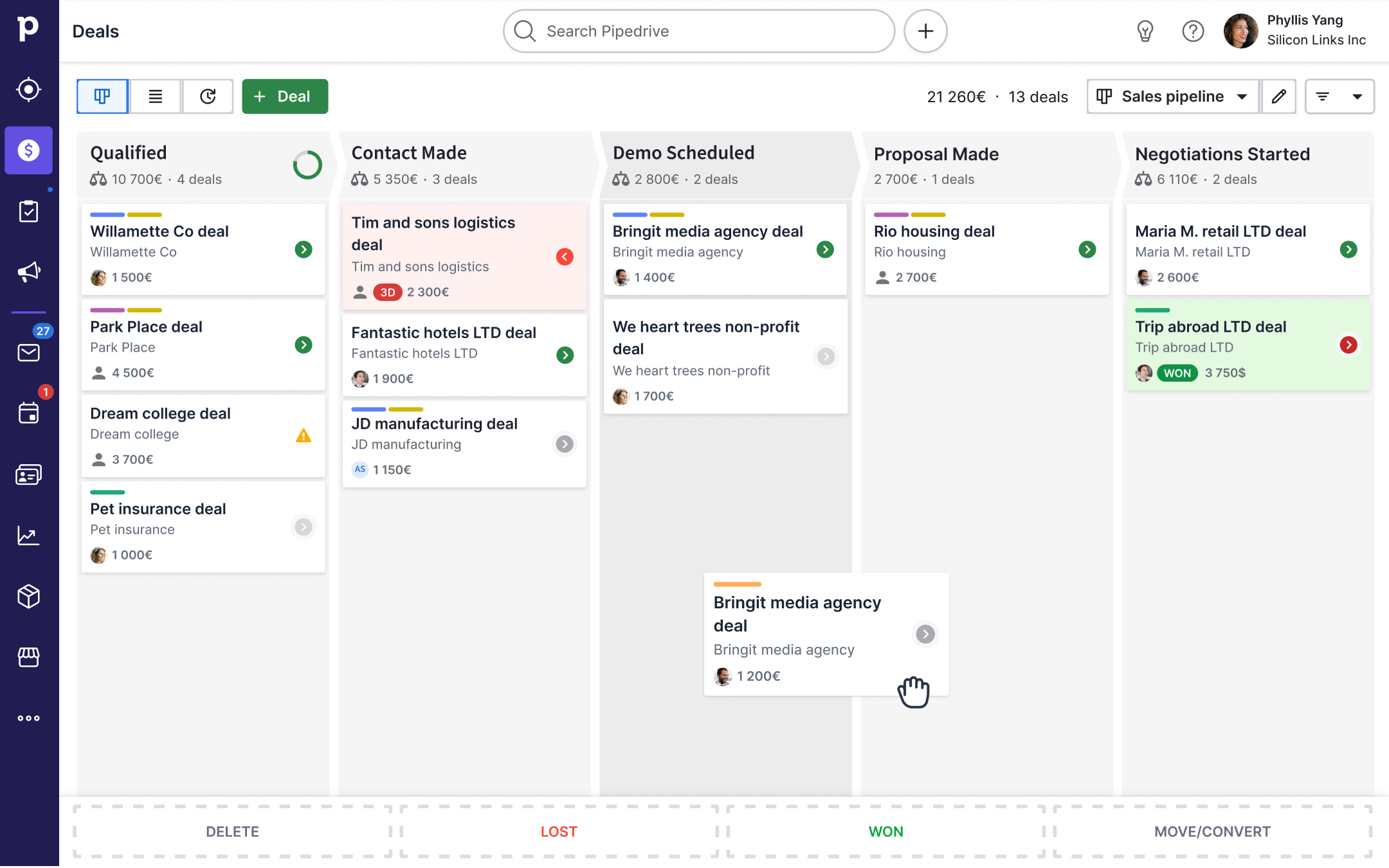
The LeadBooster add-on brings in basic prospecting capabilities, including a chatbot for website visitors, web forms, and a prospector tool for finding contacts.
It’s not in the same league as dedicated lead generation software, but for small teams that need CRM and light prospecting in one place, Pipedrive covers the basics.
Pricing:
- Essential plan starts at $14/user/mo (annual).
- Advanced at $29/user/mo. Professional at $49/user/mo.
- LeadBooster add-on is $32.50/mo.
Limitations
- Limited prospecting data
- Not built for high-volume outbound
- Requires add-ons for lead generation
Best Cold Email Prospecting Tools
These sales prospecting tools focus specifically on sending cold emails at scale with strong email deliverability.
They don’t include contact databases but are best-in-class for the outreach side of prospecting.
10. Instantly — Best Sales Prospecting Tool for High-Volume Cold Email
Best for ⭐
High-volume cold email campaigns.
G2 Rating
4.8/5
The next sales prospecting tool is Instantly, which built its reputation on one thing: deliverability at scale.
The platform lets you connect unlimited email accounts, rotate between them automatically, and warm them up before you start sending campaigns.
For agencies managing outreach for multiple clients, the multi-account management is a standout feature.
The campaign builder is straightforward. You create sequences, set timing between steps, and let Instantly handle the sending rotation.
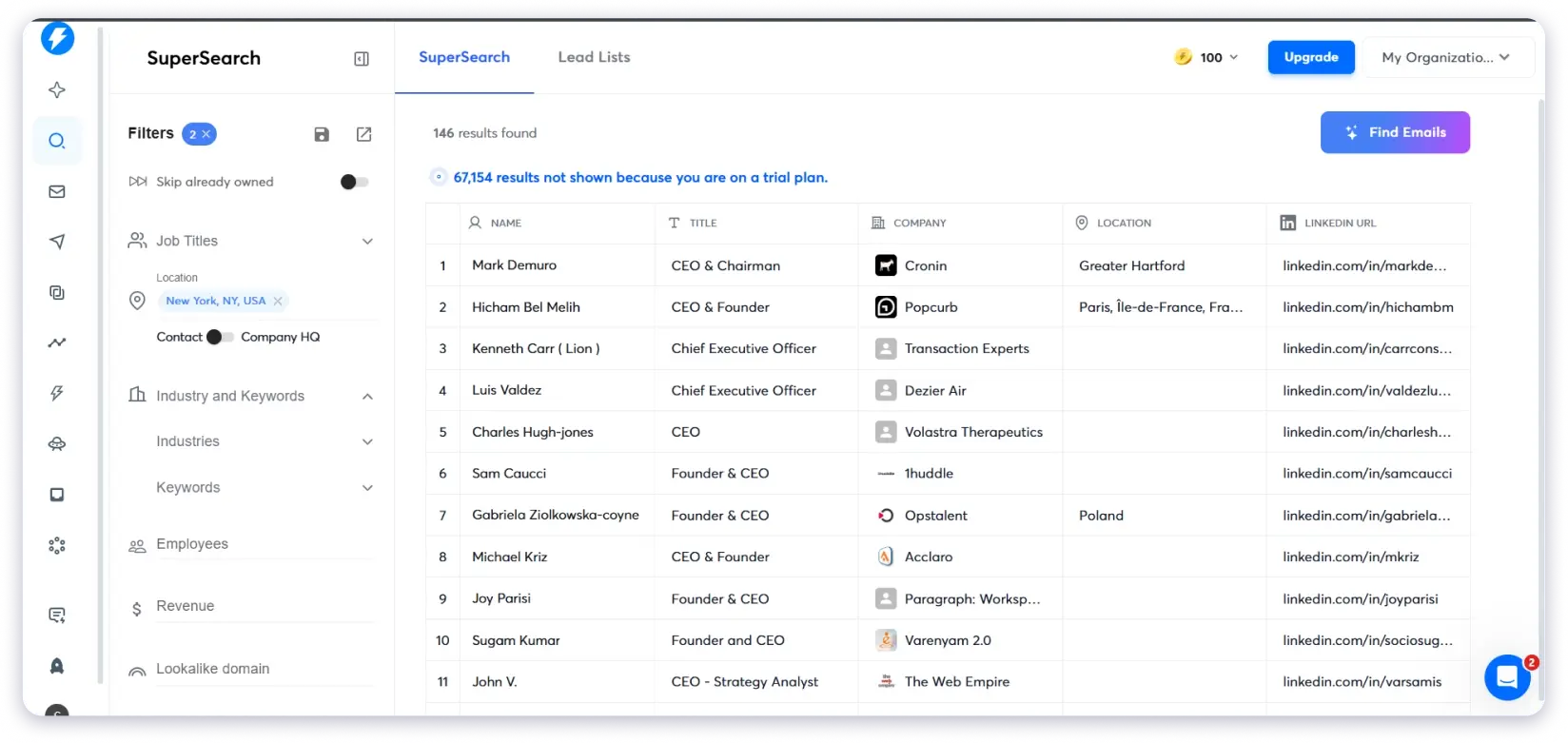
The analytics dashboard shows you open rates, reply rates, and deliverability metrics across all your sending accounts in one view.
The limitation is that Instantly doesn’t include a contact database.
You’ll need to source your prospects from a separate tool and import them.
Some teams pair Instantly with Saleshandy Lead Finder or Apollo for a complete prospecting-to-outreach workflow.
I’ve covered more options like this in my Instantly alternatives blog.
Pricing
- Growth plan starts at $30/mo
- Hypergrowth at $77.60/mo
- Higher tiers available for agencies
Limitations
- No contact database
- Email-only outreach
- Requires external tools for leads
11. Lemlist — Best Sales Prospecting Tool for Email Personalization
Best for ⭐
Personalized cold email outreach with multi-channel steps.
G2 Rating
4.4/5
The last sales prospecting tool on this list is Lemlist, which stands out for its personalization engine.
You can add custom images, dynamic landing pages, and personalized videos to your cold emails, which helps them feel less like mass outreach.
The platform includes email warm-up (through Lemwarm) and rotating sending accounts.
The pre-built email templates and the A/B testing for different personalization approaches within the same sequence are solid.
For teams that send lower volumes but want each email to convert at a higher rate, Lemlist’s approach makes sense.
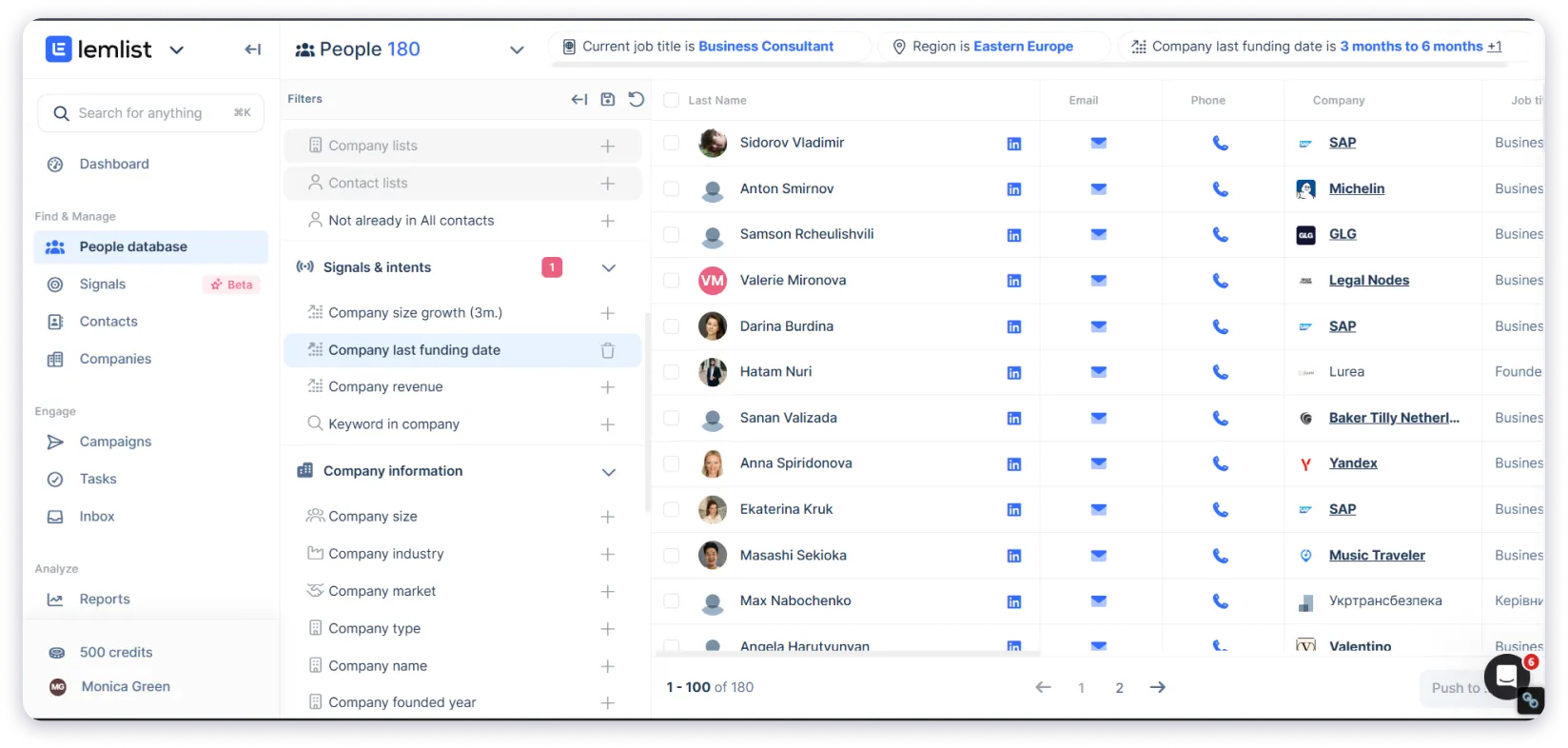
The multi-channel sequencing is also better than most email-first tools.
You can add LinkedIn steps and phone tasks to your sequences, though the LinkedIn automation requires their browser extension.
If you’re comparing options in this space, I’ve covered the trade-offs in my Lemlist alternatives breakdown.
Pricing
- Email Starter at $39/mo
- Email Pro at $69/mo
- Multichannel Expert at $99/mo
Limitations
- Smaller database (if used for prospecting)
- Learning curve for personalization features
- Per-seat pricing increases cost
Which Sales Prospecting Tool Is Right for You?
Before you pick a tool, answer these four questions. Your answers will narrow the list to 1-2 options.
Question 1: What regions does your ICP cover?
This eliminates tools fast. If you sell primarily into North America, most tools on this list will work. If your ICP is in Europe, Cognism gives you the most accurate phone-verified data for EMEA.
If you need global coverage across multiple regions, Saleshandy Lead Finder’s 800M+ database has the broadest reach. Apollo’s 275M+ database is solid for the US but drops off internationally.
Question 2: How many leads do you need per month?
If you need under 100 leads/month, a free tier from Apollo or Lusha may be enough to start. If you need 500-2,000+ leads/month, you need a tool where credits don’t expire and pricing doesn’t spike per contact.
Saleshandy’s 30,000 annual credits at $49/mo gives you the lowest cost-per-lead at scale. ZoomInfo’s credit system is generous but the minimum $14,995/year commitment means it only makes sense for teams prospecting at high volume.
Question 3: How important is data accuracy to you?
If you’re running cold email campaigns, accuracy is everything. A 15% bounce rate will wreck your sender domain.
Saleshandy’s waterfall enrichment and ZoomInfo’s 300+ human researchers deliver the highest accuracy on this list. Apollo and Lusha are decent but less consistent, especially outside the US.
Question 4: Do you need just data, or data + outreach?
If you already have an outreach tool (Outreach, Salesloft, or similar), you only need a data provider like ZoomInfo, Cognism, or Lusha.
If you want prospecting and outreach in one place, Saleshandy Lead Finder or Apollo.io are your two real options. If you need enrichment for an existing list, Clay is the best choice.
Final Verdict: Choose the Best Sales Prospecting Tools
Most teams don’t pick the wrong sales prospecting tool. They pick the right tool and then use it wrong.
They sign up for a platform with 275M contacts, burn through credits in two weeks revealing phone numbers they never call, and then wonder why their prospecting isn’t working.
Or they spend $15,000/year on ZoomInfo and only use it to pull the same 200 contacts their SDR could have found on LinkedIn for free.
The tool doesn’t fix bad targeting. Your ICP does.
So before you sign up for anything on this list, get clear on three things: who exactly you’re selling to, what job titles make buying decisions, and which companies are actually in a position to buy right now.
Once you have that, the right tool becomes obvious.
And for most B2B teams, that tool is
Saleshandy Lead Finder. The largest database on this list at 800M+ contacts, waterfall-verified data so you’re not emailing dead inboxes, and AI search that turns your ICP into a ready-to-use prospect list. Start with 50 free leads. The data quality speaks for itself.
Sales Prospecting Tools: FAQs
1. What Is a Sales Prospecting Tool?
A sales prospecting tool is software that helps you find, verify, and contact potential customers for your business.
These tools range from contact databases (like Saleshandy Lead Finder and Apollo.io) that give you verified emails and phone numbers, to sales intelligence platforms (like ZoomInfo) that add intent data and company insights, to outreach tools (like Instantly and Lemlist) that automate the process of reaching out at scale.
2. What’s the Difference Between a Sales Prospecting Tool and a CRM?
A sales prospecting tool helps you find and contact new leads. A CRM helps you manage relationships with leads and customers you’ve already connected with.
Some platforms (like Saleshandy and HubSpot) combine both. If you’re doing outbound sales, you typically need a prospecting tool first and a CRM second. If most of your leads come through inbound channels, a CRM with basic prospecting features might be enough.
3. How Much Do Sales Prospecting Tools Cost?
Pricing varies widely. Budget options like Saleshandy start at $25/mo for outreach and $49/mo for the Lead Finder. Mid-range tools like Apollo.io run $49-$119/user/mo.
Enterprise platforms like ZoomInfo start at approximately $14,995/year for a minimum of 3 seats.
Most tools charge per credit for revealing contact details, so your actual cost depends on how many contacts you prospect monthly.
4. Are There Free Sales Prospecting Tools?
Yes. Apollo.io, Lusha, and HubSpot CRM all offer free plans with limited features. LinkedIn’s free version works for basic prospect research.
Saleshandy offers 50 free Lead Finder credits with its 7-day free trial. Free plans are useful for testing but typically restrict the number of contacts you can access, the filters available, and the outreach features you can use.
5. What’s the Best Sales Prospecting Tool for Small Businesses?
For small businesses running outbound, Saleshandy Lead Finder is the most cost-effective option because it combines an 800M+ contact database with cold email automation in one platform.
Apollo.io is a strong alternative if you need multi-channel sequencing. If you’re on a very tight budget, start with LinkedIn (free) for prospect identification and a free-tier tool like Apollo or HubSpot CRM for contact management.
6. How Do I Choose Between Apollo.io and Saleshandy?
Both are all-in-one sales prospecting tools, but they differ in key areas. Saleshandy has a larger database (800M+ vs. 275M+), includes unlimited email accounts on all plans, and offers better deliverability features (built-in warm-up, inbox placement testing, sender rotation).
Apollo has stronger multi-channel sequencing (LinkedIn + phone steps) and includes a built-in dialer on higher plans. Choose Saleshandy if email outreach is your primary channel. Choose Apollo if you need integrated phone and LinkedIn touchpoints.
7. What Features Should I Look For in a Sales Prospecting Tool?
Focus on four things:
- data accuracy (verified emails with low bounce rates)
- search filter depth (the ability to narrow by ICP criteria like job title, tech stack, company size, and funding)
- integration with your CRM and outreach stack
- transparent pricing without hidden credit traps
A large database is only valuable if the contacts in it are accurate and current. An email verification tool can help you validate data quality before launching campaigns.
8. Can AI Replace Manual Sales Prospecting?
AI is transforming prospecting, but it’s not replacing it entirely. Tools like Saleshandy’s AI Lead Search and Apollo’s text-based prospecting let you describe your ideal prospect in plain language instead of manually setting filters. AI-powered email copilots generate personalized sequences in seconds.
But the strategic decisions (who to target, what message to lead with, when to follow up) still require human judgment. The best approach is using AI to handle research and personalization at scale while your reps focus on high-value conversation.