

Choosing between RocketReach and ZoomInfo comes down to two main factors: whether you need a fast email lookup tool or a full enterprise GTM platform with deep firmographics, buyer intent, and CRM-wide automation.
RocketReach is built for individual contributors and lean sales teams that want quick, self-serve contact finding.
Whereas ZoomInfo is designed for larger revenue teams that need more than just contact data: intent signals, org charts, and broader sales intelligence.
I tested both tools myself, then cross-checked the claims against 9,205+ reviews on G2, Capterra, Trustpilot, and Reddit.
Here’s the short version of what I found:
- ZoomInfo: Offers 500M+ contacts, claims 95% data accuracy, and provides buyer intent data and advanced sales intelligence. Built for enterprise GTM teams.
- RocketReach: Gives you access to 700M+ profiles for finding emails and phone numbers. Focused on contact discovery rather than running full outreach campaigns.
- Saleshandy: A genuine alternative you should consider if you are building prospect lists and running outreach campaigns. It combines real-time verified contact discovery, lead credits, and multichannel outreach in one subscription, starting at $34/mo
In the rest of this comparison, I’ll walk through data accuracy (what the numbers and real user feedback actually show), features, and the limitations that only show up once you’re using the tools day-to-day.
RocketReach vs ZoomInfo – TOC
RocketReach vs ZoomInfo at a Glance
If you’re comparing RocketReach and ZoomInfo, here’s how they stack up on contact data, prospecting features, pricing, and what you get for your money.
I’ve also included Saleshandy as an alternative if you want to find prospects and reach out from one platform.
| Factor | RocketReach | ZoomInfo | Saleshandy | Best Choice |
|---|---|---|---|---|
| Best for | Individual prospectors, recruiters, lean teams | Enterprise sales and GTM teams | Teams combining lead finding and outreach | Depends on needs |
| Contact database | 700M+ profiles | 500M+ contacts | 852M+ contacts, 42M+ companies | Saleshandy |
| Data accuracy | 82% | 92% | 98% | Saleshandy |
| Email verification process | On-demand verification; database refresh schedule not disclosed | Continuous automated verification, AI, and human checks | Verifies emails in real time before charging credits | Saleshandy |
| Charge for unsuccessful lookups | ❌ | ❌ | ✅ | RocketReach and Saleshandy |
| Email and phone finding | Emails; phones on Pro and higher | Business emails, mobile numbers, direct dials | Verified emails and phone numbers | Depends on accuracy and coverage |
| Buying signal data | ✅ | ✅ | ✅ | All |
| Website visitor identification | ❌ | ✅ | ❌ | ZoomInfo |
| Outreach capabilities | ✅ Offers basic cold email outreach | ❌ Doesn’t offer built-in outreach | ✅ Offers built-in multichannel outreach | Depends on workflow |
| CRM integrations | Available | Enterprise CRM integrations and enrichment | HubSpot, Salesforce, Zoho, Pipedrive, Zapier | Depends on integration needs |
| Starting price | $33/mo (1,200 exports/year) |
Custom quote | $34/mo (1,500 credits/mo) |
Depends on usage |
| Free access | 5 free lookups | Free trial available | 7-day trial, up to 50 free lead credits | Saleshandy |
| Contract flexibility | Monthly and annual self-serve plans | Custom contract terms | Monthly and annual plans | RocketReach and Saleshandy |
| Finding and contacting prospects together | Contact discovery with basic outreach | Broader GTM intelligence and automation | Lead Finder and outreach in one subscription | Saleshandy for integrated outbound workflow |
RocketReach vs ZoomInfo: Head-to-Head Feature Breakdown
Now that you know how RocketReach and ZoomInfo compare at a glance, let’s look at what you actually get with each tool.
I’ll compare their database coverage, contact accuracy, verification process, pricing, and prospecting features, along with what I found during testing and what real users have experienced.
1. Ease of Getting Started and Free Access
Before comparing contact data or features, I wanted to see how easy it was to actually try both tools.
And the difference was clear from the signup process.
ZoomInfo Signup Experience
I tried signing up for ZoomInfo through its website, expecting to explore the dashboard.
But after filling out the form, I landed on a page saying:
“Thank you! We’re matching you with the right specialist.”
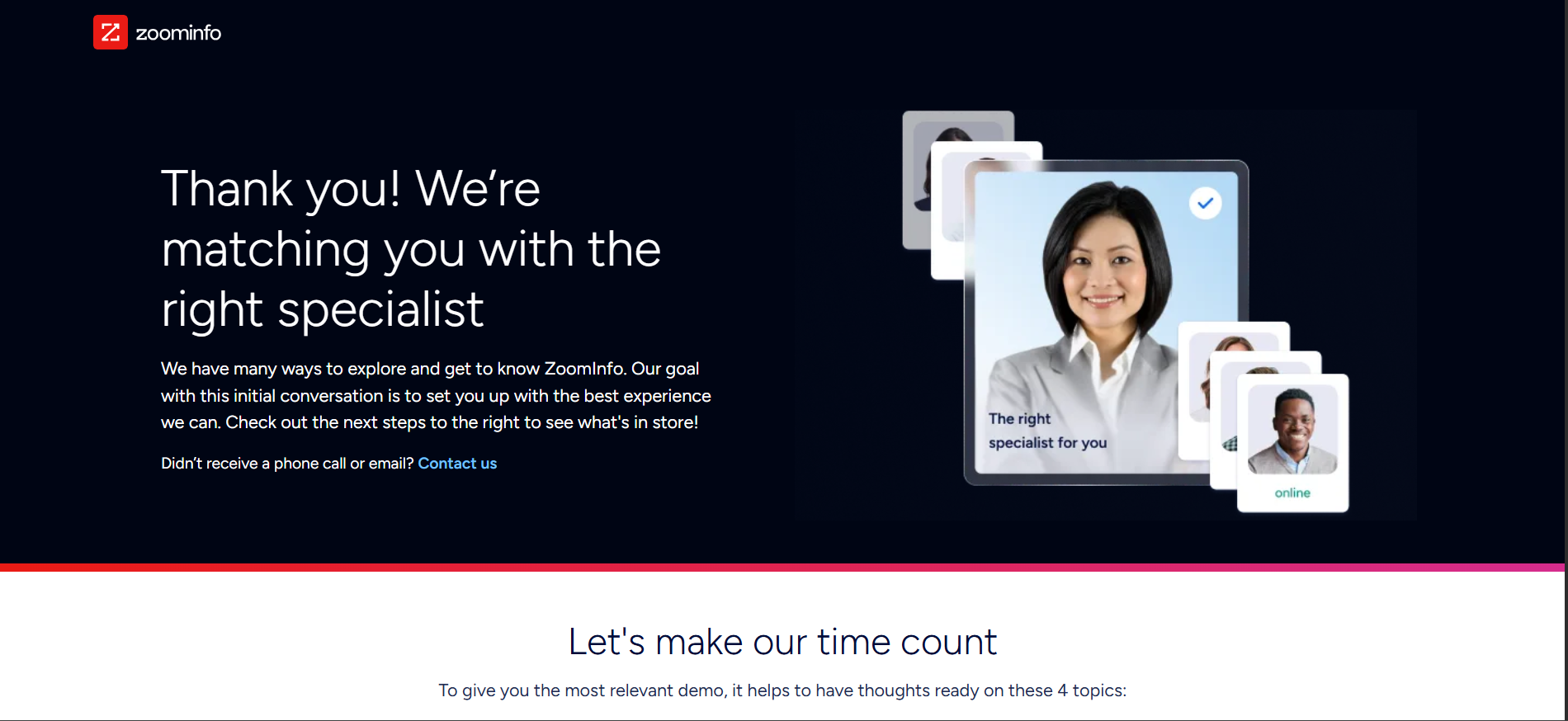
That was it. No dashboard or immediate access to start searching for contacts.
ZoomInfo does advertise a free trial, typically lasting 7 days. It also has a limited free version called ZoomInfo Lite.
But in my experience, getting access to the full platform wasn’t as straightforward as creating an account and starting to search.
For larger teams that prefer a guided demo, this might not be a problem. But if you want to test contact quality yourself before speaking with sales, it’s an extra step.
RocketReach Signup Experience
RocketReach was much quicker.
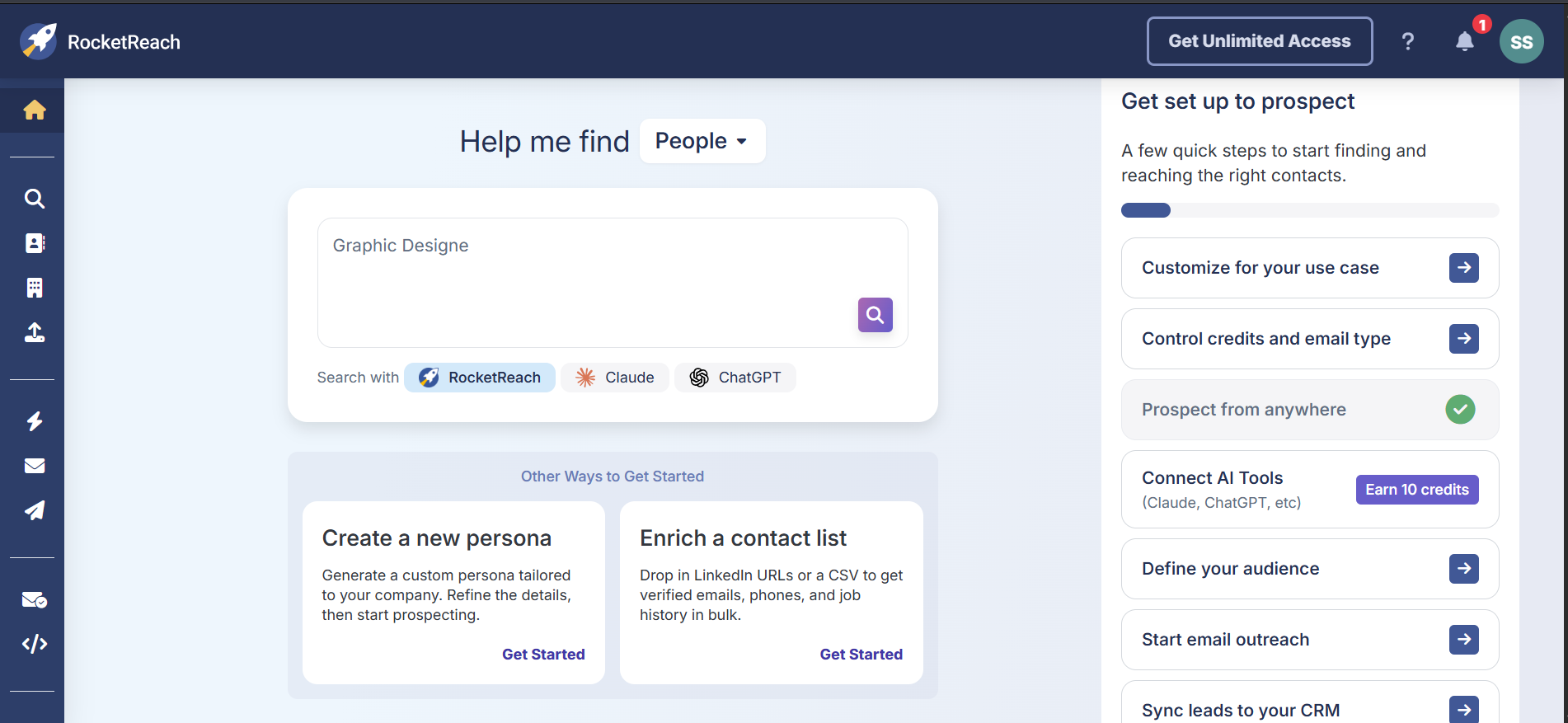
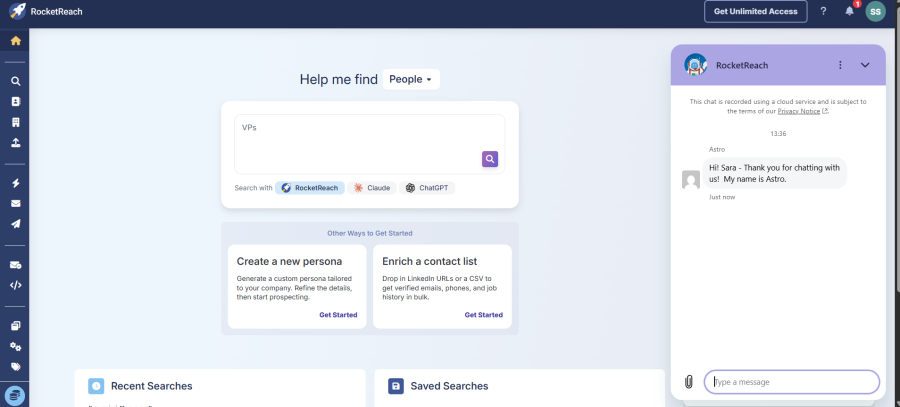
I signed up with Google, and within 90 seconds, I was inside the dashboard. No sales call or credit card needed.
My free account came with:
- 5 Lookup credits to find contact details.
- 5 Company Export credits.
- 10 Verify credits to check emails.
I could start searching for prospects right away.
But there’s something I noticed that you should know before connecting your work account.
When I checked Settings > Privacy, I found that my account had been enrolled in RocketReach’s Community Program.
The program’s terms cover access to contact information, including address books, email headers, and signatures from connected accounts. I hadn’t noticed any clear disclosure during signup.
I also found the GDPR-related setting turned off in my account.
That doesn’t automatically mean RocketReach is noncompliant with GDPR, but these are settings I’d recommend reviewing before connecting a company email account.
Who Wins on Signup and Onboarding?
RocketReach wins for getting started quickly. I was searching for contacts within 90 seconds, without talking to anyone.
ZoomInfo offers free access options, too, but I couldn’t get straight into the full platform through the signup process I tried.
For someone who wants to test contact data before spending money, RocketReach made that much easier.
Just check its privacy and Community Program settings before connecting your work email.
2. Database Size and Global Coverage
RocketReach claims 700M+ profiles, while ZoomInfo has 500M+ contacts. So, does that mean RocketReach helps you find more prospects?
Not necessarily.
What matters is whether these tools have the contacts you’re actually looking for, especially when you’re targeting specific industries, job titles, or countries.
Here’s what I found.
ZoomInfo Database Size and Coverage
ZoomInfo has 500M+ contacts and over 100M company records. What I like is that it also shares a breakdown of its global coverage.
According to ZoomInfo’s database page:
- North America: 157.8M+ contacts and 79.6M+ companies
- Europe: 66M+ contacts and 20.5M+ companies
- Asia: 68.3M+ contacts and 4.8M+ companies
That’s useful if you’re targeting prospects across multiple countries. You can see how much data ZoomInfo claims to have in each region instead of relying on one big database number.
But millions of contacts don’t guarantee they’re accurate or up to date.
I noticed this while going through ZoomInfo’s G2 reviews. Out of 9,200+ reviews, 232 mentions were tagged under “Outdated Data” and another 232 under “Inaccurate Data.”
At the same time, 384 positive mentions praised its data accuracy. So, customer experiences clearly vary.
Some users find ZoomInfo reliable for prospecting, while others report incorrect phone numbers, old job titles, and outdated emails.
One thing I’d keep in mind: ZoomInfo has impressive database coverage, but you should still test its accuracy against your own prospect list before committing to a contract.
RocketReach Database Size and Coverage
RocketReach has 700M+ professional profiles across 60M companies.
That’s more profiles than ZoomInfo claims, but RocketReach doesn’t share the same detailed breakdown of contacts by region.
So, I wanted to see how well it could find people I already knew existed.
In October 2026, I tested RocketReach with four executives from companies of different sizes.
Here’s what happened:
| Prospect | Company | Result |
|---|---|---|
| Rajeev Rajan, CTO | Atlassian | Not found |
| Melanie Perkins, CEO | Canva | Not found |
| Guillaume Moubeche, Founder | Lemlist | Found, A-grade email |
| Yamini Rangan, CEO | HubSpot | Found, A-grade email |
Only 2 out of 4 contacts showed up in my searches.
What surprised me was that even Rajeev Rajan, CTO of Atlassian, wasn’t showing up when I combined his name with the company filter.
But here’s the interesting part.
Both emails RocketReach returned matched the independent sources I checked. So, in this small test, the issue wasn’t incorrect emails. It was finding the contacts in the first place.
I’ve shared the complete testing process in my RocketReach review.
And I wasn’t the only one who ran into coverage problems.
Lisa M., a Senior Recruiter, mentioned in her Capterra review that she found working contact details for less than 35% of her list of high-end professionals.
That review is from 2021, so I wouldn’t treat it as RocketReach’s current find rate. But it does reflect the same problem I encountered.
My takeaway: RocketReach returned accurate emails for the two people I found, but missing two out of four named executives was disappointing. I’d want to test a much larger list before relying on it for regular prospecting.
Who Wins on Database Size and Coverage?
ZoomInfo gets my vote for company data and visibility into international coverage.
It provides detailed regional contact numbers and company intelligence, which is useful for teams prospecting across different markets.
RocketReach has a larger claimed professional database, but my limited test showed gaps even for well-known executives.
Still, neither tool’s database size tells you how many accurate contacts you’ll find for your specific audience. That’s why I’d check actual email accuracy and verification before making a final decision.
3. Data Accuracy and Email Confidence Grading
Finding someone’s email is one thing. Getting an email that actually works is another.
Both ZoomInfo and RocketReach make strong claims about their data quality. But I wanted to see how much confidence you can place in those numbers before adding contacts to an outreach campaign.
ZoomInfo Data Accuracy
ZoomInfo claims 96% email deliverability and 87% mobile number accuracy, along with a 72% direct-dial hit rate.
It also has a pretty extensive data verification process. According to ZoomInfo, it processes over 1.5 billion data points daily and uses automated checks, email validation, and human researchers to keep its database updated.
That sounds promising, especially if you’re building large prospect lists.
But when I looked at customer reviews, the feedback wasn’t entirely positive.
One Trustpilot reviewer complained about phone numbers not working and email bounce rates being higher than expected, despite spending $25,000 on the platform.
And that’s worth paying attention to.
If you’re spending thousands on contact data, you want more than a large database. You want confidence that the emails and phone numbers you’re paying for will work.
One thing to remember: ZoomInfo’s 72% direct-dial hit rate doesn’t mean 28% of its phone numbers are incorrect. Hit rate and accuracy measure different things.
RocketReach Data Accuracy
RocketReach takes a slightly different approach. Instead of giving you one accuracy percentage, it grades emails based on how confident it is that they’ll work.
Here’s what its email grades mean:
- A-grade: Around 98% claimed deliverability.
- A-minus: Around 90% claimed deliverability.
- B-grade: Around 75–85% claimed deliverability.
I wanted to see how reliable those grades were, so I checked the results from my October 2026 test.
As I mentioned earlier, RocketReach found only two of the four executives I searched for.
But both emails it returned were A-grade.
I cross-checked the addresses for Yamini Rangan at HubSpot and Guillaume Moubeche at Lemlist against Clay and publicly available records. Both matched.
That’s encouraging, but two matching emails aren’t enough to prove RocketReach’s 98% deliverability claim. I also didn’t send test emails to measure actual delivery.
And some users have had different experiences.
One Capterra reviewer reported getting bounced emails despite RocketReach assigning them high confidence scores.
It’s an older review from 2021, but it highlights something important: a high confidence grade doesn’t guarantee that every email will work.
My takeaway: RocketReach’s grading system is useful because you can see which emails it considers more reliable. But I’d still verify contacts before sending large campaigns, especially when using lower-confidence results.
Who Wins on Data Accuracy?
There’s no clear winner without testing both tools on the same prospect list.
ZoomInfo claims strong email deliverability and has a more extensive data verification process.
RocketReach makes it easier to judge individual email results through confidence grades, and both A-grade emails matched external records in my small test.
But neither company’s claims guarantee results for your target audience.
If I were choosing between them, I’d test the same set of prospects in both tools, compare how many valid emails each returns, and check those emails with an independent verifier before paying for a larger plan.
4. Advanced Prospecting Capabilities
Prospecting tools today do a lot more than find emails and phone numbers.
Many now offer buyer intent signals, company insights, and automation to help you find the right decision-makers and focus on prospects who are more likely to buy.
So, I wanted to see what advanced prospecting features ZoomInfo and RocketReach actually offer and how useful they are.
ZoomInfo Advanced Prospecting Capabilities
ZoomInfo gives sales teams more than a list of people to contact. It helps them understand which companies might be interested in buying and when to approach them.
Here’s what you get:
- Buyer Intent Data: Find companies researching topics related to your product. ZoomInfo claims to track signals across 210M IP-to-organization pairings and 6T+ monthly keyword-to-device pairings.
- WebSights: See which companies visit your website, what pages they explore, and which decision-makers you could contact.
- Chorus Conversation Intelligence: Record and analyze sales calls to understand what prospects say, spot objections, and coach your reps.
- ZoomInfo Copilot: Use AI to prioritize accounts, research prospects, identify buying groups, and personalize outreach.
- CRM Integrations and Automation: Connect with Salesforce, HubSpot, Outreach, and other tools to keep contact data and sales activities in sync.
Here’s where I think ZoomInfo becomes useful.
Let’s say a company has been researching your competitors and visiting your pricing page. ZoomInfo can help your team identify that account, find the right people, and prioritize outreach.
For a large sales team managing hundreds of accounts, that’s valuable.
But there’s a catch. Many of these capabilities depend on your ZoomInfo package, so you’ll need to check what’s included before signing a contract.
RocketReach Advanced Prospecting Capabilities
RocketReach doesn’t offer the same depth of sales intelligence, but it has added several features beyond its usual contact search.
Here’s what it offers:
- Buyer Intent Data: Available on its Ultimate plan through its partnership with 5×5 Data, with intent signals covering 35,000+ research topics.
- Chrome Extension: Find contact details from LinkedIn profiles and company websites without switching tabs.
- Company Insights: Explore company details, organizational structures, technologies used, and industry information.
- Autopilot: Automate prospect searches and build targeted lists based on your filters.
- CRM Integrations: Connect with Salesforce, HubSpot, Outreach, Salesloft, and other supported tools on eligible plans.
One thing I like about RocketReach is how straightforward its Chrome extension makes prospect research.
You can find someone on LinkedIn, look up their contact information, and add them to your prospect list without much effort.
RocketReach also offers buyer intent data, which makes it more useful than a basic email finder.
However, you won’t get a direct equivalent of ZoomInfo’s Chorus for analyzing sales conversations or WebSights for identifying companies visiting your website.
So, while RocketReach can help you research and organize prospects, ZoomInfo provides more tools for understanding buying interest and managing sales activities across teams.
Who Wins on Advanced Prospecting Capabilities?
ZoomInfo wins.
It offers stronger buyer intent intelligence, website visitor tracking, conversation analysis, and sales automation.
RocketReach works well if your team mainly needs prospect research, contact discovery, and list building.
But if you have a large sales team and want to know which accounts to prioritize, ZoomInfo gives you more to work with.
Just make sure those extra features are something your team will actually use before paying for them.
5. Outreach Capabilities
One thing that surprised me during this comparison was that RocketReach now lets you run email campaigns, too.
It introduced email sequences in February 2026, so it’s no longer just a tool for finding contact details.
I wanted to see how its outreach features compare with ZoomInfo and whether either tool can handle your prospecting and follow-ups in one place.
ZoomInfo Outreach Capabilities
ZoomInfo offers sales engagement features through its platform, including ZoomInfo Engage and AI-powered email and calling tools.
Here’s what you can do:
- Email Sequences: Create multi-step email campaigns with automated follow-ups.
- Sales Dialer: Call prospects directly and manage calling activities.
- Email Personalization: Use templates and AI assistance to write personalized messages.
- Task Automation: Schedule follow-ups, assign tasks, and keep track of sales activities.
- Engagement Tracking: Monitor email interactions and sales activities to understand how prospects respond.
What I found useful is how ZoomInfo connects outreach with its sales intelligence data.
For example, your team can identify an account showing buying intent, find decision-makers, and add them to an outreach workflow.
But there’s something to check before buying.
ZoomInfo’s outreach capabilities vary by product and plan. You’ll need to confirm which email, calling, and automation features are included in your quote.
RocketReach Outreach Capabilities
RocketReach introduced its Sequences feature in February 2026, allowing users to send emails and automate follow-ups without exporting contacts to another platform.
Here’s what it offers:
- Email Sequences: Create multi-step email campaigns with automatic follow-ups.
- AI Email Writer: Generate personalized emails using prospect and company information.
- Automated Stop Rules: Stop sequences when someone replies or an email bounces.
- Email Tracking: Track sends, replies, clicks, and bounces.
- Daily Sending Limit: Up to 500 emails per day on its individual paid plans.
- Mailbox Connection: Connect Gmail or Outlook accounts to send emails.
I also explored RocketReach’s outreach interface during my test.
One limitation I noticed was that I couldn’t build a sequence without connecting a mailbox first.
RocketReach’s sequences are also email-focused. You don’t get the same combination of email, calling, and task-based outreach that ZoomInfo offers.
For someone sending a few personalized emails and follow-ups, RocketReach could be enough.
But if you’re managing larger outbound campaigns across multiple channels, you’ll have fewer options.
Who Wins on Outreach Capabilities?
ZoomInfo wins for sales teams that need email and calling workflows together.
RocketReach has made a good move by adding email sequences, AI writing, and automated follow-ups. It’s useful for straightforward email outreach.
However, neither is necessarily the best fit if your main focus is running cold email campaigns at scale.
That’s where Saleshandy is worth considering. It includes unlimited connected email accounts, automated sequences, sender rotation, email warm-up, and a unified inbox. You can also manage multichannel follow-ups.
Its Starter plan supports 6,000 emails per month, while Pro increases that to 100,000 emails per month.
So, if you want to find verified prospects and run outbound campaigns from one platform, Saleshandy offers a more outreach-focused alternative.
6. Pricing, Credits, and Overall Cost
Pricing can make a big difference when you’re choosing between RocketReach and ZoomInfo, especially if you’re buying for an entire sales team.
I checked both tools’ pricing and also looked at what customers have paid, because monthly subscription costs don’t always tell you how much you’ll spend on contact data.
ZoomInfo Pricing in 2026
ZoomInfo doesn’t list fixed prices for its paid plans. You’ll need to contact its sales team to get a quote based on your team size, required features, and credit usage.
To understand what companies actually pay, I checked Vendr’s ZoomInfo pricing data.
According to Vendr, the median annual ZoomInfo contract costs $33,500.
Here’s what third-party pricing research suggests for its plans:
| Plan | Estimated Annual Cost |
|---|---|
| Professional | Around $14,995 |
| Advanced | Around $24,995 |
| Elite | $39,995+ |
These are estimates from reported quotes, not fixed prices offered to every customer.
Your final cost can also depend on:
- User licenses: Adding more team members can increase your subscription cost.
- Contact credits: Your contract determines how many contacts you can export.
- Advanced features: Buyer intent data, integrations, and additional products may increase your quote.
- Contract length: Paid plans generally involve annual commitments.
One thing I found interesting was how much pricing can vary between customers.
In one Reddit discussion, a buyer mentioned receiving a $17,500 annual quote for ZoomInfo Advanced+ and asked other sales professionals whether the price was reasonable.
This is why I’d recommend getting a clear breakdown of included credits, licenses, and add-ons before accepting a ZoomInfo quote.
Read More: ZoomInfo Pricing
RocketReach Pricing in 2026
RocketReach is easier to evaluate because you can see plan prices and sign up without speaking to sales.
But I noticed something interesting during my October 2026 test.
When I accessed RocketReach from India, its pricing appeared in INR and worked out cheaper than the US prices I found during my research.
RocketReach prices can vary by region and billing option. I couldn’t confirm whether this was due to regional pricing or an A/B test.
Here’s what US pricing research showed in October 2026:
| Plan | Monthly Billing | Annual Billing |
|---|---|---|
| Essentials | $69/month | $33/month |
| Pro | $119/month | $75/month |
| Ultimate | $209/month | $142/month |
The annual prices are monthly equivalents, paid upfront for the year.
Now, here’s something important I noticed about RocketReach’s credits.
On annual plans, you get unlimited lookups, but your exports are still limited.
- Essentials: 1,200 exports/year
- Pro: 3,600 exports/year
- Ultimate: 20,000 exports/year
So, you can search for contacts, but how many you can download or send to other tools depends on your plan.
Also, Essentials focuses on email finding. You’ll need Pro or higher to access phone numbers.
This matters if you’re building large prospect lists or regularly exporting contacts into your CRM.
Read More: RocketReach Pricing
Who Wins on Pricing?
RocketReach wins on affordability and flexibility.
You can start with a monthly subscription, test its contact data, and upgrade as your prospecting needs grow.
ZoomInfo is a much bigger investment. Its pricing makes more sense for teams that will use its advanced sales intelligence features alongside contact data.
But there’s another option worth considering.
Saleshandy starts at $34/month with annual billing and includes 1,500 Lead Finder credits per month, email verification at lookup, and cold email outreach.
So, if you need both contact finding and outreach, you won’t have to pay for two separate tools.
7. Data Privacy and Security
When you’re using a B2B data tool, you’re not only accessing someone else’s contact information. You’re also trusting that platform with your account details and potentially your company’s data.
So, I checked what security certifications RocketReach and ZoomInfo have and what users should know about their data policies.
ZoomInfo Data Privacy and Security
ZoomInfo has invested heavily in security and privacy controls, which matters when you’re dealing with large amounts of customer and prospect data.
Its certifications and independent assessments include:
- SOC 2 Type II: Independent assessment of security controls.
- ISO 27001: Information security management.
- ISO 27701: Privacy information management.
- ISO 27017: Security controls for cloud services.
- ISO 42001: AI management and governance.
- TRUSTe Responsible AI Certification: Assessment of responsible AI practices.
ZoomInfo also has a Trust Center where buyers can review its security and compliance information.
For enterprise teams, having these documents available can make vendor security reviews easier.
But certifications don’t automatically mean a tool meets every company’s privacy or regulatory requirements. You’ll still need to check how the platform collects, stores, and processes data.
RocketReach Data Privacy and Security
RocketReach also has recognized security certifications.
In September 2025, RocketReach announced that it had completed its SOC 2 Type II audit and ISO 27001 recertification.
So, it’s not fair to say RocketReach lacks enterprise security controls.
However, I noticed something during my signup test that I think deserves attention.
As I mentioned earlier, my RocketReach account was enrolled in its Community Program after I signed in with Google.
When I checked the privacy settings, I found permissions and terms relating to contact data that I hadn’t noticed during signup.
For me, that was a reason to look more closely at what access I was granting.
Before connecting your company account, I’d recommend reviewing RocketReach’s Community Program terms, checking which Google or Microsoft permissions are enabled, and confirming how to opt out if you don’t want to participate.
Who Wins on Data Privacy and Security?
ZoomInfo has an edge in documented security and compliance certifications.
It has a broader set of certifications covering information security, privacy management, cloud security, and AI governance.
RocketReach also has SOC 2 Type II and ISO 27001, so it shouldn’t be dismissed as less secure simply because it has fewer listed certifications.
If your company has strict security requirements, I’d request the latest audit reports and data processing agreements from both providers before deciding.
8. Customer Support and Cancellation Policies
One thing I always check before paying for software is how easy it will be to get help or cancel if the tool doesn’t work out.
And after going through customer reviews, I found some concerns worth knowing about for both RocketReach and ZoomInfo.
ZoomInfo Customer Support and Cancellation
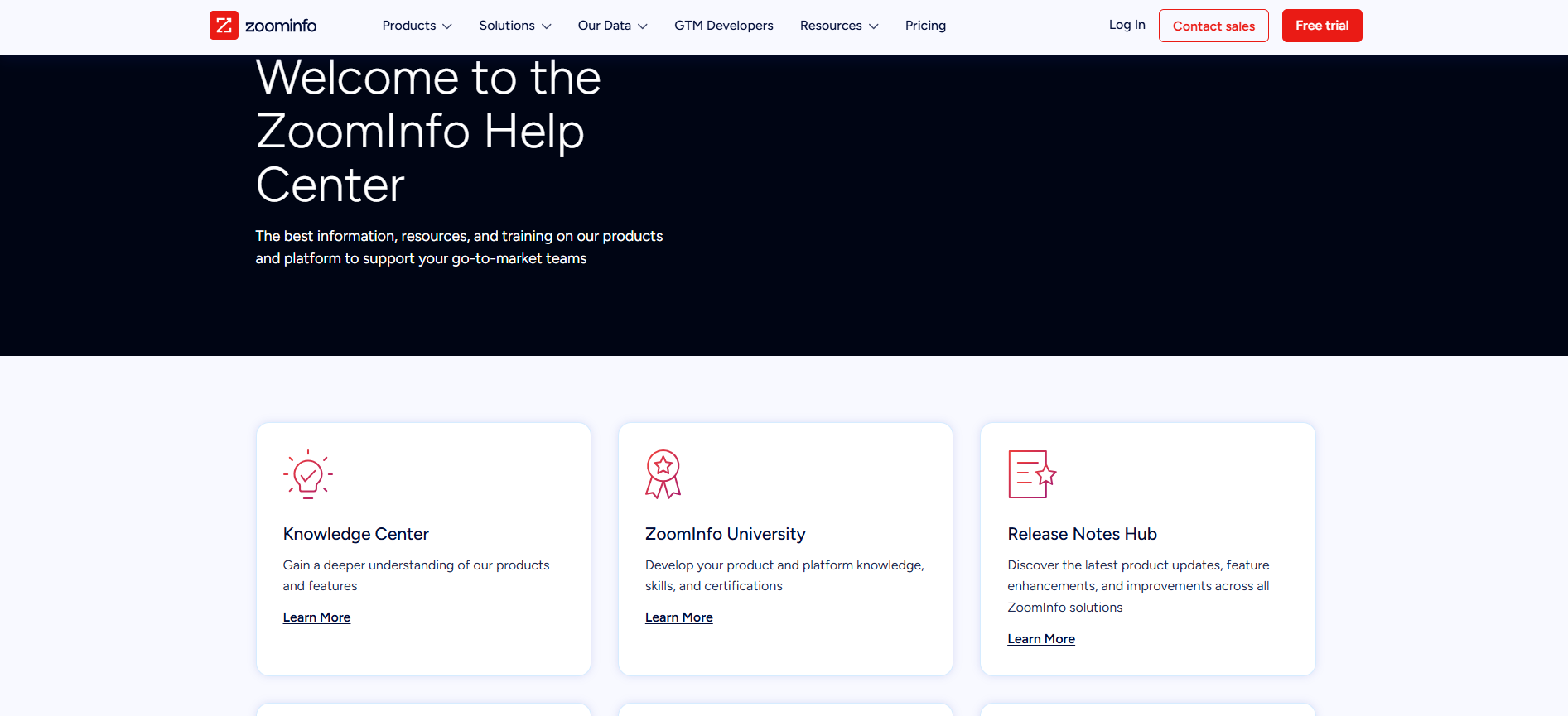
ZoomInfo offers customer support, onboarding resources through ZoomInfo University, and account management options for eligible customers.
That’s useful when your team needs help setting up integrations or getting comfortable with a larger platform.
But cancellation terms deserve attention.
ZoomInfo’s help documentation describes a 60-day notice requirement to turn off automatic renewal. Your signed contract determines which terms apply.
That means you shouldn’t assume you can cancel a few days before your subscription renews.
I found several reviews from customers who were unhappy with their renewal experience.
For example, one G2 reviewer complained about having to provide cancellation notice 60 days before renewal, particularly given the cost of the subscription.
It’s worth remembering that customer reviews describe individual experiences, not necessarily every customer’s experience.
Still, when you’re committing thousands of dollars to software, I think renewal terms deserve as much attention as the features.
Before signing, I’d ask ZoomInfo to confirm your renewal date, notice period, and cancellation process in writing.
RocketReach Customer Support and Cancellation
RocketReach takes a more self-serve approach.
You can manage your subscription through your account, and its support team can be reached by email.
The important thing to know is that RocketReach subscriptions also renew automatically.
You can cancel before the renewal date through the Usage & Billing section of your account.
While going through Trustpilot, I found complaints from customers who said they weren’t expecting renewal charges.
One reviewer complained about not receiving a reminder before renewal. Another reviewer reported being charged after a paused subscription resumed.
These complaints don’t establish that reminders are never sent, but they do show why it’s important to understand how renewals and paused subscriptions work.
My advice would be to check the next billing date in your account and cancel before renewal if you’re not planning to continue.
Who Wins on Customer Support and Cancellation?
There’s no clear winner here.
ZoomInfo offers more structured support for larger teams, but its contracts can require advance cancellation notice.
RocketReach makes subscription management easier through self-serve billing, although customers have reported frustrations with renewals.
If you want more flexibility, RocketReach’s monthly plans are easier to commit to than a large annual ZoomInfo contract.
Either way, I’d recommend saving your renewal date and checking cancellation terms before paying.
What Real Users Say About RocketReach and ZoomInfo
I’ve covered what both tools offer and what I found during testing. But I also wanted to know how they hold up for people who use them every day.
So, I compared their ratings on G2, Capterra, and Trustpilot.
Here’s what I found.
RocketReach vs ZoomInfo: Customer Ratings
| Platform | RocketReach | ZoomInfo |
|---|---|---|
| G2 | 4.4/5 (1,385 reviews) | 4.5/5 (9,218 reviews) |
| Capterra | 4.1/5 (140 reviews) | 4.1/5 (322 reviews) |
| Trustpilot | 1.2/5 (1,116 reviews) | 1.6/5 (340 reviews) |
Ratings checked in November 2026. Review counts and scores may change.
What Stood Out in Customer Reviews?
The first thing I noticed was how differently people rated both tools across platforms.
ZoomInfo scores 4.5/5 on G2 but only 1.6/5 on Trustpilot
On G2, users appreciate its contact database, advanced search filters, and sales intelligence features.
But when I looked through Trustpilot, I found more complaints about contracts, unexpected renewals, and difficulty cancelling subscriptions.
RocketReach shows a similar difference.
It has 4.4/5 on G2 but only 1.2/5 on Trustpilot
Many G2 and Capterra users like how easy RocketReach makes finding contact details, particularly through its LinkedIn extension.
On Trustpilot, complaints focus more on billing, renewals, refunds, and customer support.
Now, that doesn’t mean positive reviews are unreliable or negative reviews tell the complete story.
People leave reviews for different reasons, and the audiences on G2, Capterra, and Trustpilot aren’t necessarily the same.
✅My takeaway: Both tools receive positive feedback for their core features, but their lower Trustpilot scores make it worth checking billing terms and cancellation policies before subscribing.
I’d use customer reviews to understand what could go wrong, then test the actual contact data against your own prospect list before choosing either tool.
RocketReach vs ZoomInfo: Which Should You Choose in 2026?
After testing both tools and comparing their features, pricing, and customer reviews, I don’t think there’s one winner for everyone.
It comes down to what you’re trying to achieve with your prospecting.
Choose RocketReach If…
You’re a founder, recruiter, or part of a small sales team that mainly needs to find emails and phone numbers. You want an affordable, easy-to-use tool without committing to an expensive enterprise platform.
Choose ZoomInfo If…
You manage a larger sales team and need advanced prospecting features like buyer intent data, company intelligence, and sales automation. You have the budget for an enterprise GTM platform and plan to use its advanced capabilities.
Choose Saleshandy If…
You want to find verified B2B contacts and run outreach campaigns from one place. With 852M+ contacts, real-time email verification, automated follow-ups, and email warm-up, it’s worth considering if you want more than contact finding without the cost of a full enterprise.
Frequently asked questions about RocketReach vs ZoomInfo
1. Which is cheaper, RocketReach or ZoomInfo?
RocketReach is far cheaper. RocketReach starts at $25 to $69/month on Essentials (geo-dependent). ZoomInfo’s median signed contract is $33,500/year across 1,578 verified Vendr purchases, with Professional starting around $14,995/year. ZoomInfo has no monthly billing option. All plans are annual.
2. Is RocketReach more accurate than ZoomInfo?
No. ZoomInfo claims 95% accuracy. RocketReach claims 85% per its own knowledge base. Both tools show accuracy gaps in user reviews. ZoomInfo gets flagged for international data drift. RocketReach gets flagged for 20% bounce rates reported across multiple G2 and Capterra reviews.
3. Does ZoomInfo have a free trial?
ZoomInfo offers “ZoomInfo Lite,” a credit-limited free tier, but a full product trial is sales-gated. You must speak to a specialist before dashboard access. There is no self-serve trial without going through sales.
4. Can RocketReach replace ZoomInfo?
For solo users and lean teams, yes. For enterprise GTM teams needing intent data, Chorus conversation intelligence, WebSights visitor tracking, and 120+ integrations as a connected stack, no. RocketReach is a lookup tool. ZoomInfo is a GTM platform.
5. What is the real annual cost of ZoomInfo in 2026?
The median signed ZoomInfo contract is $33,500/year across 1,578 verified Vendr purchases. Professional starts around $14,995/year, Advanced $24,995 to $29,995, Elite $39,995+. Per-seat add-ons run $1,500 to $2,500/user/year. Credit overages cost $0.25 to $1.50 per credit.
6. Does RocketReach have intent data?
RocketReach offers Intentsify-powered topic intent as an add-on from $175/month. It is not native. ZoomInfo’s intent data is native and built on 210M IP-to-organization pairings with 6T+ monthly keyword signals.
7. Which has better international data coverage?
ZoomInfo. It has 34M+ international company records and 69M+ EU profiles. RocketReach doesn’t share international numbers, and user reviews consistently report weaker coverage outside the US.
8. Which is better for recruiters, RocketReach or ZoomInfo?
RocketReach is better for most independent recruiters and lean recruiting teams. Cheaper, self-serve, and the Chrome extension works well on LinkedIn. ZoomInfo’s TalentOS is better for enterprise talent acquisition teams with structured sourcing workflows.
9. Which is better for a 10-person sales team?
This is the exact gap neither tool fills well. ZoomInfo’s 3-seat minimum and $14,995+ entry price make it expensive at this team size. RocketReach’s per-seat pricing with export caps (3,600/year on Pro) runs out fast. Saleshandy’s unlimited email accounts on every plan plus 98% verification plus published pricing is purpose-built for this team size.
10. Is there a better alternative to both RocketReach and ZoomInfo?
Depends on what you need. For enterprise GTM with intent plus Chorus plus WebSights, ZoomInfo has no real replacement.
For modern teams that want 852M+ contacts, 98% verification, published pricing from $25/month, and data plus outreach plus free warm-up in one tool, Saleshandy is the alternative that fits the middle-ground reader both competitors leave out.
See the full ZoomInfo alternatives list and RocketReach alternatives list for more.
 Pritesh

 Anil Salvi

 Dhruv Patel