

So, exactly which tool will actually help me book more meetings in 2026, Smartlead or Apollo?
At first glance, they look like similar outbound tools. But they are built around very different strengths.
Smartlead is primarily built for cold email sending, mailbox management, warm-up, and deliverability at scale. Apollo, on the other hand, is stronger around B2B prospecting, sales intelligence, intent data, and multichannel sales engagement.
And I know it’s frustrating for you because most online comparisons of Smartlead vs Apollo don’t give the clarity you need. Worse, even review platforms confuse you.
As a result, I witnessed many outbound teams buy one tool, complain about a specific gap, then buy the other to fill it, only to end up miserably managing two subscriptions for what should be a single workflow.
So, for this comparison, I went the extra mile and looked beyond their landing & feature pages.
I actually logged into both platforms, tested the workflows, and understood how teams truly use them for prospecting and outbound.
In this guide, I will compare Smartlead and Apollo across the areas that matter most:
- B2B prospecting and data
- Email verification and enrichment
- Cold email sequences
- Email warm-up and deliverability
- Reply management and analytics
- Agency and team features
- Pricing and overall value
I will also show you where each tool wins, where it falls short, and which one makes more sense based on your outbound setup.
And if neither gives you the complete workflow you need, I’ll also introduce a 3rd tool that beats both in accurate B2B prospecting and multichannel outreach at affordable prices.
I promise you, by the end, you will know exactly which tool fits your team and why.
So, are you ready? Let’s get into it.
TOC – Smartlead Vs Apollo
For those of you short on time, here’s the quick version before we get into the details:
TL;DR: Smartlead vs Apollo (30-Second Quick Breakdown)
- Choose Smartlead if you run high-volume cold email campaigns, already have your lead lists ready, and need unlimited warm-up and inbox rotation without paying extra per mailbox.
- Choose Apollo if you want prospecting and outreach in one platform, need Bombora-powered intent signals to prioritize who you contact, and your team relies heavily on LinkedIn and the Chrome extension.
- Choose Saleshandy if you want 92% accurate data in under 30 seconds, multichannel outreach (email, LinkedIn, calls, WhatsApp, and full deliverability) without paying per seat.
All information in this comparison was sourced directly from Saleshandy’s internal product team, Apollo’s and Smartlead’s official platforms, knowledge bases, and pricing pages to ensure accuracy. Last verified: August 2, 2026.
Here’s a quick look at how real users rate Smartlead and Apollo across major review platforms.
Verified on August 2, 2026.
Smartlead vs Apollo: Head-to-Head Feature Comparison
I tested both tools across nine feature areas: database accuracy, warm-up, sequences, personalization, reply management, analytics, integrations, agency features, and pricing.
Here’s exactly where each tool wins, where it falls short, and what that means for your outbound setup.
1. Smartlead vs Apollo: Which Tool Has the Better B2B Database and Data Accuracy?
The first thing I tested was their database, because in any outbound tool, data is where everything starts.
And without a doubt, I’d say Apollo wins for data maturity, filter depth, and intent signals.
I found Smartlead’s Smart Prospect is comparatively newer and less mature. Plus, it isn’t built to compete with dedicated data platforms. (My honest take)
Here’s a quick comparison of the features for finding the right prospects, reaching them at the right time, and driving more replies.
How Accurate Is Apollo’s B2B Database?
Apollo offers 65+ genuinely useful search filters. It let me narrow down a list by job title, industry, tech stack, funding stage, and buying intent inside a single search.
I liked the Bombora integration part that helped me find contacts who are actively researching your category.
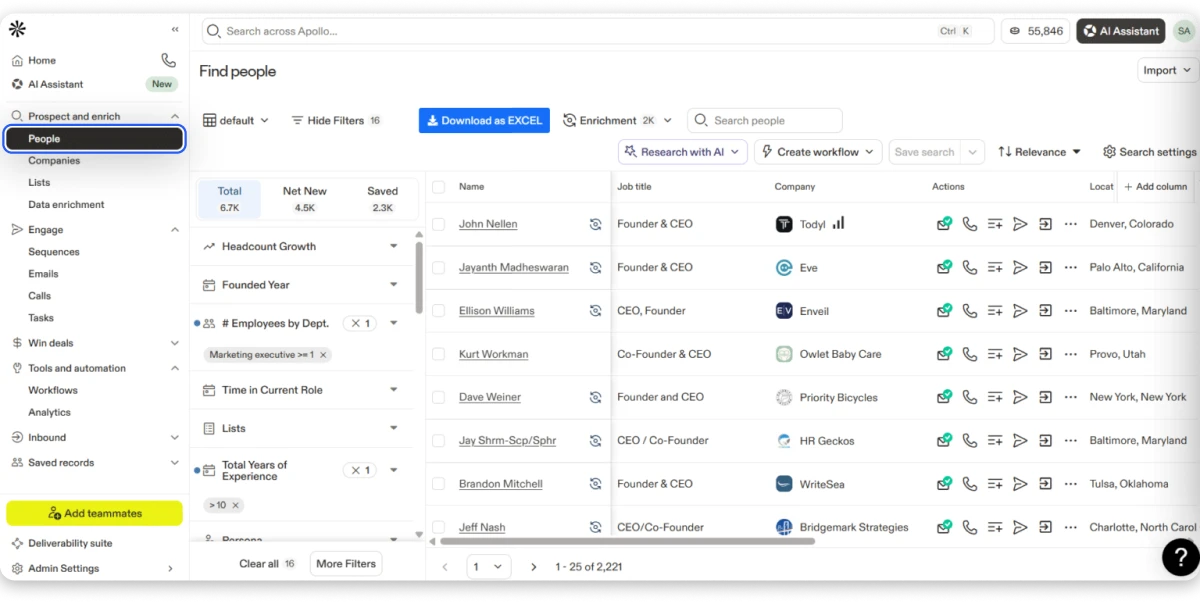
- Strength: Fast to use, deep filters, intent data on every paid plan, strong for US-based SMB and mid-market prospecting. The Persona Builder lets you save complex filter sets for reuse.
- Weakness: Apollo claims 98% email accuracy. But when I checked on G2 and Reddit, many users complained about higher bounce rates during campaigns. Also, its European coverage is noticeably weaker, and credits are charged whether the contact is verified or not. 😱
For a full breakdown of how Apollo’s credit costs stack up across plans, I’ve broken it down in this Apollo.io pricing guide.
Is Smartlead’s B2B Database & Accuracy Better than Apollo’s?
Smartlead’s prospecting tool is called Smart Prospect. It gives you filters for job title, seniority, department, company size, industry, revenue, and location.
I found their lead prospecting workflow clean: search, unlock emails at 1 credit per lead, push straight into a campaign.
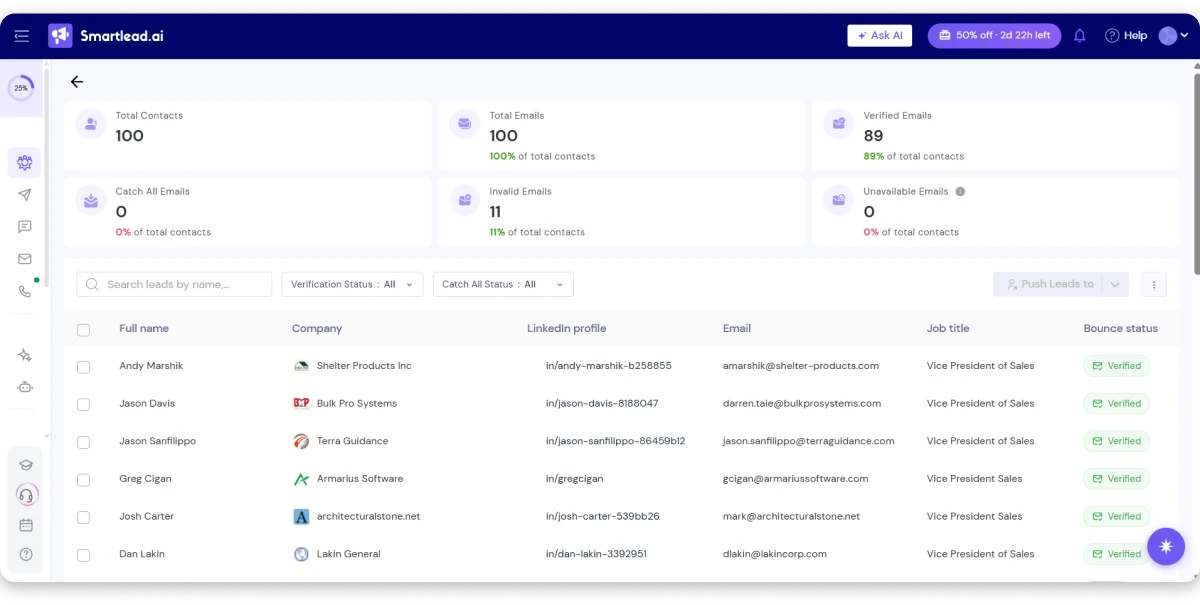
My honest take is that Smartlead is not primarily a data company.
The Smart Prospect feature is a relatively new addition to a platform built around email infrastructure.
There is no published accuracy percentage, and the database has known gaps in local-service verticals.
Biggest Drawback I Found: There’s also no intent data, no technographic filters, and no trigger-based prospecting.
- Strength: Simple workflow, built-in verification at unlock, emails feed directly into campaigns without export/import steps.
- Weakness: No published accuracy benchmark and intent data or buying signals. CSV list enrichment isn’t supported, plus phone number data isn’t provided. Weakest on local and non-SaaS verticals. No radius-based search; city/state only.
How Does Saleshandy Stand Out 💪 as a Better Alternative to Smartlead and Apollo.io?
Before I answer this, let me ask you a very important question.
Do you know what gets expensive fast in cold outreach?
It’s bad data. It wastes credits, causes bounces, hurts sender reputation, and forces you to keep hunting for replacements.
Saleshandy reduces that risk to a significant level with Waterfall Enrichment. Instead of relying on one database, it checks 9 trusted data providers to find verified contact details.
Cherry on the cake: You also get access to 852M+ B2B contacts, and you only spend a credit when Saleshandy finds a verified result. 🤩
If the contact cannot be verified, you don’t pay. So, your credits go toward usable data, not failed lookups.
Bonus Read: If data accuracy is your top priority, here’s how Saleshandy compares directly with Apollo on verified email rates, database depth, and cost per contact.
2. Smartlead vs Apollo: Which Tool Is Better for Email Warm-Up and Deliverability?
The second parameter I tested was email warm-up and deliverability because getting emails into the inbox is what decides whether your outbound efforts actually work.
And, definitely, Smartlead wins in the email warm-up and deliverability race. But the gap is smaller than most outbound teams think.
Both tools have a warm-up feature. It’s how it’s built, what’s included, and how much it costs when you scale.
Let me break it down for you.
How Good Is Apollo’s Warm-Up and Deliverability?
I want to correct something you’ve probably read in other comparisons: Apollo did not fully remove warm-up.
It’s still there. It’s powered by Warmbox.ai (a third-party provider), runs automatically once enabled, and follows the same logic: real inboxes opening, replying to, and rescuing your emails from spam.
But here’s the honest limitation I found: you get one warm mailbox per seat. Every additional mailbox costs 200 credits per 30-day billing cycle, on top of your existing plan.
For a team running 10 sending accounts across three reps, that credit consumption adds up fast.
Also, if your credit balance hits zero, warm-up pauses. It resumes when you top up, but that gap in warm-up activity can hurt the sender’s reputation you’ve spent weeks building.
The rest of Apollo’s deliverability suite is solid.
Per-mailbox deliverability scores, blocklist checks across 50+ databases, inbox placement tests, bounce logs for admins, and auto-pause protection at 10% bounce rate.
- Strength: Full deliverability suite included on paid plans. Auto-fixes SPF/DKIM/DMARC on supported DNS providers; no IT ticket required. Inbox placement tests are native, not an add-on.
- Weakness: Warm-up is third-party (Apollo doesn’t control Warmbox.ai). One mailbox per seat included, which scales warm-up costs credits. Warm-up pauses if credits run dry.
Why is Smartlead’s Warm-Up and Deliverability Better Than Apollo’s?
Warm-up runs on Smartlead’s own in-house network: real mailboxes opening, replying to, and rescuing emails from spam.
Every email account you connect gets warm-up included, with no per-mailbox credit cost. You can run 50 accounts, and warm-up doesn’t cost you a single extra credit.
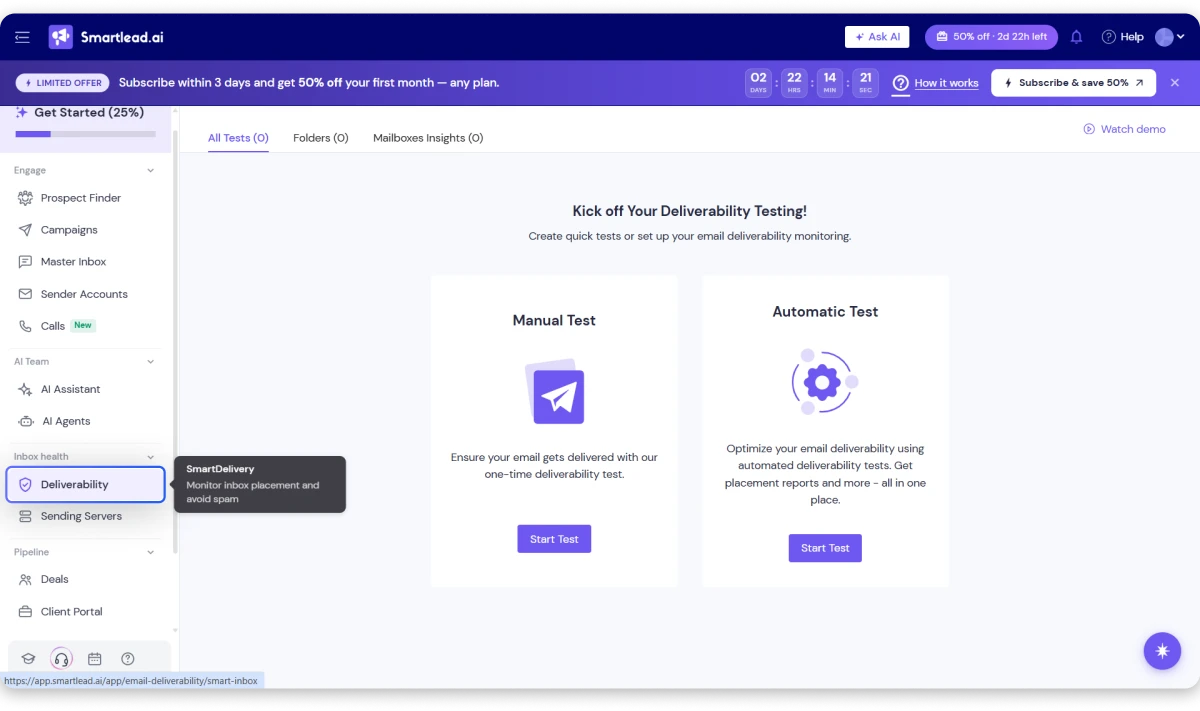
I felt the configuration is also more detailed than Apollo’s: you control daily volume, ramp-up speed, reply rate percentage, and whether auto-adjustment is on. Ongoing warm-up continues even after campaigns launch to maintain sender reputation, not just during the setup phase.
Here are the features that truly stood out to me:
- Warm-up reputation: See each account’s score from 0–100.
- Mailbox health: Monitor the health of each mailbox.
- Bounce analytics: Track hard and soft bounces by campaign and mailbox.
- Domain health: Monitor your domain’s overall health.
- Campaign diagnostics: Get alerts for unusual sending patterns, off-hours activity, and overloaded mailboxes.
One honest callout: SmartDelivery (the spam score and inbox placement testing tool) is a $39/month add-on, not included in base plans. Apollo includes inbox placement testing natively on paid plans. If you need that feature specifically, factor it in.
Also, Smartlead reports your SPF/DKIM/DMARC status but doesn’t fix DNS records for you. You need to go to your domain registrar and do it manually. Apollo auto-fixes these on supported DNS providers.
- Strength: Unlimited warm-up across unlimited accounts on every plan. Native in-house network. Warm-up continues through active campaigns. Detailed per-mailbox and per-domain health reporting.
- Weakness: SmartDelivery (inbox placement testing) is a paid add-on. DNS fixes are manual; Smartlead only shows you the problem, not fixes it.
How Does Saleshandy Keep Emails Out of Spam Without the Big Price Tag?
In Apollo, each extra mailbox costs you 200 credits per cycle. With Smartlead, SmartDelivery costs $39/month extra. These costs are invisible in pricing comparisons but very visible in your monthly bill.
Whereas Saleshandy includes unlimited warm-up across all connected mailboxes via a native in-house network, not a third-party.
Inbox Radar monitors whether your emails land in Primary, Promotions, or Spam.
And Sender Rotation, Sequence Score, AI Bounce Detection, and ESP Matching are all built in. So, you get a full deliverability stack.
And the best part?
No add-on required. No per-mailbox credit charge. 😮‼️
3. Apollo vs Smartlead: How Many Email Accounts Can You Connect?
Both tools let you connect multiple email accounts, but “how many you can connect” and “how many you can actively send from” are two different questions.
Getting this wrong is how teams end up hitting invisible limits mid-campaign.
Apollo works well if each rep only needs a small number of sending accounts. But once you start running multiple domains or mailboxes, the Basic plan becomes restrictive, and warm-up credits can add up quickly.
For agencies or larger outbound teams, the Professional plan is where Apollo becomes more practical. Even then, mailbox flexibility is not as open as Smartlead or Saleshandy.
Speaking of Smartlead, it’s much more flexible because you can connect and warm up unlimited email accounts across plans.
However, just because it’s connected does not mean it’s active. Your plan still controls how many mailboxes can send campaigns at the same time, which can become a bottleneck as your sending setup grows.
For teams rotating many inboxes, that active-sender limit matters more than the unlimited connection claim.
Why Saleshandy Doesn’t Make You Pay Extra to Add More Mailboxes
With Saleshandy, you do not have to keep checking how many mailboxes your plan allows.
You can connect unlimited email accounts 😃, use them in active campaigns, and warm them up without paying extra per mailbox, even on the $25/month Outreach Starter plan.
Plus, the Sender Rotation is built in, too. So as your outreach grows, your mailbox setup does not become another thing you have to constantly calculate or manage.
4. Smartlead vs Apollo: Which Tool Offers Better Sequence Automation and Multichannel Outreach?
Apollo wins this category, and to be honest, it’s not even close.
Smartlead is an email-first platform. Everything else (calls, LinkedIn, SMS) requires third-party integrations through Zapier, Make, or webhooks. Apollo runs email, phone, and LinkedIn tasks natively inside a single sequence flow.
How Apollo’s Sequences Feature Better than Smartlead?
Apollo is the stronger choice if you want email, call, and LinkedIn tasks inside one sequence.
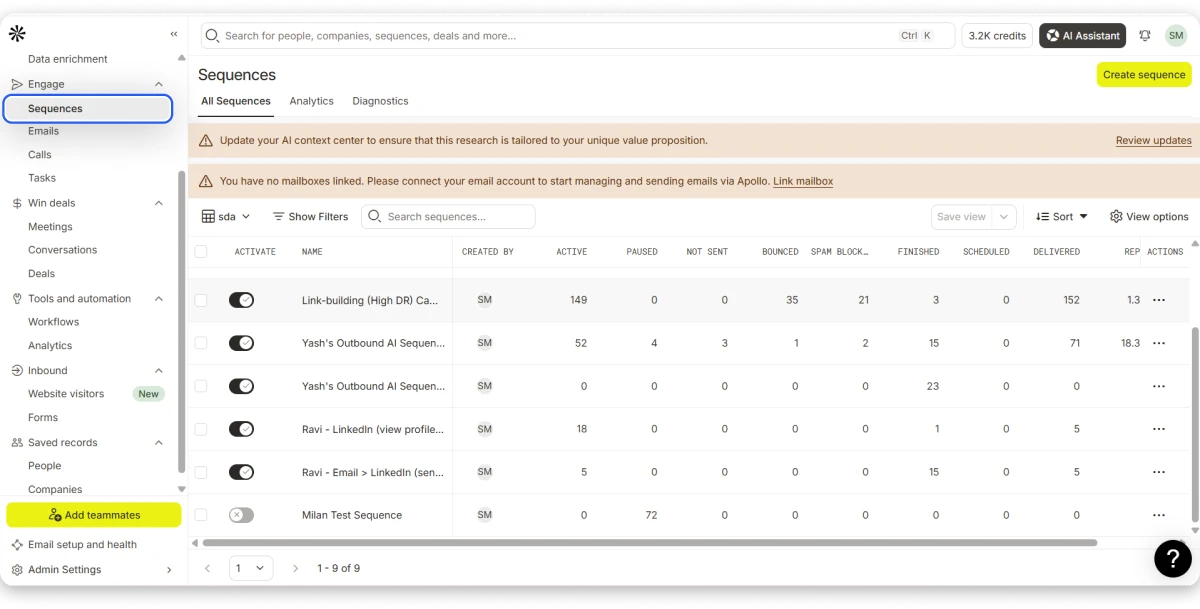
Its AI Builder can also generate a sequence using your ICP, product, and positioning, which is useful when you create campaigns often.
The minor drawback I found is that LinkedIn actions are still manual, while calling and A/B testing require higher plans. So Apollo feels multichannel, but some of that flexibility comes with plan limits and extra cost.
Worth Reading: If multichannel outreach is a priority, I’ve compared the best multichannel outreach tools tested for true automation depth across email, LinkedIn, calls, and WhatsApp.
What Smartlead Offers in Sequences?
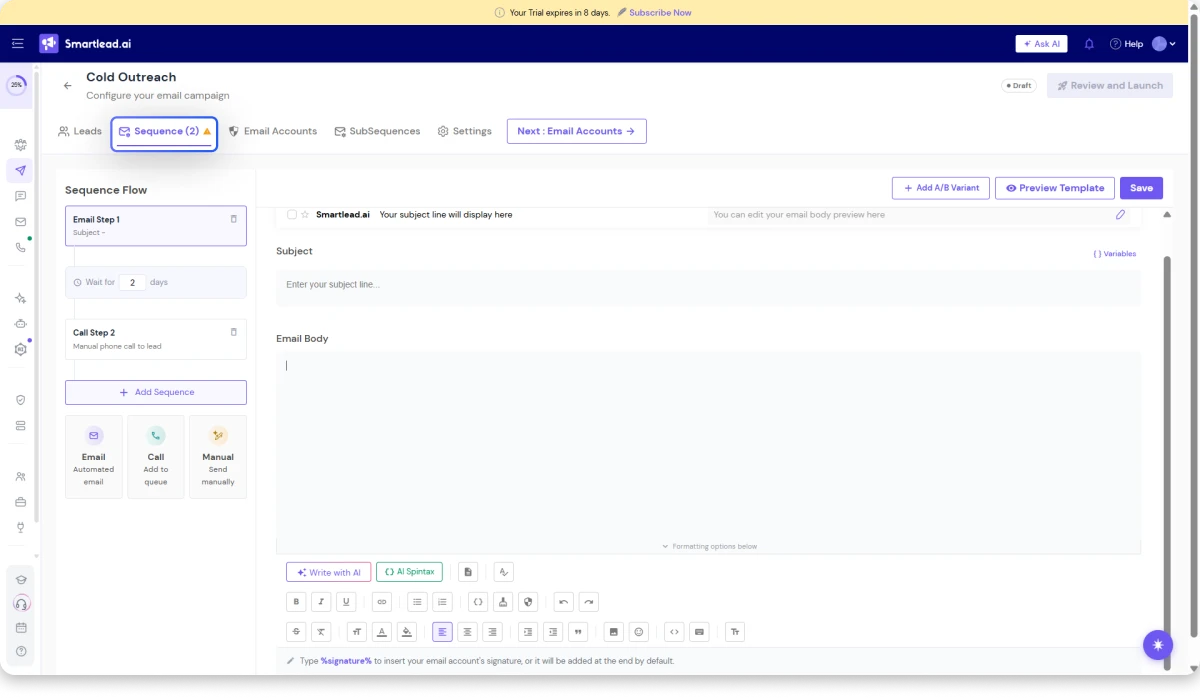
Smartlead is built much more around email automation.
Its Subsequences and Smart Automate features let you trigger follow-ups and actions based on lead behavior, which gives you strong control over email workflows.
The biggest limitation is multichannel outreach. If you want calls, LinkedIn, or other channels in the same workflow, you will need third-party tools, which adds more setup and cost.
Why Users Choose Saleshandy for Better Sequence Automation and Multichannel Outreach
Both tools have gaps. Saleshandy doesn’t.
Saleshandy’s email sequences, LinkedIn automation, AI Dialer, and WhatsApp outreach all run from one sequence, no third-party tools required.
Apollo’s LinkedIn steps are manual tasks. Saleshandy’s LinkedIn step is natively automated, so no manual clicking is required.
Apollo has no WhatsApp. Saleshandy does, natively.
Smartlead has no phone or LinkedIn without third-party tools. Saleshandy has both built in.
And where Apollo locks A/B testing behind the $79/mo Professional plan, Saleshandy runs A-Z testing, up to 26 variants in one sequence, from $25/mo.
So, you’ll be able to work in a single workflow and multiple outreach channels. And above all, no third-party integrations are required to make it work.
5. Smartlead vs Apollo: Which Tool Personalizes Cold Emails Better?
Apollo wins the personalization game with a significant gap, with AI-powered, research-backed personalization at scale.
Smartlead only gives you merge tags and custom fields.
But Apollo gives you merge tags, conditional logic, AI-generated copy per contact, intent signals as variables, and six AI models to research prospects before you send.
How Does Apollo Help You Personalize Emails at Scale?
Apollo’s personalization runs in layers. It goes above and beyond basic merge tags.
You can use Conditional logic, intent signals, and AI Research PowerUps to personalize emails based on things like company activity, hiring, LinkedIn content, or buyer intent.
That makes Apollo much stronger for teams that want deeper personalization at scale without researching every prospect manually.
The trade-off I found is cost and complexity. 😱
- A/B testing is Professional+ only ($79/mo).
- AI Research consumes credits at scale: 1,000 contacts × 3 research fields = 3,000 credits.
- AI outputs require spot-checking before launch, and English only across all AI features.
How Does Smartlead Handle Personalization?
I found Smartlead’s personalization simple.
You can use merge tags, custom fields, time-based variables, and Spintax, but the personalization data has to come from you.
So, if you want to mention recent funding, hiring activity, or another specific signal, you need to research or enrich that data before uploading it to Smartlead.
It works well when your lead data is already clean, but deeper personalization usually means adding another enrichment tool.
Personalization Fallbacks You Need to Know: No AI copy generation, auto-enrichment, or conditional fallback logic, and no intent signals. Personalization beyond basic merge tags requires manual research and clean CSV data; it doesn’t scale past 50–100 leads without external tools.
How Saleshandy Gives You Better Personalization Without the Complexity
The gap both tools leave is the same: Apollo requires credits for AI research at scale, and Smartlead requires manual research effort.
Saleshandy closes it with AI Prospect Enrichment.
It uses your choice of LLM (GPT-5, Claude, Gemini, Perplexity, or Grok) to research each contact and fill in personalization fields like icebreakers, company summaries, and role context automatically.
Plus, Spintax is included natively. A-Z Testing runs up to 26 variants in one sequence, that too with no Professional plan upgrade required.
6. Smartlead vs Apollo: Which Tool Handles Replies Better at Scale?
Smartlead wins this one, but with an important caveat depending on your plan.
Both tools have a unified inbox and AI reply categorization.
Smartlead goes deeper with AI-drafted responses, more granular intent categories, and a cleaner team collaboration layer. Apollo’s gaps are real. They have no real-time notifications, a priority reply queue, and no suggested replies surfaced automatically.
Apollo tracks replies automatically and brings them into the Emails Hub, where you can filter by sentiment, sequence, sender, and status.
It also stops follow-ups after a reply and handles OOO responses well by pausing and resuming contacts automatically.
The 3 main gaps are:
- No real-time reply alerts
- No team assignment
- No automatic AI reply suggestions when a response comes in
Whereas Smartlead brings replies from all campaigns and email accounts into one Master Inbox.
AI automatically categorizes replies by intent, while teams can assign conversations, add notes, and filter replies quickly.
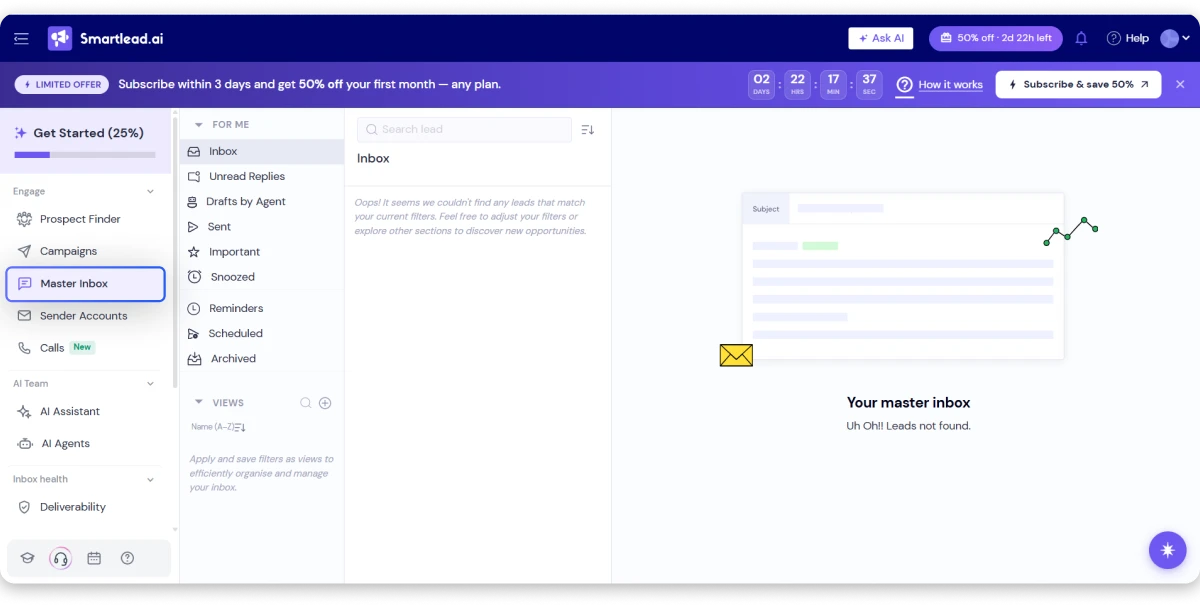
On higher plans, Reply Agent can also draft responses based on the conversation and your goal, but you still review them before sending.
The main limitation is that Reply Agent is only available on higher-tier plans.
How Does Saleshandy Stand Out in the Reply Management Race?
Saleshandy’s Unified Inbox combines what Apollo & Smartlead tools do well without the plan restrictions.
AI reply categorization, AI CoPilot for drafting responses, team assignment, and real-time Slack and email alerts when replies land, all available from the base plan. 🤩 🤩
That means you catch warm replies the moment they arrive, not the next time someone checks the inbox. Mobile apps on iOS and Android mean your team stays on top of replies wherever they are.
7. Apollo vs Smartlead: Which Tool Gives You More Useful Analytics & Reporting?
Actually, it depends on what you need analytics for.
- Apollo wins for sales teams who need to tie outreach activity to pipeline and revenue.
- Smartlead wins for outbound teams who live and breathe deliverability and campaign performance at the mailbox level.
Apollo’s Analytics: What I Found
Apollo is stronger for sales and revenue reporting. You get campaign performance, rep activity, deal analytics, pipeline insights, and an AI Assistant that can answer reporting questions in plain English.
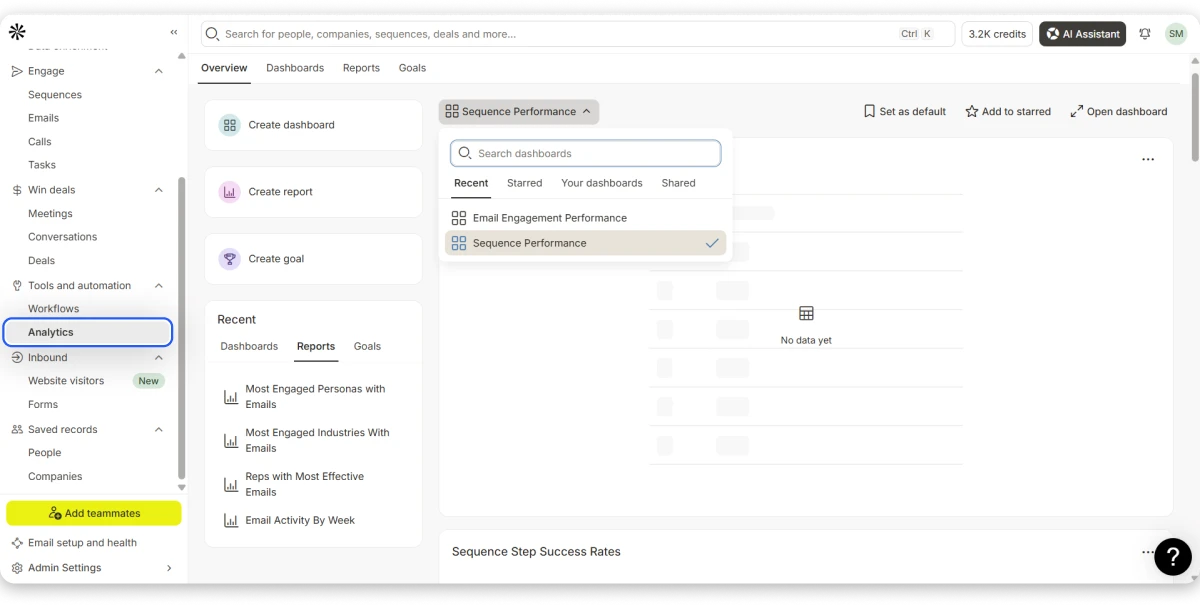
The downside is that some analytics features are plan-gated, and Apollo is not always clear about which tier includes what.
Smartlead’s Analytics: What I Found
Smartlead is stronger for outreach and deliverability analytics. You can track campaign performance, mailbox reputation, domain health, bounce rates, provider performance, and team results in one place.
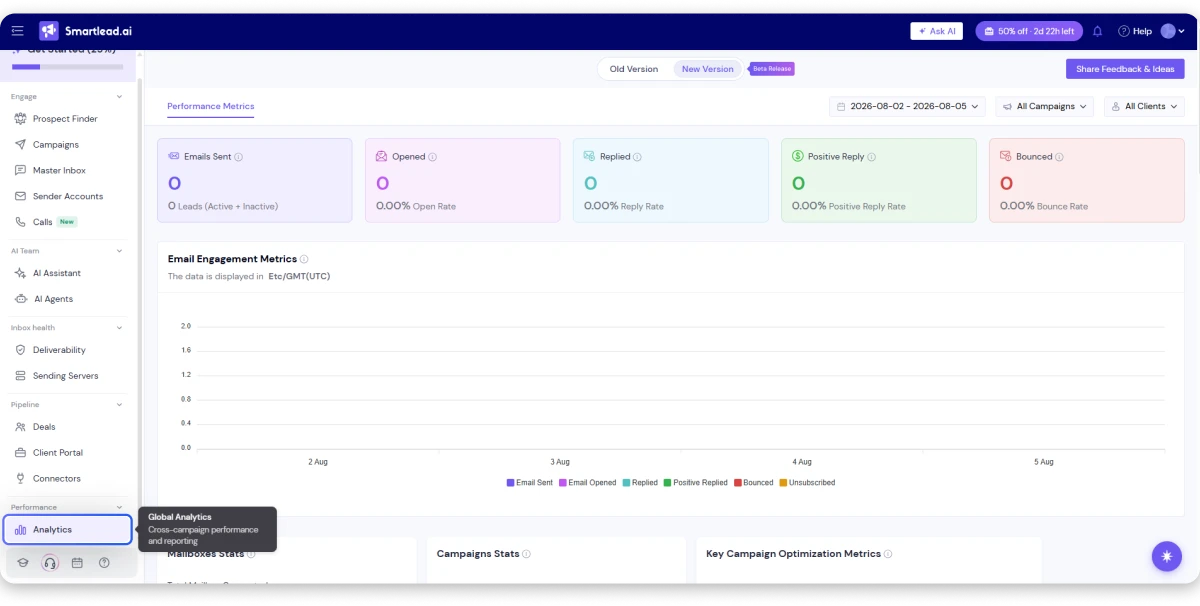
What it lacks is deeper sales reporting. There is no pipeline analytics, revenue tracking, or AI reporting assistant.
How Saleshandy Gives Better Analytics & Reporting than Apollo & Smartlead?
Both tools share one gap: neither sends you a real-time alert when something goes wrong.
Bounce rate spikes, reply rate drops, mailbox health declining, and you find out when you check, not when it happens.
But Saleshandy gives you per-account and per-domain reporting, Sequence Score to catch deliverability issues before launch, and real-time Slack and email alerts when replies land.
Combined with a 365-day analytics history, it gives you the deliverability depth of Smartlead and the campaign-level clarity of Apollo without logging in to find out something went wrong three days ago.
8. Smartlead vs Apollo: Which Tool Integrates Better With Your Existing Stack?
Apollo wins for CRM depth. Smartlead wins for simplicity.
Neither is a clear loser here; it comes down to which CRM you’re on and how technical your team is.
Apollo is stronger for deeper CRM sync, especially with HubSpot and Salesforce.
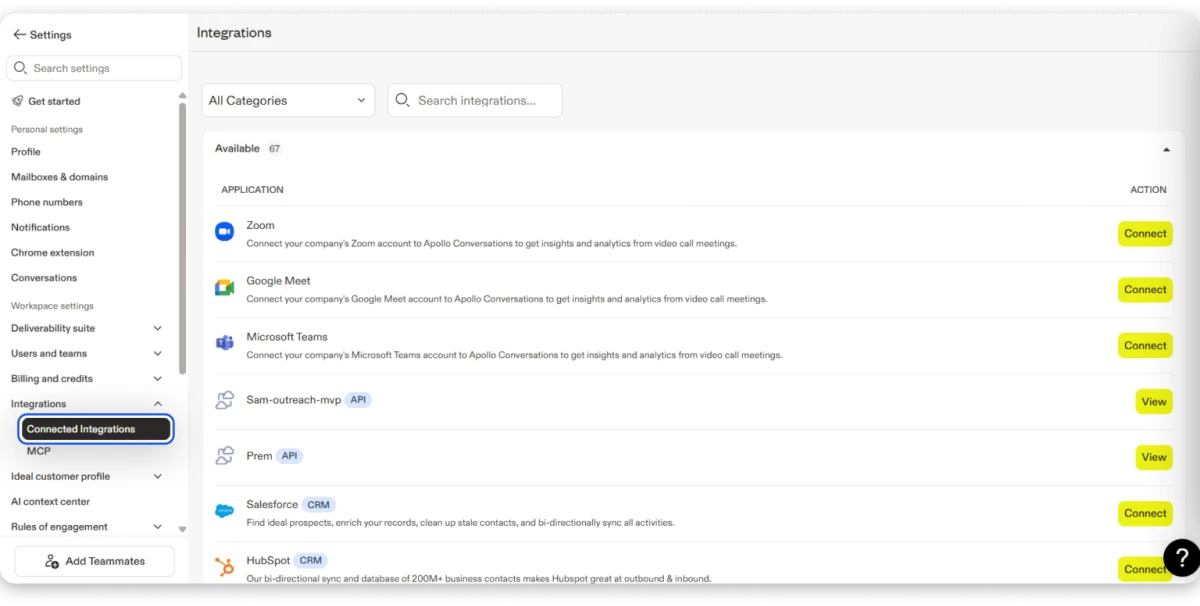
It also supports 200+ app connections through Workflows and MCP integrations for tools like ChatGPT and Claude.
The main drawback is that some CRMs have limited activity sync, and Apollo only lets you connect one CRM at a time.
On the other hand, Smartlead keeps integrations simple with native CRM connections for HubSpot, Salesforce, and Pipedrive. For everything else, it relies on Zapier, Make, and webhooks.
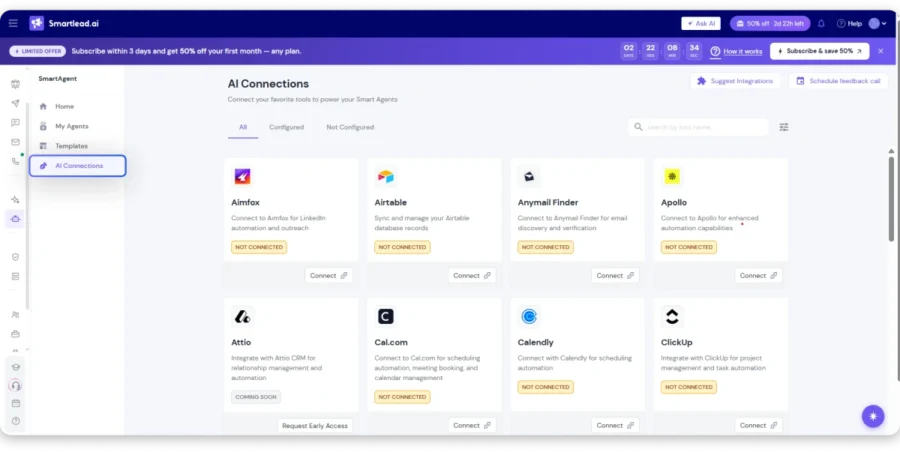
The main limitation is that external API access is restricted to higher plans.
How Does Saleshandy Stand Out in the Integration Race?
Three things separate Saleshandy from both tools here.
First, native Pipedrive integration, no Zapier workaround, no setup complexity. Apollo and Smartlead require Zapier for Pipedrive activity sync. Saleshandy connects natively with full bidirectional sync out of the box.
Second, native Zapier integration covering 9,000+ apps, not Apollo’s limited 4-trigger Zapier connection, or Smartlead’s webhook-dependent setup. The full Zapier catalog, natively.
Third, and this is where Saleshandy stands alone: both MCP and CLI support.
MCP connects Saleshandy to Claude, ChatGPT, Cursor, and n8n, with 40+ outreach actions available through plain English commands.
CLI runs the same workflows from your terminal with near-zero token overhead, no AI interface required.
For RevOps teams building automation scripts, CI/CD pipelines, or custom outbound infrastructure, that’s a capability neither Apollo nor Smartlead offers.
9. Smartlead vs Apollo: Which Tool Is Built Better for Agencies?
Well, Smartlead takes the trophy home for this category.
Apollo was not built for agencies. It has no white-label offering, no consolidated billing, no cross-client reporting, and no agency plan on its pricing page.
Smartlead has a dedicated Smart Agency plan tier designed specifically for this use case.
Apollo can work for agencies, but it is not built around agency workflows.
Its Partner Seat makes switching between client accounts easier, but each client still manages their own subscription, billing, and workspace.
Smartlead is much more agency-focused. You get separate client workspaces, white-labeling, consolidated billing, and campaign approvals from one admin setup.
The main trade-off is cost, since agency access starts on a separate paid plan.
Why Lead Gen Agencies Choose Saleshandy over Smartlead and Apollo?
Saleshandy includes the agency layer without a separate expensive plan. 🙂
Agency Portal, white-labeling, and unlimited clients are included from the Outreach Scale plan at $139/mo, not a 299–1,299/mo separate tier.
No per-client add-on fees. No shared mailbox pool that one client can hog. Unlimited team members.
If you’re running a cold email agency, here’s everything Saleshandy’s Agency Portal includes: unlimited clients, white-labeling, and consolidated billing from one plan.
For agencies that find Smartlead’s Smart Agency pricing steep and Apollo’s offering insufficient, Saleshandy closes the gap at a fraction of the cost.
Smartlead vs Apollo: What’s the Pricing Structure?
Apollo charges per seat.
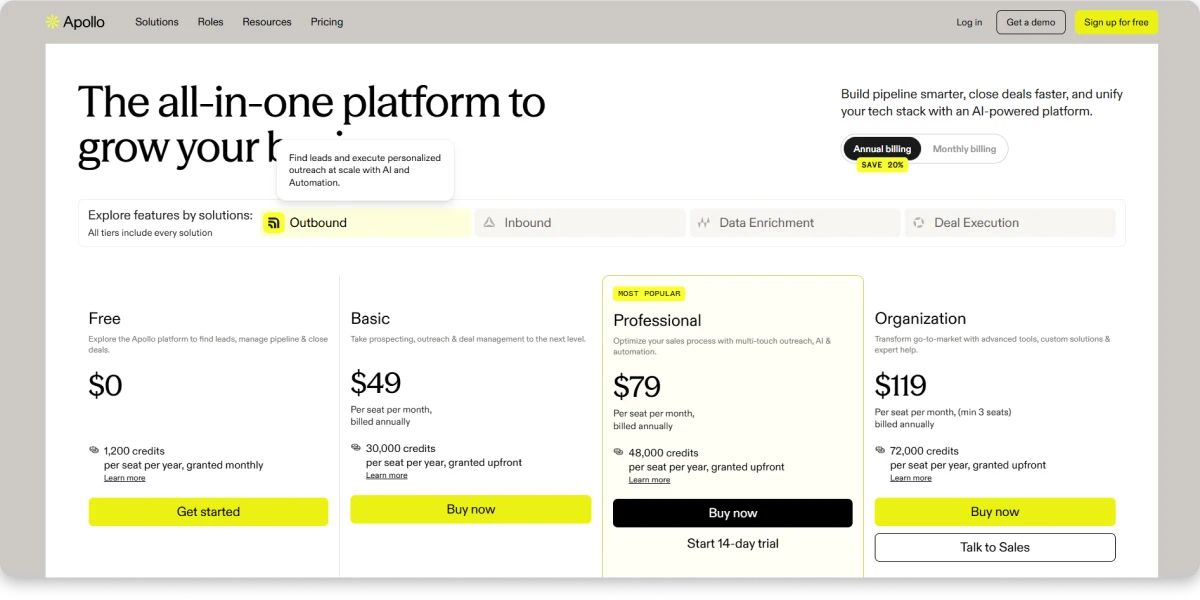
Smartlead charges by sending volume.
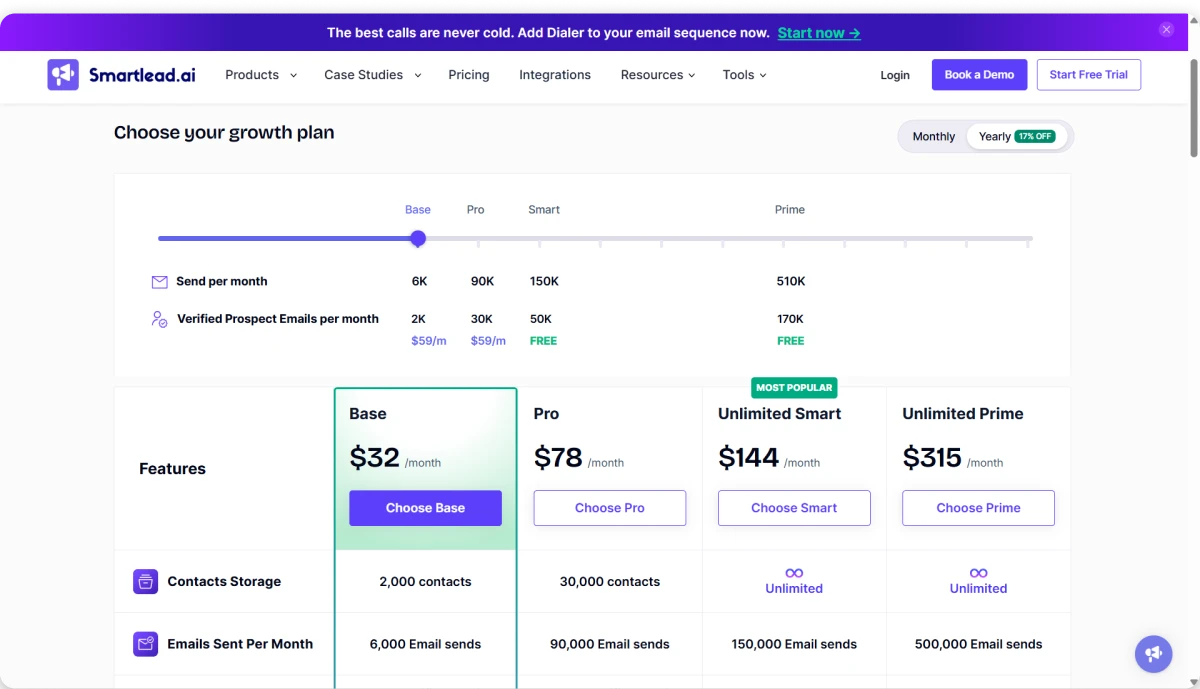
Neither includes everything you need out of the box.
Here’s how each tool structures pricing:
One thing most people miss about Apollo credits:
Credits are a separate currency on top of your subscription.
- Revealing an email costs 1 credit.
- A phone number costs 8 credits.
- AI research costs 1 credit per run.
- US Dialer costs 2 credits per minute.
And here’s the part that stings: credits are charged whether the contact is verified or not. A stale record still consumes your budget.
Scenario-based pricing With Real-world Use Cases:
- Solo founder: Saleshandy at $25/mo is the most affordable. Apollo works at $49/mo, while Smartlead is likely more than you need.
- 5-person SDR team: Smartlead is affordable for sending, but you still need prospect data. Saleshandy combines outreach + data for $118/mo with unlimited users.
- 10-client agency: Saleshandy is the simplest at $139/mo with unlimited clients. Smartlead supports agencies but gets expensive as clients increase, while Apollo lacks dedicated agency features.
What Does One Verified Contact Actually Cost?
This is the metric that actually matters in outbound, because only plan price matters, but how much you pay for a contact you can actually use.
Smartlead vs Apollo: Which Tool Is Worth Your Time and Dollars in 2026? [Final Verdict]
After testing both tools and running them against real outbound workflows, here’s what I would tell a friend:
Choose Smartlead if:
- Deliverability and warm-up matter more than prospecting depth
- You already have verified lead data and need a reliable sending infrastructure
- You run high-volume outreach across many mailboxes
- You’re an agency that needs separate, isolated client workspaces
Bonus Read: If Smartlead’s email-only limitation is the gap you’re trying to fill, here are the best Smartlead alternatives with stronger data and multichannel capabilities.
More Smartlead Resources:
Choose Apollo if:
- You want prospecting and outreach in one platform without managing two tools
- Intent data matters to your targeting; Bombora signals are included on every paid plan
- Your team lives on LinkedIn and needs the strongest Chrome extension in this comparison
- You need call recording, AI summaries, and coaching features built into your workflow
Worth Reading: If Apollo’s per-seat pricing or deliverability limitations are a concern, I’ve tested the best Apollo alternatives with stronger verification on executive-level contacts and better warm-up infrastructure.
More Apollo Resources:
Saleshandy Is Worth Considering If You Need the Best of Both Worlds
You get precise prospecting, outreach, deliverability, and multichannel engagement in one place.
Do you care about cleaner data?
Saleshandy verifies contacts before charging credits, so you spend less on unusable leads and reduce avoidable bounces.
Do you want real multichannel outreach?
With Saleshandy, you can run email, LinkedIn, calls, and WhatsApp from one sequence without connecting more tools.
Are you scaling a team or agency?
No per-seat pricing. No per-client fees. Unlimited team members, Agency Portal, and white-labeling from $139/mo. Smartlead’s Smart Agency starts at $299/mo for just one client workspace. Apollo has no agency plan at all.
Is Deliverability matters to you?
Unlimited warm-up, Inbox Radar, Sender Rotation, Sequence Score, and AI Bounce Detection are all built into your outreach plan. Not add-ons. Not separate subscriptions. Just included.
Do you want fewer subscriptions?
Lead Finder + Outreach puts your data and sending under one roof. One login, one bill, one workflow.
Apollo Professional alone costs $395/month before additional credits and deliverability tools. Smartlead can handle sending, but you may still need another data provider.
Saleshandy Outreach Pro + Lead Finder starts at $118/month with unlimited team members and a warm-up included.
If your goal is to spend less time managing your outbound stack and more time actually running outreach and booking more meetings in 2026, then Saleshandy makes a strong case.
Try Saleshandy Free for 7 Days →
FAQs People Ask About Smartlead vs Apollo
1. Is Smartlead better than Apollo for cold email?
For pure cold email deliverability at scale, yes. Smartlead’s native in-house warm-up network, unlimited sending accounts, and per-mailbox health monitoring make it a stronger infrastructure choice. Apollo’s warm-up runs on a third-party provider (Warmbox.ai), covers only 1 mailbox per seat, and pauses if your credits run out, which is a meaningful difference when you’re managing 20+ sending accounts.
2. Can you use Smartlead and Apollo together?
Yes, and many high-volume outbound teams do. The typical setup: Apollo for finding and enriching leads, Smartlead for sending at scale. It works, but you’re managing two tools, two billing cycles, and two workflows. Saleshandy replaces both with one platform.
3. Is Apollo’s warm-up feature still available?
Yes, but it’s changed significantly. Apollo’s warm-up now runs through Warmbox.ai (third-party), covers 1 mailbox per seat on paid plans, and charges 200 credits per additional mailbox per 30-day cycle. It’s not the same as a native in-house warm-up network. If your credits run dry, warm-up pauses automatically, which can hurt the sender reputation you’ve spent weeks building.
4. Which tool is more cost-effective at scale?
Saleshandy. No per-seat pricing, no separate warm-up subscription, and credits are only charged for verified contacts. Apollo Professional for 5 reps costs $395/mo before credits and before a warm-up tool. Smartlead handles sending, but still leaves data sourcing to you. Saleshandy Outreach Pro + Lead Finder starts at $118/mo with unlimited team members and a warm-up included.
5. Can I use Smartlead with Saleshandy?
Yes. Some teams use Saleshandy’s Lead Finder to source verified contacts and push them into Smartlead for sending. But since Saleshandy also handles sending, including warm-up, Sender Rotation, and multichannel sequences, most teams find that it replaces Smartlead entirely.
6. What is the best alternative to Smartlead and Apollo?
Saleshandy. It combines an 852M+ contact database with Waterfall Enrichment across 9 providers, 92% verified email accuracy, full multichannel sequences (email, calls, LinkedIn, WhatsApp), unlimited warm-up, and an Agency Portal, from $25/mo with no per-seat pricing.
7. What should I look for when choosing between Smartlead and Apollo?
Four things: verified data accuracy (test both on your actual ICP), warm-up infrastructure (Apollo’s Warmbox.ai setup has real limitations at scale), credit pricing transparency (Apollo charges whether the contact verifies or not), and multichannel needs (neither tool offers WhatsApp natively; Smartlead has no native calls or LinkedIn automation). If you find yourself wanting both tools, that’s the clearest signal to evaluate Saleshandy instead.

 Anil Salvi
 Piyush Patel