
Finding clients is usually the hardest part of running an outsourcing business.
By now, you’ve probably searched “how to get clients for an outsourcing business” more times than you’d like to admit.
And every search seems to have a different answer.
“Post on LinkedIn.”
“Run Google Ads.”
“Build a referral program.”
“Send cold email.”
To be fair, none of this advice is wrong.
I know because I’ve tested most of these channels myself.
The problem is that nobody tells you what actually works when you need clients now, not six months from now.
As I experimented with different acquisition channels, I kept running into the same issues:
- Some took months before I saw any meaningful results.
- Some worked well but required a budget most agencies can’t justify.
- Some were difficult to repeat and scale.
I spent more time testing marketing channels than talking to potential clients.
That’s when I stopped asking, “Which channel is best?” and started asking, “Which channel gets me in front of companies that already need outsourcing help?”
That one change made a huge difference.
After testing them all, one method stood out because it consistently put me in front of decision-makers at companies that were actively hiring and already had a need.
I’ll cover that method first.
Then I’ll walk through seven other proven ways to get outsourcing clients, so you can decide what makes the most sense for your business, budget, and growth stage.
How to Get Outsourcing Clients – TOC
- TL;DR: Best Way to Get Clients for an Outsourcing Business
- Which Companies Are Most Likely to Hire Outsourcing Firms?
- The Best Way to Get Verified Outsourcing Clients (Recommended)
- 6 Other Ways to Get Clients for Your Outsourcing Business
- Final Verdict: Start Finding Outsourcing Clients for Your Business
- Frequently Asked Questions
TL;DR: Best Way to Get Clients for an Outsourcing Business
After testing every method below, cold outreach was the fastest way to start booking real outsourcing conversations.
Here are 7 proven ways to get clients for your outsourcing business:
Find companies actively hiring your roles, get verified decision-maker contacts, and pitch them across email, calls, and LinkedIn from one workflow.
👉 If you want the fastest path to your first client, start with #1.
Which Companies Are Most Likely to Hire Outsourcing Firms?
Before getting into the method, it is worth getting clear on who your real buyers are.
Not every company is a good fit for outsourcing, and targeting the wrong ones can slow your sales cycle down significantly.
Companies that outsource tend to have one thing in common: they are growing faster than they can hire.
They need skills that are hard to find locally, expensive to maintain in-house, or both. That pressure is what opens the door to an outsourcing conversation.
In practice, the strongest buyer segments look like this.
1. Tech and SaaS Companies
US tech companies and SaaS startups that need engineering, QA, or DevOps work but cannot compete with larger employers on compensation. The need is real. The salary expectations are not realistic for a 50-person company. Outsourcing closes the gap.
2. Mid-Size Finance, Healthcare, and E-commerce Companies
Mid-size businesses that outsource back-office work like data processing, compliance, bookkeeping, and customer support.
The work is high-volume and recurring, but it does not justify a full internal team.
3. Digital Agencies
Agencies that outsource content production, SEO delivery, paid media execution, or development to dedicated offshore teams.
Client work scales faster than agency hiring. One new contract can create a 10-person workload overnight.
4. Professional Services Firms
Legal, consulting, and accounting firms that need research capacity, documentation support, or administrative bandwidth.
Every hour a senior consultant spends on non-billable work is revenue lost. Outsourcing the support layer protects margins.
The Best Way to Get Verified Outsourcing Clients (Recommended)
Out of all the methods I’ve tested, cold outreach has been the fastest way to reach the right decision-makers with verified contact details.
It’s also the one method I keep coming back to. I use it every week to keep my business moving forward.
The tool I rely on for cold outreach is Saleshandy.
You can access a huge B2B database (852M+ contacts), and filter companies by things like location, industry, company size, hiring activity, and even specific decision-maker roles.
The biggest advantage is that you can target companies that are already hiring for roles you can support.
That means you’re not guessing; you’re reaching out to people who already have a need.
With Saleshandy, I usually do three things in one place:
- Find companies and decision-makers actively hiring the roles my team can fill
- Customize your outsourcing leads list
- Run outreach across email, calls, and LinkedIn
Here’s exactly how I was able to build a verified list of outsourcing prospects in under five minutes.
Step 1: Find Companies & Decision Makers That Need Outsourcing Services
Go to Saleshandy and create a free account. You get 50 free credits to test everything.
Once you are in, click on Lead Finder in the left sidebar.
You will see two tabs at the top: People and Companies.
Click on Companies to find businesses that are actively looking for the skills your outsourcing team provides.
Start with the Companies Tab
Filter by Industry
Click Industry and pick the verticals that hire outsourcing services the most.
For example:
- SaaS and Software
- E-commerce and Retail
- Financial Services
- Healthcare
- Marketing and Advertising
This narrows the database down to industries that already understand the outsourcing model and have the budget to spend.
Switch to the People Tab
A list of company names is not enough. You need the person who can approve a contract. That person is not the recruiter who posted the job.
It is the person who owns the department, the budget, or the business function you support.
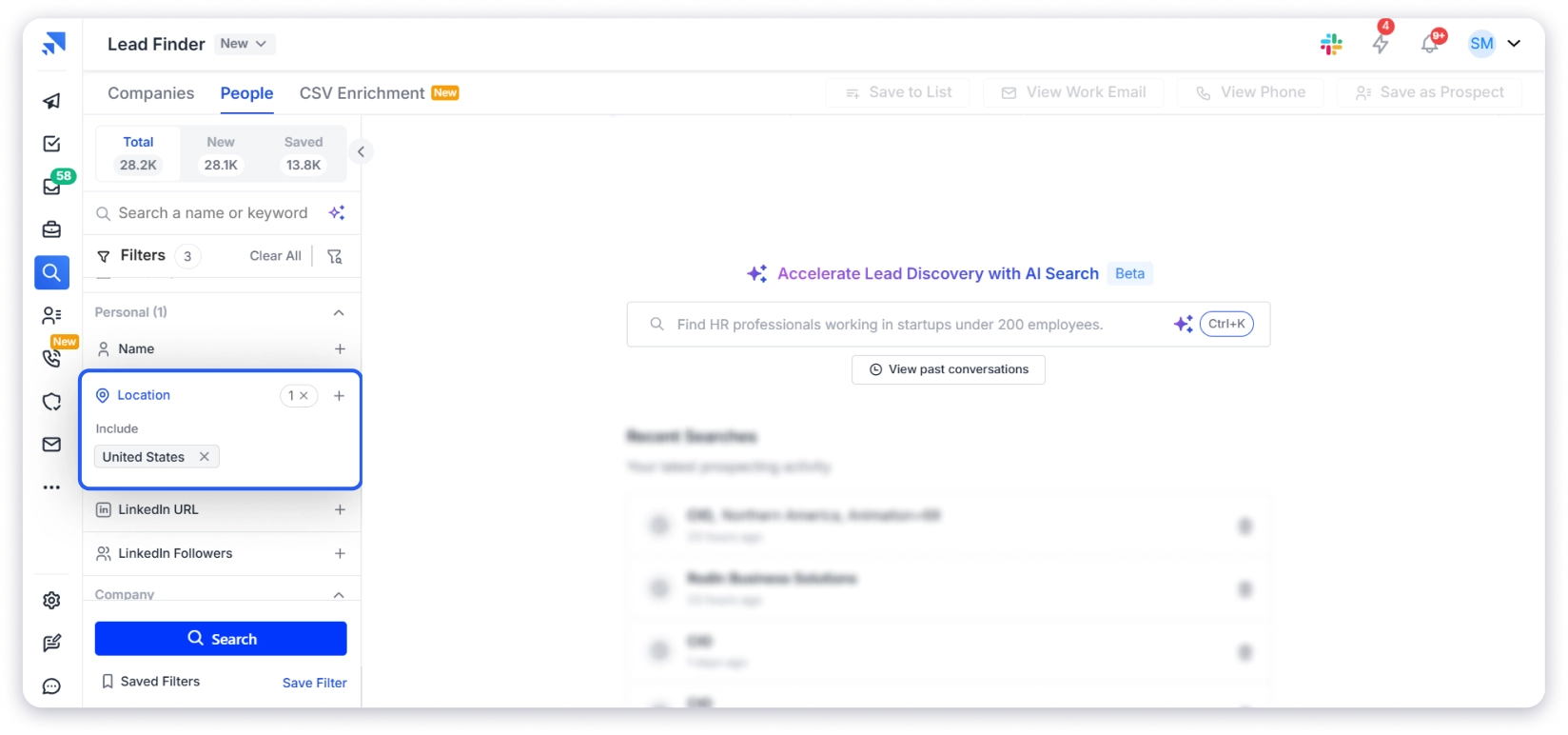
Set the Company Location
Click Location and select United States.
You can pick entire countries, specific states, or individual cities. The dropdown also covers Southeast Asia, the Middle East, Europe, and Africa.
Useful if you target clients in a specific geography.
Add Job Titles
Click Job Title and enter the roles most likely to own the problem you solve.
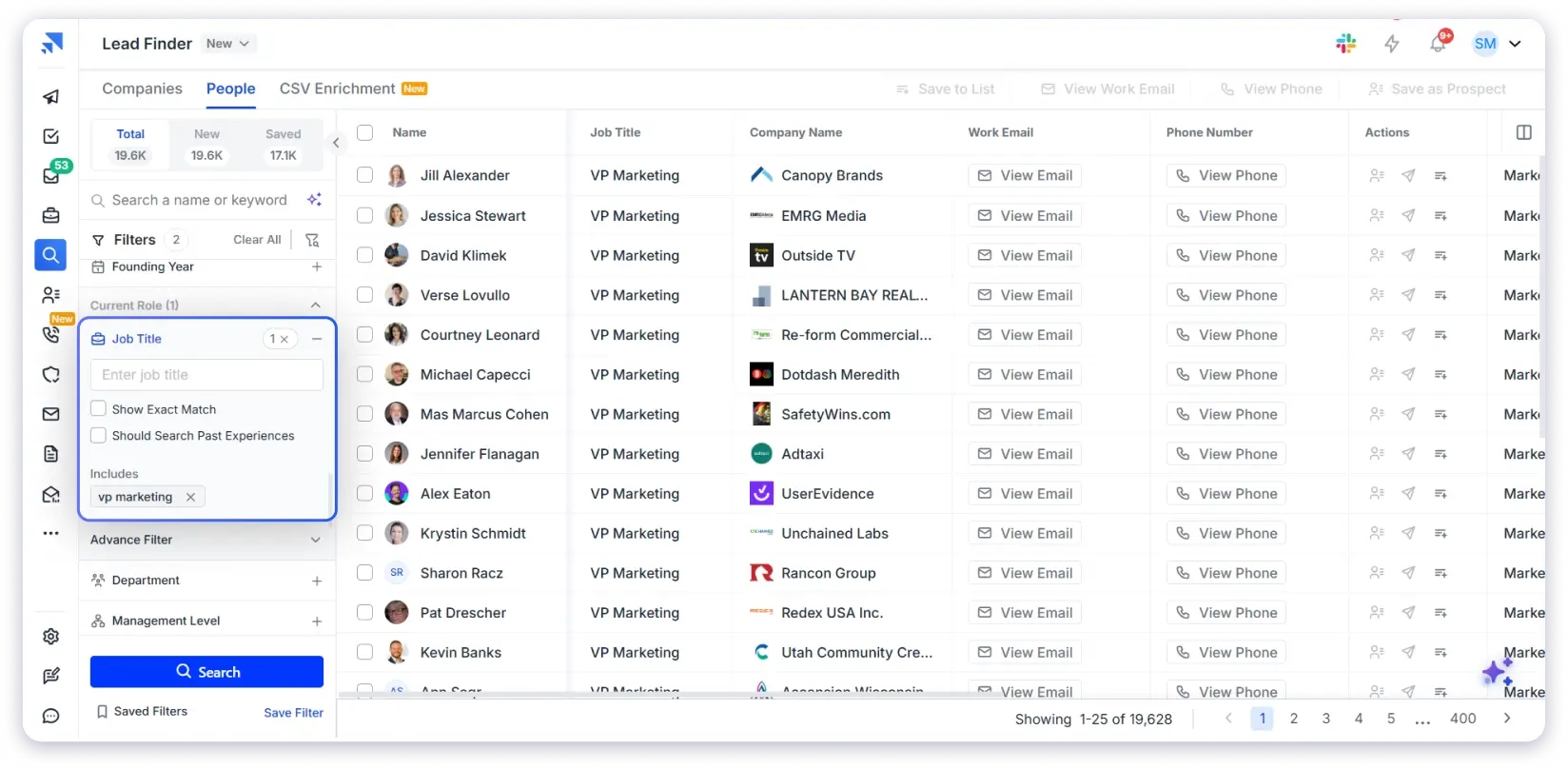
For example:
Stick to two or three closely related titles. The goal is not to build the biggest list. It is to reach the people who can actually make a buying decision.
So, now you have an email and phone number list of decision-makers in the right region.
The next step is to narrow it down to companies that are actively looking for outsourcing right now and to pull their verified contact details.
That is where Step 2 comes in.
Step 2: Customize Your Outsourcing Leads List
You have a base lead list of decision-makers. Now narrow it down to the ones ready to talk right now.
This is where the targeting gets sharp. You add filters that show which companies need outsourcing today, not three months from now.
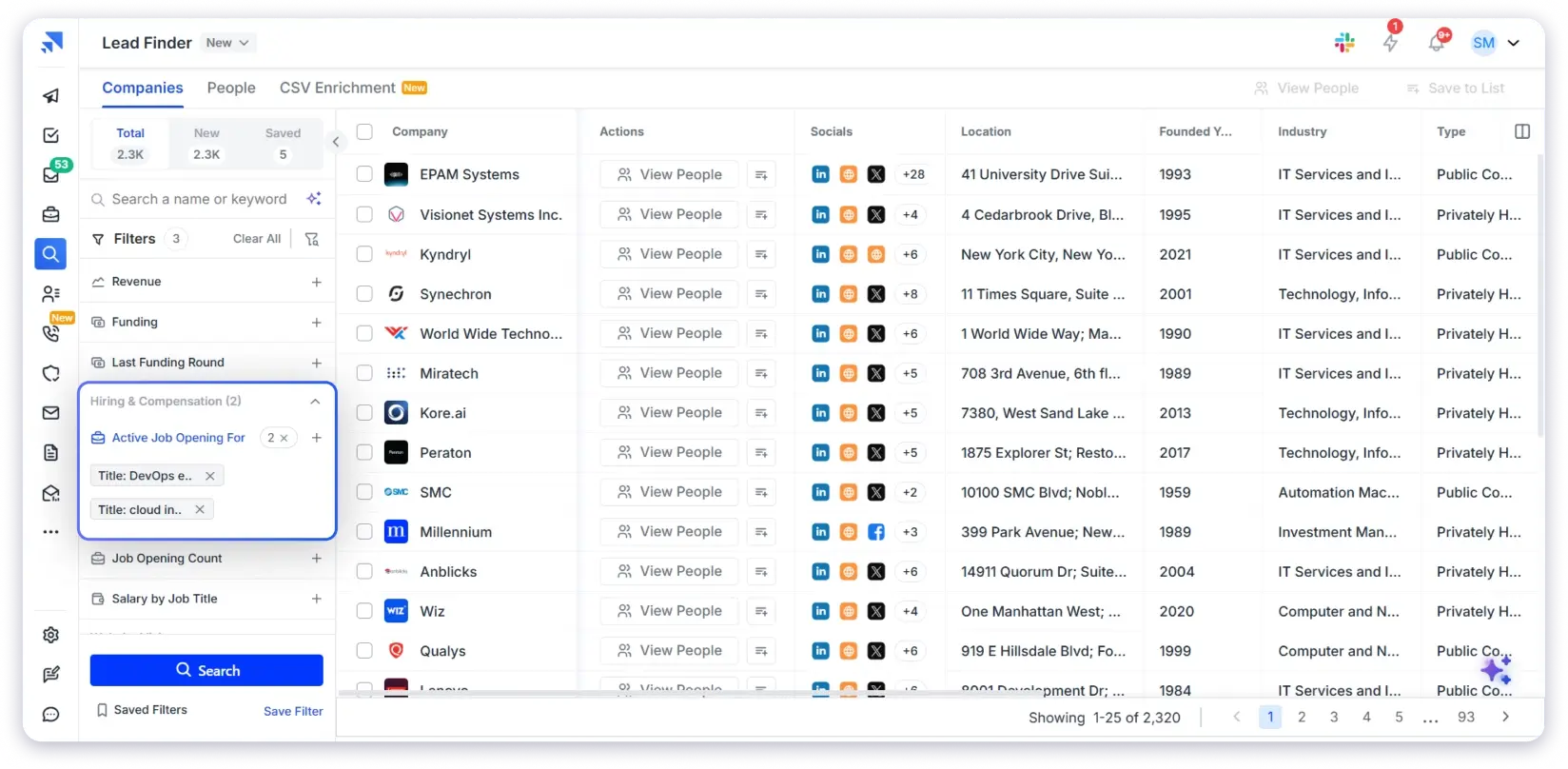
Filter by Active Job Postings
Click Active Job Postings Title and enter the roles your team can handle.
For example:
- Customer Support → Customer Support Representative, Customer Success Associate
- Accounting → Bookkeeper, Accounts Payable Specialist
- Content → Content Writer, SEO Specialist
- HR → Recruiter, Talent Acquisition Specialist
- IT → DevOps Engineer, Cloud Engineer, Software Developer
This is the most important filter. It instantly surfaces companies actively trying to fill those roles.
Hiring is a strong buying signal. The company already has the budget. They already have the business need. They just need a faster way to get the work done.
Turn On Hiring Signals
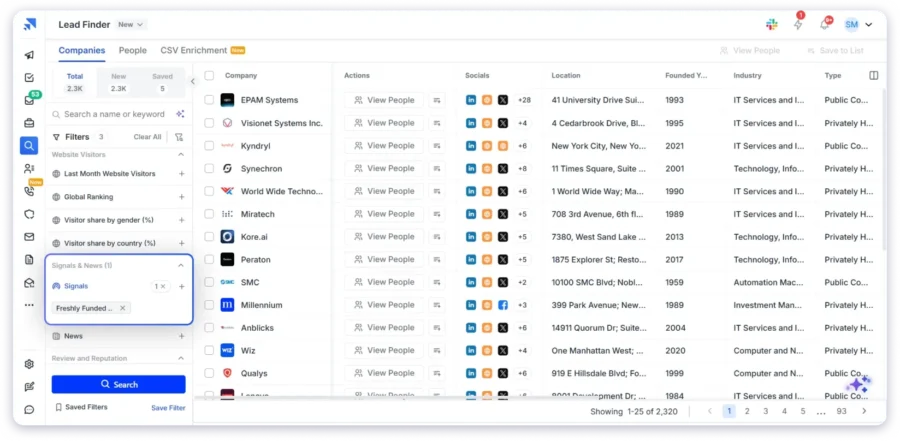
Click Hiring Signals and pick the filters that match your target.
- Rapid Growth: The company is scaling fast. Internal teams cannot keep up. They need outside help to handle the overflow.
- Freshly Funded and Hiring Fast: They just raised money, and they are hiring aggressively. The budget exists. The urgency is real.
- Actively Hiring: Multiple open roles have been posted for weeks. If the position has been open for 30 to 60 days, the traditional hiring route is not working.
- Scaling Teams: Expanding across multiple departments at once. Non-core functions are usually the first to get outsourced.
When a company shows these signals and still has unfilled positions, the gap needs to be filled. Outsourcing becomes a faster alternative.
Search and Reveal Verified Contacts
Click Search. You will see names, job titles, companies, and departments directly in the results.
Click View Email or View Phone to unlock verified contact details.
Saleshandy runs Waterfall Enrichment across 9 data providers to find the most accurate email and phone number for each contact. The verification accuracy is 92% with an under 2 to 3% bounce rate.
That means the emails you send actually land in inboxes. The phone numbers actually connect to the right person.
Once contacts are revealed, push them directly into an outreach sequence from the same platform. (No switching between tools)
Type what you need in plain English and let AI build the list for you.
Example: “Find US companies hiring DevOps engineers with 50 to 500 employees, freshly funded and actively scaling.”
AI reads your prompt, sets every filter automatically, and builds your list. It even suggests extra filters to refine the results further.
Your lead list is now ready. The next step is reaching out across email, calls, and LinkedIn.
Step 3: Reach Out to The Outsourcing Clients Across Channels
Your email and phone number list is ready. From the same Saleshandy platform, you can run outreach across three channels:
Cold Email
Build automated sequences with personalized first lines and scheduled follow-ups. Your emails land in primary inboxes, not spam.
If you want to go deeper on writing outreach that gets replies, here is a detailed cold email guide.
Cold Call
Use the built-in AI Dialer to call prospects directly from your list. Local Presence Dialing matches your caller ID to the prospect’s area code, so pickup rates go up. Call outcomes and notes get logged inside the contact timeline automatically.
If you want the full breakdown, here is a detailed cold calling guide.
LinkedIn Outreach
Add LinkedIn connection requests and messages as steps inside your sequence. Your prospect sees your name in their inbox, on the phone, and on LinkedIn. Three touchpoints, one workflow.
If you are referencing something the prospect is actually doing, the hiring signal becomes proof that you did your research. It gives immediate context for why you are reaching out.
Want the full playbook? Here is a detailed LinkedIn outreach strategy.
6 Other Ways to Get Clients for Your Outsourcing Business
Searching in a B2B database is the most targeted approach I have seen for outsourcing client acquisition.
Other methods work best when combined with it. Here are the channels that complement it well.
1. Freelance and Outsourcing Marketplaces
While not suitable for all types of outsourcing businesses, freelance networks like Upwork, Freelancer, and Fiverr can help you connect with clients who are looking for specific services. To establish your presence on these networks, create a convincing profile, exhibit your expertise, and bid on relevant projects.
Each platform works differently:
- Upwork: Best for volume. Many daily postings across support, development, and VA work.
- Fiverr: Best for packaged offers. Sell a clear outcome instead of bidding hourly.
- Freelancer: Best for smaller, fast-turnaround projects that help you build early reviews.
The real value shows up after the first project. Do not wait until the contract ends. After a successful milestone, ask the client if they want ongoing support.
2. Attend Industry Events and Webinars
Industry events and webinars work because they build authority. When a decision-maker has already heard you speak about a problem they are facing, you stop being a stranger in their inbox. You become someone worth replying to.
You do not need big conferences for this. Small virtual webinars or niche industry sessions work just as well, as long as the audience is relevant.
A short 15 to 20 minute session on a real outsourcing problem, how it shows up inside companies, and how it gets solved, puts you in front of the exact people who care about that topic.
3. Get Listed on Directories and B2B Review Platforms
Directories and review platforms work because buyers are already in “decision mode” when they visit them.
Platforms like Clutch, GoodFirms, and G2 are not for casual browsing. People go there when they are actively comparing outsourcing partners and shortlisting vendors they can trust.
That is why being listed is not enough. Your profile needs to actually sell your service.
A strong listing usually includes:
- A clear description of what you do and who you serve
- Real client reviews that prove delivery quality
- Case studies with measurable results
- Specific services instead of vague positioning
Most outsourcing companies lose leads here because their profiles are incomplete or generic. Buyers simply move on to the next option.
One underrated advantage is intent. If someone is comparing multiple vendors on these platforms, they are already close to a purchase decision.
Reaching out to those companies directly with relevant messaging often converts better than cold prospecting.
In short, these platforms do not create demand, but they capture it at the exact moment buyers are ready to choose.
4. Build Authority on LinkedIn with Personal Branding
LinkedIn is where many outsourcing decisions start, often before a single email is sent. Your consistent presence on the platform builds familiarity that cold outreach alone cannot create.
When a decision-maker receives a connection request from someone whose posts they have already seen, the response rate is far higher than a message from a stranger.
Focus on sharing real insights and results, not generic advice. Post about topics like:
- Optimizing outsourcing operations
- Cost savings from outsourcing
- Scaling teams efficiently
- Delivery management strategies
For example, a post like:
“How we helped a D2C brand cut support costs by 35% while improving customer satisfaction.” resonates far more than vague statements about why outsourcing is beneficial.
The goal is simple: become the person prospects think of when they need outsourcing. Over time, your outreach will convert better because they already know you.
Consistency beats perfection. One high-quality post per week with practical insights is better than daily recycled content.
5. Attract Clients with Strategic Content, SEO & Inbound Activities
Organic visibility and targeted ads work together to bring in high-intent leads. It doesn’t give quick results like outbound, but over time, it brings steady clients to you.
SEO is the most cost-effective method. You write pages, case studies, and guides based on what people search, like “outsourcing companies” or “how to outsource bookkeeping.” These are people already looking to buy.
Content marketing supports SEO. Posting useful insights on your blog or LinkedIn builds trust and keeps bringing leads without extra cost.
Paid ads can also work. PPC and LinkedIn ads help you reach people fast, but they can get expensive, so start with small budgets first.
The key is to focus on one channel first, go deep, and only expand once it starts working.
6. Get Referrals from Existing Clients
Referrals convert better than any cold email. A recommendation from a satisfied client carries credibility that no outreach can match.
Timing is everything. Ask for referrals after delivering a successful milestone, not after sending an invoice.
For example:
“We’re glad the project went smoothly. If you know anyone else facing a similar challenge, I’d appreciate an introduction.“
Make it easy for them to refer. Offer a small incentive like a discount, an add-on service, or a simple gift. Keep the ask natural, not transactional.
Even one warm referral from a happy client can be worth more than dozens of cold emails. Make referrals a repeatable part of your process, not a one-off activity.
Final Verdict: Start Finding Outsourcing Clients for Your Business
You now have 7 methods to get clients for outsourcing business. The best thing you can do is bookmark this blog and come back to it later.
A successful outsourcing strategy begins with recognizing companies that are already showing a need for your services.
Instead of a scattergun approach, focus on those needing your expertise, engage with the right decision-maker, and tailor your outreach to their specific circumstances.
If you want to build an ongoing flow of outsourcing clients, consider tools like Saleshandy to automate and manage your efforts effectively.
From finding companies by hiring signals, pulling verified decision-maker contacts, and running multichannel outreach from one place.
Start with a 7-day free trial and 50 free credits, no card required. Pull a real list of US targets and see the data quality before you commit to anything.
Frequently Asked Questions
1. What Is the Best Way to Get Clients for an IT Outsourcing Business?
The most reliable method is signal-based targeting. Find companies that are already trying to hire the skills your IT team provides (DevOps, QA, cloud, full-stack development) and have not been able to fill the position. A job posting that has been open for 60 to 90 days tells you the company has a validated need, budget approval, and a failed hiring attempt. Reach out to the CTO or VP of Engineering with a pitch that references their open role and offers dedicated IT capacity without the hiring timeline.
2. How Can I Get US Clients for My IT Outsourcing Business?
North America accounts for roughly 40% of the global outsourcing market. To win US clients, lead with timezone overlap, clear communication processes, and data security compliance (SOC 2, ISO 27001 if applicable). Offer a short-duration pilot project so the client can evaluate quality and communication before committing to a long-term contract. Use tools like Saleshandy Lead Finder to filter specifically for US-based companies with hiring signals in your service area.
3. Is Cold Email Effective for Getting IT Outsourcing Clients?
Yes, when done right. The key is relevance. A cold email that references a company’s specific hiring challenge or growth situation gets replies. A generic pitch about your team’s capabilities does not. Pair your cold emails with multichannel follow-ups (LinkedIn, phone) and make sure your sending infrastructure (warm-up, sender rotation, verified domains) protects your deliverability. Personalization and targeting quality matter far more than send volume.
4. How Long Does It Take to Get Your First Outsourcing Client?
It depends on your targeting quality and how quickly you can book conversations. Using signal-based prospecting, some outsourcing firms have their first qualified conversation within one to two weeks of starting outreach. The sales cycle after that depends on engagement size. Smaller pilot projects close faster (two to four weeks). Larger contracts with multiple stakeholders can take one to three months. Good targeting from the start speeds everything up.
5. Can I Get IT Outsourcing Clients Without Cold Calling?
Yes. Cold email combined with LinkedIn outreach is effective on its own for many outsourcing providers. Add a strong Clutch or GoodFirms profile with verified reviews, and you create inbound interest that supplements your outbound. That said, adding phone as a channel increases response rates, especially for larger deals where decision-makers prefer a quick call over email.
6. What Is the Difference Between Freelance Projects and IT Outsourcing Contracts?
Freelance platforms (Upwork, Fiverr) are built for project-based work where you compete with many providers on price and ratings. IT outsourcing contracts are longer-term service relationships with dedicated team capacity, recurring revenue, and SLA-driven delivery. The sales approach is different, the contract structure is different, and the revenue is more predictable. Signal-based outreach is specifically designed for the second type: finding companies ready for a sustained outsourcing engagement.
7. How Do I Find Companies That Are Looking to Outsource?
Look for buying signals: companies hiring for roles they cannot fill, companies that recently raised funding and need to scale fast, or companies posting multiple openings in a single function. Job boards (Indeed, LinkedIn Jobs) show these signals publicly. Tools like Saleshandy Lead Finder let you filter by hiring signals, company size, industry, and location to build a targeted list of companies that match your outsourcing niche.
8. What Is the Best Way to Get Outsourcing Contracts?
Contracts come from trust, not volume. Start with signal-based targeting to find the right companies. Reach out with a specific, relevant pitch. Offer a low-risk pilot project (two to four weeks, limited scope) so the client can evaluate quality before signing a larger contract. Deliver well on the pilot, then expand. Most long-term outsourcing contracts start as small trials that prove the provider can be trusted.


 Dhruv Patel