

 Anil Salvi
 Contents
- 1 TL;DR: What Analyzing 52M+ Cold Emails Taught Me About Outreach
- 2 How I Analyzed This Data
- 3 15 Data-backed Cold Email Frameworks + Templates to Increase Your Reply Rate
- 3.1 1. QVC Cold Email Framework (Question → Value → Ask)
- 3.2 2. 4-T Cold Email Framework (Truth → Tension → Third-Party → Talk)
- 3.3 3. REPLY Cold Email Framework (Results → Empathy → Personalization → Laser-Focus → You-Oriented)
- 3.4 4. Above-the-Line Cold Email Framework (Context → Problem → Say Less → Yes/No)
- 3.5 5. SPEAR Cold Email Framework (Pattern Interrupt)
- 3.6 6. Relevance-First Cold Email Framework (Trigger → Problem → Soft Ask)
- 3.7 7. Loss-First Cold Email Framework (Name the Leak → Connect to Their Stage → Soft Ask)
- 3.8 8. Social Proof Shortcut Cold Email Framework (Named Result → Shared Problem → Soft Ask)
- 3.9 9. Curiosity Gap Cold Email Framework (Specific Hook → Unfinished Thought → Minimal Ask)
- 3.10 10. Mirror-Simplicity Cold Email Framework (Their Language → Their Pain → One Easy Ask)
- 3.11 11. WYWN Cold Email Framework (Why You, Why Now)
- 3.12 12. PAS Cold Email Framework (Problem → Agitate → Solution)
- 3.13 13. Competitor Alternative Cold Email Framework
- 3.14 14. You-Me-Us Cold Email Framework
- 3.15 15. Event Invitation Cold Email Framework
- 4 What to A/B Test in Cold Email (And in What Order)
- 4.1 1. Subject Lines – Test This Ultimate Gatekeeper First
- 4.2 2. Opening Hook – It Decides Whether They Read Past Line One
- 4.3 3. Body Copy – Test Framing and Length
- 4.4 4. CTA – The Most Underrated Variable
- 4.5 5. Send Timing – When You Send Matters
- 4.6 How to Run a Valid Test
- 4.7 Best Practices to Turn Your Cold Email Templates Into Conversions
- 5 From Cold Email to Conversation, Here’s How to Start
- 5.1 FAQs People Ask About Cold Email Templates
- 5.2 1. How long should a cold email be?
- 5.3 2. Is personalization still worth it in 2026?
- 5.4 3. What CTA gets the most replies?
- 5.5 4. How many follow-ups should I send?
- 5.6 5. Should cold emails include links?
- 5.7 6. Can AI write cold emails?
- 5.8 7. How do you avoid spam filters in 2026?
Cold email has been at the core of how we’ve built a consistent sales pipeline at Saleshandy for years.
And since I do cold outreach daily, I know which subject lines, email copy, and CTAs work, helping us achieve a 20%+ reply rate and book 45+ meetings a month from Jan 2026.
Using that knowledge, I have put together this post.
I’ll be breaking down the 15 frameworks and templates we used in real campaigns, the results they drove, and exactly what we did to get replies this year.
Let’s get into it.
- TL;DR: What Analyzing 52M+ Cold Emails Taught Me About Outreach
- How I Analyzed This Data
- 15 Data-Backed Cold Email Frameworks + Templates to Increase Your Reply Rate
- What to A/B Test in Cold Email (And in What Order)
- Best Practices to Turn Your Cold Email Templates Into Conversions
- From Cold Email to Conversation, Here’s How to Start
- FAQs People Ask About Cold Email Templates
TL;DR: What Analyzing 52M+ Cold Emails Taught Me About Outreach
| Cold Email Framework | Avg Reply Rate | Positive Reply Rate | Best For |
|---|---|---|---|
| QVC (Question → Value → Ask) | 9% | 4% | B2B SaaS, volume outreach |
| 4-T (Truth → Tension → Third-Party → Talk) | 10% | 5% | Trigger-based outreach |
| REPLY Framework | 11% | 6% | High-value funded startups |
| Above-the-Line | 9% | 4% | Founders, VPs, flooded inboxes |
| SPEAR (Pattern Interrupt) | 11% | 5% | Founders, VPs |
| Relevance-First | 10% | 5% | India, APAC markets |
| Loss-First | 10% | 5% | Revenue teams, high-volume senders |
| Social Proof Shortcut | 10% | 5% | Agencies, B2B SaaS |
| Curiosity Gap | 10% | 4% | Founders, outbound teams |
| Mirror-Simplicity | 10% | 5% | SDR managers, sales teams |
| Why You, Why Now (WYWN) | 10% | 5% | Funded startups, trigger-based |
| PAS (Problem → Agitate → Solution) | 9% | 4% | SDRs, underperforming campaigns |
| Competitor Alternative | 10% | 5% | Competitive displacement |
| You-Me-Us | 9% | 4% | Partnerships, co-marketing |
| Event Invitation | 9% | 6% | Webinars, India, and APAC |
How I Analyzed This Data
The cold email frameworks and benchmarks in this guide are not based on surveys or third-party studies. They come from first-party data generated inside Saleshandy.
Here is exactly how we approached the analysis.
Took Data From Our Campaigns
52M+ cold emails sent through the Saleshandy platform in early 2026 by real users, SDRs, founders, agency owners, and enterprise sales teams running active outbound campaigns across industries, including B2B SaaS, professional services, and sales agencies.
What We Measured:
| Metric | Why We Tracked It |
|---|---|
| Reply rate | Total replies divided by delivered emails is the primary performance signal |
| Positive reply rate | Interested replies only, filters out unsubscribes and negative responses |
| Step-by-step reply distribution | Which step in the sequence generated the most positive replies |
| Campaign size impact | How the number of prospects per campaign affected reply rates |
| Sequence score | Deliverability and setup quality before campaigns went live |
How We Identified Top-Performing Campaigns:
Campaigns were evaluated across two metrics: reply rate and positive reply rate.
Reply rate measures the total volume of responses. Positive reply rate filters for genuine interest, removing unsubscribes, out-of-office replies, and negative responses that inflate total numbers without reflecting real pipeline potential.
The top-performing campaigns in our dataset consistently achieved reply rates between 9–11% and positive reply rates between 4–6%, significantly above the platform-wide average across all users and experience levels.
15 Data-backed Cold Email Frameworks + Templates to Increase Your Reply Rate
In this section, I’m breaking down 15 cold email frameworks.
Each framework includes a real campaign example, a copy-paste template, reply rate data, and the reasoning behind why and how it works.
Pro Tip
Don’t forget that your reader is also a human.
1. QVC Cold Email Framework (Question → Value → Ask)
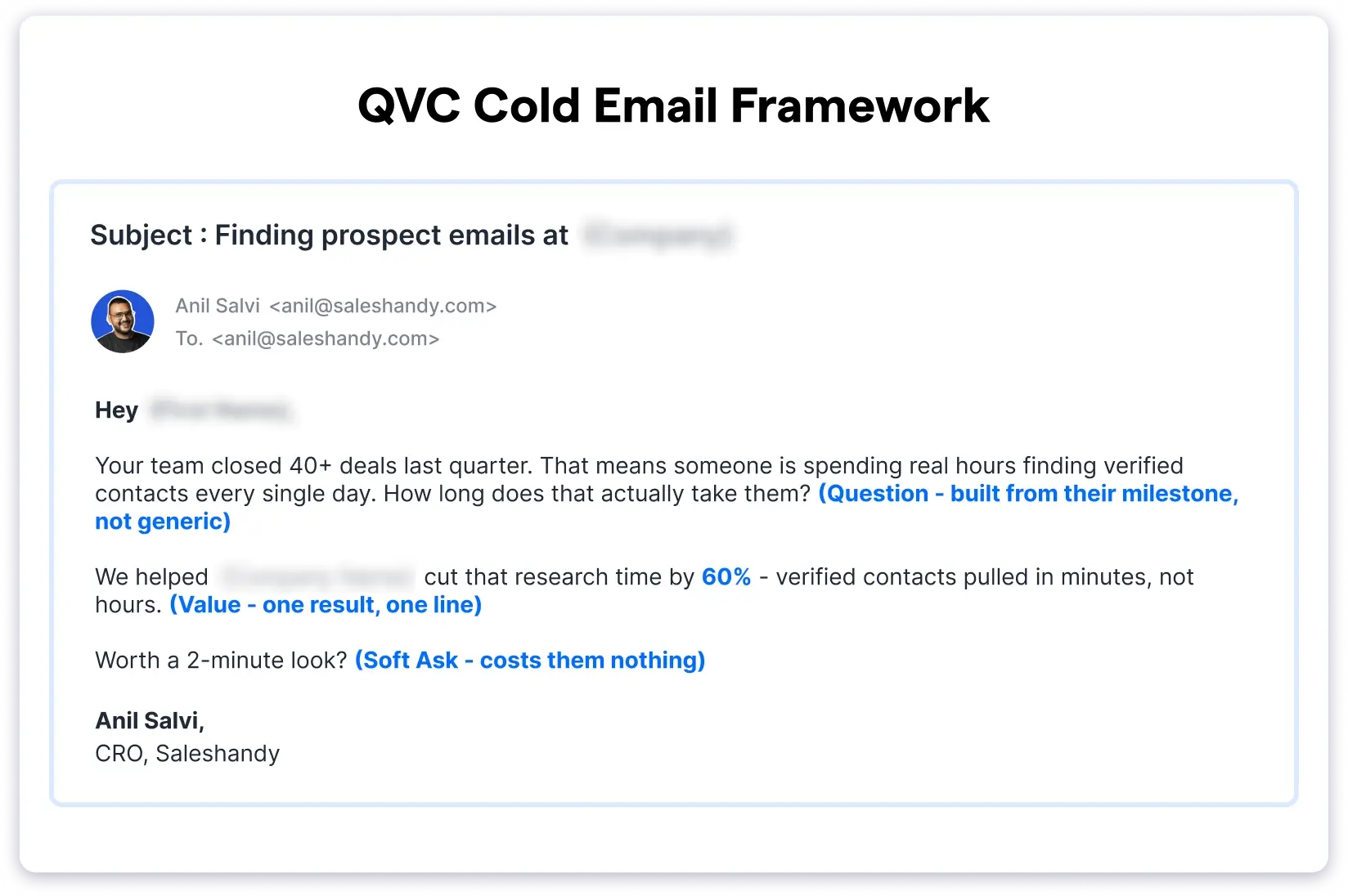
The QVC framework is built for volume outreach, where you have one real signal per prospect but not enough context for deep research.
It leads with a question anchored to something specific about their business, backs it with a single named result, and closes with the lowest-friction ask possible.
Reach out to:
The Email:
Results:
Ready-to-Use Cold Email Template:
Subject: {specific pain signal – e.g., “finding prospect emails”}
Hey {First Name},
{One observation about their business – a number, a milestone, or a recent activity}. {Connect it to a daily pain they likely feel.} How long does that actually take your team?
We helped {Similar Company} {specific result – time saved, cost cut, or meetings booked}.
{Soft ask – “Worth a look?” / “Want me to send it over?” / “Useful to share?”}
{Your Name}
{Title, Company}
Why It Works:
- Built from a real signal. The question references something specific about their business. It cannot be copy-pasted to 500 people, and prospects feel that immediately.
- Makes them answer in their head first. If the honest answer is “way too long,” you have their attention before they reply.
- One result, one line. No features. No pitch. A named company and a specific number do more than three paragraphs of positioning ever will.
- The ask costs nothing. “Worth a 2-minute look?” is not a meeting request. It is a yes or no, and low friction gets more replies.
When to Use:
Best for volume outreach where you have one real signal per prospect but not deep research on each one.
Real-life scenario: Reaching out to 200 B2B SaaS sales managers. You have one signal per person: a milestone, a team size, or a LinkedIn post. QVC turns that one data point into a relevant question, a named result, and a frictionless ask.
Avoid it when: You have no specific observation to build the question from. A generic question kills the framework entirely.
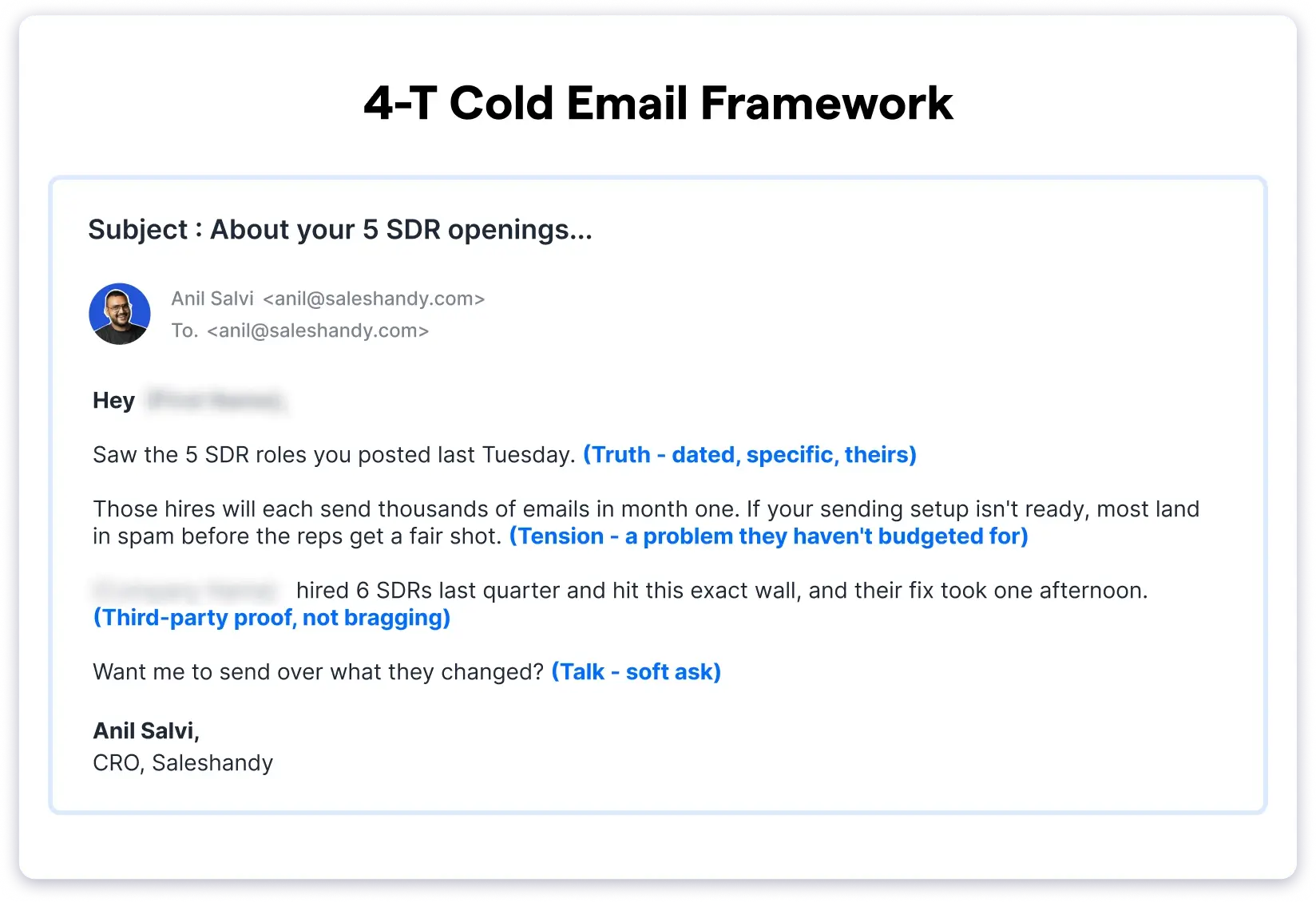
2. 4-T Cold Email Framework (Truth → Tension → Third-Party → Talk)
The 4-T framework is designed for trigger-based outreach where you have one strong, specific observation about the prospect.
It states a verifiable fact about them, connects it to a consequence they likely haven’t considered, lets a third party’s result do the convincing, and closes with a soft ask.
Reach out to:
The Email:
Results:
Ready-to-Use Cold Email Template:
Subject: {their recent trigger – job post, launch, announcement}
Hey {First Name},
{One specific, dated observation about their business.}
{One sentence on the problem this creates that they may not have thought about yet.}
{Named company} hit this exact situation – {what they did, how fast}.
Want me to send over what worked?
{Your Name}
{Title, Company}
Why It Works:
- Nothing can be argued with. The fact is theirs, the proof belongs to someone else. You never make a single claim about yourself.
- Tension lands because it’s tied to their action. It’s not a generic pain point. It’s a consequence of something they just decided to do.
- Third-party proof removes risk. A named company that solved the same problem is more convincing than any product pitch.
- The ask is pure curiosity. “Want me to send over what they changed?” costs them nothing and promises something specific.
When to Use:
Best when you have one strong, specific trigger: a job post, a product launch, a funding announcement.
Real-life scenario: A VP of Sales just posted 5 SDR openings. You know what breaks when teams scale fast. Use 4-T to connect their action to a consequence they haven’t considered.
Avoid it when: You don’t have a real, dated trigger to open with. A vague “Truth” line destroys the entire framework.
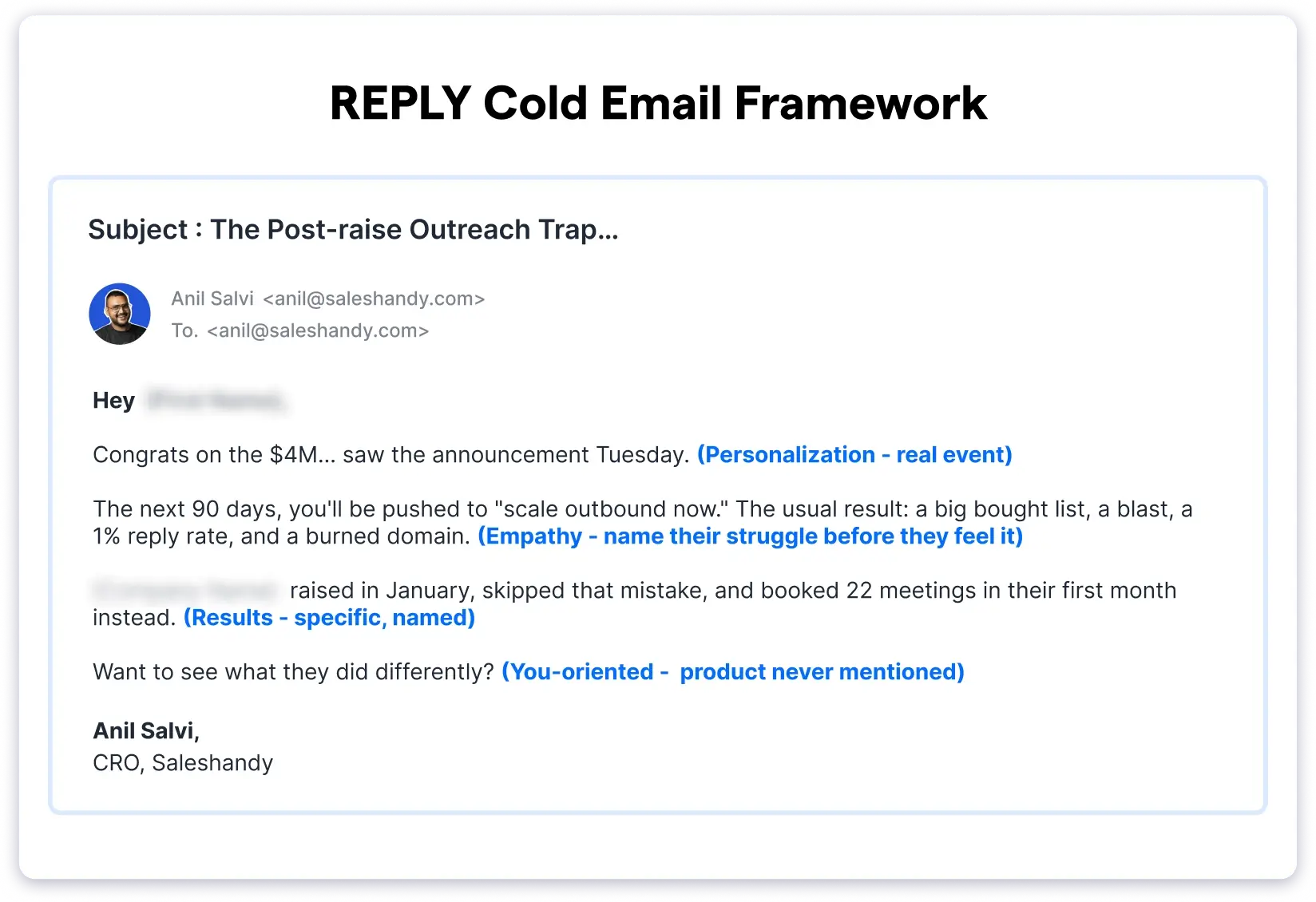
3. REPLY Cold Email Framework (Results → Empathy → Personalization → Laser-Focus → You-Oriented)
The REPLY framework is a line-by-line discipline test.
Every sentence earns its place by answering one question: Is this about them or about you?
It is designed for high-value accounts where you have done real research on the prospect’s current situation: a recent milestone, a public announcement, or a known stage-specific challenge.
Reach out to:
The Email:
Results:
Ready-to-Use Cold Email Template:
Subject: {tension they’ll face after their milestone}
Hey {First Name},
{Real event – funding, launch, hire, expansion}. Saw it {specific day}.
{Name the pressure or mistake that usually follows this milestone – write it like a friend who’s seen it before.}
{Named company} went through the same thing – {what they did, specific result}.
Want to see what they did differently?
{Your Name}
{Title, Company}
Why It Works:
- Reads like a friend, not a vendor. Empathy before pitch signals you understand their world, not just their job title.
- Laser-focused test built in. Count “I/we” vs “you” in your email. If “I/we” wins, rewrite. REPLY forces you to write first every time.
- The result is earned, not claimed. Named company, named outcome, named timeframe. That specificity is what separates proof from noise.
- The product is never mentioned. The reply comes first. The pitch comes second.
When to Use:
Best for high-value accounts where you’ve done real research – [funding announcements, major hires, public milestones.]
Real-life scenario: A founder just announced a $4M raise. You know what most teams do wrong in the next 90 days. Write it like a peer who’s watched this play out before.
Avoid it when: You haven’t done real research. Generic empathy (“scaling can be tough”) is worse than no empathy at all.
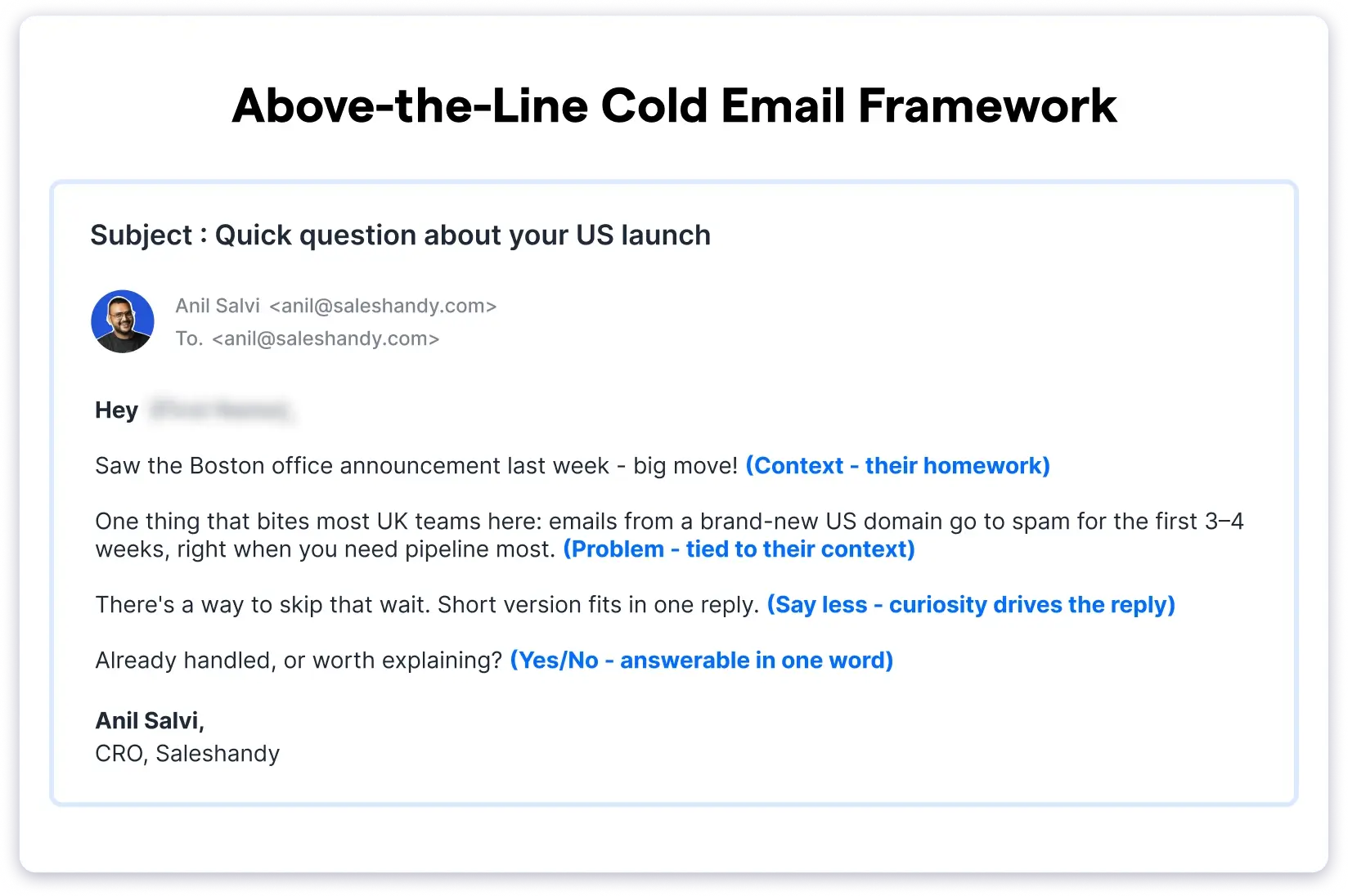
4. Above-the-Line Cold Email Framework (Context → Problem → Say Less → Yes/No)
The Above-the-Line framework is built for maximum brevity: one observation, one consequence, one-word answer.
It works because stopping before you explain forces the prospect to ask, and that reply is the entire goal.
Reach out to:
The Email:
Results:
Ready-to-Use Cold Email Template:
Subject: {their trigger + the consequence}
Hey {First Name},
{One-line context – what you noticed, when you noticed it.}
{One problem this creates that they may not have planned for.}
{Hint at a fix without explaining it. One sentence.}
Already sorted, or worth a quick note?
{Your Name}
{Title, Company}
Why It Works:
- The whole email fits above the mobile fold. If they have to scroll to get to the point, you’ve already lost them.
- “Say less” creates pull. Stopping before you explain forces the prospect to ask. That reply is the goal – not the pitch.
- Yes/No CTA is answerable instantly. “Already handled, or worth explaining?” lets them opt out or opt in with one word. Both are useful replies.
- Context ties the problem to their decision. It’s not a generic pain point – it’s a consequence of something they just did.
When to Use:
Best when you have one strong observation and want maximum brevity. Works particularly well for founders and VPs with flooded inboxes.
Real-life scenario: A UK company just announced US expansion. You know their new domain will hurt deliverability in the first month. Say just enough to make them ask.
Avoid it when: You don’t have a specific context to open with. Without a real observation, “say less” just reads as vague.
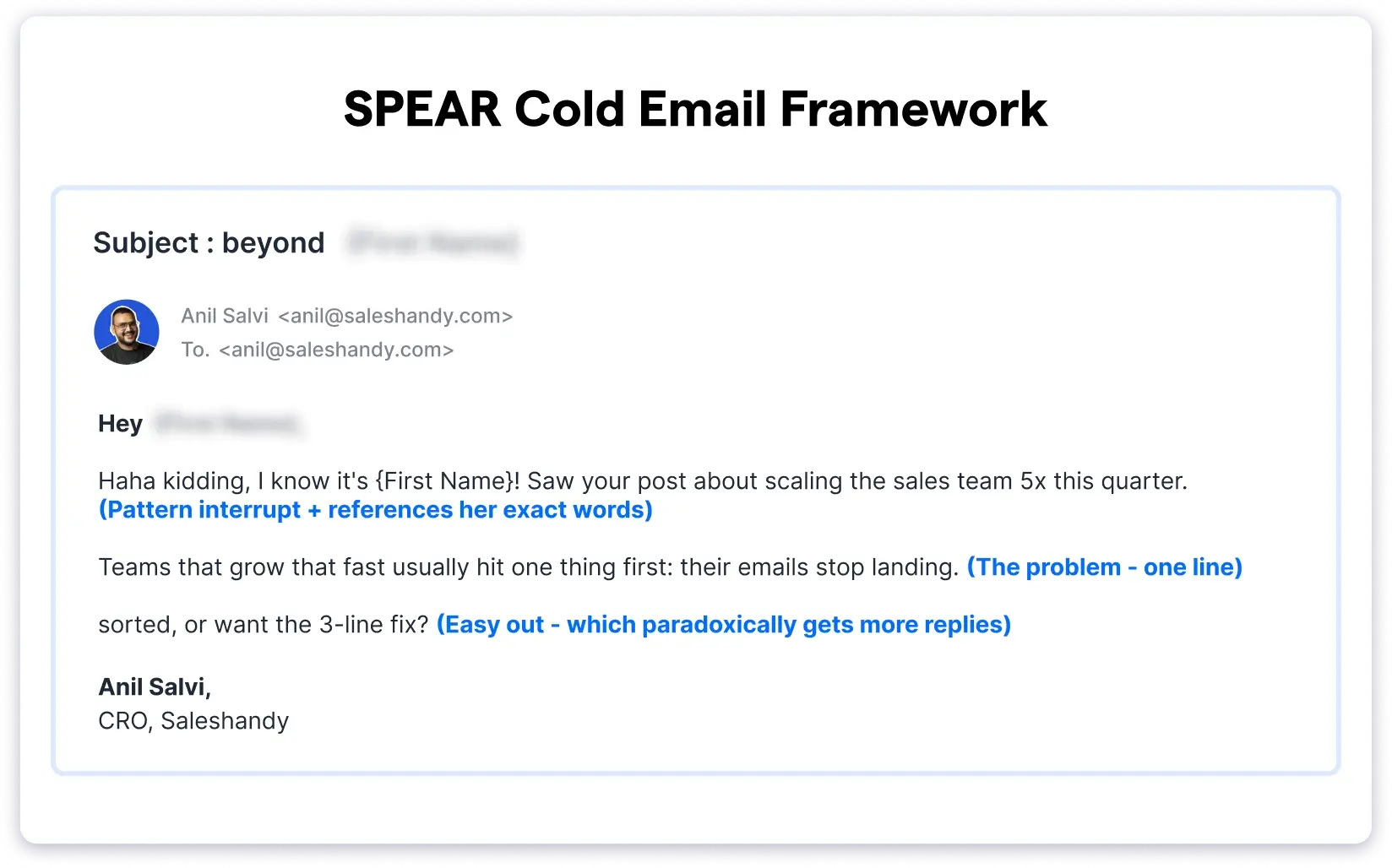
5. SPEAR Cold Email Framework (Pattern Interrupt)
The SPEAR framework is built for one specific inbox problem: Prospects, typically founders and VPs, who receive so many AI-generated cold emails that anything structured, polished, or template-like gets deleted on instinct.
SPEAR works by doing the opposite of what every other email does.
The rule is simple: Break the pattern before they can even ignore it. Keep it under 30 words, references something so specific it could not have been automated, and ends with an exit that makes it easy to say no, which is precisely why more people say yes.
Reach out to:
The Email:
Results:
Ready-to-Use Cold Email Template:
Subject: {first name} – {their specific trigger in 3 words}
saw {their exact post, tweet, or announcement – something no template could reference}.
{teams/companies} that {do what they just did} usually hit {one specific consequence} first.
sorted, or want the fix?
{your name}
{company}
Why It Works:
- Lowercase everything is deliberate. It reads like a human typed it fast – not a campaign tool sent it at 9 AM.
- Under 30 words removes all friction. There is nothing to skim. The entire email is the point.
- The “easy out” increases replies. “Sorted, or want the fix?” lets them say no – and that low pressure is exactly why more people say yes.
- References something no template could. A specific post, tweet, or announcement makes it impossible to dismiss as automation.
When to Use:
Best for founders and VPs whose inboxes are flooded with AI-generated emails. The contrast alone earns the open.
Real-life scenario: A founder posts on LinkedIn about scaling from 2 to 10 sales reps. You see it that morning. Send this within the hour.
Avoid it when: You’re writing to mid-level ICs or procurement teams who expect a formal tone. Pattern interrupts land differently depending on seniority.
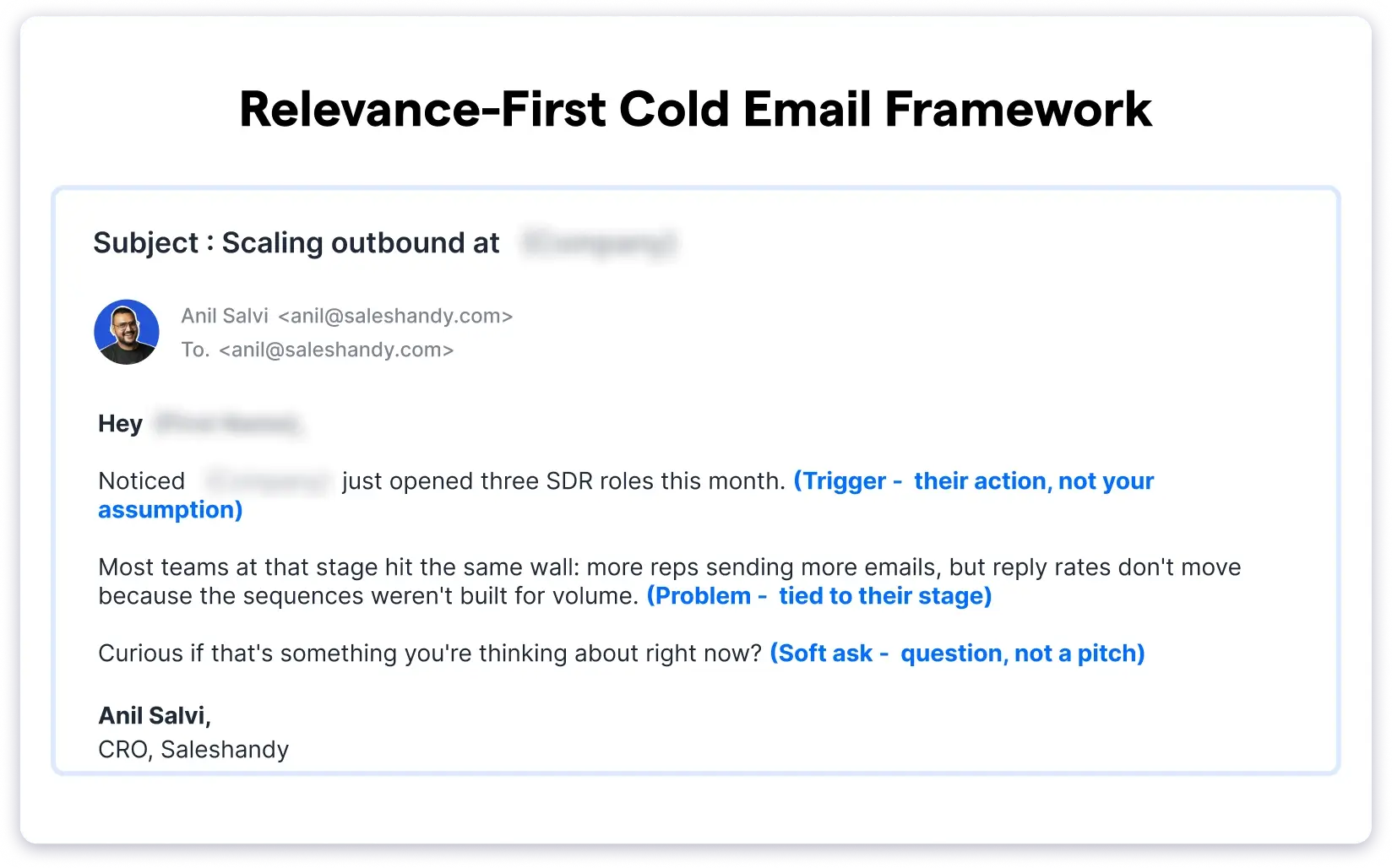
6. Relevance-First Cold Email Framework (Trigger → Problem → Soft Ask)
The Relevance-First framework is built around timing. This means reaching a prospect in the same week their situation changes. This framework:
- Start in their world.
- Name the problem their recent move creates.
- Ask one soft question.
Reach out to:
The Email:
Results:
Ready-to-Use Cold Email Template:
Subject: {what they’re building or scaling}
Hey {First Name},
Noticed {Company} {specific recent action – hiring, launching, expanding, fundraising}.
Most {teams/companies} at that stage {problem that typically follows this action}.
Curious if that’s on your radar right now?
{Your Name}
{Title, Company}
Why It Works:
- Timing beats personalization. The same email sent the week after they post three SDR openings lands 10x better than the same email sent three months later.
- “Most teams at that stage” creates recognition. It makes the prospect feel seen without making assumptions about their specific situation.
- The soft ask invites a reply, not a commitment. “Curious if that’s on your radar” is genuinely easy to answer yes or no.
- No product mentioned. Relevance earns the reply. The product comes after.
When to Use:
Best when you have a clear trigger event and want to open a conversation rather than pitch immediately. Works well for India and APAC markets where relationship-first outreach converts better.
Real-life scenario: A SaaS company in Bangalore just posted three SDR openings in one week. That’s your trigger. Send within 48 hours of the posting going live.
Avoid it when: You’re reaching out with no specific trigger. A generic “I noticed your company is growing” is not a relevance trigger.
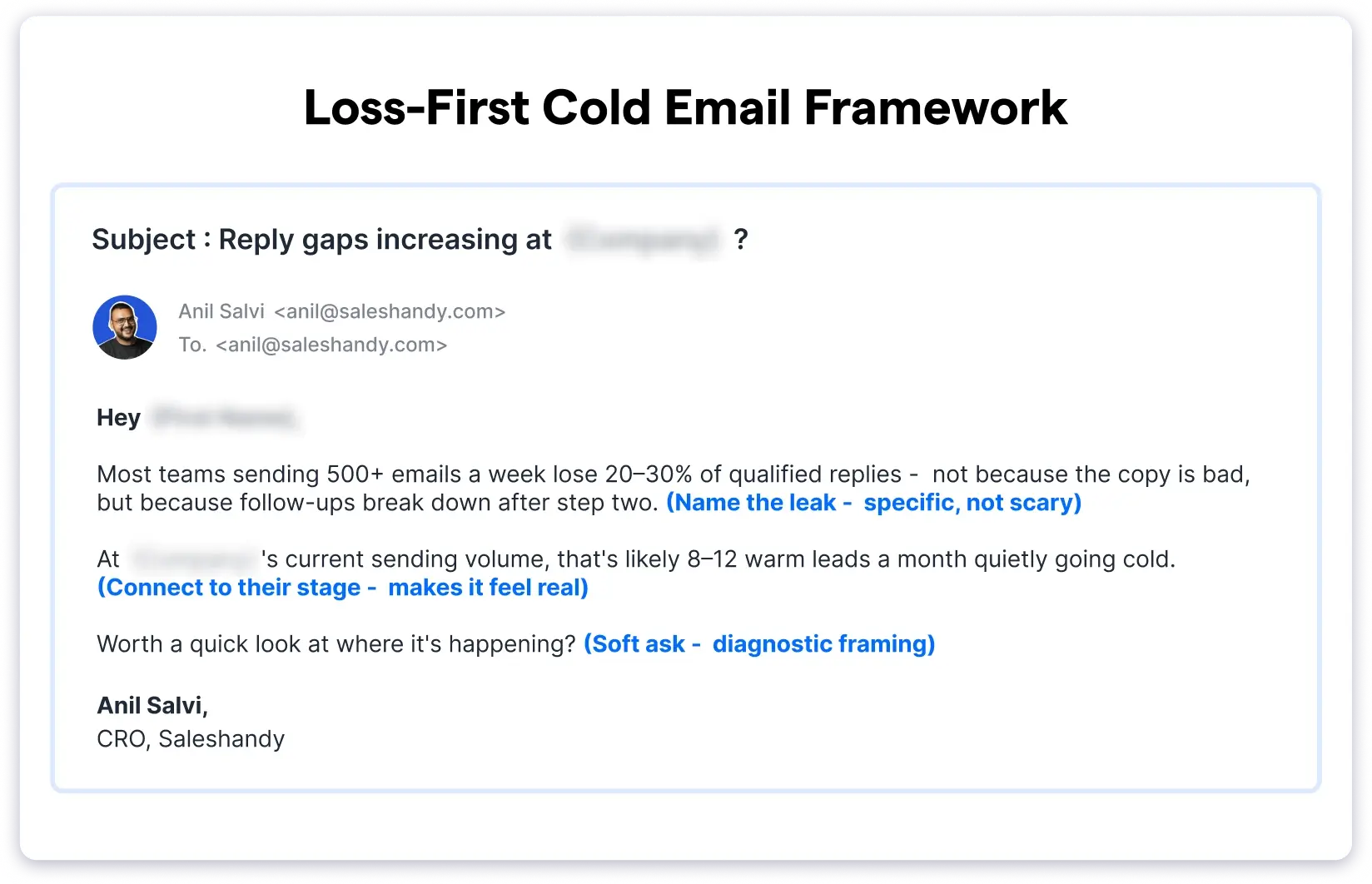
7. Loss-First Cold Email Framework (Name the Leak → Connect to Their Stage → Soft Ask)
The Loss-First framework targets prospects who are actively losing pipeline without knowing exactly why.
It names a specific leak tied to their current sending volume or growth stage, quantifies the consequence, and frames the ask as a diagnostic, not a sales pitch.
Reach out to:
The Email:
Results:
Ready-to-Use Cold Email Template:
Subject: {what they might be leaking – leads, time, replies}
Hey {First Name},
Most {teams/companies} at your stage {specific thing they’re losing} – not because of {obvious reason} but because {real reason they haven’t considered}.
At {Company}’s current {volume/stage/size}, that likely means {quantified consequence}.
Worth a quick look at where it’s happening?
{Your Name}
{Title, Company}
Why It Works:
- Loss lands harder than gain. The brain responds to “you’re losing 8 leads a month” more urgently than “you could gain 8 leads a month.” Same number, different reaction.
- Quantifying the leak makes it feel real. Vague pain (“you might be missing leads”) is easy to dismiss. A specific number tied to their situation is not.
- “Not because X, but because Y” creates a reframe. It shows you understand their problem better than they do – which builds instant credibility.
- Diagnostic CTA removes pressure. “Worth a quick look at where it’s happening?” frames you as someone helping them find the problem, not sell them a solution.
When to Use:
Best when you know their sending volume or growth stage well enough to make the loss feel specific and real.
Real-life scenario: You’re reaching out to a revenue team sending high-volume sequences. You know, follow-up drop-off is their biggest leak. Name it before they do.
Avoid it when: You’re guessing at the loss without any real signal. Fake urgency is worse than no urgency.
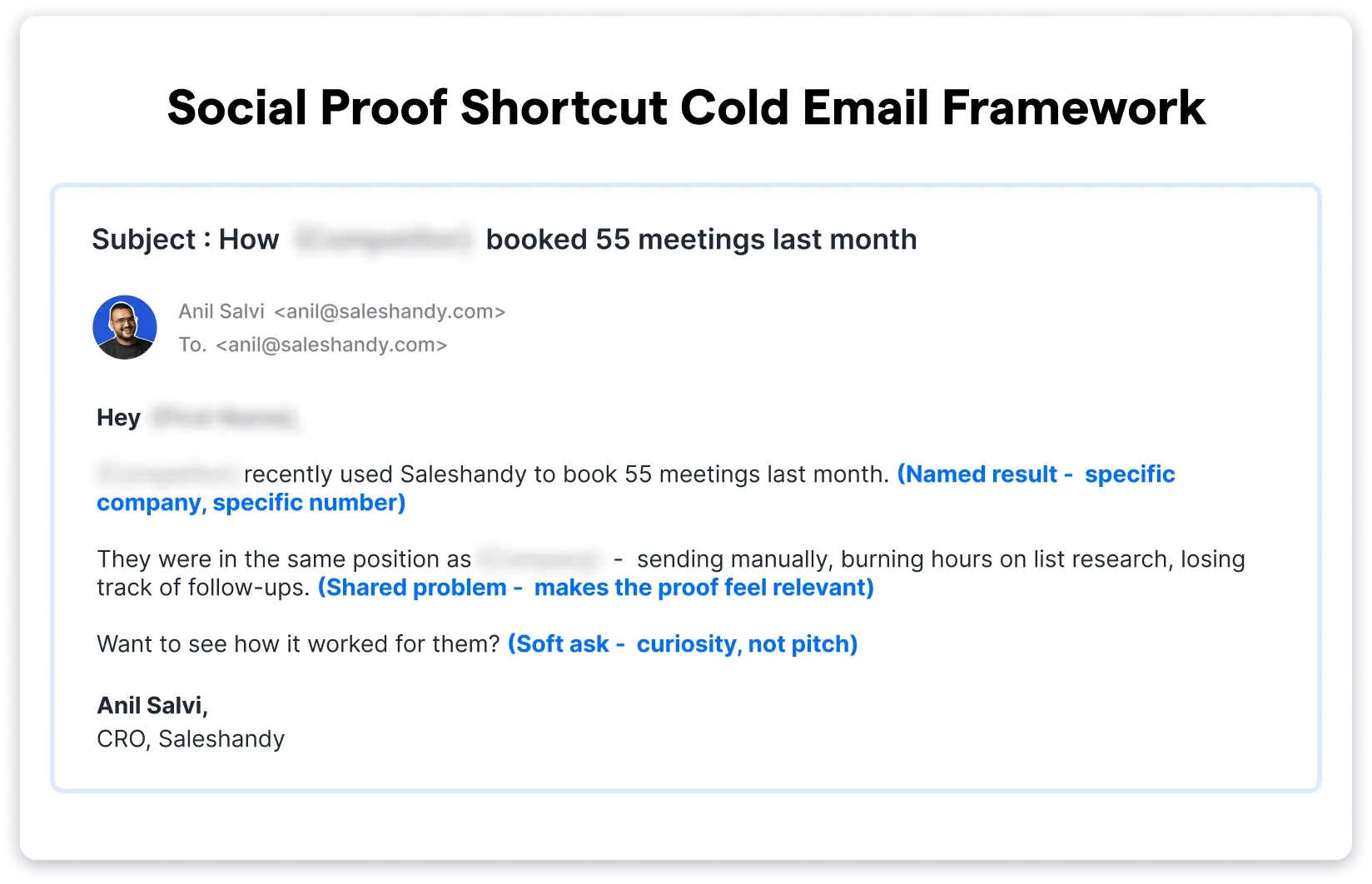
The Social Proof Shortcut framework lets someone else’s result do the convincing.
It works because a named peer who solved the same problem removes risk before the prospect even forms an objection.
Reach out to:
The Email:
Results:
Ready-to-Use Cold Email Template:
Subject: how {named company} {specific result}
Hey {First Name},
{Named company} {specific result – meetings booked, time saved, cost cut} using {your product/approach}.
They were in the same spot as {Company} – {one sentence on the shared problem}.
Want to see how it worked for them?
{Your Name}
{Title, Company}
Why It Works:
- The brain trusts peers, not vendors. A named company that solved the same problem removes risk before the prospect even forms an objection.
- “Same position as you” is the most powerful three words in cold email. It makes the proof feel directly applicable, not just impressive.
- The ask is pure curiosity. “Want to see how it worked for them?” promises something specific and costs nothing to answer.
- You never pitch yourself. The entire email is about someone else’s result. That’s what makes it believable.
When to Use:
Best when you have a named result from a company that closely resembles your prospect – same size, same stage, same problem.
Real-life scenario: You just helped a competitor of your prospect book 55 meetings. That competitor’s name is your subject line. Send it the week the result happened.
Avoid it when: You don’t have a specific named result. Vague social proof (“we’ve helped hundreds of companies”) does the opposite of what this framework needs.
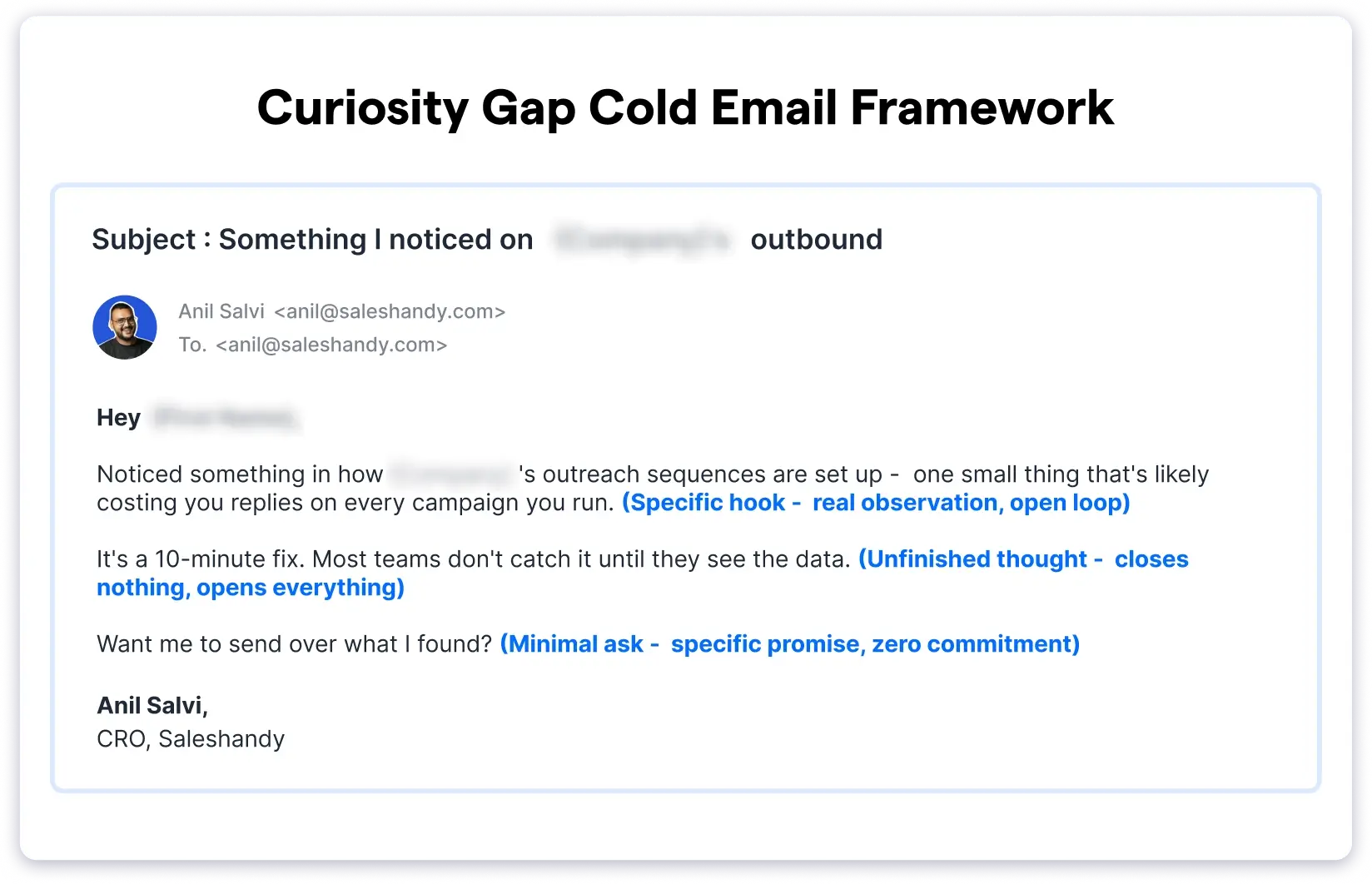
9. Curiosity Gap Cold Email Framework (Specific Hook → Unfinished Thought → Minimal Ask)
The Curiosity Gap framework is built on one psychological principle: The brain hates unresolved loops.
It hints at a specific observation about the prospect’s setup, stops before explaining it, and lets the gap drive the reply.
Reach out to:
The Email:
Results:
Ready-to-Use Cold Email Template:
Subject: something I noticed on {Company}’s {area}
Hey {First Name},
Noticed {one specific thing about their setup, outreach, or process} – {one consequence it’s likely causing} on every {campaign/quarter/outreach run}.
{Hint at a fix without naming it. One sentence.}
Want me to send over what I found?
{Your Name}
{Title, Company}
Why It Works:
- The brain hates open loops. An unresolved observation creates a pull toward resolution – and a reply is the only way to close it.
- “Likely costing you replies” makes it feel real. It’s not a vague claim. It connects the observation to something they care about measuring.
- Stopping before the explanation is the technique. Most senders over-explain. Curiosity gap works because you don’t.
- “What I found” makes it feel exclusive. It implies you did something specific for them – not that you sent this to 200 people.
When to Use:
Best when you have a specific observation about their setup, website, outreach, or process that you can credibly back up when they reply.
Real-life scenario: You audited a prospect’s outreach sequence and spotted a deliverability issue. Don’t explain it in the email. Just tell them you found something. Let them ask.
Avoid it when: You have nothing specific to back up the hook. If they reply and you have no real observation, you’ve burned the relationship instantly.
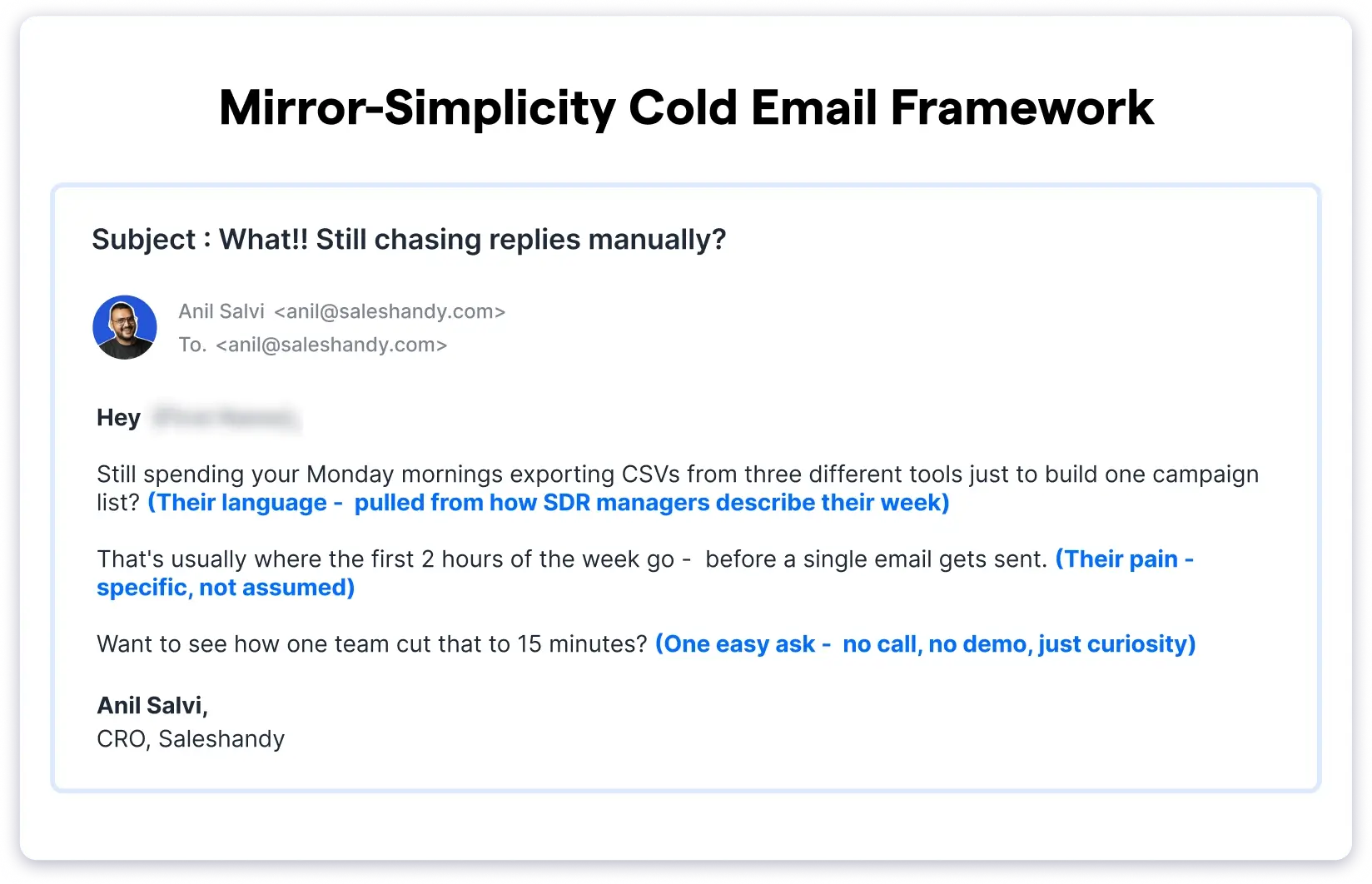
10. Mirror-Simplicity Cold Email Framework (Their Language → Their Pain → One Easy Ask)
Write the email in the exact words they use to describe their own problems. Remember, it’s about them, not you.
Reach out to:
The Email:
Results:
Ready-to-Use Cold Email Template:
Subject: {their exact phrase for the problem}
Hey {First Name},
Still {exact activity they complain about – pulled from job posts, G2 reviews, Reddit, LinkedIn}?
That’s usually where {quantified time or cost} goes – before {the thing they actually want to be doing}.
Want to see how one team fixed it in {timeframe}?
{Your Name}
{Title, Company}
Why It Works:
- Uses their words, not yours. Pulled from job posts, G2 reviews, Reddit threads, LinkedIn bios. When they read it, they think: “This person gets exactly what I deal with.”
- “Still” is one of the most powerful openers in cold email. It implies you know their current reality – and that it hasn’t been solved yet.
- Simplicity removes the decision to not reply. Short, familiar language requires zero mental effort to process. Easy to read means easy to answer.
- No jargon, no positioning, no product. The email sounds like a peer typed it in 60 seconds – which is exactly why it works.
When to Use:
Best when you’ve done real ICP research and know the exact language your prospect uses to describe their pain. G2 reviews and Reddit threads are your best sources.
Real-life scenario: You’ve read 20 G2 reviews from SDR managers. Three of them mention “exporting CSVs from multiple tools every Monday.” That phrase goes in the subject line verbatim.
Avoid it when: You’re guessing at their language without research. A wrong mirror line signals immediately that you don’t know their world.
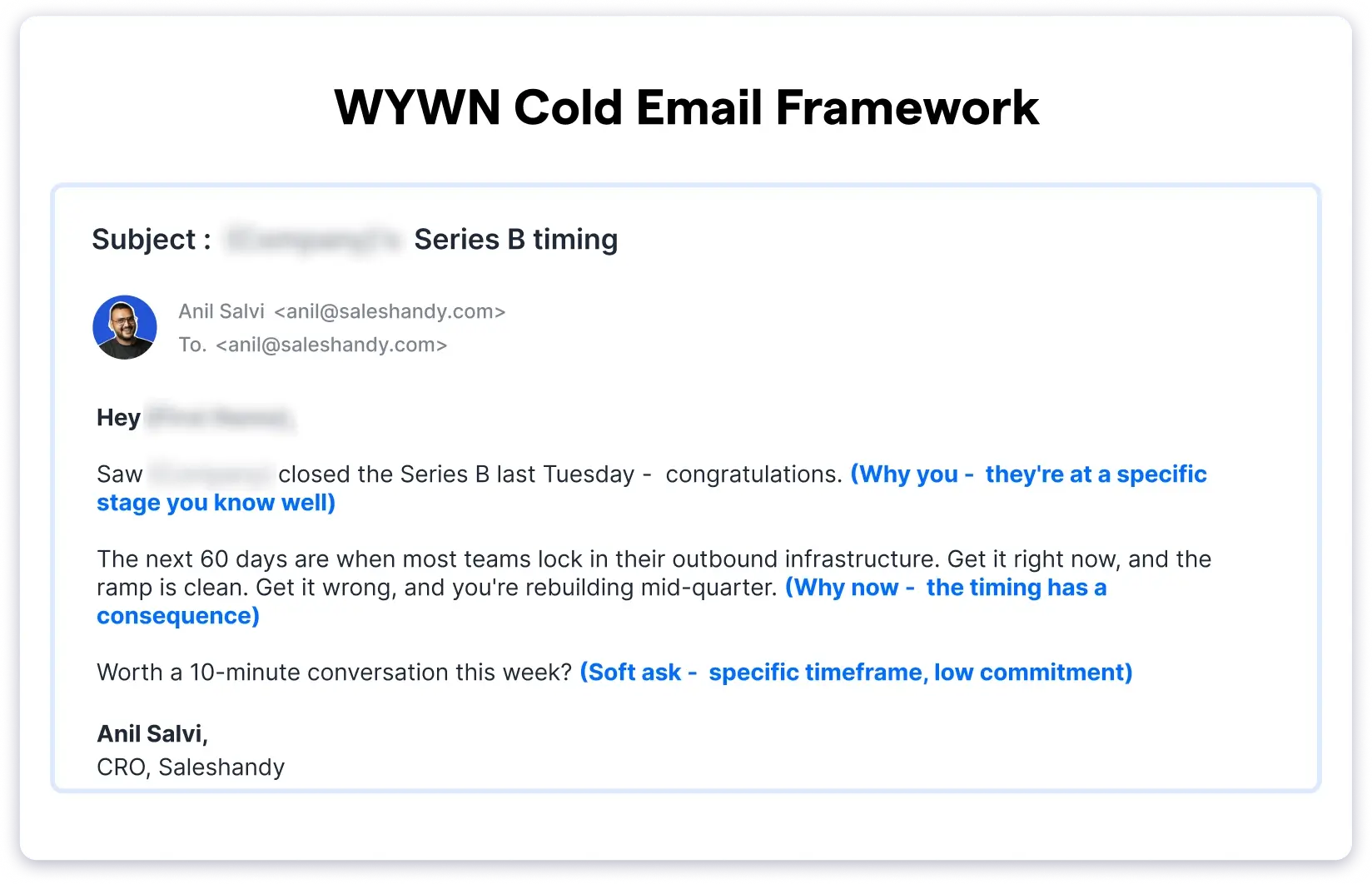
11. WYWN Cold Email Framework (Why You, Why Now)
Connect a specific trigger directly to a specific reason you’re reaching out today – not last week, not generically.
Reach out to:
The Email:
Results:
Ready-to-Use Cold Email Template:
Subject: {Company}’s {milestone} timing
Hey {First Name},
Saw {Company} {specific milestone – funding, launch, expansion, new hire} {specific day}.
The next {30/60/90} days are when most {teams/companies} {decisions that matter}. {One sentence on what getting it right vs wrong looks like.}
Worth a 10-minute conversation this week?
{Your Name}
{Title, Company}
Why It Works:
- “Why you” removes the feeling of being on a list. A specific milestone tells the prospect you reached out because of them – not because their email was in a database.
- “Why now” creates urgency without pressure. The timing window is real. Missing it has a consequence. That’s not fear tactics – it’s context.
- Named milestone + named day = impossible to dismiss. “Saw {Company} closed the Series B last Tuesday” is not something a template generates.
- The ask is proportionate to the trust built. After a relevant why-you-why-now setup, a 10-minute ask is reasonable, not presumptuous.
When to Use:
Best for trigger-based outreach tied to funding, major hires, product launches, or expansion announcements. Works best when sent within 72 hours of the trigger.
Real-life scenario: A SaaS company closes a Series B on a Tuesday. You send this by Thursday. The timing is the entire point.
Avoid it when: The trigger is older than two weeks. “Why now” only works when now is actually now.
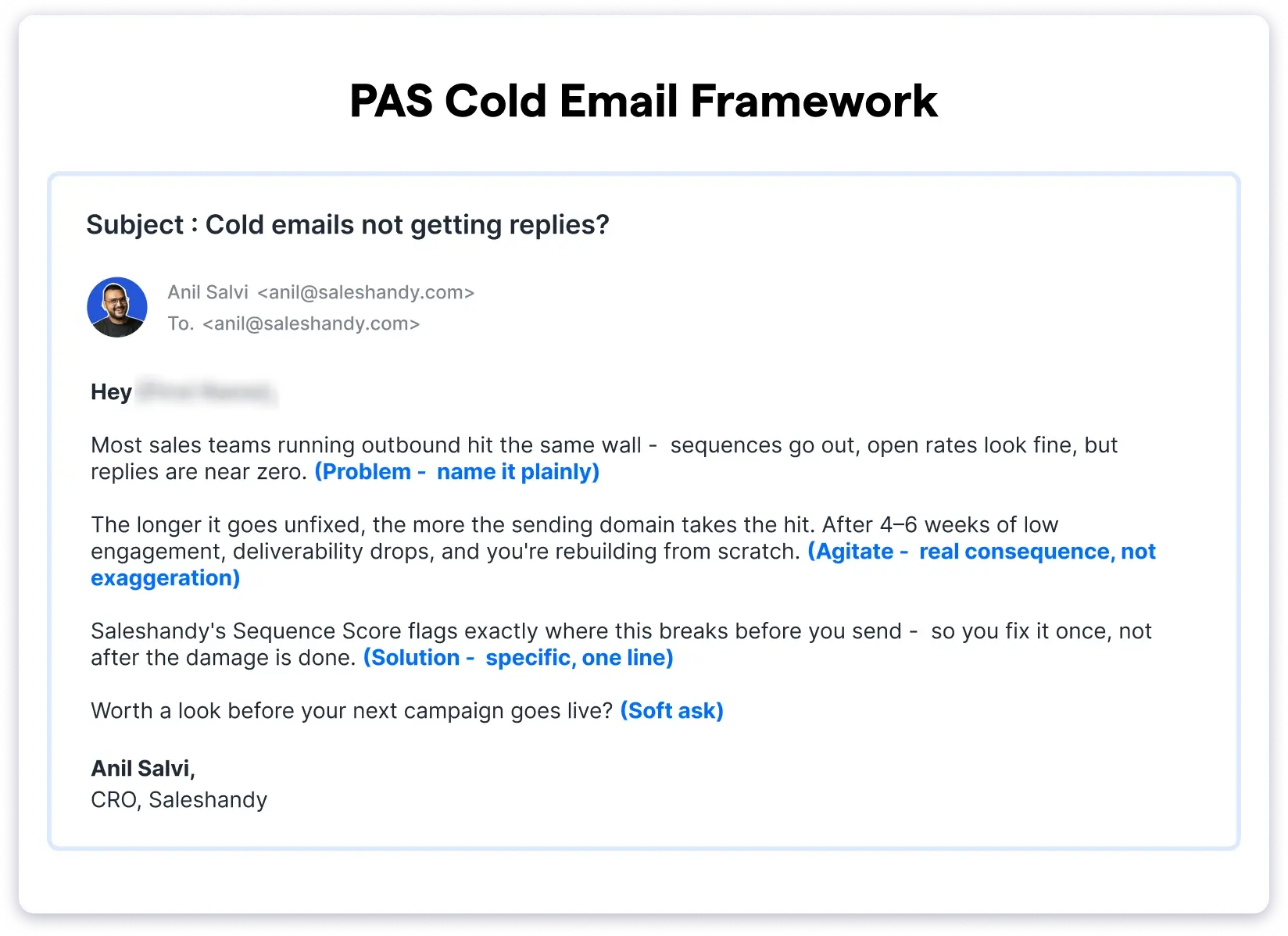
12. PAS Cold Email Framework (Problem → Agitate → Solution)
In the PAS framework, you need to:
- Name their problem.
- Make it feel urgent/bigger. [Not faking it too much that it seems unbelievable. Keep the consequences of the problem real]
- Offer the way out.
Reach out to:
The Email:
Results:
Ready-to-Use Cold Email Template:
Subject: {their problem in plain language}
Hey {First Name},
Most {teams/companies} doing {what they do} hit {specific problem} – {one line on why it happens}.
The longer it goes unfixed, {consequence that compound over time}.
{Your product/approach} {specific fix – one line, no feature list}.
Worth a look before {relevant timing}?
{Your Name}
{Title, Company}
Why It Works:
- Name the problem before pitching anything. The prospect reads the first line and thinks “that’s me” – and that recognition earns the next sentence.
- Agitation uses compounding, not fear. It’s not “you’ll fail.” It’s “this gets harder to fix the longer it sits.” That’s honest and credible.
- The solution is one line. PAS fails when the solution section becomes a product tour. One specific fix, tied directly to the problem named above it.
- The CTA is timed. “Before your next campaign goes live” creates a natural sense of relevance without manufactured urgency.
When to Use:
Best for prospects who are actively running outbound and experiencing a specific, identifiable problem you can name precisely.
Real-life scenario: You’re reaching out to SDR managers whose sequences are live but underperforming. You know the problem. Name it first, make it feel real, then offer the fix.
Avoid it when: You’re guessing at the problem. Agitating a pain the prospect doesn’t actually feel comes across as manipulative, not helpful.
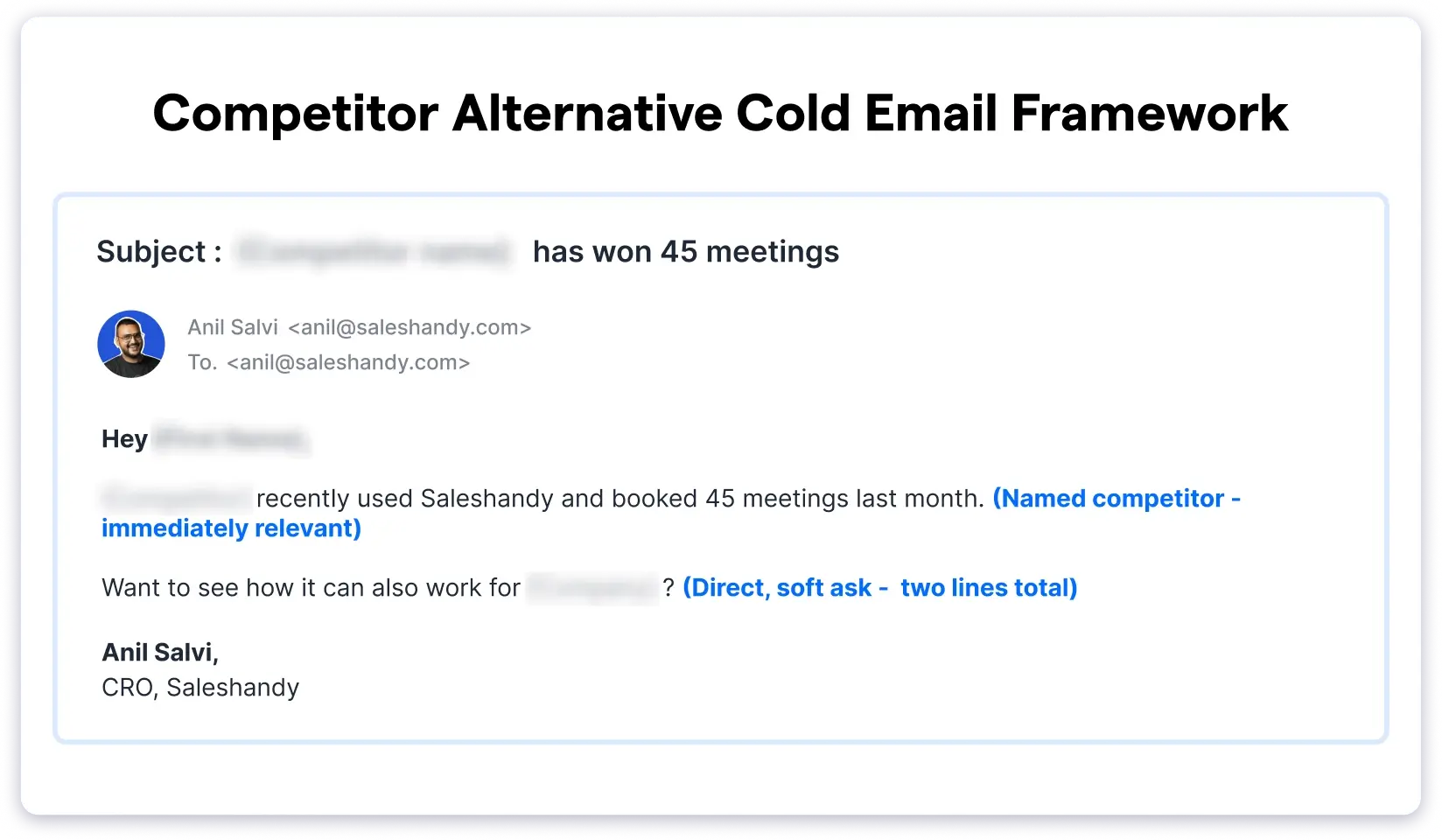
13. Competitor Alternative Cold Email Framework
The Competitor Alternative framework uses a prospect’s direct competitor as the proof point.
A named competitor who already validated the result is more convincing than any claim you make about yourself.
Reach out to:
The Email:
Results:
Ready-to-Use Cold Email Template:
Subject: {competitor name}
Hey {First Name},
{Competitor} recently used {your product} to {specific result – meetings booked, leads found, time saved}.
Want to see how it can also work for {Company}?
{Your Name}
{Title, Company}
Why It Works:
- The competitor’s name in the subject line stops the scroll. Nothing gets a prospect’s attention faster than seeing a company they compete with.
- Two sentences are the entire email. There is nothing to skim past, nothing to object to, and nothing to ignore. The brevity signals confidence.
- Social proof from a peer lands harder than any claim you make. The competitor already validated the result. You’re just connecting it to them.
- “Also work for {Company}” is the most frictionless ask in cold email. It implies the work is already done – they just need to say yes.
When to Use:
Best when you have a real, named result from a direct competitor of your prospect. Works exceptionally well in tight industry verticals where companies know each other.
Real-life scenario: You just helped a competitor book 55 meetings. Their industry peer is on your list. Send the competitor’s name as the subject line. Nothing else.
Avoid it when: The named company isn’t a real competitor. A loose “similar company” comparison doesn’t trigger the same psychological response as a direct competitor.
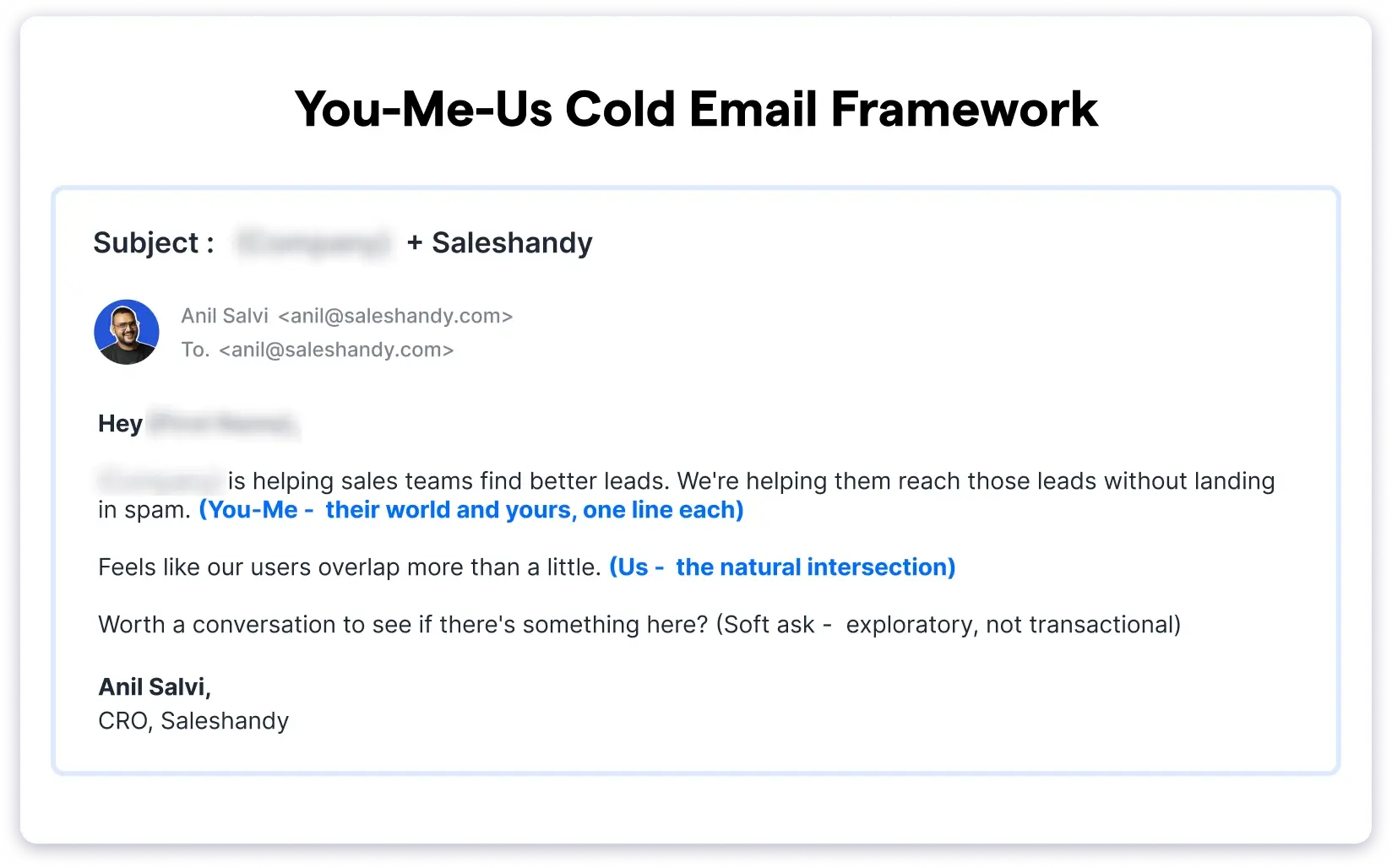
14. You-Me-Us Cold Email Framework
The You-Me-Us framework is built for partnership and co-marketing outreach where both parties stand to benefit.
It finds the natural intersection between their world and yours, and builds the conversation around what you have in common rather than what you’re selling.
Reach out to:
The Email:
Results:
Ready-to-Use Cold Email Template:
Subject: {their company} + {your company}
Hey {First Name},
{Their company} is {what they do for their users}. We’re {what you do that complements it – not competes}.
Feels like our users overlap more than a little.
Worth a conversation to see if there’s something here?
{Your Name}
{Title, Company}
Why It Works:
- “You-Me-Us” structure creates a logical progression. Each sentence earns the next. By the time you reach “our users overlap,” it feels obvious.
- Positions the outreach as a partnership, not a pitch. Nobody feels sold to when the frame is “we might be useful to each other.”
- One line each for You and Me. Symmetry signals respect. You’re not spending three sentences on yourself and one on them.
- The ask is exploratory. “See if there’s something here” is a genuine question – and that genuineness is exactly what gets replies.
When to Use:
Best for partnership outreach, co-marketing opportunities, or integration conversations where both parties genuinely stand to benefit.
Real-life scenario: A tool that helps sales teams find leads. You help those same teams send to those leads without hitting spam. Your users are the same people. That overlap is the entire email.
Avoid it when: The overlap is forced or vague. If you have to stretch to explain the connection, the reader will feel it.
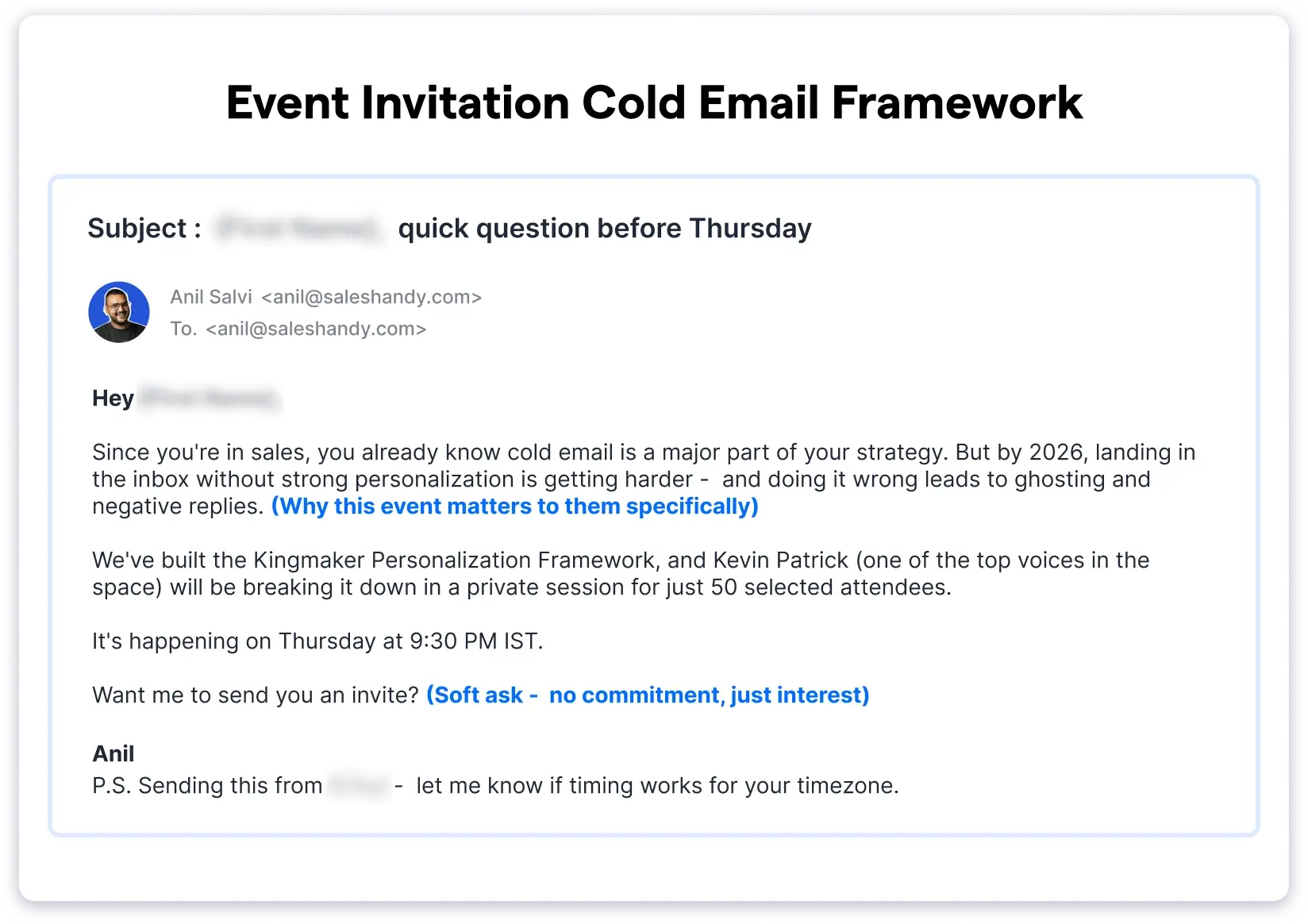
15. Event Invitation Cold Email Framework
The Event Invitation framework uses a specific event or webinar as a natural, low-pressure reason to connect.
It works because the ask is just an invite, not a meeting, not a demo, which is the lowest-friction first step possible.
Reach out to:
The Email:
Results:
Ready-to-Use Cold Email Template:
Subject: beyond {First Name}
Hi {First Name},
Haha kidding – I know it’s {First Name}!
{One sentence on why this event is specifically relevant to what they do or struggle with.}
We’ve {built/created/are hosting} {event name} with {speaker/guest} – {one line on what makes it exclusive or worth attending}.
It’s happening on {day} at {time}.
Want me to send you an invite?
{Your Name}
P.S. {Personalized location or timezone line.}
Why It Works:
- The humor opener is a deliberate pattern interrupt. “Haha, kidding, I know it’s {First Name}!” breaks the template mold immediately – and it actually makes people smile.
- Scarcity makes it feel real. “50 selected attendees” is not a mass webinar invite. It signals this is worth their time.
- The P.S. city personalization adds a human layer. It costs one merge tag but feels like a message from someone who knows where they are.
- The ask is just an invite, not a meeting. “Want me to send you an invite?” is the lowest-friction ask possible. They’re saying yes to an email, not a commitment.
When to Use:
Best for webinar and event promotion where you want genuine attendees, not just registrations. Works particularly well for Indian and APAC sales audiences where community-driven events resonate strongly.
Real-life scenario: You’re running a private 50-person session on cold email personalization. Your list is 200 sales professionals in India. This is Saleshandy’s actual Webinar India campaign – 89 prospects, 9% reply rate, 6% positive reply rate.
Avoid it when: The event isn’t genuinely exclusive or valuable. A mass webinar with 1,000 registrants does not warrant this framing.
What to A/B Test in Cold Email (And in What Order)
“What gets measured can be managed.”
Testing cold emails is not about changing things randomly and hoping for better results.
It’s about changing one thing at a time, measuring what moves, and keeping what works.
Here’s the rule before anything else: test one variable per campaign.
If you change the subject line and the CTA at the same time, you will never know which one drove the improvement.
Here are the five things worth testing, in order of impact.
1. Subject Lines – Test This Ultimate Gatekeeper First
Your subject lines directly impact your open rate. They are worth optimising, but with one important caveat.
And while open rates are less reliable after Apple Mail Privacy Protection inflated numbers across the board, they’re still worth optimizing for non-Apple recipients.
What to test:
2. Opening Hook – It Decides Whether They Read Past Line One
If your first sentence doesn’t feel relevant, the reader closes the email. You don’t get a second chance.
What to test:
The Goal: To figure out the cleverest opener, the one that makes the most prospects read the second line.
3. Body Copy – Test Framing and Length
This is where the psychology of the buyer matters most.
What to test:
One practical note: Do not test both framing and length at the same time. Pick one.
4. CTA – The Most Underrated Variable
The final line of your email carries more weight than most senders realize. Small changes here produce significant changes in reply rate.
What to test:
In most B2B cold email campaigns, the soft binary question outperforms the direct booking ask on first contact.
Prospects are more likely to reply with a “yes, tell me more” than to immediately hand over a calendar slot to a stranger.
5. Send Timing – When You Send Matters
Sometimes the when matters as much as the what.
What to test:
This is the lowest-priority variable on this list. It can contribute a 10–15% lift in reply rates, but only once your copy is already working.
How to Run a Valid Test
Before declaring a winner, follow these minimums:
Once your framework is working, the next step is testing: subject lines, opening hooks, CTAs, and send timing.
We’ve covered the full A/B testing playbook in detail here: How to Generate 5X More Leads with Cold Email A/B Testing
Best Practices to Turn Your Cold Email Templates Into Conversions
Having a good template is step one. Getting it to convert is a different skill entirely.
Here are the practices that actually move reply rates – not the recycled advice you’ve seen everywhere else.
Send to a smaller, more targeted list.
The instinct is to send it to more people to get more replies. The data says the opposite. Campaigns sent to under 200 prospects generate 4.4× more positive replies than campaigns over 1,000. Tighter targeting beats higher volume, every time.
Warm your inbox before you scale.
Emails sitting in spam do not get opened. Before running any cold email campaign, make sure your sending domain is properly warmed up. A cold inbox sending at scale is a fast path to the spam folder.
Use Spintax to avoid duplicate content flags.
If you are sending the same email copy across hundreds of prospects, spam filters notice. Spintax creates natural variations of the same email so every send looks slightly different to mail servers, without changing your message.
Run a Sequence Score check before launching.
Before any campaign goes live, check your email deliverability setup. Catching a problem before sending is significantly easier than rebuilding a damaged sender reputation after the fact.
Follow up with new angles, not reminders.
Step 1 gets 55.41% of positive replies, but sequences still matter.
Every follow-up should add something new: a different angle, a relevant example, a new question. “Just following up on my last email” is not a follow-up. It is a nudge with no value attached.
Match your template to the situation, not just the role.
A template for a VP of Sales at a 10-person startup should feel different from one for a VP of Sales at a 500-person company. Same title, completely different context.
The more your template reflects the situation, the higher the relevance, and the more likely the reply.
Test one thing at a time.
Choose your variable: subject line, opening line, CTA.
And test it across a minimum of 100 emails per variation before making a call. Random changes create random results.
From Cold Email to Conversation, Here’s How to Start
Most people treat cold email as a numbers game. Send more, hope more replies come back.
The data tells a different story.
The teams that consistently get replies are not sending the most emails.
They are sending the right emails to smaller, more targeted lists, with copy that passes the 3-second brain test, and a CTA that costs the prospect almost nothing to answer.
That is what every framework and data point in this guide points to. Not volume, but precision.
If you are starting fresh, pick one framework from the 15 above that matches your current situation. Write the email. Test it on 100 prospects. Measure the reply rate, not the open rate. And iterate from there.
The templates are ready. The data is there. The next step is sending.
Saleshandy gives you the infrastructure to put all of this into practice: sequences, inbox warm-up, deliverability scoring, and AI-assisted copy. All of this without switching between tools.
If you want to test these frameworks on a live campaign, the trial is free for 7 days.
[Start Your Free 7-Day Trial →] No credit card needed.
FAQs People Ask About Cold Email Templates
1. How long should a cold email be?
The sweet spot is 75–125 words. Short enough to read in 20 seconds, long enough to make a case. Under 50 words often feels incomplete. Over 150 words start reading like a pitch deck. If you can’t say it in 125 words, you probably haven’t refined your message enough yet.
2. Is personalization still worth it in 2026?
Yes, but only the right kind. Swapping in a name and company name does almost nothing – every sender does this now, and prospects see through it immediately. What works is situational personalization: referencing a trigger event, a recent hire, a funding round, or a specific challenge tied to their current stage. That takes more research, which is exactly why it still works.
3. What CTA gets the most replies?
Soft, binary questions consistently outperform hard meeting asks on first contact. “Would this be relevant for your team right now?” outperforms “Book 30 minutes on my Calendly.” Save the meeting, ask for the second or third touchpoint, once you’ve gotten a signal of interest.
4. How many follow-ups should I send?
Three to four follow-ups are the right range for most B2B cold email sequences, spaced 3–5 days apart. Each follow-up should offer a new angle or new value, not just bump the thread. After four touchpoints with no response, move on. Continuing to follow up beyond that damages your sender’s reputation and rarely produces a reply.
5. Should cold emails include links?
Be careful with links in cold email. Multiple links in a single email are a strong spam trigger. If you need to include one, make sure it’s going to a trusted domain and that your email is otherwise clean. On Step 1, especially, avoid links entirely if possible. The goal is a reply, not a click.
6. Can AI write cold emails?
AI can help you write cold emails faster, but it can’t replace the research behind them. The best cold emails are built on a specific trigger, a genuine understanding of the prospect’s situation, and a credible proof point. AI can generate variations and refine copy. It can’t do the ICP research or find the right trigger event. Use it as a drafting tool, not a replacement for thinking.
7. How do you avoid spam filters in 2026?
The biggest factors are infrastructure, not copy. Make sure your sending domain has proper SPF, DKIM, and DMARC records set up. Warm up your inbox before scaling. Keep bounce rates under 2% with a verified list. Avoid spam trigger words in the subject line. Use Spintax to create copy variation across large sends. And monitor inbox placement – not just open rates – to catch deliverability problems early.
8. What’s a good cold email reply rate in 2026?
Benchmark reply rates for 2026: top 10% of campaigns achieve 5%+ reply rate; solid campaigns sit at 3–5%; below average is 1–3%; and under 1% usually indicates a broken infrastructure problem.