


 optinmonster
 Contents
- 1 How to Write Cold Email – TOC
- 2 TL;DR: How to Write a Cold Email That Gets Replies
- 3 Cold Email Explained in 50 Words
- 4 How Does Cold Email Work in 2026?
- 5 How to Write Cold Emails That Get Replies: 8-Step Framework
- 5.1 Step 1: Know Your Prospect Before You Write a Word
- 5.2 Step 2: Write a Subject Line That Gets Clicks
- 5.3 Step 3: Write a Preview Text That Completes Your Subject Line
- 5.4 Step 4: Start Your Cold Email with a Personalized Touch
- 5.5 Step 5: Deliver Value in One Sentence
- 5.6 Step 6: Add Proof or Social Validation
- 5.7 Step 7: Use One Clear, Low-Friction CTA
- 5.8 Step 8: Close With a Conversational Sign-Off & Email Signature
- 5.9 Bonus Step: Plan Your Follow-Up Sequence Strategically
- 6 Cold Email Templates for Different Use Cases
- 7 Cold Email Writing Rules for 2026
- 7.1 1. Keep Subject Lines Under 6 Words
- 7.2 2. Start With Their World, Not Yours
- 7.3 3. Keep Email Body Under 100 Words
- 7.4 4. Use Two Data Points
- 7.5 5. Skip Links in the First Cold Email
- 7.6 6. Give Before You Ask
- 7.7 7. Plan a 3-5 Cold Email Follow-Up
- 7.8 8. Track Replies
- 7.9 9. Write Like a Human, Not Like AI
- 7.10 10. Follow the 30/30/50 Rule
- 7.11 11. Use First-Line Personalization Formulas at Scale
- 8 Cold Email Prep: 4 Steps Before You Hit Send
- 9 How to Send Your First Cold Email?
- 10 Conclusion: Time to Turn Your Cold Email Into a Conversation
- 11 FAQs on How to Write Cold Emails
- 11.1 1. How do you introduce yourself in a cold email?
- 11.2 2. What is the ideal length of a cold email?
- 11.3 3. Is cold emailing legal?
- 11.4 4. What’s a good reply rate for cold emails?
- 11.5 5. Does cold emailing really work?
- 11.6 6. What’s the best time to send a cold email?
- 11.7 7. How long should a cold email be in 2026?
Cold email outreach has become so cold that prospects and inboxes are numb.
AI-generated cold emails are flooding every channel.
I have sent over 10,000 cold emails in the last four years and helped outbound teams hit 25–30% reply rates.
Here’s what changed in 2026:
- AI-generated emails are flooding inboxes.
- Google and Yahoo’s sender policies have gotten stricter.
- And spam filters can now spot templated outreach in seconds.
The cold emails that still work? They sound like someone wrote them for a specific reader. Not like a pitch blasted to a list.
This guide breaks down the exact framework, templates, and writing rules I use today.
Everything here comes from real campaigns, not theory.
How to Write Cold Email – TOC
- TL;DR: How to Write a Cold Email That Gets Replies
- Cold Email Explained in 50 Words
- How Does Cold Email Work in 2026?
- How to Write Cold Emails That Get Replies: 8-Step Framework
- Cold Email Templates for Different Use Cases
- Cold Email Writing Rules for 2026
- Cold Email Prep: 4 Steps Before You Hit Send
- How to Send Your First Cold Email?
- Conclusion: Time to Turn Your Cold Email Into a Conversation
- FAQs on How to Write Cold Emails
TL;DR: How to Write a Cold Email That Gets Replies
If you want replies, this is the structure that works in 2026:
1. Research your prospect and clearly define your ICP before writing a single word.
2. Write a subject line under 7 words that sounds like a peer, not a pitch.
3. Open with a personalized line tied to their role, company, or recent activity.
4. Deliver your value in one sentence and focus on outcomes, not features.
5. Close with a single, low-friction CTA using one question, not a calendar link.
6. Follow up 2–4 times with new value in each email, spaced 3–5 days apart.
Scroll down for the full framework, 10+ ready-to-copy templates, and the writing rules that separate cold emails from spam in 2026.
Cold Email Explained in 50 Words
A cold email is when you reach out to someone who has not previously interacted with you or your brand.
It is a highly targeted outreach method that helps:
- Build connections
- Pitch your product
- Reach out to prospects
- Open doors to future business opportunities
To understand the complete basics of what cold emailing is, check out our comprehensive guide on cold emailing for beginners.
How Does Cold Email Work in 2026?
Cold email in 2026 is a completely different game from even two years ago.
Back then, I could send a semi-generic pitch to a few hundred people and still get replies.
The inbox was less crowded, and spam filters weren’t nearly as aggressive.
That playbook stopped working sometime around mid-2024.
And by early 2026, it’s basically dead.
Three big shifts happened:
- Google and Yahoo started enforcing strict sender authentication (SPF, DKIM, DMARC) across the board.
- AI-generated cold emails flooded every inbox, making people instinctively ignore anything that feels templated.
- And spam filters have become smart enough to flag patterns even when the words themselves aren’t “spammy.”
If I lead with a straight-up deal pitch today, it doesn’t just get ignored. It tanks my sender reputation.
Now, my approach is fundamentally different. This is how my cold emailing strategy looks this year:
- Hyper-personalize every email based on role, company stage, and recent triggers, not just {{First Name}}
- Set up SPF, DKIM, and DMARC before sending a single cold email (non-negotiable in 2026)
- Warm up every new inbox for at least 2–3 weeks before starting outreach
- Keep sends under 30 emails per inbox per day to protect sender reputation
- Write under 75 words per email, leading with the recipient’s problem, not my pitch
- Blend cold email with LinkedIn touches and reverse outbound for multi-channel presence
The bottom line is that:
I can still generate a strong ROI with cold email (I know agencies that send 900 emails a day and see positive results).
But it now requires 20 times as much effort!
To make it easier, we have put together the top three cold email formulas you can use. They are proven writing frameworks that can increase reply rates by 20-30%.
How to Write Cold Emails That Get Replies: 8-Step Framework
This is a framework that guarantees every email even when scaled, feels personal and valuable.
I have refined this 8-step framework (plus the critical bonus step) over countless campaigns.
It consistently delivers 25-30% reply rates!
- Step 1: Know Your Prospect Before You Write a Word
- Step 2: Write a Subject Line That Gets Clicks
- Step 3: Write a Preview Text That Completes Your Subject Line
- Step 4: Start Your Cold Email with a Personalized Touch
- Step 5: Deliver Value in One Sentence
- Step 6: Add Proof or Social Validation
- Step 7: Use One Clear, Low-Friction CTA
- Step 8: Close With a Conversational Sign-Off & Email Signature
- Bonus Step: Plan Your Follow-Up Sequence Strategically
Step 1: Know Your Prospect Before You Write a Word
The biggest cold email mistake I see? People start writing before they know who they’re writing to.
Before I draft a single subject line, I work through three things: who I’m targeting, what I know about them, and how my offering connects to their world.
Define Your ICP First:
Study your best existing customers.
What industry are they in? What’s their company size? Who’s the decision-maker? What triggered them to buy?
If you don’t have customers yet, look at who your competitors serve, check their testimonials, case studies, and review profiles.
Then use a tool like Saleshandy’s Lead Finder to build targeted lists of 200–500 prospects that match this profile.
A small, well-qualified list will always outperform a bulk blast of 2,000 random contacts.
Segment your list into meaningful groups:
- By company: Industry, size, funding stage, tech stack
- By person: Role, seniority, department
- By trigger: Recent funding, new hires, product launches, leadership changes
Research Each Prospect Before Writing:
I check their LinkedIn activity, recent company news, the tools they use, and any pain points showing up in their public reviews or content.
The goal isn’t to stalk, it’s to find one specific detail that makes my email feel like it was written for them.
Define Your Positioning Last:
Once I know their world, I frame my value around what they’d actually care about.
Not features. Not a product walkthrough. Just: “Here’s the outcome, here’s proof someone like you got it.”
This prep takes 5–10 minutes per prospect. But it’s the difference between a 3% reply rate and a 25% one.
Step 2: Write a Subject Line That Gets Clicks
Since inboxes have become smarter,
their filters label generic or salesy emails as spam instantly.
My focus now is simple: to sound completely human and relevant.
The best approach would be to:
- Treat the subject line like a peer note instead of a marketing pitch
- Keep the subject line within 6-7 words
- Hint at relevance with light curiosity; avoid assumptions
- Mirror their language
- Avoid spam trigger words like “boost,” “increase,” etc.
Some example subject lines that still work:
• “[Company Name] increased response rates by 32% using this approach.”
• “Saw your post on SDR hiring — one quick idea for you”
• “Hi [Prospect’s Name], something your competitors are quietly testing right now”
• “Your [Competitor Name] is already using this tool.”
• “What if your team could double replies without changing templates?”
Want more ideas?
We ranked the top 150+ cold email subject lines based on performance.
Step 3: Write a Preview Text That Completes Your Subject Line
The preview text (or pre-header) is the short line that appears right below or beside your subject line in the inbox.
Maybe a second chance to earn a click.

Many senders ignore this step or pull random text from the email body.
That is a mistake.
Your cold email preview text should work with your subject line.
On desktop, most inboxes show 65 to 67 characters,
for both the subject line and the preview text.
The longer the subject line, the shorter the preview text.
On mobile, the preview text is fixed and is displayed around 40 to 45 characters.
A simple writing tip for preview text:
- If the subject line is curious, let your preview text give context/benefit of the doubt
- If the subject line gives context, let your preview text be curious
An example:
Example 1:
Subject: “A small idea for improving deliverability”
Preview: “One team cut spam issues by 40%.”
Example 2:
Subject: “Noticed your team just expanded”
Preview: “Grab this to handle more outbound volume.”
Step 4: Start Your Cold Email with a Personalized Touch
I begin every cold email with a personalized line that shows I have done my homework!
The goal is to grab attention without sounding intrusive. Some proven strategies:
- Referencing their public activity, like a LinkedIn post, a product update, or company news
- Mentioning their team, role, or company without overly assuming their challenges
- Writing as if I were starting a one-on-one chat
- Avoiding overused hooks like “quick question” or “following up”
A few examples:
• “Your take on maintaining reply rates during Q2 slowdown made sense. Most teams underestimate how much timing affects engagement.”
• “I saw your comment on [Industry Influencer’s] post about deliverability. It was refreshing to see someone address it with actual data, not assumptions.”
• “It’s impressive to see [Company Name] listed among the top SaaS startups this year. Growth like that often comes with new outreach challenges.”
You can also take a look at this guide to personalize your cold emails,
and increase the likelihood of receiving replies.
Tip: Most times, I write my first line as if I were replying to their thoughts or a post. It makes the cold email feel like a part of a conversation.
Step 5: Deliver Value in One Sentence
After my personalized opening line, I jump straight into the point.
This should always be something useful for the prospect,
respecting their time.
This is the structure I live by that has gotten me replies:
- Focus on an outcome they care about
- Show proof that someone similar benefited
- Keep under 25 words and avoid a list of features
- Present it as an insight or micro-lesson
Some example value statements:
• “A few sales teams we worked with, including [Company Name], cut follow-up time by 50% with steady reply rates. Yes, even with 2026’s strict filters.”
• “Companies like [Peer Company] used this approach to increase their outbound efficiency by 30% within 30 days.”
• “Marketing teams experimenting with super-segmented lists saw a 25% increase in engagement, without increasing outreach volume.”
Step 6: Add Proof or Social Validation
Proof or social validation reassures your prospects
that your offering is truly valuable and legitimate.
I recommend using real metrics or benchmarks from case studies.
Mention recognizable companies or similar roles.
You can also include short testimonials,
or recognized experts to further prove your credibility.
For maximum impact:
- Keep social proof short and specific
- Use a few numbers and recognizable names
- Blend proof with value
- Be authentic
Step 7: Use One Clear, Low-Friction CTA
Even with perfect email lists, personalization, and proof, your cold email can fail.
All this is also decided by your CTA.
Call to actions will not work if they are either too unclear or too demanding.
With the influx of spam emails and AI filters in 2026,
people only respond to genuine, simple actions.
- Do not ask for multiple actions or big commitments
- Make it easy to say yes
- Show the benefit by taking action
- Use casual, human tone
For example:
• “Curious if this could help your team! Your take?”
• “Get a PDF summary of how we helped [Peer Company]”
• “Is [pain point] still a priority for you?”
Step 8: Close With a Conversational Sign-Off & Email Signature
How you close your cold email is also important,
because it is the last impression your prospects carry into the decision to respond.
I try to avoid corporate jargon (who likes it anyway?),
and instead add a small personal touch or subtle personality.
A few sign-off examples:
• “No rush, just tossing this your way.”
• “Only if this feels like a ‘hell yes.’ Otherwise, all good.”
• “If now isn’t a good time, I’m happy to help later.”
You can also check a collection of the best sign-offs to increase your replies.
Next, your email signature tells your prospects who you are,
and whether you are credible.
You can follow the standard email signature format:
- Full name
- Role
- Company name
Caution: Note that since inbox filters are strict now, using flashy signatures with images, banners, and too many links will trigger spam flags.
Bonus Step: Plan Your Follow-Up Sequence Strategically
Most people either skip follow-ups entirely or go overboard.
Sending a string of unwanted reminder emails screams “SPAM!” to your prospects.
I have learned the hard way that neither approach works.
Writing follow-up emails is now a delicate art.
They should reinforce your offering’s value,
not just remind them that you exist.
To write your cold email follow-ups strategically:
• Space follow-ups 2-5 days apart; do not be too aggressive
• Add something new or valuable to each follow-up
• Reference prospect’s role or industry challenges again
Instead of sending a dry reminder in a follow-up,
you can offer a new data point or a short resource that connects to their pain point.
You can also point out a recent trend,
or a missed opportunity you noticed about their company or market.
Consider following it up with related examples, industry tips, or mini case studies.
My rule: Every email should answer, “Why is this worth my prospect’s time?”
These are example follow-up sequence emails I have tested with strong results:
• Email 1: Short intro + clear CTA
• Email 2: Peer case study or benchmark
• Email 3: A personalized tip, resource, or insight
• Email 4: The “last nudge” with personality or light humor
Cold Email Templates for Different Use Cases
Writing a cold email from the ground up can feel overwhelming.
That’s why I have included a few ready-to-use templates below.
Each of the examples below follows the tips we have discussed above, from personalization to offering value.
- How to Write a Cold Email for B2B SaaS Sales
- How to Write a Cold Email for Product Outreach and Demos
- How to Write a Cold Email for Partnerships
- How to Write a Cold Email for Networking
- How to Write a Cold Email for Recruiting
- How to Write a Cold Email for a Job
1. How to Write a Cold Email for B2B SaaS Sales
These email templates are for sales representatives or founders.
They will help write emails that convince your prospects.
All without being pushy.
Keep in mind these three writing tips for B2B SaaS sales cold emails:
• Follow the 8:2 ratio; focus 80% on outcomes/benefits and 20% on features
• Show that you understand their specific workflow and industry pain points
• Mention any public triggers to show genuine interest
Template 1: Social Proof + Value Breakdown
Subject: How other {{Role(s)}} are benefitting!
Hey {{First Name}},
I just saw that your team at {{Company}} is improving {{function or process}}.
Companies like {{Recognizable Company Names}} used {{Tool}} to automate exactly what you are facing. They have now saved 30% of the time.
Not sure if that’s your current focus, but I would love to show how you too can {{mention specific benefit 2}}. But you can totally get the breakdown for free!
{{CTA: Send me the 1-page breakdown}}
Best,
{{Your Name}}
{{Your Role}}, {{Your Company}}
Template 2: Outreach With Challenge & Solution Resource
Subject: {{Company Name}} solves {{pain point}}
Hey there, {{First Name}}!
I saw that {{Company}} is dealing with {{specific challenge}} with {{current solution or approach}}.
At {{Company}}, we implemented a small adjustment in our onboarding sequence using {{specific SaaS method/tool}}, and it reduced churn by 15% in a few weeks.
I can share the exact sequence we used. It would definitely improve user retention quickly.Can I send it over?
Cheers,
{{Your name}}
{{Your Role}}, {{Your Company}}
2. How to Write a Cold Email for Product Outreach and Demos
Your product is ready for testing;
you want users who know the space to try it first.
Keep in mind these three writing tips for product demo or outreach cold emails:
• Educate the recipient on your product’s two key benefits
• Give a specific call-to-action and experiment with different demo options like live, recorded, interactive, etc.
• Focus on the product’s value proposition specific to the prospect
Template 1: Problem-Driven Product Outreach
Subject: Another {{mention pain point}}, {{First Name}}?
Hey {{First Name}},
We all know that small inefficiencies like stuck approvals or missed follow-ups become irritating when teams grow fast.
It drains hours from operations and the sales team that should be closing deals.
All we need is a simple workflow layer that you can plug into your existing stack. Our customers, {{Company Names}}, cut nearly a full workday per person each week.
Interested? I’ll show you how top-performing teams structure it.
{{CTA: Book a 10-min walkthrough with me}}
Looking forward,
{{Your Name}}
{{Your Role}}, {{Your Company}}
Template 2: Pain Point Product Demo Outreach
Subject: {{First Name}}, struggling with {{specific challenge}}?
Hi {{First Name}},
It can be tough to maintain retention when customer signals live miles apart.
Maybe a few usage drops here, feedback forms there, and CS notes at God knows where.
And by the time churn risk shows up, it’s too late.
All you need is a system that connects all of these signals and flags “at-risk” accounts automatically. You can reduce churn by 15–20% just by acting earlier!
Would it help if I shared a quick 3-minute demo of how {{Your Product}} identifies those patterns?
{{CTA: Send me the demo}}
Cheers,
{{Your Name}}
{{Your Role}}, {{Your Company}}
3. How to Write a Cold Email for Partnerships
Note that partnership cold emails are different from sales emails.
Here, you see a real mutual opportunity where both products can support each other.
Some best writing tips for cold email for partnerships:
• Clearly show how the partnership benefits both partners; tie to their goals
• Mention your achievements, mission, and existing partnerships without boasting
• Plan a follow-up strategically, adding a new partnership angle
Template 1: Integration + Mutual Growth Partnership
Subject: Potential integration between {{Company}} + {{Your Company}}
Hey {{First Name}},
We love the direction of your recently rolled out {{feature/product update}}.
Our platform helps {{type of users}} automate {{related task}} through lightweight APIs. We believe our tools could work perfectly together.
An integration with us will help your users {{specific outcome}} while opening a new channel for both of us.
You can go through the overview deck we prepared before we hop on the call. Just send me a “YES.”
Best,
{{Your Name}}
{{Your Role}}, {{Your Company}}
Template 2: Affiliate/Partner Program Invitation
Subject: Partnership that increases {{Company’s}} ROI
Hello there {{First Name}},
{{Company}} is growing fast among {{audience segment}}, congrats on the momentum!!
We are expanding our partner network for {{Your Product}}, a tool that helps {{audience}} {{main outcome}}.
We have seen our partners increase their revenue by {{mention number}} through co-selling and joint webinars.
It’s simple. We handle the product side, while partners like you bring the community and insight.
Let me know if you want a short overview of how the program works.
Regards,
{{Your Name}}
{{Your Role}}, {{Your Company}}
4. How to Write a Cold Email for Networking
Cold emails for networking focus on mutual benefit opportunities.
These emails usually do not have product or sales pitches.
Three writing tips when writing a cold email for networking:
• Open by referencing something specific about the prospect’s work
• Offer value upfront, like an introduction, insight, or article
• Send a gentle reminder after 5-7 days
Template 1: Reaching Out For Insights
Subject: Inspired by your post on {{Topic}}
Hey {{First Name}},
I came across your X thread on {{specific topic}}, your take on {{key point}}. It really resonated with me.
I’m a {{Role}}, I’ve been exploring similar ideas around {{related area}} at {{Your Company}}. Your perspective helped me think differently about {{specific challenge}}.
If you’re open to it, I’d love to hear how you specifically approach {{aspect}}. Even a few quick thoughts would mean a lot.
I’d be happy to share what we’re seeing in {{your field}} too.
Thanks for your time. Your work continues to inspire many who are building AI.
Warmly,
{{Your Name}}
{{Your Role}}, {{Your Company}}
Template 2: Networking Through Shared Research/Thought Leadership
Subject: I loved your talk on {{topic}} at {{event}}
Hey {{First Name}},
Your recent talk on {{specific topic}} was absolutely brilliant, especially your point about {{insight}}.
I have been working on {{area of focus}} at {{Company Name}}. There’s an overlap in how we both see {{theme}} rising up.
Are you open to collaboration posts or X DM exchange sometime?
Cheers,
{{Your Name}}
{{Your Title}}, {{Your Company}}
5. How to Write a Cold Email for Recruiting
Use these templates when you want to attract talent to apply for open roles.
Follow these writing tips when writing a cold email for hiring:
• Mention the candidate’s specific work/project on GitHub or other sites to show interest
• Connect the candidate’s role to your company’s specific vision
• Showcase your company’s environment and appeal
Template 1: Showing Company Vision and Role Impact
Subject: Building the future of {{role/function}} with {{Candidate Name}}
Hey {{Candidate Name}},
I came across your {{GitHub/X/LinkedIn}} profile. Your work in {{field}} aligns very closely with the thinking that shaped our company, {{Company Name}}.
We are building tools that improve {{specific function}}. We are assembling a small world-class team of {{specific roles}} who share a curiosity to solve {{challenge}}.
Your expertise could have a massive impact on a global level.
Here, you will work in an environment that encourages freedom to think and act. You will not be confined by bureaucracy.
If you want to discuss further, consider booking a casual chat with {{Role}} here.
{{CTA: Glance at the responsibilities here}}
Warm regards,
{{Your Name}}
{{Your Title}}, {{Your Company}}
{{LinkedIn or Website}}
{{Phone number}}
Template 2: Connecting Candidate’s Skills to Company’s Mission
Subject: Your {{field}} expertise + {{Company}}’s mission
Hi {{Candidate Name}},
I have been following your design work on {{specific product or interface}} on LinkedIn, especially the way you {{highlight specific skills}}.
We are {{mention vision}} that {{mention goal}}. As a product designer, your understanding of {{mention expertise}} could help us achieve our goal.
At {{Company Name}}, we keep our team small and focused. You will be working directly with researchers and founders in a culture that values visionary design and ownership.
We are confident that your work could change {{mention current challenge by company}}.
{{CTA: Grab a slot here with [Role]}}
P.S. I am attaching the job description for {{Role}}. Do check!
Looking forward,
{{Your Name}}
{{Your Title}}, {{Your Company}}
{{LinkedIn or Website}}
{{Phone number}}
6. How to Write a Cold Email for a Job
When writing cold emails for a job, you talk about how your skills and experience match the company’s role and mission.
A few writing tips for writing a cold email for a job:
• Explicitly connect your skills and experience to the company’s roles
• Show achievements from previous work to prove value
• Address the email to a specific hiring manager or recruiter
• Reach out on LinkedIn as a second touchpoint within 24-48 hours of cold emailing
Template 1: Expressing Alignment With Company’s Outcomes
Subject: Advancing {{Company}}’s mission through {{function}}
Hey {{Recruiter/Manager Name}},
I have been following {{Company}}’s work on {{specific project}}. I am really drawn to how your team approaches {{specific aspect}}.
I am reaching out regarding the {{Role Title}} opening. I strongly believe my experience aligns closely with {{mention mission/goal}}.
At {{Previous Company}}, I led {{specific achievement}}. I drove {{mention outcome in numbers}}.
I would love to discuss how I could contribute to your team.
Best,
{{Your Name}}
{{LinkedIn / Portfolio / Resume link}}
{{Phone number}}
Template 2: Showing How Experience Supports Team Goals
Subject: Scaling {{Company}}’s {{mention goal}} faster
Hey {{Manager Name}},
I saw that {{Company}} is expanding its {{function}} team. I wanted to reach out because my recent work directly aligns with what you are building.
At {{Previous Company}}, I led the deployment of {{mention project}} that {{mention achievements}}.
That experience, along with my interest and focus on {{mention field}}, could directly help {{Company}} push {{mention goal}}.
I would be overjoyed to discuss further on a quick call if you are interested.
Regards,
{{Your Name}}
{{LinkedIn / Portfolio / Resume link}}
{{Phone number}}
Need more inspiration? Then, check out my complete list of Cold Email Templates that get responses:
Cold Email Writing Rules for 2026
After years of sending and testing cold emails, I have learned what works and what fails.
These are the nine rules I live by when writing cold emails for higher conversions.
- Keep Subject Lines Under 6 Words
- Start With Their World, Not Yours
- Keep Email Body Under 100 Words
- Use Two Data Points
- Skip Links in the First Cold Email
- Give Before You Ask
- Plan a 3-5 Cold Email Follow-Up
- Track Replies, Not Open
- Write Like a Human, Not Like AI
- Follow the 30/30/50 Rule
- Use First-Line Personalization Formulas at Scale
1. Keep Subject Lines Under 6 Words
If your subject line sounds like clickbait, it is already ignored.
Keep your cold email’s subject line short and specific.
Six words or fewer work best.
I test three subject lines weekly.
Anything below a 20% open rate gets replaced without hesitation.
2. Start With Their World, Not Yours
Do not open with “I.”
Start with what the recipient would care about.
Show that you have done your research before hitting send.
For example: “Noticed your post on retention! We fixed a similar issue last quarter.”
That single line earns you five more seconds of attention.
3. Keep Email Body Under 100 Words
No one reads long cold emails. Write like you would message a colleague.
Structure it around three ideas:
- One challenge
- One value point
- One simple next step
4. Use Two Data Points
Generic introductions in cold emails are a dealbreaker.
Pull insights from the prospect’s LinkedIn posts, job listings, or tools they use.
For example: “Noticed {{Company}} recently moved to HubSpot; curious if lead scoring has improved yet?”
Two personalized details are enough. More feels overdone and intrusive.
5. Skip Links in the First Cold Email
Links can hurt email deliverability, especially when sending cold emails.
Keep your first messages link-free if possible.
You can ask a simple question that invites a reply, instead of sending a calendar link.
Once they respond, send the link. It also warms up your email
6. Give Before You Ask
Every cold email is an exchange of time for value.
Offer one useful resource, tip, or insight before asking for theirs.
For example: “We found a two-step fix that cut unsubscribe rates by 17%. Want the steps?”
7. Plan a 3-5 Cold Email Follow-Up
Most deals do not happen with the first cold email itself,
but after the first silence.
Each follow-up email should add something new,
not repeat your first message.
A simple follow-up email flow:
• Second email: A quick outcome
• Third email: A new idea
• Fourth: Simple check-in
Never check in directly. Add value or do not follow up.
8. Track Replies
Open rates may not always be reliable,
especially since privacy updates skew data, like in Apple Mail.
If reply rates drop below 15%, check your first line, CTA, email list, or audience match.
When replies rise but conversions do not,
it is time to check your offer and not the email.
9. Write Like a Human, Not Like AI
This is the single biggest differentiator in 2026.
Spam filters and recipients have both gotten very good at spotting AI-generated emails.
If your cold email reads as ChatGPT wrote it, perfectly structured, overly polished, using words like “I hope this message finds you well,” it’s getting ignored or flagged.
What to Do Instead: write with slight imperfections. Use contractions. Start sentences with “And” or “But.” Reference specific, verifiable details about the prospect.
Read your email out loud. If it sounds like a press release, rewrite it.
10. Follow the 30/30/50 Rule
This keeps showing up in People Also Ask results, and it’s a useful framework for thinking about cold email performance:
- 30% of your results come from your list quality (right people, right timing)
- 30% comes from your offer and messaging (what you’re saying and how)
- 50% depends on your follow-up sequence (most replies come from emails 2–4, not email 1)
The math adds up to more than 100% because these factors compound.
A great message to the wrong person still fails. A perfect list with no follow-ups still underperforms.
I use this as a diagnostic tool: if reply rates drop, I check each bucket to figure out where the problem actually is.
11. Use First-Line Personalization Formulas at Scale
Personalizing each email manually works when you’re sending 20 emails a day.
When you’re sending 200, you need a system.
Here’s what I do: I create 4–5 first-line “formulas” tied to different prospect triggers such as recent funding, new hire, content they published, a tool they use, or an industry trend affecting their vertical.
Then, for each prospect, I pick the formula that fits and fill in the specifics.
It takes 30–60 seconds per email instead of 5 minutes, and the reply rate stays between 20–30%.
Cold Email Prep: 4 Steps Before You Hit Send
Before you send your cold email, take a pause.
17% of cold emails never even land in the inbox, due to a lack of proper setup.
Even a well-written cold email can bounce, land in spam, or not reach the inbox at all.
I will walk you through the four most important cold email preparation steps to avoid this.
- Step 1: Set Up a Professional Sender Email Address
- Step 2: Build a Quality Lead List
- Step 3: Warm-Up Your Email Domain
- Step 4: Fix Your Email Deliverability
Step 1: Set Up a Professional Sender Email Address
The recipients may not always be aware of who the sender is, or whether they are legitimate.
Your recipients must know who you are and why you are sending them an email.
Think of the “From” line as your first impression.
It appears right next to or above the subject line.
It will play a big role in whether your recipient will open the email.
If you have your own domain, always send from a personal address under that domain.
- Avoid using generic addresses like involving info or support
- Show that a real person is reaching out
- Use examples like “John from Saleshandy”
Also, keep consistency between your From name, email signature, and company domain.
Step 2: Build a Quality Lead List
A great cold email starts long before you write it.
It depends on how you build your quality lead list.
Once you have identified your ICP and important filters, use reliable data sources like Saleshandy to verify email addresses.
Tools like Saleshandy are a better option than scraping random lists or buying bulk data.
Always remember:
A small, well-qualified list of 200 contacts who fit your ICP will always outperform 2,000 risky emails blasted at scale.
Step 3: Warm-Up Your Email Domain
Before beginning any outreach, warm-up your domain.
Start warming up in small steps:
- Send a few emails per day to verified inboxes
- Gradually increase the volume week by week
- Use real human replies for natural engagement
Keep up this process for at least 2-3 weeks before a cold email campaign.
Step 4: Fix Your Email Deliverability
Email deliverability setup helps your emails land in the prospect’s main inbox.
First, set up proper authentication records on your domain:
- SPF (Sender Policy Framework)
- DKIM (DomainKey Identified Mail)
- DMARC (Domain-based Message Authentication, Reporting & Conformance)
Most ESPs, such as Google Workspace or Microsoft,
allow you to configure these settings in your DNS settings.
Once set up, you can test them using MXToolbox or Mail-Tester for a final check.
How to Send Your First Cold Email?
If you have read this far, you already know what would work.
Now, let us put it into action.
This is how I send my cold emails using Saleshandy, without touching a spreadsheet or third-party tool.
With Saleshandy, you can:
- Automate cold outreach using the new AI Sequence
- Personalize emails at scale with merge tags, spintax, and AI-assist
- Set auto follow-ups that trigger on any behavior
- Manage every reply in one Unified Inbox
- Enrich leads with Lead Finder
Step-by-Step: Sending Your First Cold Email
Step 1: Select Your First Sequence
Click “Create a Sequence.” Rename it to match your campaign as needed.
Your sequence can be an email, LinkedIn message, call, WhatsApp, etc.
Select “Email” and connect to Gmail, Outlook, etc., from which you will be running your cold email campaigns.

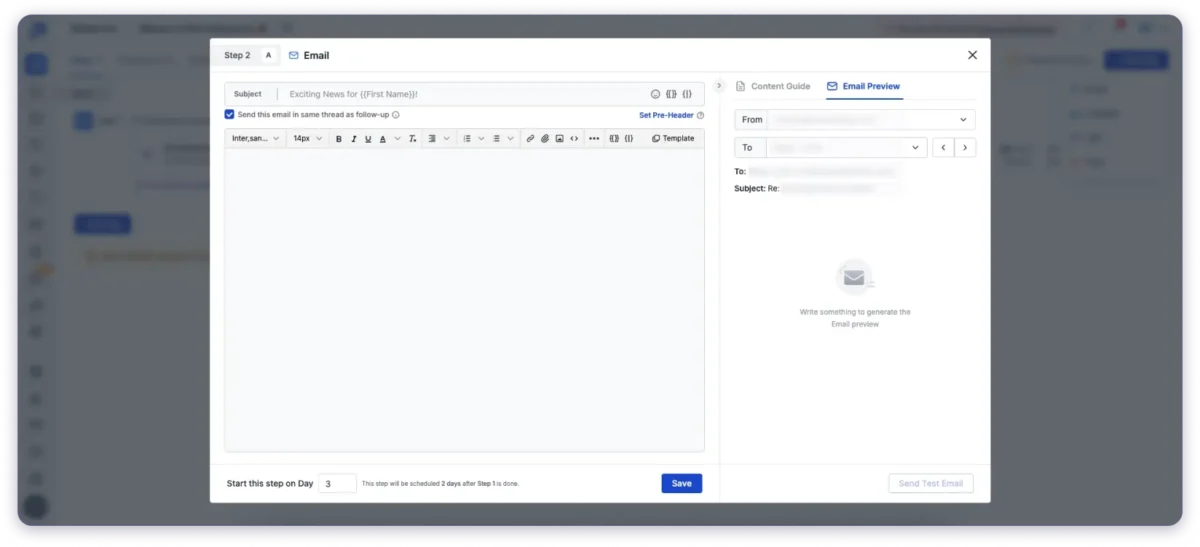
Step 2: Draft Your Email
Use the AI Copilot or your own framework. Keep it under 100 words initially, and personalize with merge tags or Spintax.
You can schedule when you want this step to start, for example, on Day 1, Day 2, and so on.
Preview your email and then click on “Save.”
You can also send a test to yourself.
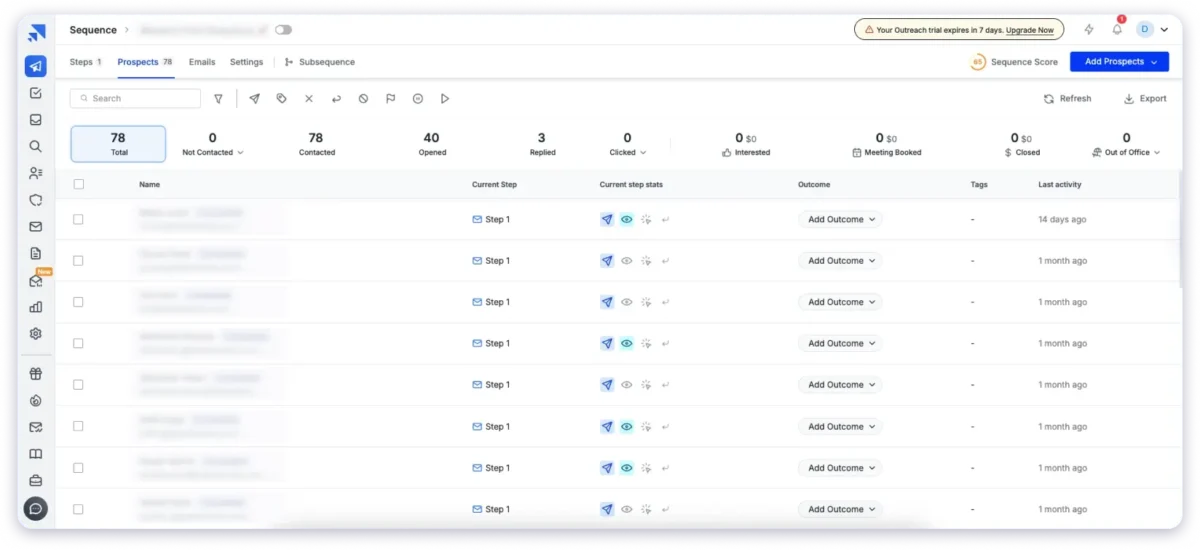
Step 3: Add Your Prospects
Import your ICP list or find verified leads using Saleshandy’s Lead Finder. Enrich them with intent data before sending.
Step 5: Set the Send Time in Settings
Schedule for when replies actually happen, with the global standard being Tuesday to Thursday, 9 AM to 11 AM or 1 PM to 3 PM.
You can also add more email accounts to enable sender rotation, enable ESP matching, and track what you would like to.

Step 6: Add Smart Follow-Ups
Add 1-3 follow-ups that add new value. Use condition-based triggers for smarter email sequencing. You can also set follow-up steps for your subsequences.

Step 7: Send and Track
Check your cold email in Unified Inbox and track all your replies in one place.

Step 8: Monitor Your Cold Email’s Performance
You can filter your campaign’s performance with funnel-style breakdowns and reply trends.

Conclusion: Time to Turn Your Cold Email Into a Conversation
When you start getting replies… do not pat yourself on the back just yet.
Because you have not won, but earned a chance.
When someone responds, keep connecting with one simple question instead of pitching.
If they say, “We already use something similar,” do not argue but ask what is working for them.
The goal is to start a conversation that leads to a conversion later.
Want to put this into practice?
Try it with Saleshandy. Take a free trial and get five free leads every month!
FAQs on How to Write Cold Emails
1. How do you introduce yourself in a cold email?
Introduce yourself in a cold email by stating your name, role, and company. Explain why you are reaching out, and the specific value or benefit you offer.
2. What is the ideal length of a cold email?
The best cold email length should be between 50 to 125 words. There should be limited links, images, and banners as well. This is to avoid getting flagged for spam.
3. Is cold emailing legal?
Yes, sending cold emails is legal. Some countries require user consent, while some do not. In the US, follow the CAN-SPAM Act, and the IT Act in India. EU/UK, Canada, Australia, and China require consent to receive cold emails.
4. What’s a good reply rate for cold emails?
A good reply rate for cold emails is 20-25%. Top cold email performers achieve 25% and above with personalization and follow-ups.
5. Does cold emailing really work?
Yes, cold emailing still works. You can still get 15-20% of reply rates with some good personalization, targeted leads, and tools like Saleshandy. But it requires persistence amid spam filters.
6. What’s the best time to send a cold email?
The best time to send a cold email is between Tuesday to Thursday, between 9 AM to 11 AM or 1 PM to 3 PM local time.
7. How long should a cold email be in 2026?
Aim for 50–75 words for the email body. In 2026, with AI-generated emails flooding inboxes and attention spans shrinking, shorter emails consistently outperform longer ones.
The goal is to deliver one clear value statement and one easy-to-answer CTA. If it takes more than 15 seconds to read, it’s too long.