


 Anil Salvi
 Contents
- 1 Cold Email Laws – TOC
- 2 TL;DR: Cold Email Laws in 2026
- 3 Is Cold Email Legal in 2026?
- 4 Cold Email Laws by Region: Quick Overview
- 5 Cold Email Laws by Region
- 6 Consent Rules Explained (Without Legal Jargon)
- 7 What Every Compliant Cold Email Must Include
- 8 What Makes a Cold Email Illegal
- 9 Penalties for Violating Cold Email Laws
- 10 Final Thoughts: Cold Email Laws Are About Responsibility, Not Fear
- 11 FAQs on Cold Email Laws
- 11.1 1. Is cold email legal for B2B outreach?
- 11.2 2. Is adding an unsubscribe link enough to make a cold email legal?
- 11.3 3. What counts as a “legitimate business reason” for cold emailing someone?
- 11.4 4. Can I send the same cold email to prospects in different countries?
- 11.5 5. Does personalization affect legal compliance or just conversions?
- 11.6 6. Is cold email riskier in 2026 than before?
If you are here, you want to make sure your cold emails are not risky.
In 2026, cold email rules depend on where your recipient is, how the data was sourced, and what your message contains.
What works in one country can cause problems in another.
This guide explains when cold email is legal, which laws matter by region, what every compliant email must include, and the mistakes that hurt compliance and deliverability.
By the end, you will know exactly what you can send, where, and how without second-guessing.
Cold Email Laws – TOC
- TL;DR: Cold Email Laws in 2026
- Is Cold Email Legal in 2026?
- Cold Email Laws by Region: Quick Overview
- Cold Email Laws by Region
- Consent Rules Explained (Without Legal Jargon)
- What Every Compliant Cold Email Must Include
- What Makes a Cold Email Illegal
- Penalties for Violating Cold Email Laws
- Final Thoughts: Cold Email Laws Are About Responsibility, Not Fear
- FAQs on Cold Email Laws
TL;DR: Cold Email Laws in 2026
If you want the short version before going deeper, this is what actually matters.
1. Cold Email Is Not Illegal by Default: It is legal in many regions, but only when you follow the rules that apply to your recipient’s location. There is no single global law.
2. Recipient Location Determines Compliance: The laws that matter are based on where your prospect lives, not where your company is based.
3. Consent Rules Change by Region: Some regions allow opt-out cold emails. Others require consent or a valid legitimate interest, especially for B2B outreach.
4. Relevance and Transparency Are Required: Every email must clearly state who you are, why you are reaching out, and why it matters to the recipient.
5. Unsubscribes Must Be Respected Immediately: Unsubscribe links are mandatory, and once someone opts out, further emails must stop.
6. Most Compliance Issues Come From Basic Mistakes: Scraped lists, irrelevant outreach, misleading details, and ignored opt-outs cause most violations.
7. Inbox Penalties Happen Before Legal Penalties: Spam filtering and domain damage usually show up long before any fines or formal enforcement.
8. Good Compliance Aligns With Good Outreach: Clear, relevant, and respectful emails align with how most laws are designed.
Cold email still works for teams that treat compliance as part of responsible outreach, not a loophole to exploit.
Is Cold Email Legal in 2026?
Yes, cold email is legal in many regions, but only if you follow specific rules.
There is no single global law that makes cold email legal or illegal everywhere.
Whether you can send a cold email depends on where your recipient is located, how their data was sourced, and whether your message meets the legal requirements in that region.
Some countries allow cold email under an opt-out model.
Others require prior consent or a clearly defined legitimate interest.
This is why a campaign that works in one country can create legal risk in another.
What Makes Cold Email Legal
Cold email is considered legal when:
- You have a valid legal basis to contact the recipient
- The message is relevant to the recipient’s role or business
- Your identity and intent are clearly stated
- A working opt-out option is included and honored
What Makes Cold Email Illegal
Cold email becomes illegal when:
- Personal data is collected or used without permission
- Emails are sent without a lawful basis
- Opt-out requests are ignored or delayed
- Sender details or subject lines are misleading
Just adding an unsubscribe link alone does not guarantee compliance.
Laws focus on how and why you contact someone, not just what appears in the email.
Next, we will break down the specific cold email laws by region so you know exactly which rules apply to your outreach.
Cold Email Laws by Region: Quick Overview
Here is a quick comparison table for how cold emails are seen across different regions before discussing it in detail.
| Region | Is Cold Email Allowed? | What Changes | Common Pitfall |
|---|---|---|---|
| US | Yes | Opt-out based | Ignored unsubscribes |
| EU & UK | Limited | Relevance or consent | Weak lawful basis |
| Canada | Limited | Consent-first | No consent proof |
| Australia & APAC | Limited | Consent expected | Assumed consent |
| India & Emerging | Yes | Deliverability-led | Inbox blocking |
Cold Email Laws by Region
Cold email is regulated differently across regions.
Whether cold outreach is allowed depends on local email marketing laws, data protection regulations, and how consent is defined and enforced.
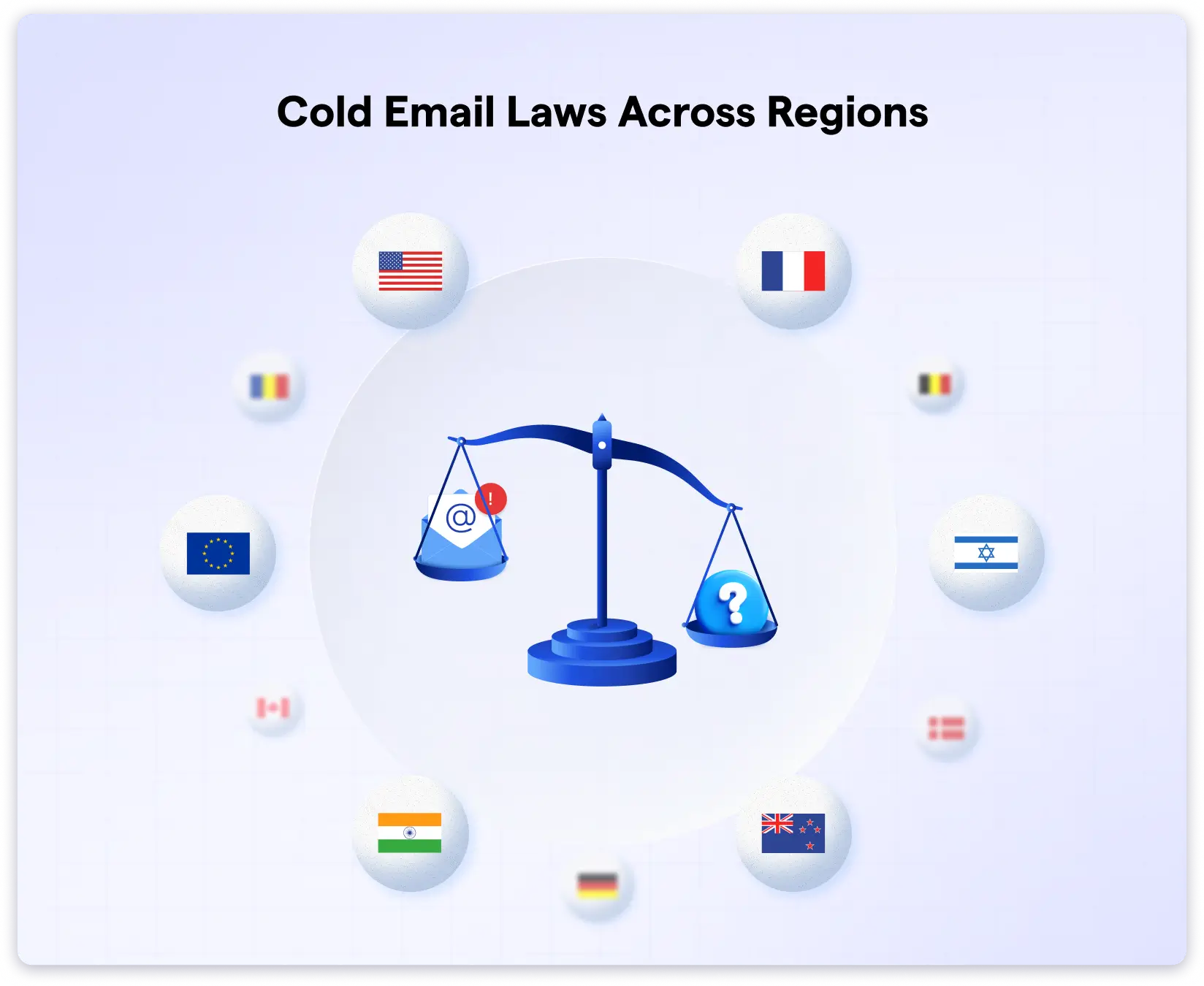
Let’s understand how compliance works in major regions.
- United States
- European Union and the United Kingdom
- Canada
- Australia and APAC
- India and Other Emerging Markets
1. United States
The United States regulates cold email under the CAN-SPAM Act.
This law does not require prior consent for commercial emails, including B2B outreach.
Instead, it focuses on transparency, accurate identification, and recipient control.
To Comply, Senders Must:
- Use accurate and non-deceptive sender and subject line information
- Clearly identify the sender
- Include a valid physical postal address
- Provide a clear and functional opt-out mechanism
- Honor opt-out requests within the required timeframe
Key Takeaway:
Cold email is legally permitted in the United States without prior consent, but failure to meet disclosure or opt-out requirements can result in penalties and enforcement action.
2. European Union and the United Kingdom
Cold email in the EU and UK is governed primarily by GDPR, alongside local electronic communications rules such as PECR in the UK.
These laws regulate how personal data is collected and used.
Cold email is not automatically illegal, but it requires a lawful basis.
This is usually:
- Explicit consent, or
- Legitimate interest for certain types of B2B communication
To Comply, Organizations Must:
- Have a clear lawful basis for processing personal data
- Ensure outreach is relevant and expected within a professional context
- Provide clear sender identification and contact details
- Offer an easy way to object or opt out of future emails
Key Takeaway:
Cold email is allowed in limited circumstances, mainly for relevant B2B outreach.
Data sourcing, relevance, and lawful justification matter more than email format alone.
3. Canada
Canada regulates cold email under CASL, one of the strictest anti-spam laws globally.
CASL generally requires consent before sending commercial electronic messages.
Consent can be:
- Express, where the recipient has clearly agreed, or
- Implied, under specific conditions, such as an existing business relationship
To Comply, Senders Must:
- Be able to demonstrate valid consent
- Identify the sender and include contact information
- Provide a working unsubscribe mechanism
- Process opt-out requests within the required timeframe
Key Takeaway:
In Canada, cold email without provable consent carries a high legal risk. Compliance depends on consent, not just transparency.
4. Australia and APAC
Australia regulates cold email through the Spam Act.
Similar consent-based frameworks exist across several APAC (Asia-Pacific, a broad geographical and economic region covering East Asia, Southeast Asia, South Asia, and Oceania).
Commercial emails generally require:
- Express consent, or
- Inferred consent based on a clear and existing relationship
Senders Must Also:
- Clearly identify themselves
- Include accurate contact details
- Provide a functional unsubscribe option
- Avoid misleading or deceptive content
Key Takeaway:
Consent is central in Australia and much of APAC.
Sending a cold email without a clear consent basis increases both legal and enforcement risk.
5. India and Other Emerging Markets
India does not currently have a single, clearly defined law that directly regulates B2B cold email.
Instead, cold outreach intersects with broader data protection rules and anti-spam provisions.
What is Written:
- Regulations restrict unsolicited commercial communication
- Personal data should be collected and used for lawful purposes
- Recipients should be given the ability to opt out
- Deceptive or misleading communication is prohibited
What is Actually Enforced:
- Enforcement primarily targets consumer spam, especially SMS and telecom messaging
- Public enforcement actions related to B2B cold email are rare
- Most consequences come from email providers rather than regulators
Key Takeaway:
The legal environment is unclear rather than permissive.
While enforcement is limited, poor cold email practices still lead to account restrictions and long-term deliverability issues.
Legal compliance does not guarantee inbox placement.
But they are used by email platforms to apply stricter standards that can block or penalize non-compliant outreach.
Consent Rules Explained (Without Legal Jargon)
When people talk about cold email consent, they often make it sound complicated.
In reality, most laws are trying to solve one simple problem.
People should not be contacted unexpectedly, repeatedly, or without control.
Each country enforces this idea differently, but the intention is the same.
Let us break it down.
- Opt In vs Opt Out: What Actually Changes
- When Legitimate Interest Is Allowed
- B2B vs B2C Cold Email: Why the Rules Feel Different
1. Opt In vs Opt Out: What Actually Changes
Opt in means permission comes first.
You are expected to get approval before sending the first email.
Opting out means you can send an email first, as long as the recipient can stop you from sending future messages.
This difference exists because countries balance business outreach and privacy differently.
In Practice:
- The United States allows opt-out for commercial emails
- Canada and Australia expect consent first in most cases
- Europe allows limited B2B outreach without consent, but under stricter conditions
This is why teams get confused. Cold email itself is not banned, but the timing of consent changes by region.
Note:
If you do not know where your recipient is based, you do not know which consent rule applies.
2. When Legitimate Interest Is Allowed
Legitimate interest is often misunderstood by many.
It is not a loophole but a justification.
It means you can contact someone without prior permission only if your reason for emailing them is reasonable, relevant, and expected in a professional context.
For Example, emailing a Head of Sales about a sales tool can be legitimate.
Emailing the same person about an unrelated product is not.
Regulators look at intent and context, and not just message content.
Legitimate Interest Usually Works When:
- The recipient is contacted because of their job role
- The message relates directly to their responsibilities
- The outreach is targeted, not mass-sent
Note:
If your email feels random or confusing to the recipient, legitimate interest probably does not apply.
3. B2B vs B2C Cold Email: Why the Rules Feel Different
Most laws treat business inboxes differently from personal inboxes.
The assumption is that professionals expect some level of outreach related to their work.
Consumers do not.
That is why:
- B2C emails usually require explicit consent
- B2B emails allow more flexibility in certain regions
However, flexibility does not mean freedom.
Even in B2B outreach, relevance, transparency, and opt-out rights still apply.
Note:
B2B cold emails are more tolerated but not unregulated.
Now you know why consent is required, and regulators often regulate emails based on that.
Let us now understand what every legal cold email must include to surpass these regulators and land in the inbox.
What Every Compliant Cold Email Must Include
While consent rules vary by country, the basic expectations of a legal cold email are surprisingly consistent.
These rules exist so recipients always know who contacted them and how to stop it.
1. Sender Identification
A legal cold email should never feel anonymous.
The recipient should immediately understand:
- Who sent the email
- Which company does it represent?
- That the sender is a real person and should be reached out to.
This is why fake names, unclear domains, or hidden identities create problems.
Why this Matters:
Transparency reduces both legal risk and spam complaints.
2. Unsubscribe Rules
The right to stop future emails is central to almost every regulation.
This is not about formality. It is about control.
An unsubscribe option is a must.
Once someone opts out, continuing to email them is one of the clearest violations across regions.
Why this Matters:
Ignoring opt-outs and not including them in your emails is one of the fastest ways to trigger complaints and enforcement.
3. Subject Line Rules
Subject lines are regulated because they influence whether someone opens an email.
Regulators and email providers flag subject lines that:
- Promise something the email does not deliver
- Create false urgency
- Intentionally mislead
This applies even if the email body is honest.
Why this Matters:
Misleading subject lines are treated as deceptive communication and should not be adopted.
4. Physical Address Requirements
Many laws require commercial emails to include a physical address.
This is not about paperwork. It is about accountability.
In most cases, a registered office, mailbox, or legally valid virtual address is sufficient.
Why this Matters:
Anonymous senders are treated as higher risk by both regulators and inbox providers.
What Makes a Cold Email Illegal
An illegal cold email usually comes from ignoring fundamentals, not missing fine print.
Here are a few reasons that make an email illegal to send.
- Using Scraped or Unauthorized Lists
- Ignoring Opt-Outs
- Sending Irrelevant or Misleading Outreach
- Hiding Identity or Spoofing Domains
If email addresses were collected without permission, scraped from websites, or bought from unreliable sources, using them creates immediate risk.
Many regulations care more about how data was obtained than how polite the email sounds.
2. Ignoring Opt-Outs
Re-mailing someone who has unsubscribed is a direct violation in most regions.
There is no gray area here.
3. Sending Irrelevant or Misleading Outreach
Contacting people with no logical connection to your offer, or being unclear about why you are emailing them.
It often violates data use principles.
Relevance is not just a conversion tactic. It is a compliance expectation.
4. Hiding Identity or Spoofing Domains
Impersonation, misleading sender names, or domain spoofing are treated as serious violations.
These practices signal intent to deceive, which attracts both legal and platform-level action.
Penalties for Violating Cold Email Laws
Penalties for cold email violations are often misunderstood.
While fines exist, they are usually not the first or most common consequence.
In most cases, problems surface through inbox and account restrictions long before regulators get involved.
- Fines Under Major Regulations
- Real-World Enforcement Patterns
- Deliverability Damage Beyond Legal Penalties
1. Fines Under Major Regulations
Major regulations allow authorities to issue financial penalties, but these are typically reserved for serious or repeated violations.
Laws like GDPR, CASL, and CAN-SPAM focus on preventing abuse, not punishing small or accidental mistakes.
Fines usually follow clear patterns of non-compliance, such as ignoring complaints, misusing personal data, or continuing outreach after warnings.
Single campaigns rarely trigger legal action on their own.
Outcome?
A company keeps emailing people who have already unsubscribed.
Complaints pile up, the behavior continues, and regulators step in with penalties.
2. Real-World Enforcement Patterns
Regulators tend to act on patterns rather than one-off incidents.
Enforcement commonly targets high-volume senders, deceptive campaigns, or businesses that repeatedly ignore opt-outs and complaints.
Smaller teams are less likely to face immediate fines, but repeated issues can still escalate over time.
Outcome?
A sales team uses the same lead list for every campaign, even though many contacts complain or ask to be removed.
The issue is not fixed, so enforcement escalates.
3. Deliverability Damage Beyond Legal Penalties
The most immediate penalties usually come from email providers, not regulators.
When complaint rates rise or behavior looks suspicious, inbox providers reduce visibility quickly.
Emails begin landing in spam, domains lose trust, and accounts may be restricted or shut down.
Recovery is slow and often more costly than any fine.
Outcome?
Cold emails start landing in spam. Open rates drop. Replies slow down.
Eventually, new emails stop reaching inboxes at all.
Final Thoughts: Cold Email Laws Are About Responsibility, Not Fear
If cold email laws feel confusing, that is normal.
Most of the rules were written to stop abuse, not responsible outreach.
In 2026, cold email laws are less about stopping outreach and more about setting boundaries around how data is used, how people are contacted, and how much control recipients have.
The biggest mistakes teams make are not legal loopholes.
They are basic oversights like unclear data sources, weak relevance, or ignoring opt-outs.
If you understand where your recipients are located, why you are emailing them, and how to give them an easy way to disengage, you are already ahead of most senders.
At the end, cold email works best when it is intentional, respectful, and transparent.
FAQs on Cold Email Laws
1. Is cold email legal for B2B outreach?
In most regions, B2B cold email is treated more leniently than B2C. However, it is still regulated. Relevance, transparency, and opt-out rights are required even for business emails.
2. Is adding an unsubscribe link enough to make a cold email legal?
No. An unsubscribe link is required, but it does not make an email compliant on its own.
Laws also care about how you got the email address, why you are contacting the person, and whether the message is relevant.
Unsubscribe handles future emails. It does not justify the first one.
3. What counts as a “legitimate business reason” for cold emailing someone?
A legitimate business reason usually means the email is:
- Sent to someone in a professional role
- Directly related to what they do at work
- Reasonably expected in a business context
If the recipient would reasonably ask, “Why am I getting this?” then the justification is weak.
4. Can I send the same cold email to prospects in different countries?
You can, but it increases risk.
A message that is compliant in the United States may violate consent rules in Canada or Europe.
This is why many teams separate campaigns by region or apply stricter standards globally.
Design campaigns to meet the strictest applicable rules instead of optimizing for the loosest ones.
5. Does personalization affect legal compliance or just conversions?
It affects both.
Poor personalization can weaken your legal justification, especially in regions where relevance is tied to lawful data use.
Generic or mass emails are harder to defend under legitimate interest.
Relevance is not just a sales tactic. It is part of compliance.
6. Is cold email riskier in 2026 than before?
Yes, not because laws are entirely new, but because enforcement and inbox filtering are more coordinated.
Privacy regulation, spam filtering, and email provider policies now reinforce each other.
Even if regulators never contact you, inbox providers will.