

 Anil Salvi
 Contents
- 1 How to Write a Sales Email – TOC
- 2 TL;DR: How to Write Sales Emails That Work in 2026
- 3 What Is a Sales Email & Why It Still Works?
- 4 The Anatomy of a High-Performing Sales Email
- 5 How to Write a Sales Email Step by Step?
- 6 10 Sales Email Templates and When to Use Them
- 6.1 1. Cold Email Outreach
- 6.2 2. Cold Email Based on Timing or Activity
- 6.3 3. Insight-First Outreach
- 6.4 4. Soft Follow-Up After No Response
- 6.5 5. Follow-Up With Added Context
- 6.6 6. Re-Engagement After a Long Gap
- 6.7 7. Warm Lead or Inbound Follow-Up
- 6.8 8. Referral or Right Contact Check
- 6.9 9. Low-Pressure Demo or Walkthrough Request
- 6.10 10. Polite Breakup Email
- 7 What Are the Common Mistakes in Sales Email and How to Avoid Them
- 8 Conclusion and What to Do Next
- 9 FAQs on Writing Sales Email
The first real moment in most sales conversations is not the demo.
It is not the follow-up.
It is not even the product.
It is the first email.
That single message often decides whether a conversation starts or never happens at all.
When a sales email feels unclear, irrelevant, or difficult to respond to, prospects do not reject it.
They simply move on.
That is why writing sales emails in 2026 is no longer about persuasion.
It is about precision.
The best sales emails quickly make three things clear.
- Why the message matters right now.
- Who it is meant for.
- And how easy it is to respond.
In this guide, you will learn how to write sales emails that actually get replies in 2026, using modern structure, AI-assisted decision making, and templates that work in real inboxes.
How to Write a Sales Email – TOC
TL;DR: How to Write Sales Emails That Work in 2026
What Sales Emails Are Meant to Do
1. Sales emails exist to start conversations, not close deals: Your goal is to get a reply, not deliver a pitch-perfect explanation.
2. Relevance decides everything in the first few seconds: If the reader cannot quickly see why the email matters to them, it gets ignored.
How to Structure Every Sales Email
3. Use a simple, repeatable structure: A short subject line, a relevant opening, one problem, one benefit, and one clear CTA work best.
4. Lead with BLUF (Bottom Line Up Front): If the value is not clear in the first two lines, the rest of the email rarely gets read.
5. Keep the body focused and lightweight: One clear idea per email performs better than trying to explain everything at once.
How to Improve Reply Rates
6. Personalization should explain timing, not show effort: Context beats clever details every time.
7. Follow-ups are not optional: Most replies come from follow-ups, not the first email.
8. Make the CTA easy to act on: If replying feels like a commitment, people postpone and forget.
What to Measure and Why
9. Track only metrics tied to intent: Open rate shows subject line and timing, reply rate shows message relevance, and conversion rate shows real impact.
10. Improve using a simple loop: Send, measure, change one thing, and repeat.
What’s Changing in 2026
11. Sales emails are becoming behaviour-driven: Emails triggered by actions consistently outperform fixed schedules.
12. AI is shifting from writing to decision support: AI helps with timing, prioritisation, and testing, while humans stay in control of the message.
What Is a Sales Email & Why It Still Works?
A sales email is a short, one-to-one message sent to start a conversation with a potential buyer.
It’s not meant to sell or pitch your product immediately.
The goal is to show relevance, spark interest, and make replying feel easy.
Why Sales Emails Still Work in 2026?
Below are some of the reasons why sales emails are still relevant in 2026.
But the catch is that the approach has to be changed.
- Buyers Now Filter, Not Explore: Prospects don’t browse solutions anymore, and they quickly decide what to ignore. A clear sales email helps them make that decision faster.
- Communication Beats Interruptions: Unscheduled calls and DMs feel intrusive. Email lets buyers engage on their own terms, which increases the chance of a response.
- Sales Emails Fit Multi-threaded Buying: Modern deals involve multiple stakeholders, and email is still the easiest way to loop people in and move conversations forward.
- Personal Relevance Matters More Than Creativity: In 2026, generic “clever” emails are ignored. Simple, relevant messages stand out because they respect attention limits.
- Follow-Ups Are Part of the Decision Process: Buyers expect reminders. Well-timed follow-ups feel helpful, not pushy, when done via email.
- AI Raised the Bar, Not Killed the Channel: AI made bad emails more common. That’s why thoughtful, human-sounding sales emails perform better than ever.
The Anatomy of a High-Performing Sales Email
High-performing sales emails don’t happen by accident.
They follow a structure that matches how people read emails today, which is fast, selective, and impatient.
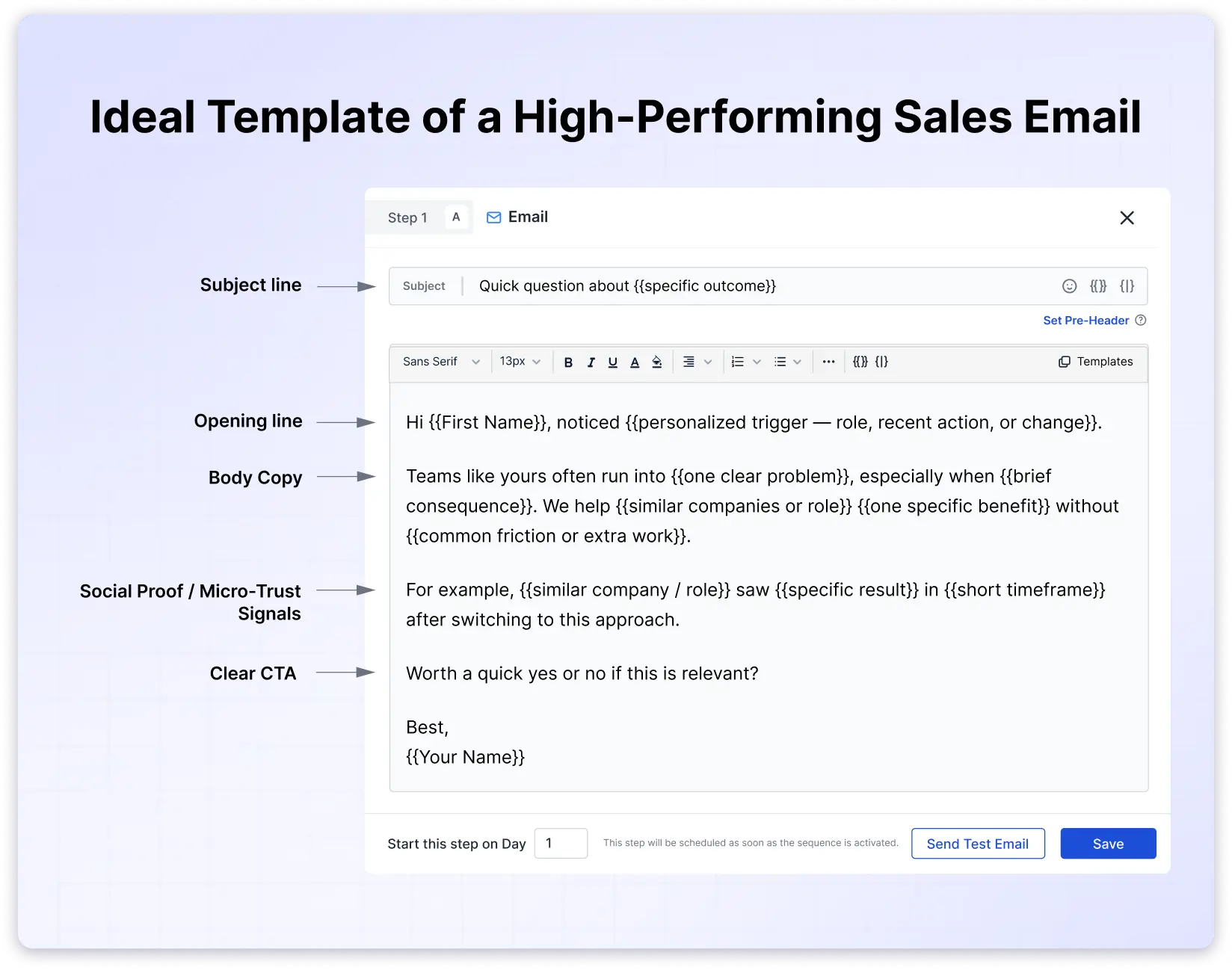
Let’s break down each element and understand what it’s responsible for.
- Subject Line: Short, Clear, Curiosity-Driven
- Opening Line: Personal and Relevant
- Body Copy: Value First, One Problem & One Benefit
- Social Proof or Micro-Trust Signals
- Clear CTA: One Easy Next Step
1. Subject Line: Short, Clear, Curiosity-Driven
The subject line is your first and often only chance to earn attention.
Before anyone reads your email, they decide based on the subject line alone whether it’s worth opening or ignoring.
The best subject lines:
- Hint at a benefit or idea
- Feel relevant, not promotional
- Avoid explaining too much
If it looks like a sales pitch, it gets skipped.
Examples:
• Quick question about {{specific outcome}}
• {{Company Name}} + {{one goal}}
• Worth a quick yes or no?
• Idea for your {{team/role}}
2. Opening Line: Personal and Relevant
Once the email is opened, the opening line determines whether the reader keeps going or closes it.
This line should immediately answer an unspoken question: “Why are they emailing me?”
A strong opening line shows:
- Why are you reaching out to this person
- That the email is not generic and has written after good research and intent.
Referencing role, timing, activity, or context helps the reader instantly understand the relevance.
Example:
Hi {{First Name}}, noticed your team recently started hiring SDRs—thought this might be relevant.
3. Body Copy: Value First, One Problem & One Benefit
This is where most sales emails lose the reader.
Long explanations, feature lists, and multiple ideas create friction and slow the reader down.
High-performing sales emails have:
- Focus on one clear problem
- Connect it to one meaningful benefit
- Avoid feature lists and long explanations
Less content with more clarity usually does the job.
Example:
Teams in {{industry}} often struggle with {{problem}}, especially when {{common consequence}}.
We help them {{specific benefit}} without {{common friction}}.
4. Social Proof or Micro-Trust Signals
At this point, the reader understands what you are offering, but they still need a reason to trust it.
This is where a small trust signal makes a big difference.
A micro-trust signal does not try to persuade. It simply reduces doubt.
This could be:
- Any recent result
- A relevant statistic or report
- A short mention of a similar company
Always focus on keeping it brief. Its job is to reassure and not convince.
Examples:
• Helped a similar {{company type}} improve {{metric}} by {{result}}
• Used by teams at {{company name}}
• Recently worked with a {{role/team}} facing the same challenge
5. Clear CTA: One Easy Next Step
The final step of a sales email is not closing a deal.
It’s guiding the reader toward a low-effort response. If the CTA feels heavy or demanding, replies drop.
Every sales email should end with one simple action.
Good CTAs always:
- Feel low effort
- Don’t push for commitment
- Make replying easy
The easier the action, the higher the chance of a response.
Examples:
• Worth a quick yes or no?
• Open to a short chat?
• Should I send more details?
• Is this relevant to you?
This structure removes guesswork and makes writing sales emails faster, simpler, and far more consistent.
How to Write a Sales Email Step by Step?
Now that the structure is clear, let’s understand how to write a perfect sales email that is not only personalized but also grabs the attention of your recipients.
- Define the Audience and the Goal
- Research Prospect Triggers or Events
- Draft Using BLUF (Bottom Line Up Front)
- Insert Proof Points and Keep the Body Concise
- Add a Clear, Low-Friction CTA and Sign-Off
- Create Variants and Improve Through Testing
1. Define the Audience and the Goal
Before you type the first line, pause for a second.
Who is this email for, and what do you want from them?
Most sales emails fall apart because they try to do too much. They talk to multiple roles, cover too many ideas, or ask for more than one thing.
The clearer you are here, the easier the email becomes to write and read.
If you’re not sure what the goal is, the reader won’t be either.
Quick Tip:
If you can’t describe the goal of the email in one sentence, the email isn’t ready yet.
2. Research Prospect Triggers or Events
Sales emails perform better when they feel timely.
Instead of sending generic outreach, look for a small but relevant trigger that explains why you’re reaching out now.
This could be a role change, a recent hire, a product launch, or a common challenge tied to their role.
You don’t need deep research, just enough context to make the email feel intentional rather than random.
Quick Tip:
One accurate trigger is better than three vague ones.
3. Draft Using BLUF (Bottom Line Up Front)
In 2026, attention spans are short, and readers decide quickly whether an email is worth their time.
That’s why strong sales emails lead with the bottom line. Instead of building up slowly, open with the value or insight that matters most to the reader.
If the first few lines don’t feel useful, the rest of the email won’t get read.
Quick Tip:
If the value isn’t clear in the first two lines, rewrite the opening.
4. Insert Proof Points and Keep the Body Concise
Once you have the reader’s attention, keep the message focused.
A good sales email highlights one clear problem and connects it to one meaningful benefit.
Adding a small proof point, such as a result, a similar company, or a relevant outcome, helps build trust without overwhelming the reader.
The goal here is clarity, not persuasion.
Quick Tip:
One strong proof point works better than multiple weak ones.
5. Add a Clear, Low-Friction CTA and Sign-Off
The purpose of a sales email is to start a conversation, not force a decision.
End the email with a simple call to action that feels easy to respond to. A low-commitment CTA reduces hesitation and increases replies.
Keep the sign-off professional and brief so the email ends cleanly.
Quick Tip:
If the CTA feels like a commitment, make it smaller.
6. Create Variants and Improve Through Testing
Even well-written emails won’t work the same for everyone.
Creating two or three variations allows you to test different openings, value angles, or CTAs without rewriting everything from scratch.
In 2026, AI can accelerate this process, but results still depend on measuring replies and refining what works over time.
Quick Tip:
Change one element at a time so you know which ones actually improve results.
10 Sales Email Templates and When to Use Them
Instead of starting from a blank screen every time, use the templates below as a starting point.
They are based on different use cases, so you can use them as per your requirements.
- Cold Email Outreach
- Cold Email Based on Timing or Activity
- Insight-First Outreach
- Soft Follow-Up After No Response
- Follow-Up With Added Context
- Re-Engagement After a Long Gap
- Warm Lead or Inbound Follow-Up
- Referral or Right Contact Check
- Low-Pressure Demo or Walkthrough Request
- Polite Breakup Email
1. Cold Email Outreach
Subject: Quick question about {{specific context}}
Hi {{First Name}},
I noticed {{specific trigger or recent change}} and thought this might be relevant to your team.
Teams in {{their role or industry}} often face {{problem}} at this stage. We help them {{specific outcome}} without adding unnecessary complexity.
Would it make sense to explore this further?
Best regards,
{{Your Name}}
2. Cold Email Based on Timing or Activity
Subject: Noticed this at {{Company}}
Hi {{First Name}},
I came across {{recent action or signal}} and wanted to reach out at the right time.
When this happens, teams usually start thinking about {{problem or next step}}. We have helped similar teams handle this more effectively.
Happy to share more if it is useful.
Best regards,
{{Your Name}}
3. Insight-First Outreach
Subject: One observation worth sharing
Hi {{First Name}},
I have been noticing a common pattern among {{role or industry}} teams around {{specific challenge}}.
It often goes unnoticed until it starts affecting results. I was curious whether this is something you are seeing as well.
Looking forward to your thoughts.
Best regards,
{{Your Name}}
4. Soft Follow-Up After No Response
Subject: Following up
Hi {{First Name}},
I wanted to follow up in case my previous email got missed.
Just checking whether {{topic or challenge}} is something you are currently focused on.
Please feel free to let me know either way.
Best regards,
{{Your Name}}
5. Follow-Up With Added Context
Subject: One more thought on {{topic}}
Hi {{First Name}},
I wanted to share one additional detail. Teams similar to yours often see {{specific outcome}} when they address {{problem}} earlier.
If helpful, I can share a brief example.
Best regards,
{{Your Name}}
6. Re-Engagement After a Long Gap
Subject: Checking back in
Hi {{First Name}},
It has been some time since I last reached out, so I wanted to reconnect.
Is {{problem or goal}} still something your team is thinking about this quarter, or should I pause outreach for now?
Either way, I appreciate your guidance.
Best regards,
{{Your Name}}
7. Warm Lead or Inbound Follow-Up
Subject: Following up on {{action}}
Hi {{First Name}},
I noticed that you recently {{signed up for or downloaded}} {{resource}}.
At this stage, teams often look for clarity around {{next step or challenge}}. I would be happy to share a few relevant insights if helpful.
Would that be useful?
Best regards,
{{Your Name}}
8. Referral or Right Contact Check
Subject: Quick question about {{Company}}
Hi {{First Name}},
I am trying to connect with the right person who handles {{area or responsibility}} at {{Company}}.
If that is you, I would be glad to explain why I reached out. If not, I would appreciate it if you could point me in the right direction.
Thank you for your help.
Best regards,
{{Your Name}}
9. Low-Pressure Demo or Walkthrough Request
Subject: Would a brief walkthrough help?
Hi {{First Name}},
Teams similar to yours use {{solution}} to {{specific outcome}}, particularly to reduce {{common frustration}}.
If it would be helpful, I can walk you through how this works in a short session.
Please let me know what you think.
Best regards,
{{Your Name}}
10. Polite Breakup Email
Subject: Closing the loop
Hi {{First Name}},
I have not heard back, so I will pause outreach for now.
If {{problem or goal}} becomes a priority in the future, I would be happy to reconnect.
Thank you for your time.
Best regards,
{{Your Name}}
If you want even more sales and cold email templates that are already proven to get replies across industries and use cases, check out this full list of B2B cold email templates.
What Are the Common Mistakes in Sales Email and How to Avoid Them
Most sales email mistakes are not easily noticeable.
They are small, repeatable habits that quietly reduce replies over time.
The best part is that they are also easy to fix once you know what to add and what to avoid.
- Writing Emails That Are Too Long or Too Vague
- Confusing Personalization With Relevance
- Treating Silence as a No
- Ending Without a Clear Next Step
- Sending Emails Without Looking at the Results
1. Writing Emails That Are Too Long or Too Vague
If someone has to scroll to understand your email, you have probably lost them already.
Long emails ask for more attention than most inboxes can give.
Vague emails make readers work to figure out why they should care.
Either way, the result is the same ~ the email gets skipped.
How to Avoid It:
Read your email once as if you are seeing it for the first time.
If the main point is not obvious in the first few lines, cut it down.
2. Confusing Personalization With Relevance
Personalization is helpful until it feels unnecessary or uncomfortable.
Mentioning random details, stretching for something “unique,” or referencing things that are not connected to your message can feel forced.
The reader is not impressed. They are confused.
How to Avoid It:
Personalize only what supports the reason for reaching out. If a detail does not help explain why this email matters right now, leave it out.
3. Treating Silence as a No
One of the most common mistakes is assuming no reply means no interest.
In reality, silence usually means bad timing, a busy inbox, or a quick skim with the intention to reply later.
Without a follow-up, the conversation never has a chance.
How to Avoid It:
Plan your follow-ups in advance. Keep them short, polite, and slightly different from the first email.
A simple reminder often works better than a new pitch.
4. Ending Without a Clear Next Step
An email can be well written and still fail if the reader does not know how to respond.
When the next step is unclear or feels like a big commitment, people postpone replying.
Most of the time, that reply never comes.
How to Avoid It:
End with one easy question or action. If replying feels harder than ignoring the email, the CTA needs to be simpler.
5. Sending Emails Without Looking at the Results
Sending emails without checking performance is like guessing what works and hoping for the best.
Without looking at replies, patterns, or outcomes, the same mistakes repeat. Small improvements get missed.
How to Avoid It:
After each campaign, review what actually happened. Identify one thing to improve next time.
Over time, these small changes add up.
Conclusion and What to Do Next
Sales emails that get replies follow a simple pattern.
They are short, relevant, and written to start a conversation, not close a deal.
When you use a clear structure, focus on one idea, and follow up thoughtfully, results become more consistent.
You can apply everything in this guide manually, but tools make it easier to do it well at scale.
Using ready-to-send templates, testing variations, tracking replies, and managing follow-ups in one place helps turn best practices into daily execution.
Saleshandy helps you do exactly that.
Start with one template, send a small batch, review the responses, and refine.
FAQs on Writing Sales Email
1. What is a good sales email?
A good sales email is easy to read and easy to respond to.
It clearly explains why you are reaching out and why it might matter to the person reading it.
It does not try to sell too much or sound fancy. If someone can understand your message in a few seconds and knows what to do next, that email is doing its job.
2. How do you make your sales email stand out?
Sales emails stand out when they feel relevant, not clever.
Mention something that actually connects to the person’s role or situation, and keep the message short.
Avoid generic lines that could be sent to anyone. When an email feels like it was written for one person and respects their time, it naturally gets noticed.
3. Why are sales emails important?
Sales emails are important because they are often the first way you reach a potential customer.
They let you start a conversation without interrupting someone’s day.
A good sales email opens the door, builds interest, and gives the other person the choice to respond when it suits them.
4. How long should a sales email be?
A sales email should be short enough to read quickly. In most cases, that means around 75 to 120 words.
Long emails usually get skimmed or ignored. The goal is not to explain everything, but to share just enough to start a conversation.
5. How many follow-ups should I send?
You should expect to send follow-ups. One email is rarely enough. Sending two to four follow-ups over a couple of weeks is normal.
Most people are busy and may miss the first message.
As long as your follow-ups are polite and not repetitive, they help more than they hurt.
6. What is a good response rate for sales emails?
For sales emails, a response rate between 5 and 15 percent is considered good.
What matters more is whether your response rate improves over time. If small changes lead to more replies, you are moving in the right direction.