


 Dhruv Patel
 Contents
- 1 ChatGPT Cold Emails – TOC
- 2 How to Structure a ChatGPT Prompt for Cold Emails
- 3 14 Best ChatGPT Prompts and Templates for Cold Emails Based on Different Use Cases
- 3.1 1. ChatGPT Cold Email Prompt For Generic Cold Email Outreach
- 3.2 2. ChatGPT Cold Email Prompt For Sales
- 3.3 3. ChatGPT Cold Email Prompt For Short “Quick Question”
- 3.4 4. ChatGPT Cold Email Prompt For Targeting a Specific Pain Point
- 3.5 5. ChatGPT Cold Email Prompt For Demo-Booking
- 3.6 6. ChatGPT Cold Email Prompt For Friendly Follow-Up Email When No Response
- 3.7 7. ChatGPT Cold Email Prompt For Re-Engagement
- 3.8 8. ChatGPT Cold Email Prompt For Job
- 3.9 9. ChatGPT Cold Email Prompt For a LinkedIn Connection
- 3.10 10. ChatGPT Cold Email Prompt For Resource-Sharing / Adding-Value
- 3.11 11. ChatGPT Cold Email Prompt For Conference / Post-Event Outreach
- 3.12 12. ChatGPT Cold Email Prompt For Agency / Freelancer Pitch
- 3.13 13. ChatGPT Cold Email Prompt For Partnership / Collaboration Outreach
- 3.14 14. ChatGPT Cold Email Prompt For Upselling / Cross-Selling
- 4 Best Practices for Using ChatGPT in Cold Email Outreach
- 5 Your First Email Is One Prompt Away
- 6 FAQs on ChatGPT Cold Emails
- 6.1 1. Can ChatGPT write effective cold emails?
- 6.2 2. How do I use ChatGPT to write cold emails?
- 6.3 3. Which ChatGPT model is best for writing cold emails?
- 6.4 4. How can I make ChatGPT cold emails sound more human?
- 6.5 5. Can I use ChatGPT to write follow-up emails?
- 6.6 6. How do I connect ChatGPT outputs with Saleshandy sequences?
Most people open ChatGPT, type “write me a cold email,” and get something generic.
Something that sounds like every other email already sitting in their prospect’s inbox.
The problem is not ChatGPT. The problem is the prompt.
I’ve tested dozens of prompts across different outreach scenarios, and the difference between a prompt that gets you a reply-worthy email and one that gets you filler is surprisingly small.
It comes down to how much context you give the model.
In this guide, I’ve put together 14 ChatGPT prompts for cold emails, each built for a specific use case.
You’ll also find a section on how to structure your prompts properly so you stop getting generic output.
Copy what works for you, plug in your details, and start sending.
ChatGPT Cold Emails – TOC
TL;DR: What You Need to Know Before Writing Cold Emails with ChatGPT
1. ChatGPT writes better cold emails when you give it specific context, not vague instructions.
2. A strong prompt includes your role, the prospect’s pain point, your value proposition, tone, and word count.
3. Always edit the output before sending raw AI copy is easy to spot.
4. GPT-4o currently delivers the best results for cold emails with clear instructions and natural tone.
5. Use prompts as a starting point, then personalize before you hit send.
How to Structure a ChatGPT Prompt for Cold Emails
Here’s something I noticed early on.
The more detail I gave ChatGPT, the better the email it produced.
A strong cold email prompt has seven parts.
1. Role: Tell ChatGPT who it is. This sets the tone and voice for the entire email. Example: “You are an experienced B2B sales rep at a cold email software company.”
2. ICP (Ideal Customer Profile): Describe who you’re writing to. Industry, company size, job title. Example: “The recipient is a VP of Sales at a SaaS company with 50–200 employees.”
3. Pain Point: Name the specific problem your prospect is facing. The more specific, the better the email. Example: “Their team is sending cold emails but struggling with low reply rates.”
4. Value Proposition: What do you offer, and what result does it produce? Example: “We help outbound teams book more meetings by improving email copy and automating follow-ups.”
5. Tone: Casual, conversational, professional, direct? Pick one. Example: “Keep the tone casual and conversational. No corporate speak.”
6. Word Count: Set a limit. Without one, ChatGPT will write a wall of text. Example: “Keep the email under 120 words.”
7. Output Format: Tell it exactly what to produce. Example: “Output a subject line and email body in plain text.”
Example:
“You are a B2B sales rep at a cold email automation tool. Write a short cold email to a Head of Sales at a 100-person SaaS company. They’re struggling with low reply rates on outbound campaigns. We help outbound teams increase replies by automating personalized follow-ups. Keep the tone conversational. Under 120 words. Output a subject line and email body in plain text.”
14 Best ChatGPT Prompts and Templates for Cold Emails Based on Different Use Cases
I have compiled some very frequently used cold email templates with their ChatGPT prompts, which you can use as needed.
- ChatGPT Cold Email Prompt For Generic Cold Email Outreach
- ChatGPT Cold Email Prompt For Sales
- ChatGPT Cold Email Prompt For Short “Quick Question”
- ChatGPT Cold Email Prompt For Targeting a Specific Pain Point
- ChatGPT Cold Email Prompt For Demo-Booking
- ChatGPT Cold Email Prompt For Friendly Follow-Up Email When No Response
- ChatGPT Cold Email Prompt For Re-Engagement
- ChatGPT Cold Email Prompt For Job
- ChatGPT Cold Email Prompt For a LinkedIn Connection
- ChatGPT Cold Email Prompt For Resource-Sharing / Adding-Value
- ChatGPT Cold Email Prompt For Conference / Post-Event Outreach
- ChatGPT Cold Email Prompt For Agency / Freelancer Pitch
- ChatGPT Cold Email Prompt For Partnership / Collaboration Outreach
- ChatGPT Cold Email Prompt For Upselling / Cross-Selling
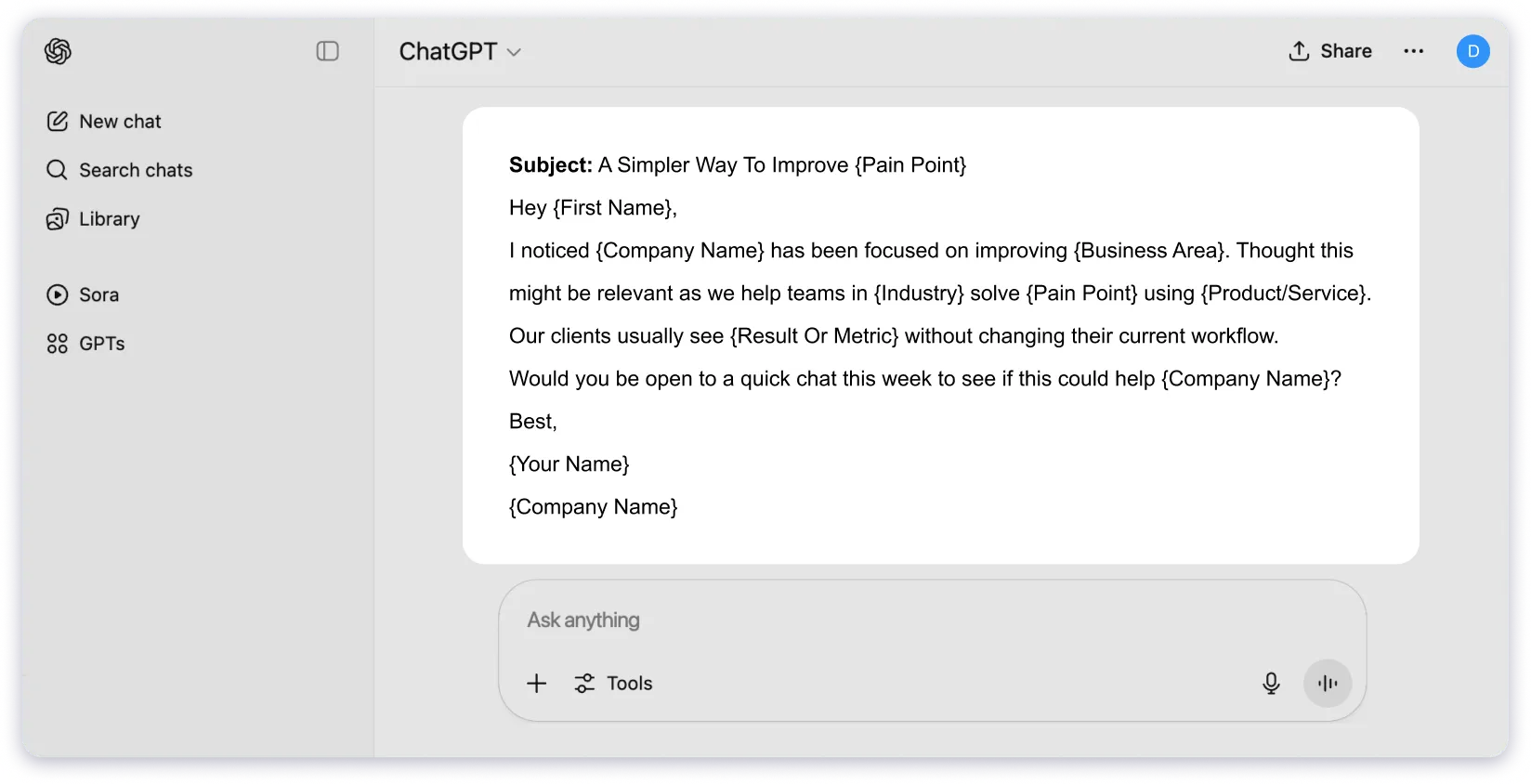
1. ChatGPT Cold Email Prompt For Generic Cold Email Outreach
Prompt:
Write a short, value-led cold email to introduce a product or service. Keep it clear and conversational, no sales fluff or exaggerated claims.
Include:
If you are just starting, you should check this guide on how to write cold emails to get replies.
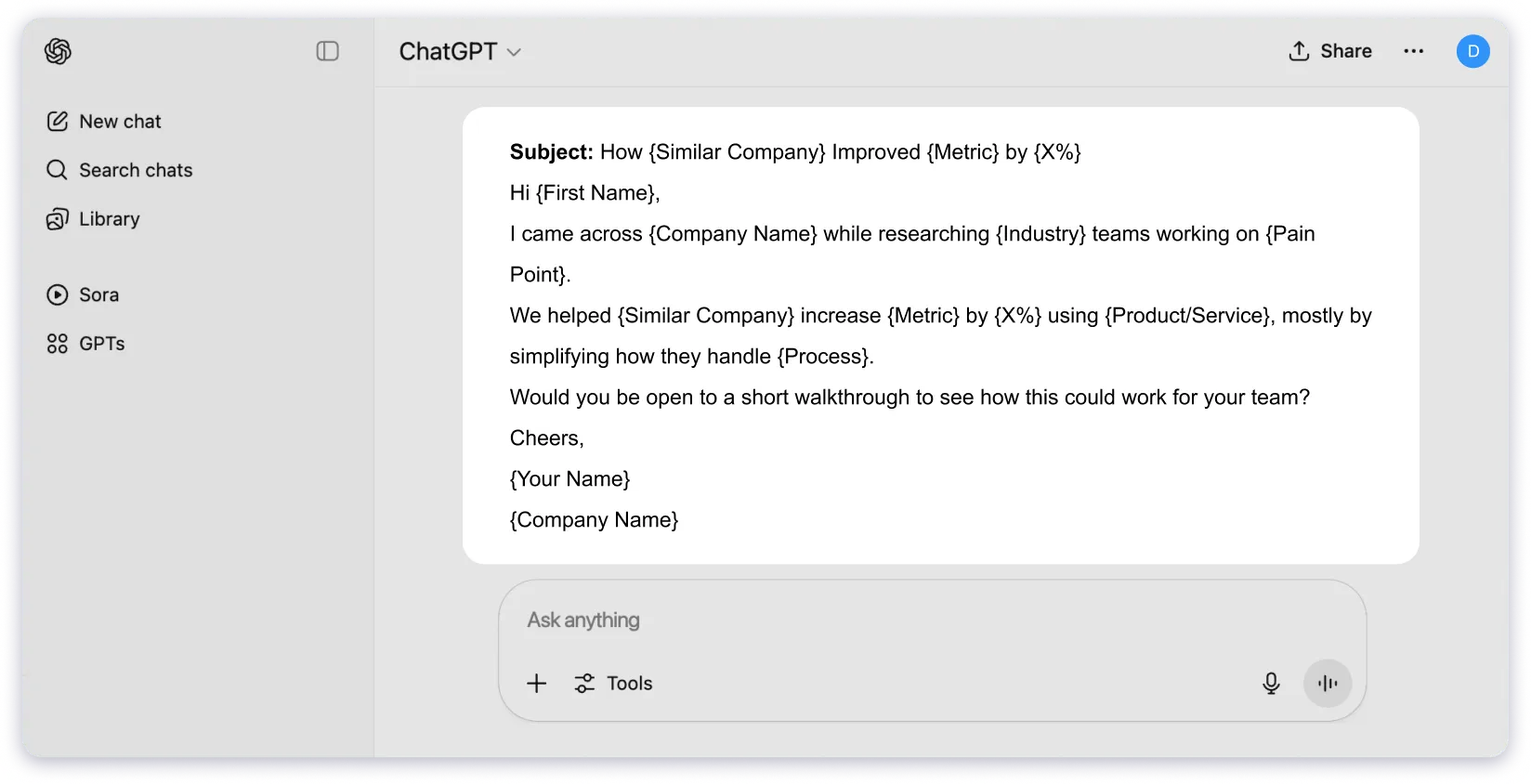
2. ChatGPT Cold Email Prompt For Sales
Prompt:
Write a straightforward sales email that highlights a real benefit or outcome without sounding pushy.
Include:
If you are wondering how to generate sales leads, check out these 15 strategies to help you find new sales prospects.
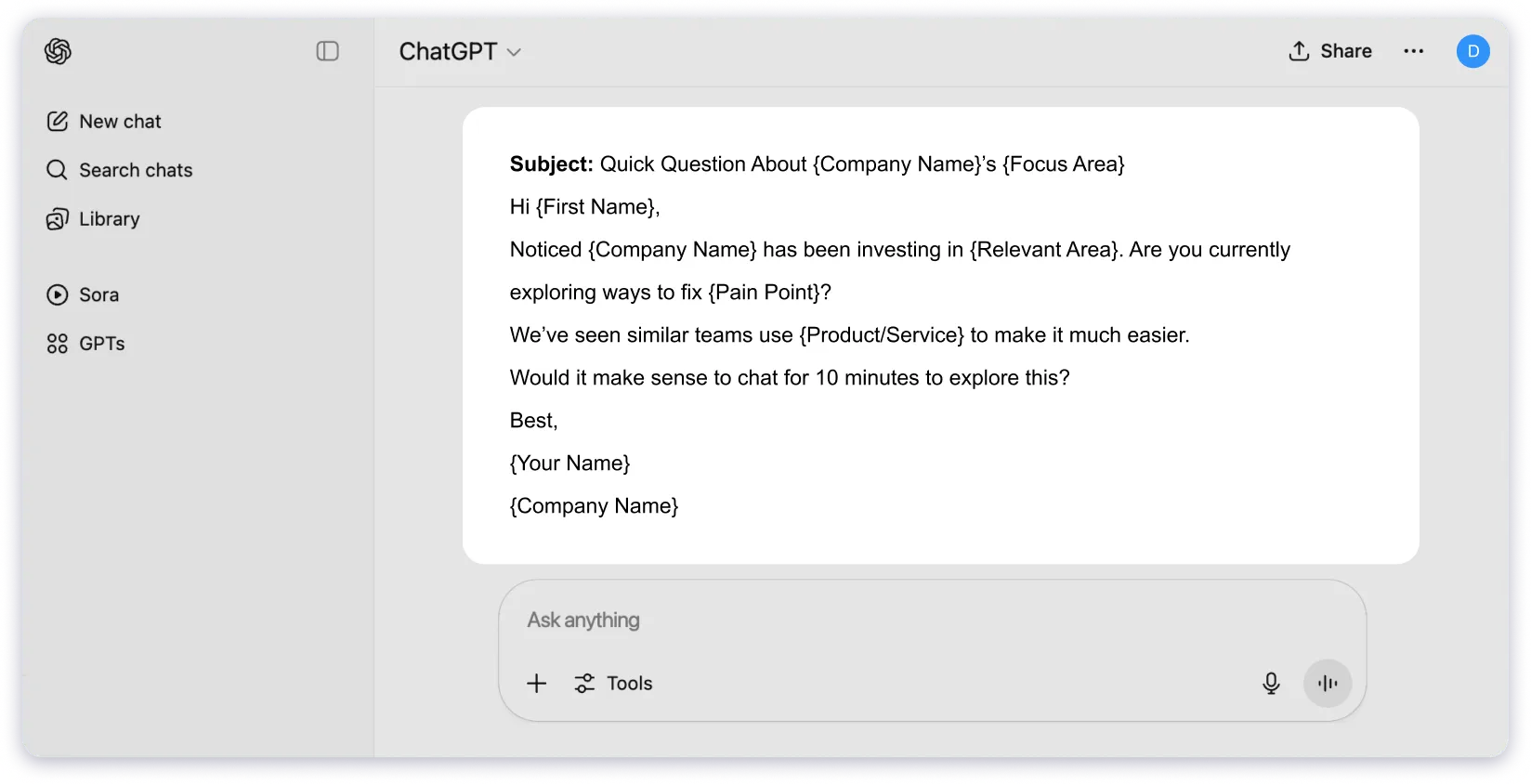
3. ChatGPT Cold Email Prompt For Short “Quick Question”
Prompt:
Write a short, curiosity-driven cold email that invites a quick response.
Include:
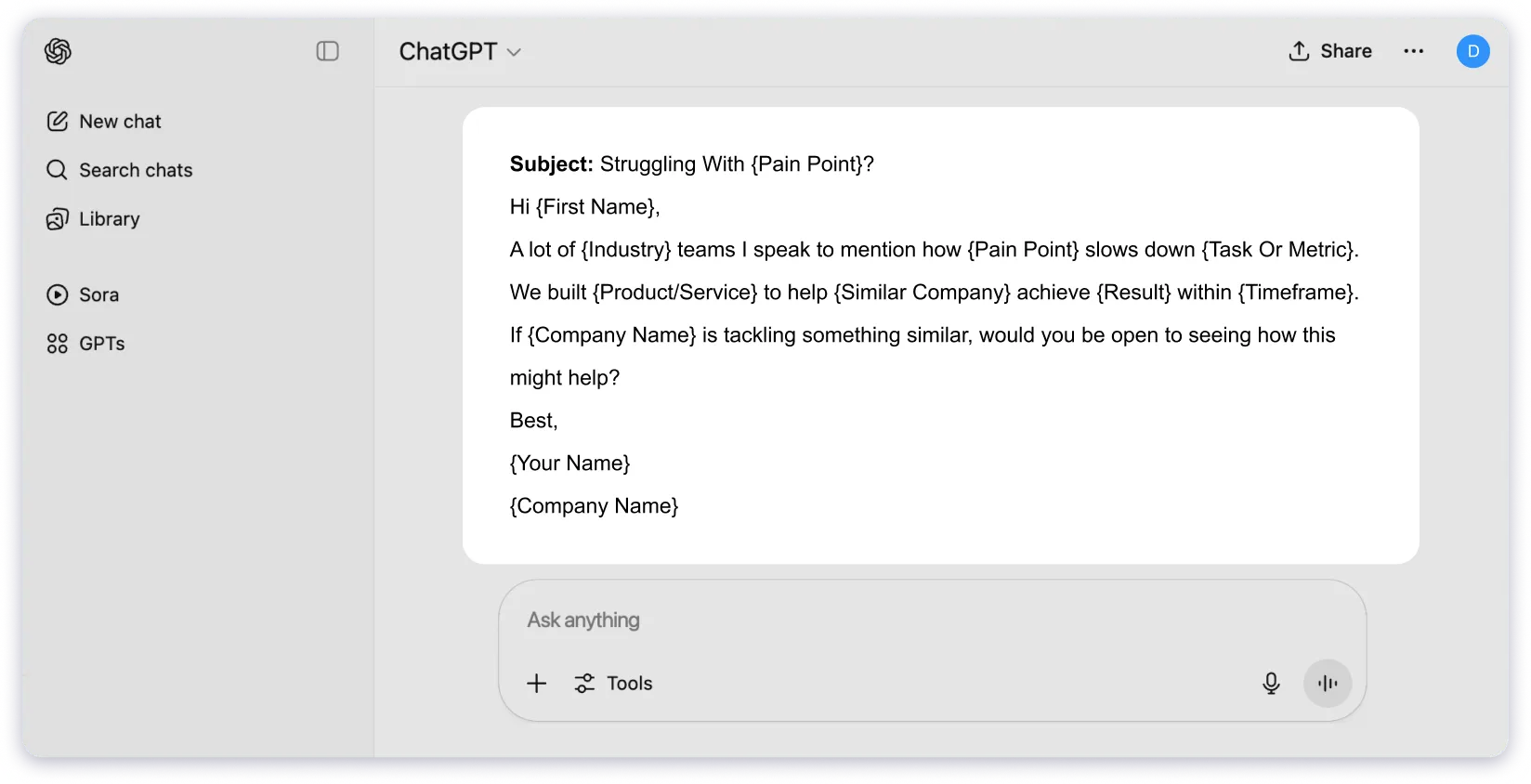
4. ChatGPT Cold Email Prompt For Targeting a Specific Pain Point
Prompt:
Write a cold email that focuses on solving one clear pain point for the recipient.
Include:
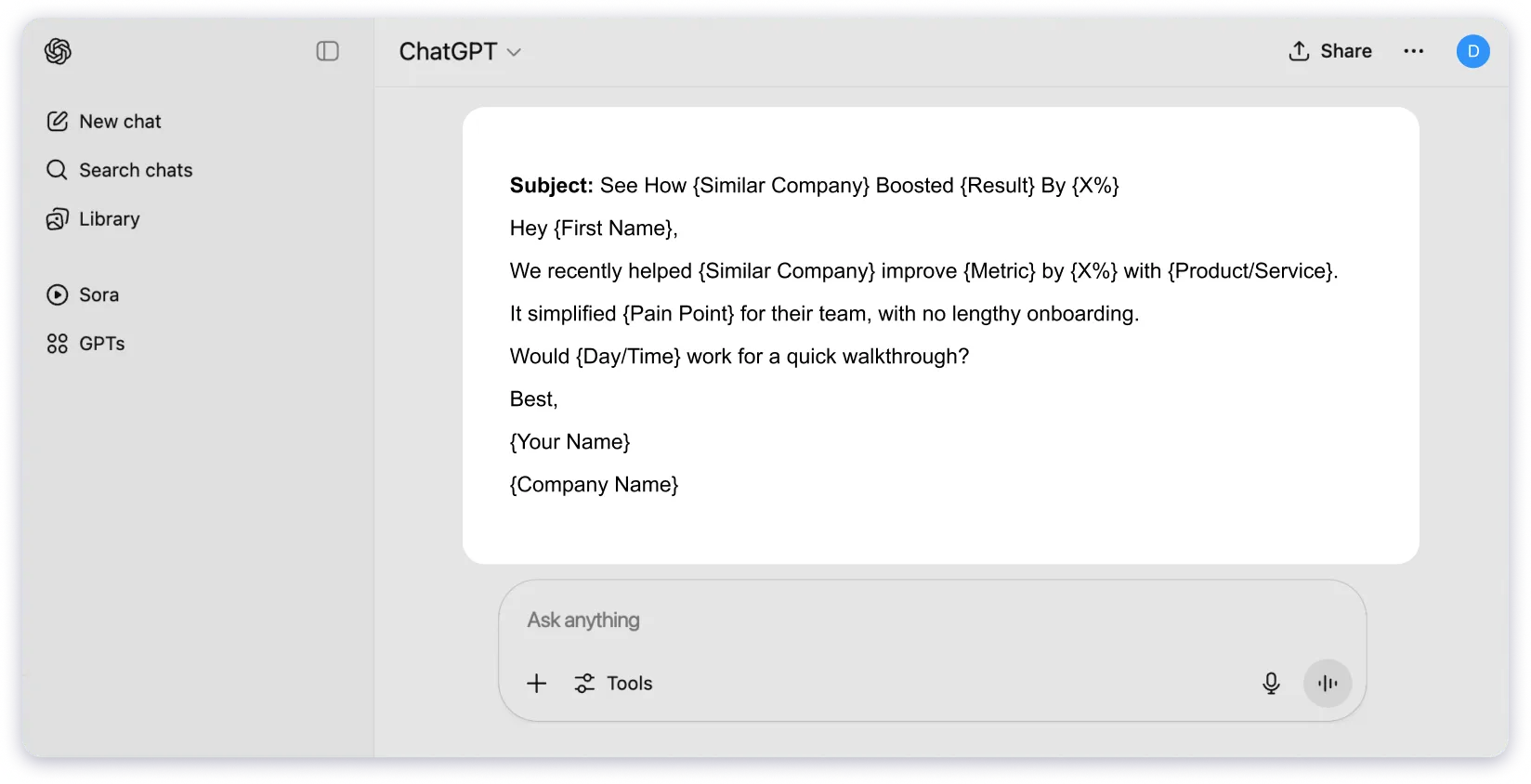
5. ChatGPT Cold Email Prompt For Demo-Booking
Prompt:
Write a trust-building cold email that encourages the recipient to book a quick demo.
Include:
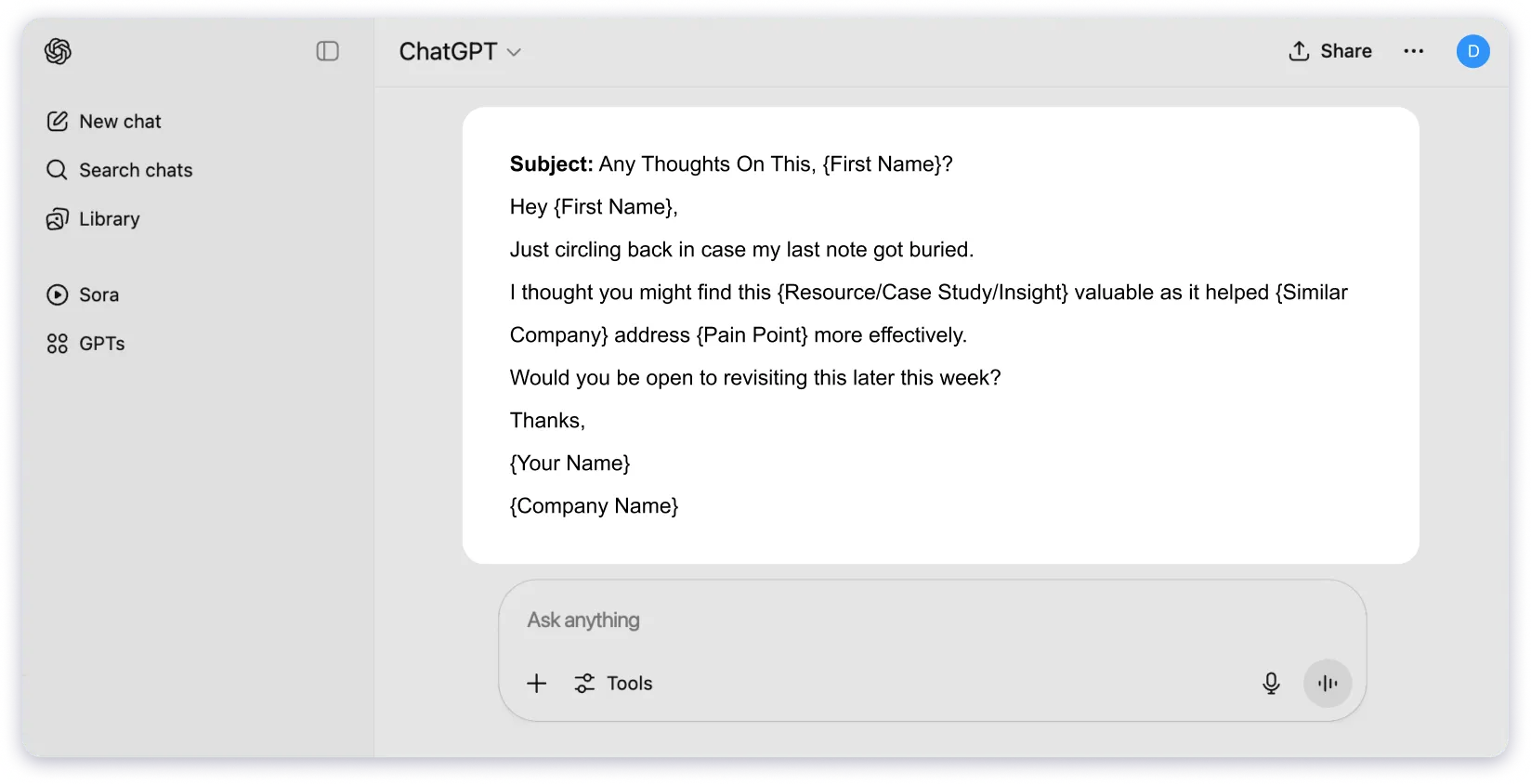
6. ChatGPT Cold Email Prompt For Friendly Follow-Up Email When No Response
Prompt:
Write a polite follow-up email for someone who did not reply to your previous message. It should add value, not pressure.
Include:
Have more doubts about follow-up emails? Refer to this guide to master cold email follow-ups.
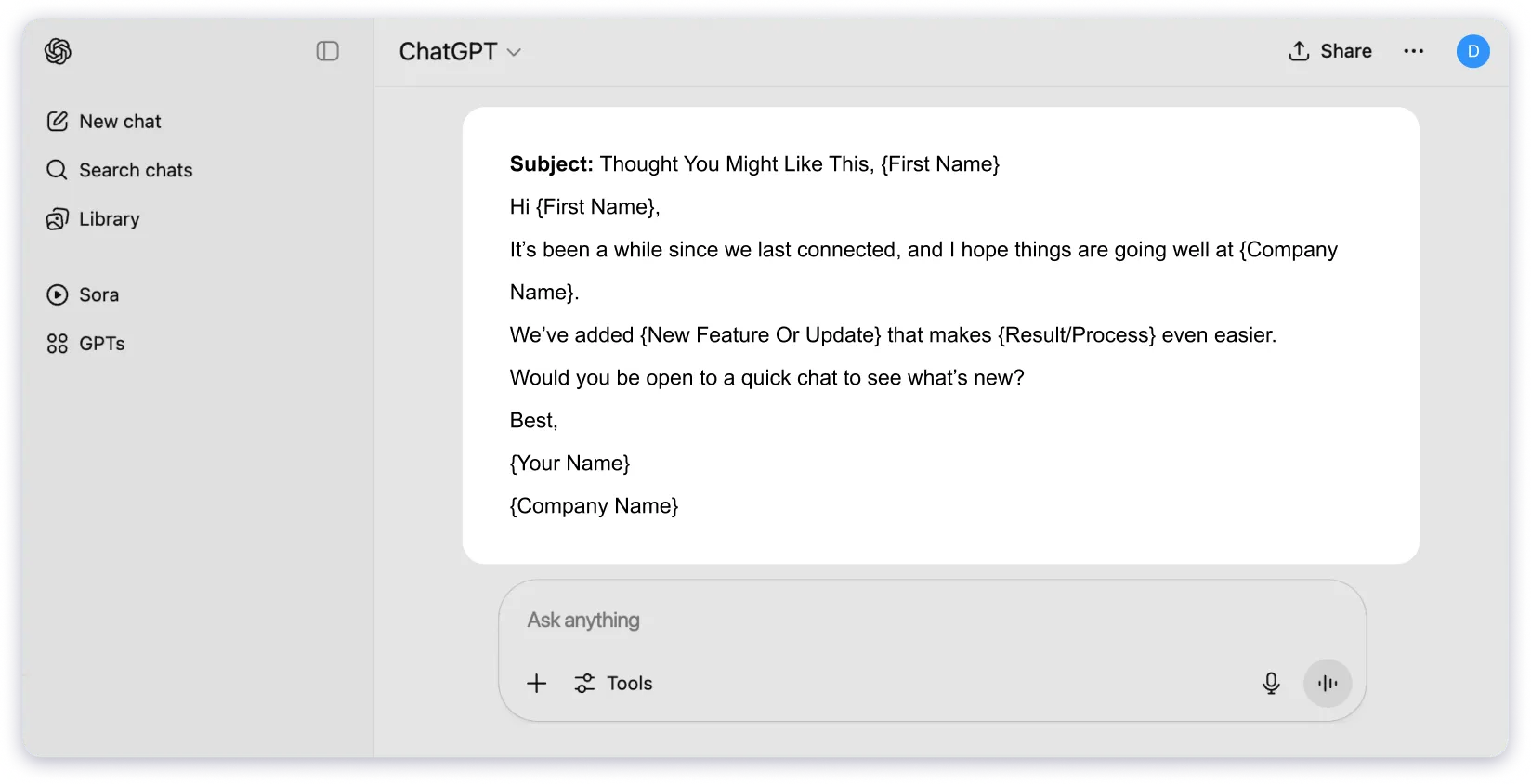
7. ChatGPT Cold Email Prompt For Re-Engagement
Prompt:
Write a re-engagement email for a lead that’s gone quiet. Keep it friendly and give them a reason to reply.
Include:
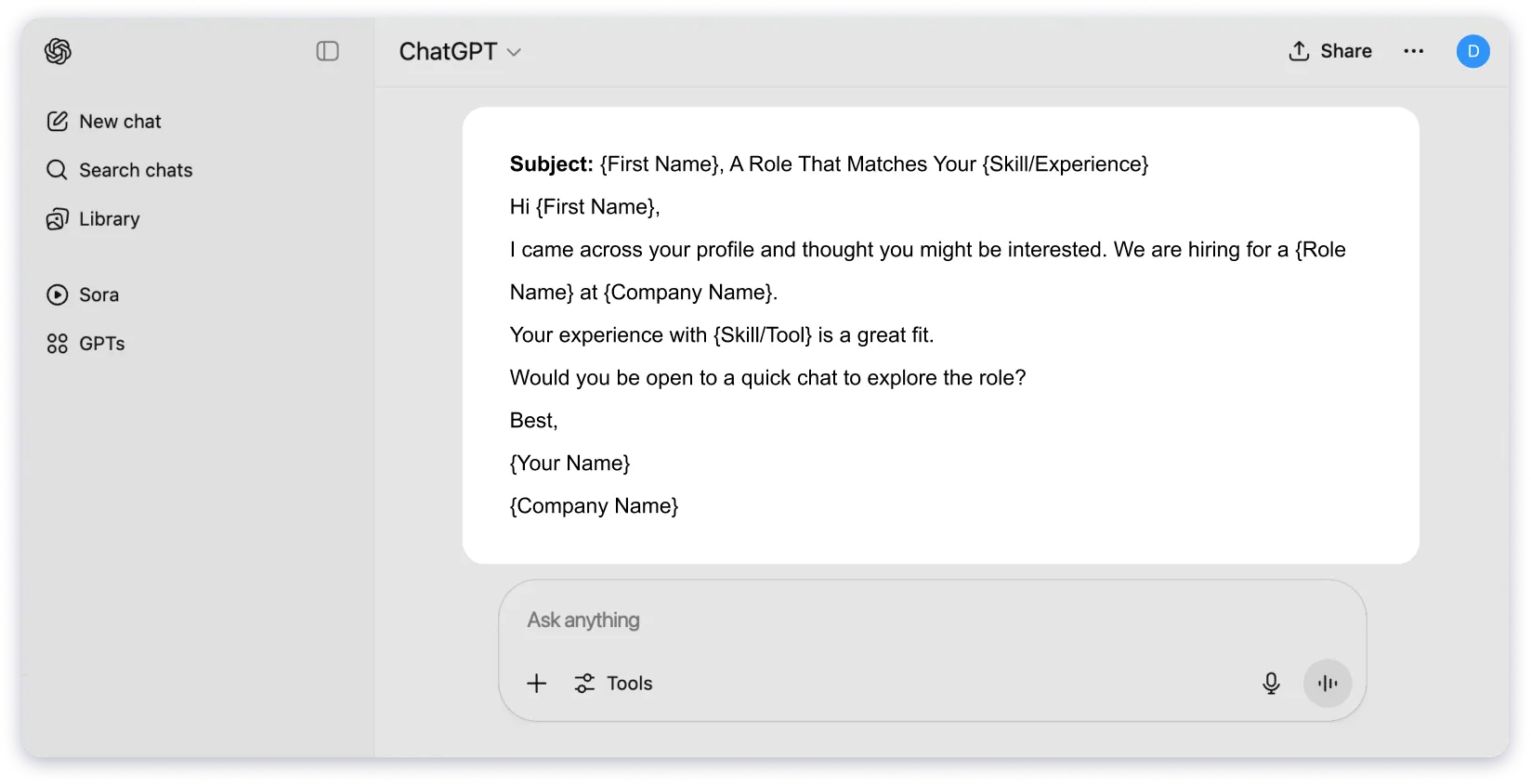
8. ChatGPT Cold Email Prompt For Job
Prompt:
Write an outreach email for a recruiter pitching an open role to a potential candidate. Keep it human and conversational.
Include:
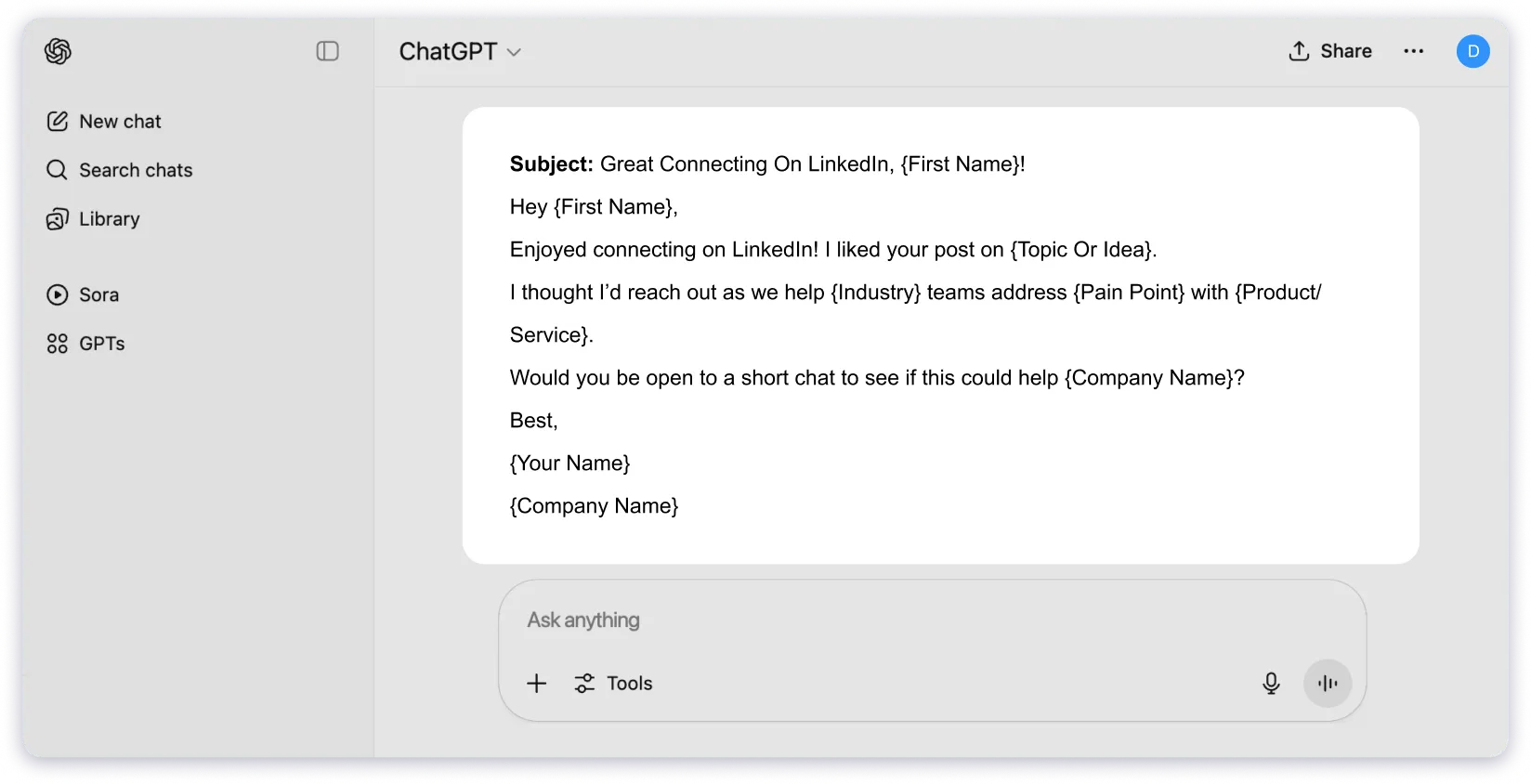
9. ChatGPT Cold Email Prompt For a LinkedIn Connection
Prompt:
Write a friendly email to someone you recently connected with on LinkedIn.
Include:
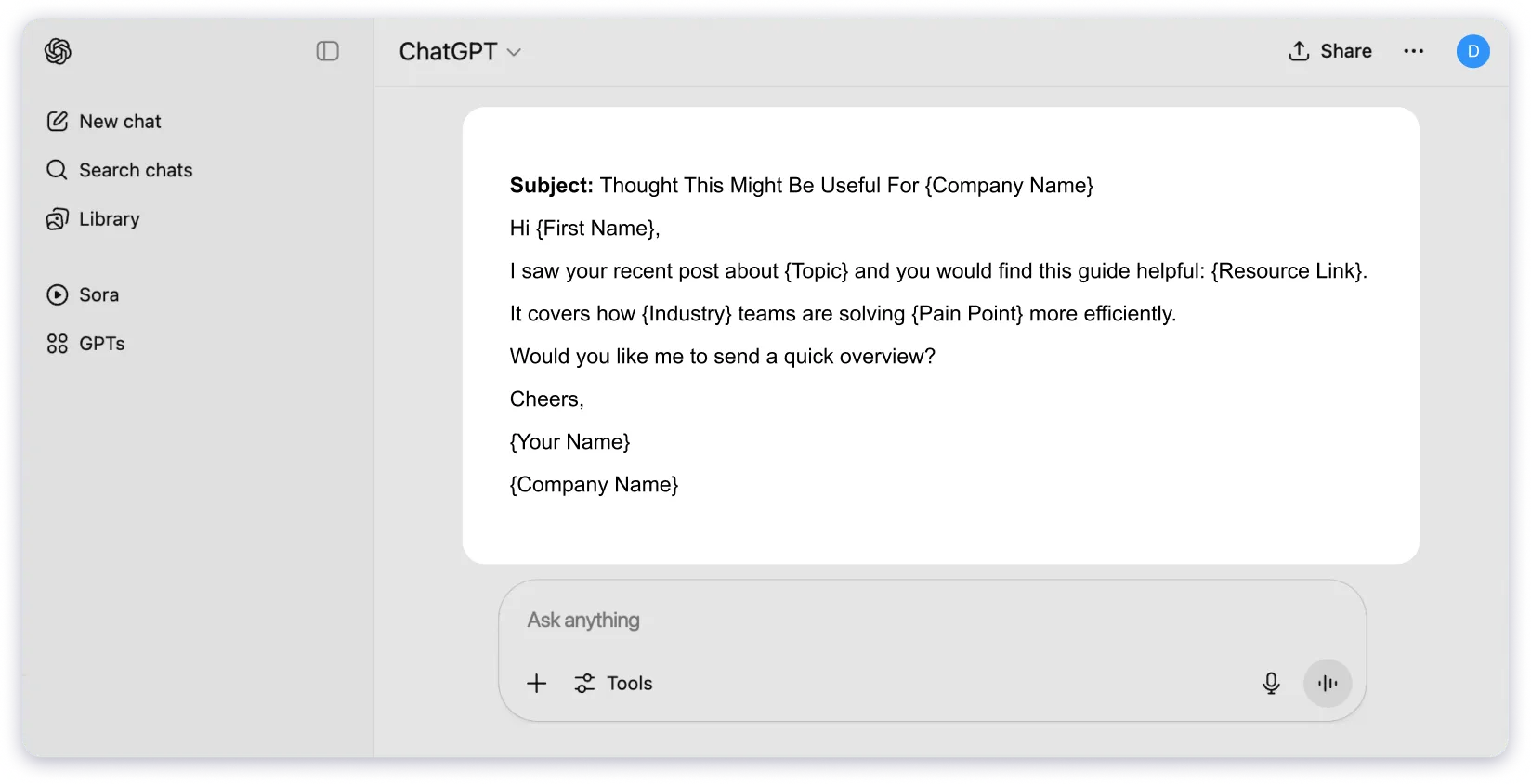
10. ChatGPT Cold Email Prompt For Resource-Sharing / Adding-Value
Prompt:
Write an email that shares a genuinely helpful resource or insight to start a conversation.
Include:
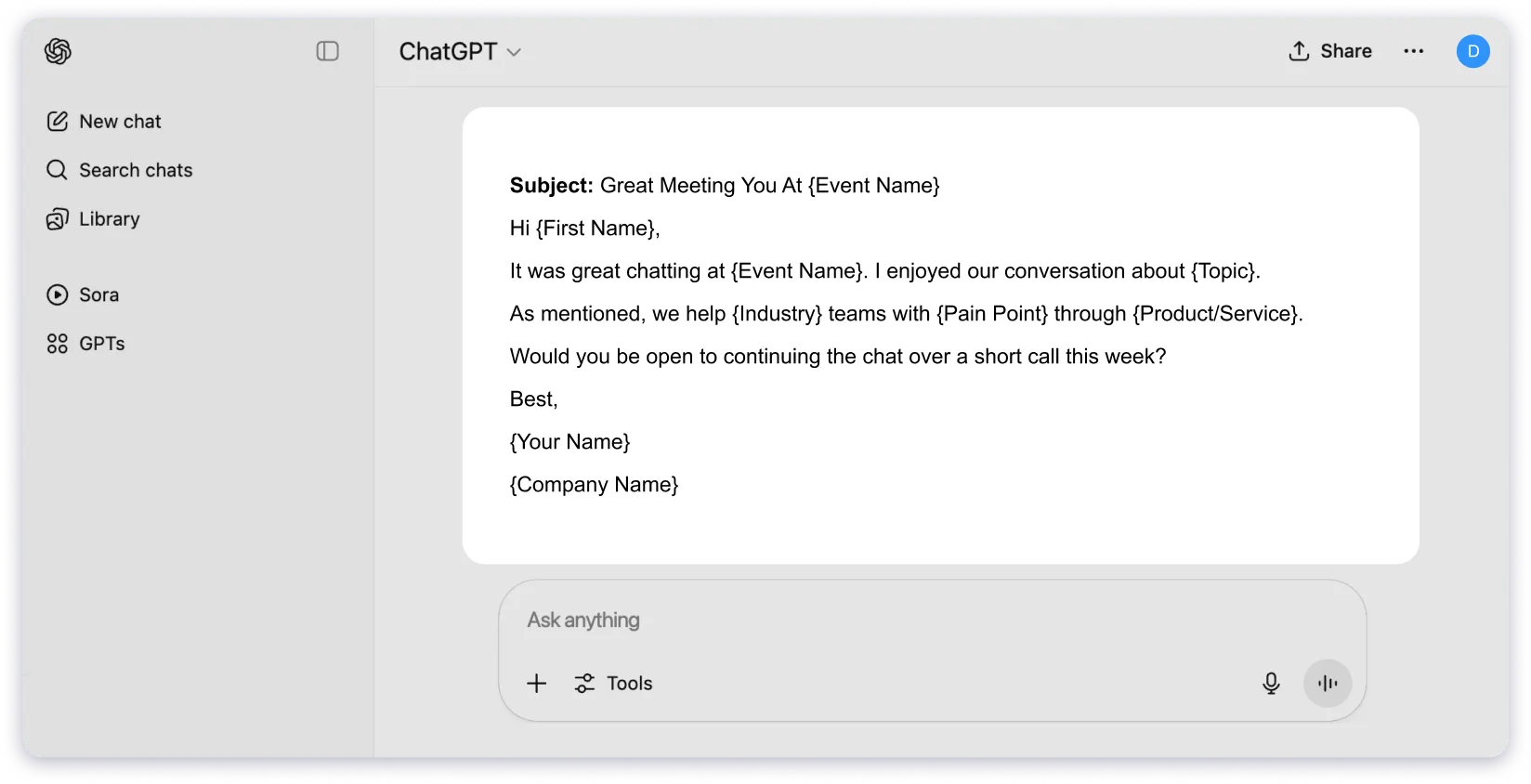
11. ChatGPT Cold Email Prompt For Conference / Post-Event Outreach
Prompt:
Write a follow-up email for someone you met at a conference or event. Keep it personal and direct.
Include:
12. ChatGPT Cold Email Prompt For Agency / Freelancer Pitch
Prompt:
Write a personalized email for a freelancer or agency pitching the services.
Include:
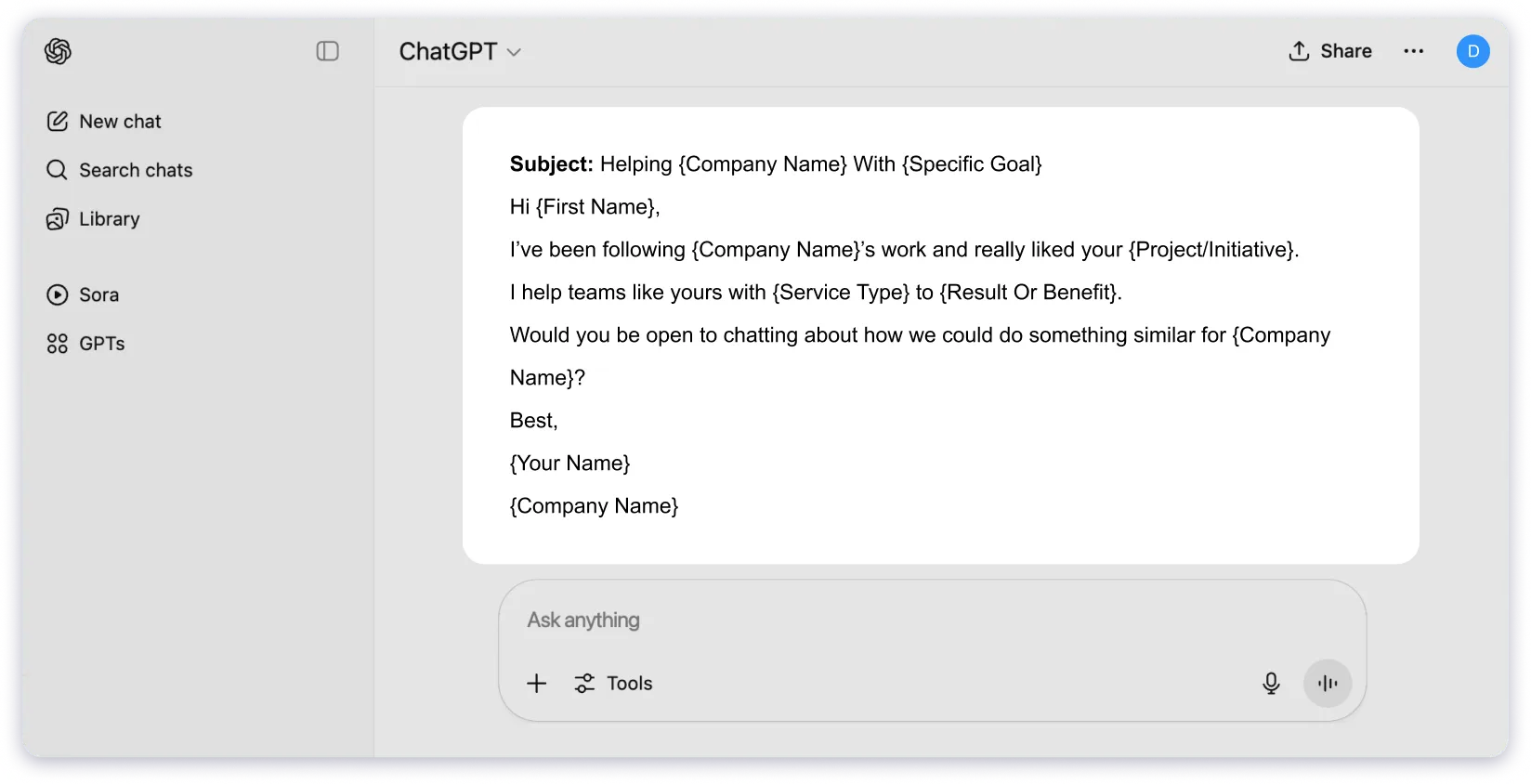
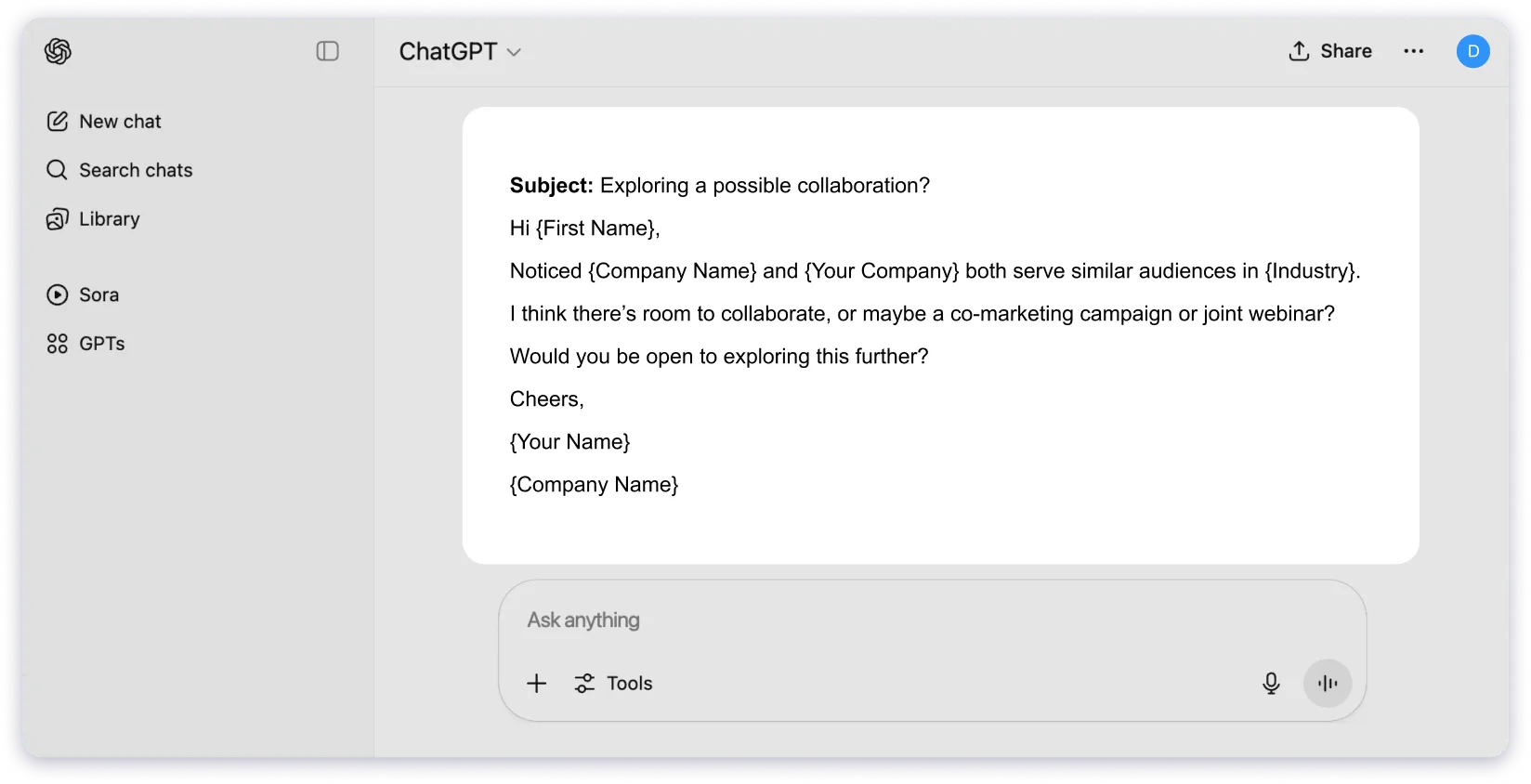
13. ChatGPT Cold Email Prompt For Partnership / Collaboration Outreach
Prompt:
Write a short outreach email proposing a partnership or collaboration.
Include:
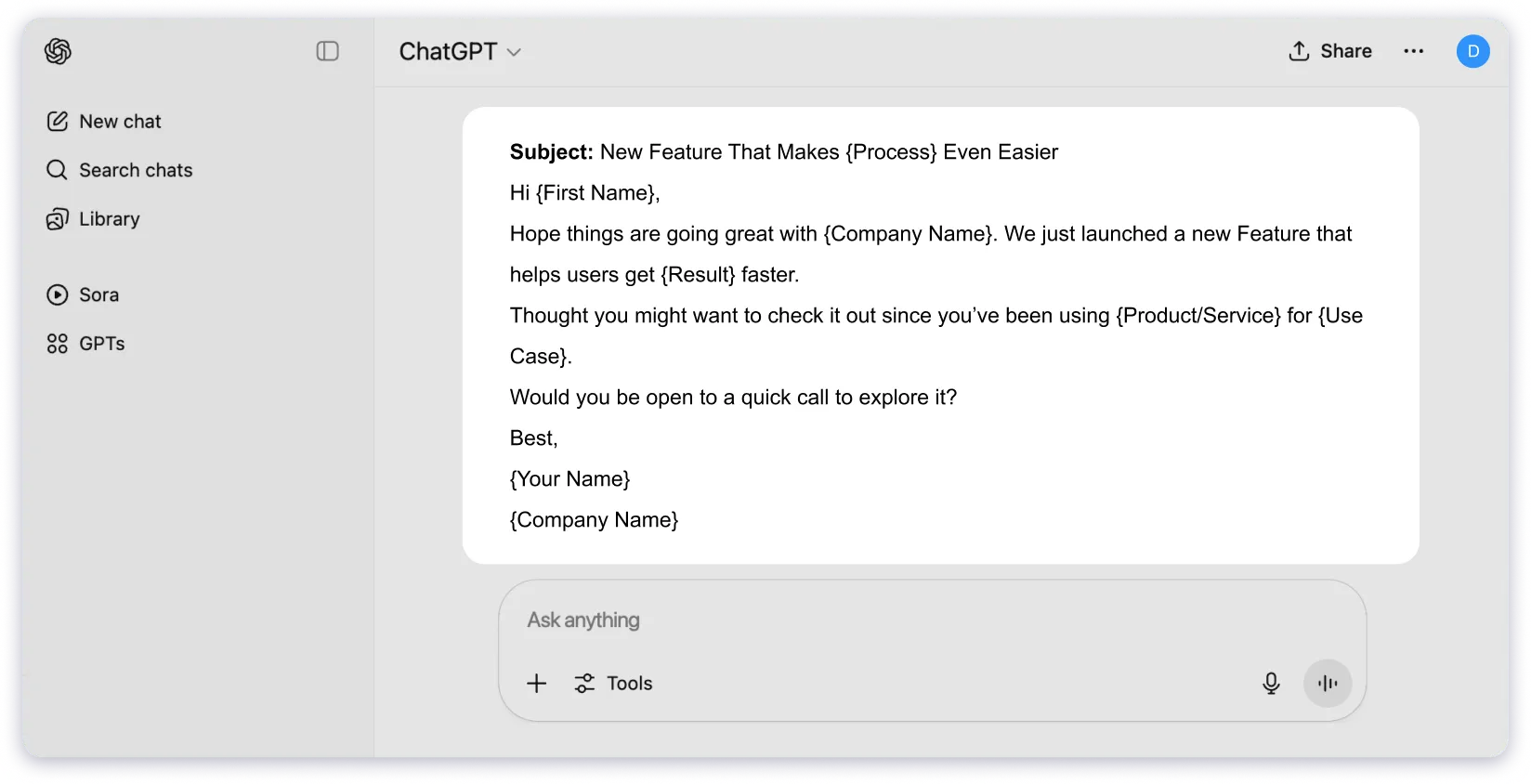
14. ChatGPT Cold Email Prompt For Upselling / Cross-Selling
Prompt:
Write an upsell or cross-sell email to an existing customer introducing a new feature or plan.
Include:
Best Practices for Using ChatGPT in Cold Email Outreach
The prompts above will get you a solid first draft.
But there are a few things that separate a good AI-assisted email from one that actually gets replies.
- Always Give ChatGPT Real Context
- Keep Emails Under 100 Words After Editing
- Never Send Raw AI Output
- Add One Personalization Detail ChatGPT Cannot Invent
- Run Every Draft Through a Spam Checker Before Sending at Scale
1. Always Give ChatGPT Real Context
Vague input gets you vague output.
The more specific you are about who you’re writing to and why, the better the email will be.
If you know the prospect’s company recently raised funding or posted about a challenge on LinkedIn, put that in the prompt.
2. Keep Emails Under 100 Words After Editing
ChatGPT tends to write longer than needed.
Most cold emails that get replies are short and scannable.
After you get the draft, cut anything that doesn’t directly help the reader understand why they should reply.
3. Never Send Raw AI Output
It’s easy to spot a copy-pasted AI email.
The phrasing is slightly off, the sentences are too balanced, and there’s no personality.
Always read through the draft, rewrite a line or two in your own voice, and make it sound like you wrote it.
4. Add One Personalization Detail ChatGPT Cannot Invent
This could be a recent LinkedIn post they shared, a funding announcement, a new hire, a podcast they appeared on, or something from their company’s website.
One real, specific detail does more than five generic compliments.
5. Run Every Draft Through a Spam Checker Before Sending at Scale
Words like “free,” “guaranteed,” or “no risk” can hurt deliverability even if the email itself is good.
Before you launch a campaign, run your copy through Saleshandy’s Email Spam Checker to catch anything that might send your email to the junk folder.
Your First Email Is One Prompt Away
ChatGPT can help you write a cold email in under two minutes.
But it can’t personalize at scale, send automatically, track who opened what, or follow up for you.
That’s the gap. And that’s exactly what a tool like Saleshandy fills.
Start with one of the prompts above.
Edit the output, add one real personalization detail, and send.
Once you find what works, Saleshandy can help you scale it.
FAQs on ChatGPT Cold Emails
1. Can ChatGPT write effective cold emails?
Yes, but only with the right prompt. A vague prompt gets you a generic email.
When you give ChatGPT specific context, such as the prospect’s role, their pain point, and your value prop, it can produce a solid first draft you can edit and send.
2. How do I use ChatGPT to write cold emails?
Start with a structured prompt. Include who you are, who you’re writing to, what problem you solve, and what you want the reader to do.
Set a word limit and specify the output format. Then edit the draft before sending.
3. Which ChatGPT model is best for writing cold emails?
GPT-4o is the best option right now. It follows complex instructions well, keeps the tone natural, and produces cleaner output than older models.
GPT-4o mini is faster and cheaper, which works fine for high-volume drafting where you plan to edit heavily.
4. How can I make ChatGPT cold emails sound more human?
Two things help the most. First, add one specific personalization detail that ChatGPT cannot generate on its own, like a LinkedIn post or recent company news.
Second, rewrite at least two sentences in your own voice after you get the draft. That small edit makes a noticeable difference.
5. Can I use ChatGPT to write follow-up emails?
Yes. Use prompt #6 for a single follow-up and prompt #13 for a full sequence. The key is to make each follow-up feel different from the one before.
Add a new piece of information, a resource, or a social proof point rather than just bumping the thread.
6. How do I connect ChatGPT outputs with Saleshandy sequences?
Once you have your email copy from ChatGPT, go to Saleshandy and create a new sequence.
Paste the emails into each step, set the delay between follow-ups, and connect your sending account.
Saleshandy will handle the rest automatically, including follow-ups and reply detection.