

 Dhruv Patel
 Contents
- 1 Cold Email Drip Campaign– TOC
- 2 What is a Cold Email Drip Campaign?
- 3 Why Should You Make a Drip Campaign for Cold Emailing?
- 4 How to Create a Cold Email Drip Campaign In 6 Steps?
- 5 Cold Email Drip Campaign Best Practices
- 6 Cold Email Drip Campaign Flowchart Examples
- 7 4 Mistakes to Avoid When You Run Cold Email Drip Campaigns
- 8 How to Create a Cold Email Drip Campaign- Key Points
- 9 FAQs
Sending the generic follow-up emails and hoping for a reply?
Well, that doesn’t work anymore!
Leads are busy. Inboxes are packed. And if you’re not following up — strategically and consistently — your messages will get ignored.
That’s where a cold email drip campaign comes in.
It’s an automated, trigger-based sequence that sends the right message to the right lead at the right time.
If you’re looking to build a cold email drip campaign that actually gets responses, I have got you covered.
In this blog, you’ll learn:
- What a cold email drip campaign is
- Why it works (when done right)
- How to create one from scratch
- Bonus Read: Proven cold email drip campaign flowchart examples
Let’s get into it!
Cold Email Drip Campaign– TOC
- What is a Cold Email Drip Campaign?
- Why Should You Make a Drip Campaign for Cold Emailing?
- How to Create a Cold Email Drip Campaign In 6 Steps?
- Cold Email Drip Campaign Best Practices
- Cold Email Drip Campaign Flowchart Examples
- 4 Mistakes to Avoid When You Run Cold Email Drip Campaigns
- How to Create a Cold Email Drip Campaign- Key Points
- FAQs
What is a Cold Email Drip Campaign?
Unlike a basic automated cold email sequence (where all your prospects get the same emails at the same time intervals, no matter what they do), a cold email drip sequence adjusts itself based on how your lead behaves.
A cold email drip campaign is a series of personalized emails sent automatically based on actions like opening a previous email, clicking a link, or not replying.
They’re typically used in outbound sales and lead generation.
These emails are sent with the goal of nurturing your prospects towards a desired action, like booking a meeting or closing a deal.
In short, cold email drip campaigns are a smarter and more strategic way to follow up.
Know the difference💡: Cold email drip campaigns vs. email marketing drip campaigns.
- Cold email drip campaigns = initiating conversations with cold leads.
- Marketing drip campaigns = deepening relationships with warm leads.
| Feature | Cold Email Drip Campaigns | Email Marketing Drip Campaigns |
|---|---|---|
| Purpose | Outreach | Nurturing |
| Audience | Cold leads (no prior relationship) | Warm leads or existing subscribers |
| Goal | Start a conversation that could lead to a meeting or deal | Nurture interest, educate, promote content or products |
| Sending Tools | Cold outreach tools (e.g., Saleshandy, Instantly) | Marketing tools (e.g., Mailchimp, Klaviyo) |
Why Should You Make a Drip Campaign for Cold Emailing?
Cold email drip campaigns do more than just help you follow up—they help you run a targeted follow-up sequence that is more likely to get replies.
I include drip sequences in every cold email campaign I launch — and there are solid reasons why.
With a well-planned cold email drip campaign, you can:
Let’s get into details!
1. Send Targeted Follow-Ups
Cold email drip campaigns = Segmentation + Personalization = Targeted Outreach
As I’ve said above, normal automated cold email sequences send the same follow-up emails to all your prospects.
No matter if they opened your email or ignored it, they all get the same message.
And let’s be real — it’s 2025. Generic follow-ups won’t get you leads anymore.
However, cold email drip campaigns fix this by combining segmentation and personalization.
Here’s how 👇🏼
When a prospect takes action, like opening your email but not replying or ignoring it, they’re automatically segmented based on their intent (what their action tells you about their interest or needs) within the sequence.
Then, each segment gets personalized follow-ups that match their level of interest, specific pain points, etc.
💡Pro Tip: Set up behavior-based triggers inside your cold email tool. These triggers will automatically segment your leads based on what action they take (or don’t), and send personalized follow-ups accordingly.
2. Increase Your Reply Rates
Most of the deals are closed in the follow-up emails.
And that’s 100% true.
But here’s the flip side — a large number of prospects still don’t reply, even after multiple follow-ups.
Why?
Because the email either didn’t feel helpful or didn’t reach them at the right time.
This is a big issue with cold emails today — sending the same message to everyone, no matter where they are in the buying process.
That’s why cold email drip campaigns work better.
They let you send follow-ups that are more personal, better timed, and more useful to each person.
And when your emails actually match what the lead needs, you’re much more likely to get a reply.
💡Pro Tip: Use these tricks to optimize your follow-up emails:
3. Iterate, Learn, and Scale What Works
Cold email drip campaigns allow you to test different elements of your cold email with a different set of leads.
For instance, you can track:
- Which subject lines get opened
- Which email copies and CTAs to get replies
- Where do people drop off in your sequence
And once you figure out what resonates with your target audience, you can proactively scale that winning formula in other sequences as well.
💡Pro Tip: You should definitely run A/B tests, but don’t rush it!
Take this advice from someone who has been in the cold emailing space for a decade.
Test one/two variables at a time (like subject lines or CTAs). Use those learnings to refine your sequence step by step.
How to Create a Cold Email Drip Campaign In 6 Steps?
To set up a cold email drip campaign, you’ll need cold email software.
Saleshandy makes it easy to build smart, targeted cold email drip campaigns that move prospects forward in their buying journey.
Here’s a quick step-by-step process to launch your cold email drip campaign:
- Create Your Email Sequence
- Add Steps to Your Sequence
- Set Conditions and Triggers
- Build Your Subsequence
- Import Your Prospects
- Launch and Monitor Your Campaign
Let’s get into the detailed process!
1. Create Email Sequence
Go to the “Sequences” icon on the left menu and click on it.
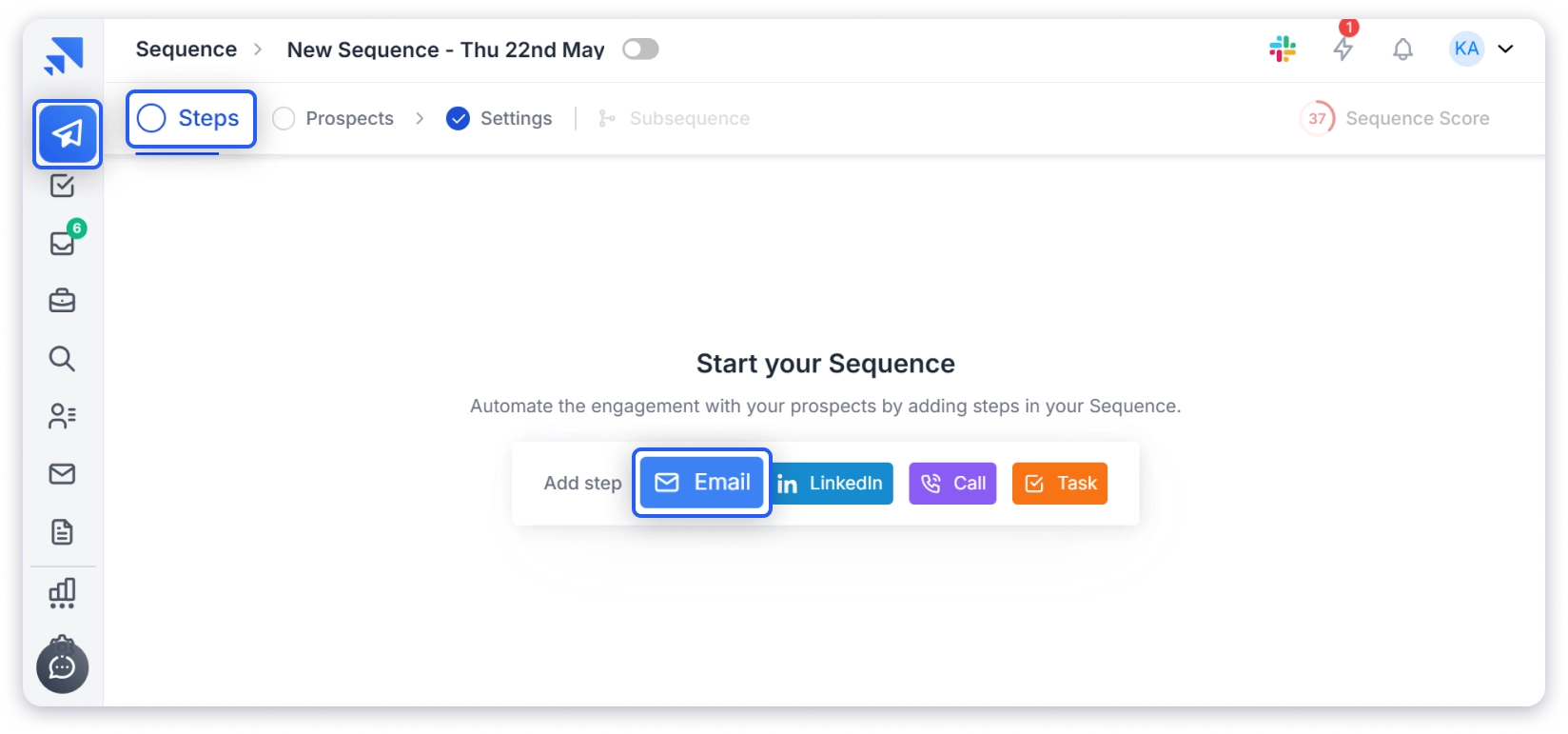
Now you will see a campaign creation window open where you can build your drip campaign in 4 easy steps:
- Steps – for crafting the first email (or sequence)
- Prospects – uploading the recipients.
- Settings – review sending options
- Subsequence – to create advance drip campaigns
2. Add Steps to Your Sequence
Click on the “Email” icon and an email composer window will open where you can compose your first email of your subsequence.

Save your “EMAIL” once done.
3. Determine the Conditions & Triggers
Now, click on the “SUBSEQUENCE TAB”.
(This is where you define what triggers your follow-ups.)
A conditions setting window will appear, where you must define trigger conditions using multiple criteria connected with ‘AND’ operators.
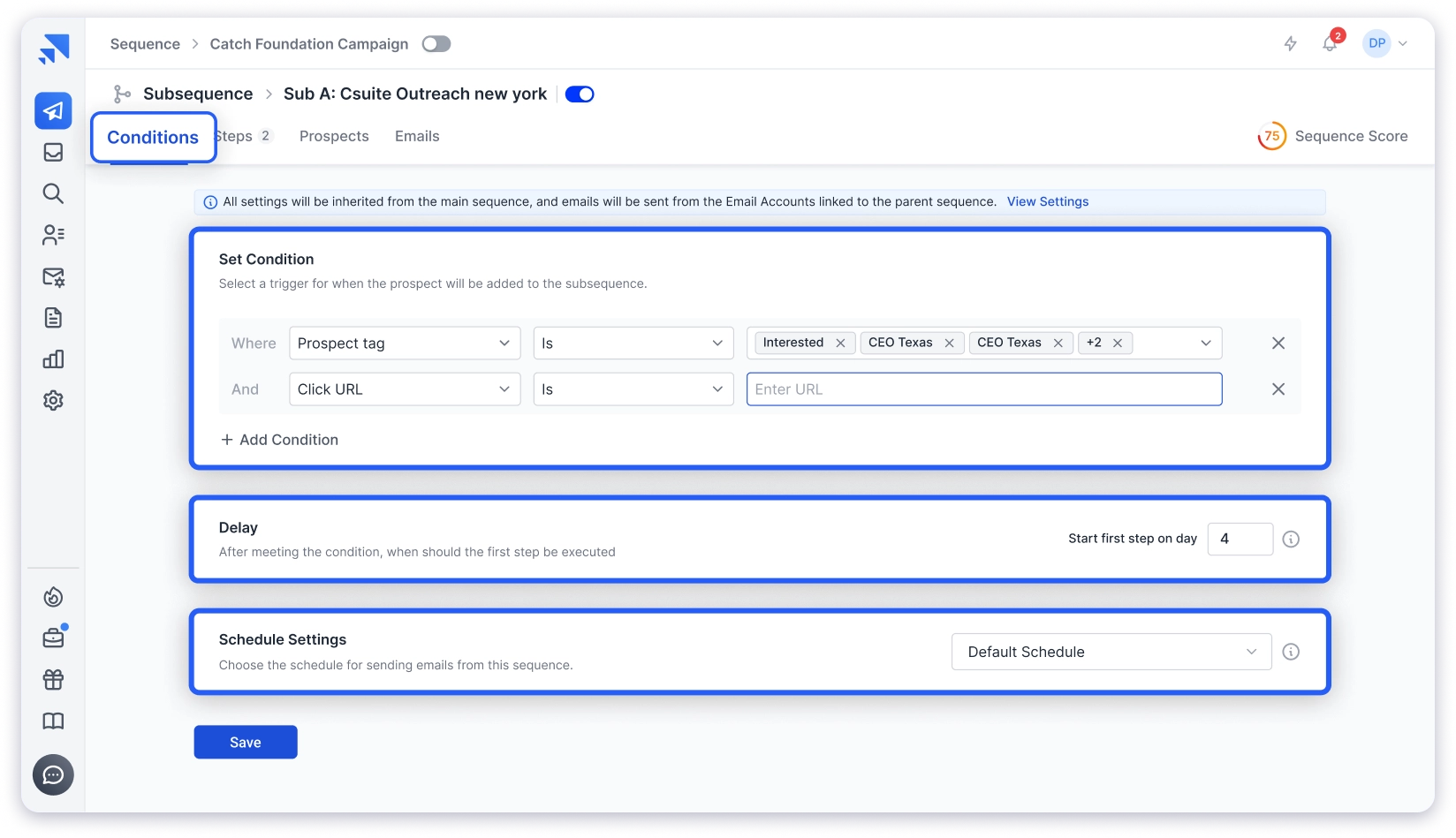
You can set single or combined conditions for targeted outreach, such as:
- Replied
- Not Replied
- Clicked URL
- Open Counts
- Specific Outcome assigned
- Steps Completed
- Prospect Tag
Once you’ve set the trigger conditions, add a “DELAY” to control how long to wait before the next steps in the sequence begin.
Click “Save.”
4. Create Subsequence Steps
After configuring settings, you need to add steps to your Subsequence.
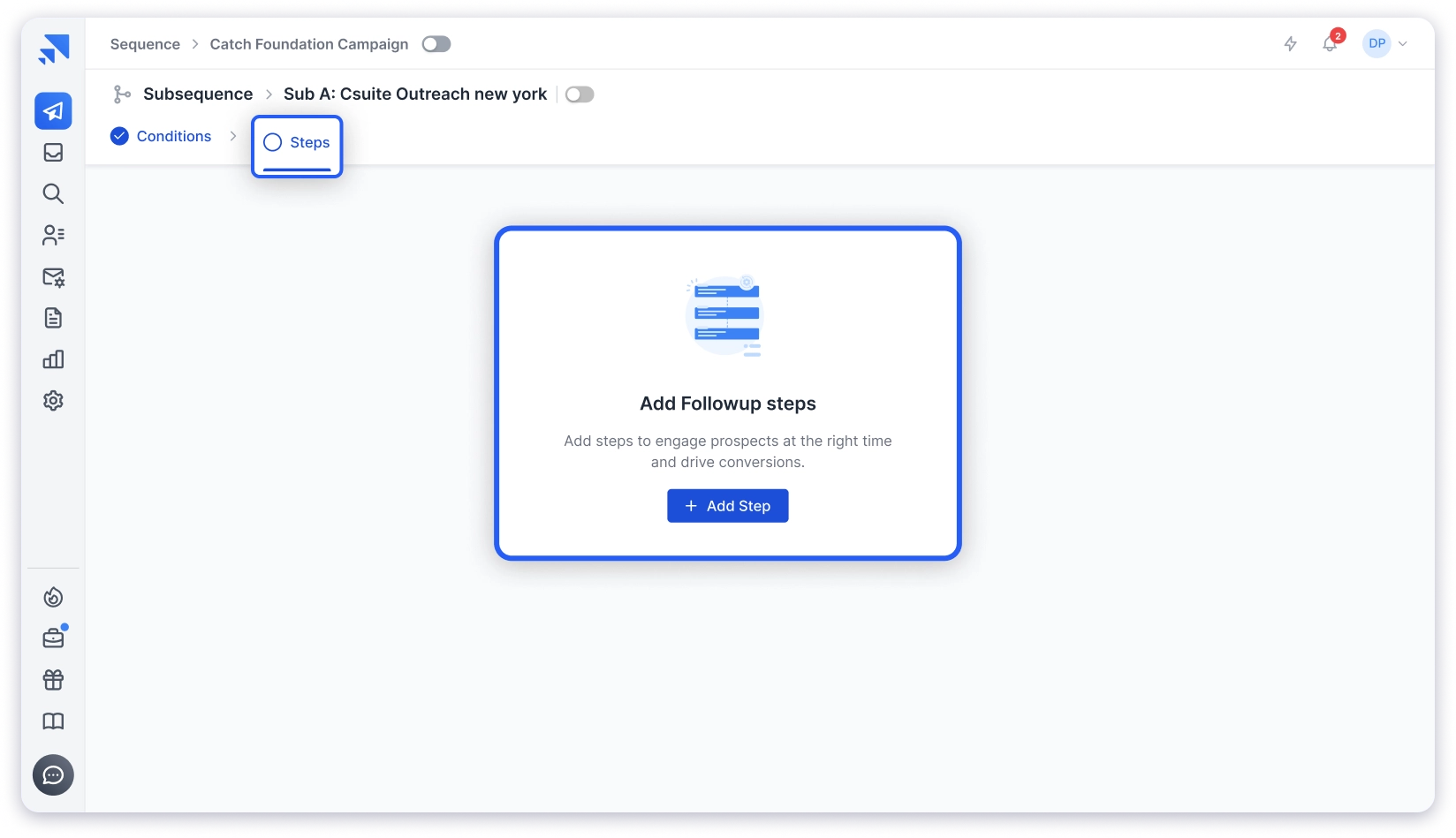
Click “EMAIL” to compose the next message in your trigger-based sequence.
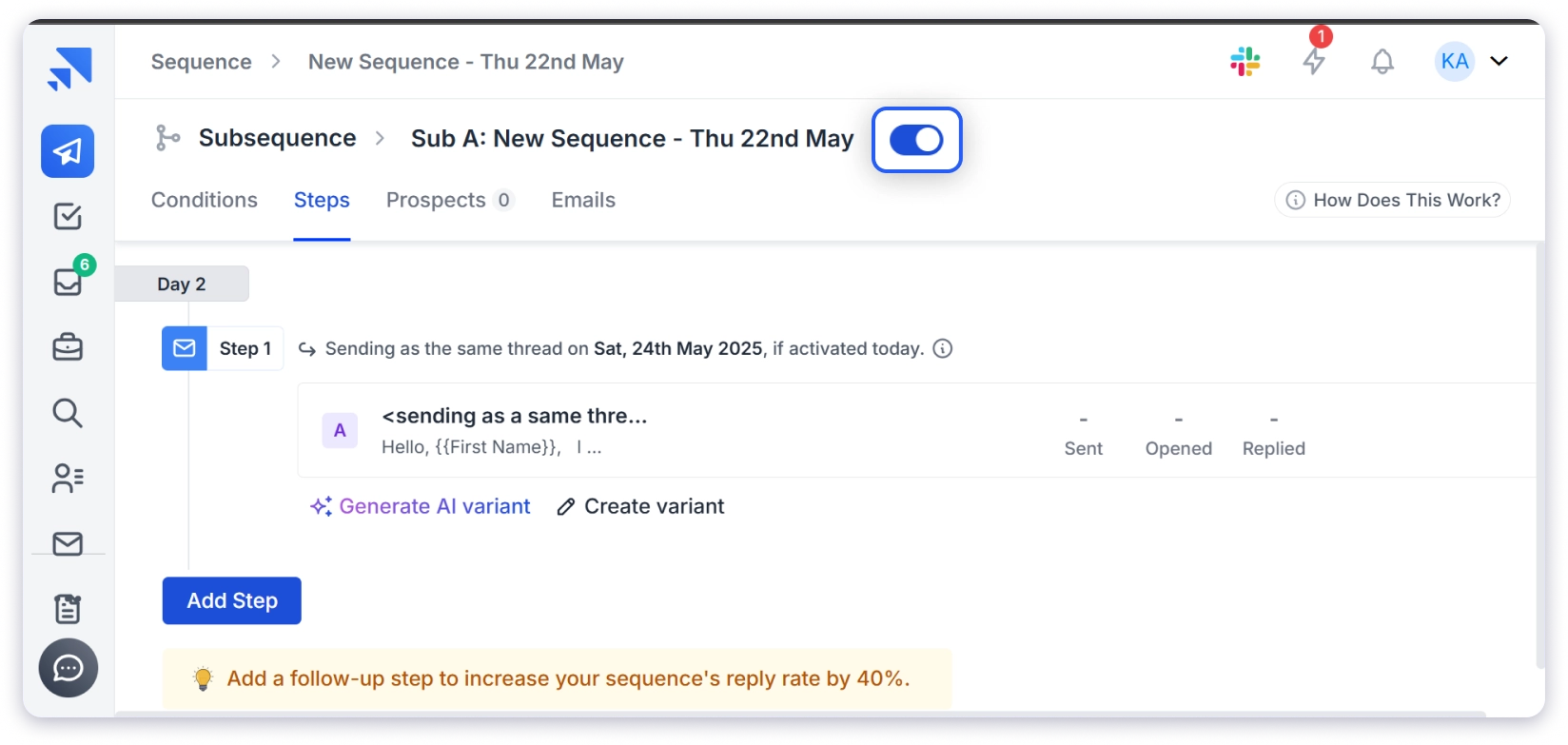
Make sure you tailor each follow-up to the specific trigger conditions you defined earlier.
Once your steps are ready, “TURN ON THE TOGGLE” to activate your subsequence.
5. Add Your Prospects
Go back to the main campaign window by clicking “SUBSEQUENCE” again.
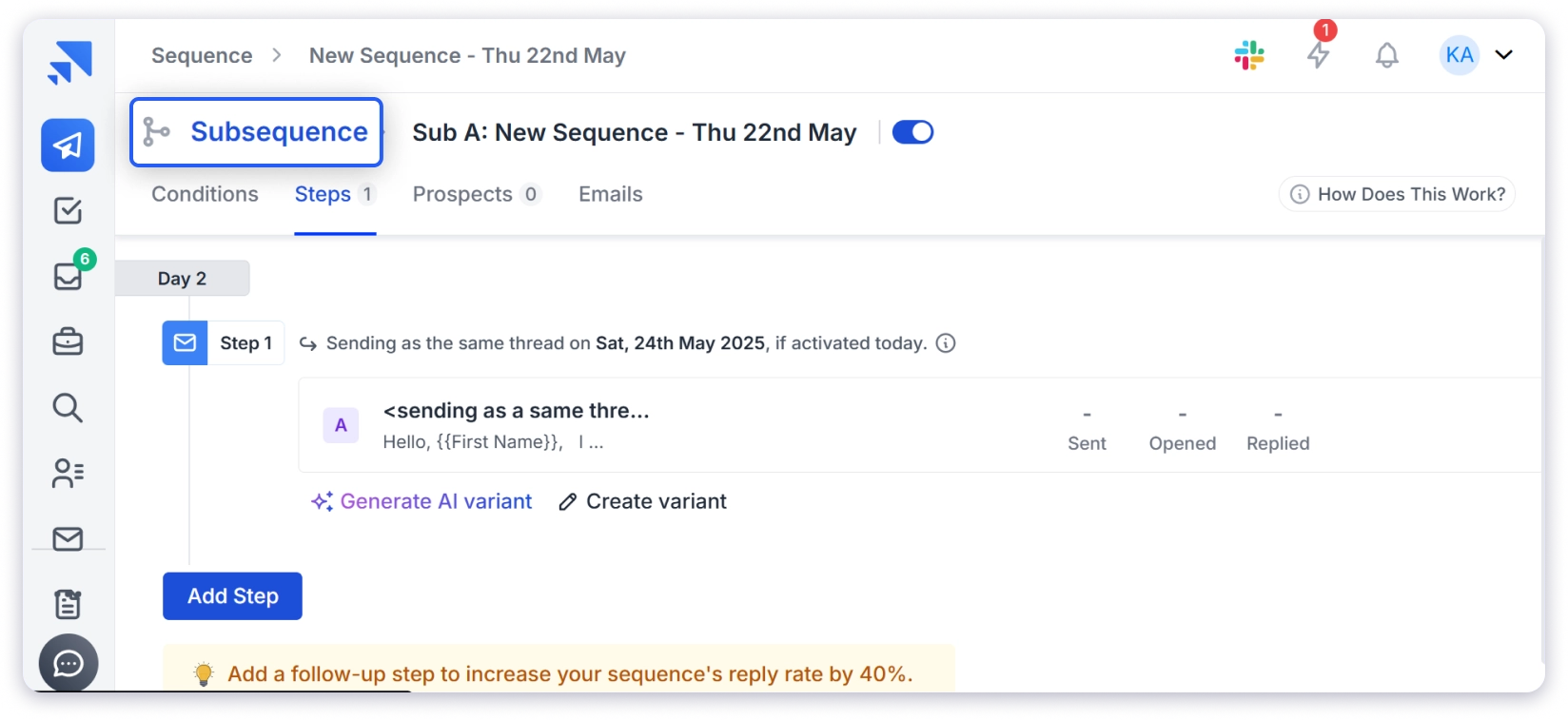
Now, click on the “PROSPECTS” tab.
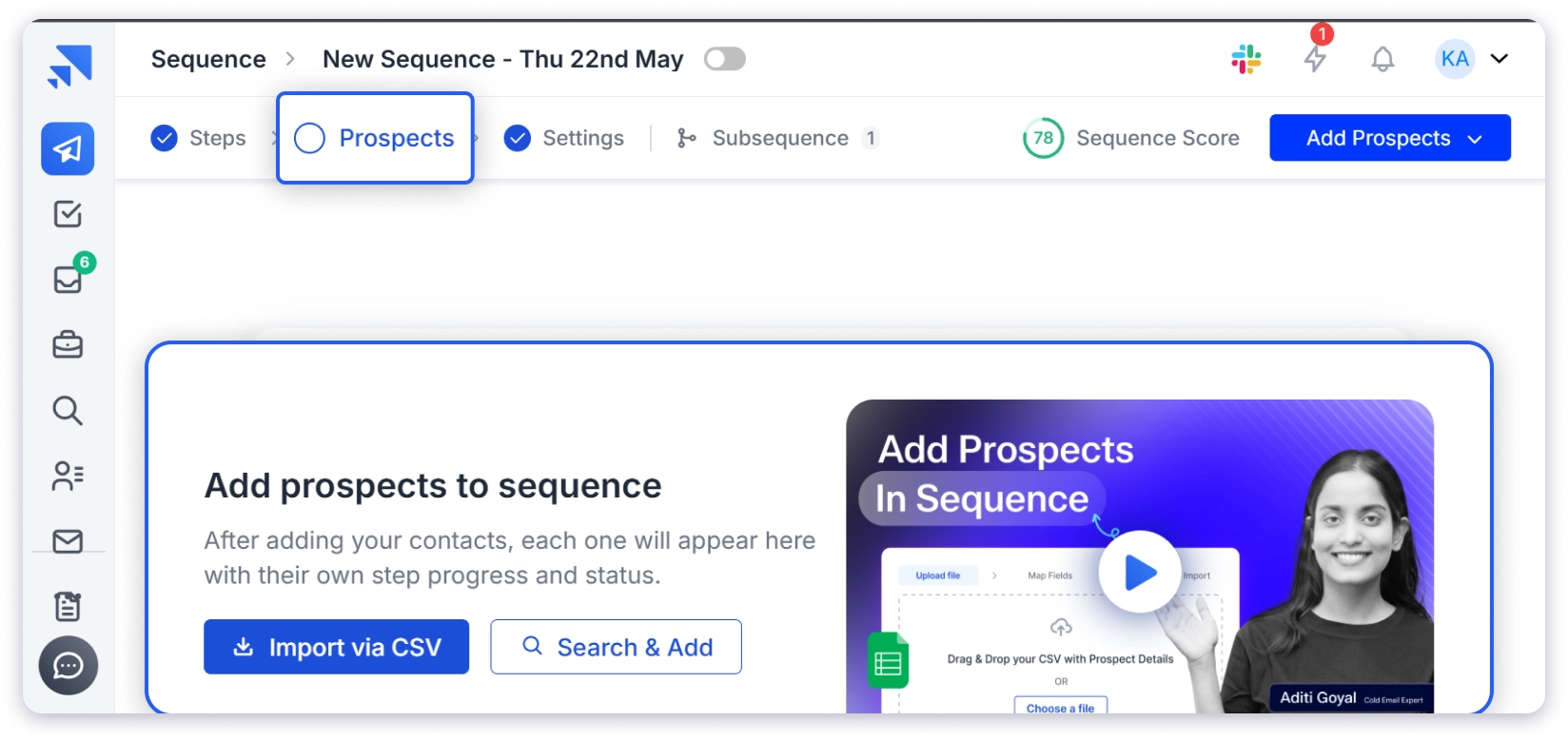
Upload or add your list of recipients.
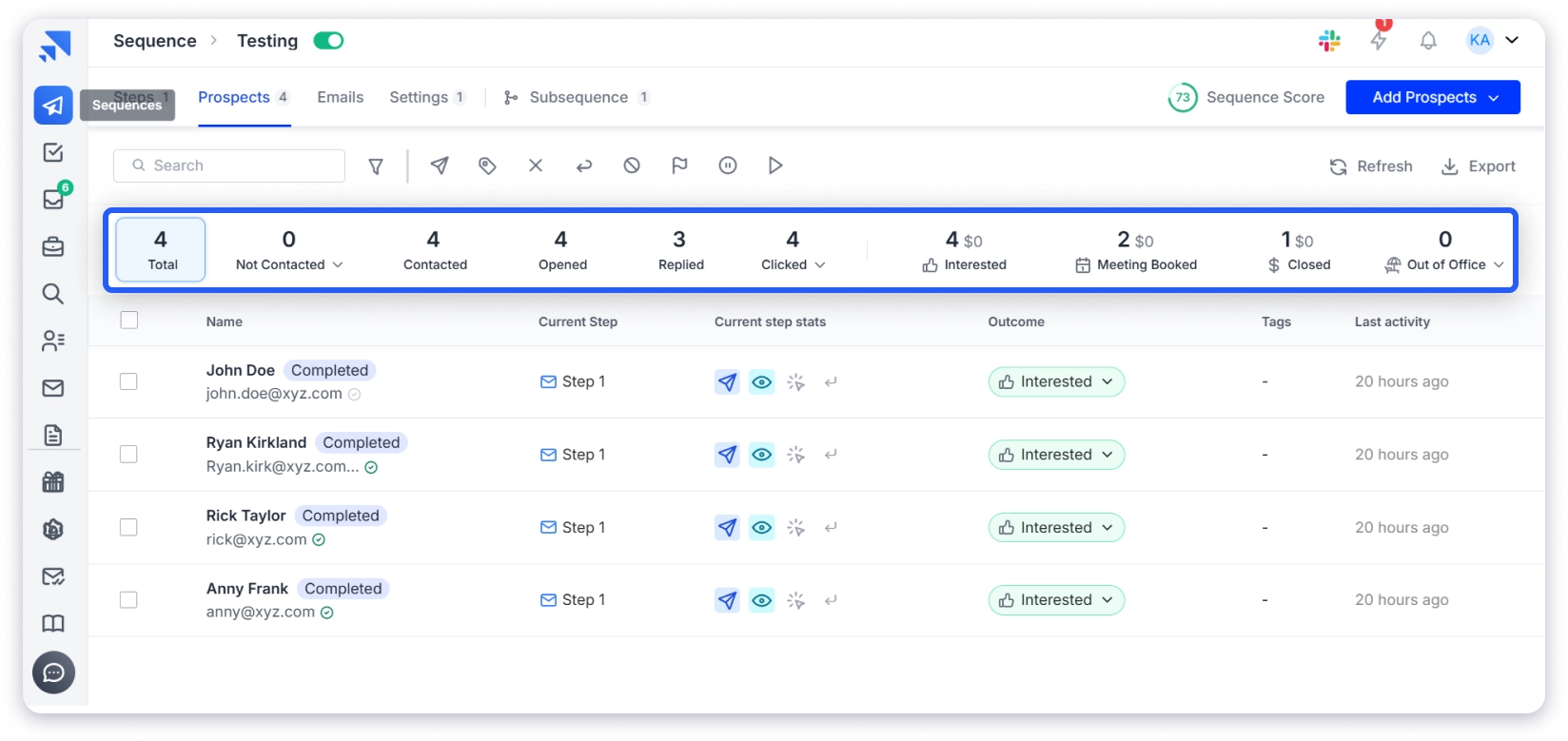
6. Activate and Monitor Your Campaign
Once everything’s set, activate your campaign by switching on the toggle.
Track performance in real-time and monitor opens, clicks, and replies.
Cold Email Drip Campaign Best Practices
If you want your cold email drip campaign to deliver successful results, there are some rules you can’t skip—otherwise, you risk losing important business opportunities.
Here are the best practices you need to follow to get real results.
- Set Clear Goals for Your Drip Campaign
- Personalize Every Email
- Get Your Timing and Frequency Right
- Use Smart Behavior-Based Triggers
- Align Your Sequence with Buyer Stages
Let’s get into the details!
1. Define Goals for the Drip Campaign
Setting a clear goal is the first step to creating a drip campaign that actually works.
Why?
Knowing your goal = Knowing what to write + How to measure success + Which CTA to use
Here’s how different goals shape your strategy:
| Goal | Email Approach | CTA Style | Metric to Track |
|---|---|---|---|
| Book meetings | Be direct and value-focused | “Book a quick call” | Reply rate + Meetings booked |
| Start conversations | Friendly, open-ended tone to spark replies | “What do you think?” | Open rate + Reply rate |
| Qualify leads | Show quick value, link to demo or relevant resource | “Take a quick look at this” | Click-through rate + Replies |
| Drive signups | Focus on solving pain points and show the benefits | “Sign up in 2 clicks” | Conversion rate + Clicks |
| Re-engage cold leads | Schedule the follow-up emails in the timeframe of 3-5 days and offer something fresh or helpful | “Still interested?” | Open rate + Reply rate |
2. Personalization
If your cold emails sound like generic messages, people will ignore them. Personalization makes your emails feel like they were written just for the reader, which gets replies.
Start by using their name and company. But don’t stop there.
Mention something that shows you did your homework, like a recent achievement, a shared connection, or a detail from their website or LinkedIn.
This small effort can help you stand out in a crowded inbox.
Here’s how different levels of personalization can look:
| Level of Personalization | Example | Why It Works |
|---|---|---|
| Basic = Name + Company | “Hey John, I saw your team at BrightTech is growing fast.” | Shows you know who they are. |
| Mid = Role + Context | “As a sales manager, I thought you might relate to this challenge…” | Makes it feel relevant to their job. |
| Deep = Specific Trigger | “I noticed your team just launched a new product — congrats! Curious if you’re also scaling your outreach?” | Shows you’ve done research and are reaching out for a reason. |
The more personal your email, the more likely it is to get opened, read, and replied to.
3. Timing and Frequency
When you send the email and how you space your follow-up emails play a huge role in determining the success of your drip campaigns.
How?
Well, if you send emails too often, you’ll push them towards the edge. If you wait too long, they’ll forget you.
That’s why getting the timing and number of emails right is important.
Here is how you:
- Space emails 3–5 days apart
- Add 6–7 emails in a sequence
- Send emails on weekdays (Tuesdays, Wednesdays, and Thursdays usually get the best results.)
- Avoid weekends and holidays
- Use time zones wisely ( Schedule emails to land in their inbox during working hours — ideally, mid-morning.)
4. Choose Triggers Smartly
Don’t just set random triggers because that’s what everyone else is doing.
If you want your drip campaign to actually work, you need to choose behavior triggers based on your campaign goals and audience behavior.
Start by asking:
- What action matters most for this goal? (Opening an email? Clicking a link? Booking a demo?)
- What does that action tell me about the lead? (Are they just curious, or ready to talk?)
- What should happen next based on that action? (Send more info, ask a question, or pause?)
For example:
- If your goal is to book meetings, the trigger shouldn’t just be open — that’s too weak. Focus on replies or link clicks.
- If you want to nurture cold leads, track who hasn’t opened after 2–3 emails, then switch them to a slower sequence.
😎Smart tip: Before choosing triggers, review past campaigns. Look at the steps where people actually engage — those are your real signals.
The more intentional your triggers are, the more your sequence adapts to how your leads behave — and that’s what gets replies.
5. Build Sequences Around Buyer Stages
Not every lead is in the same place when it comes to buying.
Some are just learning about the problem. Others are already looking for a solution.
That’s why your cold email drip campaign should match where each person is in the buying process.
Here’s how you can do it:
- Top of the Funnel = Awareness + Education <> Educate them
These leads might not even realize they have a problem. Help them understand what the problem is and why it matters. Share helpful tips or insights to spark interest. - Middle of the Funnel = Build Trust + Provide Value <> Show social proof
These people know their problem and are checking out different solutions. Share case studies, quick wins, or social proof to build trust and show that your solution works. - Bottom of the Funnel = Show Urgency + Next Action <> Convert them
These leads are ready to choose. Highlight product benefits, offer a free trial or demo, and include a strong CTA, such as booking a quick call.
😎 Pro tip: Segment your leads by their stage before writing your sequence.
Cold Email Drip Campaign Flowchart Examples
If you want to map out your cold email campaigns effectively, flowcharts are a must.
Below are some tried-and-tested cold email drip campaign flowchart examples that’ll help you build high-performing sequences for different goals →
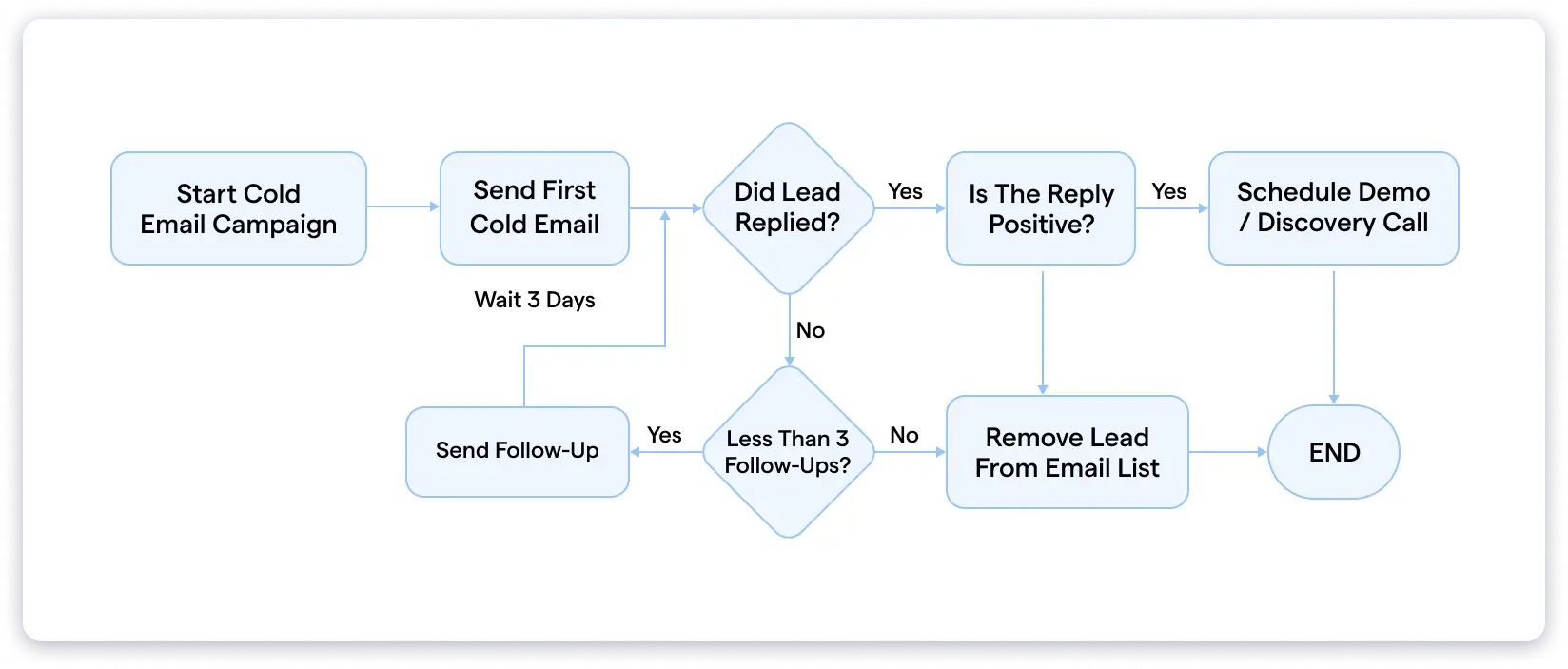
#1: Cold Email Drip Campaign Flowchart for Lead Generation
This is my go-to sequence for lead generation—and it’s helped me close high-ticket leads more than once.
It includes 4–5 emails sent over 3–5 day intervals, with trigger-based follow-ups built in.
Here’s what the flow looks like →
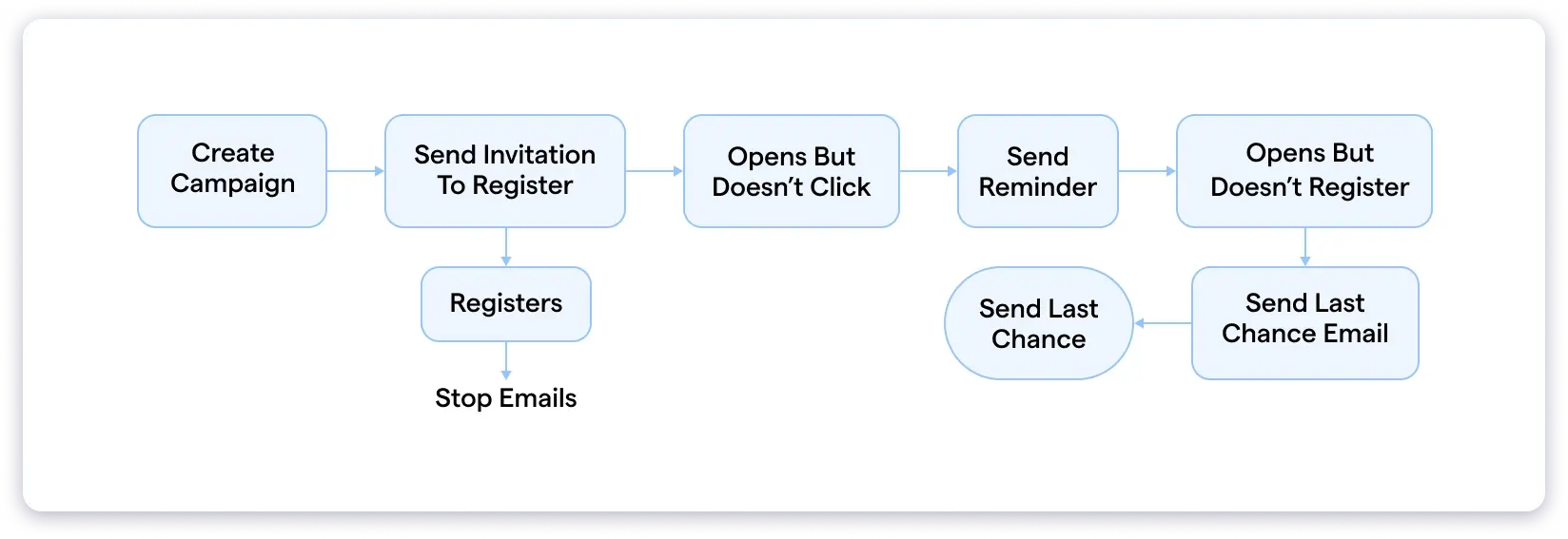
#2: Cold Email Drip Campaign Flowchart for Webinar Promotion
My marketing team uses this flow when promoting a webinar. It’s a 4-email sequence that runs across 2 weeks.
Pro tip: We launch this campaign at least a month before the event for best results.
Here’s the sequence →
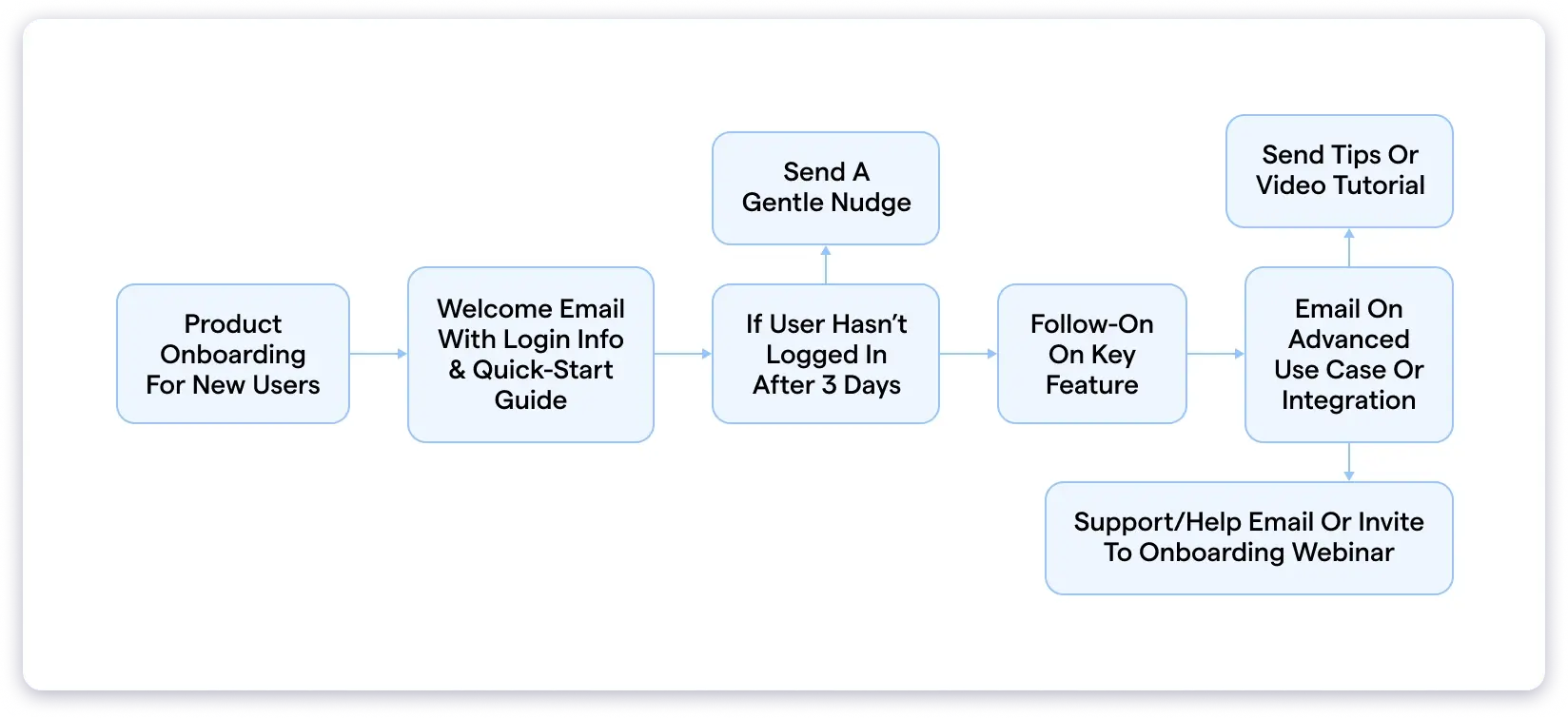
#3: Cold Email Drip Campaign Flowchart for Product Onboarding
This onboarding sequence is designed to help new users get started fast and push SQLs toward becoming paying customers.
It’s a simple yet powerful 4-step flow based on product engagement triggers.
Take a look →
4 Mistakes to Avoid When You Run Cold Email Drip Campaigns
Even a well-planned cold email drip campaign can fail if you overlook these common mistakes. Therefore, when setting up your cold email drip campaign, you also need to know what not to do.
Here are the key mistakes to avoid in cold email drip campaigns:
- Stop Sending Generic, AI-Written Emails
- Don’t Ignore Campaign Analytics
- Clean Your Email List Regularly
- Avoid Multiple or Confusing CTAs
Let’s break them down in detail!
1. Sending Copy-Paste Emails Written by AI
Let’s be real — it’s easy to grab a cold email template or ask AI to write one and hit send.
But here’s the problem: these emails all sound the same. They sound robotic and feel generic, not for the person you’re reaching out to.
And guess what?
People can tell.
If your recipients sense that you haven’t taken the time to understand them or personalize your message, they’ll likely ignore it altogether.
Here is how to fix it→
Use AI or templates to start your email, not finish it. Always add a human touch — mention something specific about the person or company you’re emailing.
Make it sound like it’s coming from you. That personal touch is what gets replies.
2. Ignoring Analytics and Campaign Performance
When you ignore important data like replies, clicks, and conversions, you miss the chance to fix low-performing emails or focus on what’s getting results.
Here is how to fix it→
Check your numbers after each campaign. If people aren’t opening your emails, tweak your subject lines.
If no one’s clicking, test a better CTA. Use the data to keep improving — that’s how you get better results, faster.
3. Not Cleaning Your Email List
Before you set up your cold email drip sequence, make sure you verify the email addresses.
If you keep sending emails to old or fake addresses, they’ll bounce or get no replies.
This can hurt your sender reputation and lower your chances of landing in the inbox.
Here is how to fix it→
Use an email verification tool to clean your list often.
This way, you only reach out to real and active emails—and protect your deliverability.
4. Having Multiple or Unclear CTAs
One clear CTA = more replies.
If your email has too many buttons or asks the reader to do different things, it gets confusing.
When people aren’t sure what to click or do next, they usually do nothing—and that means fewer replies or conversions.
Here is how to fix it→
Stick to one clear and focused CTA per email.
Tell the reader exactly what you want them to do—like “Book a call” or “Check out this case study.”
PS: Here is an example of clear and direct CTAs
- “Can we hop on a quick 15-minute call this week?”
- “Does Tuesday work for a quick chat?”
How to Create a Cold Email Drip Campaign- Key Points
A cold email drip campaign helps you connect with leads and turn them into customers.
You just have to be mindful of a few things,
- Set your goals
- Know who you are sending emails to (ie. your audience)
- Write clear and helpful emails
- Pick the right triggers
- Time them right
- & keep improving
This can make your campaign work like anything.
Rememeber:
Cold email drip campaigns are about building trust, not just sending emails.
FAQs
1. How Many Emails Should Be in a Cold Email Drip Campaign?
Start with 3–5 emails, spaced a few days apart. Adjust based on how people respond.
2. How Do I Know if My Cold Email Drip Campaign Is Working?
For this, you have to keep a track of open rates, reply rate, and CTR (click-through rate). It will help you get insights into what’s working and what’s not.
3. What if No One Responds to My Emails?
That can be because your emails are either landing in spam, or they are not interesting.
For this, try tweaking your subject lines and making your emails more personal or offering something valuable, like a free tip or resource. Also, keep a check on the overall email deliverability and bounce rate.