
Cold calling is dead.
Cold emailing is dead.
Wait… what?
Well, neither is dead.
Both channels are very well alive,
and still booking meetings and closing deals every day.
The people screaming “It’s dead” are the ones using:
Lazy email lists, copy-paste templates, zero personalization, etc.
And the belief that one channel alone will save you.
In the last 16 months, my sales teams have booked 200+ meetings and closed deals worth $300k+, all by using both cold calling and cold emailing
In this blog, I will share the differences, pros & cons, the exact scenarios where each one wins, and which one is safer.
Let us finally end the cold-email vs. cold-call debate!
Cold Email vs Cold Call – TOC
- What is Cold Emailing?
- What is Cold Calling?
- Cold Email vs Cold Call: 7 Main Differences
- Pros and Cons of Cold Email in 2026
- Pros and Cons of Cold Calling in 2026
- Cold Email vs Cold Call Statistics 2026: Success Rates & Benchmarks
- When to Cold Email vs When to Cold Call: Use Cases & Tips
- Cold Email vs Cold Call: Which is Safer Legally in 2026?
- Final Verdict: Which Should You Bet On in 2026?
- Cold Email vs Cold Call: FAQs
What is Cold Emailing?
Cold emailing is a lead-generation technique in which you reach out to someone you have never interacted with, with the clear intent to establish a new professional connection or conversation.
It briefly explains who you are, why your message matters to them, and the next step you want them to take.
So, a good cold email quickly communicates:
- Who you are
- What value can you provide (for their challenge)
- What action should the recipient take next (the CTA)
Ideally, a cold email should start a business conversation, almost always to book a meeting.
Best Cold Emailing Practices:
• Hyper-personalized email copy that feels like a 1:1 conversation
• 25-120 words maximum
• Written to deliver value first, product second
• Sent from a properly warmed-up domain that is compliant
You can also check out more cold emailing best practices.
Cold email is the primarily sales technique used by the majority of B2B SaaS, agency, and mid-market sales teams.
Check if your prospect has a valid business email, and you can identify how you can help them.
If yes, cold emailing becomes the easiest and most cost-effective way
to start a conversation (and build your pipeline).

What is Cold Calling?
Cold calling is a lead-generation technique in which a salesperson reaches out to potential customers who have not yet shown interest through a phone call.
The goal is to introduce the offer, understand their needs, and start a conversation that could lead to a sale.
Best Cold Calling Practices:
• Researched and intentional (you know the person’s role, recent company events, pain points, or triggers)
• Short (30-90 seconds if you get them live)
• Delivered with a calm, professional tone. Never intrusive or sales-y. Any AI agents used must be trained to maintain this standard.
• Avoided as a first touch outreach. Better used in a multi-touch sequence (voicemail + email + LinkedIn + second call)
• Made from a local presence or clearly identified number (caller ID matters)
• Fully compliant with TCPA, DNC registries, etc.
Cold calling wins for high-ticket B2B, local services,
and any situation where the buyer is a founder, owner, or a C-level executive.
The initial call may not always result in an immediate sale.
Instead, a successful call may set up an appointment for a later meeting or demo.
But it is the fastest path from first contact to a live conversation,
and promises high close rates when the deal size is justifiable.
So, if your prospect picks up, nothing builds trust fast than a real voice.
That is why, despite all the doubts,
top enterprise and high-ticket teams will never fully abandon cold calling.
Cold Email vs Cold Call: 7 Main Differences
Take a look at the main differences to decide which outreach channel to open your next campaign with:

All seven differences drill down to a single trade-off: control vs. conversation.
- Cold email gives you complete control over volume, timing, cost, and testing. But it depends on when they choose to reply, which means no instant back-and-forth.
- Cold calling gives you zero control (gatekeepers, voicemails, regulations, burnout). But the moment a verified lead answers, you get an instant human conversation.
This is why cold emailing is usually the first touch for most B2B teams.
Cold calling works best as part of a multichannel sequence, especially in high-ticket or founder-led sales.
Pros and Cons of Cold Email in 2026
Let us look at the most important pros and cons of cold emailing.
This helps you figure out if this is the right cold outreach sales technique for your business.

Pros of Cold Emailing
Cold emailing has certain key advantages that make it a highly effective outbound lead generation and sales tactic.
1) You Can Scale Outreach Massively Without Scaling Headcount
Cold email allows one sales representative to do what would take a full calling team.
When you follow email deliverability & warm-up practices:
A single SDR can send 1,000 to 3,000 personalized emails per day.
And even 10,000+ if using AI to personalize every contact.
So, unlike cold calls that are capped by hours and energy,
cold email outreach continues 24/7.
2) Costs are Extremely Low, Driving Huge ROI
Cold emailing removes the single biggest expense in outbound sales:
Human time spent on live attempts.
For every $1 spent, cold emailing gives an ROI of $36–$42.
Every cold call costs real salary minutes, whether the prospect answers or not.
On the other hand, every email costs almost nothing after the first hour of setup.
For example, one SDR sending 600 cold emails per day costs $80-$100 (salary, tools, and email verification), and may book up to 10 meetings at maximum.
The same SDR making 80 cold calls per day can cost $300-$600 in salary and tools.
They can book up to 5 meetings maximum.
3) Always-On Global Reach — Prospects Reply When They Want
Cold email removes any time-zone bottlenecks.
You can just schedule your emails to hit inboxes right when the buyers are active.
For global teams selling to APAC, Asia, EU, etc.,
Cold email keeps outreach running nonstop.
You do not have to compress around business hours.
4) Data-Driven Optimization Compounds Results
You can test subject lines, personalization, CTAs, and many more. For example:
- A/B testing improves opens and replies
- Cold email follow-ups double or triple positive responses
As time goes by, your email outreach only improves!
5) Lower Emotional Fatigue Keeps SDRs Performing
Cold calling exposes SDRs to 80-100 rejections every day.
Cold email removes this fatigue.
Instead, they focus on deeply personalizing emails, running A/B tests, and remaining consistent.
This produces higher-quality outreach.
6) Campaigns Keep Generating a Pipeline for Months
You do not just email one batch, but new prospects every week.
When one group of prospects is just getting their first email,
others might already be receiving scheduled follow-ups.
So even if you stop sending new emails today,
four to eight weeks of prospects are still mid-sequence.
This means they are still replying and capable of converting.
7) Ideal Pivot Into a Multi-Channel Motion
Cold email warms up your prospects before higher-touch channels.
When you connect later on LinkedIn or calls referencing the prior email,
your reply and meeting rates also increase.
Your cold emails can introduce the problem, social reinforce value, with calls closing the loop.
Cons of Cold Emailing
While cold emailing offers a lot of advantages, it also has its fair share of disadvantages. Let’s take a quick look at the main disadvantages of using cold emailing.
1) Easy to Get Ignored
Prospects receive hundreds of emails per day.
If your message is not immediately clear or relevant, it will be marked as spam or deleted.
It takes very few seconds for a buyer to decide if your message earns their attention.
Without those, the email vanishes before you can measure.
Generic blasts and less-researched emails do not stay in the field too long.
2) Deliverability Issues Stop Your Emails Before They are Seen
These days, cold emails’ biggest enemy is spam filters.
Email Service Providers like Google and Microsoft filter suspicious, unwarmed, and over-automated campaigns into the spam or promotions tab.
One bad list or templated blast can seriously hurt your inbox placement and damage your sending reputation for months.
SPF/DKIM/DMARC authentication and rotating domains also hold important value for high email deliverability.
3) Lack of Replies Can Make Performance Unclear
Unlike calls where “not interested” at least gives clarity,
your recipients just ghost you in cold emails.
Even with opens and reads, it can be hard to know if your message resonated with the prospects.
To avoid wasted sequence cycles, your emails need quick iteration and strong analytics.
4) Compliance Mistakes Can Carry Financial Risk
Regulations like CAN-SPAM, GDPR, CASL, and region-specific laws demand:
- Opt-out systems
- Accurate sender identity
- Data sourcing transparency
- Audience-appropriate consent
Violations can lead to €20M fines for B2B teams, domain blacklisting, or even lawsuits.
5) Hyper-Personalization Still Requires Work
You have to invest time in researching the company’s goals, buying triggers, and current initiatives.
Relying too much on automation and less on ICP, buyer intent, and challenges will backfire.
Pros and Cons of Cold Calling in 2026
Now that we have covered the pros and cons of cold emailing, let’s also look at the pros and cons of cold calling.
Pros of Cold Calling
Cold calls, in the same way as cold emails, have certain benefits that one just can’t (and shouldn’t) ignore.
Let’s check them out one by one.
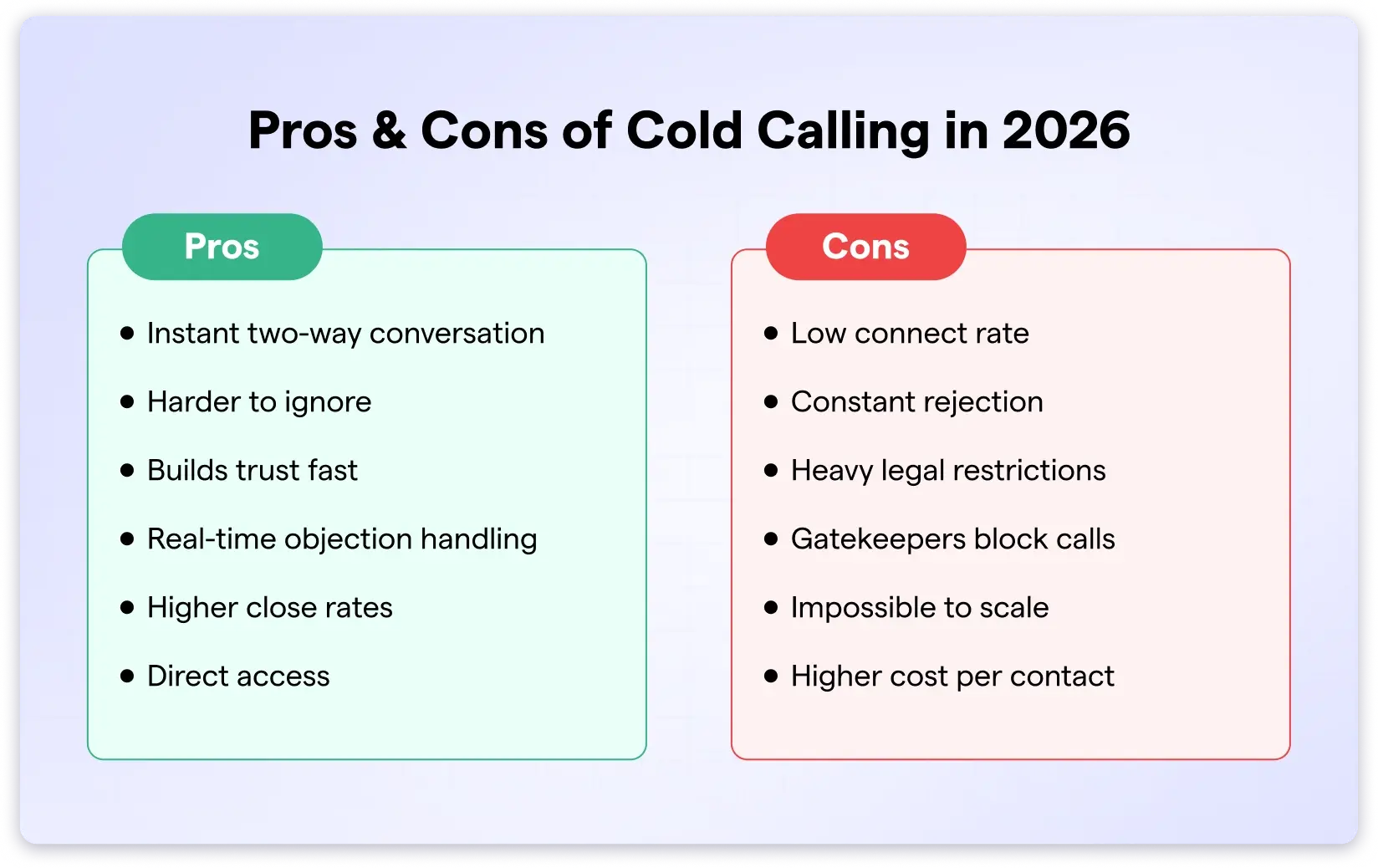
1) Instant Two-Way Conversations Qualifies Leads
With cold calls, you can directly talk to a prospect and ask the right questions.
You will know instantly if they have a real need, the authority to make decisions, and a budget.
If connected, a short call can replace multiple follow-ups,
helping the team focus on serious opportunities.
2) Calls Get Noticed More Than Emails
People may take their time checking their email inbox,
but a phone call calls for their attention.
Even if they do not answer, your caller ID shows up and creates awareness.
This human interaction makes your outreach more memorable,
and increases the chances of future engagement.
3) Talking Builds Trust Faster
Buyers always prefer to listen to a trustworthy caller.
Especially in finance, healthcare, or enterprise software industries.
Hence, voice communication increases the buyer’s level of comfort.
4) Buyer Objections are Addressed Immediately
Cold calls allow teams to respond quickly to any concerns raised by the prospect.
Without this immediate response and flow of conversation,
leads may lose interest or delay decisions.
So, sales teams must master objection handling to move a majority of the opportunities forward.
5) Reached Calls Often Have Higher Intent
Calls that reach the right person are more likely to lead to meetings.
Unlike emails, where opens and clicks do not always mean interest,
live calls signal readiness accurately.
6) Direct Access to Decision-Makers
Cold calling is a good way to bypass strict spam filters.
Since decision-makers also have their inboxes overflowing,
it can be difficult getting them alone with only emails.
With accurate contact information, teams can connect with executives or managers directly.
Cons of Cold Calling
Just like cold emails, cold calls also have their shortcomings.
1) Few Calls Actually Connect With Prospects
Despite the effort invested, your most cold calls may not reach a live person.
Current benchmarks show that only 1-3% of dials result in proper sales conversations.
Also, voicemail, call screening, and busy schedules further reduce contact rates.
This means that sales representatives must make many calls to achieve a few qualified conversations.
This is very inefficient for smaller teams and businesses.
2) Rejection Can Be Discouraging
Your teams are exposed to constant hang-ups, pushbacks, and refusals.
This affects morale and motivation to close deals.
Without proper coaching and support, teams will struggle to maintain that productivity.
3) Compliance Rules are Stricter
Compared to cold email, cold calling is even stricter with region-specific rules.
Companies must maintain proper documentation, follow DNC lists, and be careful of risks.
Investing in legal guidance and specialized software is the key.
Though this is not always ideal for small businesses.
4) Gatekeepers Limit Access to Decision-Makers
Many cold calls never even reach the intended person because of assistants, receptionists, etc.
Gatekeepers protect executives from unwanted or uninvited outreach.
Teams will need to repeatedly attempt calls to reach prospects.
5) Increasing Volume Requires More Human Effort
While cold emailing is automated, each cold call requires actual human interaction.
Scaling outreach needs more sales representatives.
This increases labor costs, training expenses, and can complicate management.
You can still use automated tools to assist with dialing or call tracking,
but they cannot require the core human effort required.
6) High Cost Per Qualified Conversation
Because the connect rates are low and each call takes up a caller’s time,
the effective cost per qualified call is higher.
Benchmarks show that costs per booked meeting can reach up to $180,
depending on call volume, representative efficiency, and other factors.
Companies must weigh the ROI to balance the higher conversion potential against the costs involved.
Cold Email vs Cold Call Statistics 2026: Success Rates & Benchmarks
Below are the actual numbers and benchmarks you can consider for your outreach in 2026.
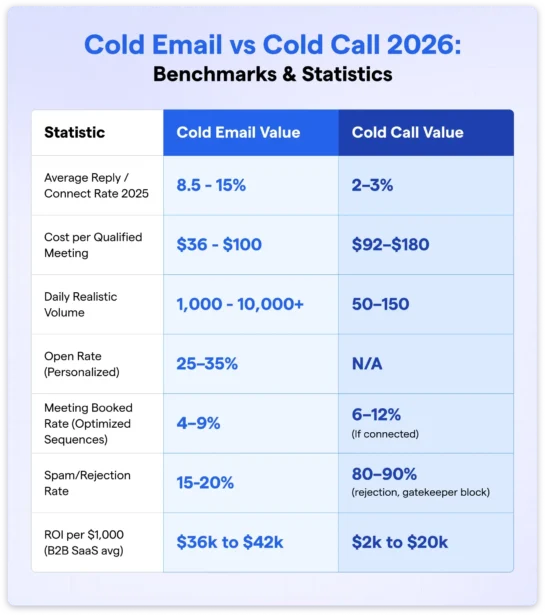
- Open Rate or Live Connect Rate
- Reply Rate/Conversation Rate
- Meetings Booked per 100 Touches
- Cost per Booked Meeting
- Daily Realistic Volume
- ROI per Dollar Spent
- Buyer Preferences for First Contact
- Other Statistics You Should Know
Open Rate or Live Connect Rate
Cold email: 20-30% of emails are opened and seen
Note: Avoid relying on open rates in cold emails. Tracking pixels are now widely blocked by privacy features implemented by Apple, Google, and other major inbox providers.
Cold calling: Only 3-10% of dials reach a live human (the rest hit voicemail or gatekeepers)
Hence, cold emailing wins by 4-10x on message delivery.
Reply Rate/Conversation Rate
Cold email: 5-15% average reply rate, top 10% of campaigns consistently hit 15-25%
Cold call: 4-10% of live connects turn into meaningful conversations
Here, email still pulls ahead, and even a silent open warms the lead.
Meetings Booked per 100 Touches
Cold email: 3-12 qualified meetings
Cold calling: 1-5 qualified meetings
Email creates 3 to 5 times more pipeline than calling from the same sales representative effort.
Cost per Booked Meeting
Cold email: $40 to $150
Cold calling: $400 to $1,200
Cold emailing is eight to fifteen times cheaper when you factor in salaries and dialer times.
Daily Realistic Volume
Cold email: 500-1,500 highly personalized emails (across 3-5 warmed inboxes)
Cold calling: 70-100 quality dials
One email outproduces an entire cold-calling pod!
ROI per Dollar Spent
Cold email: $36 to $42 return on every dollar (can skyrocket to 287% higher when combined with LinkedIn/calls)
Cold calling: $8 to $15 return per dollar
Buyer Preferences for First Contact
- 68% to 79% of decision-makers want to be reached by email first.
- Only 57% of C-suite and VP-level buyers are open to an uninvited call (and only when it is super relevant)
Other Statistics You Should Know
- 82% of buyers have booked a meeting with someone who reached out to them via cold email/cold call in the previous year
- 69% of buyers accepted a meeting from a cold call sequence
- 80% of sales require 5+ touches. And yet 44% of representatives give up after one or two follow-ups
- Multi-channel sequences (email + call + LinkedIn) increase response rates by up to 287%
- With AI personalization and intent data, top cold call teams push 6-10% of dials into meetings (vs the 2-3% average)
- Properly warmed domains and verified leads result in 95%+ inbox placement for email
When to Cold Email vs When to Cold Call: Use Cases & Tips
Cold email and cold calling are both tools.
And the wrong one in the wrong situation is like bringing a knife to a gunfight.
When to Lead With Cold Email: Use Cases & Tips
Cold email works best at volume and subtlety.
Short, insight-based sequences generate more engagement than calls.
Replies also reach 20-25% when cold emails are personalized.
Choose cold emailing if these fit your primary use case:
- Mid-Market Volume
- Partnership and Channel Deals
- Global Teams or Scattered Time Zones
- Reviving Old or Dead Leads
- Testing New Messaging or ICPs
- Small Teams or Bootstrapped Budgets
1) Mid-Market Volume
You have 500-5,000 prospects per month, and your deal size ranges $3k to $40k. Your representative can send 1,000 to 3,000 hyper-personalized emails per day and book 5-25 meetings without burnout.
Tip: Use AI-assisted tools for deep personalization to keep quality high
2) Partnerships and Channel Deals
Cold email suits best if you want to approach potential resellers, affiliates, and other partnership opportunities. These relationships move slowly and usually involve multiple people. Email is the best way to keep everything documented.
Tip: Try to loop in stakeholders early on so the deal does not break/delay later.
3) Global Teams or Scattered Time Zones
If your prospects are from different time zones, cold email is the answer. Your emails land when they are actually checking their inbox.
Tip: Schedule sending time as per each region’s peak inbox hours.
4) Reviving Old or Dead Leads
Cold email helps you re-engage leads that went quiet months ago. A short email sequence can help revive them, often without the need for a phone call.
Tip: Refer to past context or results your customers achieved.
5) Testing New Messaging or ICPs
If you are not sure your messaging will resonate with your ICP, email lets you A/B test. You can test subject lines, value propositions, and offering in a single week and know what exactly drives replies.
Tip: Run tests on one variable at a time to clearly see which one brings results.
6) Small Teams or Bootstrapped Budgets
You cannot afford full-time callers. In this case, choose cold emailing as it costs pennies and runs on autopilot.
Tip: Consider automating follow-ups. Humans step in once someone engages.
Need more tips on writing a cold email? Check out How to Write Cold Emails in 2026 [10 Proven Steps + Templates]
When to Lead With Cold Call: Use Cases & Tips
Cold calling works best through urgency and direct interaction.
It creates an immediate conversation that cold email cannot match.
Choose cold call if these fit your primary use case:
- High-Ticket & Enterprise Deals
- Local Services and Relationship Sales
- Real Estate and High-Value Local B2B
- Following Up Warm Email Leads
1) High-Ticket & Enterprise Deals ($50k to $500k)
A single conversation with a VP or founder builds trust easily. It is easier to handle objections and show credibility, considering you warmed up your leads with a cold email.
Tip: Always call first. Then, send a follow-up email for more credibility.
2) Local Services and Relationship Sales
If you are an agency, consultant, commercial real estate, or private equity roll-up, choose cold calling. A calm, confident voice with local presence still closes deals faster than an email thread.
Tip: Show that you are familiar with the locality. Mention a nearby client or a shared location.
3) Real Estate and High-Value Local B2B
Owners and General Managers who work in commercial insurance, payroll services, etc., still pick up the phone. When you position yourself like a trustworthy peer, they can make big decisions quickly.
Tip: Use a strong reason for calling immediately to avoid being blocked.
4) Following Up Warm Email Leads
If someone has opened three emails, clicked the case study, but did not reply, it can be the perfect moment to call. They already know who you are, and the pain point is top of mind.
Tip: Call within an hour of the engagement while intent is still high.
Cold Email vs Cold Call: Which is Safer Legally in 2026?
While making your decision, you might think – “But are they both legally safe?”
This is a very important question to ask yourself, especially for your business survival!
In short, cold emailing is legally the safer bet for businesses.
They respect recipients’ space and are easier to automate with safe opt-out options.
Calls, on the other hand, are slightly intrusive and can invite complaints.
Let us break it down so you have a better idea.
(P.S. Consider a lawyer for your jurisdiction. These are guidelines, not legal advice!)
Cold Email: Why it is Safer Than Cold Calling
Cold emails to business addresses are broadly legal worldwide (if not spam).
Public emails (e.g., from LinkedIn or websites) often imply consent.
Key laws:
1) CAN-SPAM Act (U.S.)
No prior consent needed. But be honest, include a physical address in the footer, and add an unsubscribe button (honor within days). While AI filters now flag non-compliant senders, tools like Saleshandy auto-add opt-outs.
2) GDPR (EU/UK)
Using ‘legitimate interest’ is valid for B2B outreach when your message is relevant to the recipient’s role. You would still need to get consent before you process their personal data. It is a good practice to give a link to your privacy policy and offer data privacy options.
3) CASL (Canada)
This is the strictest for emails. Consent is only implied for B2B if the email is public and relevant (expires 2 years). Explicit opt-in is best practice, and always include an unsubscribe button.
4) Spam Act 2003 (Australia)
You can email a business if its address is public and your message is relevant. Clearly show who you are and include an easy unsubscribe link.
Cold Calling: High Stakes, Even for B2B
B2B exemptions exist (no DNC for business lists), but cell phones trigger TCPA. Enforcement of laws here is aggressive.
Key laws:
- TCPA (US Telephone Consumer Protection Act)
- National DNC Registry (U.S.)
- Telemarketing Sales Rule (TSR)
- ePrivacy Directive/PECR (EU & UK)
- Canada’s Anti-Spam Legislation (CASL) + National DNCL
- Do Not Call Register (Australia)
1) TCPA (US Telephone Consumer Protection Act)
You cannot use an autodialer, pre-recorded voice, or AI voice without prior consent. Manual dialing is allowed, but almost every power dialer is considered an autodialer.
2) National DNC Registry (U.S.)
Anyone who registered their number (even a cell) cannot receive telemarketing calls. B2B gets an exemption only if you already have an established business relationship.
3) Telemarketing Sales Rule (TSR)
Caller ID must be accurate, and you have to disclose that you are selling within the first few seconds. You also cannot abandon more than 3% of answered calls.
4) ePrivacy Directive/PECR (EU & UK)
Unsolicited direct marketing calls require opt-in consent. B2B gets slight lenience but still needs an opt-in or clear opt-out opportunity. So, calling without consent is basically illegal unless you have a rock-solid legitimate interest argument.
5) Canada’s Anti-Spam Legislation (CASL) + National DNCL
Express or implied consent is required for marketing calls. This lasts 6-24 months and only in specific cases. Most teams just avoid Canada entirely.
6) Do Not Call Register (Australia)
Similar to the U.S. DNC, registered numbers are off-limits unless you have consent. B2B exemption exists but is narrow. Make sure to honor every opt-out within 30 days.
Final Verdict: Which Should You Bet On in 2026?
To close more deals in 2026, you don’t want to rely on just one outreach channel.
If you want to close deals, you will definitely need both channels.
Cold email warms up your leads and builds reputation slowly, all without being intrusive.
It is the most scalable way to open new markets, test messaging, and warm up interest before a live conversation happens.
You can layer in calls only after you have proof of interest or a particular reason.
Introduce it slowly once you have warmed leads ot hit the exact scenarios where a live voice is better.
If you do it right, emails will open doors to business opportunities. Calls can walk in and close them.
Saleshandy gives you both verified business + personal emails and direct cell numbers in one platform.
And with its built-in dialer, you can place those calls right from the same platform.
Start your 7-day free trial and get your 5 free leads!
Cold Email vs Cold Call: FAQs:
1) Is it better to cold call or cold email?
Cold email is better for B2B teams. It scales easily, costs less, and is legally safer. It also respects the buyer’s time.
Cold calling only wins when the deal is large enough, urgency is high, and the buyer is senior enough that one live conversation outweighs everything else.
2) Should I cold call or email first?
Always cold email first. It lands softly and builds familiarity without interrupting. It filters those who are interested and creates a paper trail.
Only pick up the phone once the prospect has shown curiosity or the opportunity is too valuable to leave to inbox timing.
3) Are cold emails better than cold calls?
Yes, cold emails are slightly better than cold calls. It is preferred for teams for most of the use cases.
Cold calling is better when immediate trust, objection-handling, or urgency are required. Otherwise, email wins on efficiency and buyer preference.
4) What is the main difference between cold calling and cold email?
The main difference between cold calling and cold emailing is that one gives you a conversation, and the other control.
Cold emails give you complete control over timing, cost, testing, etc, but zero live dialogue until they choose to respond. Cold calling gives you no control at all, yet an instant human connection the second they answer.
5) How many cold emails should you send per day?
You can send up to 10,000 cold emails per day, given that you keep all genuinely personalized and delivered appropriately.
With proper domain warm-up, relevance, and multiple inboxes, teams can send at volume while staying out of spam as well.
 Piyush Patel
 Dhruv Patel