

You don’t need more real estate investors.
You need the ones who are actually ready to invest when you reach out.
Here’s what usually happens.
You send messages to a list of investors and hear nothing back.
A few replies come in, but they’re not serious.
By the time you find someone genuinely interested, the deal has already moved on.
The problem isn’t that investors are hard to find.
The actual problem lies in finding the right ones and having a reliable way to contact them directly.
When deals move fast, that gap costs you real opportunities.
So, how do you actually find active real estate investors and get their verified email and phone number?
Well, that’s exactly what this guide covers.
Let’s get started!
Find Real Estate Investors – TOC
- TL;DR: Find Real Estate Investors in 5 Minutes
- Common Methods to Find Real Estate Investors
- How to Find Accurate Real Estate Investors Using Saleshandy Lead Finder [Step-by-Step]
- Important Things to Keep in Mind While Finding Real Estate Investors’ Contact Information
- Your Real Estate Investor Pipeline Starts with the Right Contact Data
- FAQs on Finding Real Estate Investors
TL;DR: Find Real Estate Investors in 5 Minutes
Real estate investors aren’t hard to find. Reaching the right ones with verified contact data is.
Most Outreach Fails Because:
- Investors operate behind LLCs and gatekeepers
- Public sources don’t give direct emails or phone numbers
- Traditional methods like networking, LinkedIn, and referrals don’t scale
To build a real pipeline, you need a way to filter and reach verified investors directly.
A B2B Lead Finder Like Saleshandy Lead Finder Lets You:
- Filter from 800M+ contacts using 75+ data points
- Target investors by title, location, company size, and more
- Get real-time verified emails (and phone numbers where available)
Common Methods to Find Real Estate Investors
Let’s understand some of the methods people usually use to get contacts of real estate investors.
1. Networking Events and REIAs
Real Estate Investor Association chapters exist in most US cities and hold regular meetups for education and deal-sharing.
They’re the most commonly recommended starting point for connecting with local investors, and for good reason.
In-person trust builds faster than any online channel.
What Works:
- Face-to-face trust building in your local market.
- Meeting first-time investors open to new partnerships.
- Word-of-mouth referrals that compound over time.
What Doesn’t:
- Can’t reach investors in other cities or countries.
- 10–20 contacts per event, most aren’t serious buyers.
- No verified data you can plug into an outreach campaign.
- The 200 NRI investors in the Bay Area who buy Miami condos will never walk into that room.
2. Online Communities
Online platforms like BiggerPockets, Facebook groups, and LinkedIn communities have created massive networks of real estate investors.
BiggerPockets alone has 3M+ members discussing everything from wholesaling to multifamily syndication.
These communities are where investors share strategies, ask questions, and evaluate opportunities.
What Works:
- Learning investor language, deal structures, and market dynamics.
- Building credibility through posts and discussions.
- Identifying active investors by their forum activity.
What Doesn’t:
- Can’t export emails or phone numbers from profiles.
- No way to build a filtered and targetable contact list.
- Messaging is limited and easily ignored.
- It’s a learning platform, not a prospecting tool.
3. Referrals
In real estate, a warm introduction from a trusted agent, broker, or financial advisor carries more weight than almost any cold outreach.
Referrals come with built-in credibility because the investor already trusts the person making the introduction.
It’s the oldest and most effective channel in the industry.
What Works:
- Trust is pre-built, sales cycle is shorter.
- Higher close rates than any cold channel.
- Access to investors you’d never find on your own.
What Doesn’t:
- Zero control over volume or timing.
- Referrals may not match your ICP.
- Pipeline stays inconsistent month to month.
- Can’t scale a business on unpredictable introductions.
4. LinkedIn Prospecting
LinkedIn is the largest professional network in the world, and most real estate investors have a profile on it.
With Sales Navigator, you can search by title, company size, location, and industry to identify potential investor contacts.
It’s useful for research and one-to-one outreach.
What Works:
- Research investor backgrounds before outreach.
- Filter by title, company, and geography.
- One-to-one connection requests for warm engagement.
What Doesn’t:
- Verified emails and direct phone numbers are locked.
- InMail limits your outreach volume.
- Connection requests go ignored at scale.
- No way to export contacts into an email sequence or calling list.
How to Find Accurate Real Estate Investors Using Saleshandy Lead Finder [Step-by-Step]
What if I tell you that there is a reliable method to get verified contacts of real estate investors without even spending more than 30 minutes?
Seems impossible, right!!
Saleshandy Lead Finder has made it possible with an 800M+ database and 75+ filters to connect with the right real estate investor.
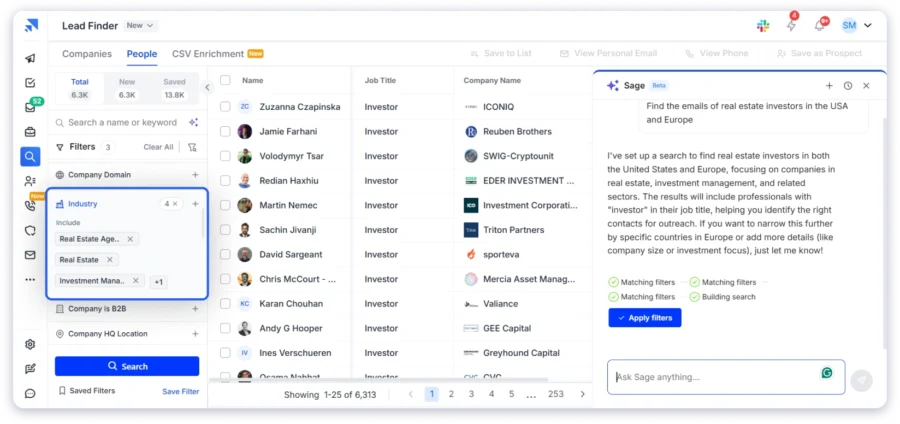
You just have to follow these steps to build a targeted real estate investor list with verified contacts.
- Step 1: Define Your Investor Profile First
- Step 2: Log in to Saleshandy Lead Finder & Set Industry Filters
- Step 3: Filter by Job Title and Seniority
- Step 4: Apply Location Filters
- Step 5: Narrow with Company Size, Revenue, and Buying Signals
- Step 6: Review, Verify, and Export
- Step 7: Reach Investors Through Email + Phone
Step 1: Define Your Investor Profile First
Before touching any filter, get clear on three things:
- Investor Type: Private individual, fund manager, institutional buyer, NRI, REIT acquisition team?
- Geography: Local US, cross-border, NRI-heavy countries?
- Deal Size: A $500K residential flip needs a different investor than a $30M commercial acquisition. This shapes your company size and revenue filters.
Note: Lead Finder uses a credit-based system. 1 credit = 1 verified contact. You’re only charged when verification passes through 9 data providers. Precision in filters = efficient credit usage.
Step 2: Log in to Saleshandy Lead Finder & Set Industry Filters
Log in to your saleshandy account and go to Lead Finder → People tab.
Start with:
- Real Estate (broadest, catches most investor profiles)
- Commercial Real Estate (CRE-specific investors)
- Investment Management (fund managers investing in RE)
- Real Estate Investment Trusts (institutional/REIT buyers)
Step 3: Filter by Job Title and Seniority
Enter investor-relevant titles:
- Real Estate Investor / Fund Manager / Acquisition Director
- Managing Partner / Principal / VP of Acquisitions
- Portfolio Manager / Investment Director
Set Seniority to C-Level, VP, or Director to reach capital decision-makers.
Pro Tip: Use the exclusion feature. Add “Intern,” “Assistant,” and “Coordinator” as exclusions. Keeps your list tight and prevents wasted credits.
Step 4: Apply Location Filters
Saleshandy gives 75+ filters that you can apply efficiently to get better results.
- Domestic US: Filter by high-activity metros like New York, Miami, Dallas, Los Angeles, Houston, Chicago, Phoenix, Atlanta.
- Overseas Investors: Set Location to the UK, UAE, Canada, Singapore, and Australia. Pair with the Real Estate industry and Director+ seniority.
Example: You’re selling luxury apartments in the US. Set Location → US + UAE, Industry → Real Estate + Investment Management, Seniority → Director+, Company Size → 11–50 (targets smaller investment firms and family offices).
You now have a targeted NRI investor list, not random contacts.
Step 5: Narrow with Company Size, Revenue, and Buying Signals
Company Size maps to investor type:
- 1-10: Solo investors, family offices, small LLCs
- 11-50: Boutique investment firms, regional funds
- 51-200: Mid-market funds, multi-property REITs
- 200+: Institutional investors, PE-backed platforms
Revenue: Set $10M+ or $50M+, depending on your deal size.
Buying Signals (the difference between a cold list and a warm one):
- Recent Funding → Fresh capital to deploy
- Leadership Changes → New acquisition head = new deal sourcing
- Hiring for Investment Roles → Expansion signal
Step 6: Review, Verify, and Export
Results show each contact’s name, title, company, verified email, verified phone number, and verification status.
How Verification Works:
Waterfall enrichment checks each contact across 9 data providers (Findymail, Prospeo, RocketReach, Wiza, and others) in real time.
- Verified → 1 credit used
- Not verifiable → 0 credits used
Average bounce rate: under 3%. Generic third-party RE email lists typically run 30-40%.
The Net New tab automatically excludes contacts you’ve already saved, preventing duplicate credit charges across searches.
From the results, you can: Save to a list, export as CSV, or push directly into an outreach sequence.
Step 7: Reach Investors Through Email + Phone
You now have a verified investor list.
If you’re planning outreach at scale, you can push these contacts directly into a cold email sequence or call them using the built-in dialer with local presence, without leaving the platform.
The highest-converting pattern for high-ticket real estate deals is sending a cold email first, then calling them 24-48 hours later.
Pro Tip: Need help structuring these? These cold email templates are a good starting point.
What to Do After Sending an Email to Investors?
Following Up With a Call
Real estate investors don’t close $5M deals over email threads. They want a conversation.
With verified phone numbers from Lead Finder, use the built-in dialer to:
- Call from the prospect’s profile with one click.
- Show a local area code using local presence, as local numbers get picked up far more than unknown ones.
- Record and transcribe every call with AI summaries like key points, objections, and next steps captured automatically.
- Log everything to CRM. Call outcome, duration, recording, and transcript added to the prospect’s timeline.
Adding LinkedIn to the Mix
For investors active on LinkedIn, Saleshandy integrates with HeyReach for LinkedIn automation.
Email, phone, and LinkedIn run from one prospect list without juggling three tools.
The winning pattern for high-ticket deals:
- Day 0: Cold email with the deal/property
- Day 1-2: Call with local presence referencing the email
- Day 3: LinkedIn connection request
This helps investors see your name everywhere without it feeling spammy.
Important Things to Keep in Mind While Finding Real Estate Investors’ Contact Information
Finding real estate investors’ contact information sounds simple—until you realize most of the data out there is outdated, scraped, or just plain wrong.
If you don’t get this part right, everything that follows (outreach, replies, deals) falls apart.
Here’s what actually matters:
- Don’t Rely on Pre-built Lists
- Prioritize Verified Contact Data
- Use Filters to Narrow Down Actual Investors
- Context > Just Contact Details
- Cross-Check Data Before Outreach
- Avoid Scraping From Random Sources
- Segment Your List From Day One
- Stay Compliant (This One Gets Ignored a Lot)
- Keep Your Data Updated Continuously
- Think Beyond Email
1. Don’t Rely on Pre-built Lists
Buying a “real estate investor email list” feels like a shortcut but it usually backfires.
Most of these lists are:
- Collected months (or years) ago
- Built using scraping or unreliable sources
- Sold to multiple buyers
Which means you’re emailing people who’ve:
- Already been spammed heavily
- Changed roles or companies
- Or were never real investors to begin with
Result?
Low replies, high bounce rates, and damaged sender reputation.
2. Prioritize Verified Contact Data
Raw data is easy to find. Accurate data is not.
If you’re not using verified contacts:
- Your emails will bounce
- Your domain reputation will drop
- Future campaigns will land in spam
Always look for:
- Recently verified emails (not “guessed” emails)
- Direct phone numbers instead of company lines
- Active profiles (a quick sign that the person is still relevant)
Think quality over quantity here: 100 solid contacts beat 1,000 risky ones.
3. Use Filters to Narrow Down Actual Investors
This is where most people mess up.
“Real estate” includes:
- Brokers
- Agents
- Property managers
- Consultants
But you’re looking for people who actually invest money.
Use filters like:
- Job titles: Investor, Principal, Partner, Managing Director
- Company type: Real estate funds, investment firms, REITs
- Activity: Companies actively acquiring or funding deals
This one step alone can double your reply rates.
4. Context > Just Contact Details
If all you have is a name and email, your outreach will sound generic.
And generic outreach gets ignored.
What actually works is adding context like:
- Recent deals they’ve been part of
- The type of properties they invest in
- Markets they’re active in
Example Difference:
- Generic: “Are you open to new investment opportunities?”
- Context-driven: “Saw your recent multifamily acquisition in Texas…”
One feels like spam. The other feels relevant.
5. Cross-Check Data Before Outreach
Even “verified” data isn’t perfect.
People in real estate:
- Switch firms
- Launch new funds
- Change focus areas
Before you hit send:
- Check their LinkedIn in 20–30 seconds
- Confirm their current role
- See if they’re still investing in your category
This small step saves you from awkward, irrelevant outreach.
6. Avoid Scraping From Random Sources
Directories, listing sites, and forums look tempting, but they create more problems than they solve.
Common issues:
- Generic emails like info@ or contact@
- Outdated or inactive contacts
- No context about the person
Worse, scraping at scale can:
- Violate platform policies
- Hurt your email deliverability
Structured, compliant data sources will always perform better long term.
7. Segment Your List From Day One
If you’re sending the same message to everyone, you’re leaving replies on the table.
Segment based on:
- Investor type (angel, institutional, fund managers)
- Geography (where they invest, not just where they sit)
- Deal size or asset class
This lets you tailor messaging like:
- Different pitch for small vs large investors
- Different angle for residential vs commercial
More relevance = more replies.
8. Stay Compliant (This One Gets Ignored a Lot)
Cold outreach works, but only if you do it right.
Basic things to follow:
- Only use data from legitimate sources
- Clearly identify yourself and your company
- Always include an opt-out option
Ignoring compliance doesn’t just risk penalties, it hurts deliverability fast.
9. Keep Your Data Updated Continuously
Your list is not a one-time project.
In real estate:
- Investors change firms frequently
- Funds open and close
- Investment focus shifts with the market
If you’re not updating your data:
- Your accuracy drops every month
- Your campaigns get weaker over time
Set a process to refresh and re-verify regularly.
10. Think Beyond Email
Email is just one touchpoint. The best outreach strategies combine:
- Email (for scale)
- LinkedIn (for familiarity)
- Calls (for high-intent prospects)
For example:
- View their profile before emailing
- Engage with a post
- Then send a personalized email
This builds recognition and improves response rates.
Your Real Estate Investor Pipeline Starts with the Right Contact Data
Finding real estate investors was never the hard part.
Their names are everywhere, like deal announcements, LinkedIn profiles, and public records.
The real challenge?
Getting direct, reliable contact data without spending weeks chasing connections or waiting for referrals.
That’s where a solid B2B database like Saleshandy Lead Finder changes the game.
Instead of guessing emails or digging through profiles, you can:
- Filter down to your exact investor segment
- Access verified contact details
- Export a clean, ready-to-use list in minutes
If you’ve read this far, you already know who you want to reach.
Now it’s just about getting in front of them faster.
Also Read: A step-by-step guide on how to build a high-quality real estate broker email list.
FAQs on Finding Real Estate Investors
1. Where Can I Find a Real Estate Investor Email List?
Build one using Saleshandy Lead Finder.
Filter by Industry (Real Estate), Job Title (Investor, Fund Manager, Acquisition Director), and Location.
You get verified emails from an 800M+ database, which is more current and accurate than buying pre-made lists from third-party data brokers.
2. How Do I Find Private Investors for Real Estate?
Private investors operate through small firms, LLCs, or family offices.
In Lead Finder, set Industry to Real Estate, Company Size to 1-50 employees, and Job Title to Investor, Managing Partner, or Principal. Add a location filter to narrow by your target market.
3. How Can I Reach NRI Real Estate Investors?
Set location filters to NRI-heavy countries (US, UK, UAE, Canada, Singapore, Australia).
Combine with the real estate industry, Director+ seniority, and relevant titles.
Export and run a cold email sequence focused on Indian market opportunities, currency advantage, and RERA-backed transparency.
4. Can I Find Commercial Real Estate Investors Through a Database?
Yes. Filter by Industry (Commercial Real Estate, REIT), Job Title (Acquisition Director, VP of Acquisitions, Portfolio Manager), and Revenue ($50M+).
This surfaces decision-makers at firms actively deploying capital into commercial properties.
5. How Accurate Is the Contact Data From Lead Finder?
Saleshandy runs waterfall enrichment across 9 data providers in real time. You only use a credit when verification passes. Bounce rates stay under 3%. Unverified contacts are not returned and cost nothing.
6. What Is the Fastest Way to Find and Contact Real Estate Investors?
Use Lead Finder to build a targeted list, then push contacts into a cold email sequence with automated follow-ups. Search for the first email takes under 30 minutes.


 Anil Salvi