

 Anil Salvi
 Contents
- 1 Buy Email Lists – TOC
- 2 Quick Comparison: 9 Best Email List Providers (2026)
- 3 9 Best Places to Buy Email Lists (Pricing & Reviews Compared)
- 4 Is It Legal to Buy Email Lists in 2026?
- 5 How to Buy Email Lists Without Getting Burned
- 6 Best Email List Providers by Industry in 2026
- 7 Buying vs Building an Email List: Which is Better?
- 8 Final Verdict: Choose the Select the Right Email Provider in 2026
- 9 Best Places to Buy an Email List: FAQs
Yes, I know. Most experts say “never buy email lists.”
And they’re half right. If you buy a scraped, unverified list from a shady vendor, you’ll torch your sender reputation, hit spam traps, and bounce your way into blacklists.
But here’s what nobody tells you.
Thousands of B2B companies buy email lists every day and consistently hit 25-30% reply rates.
The difference?
They buy from verified, compliant B2B data providers, not random list sellers.
That one decision changes everything.
I spent weeks testing 9 email finder tools, comparing database size, accuracy, pricing, and compliance.
This isn’t a roundup of every tool on the market. These are the 9 platforms I’d actually trust with my own outreach budget.
If you’re looking to buy an email list that won’t wreck your deliverability, this guide will help you pick the right one.
Buy Email Lists – TOC
- Quick Comparison: 9 Best Email List Providers (2026)
- 9 Best Places to Buy Email Lists (Pricing & Reviews Compared)
- Is It Legal to Buy Email Lists in 2026?
- How to Buy Email Lists Without Getting Burned
- Best Email List Providers by Industry in 2026
- Buying vs Building an Email List: Which is Better?
- Final Verdict: Choose the Right Email Provider in 2026
- Best Places to Buy an Email List: FAQs
Quick Comparison: 9 Best Email List Providers (2026)
| Email Provider | Database Size | Region Coverage | Accuracy | Starter Plan | Leads/Credits | Compliant? |
|---|---|---|---|---|---|---|
| Saleshandy Lead Finder | 800M+ | Global | 95-98% | $49/month | 30,000 | ✅ |
| ZoomInfo | 400M+ | Primarily US | 85-90% | $14,995/year | 5,000 | ✅ |
| Apollo.io | 210M+ | Strong US, decent EU | 80-90% | $49/month | 30,000/year (per user) | ✅ |
| Lusha | 280M+ | North America + Europe | 92% | $29/month | 3,000/year per user | ✅ |
| Cognism | 400M+ | Global | 87-95% | Custom | Custom | ✅ |
| Hunter.io | 117M+ | Global | 90%+ | $34/month | 24,000/year | ✅ |
| UpLead | 160M+ | Global | 95% | $74/month | 170/month | ✅ |
| RocketReach | 700M+ | Global | 85% | $33/month | 100 email lookups | ✅ |
| Lead411 | 450M+ | Global | 95% | $49/month | 1,000 exports | ✅ |
| Seamless AI | 1.8B+ | Global | 90%+ | Custom | Custom | ✅ |
| BookYourData | 250M+ | Global | 95-97% | $99/month | 250 credits | ✅ |
9 Best Places to Buy Email Lists (Pricing & Reviews Compared)
Ready? Let us dig into the top email finders we have handpicked for you!
But remember: every tool gives you email lists. Only a few ensure they are fresh and safe to use.
So, watch out for strong email verification and compliance features.
These are non-negotiable!
1. Saleshandy Lead Finder
Quick Facts:
- Database: 800M+ verified B2B contacts, 60M+ companies
- Starting Price: $59/mo (or $49/mo billed annually)
- Credits: 2,500/mo (Starter) or 4,000/mo (Pro)
- Accuracy: 95-98% (real-time verified)
- Compliance: GDPR, SOC 2 Type II, ISO 27001:2022, CAN-SPAM
- Region Coverage: Global
- Credit Rollover: 50% unused credits roll over
- Free Credits: In the trial, you get 50 free credits
What I Liked Best About Saleshandy Lead Finder
Saleshandy Lead Finder is a B2B sales engagement platform trusted by over 10,000 businesses globally.
Its Lead Finder gives you access to 800M+ verified contacts, one of the largest B2B databases available, and connects directly to cold email outreach and CRM, all inside one platform.
If you’re looking to buy an email list, Saleshandy is one of the few tools where you can find verified leads, build a targeted list, and start emailing without switching between tools.
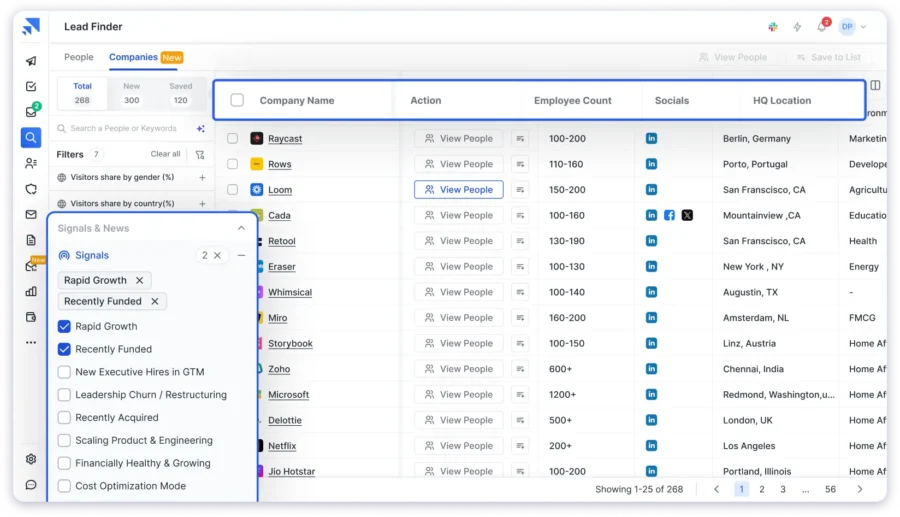
You get 60-70+ advanced filters to build email lists by industry, job title, company size, location, revenue, technology stack, and more.
There’s also AI Lead Search. Type a plain-text description of your ideal customer, and it returns a matching, verified list in seconds.
Every email is verified in real time through waterfall verification from multiple data providers before it’s revealed. You don’t spend credits on bad data.
What makes Saleshandy different from most providers on this list: it’s not just a data tool.
After building your email list, you can launch cold email sequences, use automated email warm-up, and manage prospects in the built-in Saleshandy CRM, a Kanban-style pipeline that tracks every reply, follow-up, and deal stage.
Credits are also more efficient. 7 credits reveal both email and phone number (compared to 9 on Apollo). And 50% of unused credits roll over to the next cycle, which no other major competitor offers.
Best For:
B2B sales teams, lead gen agencies, and founders who want to buy verified email lists and run outreach from one platform without paying enterprise prices.
Saleshandy Lead Finder Pricing:
| Plan | Credits | Price (Monthly) | Price (Annual) | Cost Per Credit |
|---|---|---|---|---|
| Lead Starter | 2,500/mo (or 30,000 upfront annually) | $59/mo | $49/mo | ~$0.02 |
| Lead Pro | 4,000/mo (or 48,000 upfront annually) | $99/mo | $79/mo | ~$0.02 |
| Add-On Credits | 500 to 500,000 | Starting at $12.50 | - | $0.015 to $0.025 |
You can get more details on pricing from this Saleshandy Lead Finder pricing page.
Pros of Saleshandy Lead Finder
- 800M+ verified B2B contacts, 4x larger than Apollo
- Real-time email verification included (no extra cost)
- 50% unused credit rollover (competitors offer zero)
- 7 credits for email + phone (Apollo charges 9)
- 60-70+ search filters including buying signals and technographics
- AI Lead Search for instant list building
- Company Tab with Look Alike search for account-based targeting
- Built-in cold email sequences + automated warm-up
- Saleshandy CRM for post-outreach prospect management
- No per-user pricing, scales without multiplying costs
Cons of Saleshandy Lead Finder
- Free credits offer basic filter access only (Pro filters need Lead Finder plan)
- Newer platform compared to legacy providers like ZoomInfo
What do users say?
“The Saleshandy Lead Finder tool has an easy-to-use interface and wide coverage. It gives you data, including email, phone, and social accounts, on almost all leads.”
2. ZoomInfo
Quick Facts:
- Database: 260M+ professional emails, 135M+ phone numbers
- Starting Price: $14,995/year (annual contracts only)
- Credits: 5,000 bulk credits (Professional plan)
- Accuracy: 85-90%
- Compliance: GDPR, CCPA
- Region Coverage: Primarily US
- Credit Rollover: No
- Free Credits: 25 credits (ZoomInfo Lite)
What I Liked Best About ZoomInfo
ZoomInfo is one of the most established B2B data platforms and a go-to for enterprise sales teams. It offers deep contact and company intelligence alongside intent data powered by Bombora.
If you’re looking to buy email lists for large-scale, enterprise-level outreach, especially focused on the US market, ZoomInfo delivers solid data depth.
The platform includes features like “Likely to Engage” contact filtering, which prioritizes contacts by communication channel preference, and WebSights for tracking anonymous website visitors.

That said, the pricing is a hard pill to swallow for most teams. The minimum spend is $14,995/year with annual contracts only, no monthly option. And several G2 users report hidden fees, slow support, and data quality that drops off outside the US.
For context, ZoomInfo’s database of 260M+ contacts is roughly one-third the size of Saleshandy’s 800M+. And ZoomInfo charges significantly more per lead.
Best For:
Large enterprise teams with $15K+ annual budgets that need intent data, visitor tracking, and deep US contact coverage.
ZoomInfo Pricing:
| Plan | Leads/Credits Per Year | Price (billed annually) | Cost Per Valid Lead |
|---|---|---|---|
| Professional (recommended starter) | 5,000 bulk | $14,995 | $3.00 |
| Advanced (best for scale) | 10,000 | $24,995+ ($2,500/user after 3) | $0.20-$0.60 |
| Elite + Large Credit Packs | 10,000+ bulk + 1,000/month per user | $39,995+ (custom quote) | As low as $0.20 |
Pros of ZoomInfo
- Deep US enterprise contact data
- Bombora intent data integration
- WebSights for website visitor tracking
- “Likely to Engage” filtering
- Strong Salesforce and HubSpot integrations
Cons of ZoomInfo
- Minimum $14,995/year, annual contracts only
- No monthly option
- Smaller database (260M+ vs. 800M+ competitors)
- Data quality drops outside the US
- Hidden fees and slow support reported by users
What do users say?
“They have contacts for every company and, in most cases, a direct email, phone number, and/or cell phone number. Additionally, you can see who is likely to respond, which helps in guiding my multi-threading efforts.”
3. Apollo.io
Quick Facts:
- Database: 210M+ contacts (128M+ emails, 144M+ phone numbers)
- Starting Price: $49/mo per user
- Credits: 2,500/mo per user (Basic plan)
- Accuracy: 80-90%
- Compliance: GDPR, ISO 27001, SOC 2
- Region Coverage: Strong US, decent Europe
- Credit Rollover: No, unused credits expire
- Free Credits: 1,200 credits/year per user (free plan)
What I Liked Best About Apollo.io
Apollo.io is one of the most popular B2B sales intelligence platforms, combining prospecting, email sequences, and CRM integrations in one tool. It’s widely adopted by growing sales teams.
For buying email lists, Apollo gives you 65+ search filters, including VC funding, technologies used, hiring activity, and company headcount.
The AI lead scoring feature rates prospects as Excellent, Good, or Poor, helpful when you’re building large lists and need to prioritize.

Apollo also includes built-in email sequences and a Chrome extension for pulling contacts from LinkedIn, so you can go from list building to outreach quickly.
The main drawback: per-user pricing. A team of 5 reps on the Basic plan costs $245/month. Credits don’t roll over, the email match rate sits around 85%, and phone + email reveals cost 9 credits (vs. 7 on Saleshandy).
The database of 210M+ contacts is also significantly smaller than newer competitors.
Best For:
Growing sales teams that want prospecting + email sequences in one tool and don’t mind per-user pricing.
Apollo.io Pricing:
| Plan | Leads/Credits Per Year (per user) | Price (billed annually) | Cost Per Valid Lead |
|---|---|---|---|
| Basic | 30,000 | $49/month per user | $0.019 – $0.023 |
| Professional | 48,000 | $79/month per user | $0.02 |
| Organization + Add-Ons | 72,000+ (minimum 3 users) | $119/month per user | As low as $0.014 |
Pros of Apollo.io
- 65+ advanced search filters
- AI-powered lead scoring
- Built-in email sequences
- Chrome extension for LinkedIn
- Good CRM integrations (Salesforce, HubSpot, Pipedrive)
- Free plan available (limited)
Cons of Apollo.io
- Per-user pricing, costs multiply with team size
- No credit rollover, unused credits expire
- Email match rate around 85%
- 9 credits for email + phone (higher than competitors)
- Database (210M+) smaller than newer alternatives
Check Out: Apollo.io Review – Is It Worth The Investment in 2025?
What do users say?
“Apollo makes it really easy to find accurate contact information and build targeted lead lists. The Chrome extension is a huge time saver for grabbing contacts directly from LinkedIn.”
4. Lusha
Quick Facts:
- Database: 280M+ contacts
- Starting Price: $29/mo per user
- Credits: 3,000/year per user (Pro plan)
- Accuracy: 92%
- Compliance: GDPR, CCPA, ISO 27701
- Region Coverage: North America + Europe
- Credit Rollover: No
- Free Credits: 5 credits/month (free plan)
What I Liked Best About Lusha
Lusha is a B2B contact data platform known for its simplicity and strong accuracy in North American and European markets. It’s popular among individual sales reps and small teams who want quick, reliable contact data without a steep learning curve.
For buying email lists, Lusha’s strength is its user-friendly interface and high accuracy rate of 92%. The Chrome extension works well for grabbing contacts from LinkedIn and company websites.
Lusha also offers Buyer Intelligence features that highlight prospects showing buying intent.

The limitation? Lusha’s credit system is per-user, and the allocations are tight.
The Pro plan gives you just 3,000 credits per year per user, which runs out fast for teams running volume outreach. Scaling beyond a few reps gets expensive quickly.
Lusha’s database of 280M+ contacts is decent but focused heavily on North America and Europe. Coverage in Asia-Pacific, Latin America, and other regions is thinner.
Best For:
Individual reps and small teams focused on North American or European markets who need simple, accurate contact data.
Lusha Pricing:
| Plan | Credits/Year (Per User) | Price (Monthly) | Cost Per Credit |
|---|---|---|---|
| Pro | 4,800 | $37.45/mo per user | ~$0.094 |
| Premium | 7,200 | $52.45/mo per user | ~$0.087 |
| Scale | Custom | Custom pricing | Custom |
Pros of Lusha
- 92% accuracy rate
- Simple, easy-to-use interface
- Strong North America and Europe coverage
- Chrome extension for LinkedIn prospecting
- Buyer intent signals on higher plans
- GDPR and ISO 27701 compliant
Cons of Lusha
- Per-user pricing, scales poorly for teams
- Low credit allocations (3,000/year on Pro)
- No credit rollover
- Weak coverage outside NA and Europe
- Advanced features locked behind higher-tier plans
What do users say?
“What I like best about Lusha is how quick and easy it is to find direct contact details like phone numbers and verified emails — it saves a lot of time when prospecting and helps me reach the right people faster.”
5. Cognism
Quick Facts:
- Database: 400M+ B2B contacts
- Starting Price: Custom pricing (request a demo)
- Credits: Custom based on contract
- Accuracy: 87-95% (Diamond Data® phone-verified)
- Compliance: GDPR, SOC 2, DNC list checking
- Region Coverage: Global (strong EMEA)
- Credit Rollover: No
- Free Credits: 25 free leads (free trial)
What I Liked Best About Cognism
Cognism is a B2B sales intelligence platform based in the UK, known for having some of the strongest EMEA (Europe, Middle East, Africa) data coverage in the market.
It’s particularly popular with companies that need GDPR-compliant data and verified European phone numbers.
Cognism’s Diamond Data® feature delivers phone-verified mobile numbers, meaning their team has manually dialed and confirmed the number works.
If your outreach includes cold calling in EMEA, this is a significant advantage.

For buying email lists, Cognism offers solid filtering by industry, company size, seniority, and technology stack. The platform also includes Bombora intent data on higher plans and integrates with major CRMs.
The downside is pricing transparency. Cognism doesn’t publish pricing. Everything requires a sales demo and a custom contract.
Based on industry reports, annual costs typically range from $15,000 to $40,000+, depending on team size and data access level. There’s also no self-serve option, which makes it a poor fit for startups and solo operators.
Also Read: Cognism Alternatives
Best For:
Mid-market and enterprise teams selling into EMEA that need GDPR-compliant, phone-verified data and don’t mind enterprise pricing.
Cognism Pricing:
Cognism offers two plans: Grow and Elevate.
Both plans limit the number of saved contact lists (3-10 per user) and the number of contacts per list (10-500).
This is not ideal for team-wide bulk email list exports.
Since Cognism follows a custom pricing model,
You can get a custom quote tailored to your needs.
Industry estimates place Cognism’s annual cost at $15,000 to $40,000+, depending on data access and team size.
Pros of Cognism
- Strongest EMEA data coverage in the market
- Diamond Data® phone-verified mobile numbers
- Bombora intent data on higher plans
- GDPR-compliant with DNC list checking
- Good CRM integrations
Cons of Cognism
- No public pricing, requires sales demo
- Expensive, typically $15K-$40K+/year
- No self-serve or monthly option
- Weaker outside EMEA (especially in APAC and LATAM)
- Credit-based access with no rollover
What do users say?
“What I like best about Cognism is the accuracy and depth of B2B contact data, especially for EMEA and APAC regions. The platform makes it easy to discover direct dials and verified emails through their diamond data, which saves a lot of SDR time.”
6. Hunter.io
Quick Facts:
- Database: 117M+ professional email addresses
- Starting Price: $34/mo
- Credits: 24,000 searches/year (Starter plan)
- Accuracy: 90%+
- Compliance: GDPR
- Region Coverage: Global
- Credit Rollover: No
- Free Credits: 25 searches/month (free plan)
What I Liked Best About Hunter.io
Hunter.io is an email finder tool built around a simple concept: enter a company domain, get the email addresses of people who work there.
It’s been around since 2015 and is widely used by sales teams, marketers, and freelancers.
For buying email lists, Hunter takes a domain-first approach. Instead of searching by job title or industry, you search by company website. Hunter then returns all the email addresses associated with that domain, along with confidence scores and sources.
This makes Hunter great for targeted, account-based prospecting where you already know which companies you want to reach. It’s less useful for building large, filtered lists from scratch.
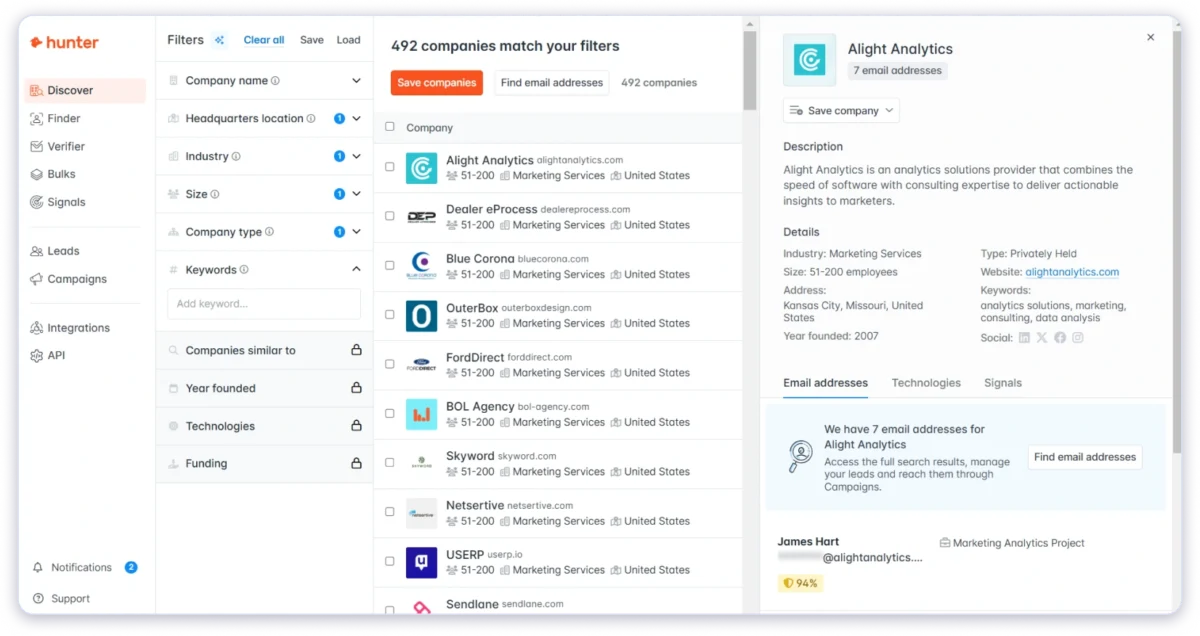
Hunter also offers a Bulk Email Finder. Upload a CSV of names and company domains, and it returns verified emails in bulk. The email verification tool is solid and available separately.
The main limitation is database size. At 117M+ emails, Hunter’s database is significantly smaller than competitors. And it only provides email addresses, no phone numbers, no company intelligence, no intent data.
Best For:
Freelancers, small teams, and marketers who need a simple, affordable way to find email addresses by company domain.
Hunter.io Pricing:
| Plan | Leads/Credits Per Year | Price (billed annually) | Cost Per Valid Lead |
|---|---|---|---|
| Starter | 24,000 | $34/month | $0.02 |
| Growth | 120,000 | $104/month | $0.01 |
| Scale/Enterprise | 300,000+ | $209/month or custom | As low as $0.008 |
Pros of Hunter.io
- Simple domain-based email search
- Transparent, affordable pricing
- Bulk email finder and verification tools
- Good for account-based targeting
- Free plan available
- API access for automation
Cons of Hunter.io
- Smaller database (117M+ emails only)
- No phone numbers or direct dials
- No company intelligence, intent data, or buying signals
- Not ideal for building large filtered lists
- Limited search filters compared to full platforms
What do users say?
“Hunter is fast, accurate, and reliable, perfect for finding professional emails and boosting outreach!”
7. UpLead
Quick Facts:
- Database: 160M+ B2B contacts across 200+ countries
- Starting Price: $74/mo
- Credits: 170/month (Essentials plan)
- Accuracy: 95% accuracy guarantee
- Compliance: GDPR, CCPA
- Region Coverage: Global (200+ countries)
- Credit Rollover: Yes, unused credits roll over
- Free Credits: 5 free credits (free trial)
What I Liked Best About UpLead
UpLead is a B2B data provider that markets itself heavily on accuracy, offering a 95% data accuracy guarantee. If a contact bounces, you get the credit back. That’s a commitment few competitors are willing to make publicly.
For buying email lists, UpLead offers 50+ search filters, including job title, industry, company size, technologies used, and location.
The real-time email verification checks every contact before you download it, so you’re not wasting credits on invalid emails.

UpLead also includes technographic data. You can filter companies by the software they use (CRM, marketing tools, hosting, etc.), which is useful if you sell to specific tech stacks.
The downside is credit allocation. The Essentials plan gives you just 170 credits/month for $74, which is expensive per lead compared to platforms like Saleshandy or Apollo. If you need volume, you’ll need to move to higher plans quickly.
Best For:
Teams that prioritize data accuracy above all else and are willing to pay a premium per lead for a verified, guaranteed-accurate email list.
UpLead Pricing:
| Plan | Leads/Credits Per Month | Price (billed annually) | Cost Per Valid Lead |
|---|---|---|---|
| Essentials | 170 | $74 per month | $0.44 |
| Plus | 400 | $149 per month | $0.37 |
| Professional | Custom | Custom | Custom |
Pros of UpLead
- 95% data accuracy guarantee (credit-back if bounced)
- Real-time email verification before download
- 50+ search filters including technographics
- 200+ country coverage
- Credits roll over to next month
- Clean, user-friendly interface
Cons of UpLead
- Expensive per credit ($0.37 to $0.44 per lead)
- Low credit allocations on starter plans
- Smaller database (160M+) than newer competitors
- No built-in email outreach or sequences
- Phone numbers cost extra credits
What do users say?
“I used them quite a bit to search for contacts and to get and use the contact info, like phone numbers and emails. They were very good about crediting back if they supplied a bad email or phone number that I used to get credits for.”
8. RocketReach
Quick Facts:
- Database: 700M+ professional profiles
- Starting Price: $33/mo
- Credits: 100 lookups/month (Essentials plan)
- Accuracy: 85%
- Compliance: GDPR, CCPA
- Region Coverage: Global
- Credit Rollover: No
- Free Credits: 5 free lookups
What I Liked Best About RocketReach
RocketReach is a contact data platform with one of the larger databases on this list, 700M+ professional profiles across companies worldwide.
It provides both personal and professional email addresses, along with phone numbers and social media profiles.
For buying email lists, RocketReach works well for individual lookups and targeted prospecting. The bulk lookup tool lets you upload a list of names or companies and get verified emails back. The Chrome extension pulls contact data from LinkedIn, company websites, and Crunchbase.
Where RocketReach falls short is volume prospecting. The starter plan gives you just 100 lookups per month for $33. If you’re building large email lists for cold outreach campaigns, you’ll burn through credits fast and need to upgrade to significantly more expensive plans.
The accuracy rate of 85% is also lower than competitors like UpLead (95%) and Saleshandy (95-98%), meaning you’ll see more bounces when running campaigns from RocketReach data.
Best For:
Individual professionals and recruiters who need personal and professional emails for targeted lookups, not high-volume list building.
RocketReach Pricing:
| Plan | Leads/Credits Per Month | Price (billed annually) | Cost Per Valid Lead |
|---|---|---|---|
| Essentials | 100 lookups | $33 per month | $0.33 |
| Pro | 250 lookups | $75 per month | $0.30 |
| Ultimate | 1,000 lookups | $175 per month | As low as $0.20 |
Pros of RocketReach
- Large database (700M+ profiles)
- Personal and professional email addresses
- Chrome extension for LinkedIn and Crunchbase
- Bulk lookup feature
- API access available
- Affordable entry pricing
Cons of RocketReach
- Lower accuracy (85%) compared to top competitors
- Very limited credits on starter plans (100/month)
- No credit rollover
- No built-in email outreach tools
- Advanced filters limited to higher plans
What do users say?
“RocketReach is an excellent resource for finding email addresses. In many cases, they also identify personal emails. I have been using them for several years, and my results have been very good.”
9. Seamless AI
Quick Facts:
- Database: 1.8B+ contact and company records
- Starting Price: Custom pricing (free plan available with 50 credits)
- Credits: 250/month (free plan), paid plans are custom
- Accuracy: 90%+
- Compliance: GDPR, SOC 2
- Region Coverage: Global
- Credit Rollover: No
- Free Credits: 50 credits (free plan)
What I Liked Best About Seamless AI
Seamless AI claims the largest database on this list with 1.8B+ total records, though that number includes company records.
The platform uses AI to search and verify B2B contact data in real time.
For buying email lists, Seamless AI offers an Autopilot feature that automatically builds lead lists based on your ICP criteria. Set your filters, and it generates lists without manual searching. The Buyer Intent feature (powered by Bombora) helps identify companies actively researching solutions in your category.
Seamless AI also includes a Chrome extension and integrates with major CRMs like Salesforce and HubSpot.
The catch: pricing is completely opaque. No public pricing beyond the free plan. You have to go through a sales process, and users on G2 report annual contracts ranging from $10,000 to $25,000+ for team plans. Several users also report aggressive sales tactics and difficulty canceling contracts.
The “1.8B+” database claim also comes with a caveat. Many of those records are company profiles, not unique individual contacts with verified emails.
Best For:
Teams with budget for annual contracts who want AI-powered list building and buyer intent, and don’t mind going through a sales process for pricing.
Seamless AI Pricing:
| Plan | Credits | Price (billed annually) | Cost Per Valid Lead |
|---|---|---|---|
| Pro | Custom with daily credit refresh | Per user | Custom |
| Enterprise | Custom credits | Unlimited users | Custom |
Pros of Seamless AI
- Massive database (1.8B+ total records)
- Autopilot for automated list building
- Buyer Intent data (Bombora)
- Chrome extension for LinkedIn
- Real-time AI-powered search and verification
- Free plan available
Cons of Seamless AI
- No public pricing, requires sales demo
- Aggressive sales tactics reported by users
- Difficult to cancel contracts (per G2 reviews)
- “1.8B+” includes company records, not all individual contacts
- No credit rollover
- Per-user pricing on paid plans
What do users say?
“What I liked most about Seamless.AI is how easy it makes finding and connecting with the right prospects. The platform saves a lot of time by delivering verified emails and direct dials quickly, and the Chrome extension works seamlessly with LinkedIn.”
Is It Legal to Buy Email Lists in 2026?
This is the question that stops most people from pulling the trigger. And the short answer is: yes, buying email lists is legal, but only if you buy from the right source.
Let me break down the three regulations that matter.
1. GDPR (European Union)
GDPR allows B2B cold emailing under the “legitimate interest” basis. That means you can email a business contact if your offer is genuinely relevant to their role or company, and you provide a clear way to opt out.
What’s not allowed: buying scraped consumer data or emailing people who’ve explicitly opted out.
If your email list provider is GDPR-compliant (like Saleshandy, which holds SOC 2 Type II and ISO 27001 certifications), you’re on solid legal ground for B2B outreach in Europe.
2. CAN-SPAM (United States)
CAN-SPAM is more lenient than GDPR. You don’t need prior consent to send cold emails in the US. But you must include your physical address, use honest subject lines, and provide a clear unsubscribe option in every email.
Buying a B2B email list and cold emailing from it is perfectly legal under CAN-SPAM, as long as you follow these rules.
3. CCPA (California)
CCPA gives California residents the right to know what personal data is collected about them and to opt out of its sale. For B2B email lists, this means your provider must be transparent about how they source and process data.
Providers like Saleshandy, ZoomInfo, and Cognism all claim CCPA compliance.
The bottom line: Buying email lists is legal when you buy from verified, compliant providers that source data ethically. The risk comes from shady vendors selling scraped, unconsented lists. Stick with providers that carry GDPR, SOC 2, or ISO certifications, and you’re in the clear.
How to Buy Email Lists Without Getting Burned
Not all email list providers are created equal. Before you spend money on any tool, here’s what to check and what to avoid.
What to look for:
- Compliance certifications. At a minimum, your provider should be GDPR compliant. Ideally, look for SOC 2 Type II, ISO 27001, and CAN-SPAM compliance. Saleshandy carries all four.
- Real-time email verification. If the provider doesn’t verify emails before revealing them, you’ll waste credits on invalid addresses. Tools like Saleshandy and UpLead verify in real time.
- Transparent pricing. If you can’t see pricing on their website, expect a long sales cycle and potentially aggressive upselling. This is a common complaint with Cognism and Seamless AI.
- Credit rollover policy. Most providers let unused credits expire at the end of the month. Saleshandy rolls over 50% of unused credits. This matters if your outreach volume fluctuates.
- Search filters. The more filters, the more targeted your email list. Look for filters like job title, industry, company size, revenue, technology stack, and buying signals.
- Export flexibility. Can you export to CSV? To your CRM directly? In bulk? Some tools cap exports or charge extra for CRM integration.
- User reviews. Check G2 and Capterra for real user feedback, especially around data accuracy and support responsiveness.
Red flags to watch for:
- Suspiciously low prices. If someone is selling 100,000 emails for $50, those are scraped, unverified, and likely to destroy your sender reputation.
- No segmentation or filters. If you can’t filter by industry, job title, or location, you’re buying a generic list that won’t convert.
- No verification process. If the provider doesn’t mention how they verify data, assume the data isn’t verified.
- No compliance mentions. If there’s no mention of GDPR, CCPA, or any certifications on their website, walk away.
- One-time list purchases with no updates. B2B contact data decays at roughly 30% per year. If you’re buying a static list with no refresh option, that list will be useless within months.
- Aggressive sales tactics. Several G2 users report this with Seamless AI. If the sales process feels pushy, the cancellation process will likely be worse.
The safest approach: start with a free trial (Saleshandy offers a 7-day trial with 5 free credits) and test data quality before committing to a paid plan.
Best Email List Providers by Industry in 2026
Different industries need different data strengths. Here’s which provider I’d pick based on the industry you’re targeting.
Where to Buy a Tech & SaaS Email List
Recommended: Saleshandy Lead Finder, Apollo.io, Hunter.io
Tech and SaaS teams need contacts filtered by technology stack, funding stage, and company size. Saleshandy’s 800M+ database with technographic filters and AI Lead Search makes it the easiest option. Apollo’s 65+ filters include technologies used and VC funding. Hunter.io’s TechLookup feature is great if you’re targeting companies using specific software.
Where to Buy a Marketing Agency Email List
Recommended: Saleshandy Lead Finder, Lusha
Agencies manage multiple client campaigns and need affordable, scalable data without per-user pricing. Saleshandy’s flat pricing (no per-user cost) and built-in cold email sequences make it ideal for agencies running outreach across multiple clients. Lusha works for smaller agencies focused on North American markets.
Where to Buy a Finance & Fintech Email List
Recommended: ZoomInfo, Cognism
Finance requires strict compliance and verified C-suite data. ZoomInfo’s deep US enterprise data and Bombora intent signals help identify companies actively looking for financial services. Cognism’s Diamond Data and 13+ DNC list checking make it the safest choice for EMEA-focused financial outreach.
Where to Buy a Manufacturing & Industrial Email List
Recommended: Saleshandy Lead Finder, RocketReach
Manufacturing contacts are notoriously hard to find because many decision-makers don’t have active LinkedIn profiles. Saleshandy’s 800M+ global database and industry filters provide the broadest coverage for industrial verticals, and AI Lead Search helps you find niche manufacturing roles without manually guessing job titles. RocketReach’s personal and professional email coverage helps reach people beyond LinkedIn when standard business emails aren’t available.
Where to Buy a Retail & E-commerce Email List
Recommended: Saleshandy Lead Finder, Seamless AI
Retail and e-commerce outreach requires high volume. Saleshandy’s AI Lead Search lets you describe your ideal retail buyer in plain text and get a verified list in seconds, without manually applying filters. The 800M+ database covers retail decision-makers globally. Seamless AI’s Autopilot feature is a solid backup for teams that want fully automated list building at scale.
Check trusted platforms to get a realtor email list.
Where to Buy a Real Estate Email List
Recommended: Lusha, UpLead
Real estate outreach needs location-specific, accurate contacts with direct dials. Lusha’s strong North American coverage and Chrome extension work well for pulling contacts from property and business directories. UpLead’s 95% accuracy guarantee and 200+ country coverage help if you’re targeting international real estate markets.
Buying vs Building an Email List: Which is Better?
This is the debate that never dies. Here’s the honest breakdown.
Buying an Email List
Pros:
- Instant access to thousands of verified contacts
- Saves weeks or months of manual prospecting
- Pre-verified data means lower bounce rates (if from a good provider)
- Scales fast for outbound campaigns
Cons:
- Costs money (ranging from $0.002 to $3+ per lead)
- Data decays over time and needs refreshing
- Contacts haven’t opted in, so engagement rates may be lower than inbound leads
- Risk of bad data if you choose the wrong provider
You can also check out this blog on different ways to find someone’s email address.
Building Your Own Email List
Pros:
- Higher engagement because contacts opted in voluntarily
- Full consent means better deliverability
- Stronger long-term relationship with your audience
- Zero data quality risk
Cons:
- Takes months or years to build meaningful volume
- Requires content, landing pages, lead magnets, and ad spend
- Hard to scale quickly
- Doesn’t work for cold outbound strategies
You can also build a completely verified email list with Saleshandy Lead Finder. Check out our quick video.
The Hybrid Approach (Recommended)
In my experience, the smartest teams do both.
They buy verified email lists from compliant providers for immediate outbound campaigns. This gets meetings booked and pipeline moving within days, not months.
At the same time, they build organic lists through content marketing, webinars, and opt-in forms. This creates a long-term inbound engine.
Tools like Saleshandy make this hybrid approach easy because you can prospect with Lead Finder, launch cold email sequences, warm up your sender accounts, and manage everything in the built-in CRM, all from one platform. You don’t need to duct-tape 3-4 tools together.
Final Verdict: Choose the Select the Right Email Provider in 2026
As I discussed throughout this guide, it is always safer to prefer email list providers that deliver verified, compliant, and accurate data.
If you are looking for the best balance of pricing, accuracy, filters, industry coverage, and AI features, these are the 3 best places you can buy emails from right now:
- Saleshandy Lead Finder (800M+ verified contacts, lowest cost per lead, built-in outreach + CRM)
- ZoomInfo (deep US enterprise data with intent signals and visitor tracking)
- Apollo.io (AI lead scoring with built-in sequences for growing teams)
For enterprise teams that need advanced intent data and organizational charts, ZoomInfo and Cognism are good options. But they are expensive, with annual contracts starting at $15,000 and going up to $40,000+.
Choose a trusted source, verify your emails, and stay compliant.
Want to get started right away? Take a 7-day free trial with Saleshandy and get your first 50 verified emails free!
Best Places to Buy an Email List: FAQs
1. What are the best alternatives to buying an email list?
If you’re not ready to buy an email list, you can build one organically through content marketing, LinkedIn outreach, webinars, lead magnets, and referral programs. These methods take longer but generate higher-engagement contacts. The most effective approach is a hybrid strategy: buy verified lists for immediate outbound while building organic lists for long-term inbound.
2. Where can I buy verified B2B email lists?
The most trusted places to buy verified B2B email lists in 2026 include Saleshandy Lead Finder (800M+ contacts), Apollo.io (210M+), ZoomInfo (260M+), Cognism (400M+), and Lusha (280M+). Always check for real-time email verification, compliance certifications (GDPR, SOC 2, ISO 27001), and user reviews on G2 before purchasing.
3. Is buying an email list safe and legal?
Yes, buying B2B email lists is legal in most countries, including the US and EU, as long as you buy from a GDPR and CAN-SPAM compliant provider. The key is choosing a provider that sources data ethically, verifies contacts in real time, and offers opt-out mechanisms. Avoid scraped or unconsented lists from unknown vendors.
4. How much do verified B2B email lists cost?
Prices range significantly depending on the provider. At the low end, Saleshandy Lead Finder costs approximately $0.02 per verified lead. Mid-range tools like Apollo ($0.02), UpLead ($0.37-$0.44), and RocketReach ($0.18-$0.33) fall in between. At the high end, ZoomInfo costs around $3.00 per lead on its starter plan. The right provider depends on your budget and volume needs.
5. How to get email lists for marketing?
Use a B2B data provider like Saleshandy Lead Finder to search by industry, job title, company size, location, technology stack, and buying signals. Apply your ICP filters, verify the contacts, and export the list directly to your CRM or email marketing tool. You can also use AI-powered search to describe your ideal customer in plain text and get a matching verified list instantly.
6. How much is a 1,000 email list worth?
The value of 1,000 emails depends entirely on the source and quality. From Saleshandy, 1,000 verified B2B emails cost approximately $20. From ZoomInfo, that same list could cost $3,000. From a cheap, unverified vendor, it might cost $10 but destroy your sender reputation. Quality and verification matter far more than list size. A smaller, verified list will always outperform a large, unverified one.