

Here’s the thing about cold outreach.
Most of it fails because you’re reaching people who aren’t looking for what you sell. Not right now, at least.
Intent data fixes that.
It picks up real signals like what companies are researching online, who’s hiring aggressively, and who just got funded. It tells you exactly which accounts are in a buying cycle right now.
So instead of spraying emails at a cold list, you’re talking to people who are already halfway to a purchase decision.
I’ve spent the last few weeks testing B2B intent data providers to figure out which ones actually give you usable, accurate signals and which ones are just selling hype.
Here are the 8 that made the cut.
B2B Intent Data Providers – TOC
TL;DR — Which B2B Intent Data Provider Should You Pick?
- Best B2B intent data provider for prospecting & outreach → Saleshandy Lead Finder
- Best for pure third-party intent data → Bombora
- Best enterprise ABM with predictive intent → 6sense
- Best ABM + B2B advertising with intent → Demandbase
- Best sales intelligence + intent at scale → ZoomInfo
- Best for EU/global prospecting + intent → Cognism
- Best affordable all-in-one with intent → Apollo.io
- Best for EU SMBs + website visitor ID → Dealfront
Side-by-Side Comparison of 8 Best B2B Intent Data Providers
| Intent Data Provider | Best For | Intent Signal Type | Starting Price |
|---|---|---|---|
| Saleshandy | B2B prospecting + outreach with intent signals | Funding, hiring, M&A, growth, news triggers | $34/mo |
| Bombora | Pure third party intent data | Content consumption (publisher co-op) | ~$25K+/yr |
| 6sense | Enterprise ABM + predictive intent | Multi source AI aggregated signals | ~$60K+/yr |
| Demandbase | ABM + B2B advertising | Multi source signals + account ID | ~$50K+/yr |
| ZoomInfo | Sales intelligence + intent | Bidstream data + partner sources | ~$15K+/yr |
| Cognism | EU/global prospecting + intent | Bombora powered intent signals | ~$20K+/yr |
| Apollo.io | Affordable all in one platform | Topic intent + engagement signals | Free–$49/user/mo |
| Dealfront | EU SMBs + website visitor identification | First party website visits | Free–€99/mo |
8 Best B2B Intent Data Providers
I’ve broken down each provider by what it does, how the intent signals work, pricing, limitations, and who it’s the best fit for.
That way you can quickly scan the one that matches your use case without reading through the entire list.
1. Saleshandy
Saleshandy gives you access to an 852M+ verified B2B database with real-time intent signals built into the prospecting workflow.
Now, most intent data providers focus on content consumption, essentially monitoring which companies read articles about topics like “CRM software” across publisher networks.
That’s useful, but it’s only one type of intent signal. Saleshandy takes a different approach by tracking company actions that indicate a buying window is opening, such as
- new funding rounds
- GTM hiring surges
- M&A activity
- rapid growth
- active M&A & org reshuffle
- leadership churn / restructuring
- recently acquired
- financially healthy
- cost optimization mode
These are the moments when companies are actively spending, scaling, or restructuring, and that’s exactly when purchasing decisions happen.
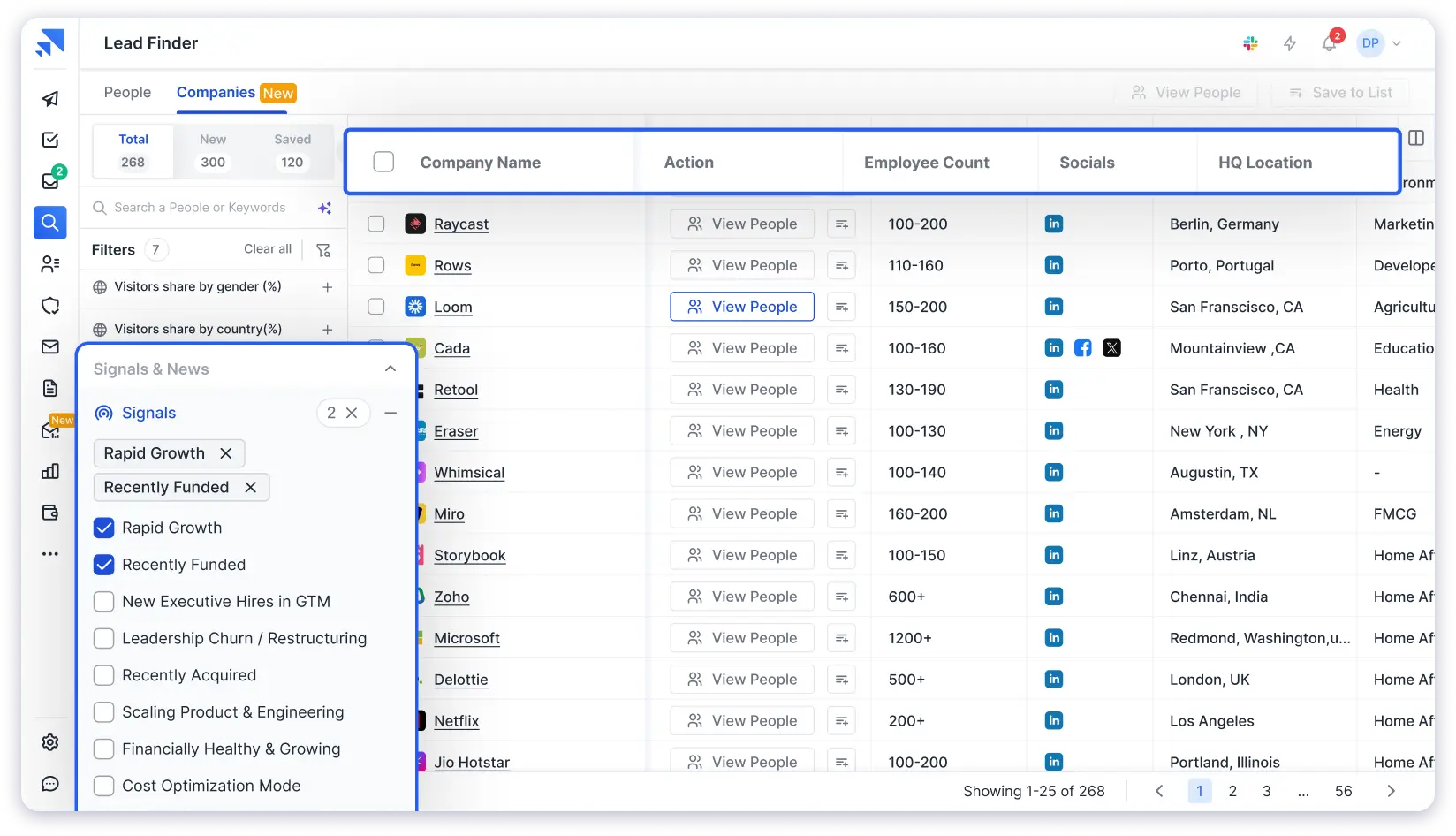
What I found particularly useful is that Saleshandy supports both outbound prospecting and account-based workflows.
The Company tab lets you build target account lists using firmographic, technographic, and intent signal filters, while the Look Alike feature helps you find similar companies that match your ICP.
From there, you can map decision-makers within those accounts and reach out directly.
In other words, you get the signal, verified contact data, and cold email outreach all in one platform. There’s no need to pipe intent data from one tool into another just to send a first email.
- 800M+ verified B2B contacts from 60M+ companies
- Dedicated Company tab with company level search and Look Alike functionality
- 75+ advanced search filters covering firmographics, technographics, and intent signals
- AI powered lead search where you describe your ideal prospect in plain English
- Waterfall enrichment from multiple trusted data providers
- Real time email verification with no credit charged if the email does not verify
- Find, enrich, and add to a cold email sequence without leaving the platform
- Kanban based CRM to track prospect progress after outreach
- Does not track web content consumption or topic level research surges like Bombora
- Intent signals focus on company actions rather than publisher network behavior
- No predictive buying stage scoring like 6sense
Pricing
• Starter: $34/mo (billed annually) — 18,000 credits/year, 60+ search filters
• Pro: $76/mo (billed annually) — 48,000 credits/year, 70+ filters including all intent signals
• Scale: $149/mo (billed annually) — 96,000 credits/year, 70+ filters, unlimited users
• Enterprise: Custom, credits sized to your volume
Sales teams, SDRs, founders, and agencies that want real time intent signals layered on verified contact data. Works well for outbound prospecting and account based workflows with cold email built directly into the platform.
2. Bombora
Bombora pioneered the third-party intent data category and still leads it.
It operates a co-op of 5,000+ B2B publisher websites that share anonymized content consumption data, and when accounts research specific topics above their historical baseline, Bombora flags the surge through its Company Surge® scoring.
Worth noting here is that many platforms, including 6sense, Cognism, and Demandbase, actually license Bombora’s data as part of their own offerings
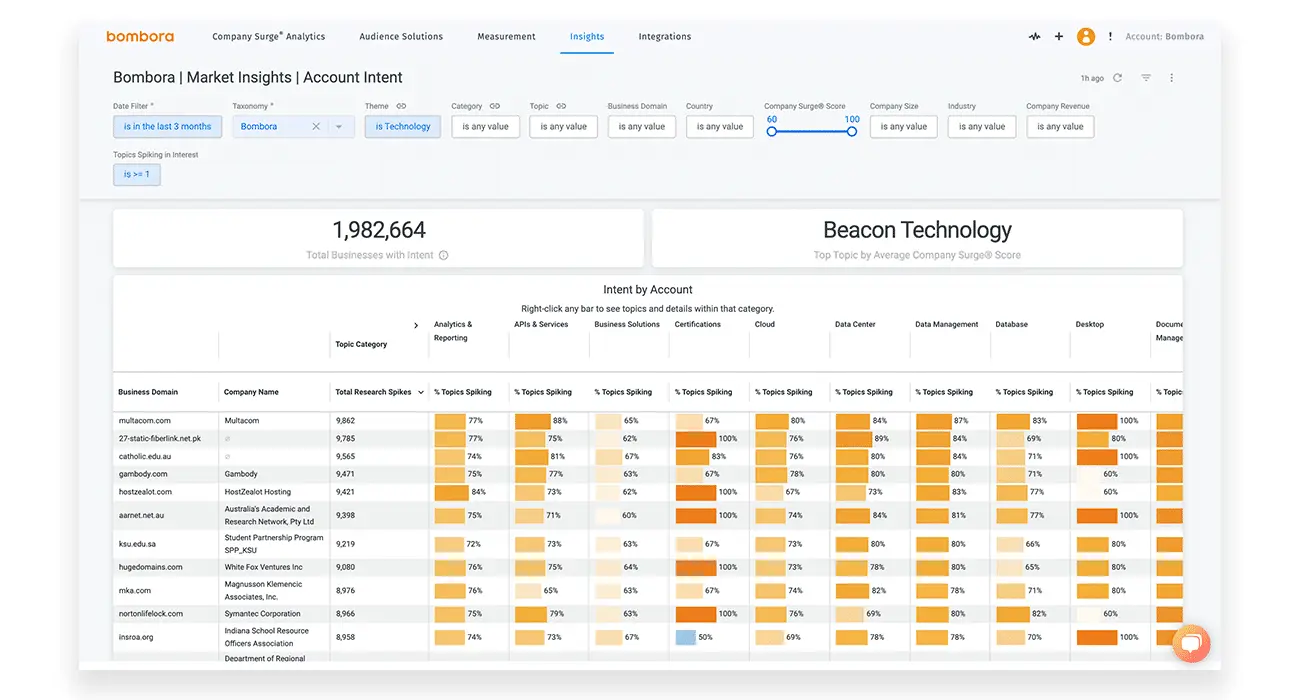
So in many cases, the intent data you’re paying for elsewhere originates from Bombora anyway.
That said, Bombora is strictly a data provider. It doesn’t include an outreach tool, CRM, or sequences. You get the signals and integrate them into whatever stack you already use.
- Company Surge® scores flag accounts researching topics above their historical baseline
- Co op network spans 5,000+ B2B publisher sites
- 12,000+ intent topics available for targeting
- Integrates with most major CRMs, ABM platforms, and sales engagement tools
- Topic taxonomy covers specific product categories, competitors, and industry themes
- Only provides account level signals and does not identify specific contacts
- You need additional tools to act on the signals since there is no outreach or CRM built in
- Pricing puts it out of reach for most SMBs and small outbound teams
Pricing
- ~$25,000–$300,000+/yr
- Varies by data volume, topics tracked, and integrations
- Not publicly listed and requires a sales conversation
Marketing teams and enterprises that want raw third party intent signals to feed into their existing ABM platforms, CRMs, or sales intelligence tools.
Also Read: Best sales intelligence tools
3. 6sense
6sense uses AI to predict buying stages of target accounts by pulling intent data from multiple sources and combining it with engagement signals to prioritize accounts and automate targeting.
In fact, Gartner has named it a Magic Quadrant Leader for ABM five years running.
From what I’ve seen, 6sense is easily one of the most comprehensive platforms in this space.

However, that power comes at a cost, both in terms of pricing and setup complexity. If your team has the budget and dedicated ops resources to run it properly, it’s hard to match.
- Predicts buying stage of accounts using AI
- Pulls multi source intent from content consumption, search behavior, and engagement
- Prioritizes and scores accounts automatically
- Orchestrates campaigns and personalizes outreach
- Uncovers dark funnel activity that does not show up in your CRM
- Requires heavy setup and onboarding and is not a plug and play tool
- Steep pricing makes it impractical for small or mid size teams
- Complexity can be overkill if you just need signals for daily prospecting
Pricing
- ~$60,000–$300,000+/yr (enterprise contracts)
- Custom pricing based on account volume and features
- Not publicly listed
Enterprise ABM teams running predictive campaigns across marketing and sales with large budgets and dedicated ops resources.
4. Demandbase
Demandbase combines intent data with account-based advertising, sales intelligence, and campaign orchestration.
It identifies in-market accounts and then activates campaigns across ads, web, and sales channels from one platform.
What stood out to me is how tightly the intent data connects to the ad orchestration layer.
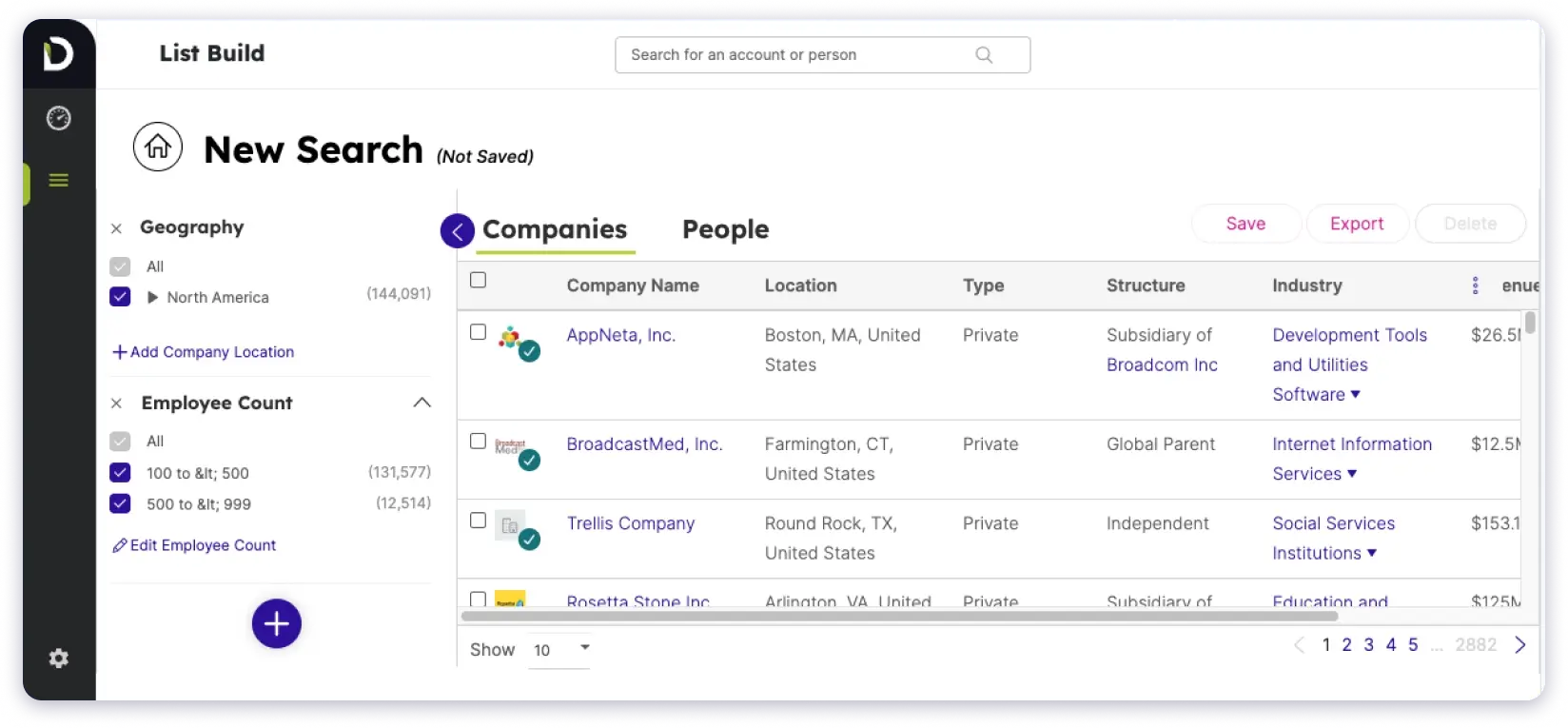
So if your team runs account-based ads alongside outbound, Demandbase really shines compared to the other providers on this list.
- Combines multi source intent data with identity resolution
- Includes account based B2B advertising built in
- Identifies accounts in real time
- Orchestrates campaigns across ads, web, and sales channels
- Integrates with major CRMs and marketing automation tools
- Primarily built for marketing teams and less practical for SDRs doing daily outbound
- Complex platform with a meaningful learning curve
- Expensive for teams not running ABM at scale
Pricing
- ~$50,000+/yr (custom)
- Depends on modules, account volume, and ad spend
- Not publicly listed
Global B2B organizations running ABM with advertising, intent, and orchestration across multiple regions and teams.
Check out our B2B data providers comparison.
5. ZoomInfo
ZoomInfo is one of the largest B2B sales intelligence platforms, combining a massive contact database with built-in intent signals from multiple sources including review sites, publisher data, and partner integrations.
The database is huge, and the brand recognition speaks for itself.
That said, intent accuracy and pricing complexity are the two issues that come up most in user reviews.
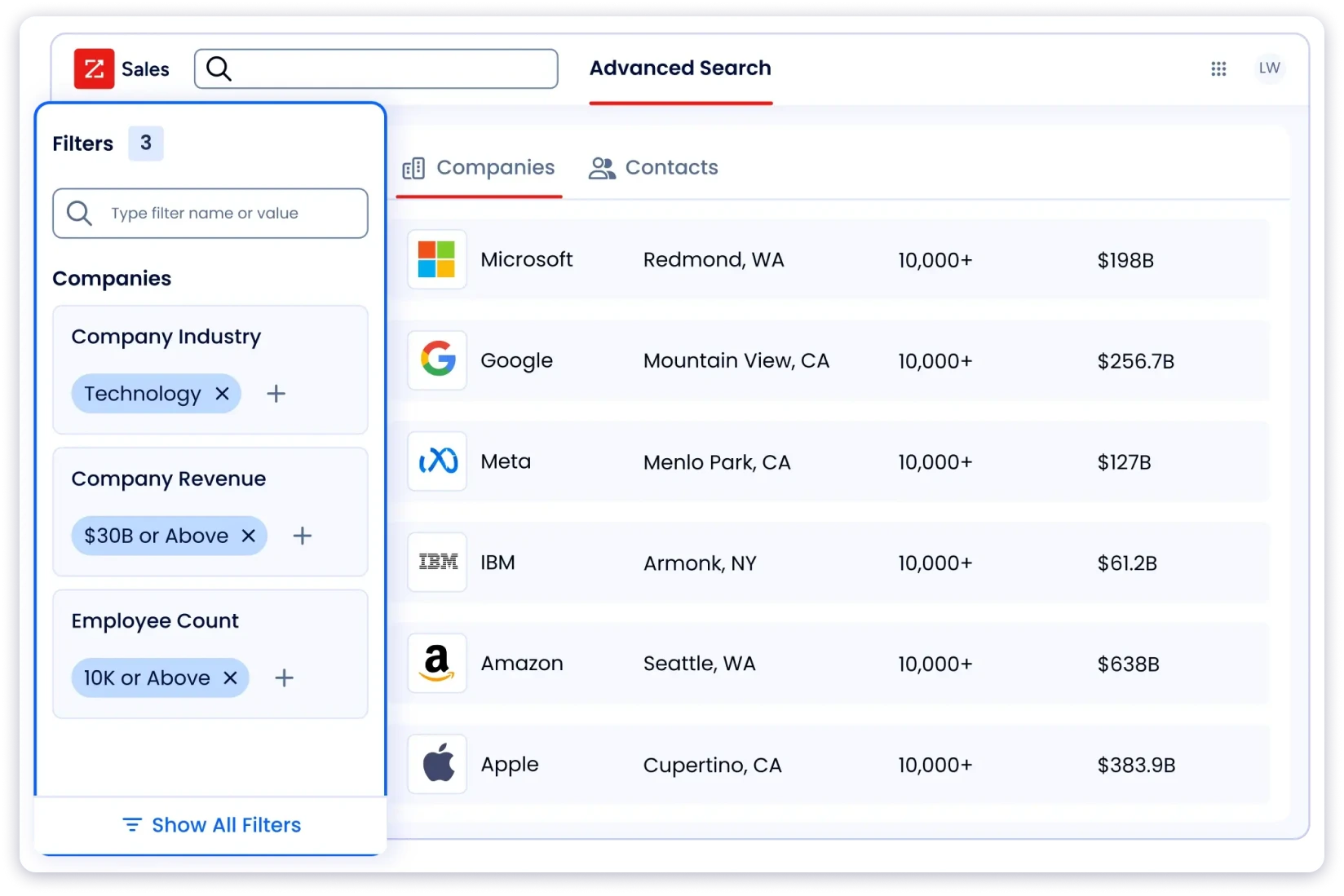
It’s worth keeping that in mind if you’re evaluating ZoomInfo against newer, more affordable alternatives.
- 200M+ contacts with firmographic, technographic, and intent data
- Pulls intent signals from multiple sources
- Enriches and verifies data in real time
- Offers 30+ advanced search filters
- Automates workflows and integrates with major CRMs
- Sends buyer intent alerts and scores accounts
- Gets expensive fast for small teams as pricing scales with seats
- Intent accuracy gets mixed reviews on G2
- Pricing structure includes variable costs per feature
- Phone number accuracy can be inconsistent in some regions
Pricing
- ~$15,000+/yr (custom per seat)
- Locks intent features behind higher-tier plans
- Not publicly listed and requires a sales conversation
Enterprise sales and outbound teams that need a large contact database combined with intent signals and CRM integrations at scale.
If you’re evaluating options, here’s a deeper look at ZoomInfo alternatives.
6. Cognism
Cognism partners with Bombora to deliver intent data alongside its own sales intelligence platform.
It’s especially strong in European and global markets, with solid GDPR compliance and phone-verified Diamond Data® contacts.
That said, one thing worth understanding is that Cognism doesn’t generate its own intent data.

It layers Bombora’s Company Surge® signals on top of its own contact database, which isn’t necessarily a weakness but does mean the intent signals are essentially the same ones you’d get from Bombora directly.
- Delivers Bombora powered Company Surge® intent data
- Provides phone verified Diamond Data® contacts with reportedly 3x better connect rates
- Supports 12 intent topics per account refreshed quarterly
- Maintains strong GDPR and CCPA compliance
- Integrates with Salesforce, HubSpot, and other CRMs
- Offers a browser extension for LinkedIn prospecting
- Sources intent data from Bombora and not proprietary data
- Limits you to 12 intent topics per account
- Does not offer first party website visitor intent tracking
- Pricing sits out of reach for most SMBs
Pricing
- ~$20,000+/yr (custom per user)
- Two plans: Grow (email + phone data) and Elevate (adds intent + signals)
- Makes intent data available only on the Elevate package
- Not publicly listed
Teams targeting European and global prospects who need compliant, phone verified contact data with Bombora intent signals layered in.
For more options in this space, check out Cognism alternatives.
7. Apollo.io
Apollo.io combines a B2B contact database with intent signals, engagement tools, and sequences in one platform, making it probably the most accessible entry point for teams that want intent data without enterprise pricing.
The free plan is genuinely useful for testing.
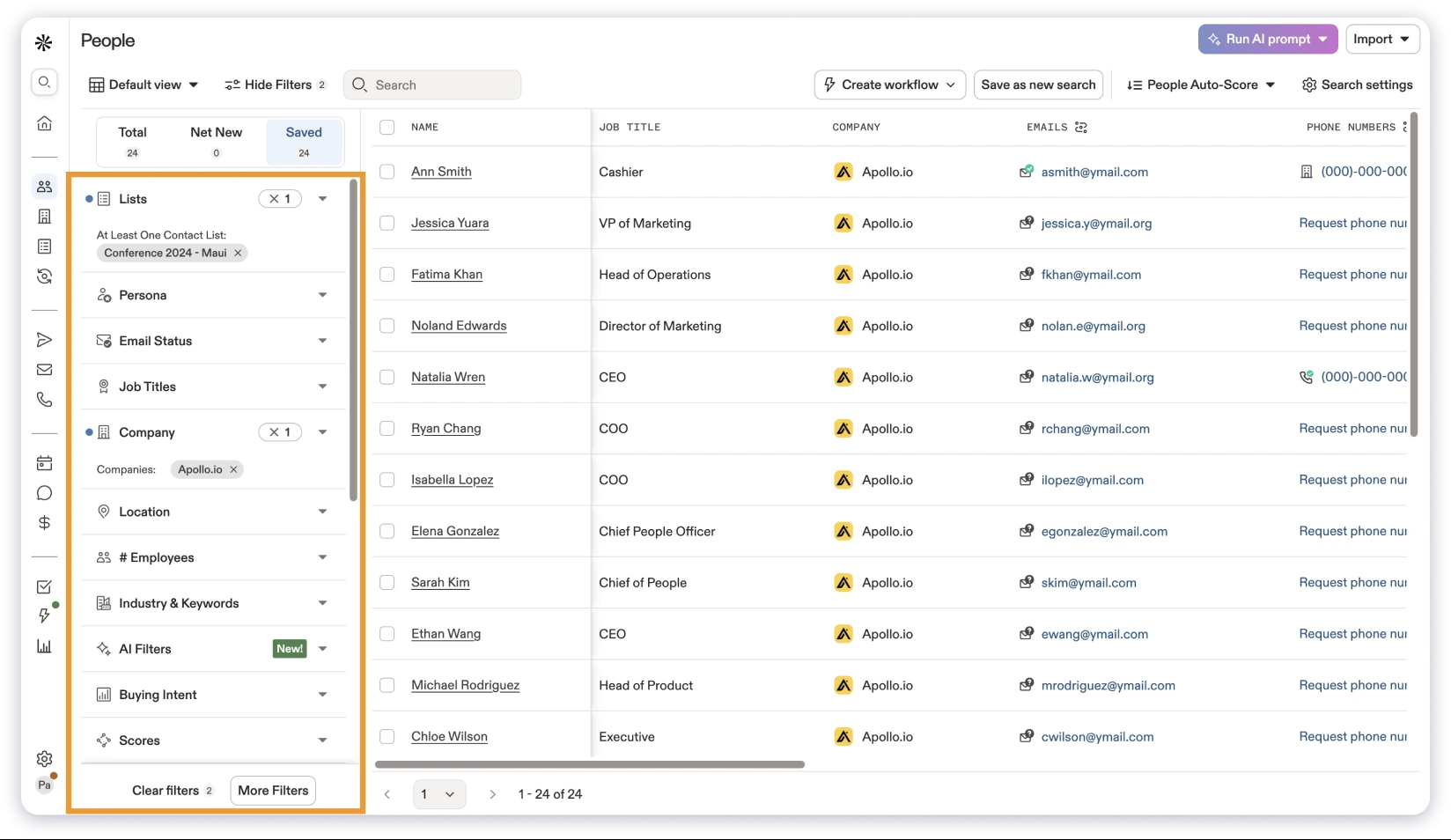
The intent signals aren’t as deep as what you’d get from Bombora or 6sense, but for the price, Apollo covers the basics well enough to get started.
- 210M+ contacts with firmographic and intent data
- Tracks buying intent signals and job change alerts
- Includes built in email sequences and multi channel outreach
- Provides a CRM with deal tracking and pipeline management
- Offers a free plan with 100 credits per month
- Database is significantly smaller than Saleshandy
- Phone number accuracy gets mixed reviews on G2
- Credits expire with no rollover unlike Saleshandy
- Locks intent features behind higher tier plans
- Variable credit costs make budgeting unpredictable
Pricing
- Free plan: 100 credits/month + basic sequences
- Basic: $49/user/mo (billed annually) — 5,000 credits/year
- Professional: $79/user/mo (billed annually) — 10,000 credits/year
- Organization: $119/user/mo (billed annually, min 3 users) — 15,000 credits/year
SMBs and startups that want contact data, intent signals, and outreach in one platform at an affordable price point.
If you’re exploring options, here’s a comparison of Apollo alternatives.
8. Dealfront (formerly Leadfeeder)
Dealfront (formerly Leadfeeder) identifies anonymous website visitors and connects IP addresses to specific companies, with a strong focus on European markets, regional compliance, and localized datasets.
Unlike the other providers on this list, Dealfront captures purely first-party intent.
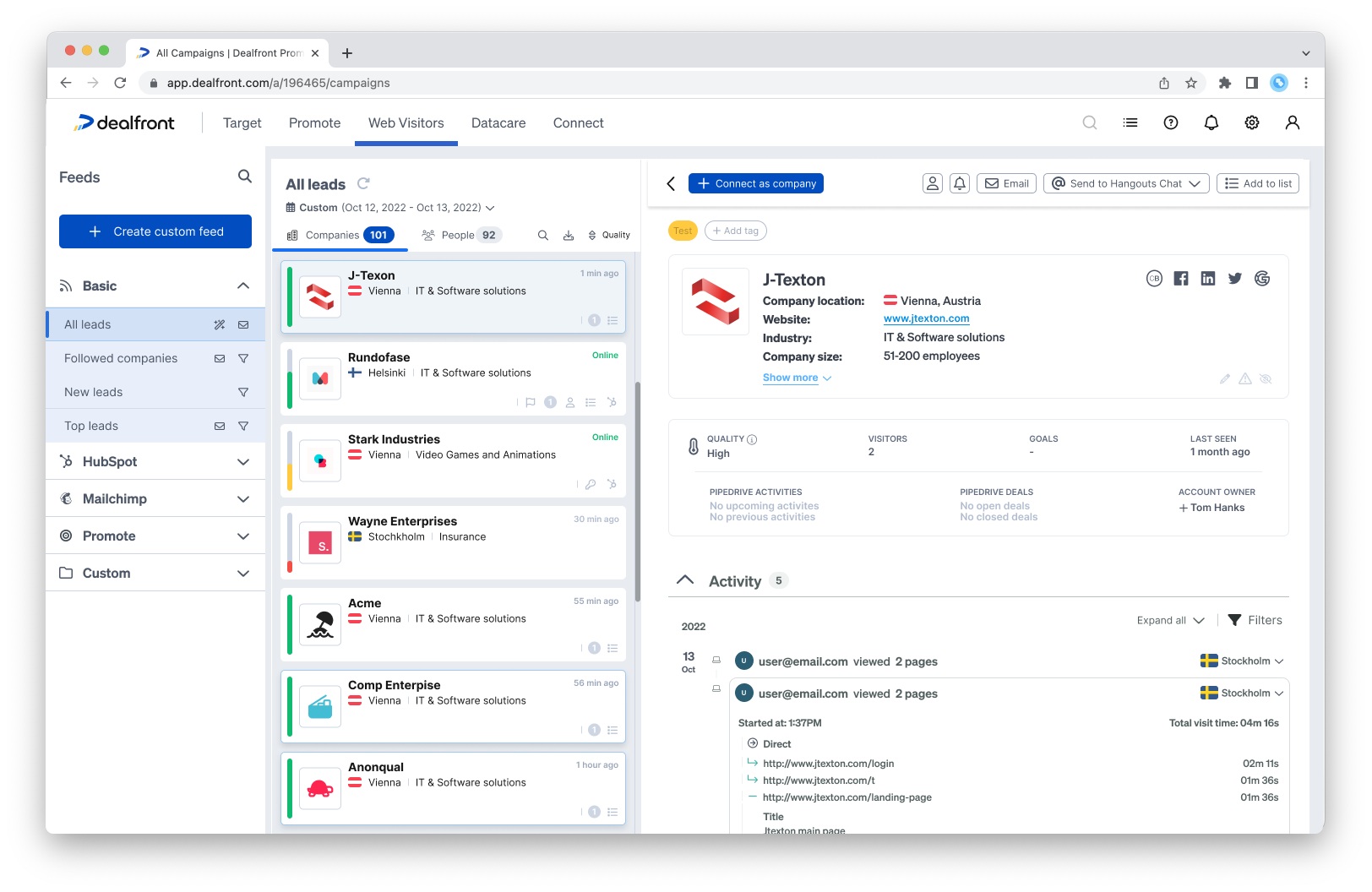
It tracks who visits your website rather than what companies research across the broader web, which makes it a different kind of tool altogether.
- Identifies website visitors via IP matching
- Tracks company level visits with page level detail
- Focuses on European markets with built in EU compliance
- Offers a free tier to get started
- Integrates with major CRM platforms
- Only tracks first party intent from your own website visitors
- Provides no third party content consumption signals
- Delivers limited value if your website traffic is low
- Identifies companies only and not individual contacts
Pricing
- Free plan available with limited features
- Paid plans start from ~€99/mo
- Custom pricing for enterprise
EU based SMBs and mid market teams that want fast, low lift visibility into anonymous website visitors without enterprise complexity.
Check out our list of best sales prospecting tools.
Final Verdict
I’ve compared 8 of the best B2B intent data providers across signal types, pricing, and real-world fit for different GTM motions.
By now, you should have a clear picture of which provider aligns with your team’s workflow and budget.
That said, if you’re still unsure where to start, I’d recommend going with Saleshandy. Here’s why:
- 10 real-time intent signal filters that surface companies actively funding, hiring, restructuring, or scaling
- 800M+ verified B2B contacts from 60M+ companies with 75+ advanced search filters
- Prospecting, enrichment, cold email sequences, and CRM all built into one platform
- Starts at $34/mo, so you’re not locked into a $15K+ annual contract
- 7-day free trial with 5 free credits and no credit card required
FAQs
1. What are B2B intent data providers?
B2B intent data providers track and deliver signals about which companies are actively researching products or services in your category.
These signals come from content consumption across publisher networks, website visits, search behavior, or company-level actions like funding and hiring activity.
Sales and marketing teams use this data to prioritize accounts that are more likely to convert rather than prospecting blind.
2. What’s the difference between intent data and buying signals?
Intent data is a broad category that covers any behavioral signal indicating purchase interest.
Content-based intent tracks what companies read across publisher networks. Bombora is the classic example.
Action-based intent (sometimes called buying signals) tracks company-level events like funding rounds, executive hires, M&A activity, or rapid growth. These indicate a buying window is opening.
Both are types of intent data. Providers like Saleshandy focus on action-based intent signals, while providers like Bombora focus on content consumption signals.
3. Which intent data provider is best for small outbound teams?
Saleshandy and Apollo.io are the most practical starting points for small teams with limited budgets.
Saleshandy starts at $34/mo with 10 intent signal filters, an 800M+ contact database, and cold email built in.
Apollo offers a free plan with basic intent signals and sequences.
Enterprise platforms like 6sense ($60K+/yr) and Demandbase ($50K+/yr) are typically too expensive and complex for teams with fewer than 10 reps.
4. Can I use multiple intent data providers together?
Yes, and many mature revenue teams do exactly this.
A common approach: combine one content consumption provider (like Bombora) for early-stage account identification with an action-based intent tool (like Saleshandy) for outbound execution and timing.
Some teams also layer in website visitor identification (Dealfront) or product review intent (G2).
The key is making sure the signals feed into a single workflow so your team can actually act on them without tab-switching.
5. How much do intent data providers typically cost?
Pricing ranges widely depending on the provider type.
Free tiers are available from Apollo.io and Dealfront. Saleshandy’s starts at $34/mo with intent signals included on the Lead Pro plan at $79/mo.
Mid-range platforms like ZoomInfo and Cognism typically start at $15K–$20K/yr with custom per-seat pricing.
Enterprise ABM platforms like 6sense and Demandbase can run $50K–$300K+/yr depending on features, account volume, and contract length.
6. What’s the difference between first-party and third-party intent data?
First-party intent data comes from behavior on your own properties. Website page visits, form fills, content downloads, and email engagement. Tools like Dealfront capture this by identifying anonymous website visitors.
Third-party intent data tracks behavior across external publisher networks and content sites. Bombora’s co-op of 5,000+ B2B sites is the most well-known example.
First-party signals are higher quality because you know exactly who interacted and what they did. But they’re limited in reach since you only see accounts that have already found you.
Third-party signals catch buyers earlier in the research cycle, before they ever visit your site.
7. How do outbound teams use intent data to book more meetings?
Outbound teams use intent data to decide which accounts to reach out to and when.
Instead of blasting a generic list, you target companies that are actively researching your category or showing intent signals like new funding, executive hires, or rapid growth.
Tools like Saleshandy let you filter by these intent signals, find verified contacts at those companies, and add them directly to a cold email sequence from one platform.
The result: better timing, more relevant outreach, and higher reply rates compared to cold prospecting without any signal data.


![9 Best Firmographic Data Providers for B2B Teams [2026]](https://www.saleshandy.com/blog/wp-content/uploads/2026/03/Firmographic-Data-Providers-for-B2B-Teams.webp)