


 Anil Salvi
 Contents
- 1 Target Market Segmentation – TOC
- 2 TL;DR: Quick Overview
- 3 What Is Target Market Segmentation?
- 4 Why B2B Teams Struggle Without a Target Market Segmentation
- 5 4 Types of Market Segmentation (With B2B Examples)
- 6 How to Build a Target Market Segmentation Framework
- 7 Target Market Segmentation Examples for B2B
- 8 Common Mistakes B2B Teams Make in Segmentation
- 9 How to Find Verified Contacts Inside Your Target Segment
- 10 Stop Targeting Everyone. Start Closing the Right Ones
- 11 FAQs on Target Market Segmentation
- 11.1 1. What is the difference between market segmentation and target market?
- 11.2 2. What are the 4 main types of market segmentation?
- 11.3 3. How do you identify your target market in B2B?
- 11.4 4. How does market segmentation help cold email outreach?
- 11.5 5. How many segments should I start with?
- 11.6 6. What tools can help with B2B market segmentation?
Most B2B teams describe their target market like this: “mid-sized companies that need lead generation.”
That’s not a target market. It’s a guess.
Target market segmentation turns that guess into something actionable.
It breaks a broad market into specific groups based on industry, company size, job role, buying signals, and the problems they’re trying to solve.
Without it, your emails reach the wrong people, your messaging feels generic, and your pipeline fills with leads that never convert.
In this guide, you’ll learn the four types of B2B market segmentation and a step-by-step framework to build your own segments.
Target Market Segmentation – TOC
- TL;DR: Quick Overview
- What Is Target Market Segmentation?
- Why B2B Teams Struggle Without a Target Market Segmentation
- 4 Types of Market Segmentation (With B2B Examples)
- How to Build a Target Market Segmentation Framework
- Target Market Segmentation Examples for B2B
- Common Mistakes B2B Teams Make in Segmentation
- How to Find Verified Contacts Inside Your Target Segment
- Stop Targeting Everyone. Start Closing the Right Ones
- FAQs on Target Market Segmentation
TL;DR: Quick Overview
1. Target market segmentation breaks a broad market into smaller groups based on company attributes, job roles, behaviors, and pain points.
2. It improves reply rates, deliverability, and deal quality by ensuring outreach reaches the right prospects.
3. The four main segmentation types are firmographic, demographic, behavioral, and psychographic.
4. Effective B2B segments combine company attributes, decision-maker roles, and buying signals.
5. The best starting point is analyzing your highest-value existing customers to identify patterns.
6. A good outbound segment usually contains 500–5,000 prospects to balance focus and scale.
7. Start with one segment, test your outreach, then scale what works.
What Is Target Market Segmentation?
Target market segmentation is the process of dividing a broad market into smaller, clearly defined groups.
Each group shares specific characteristics, such as industry, job title, company size, buying behavior, or pain points.
The idea is simple, which is that every prospect is not the right prospect. Segmentation helps you figure out which ones are.
In B2B, this matters more than most people realize.
A CFO at a 50-person SaaS company has very different priorities than a VP of Sales at a 500-person IT services firm.
If you treat them the same way, both will ignore you.
Why B2B Teams Struggle Without a Target Market Segmentation
Most outbound teams skip proper segmentation because it feels like extra work.
But here’s what actually happens when you skip it:
- Low Reply Rates: Your message doesn’t speak to a specific pain.
- Poor Deliverability: Bulk, untargeted emails get marked as spam.
- Wasted Opportunities: Reps end up chasing leads that were never a good fit.
I’ve watched founders spend three months running cold email campaigns with solid open rates and near-zero replies.
Once they segmented their list and adjusted the messaging per segment, replies picked up within two weeks.
Segmentation isn’t the exciting part of outbound. But it’s the part that makes everything else work.
4 Types of Market Segmentation (With B2B Examples)
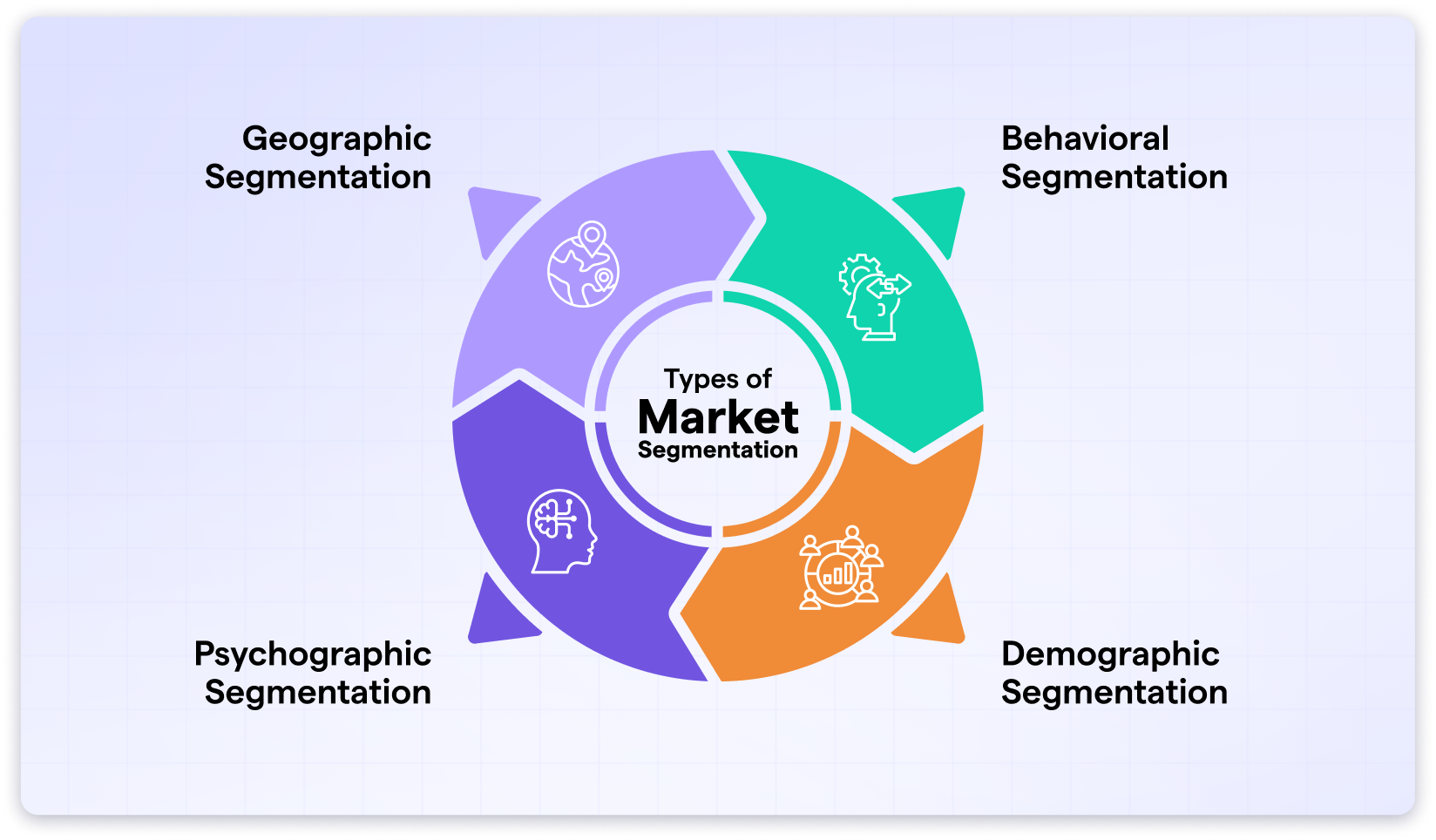
Most B2B teams use a combination of these four types. Here’s what each one means in practice.
1. Firmographic Segmentation
This is the most common starting point for B2B.
Firmographics are company-level attributes, similar to demographics, but for businesses.
Based On:
- Industry (SaaS, IT services, agencies, manufacturing, etc.)
- Company size (headcount or revenue)
- Geography (country, city, region)
- Business model (B2B vs B2C, product vs service)
- Tech stack (what tools they already use)
B2B Example: Targeting SaaS companies with 50–200 employees in the US that use HubSpot.
This segment tells you the company is likely revenue-focused, has a sales team, and is already investing in outbound tools.
2. Demographic Segmentation
In B2B, demographics means the people inside those companies, not the companies themselves.
Based On:
- Job title and seniority (VP, Director, Founder, Head of…)
- Department (Sales, Marketing, RevOps, IT)
- Years of experience
- Decision-making authority
B2B Example: Targeting VPs of Sales or Heads of Growth at mid-market SaaS companies.
These are the people with budget authority and enough context to evaluate your solution quickly.
3. Behavioral Segmentation
This is where outbound gets really specific.
Behavioral signals tell you what a company is doing right now, not just what it looks like.
Based On:
- Recent funding rounds (companies that just raised are hiring and spending)
- Active hiring in a specific department (e.g., hiring 5+ SDRs = scaling sales)
- Tech stack changes (just switched CRM or added a new tool)
- Content engagement or buying signals
- News and announcements
B2B Example: Targeting SaaS companies that raised a Series A in the last 90 days and are actively hiring SDRs.
This tells you they have money, are building a sales team, and almost certainly need tools to support outbound.
4. Psychographic Segmentation
This one is harder to measure, but incredibly useful for messaging.
Psychographics describe the mindset, goals, and pain points of your target personas.
Based On:
- What are they trying to achieve? (faster pipeline, more meetings, better deliverability)
- What are they frustrated by? (missed follow-ups, stale data, long sales cycles)
- What do they value? (simplicity, scalability, cost-efficiency)
- What risks do they worry about?
B2B Example: Founders at early-stage SaaS companies who are doing outbound themselves and need a simple, affordable tool, not an enterprise platform.
They care about ease of use and speed to results over feature depth.
How to Build a Target Market Segmentation Framework
Here’s the step-by-step process I’d recommend for any B2B outbound team.
- Step 1: Start with Your Best Existing Customers
- Step 2: Define Your Segmentation Criteria
- Step 3: Validate the Segment Size
- Step 4: Map Your Messaging to the Segment
- Step 5: Test, Then Scale
Step 1: Start with Your Best Existing Customers
Don’t guess. Look at the data you already have.
Pull your top 10–15 customers, the ones who:
- Converted fastest
- Have the lowest churn
- Gave you the most referrals
- Get the most value from your product
Look for patterns like:
- What industry are most of them in?
- What’s their typical company size?
- What job title do they hold?
- What problem were they trying to solve when they found you?
This is the foundation of your ideal customer profile.
Step 2: Define Your Segmentation Criteria
Once you have patterns from Step 1, translate them into filters.
For most B2B outbound teams, a solid starting segment looks like this:
- Industry: [e.g., SaaS]
- Company size: [e.g., 50–200 employees]
- Geography: [e.g., US-based]
- Job title: [e.g., VP Sales, Head of Growth]
- Behavioral signal: [e.g., actively hiring SDRs]
Don’t over-segment early. Pick 2–3 firmographic filters and 1–2 behavioral signals.
That’s enough to build a focused, testable segment.
Step 3: Validate the Segment Size
A segment that’s too small won’t give you enough volume to build a pipeline.
A segment that’s too broad puts you back to square one.
Before you invest time writing a sequence or building a list, check: how many prospects actually exist in this segment?
Somewhere between 500 and 5,000 verified prospects is a good working size for most outbound campaigns.
Step 4: Map Your Messaging to the Segment
Different segments care about different things.
A 10-person agency doesn’t care about “enterprise scalability.”
A VP of Sales at a 300-person company doesn’t want to hear about how easy the tool is to set up.
For each segment, define:
- The core pain they’re experiencing
- The outcome they want
- The hook that makes them open your email
If you want to learn how to write copy that resonates per segment, this guide on how to write a cold email walks through it in detail.
Step 5: Test, Then Scale
Don’t build 10 segments on day one.
Pick one segment. Run a small campaign of 200 to 300 prospects. See what your open rate, reply rate, and positive reply rate look like.
If it’s working, scale it. If it’s not, adjust the segment criteria or the messaging, not both at once.
This is how you build a predictable outbound process instead of a guessing game.
Target Market Segmentation Examples for B2B
Here’s how segmentation turns a broad market into targeted outreach that actually gets replies.
Example 1: Cold Email Tool Targeting Agencies
Market: Marketing agencies
Segment: US-based agencies with 10–50 employees currently hiring a Lead Generation Specialist.
Cold Email Template:
Subject: Saw you’re hiring for lead gen
Hi {{FirstName}},
Noticed you’re hiring a Lead Generation Specialist.
Many agencies we work with hit the same bottleneck — outreach volume grows, but managing campaigns becomes messy.
We built a tool that helps agencies book more meetings without adding more SDRs.
Worth sharing how it works?
Example 2: IT Services Targeting SaaS Companies
Market: SaaS companies
Segment: B2B SaaS companies with 100–500 employees that raised funding recently.
Cold Email Template:
Subject: Quick idea for your Salesforce setup
Hi {{FirstName}},
Congrats on the recent funding round.
Many SaaS teams scaling with Salesforce run into CRM complexity as their pipeline grows.
We’ve helped similar teams simplify integrations and improve pipeline visibility.
Would it be helpful if I shared how they approached it?
Example 3: Prospecting Tool Targeting Founder-Led Sales
Market: SaaS founders
Segment: B2B SaaS founders with <20 employees
Subject: Saw your post on cold outreach
Hi {{FirstName}},
I came across your LinkedIn post about outbound.
A lot of founder-led teams we talk to are trying to book meetings without building a full SDR team yet.
We built a simple way to find verified prospects and run outreach without extra tools.
Happy to share what’s been working for similar founders.
To see what a clearly defined segment actually looks like, check out these target market examples.
Common Mistakes B2B Teams Make in Segmentation
I’ve seen these come up repeatedly, and most of them are easy to avoid once you know what to look for.
- Mistake 1: Calling a Market a Segment
- Mistake 2: Building Segments From Gut Feeling Instead of Data
- Mistake 3: Using Only Firmographic Filters
- Mistake 4: Running Too Many Segments at Once
- Mistake 5: Setting Segments Once and Forgetting Them
Mistake 1: Calling a Market a Segment
“Companies that need lead generation” is not a segment.
It’s a description of your entire market.
A segment needs to be specific enough that you can write one email that genuinely speaks to everyone in it.
If you couldn’t do that, your segment is too broad.
Narrow it down by industry, size, or a specific signal before you build your list.
Mistake 2: Building Segments From Gut Feeling Instead of Data
Your instinct about who your best customer is often doesn’t match what your data actually shows.
Before you define a new segment, look at the customers you already have.
Who converted fastest? Who has stayed the longest? Who gave you referrals?
The patterns in your existing customer base are far more reliable than a guess.
Mistake 3: Using Only Firmographic Filters
Firmographics tell you what a company looks like.
They don’t tell you whether this is the right time to reach out.
A company might fit your ICP perfectly and still be in the middle of a hiring freeze or a product pivot.
Behavioural signals like funding activity, job postings, or tech stack changes tell you when a company is actually in buying mode.
Use both.
Mistake 4: Running Too Many Segments at Once
It’s tempting to build five or six segments on day one.
But if none of them are validated, you’re just splitting your effort across five guesses instead of one.
Start with your single best hypothesis.
Run a campaign of 200 to 300 contacts. See what happens. Then scale what works or adjust what doesn’t.
One validated segment beats five untested ones every time.
Mistake 5: Setting Segments Once and Forgetting Them
Your product changes. Your market changes.
The people who were a great fit a year ago might not be anymore.
A Good Rule of Thumb: Review your segment criteria every 90 days. Look at which ones are generating positive replies and meetings.
If a segment has gone quiet, either the messaging needs work or the criteria need updating.
How to Find Verified Contacts Inside Your Target Segment
Once you’ve defined your segments, you need actual verified contact data to act on them.
This is where most teams either get stuck or waste money buying static lists that are 40% out-of-date before the campaign even starts.
I’ve found that the cleanest approach is to use a real-time verified B2B database with enough filters to match your exact segment criteria.
Saleshandy’s Lead Finder lets you search across 800M+ verified contacts using 75+ filters, including firmographic, demographic, behavioral, and tech stack signals.
You can filter by:
- Job title and seniority
- Industry and company size
- Geography
- Revenue and funding stage
- Hiring activity and buying signals
- Tech stack (what tools they already use)
Once you build your segment, you get real-time verified email addresses and phone numbers, so your outreach starts on clean data.
After you export your list, you can plug it directly into a cold email sequence with follow-ups built in, so no prospect falls through the cracks.
Stop Targeting Everyone. Start Closing the Right Ones
Segmentation is what separates teams that send a lot of cold emails from teams that book a lot of meetings.
It’s not complicated, but it does require you to be deliberate.
Define your segment clearly. Validate it with data. Match your messaging to what that segment actually cares about.
Then find the right contacts, reach out at the right time, and follow up until you get an answer.
If you want to skip the manual part of building your list, Saleshandy Lead Finder is worth trying.
FAQs on Target Market Segmentation
1. What is the difference between market segmentation and target market?
Market segmentation is the process of dividing a broad market into smaller groups. Your target market is the specific segment (or segments) you choose to go after. Segmentation gives you the groups. Your target market is the one you focus on.
2. What are the 4 main types of market segmentation?
The four types are firmographic (company attributes), demographic (contact-level attributes), behavioural (actions and signals), and psychographic (mindset and pain points). In B2B outbound, firmographic and behavioural segmentation are the most actionable starting points.
3. How do you identify your target market in B2B?
Start by analyzing your best existing customers. Look for patterns in industry, company size, job titles, and pain points. Then, validate the segment size using a B2B lead database before committing to a full campaign.
4. How does market segmentation help cold email outreach?
When your email speaks to a specific pain point that’s relevant to a specific type of company and person, your reply rate goes up. Segmentation makes sure your message lands in the right inbox and actually resonates when it does.
5. How many segments should I start with?
Start with one. Validate it, learn from it, and scale it before adding more. Running too many segments in parallel before you have validated messaging is one of the most common reasons outbound campaigns underperform.
6. What tools can help with B2B market segmentation?
A real-time B2B lead database is the most direct tool. Saleshandy Lead Finder lets you filter 800M+ contacts by over 75 criteria so you can build a verified list that matches your exact segment in minutes.