

 Anil Salvi
 Contents
- 1 Import Export Data Providers – TOC
- 2 TL;DR- Best Import Export Data Providers at a Glance
- 3 5 Best Import Export Data Providers in 2026
- 4 How to Choose the Right Import Export Data Provider
- 5 Find the Right Import Export Data Provider for Your Business
- 6 FAQs
- 6.1 1. What Is an Import Export Data Provider?
- 6.2 2. How Do Import Export Data Providers Help Find New Buyers?
- 6.3 3. Can I Use Saleshandy Lead Finder for Import Export Business?
- 6.4 4. What Is the Difference Between Trade Data and B2B Contact Data?
- 6.5 5. Which Import Export Data Provider Gives the Most Accurate Contact Data?
Finding real buyers or suppliers is the easy part.
Everyone has a list of company names.
The hard part is getting the accurate email and direct phone number of the person who actually makes purchasing decisions.
That’s what separates a useful import export data provider from one that just gives you company names and shipment records.
I’ve reviewed 5 platforms that help with exactly this.
Each one takes a different approach, but they all solve the same core problem: helping you find the right companies and the right people to contact.
Here’s how they compare and which one fits your use case.
Import Export Data Providers – TOC
TL;DR- Best Import Export Data Providers at a Glance
- Saleshandy Lead Finder: Best for finding verified contact details of import export buyers and suppliers from an 852M+ B2B database
- Apollo.io: Best for finding buyer contacts with real-time buying intent signals
- ZoomInfo: Best for enterprise teams that need deep company intelligence alongside contact data
- Tendata: Best for combining traditional trade data with buyer and supplier contact discovery
- Dun & Bradstreet: Best for verifying international buyer/supplier credibility before making contact
| Provider | Best For | Database Size | Verified Emails | Verified Phones | Starting Price |
|---|---|---|---|---|---|
| Saleshandy Lead Finder | Finding buyers/suppliers with verified contacts | 852M+ contacts, 42M+ companies | Yes | Yes | $49/month |
| Apollo.io | Contact discovery + buying intent | 270M+ contacts | Yes | Yes | ~$49/user/month |
| ZoomInfo | Enterprise contact + company intelligence | 260M+ professionals, 100M+ companies | Yes | Yes | Contact for pricing |
| Tendata | Trade data + buyer/supplier contacts | 10B+ trade records, 850M+ contacts | Yes | Yes | Contact for pricing |
| Dun & Bradstreet | Business verification + risk intelligence | 500M+ business records | Yes | Limited | Custom pricing |
✅ Quick verdict: If your end goal is finding real buyers or suppliers with verified contact details, start with Saleshandy Lead Finder.
If you also need customs-level trade intelligence in the same platform, Tendata bridges that gap.
5 Best Import Export Data Providers in 2026
I’ve spent time evaluating each of these platforms based on what matters most for import-export businesses:
- database size
- contact accuracy
- regional coverage
whether the tool actually gives you verified emails and phone numbers, not just company names.
Here’s a closer look at each one.
1. Saleshandy Lead Finder
If you want just one tool to find accurate contact details of your target buyers or suppliers, Saleshandy Lead Finder is the strongest recommendation.
I’ve tested several import export data providers, and the biggest frustration with most of them is the gap between finding a company name and actually getting the contact details of someone you can talk to. Saleshandy Lead Finder closes that gap.
The database covers 852M+ contacts across 42M+ companies globally.
That’s not limited to any single region or industry.
Whether you’re looking for buyers in the US, the EU, the Middle East, or Southeast Asia, the coverage is wide enough to work for most import-export scenarios.
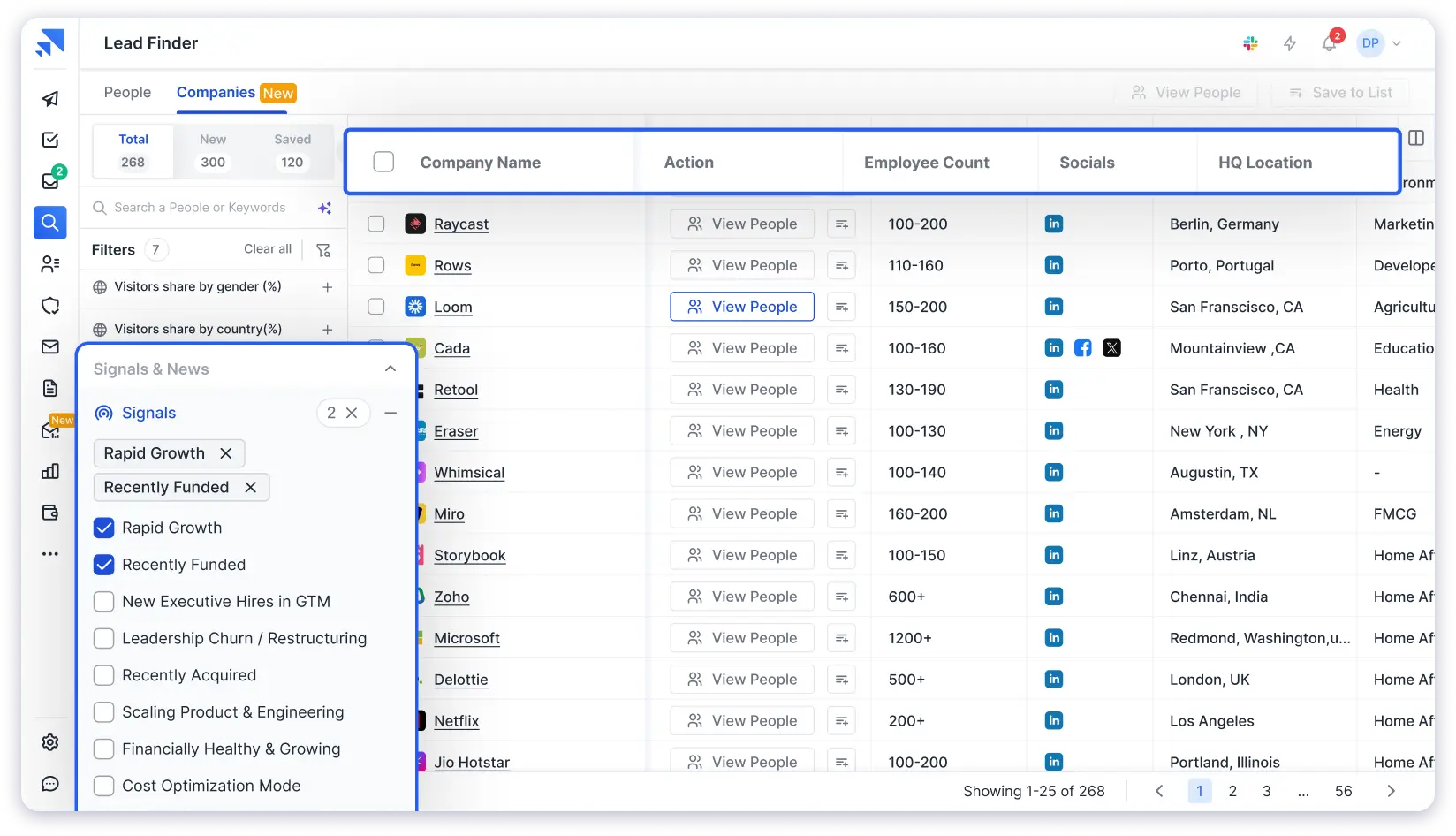
What stood out to me is the data accuracy.
Every contact goes through a waterfall enrichment process, which means the platform cross-references multiple data sources before returning a result.
This keeps email bounce rates low and gives you higher accuracy on phone numbers compared to platforms that rely on a single data source.
You do not pay credits for stale or unverified contacts.
To give you a practical example, say you’re an exporter looking for textile importers in Germany.
You can filter by industry (textiles), country (Germany), job title (procurement manager, sourcing head), company size, and revenue.
Within seconds, you get a list of real people with verified emails and direct phone numbers. No hours on LinkedIn trying to track down the right person.
I also found the AI-powered search useful. Instead of manually setting filters, you can type something like “find procurement heads at mid-size manufacturing companies in the UAE” and the tool generates a targeted list.
For import-export teams that work across multiple product categories and regions, this saves a lot of time.
Saleshandy Lead Finder – Key Features
- 852M+ B2B contacts with verified email addresses and direct phone numbers
- 42M+ company profiles covering every major industry and region
- 75+ search filters including industry, country, company size, revenue, job title, years of experience, and tech stack
- AI-powered lead search: describe your ideal buyer in plain English and get matched results instantly
- Waterfall enrichment for high data accuracy across regions
- Credits rollover: unused credits carry forward to the next month
- One-click export to CSV or directly into your CRM
Pricing:
- Lead Starter: $49/month
- Lead Pro: $79/month
2. Apollo.io
The next import export data provider on my list is Apollo.io, and it earns the spot because of one thing most contact databases don’t offer: buying intent signals.
Apollo gives you access to 270M+ contacts with verified emails and phone numbers.
That’s a solid database on its own.
But what I found most useful for import-export use cases is the ability to filter for companies that are actively researching suppliers or products in your category right now.
Instead of reaching out to every importer in a country and hoping someone responds, you can focus on companies showing real buying interest.
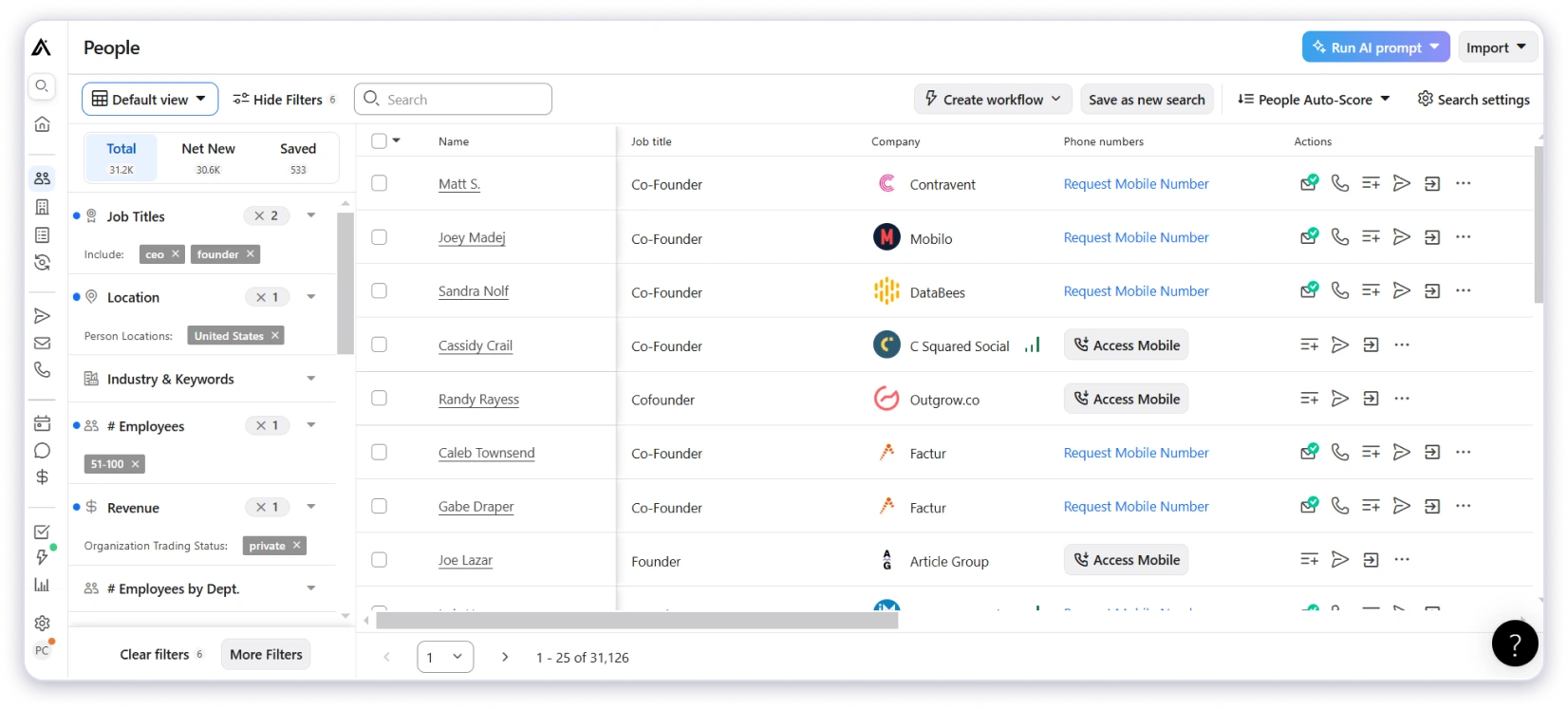
That changes the math on how many contacts you need to go through before you get a response.
I also liked the job change alerts.
In the import-export world, when a procurement head or sourcing manager moves to a new company, that’s often a window where they’re open to new supplier relationships.
Apollo catches those moments and flags them for you.
The free tier is worth trying if you want to test the data quality in your target market before committing. That said, the per-user pricing adds up fast.
If you have a team of 5 reps, you’re paying $245/month minimum, compared to a flat rate on platforms like Saleshandy.
Apollo.io – Key Features
- 270M+ B2B contacts with verified emails and phone numbers
- Buying intent data showing which companies are actively researching your product category
- Job change alerts to catch when key contacts move to new companies
- Advanced filters for industry, title, location, company size, revenue, and technology
- CRM integrations with Salesforce, HubSpot, and other major platforms
- Free tier available for small-scale testing
Pricing:
- Free tier with limited credits and basic filters
- Basic: ~$49/user/month with more credits and advanced filters
- Professional: ~$79/user/month with intent data and enhanced features
- Organization: ~$119/user/month with full feature access
3. ZoomInfo
If you’re running a larger export operation and need more than just email addresses, ZoomInfo is the enterprise-level import export data provider worth considering.
I’ve looked at ZoomInfo primarily for its depth of company-level data.
The database covers 260M+ professionals across 100M+ companies, and every profile comes with layers of context that most contact databases don’t provide.
You get org charts, funding history, technographic data, revenue estimates, and hiring trends alongside the contact details.
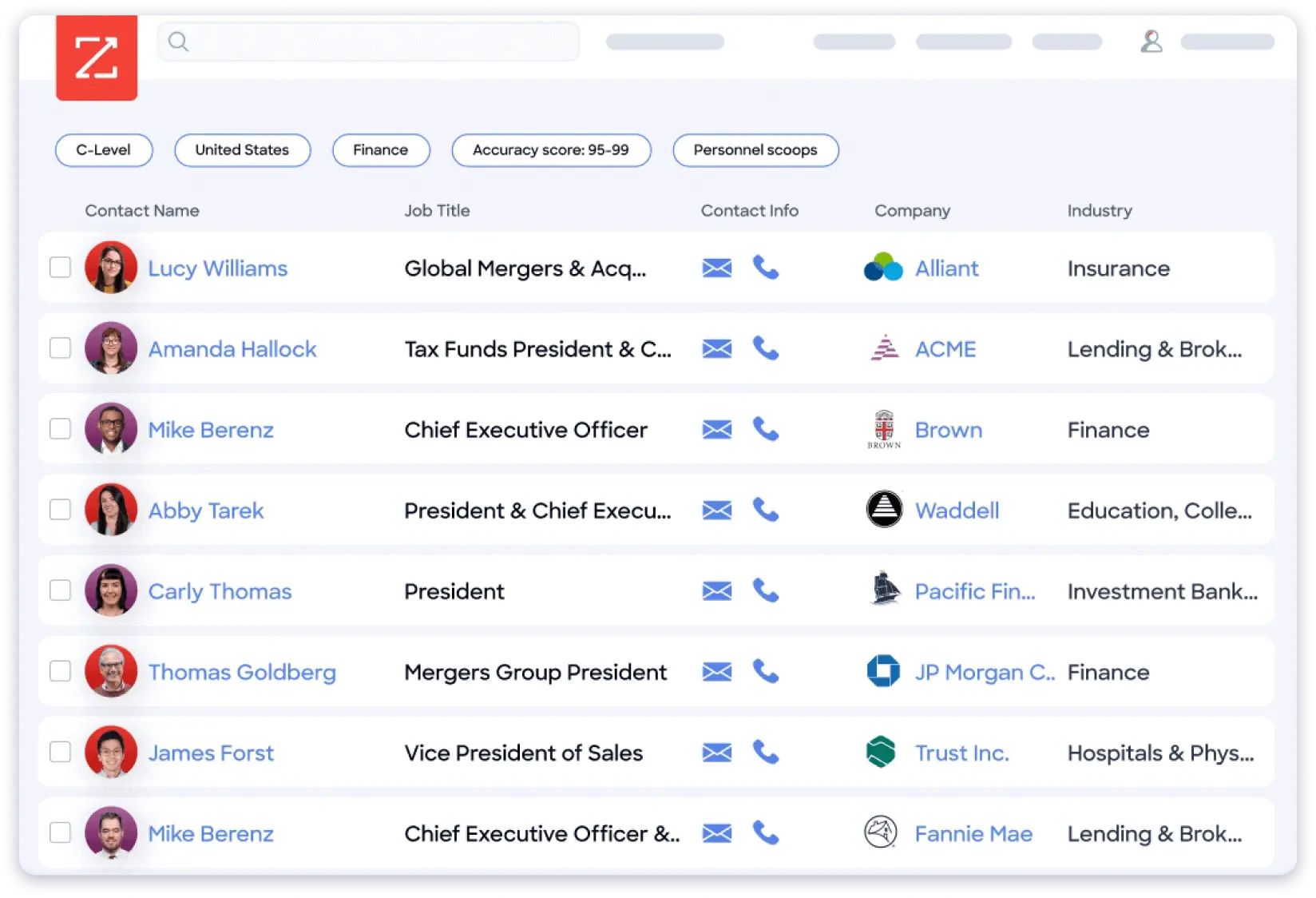
For import-export teams going after large accounts, this kind of context matters.
You’re not just finding the procurement director’s email.
You’re understanding the company’s size, growth trajectory, and organizational structure before you make the first contact.
That level of preparation makes a real difference when you’re competing with other suppliers for a large buyer’s business.
Where ZoomInfo falls short for most importers and exporters is the price.
Plans typically start around $15,000 per year with custom contracts.
That makes sense for enterprise sales teams with dedicated budgets, but it’s hard to justify for small or mid-size trading companies.
If you need verified contacts without the enterprise price tag, Saleshandy or Apollo get you there at a fraction of the cost.
ZoomInfo – Key Features
- 260M+ professional profiles with verified emails and direct phone numbers
- 100M+ company profiles with revenue, headcount, technology, and funding data
- Org charts to identify decision-makers and reporting structures
- Technographic data showing what software and tools a company uses
- Advanced search with filters for industry, title, geography, company size, and more
- Intent data on higher-tier plans showing active buying interest
Pricing:
- Custom-quoted plans, no public pricing
4. Tendata
Another import export data provider I looked at closely is Tendata, and this one is different from the others on this list because it actually bridges two worlds:
- traditional customs trade data
- B2B contact discovery
Most tools on this list give you either trade records or contact details. Tendata gives you both.
The platform covers 228 countries with 10 billion+ trade records, which puts it in the same category as traditional customs data providers.
But it also includes 850M+ buyer and supplier contacts with email addresses and phone numbers.
What I found practical about this combination is the workflow.
You can start by analyzing which companies are importing your product category in a specific market (using the customs data), and then pull up verified contact details of decision-makers at those companies (using the contact database), all within the same platform.
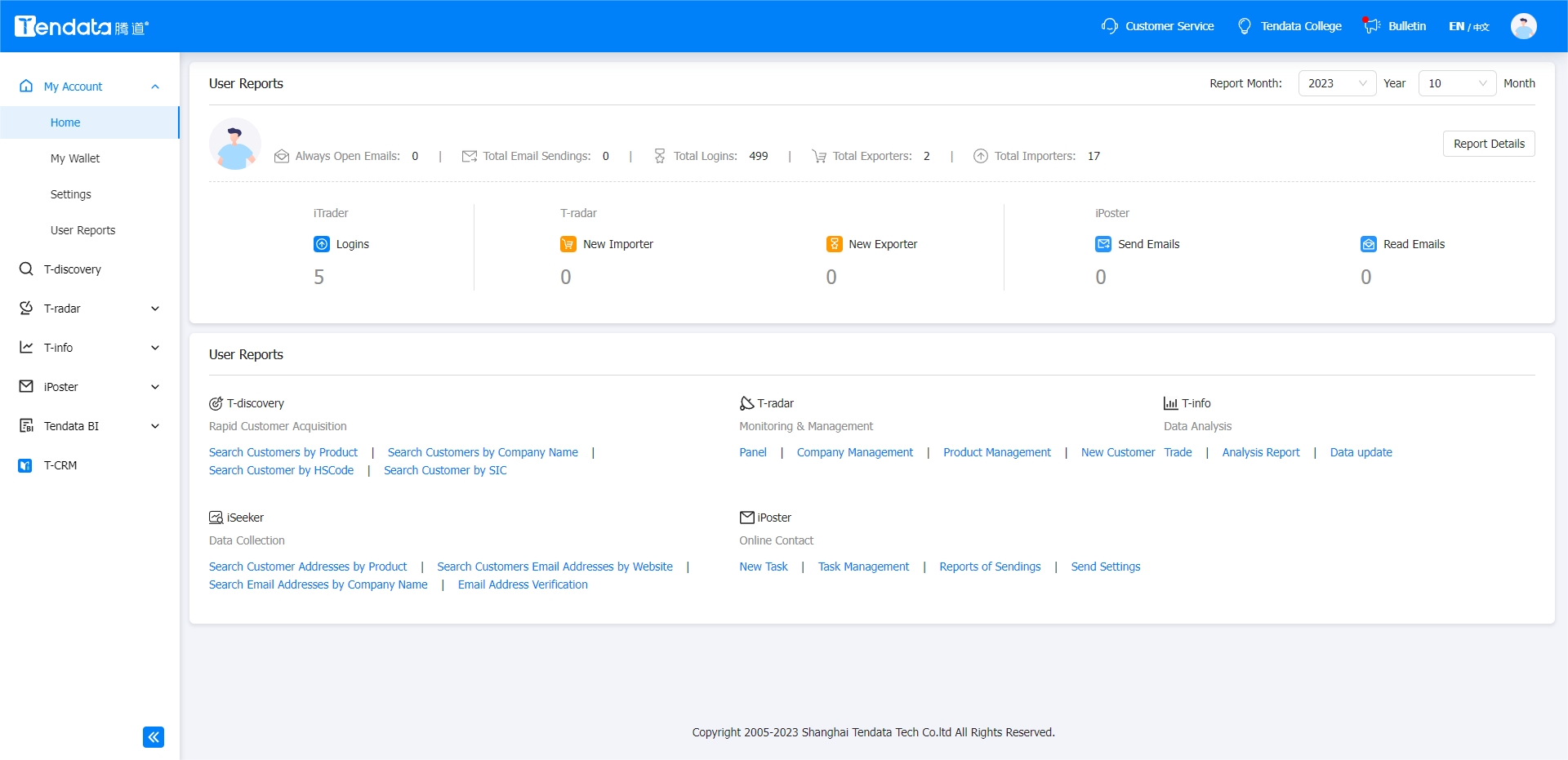
That eliminates the step where you find a company name in customs records and then have to search for contact details elsewhere.
If you’ve been through that process, you know how much time it wastes.
Tendata has also added AI-driven features for customer discovery.
You can describe your product, and the platform matches you with potential buyers based on real trade activity.
For exporters entering new markets, that’s a faster path to finding relevant contacts than manually searching through HS code data.
The downside is that pricing is not transparent. You’ll need to request a demo and negotiate based on your data access needs.
The platform can also feel complex for first-time users, so there’s a learning curve to get comfortable with both the trade data and contact sides.
Tendata – Key Features
- 10 billion+ global trade records covering 228 countries
- 850M+ buyer and supplier contacts with email addresses and phone numbers
- 500M+ company records with business profiles
- AI-powered customer discovery that matches your product to potential buyers
- Customs data with HS code search, shipment tracking, and competitor analysis
- Market trend analysis and demand forecasting tools
Pricing:
- Custom pricing based on data access and feature tier
5. Dun & Bradstreet
The last import export data provider on my list is Dun & Bradstreet, and I’ve included it for a specific reason that none of the other tools on this list cover: business verification and risk assessment.
D&B maintains one of the largest business databases globally, covering 500M+ business records.
Every company in their database gets a DUNS number, a unique identifier used by governments, financial institutions, and enterprises worldwide to verify business legitimacy.
For import-export businesses, this matters more than most people realize.
Before you send samples, negotiate pricing, or commit to a shipping contract, you want to know if the importer or exporter on the other end is financially stable, legally registered, and has a clean trade history.
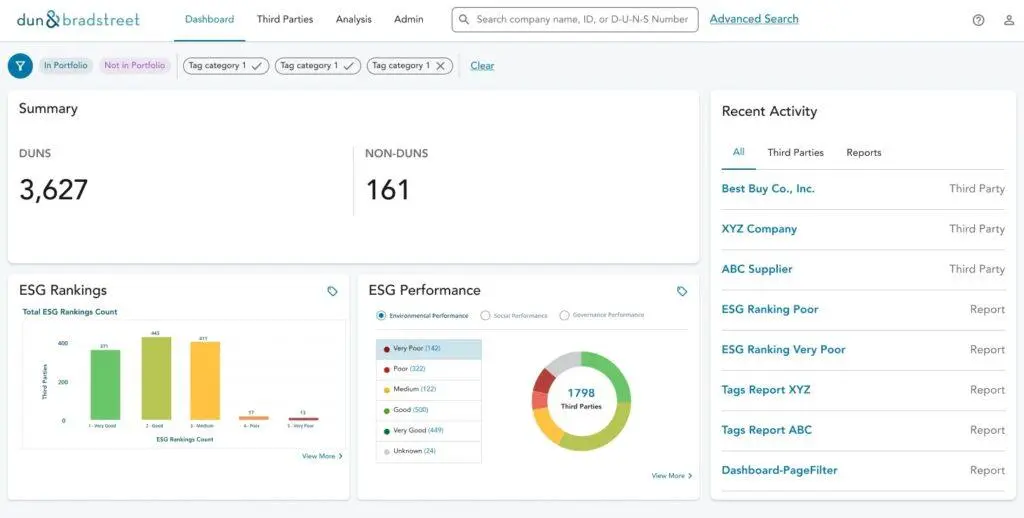
I’ve seen too many cases where an exporter finds a “buyer” through a trade directory, only to discover the company has financial issues or compliance red flags. D&B helps you avoid that.
The platform provides credit scores, financial risk assessments, and compliance screening for international trade.
On the contact side, you get verified business profiles with key decision-maker information.
The contact detail depth is not as granular as Saleshandy or Apollo (you won’t always get direct phone numbers for individual contacts), but the verification layer makes it a unique fit for high-value deals.
If you’re exporting machinery worth $500K to a new buyer in a country you haven’t worked in before, knowing whether that company is creditworthy and legally sound is worth the investment.
For day-to-day prospecting where you need 500 buyer contacts fast, D&B isn’t the right tool.
Use it for verification, and pair it with Saleshandy or Apollo for contact discovery.
Dun & Bradstreet – Key Features
- 500M+ global business records, each assigned a unique DUNS number for verification
- Financial risk scores and credit assessments to evaluate buyer/supplier reliability
- Compliance and sanctions screening for international trade
- Verified business profiles with key contact information
- Industry classification and company hierarchy mapping
- Widely accepted by governments and financial institutions as a verification standard
Pricing:
- Custom pricing tailored to data needs
How to Choose the Right Import Export Data Provider
Picking the right import export data provider comes down to four things.
I’ve broken them down based on what I’ve seen work for different types of import-export businesses, from solo exporters to enterprise trading teams.
1. Start With What You Actually Need: Company Names or Contact Details?
2. Check Contact Data Accuracy in Your Target Region
3. Compare Pricing Models: Credits vs. Per-User vs. Enterprise
4. Consider Whether You Need Business Verification
Let’s get into the details!
1. Start With What You Actually Need: Company Names or Contact Details?
This is the first question worth answering before you sign up for anything.
Some platforms give you company-level trade data, who’s importing what and in what volumes. Others give you the actual contact details of the person at that company. A few, like Tendata, give you both.
If you already know which companies you want to target and just need verified contacts, Saleshandy Lead Finder or Apollo will get you there fastest.
If you need to first figure out who’s buying your product category before finding contacts, Tendata bridges that gap.
2. Check Contact Data Accuracy in Your Target Region
A database with 1 Billion+ contacts sounds impressive until you realize half the emails in your target country bounce.
Contact accuracy varies by region across every platform.
If your buyers are in the US, most tools perform well.
If you’re targeting the Middle East, Southeast Asia, or Africa, test before you commit.
Saleshandy’s waterfall enrichment pulls from multiple data sources, which helps in regions where single-source providers often fall short.
3. Compare Pricing Models: Credits vs. Per-User vs. Enterprise
This is where the total cost changes dramatically.
Credits-based pricing (Saleshandy) means you pay a flat rate for a pool of credits, one price regardless of team size.
Per-user pricing (Apollo) works if you have 1-2 reps but gets expensive with larger teams.
Enterprise pricing (ZoomInfo, D&B) typically starts at $15K+ per year and only makes sense for large sales operations.
4. Consider Whether You Need Business Verification
If you’re doing standard prospecting and need contact details, a tool like Saleshandy or Apollo is enough.
But if you’re entering new markets, working with unfamiliar buyers, or dealing with high-value shipments, verifying the business before you engage saves you from costly mistakes.
D&B is the strongest option for that. For most other use cases, verified contact details and accurate filters are what you need to get started.
Find the Right Import Export Data Provider for Your Business
Finding accurate contact information of your buyers or suppliers is not that difficult.
You just need the right tool.
Saleshandy Lead Finder gives you access to 852M+ verified contacts across 42M+ companies.
Filter by industry, country, job title, company size, and 70+ other criteria.
Get verified emails and direct phone numbers of the people who actually make purchasing decisions.
FAQs
1. What Is an Import Export Data Provider?
A platform that helps businesses find buyers for export, suppliers, or market opportunities using trade-related data. Some focus on customs and shipment records.
Others focus on verified contact details like emails and phone numbers of decision-makers. The best ones for prospecting give you both.
2. How Do Import Export Data Providers Help Find New Buyers?
They help you identify companies importing your product category in a specific country and give you the contact details of people responsible for purchasing or sourcing at those companies.
This cuts research time from hours to minutes.
3. Can I Use Saleshandy Lead Finder for Import Export Business?
Yes. You can filter 852M+ contacts by industry, country, company size, revenue, and job title.
This means you can find procurement managers, sourcing directors, or business development heads at companies in your target market with verified emails and phone numbers.
4. What Is the Difference Between Trade Data and B2B Contact Data?
Trade data comes from customs records, showing what was shipped, between which companies, and in what volumes. B2B contact data gives you verified emails, phone numbers, and job titles of individuals at those companies. Tendata offers both. Saleshandy focuses on contact data.
5. Which Import Export Data Provider Gives the Most Accurate Contact Data?
It depends on your target region.
Saleshandy uses waterfall enrichment across multiple data sources, which improves accuracy in regions where single-source providers fall short.
Best approach: test with free credits before committing.