


 Anil Salvi
 Contents
- 1 9 Best Industry Email List Providers – TOC
- 2 TL;DR: Best Industry Email List Providers at a Glance
- 3 Is It Legal to Buy Industry Email Lists?
- 4 9 Best Places to Buy an Industry Email List
- 5 Best Industry Email List Providers by Industry and Use Case
- 6 Buying vs. Building Industry Email Lists
- 7 How to Choose the Right Industry Email List Provider
- 8 Final Verdict: Select the Right Industry Email List Provider in 2026
- 9 Frequently Asked Questions
So you’re thinking about buying an industry email list to boost your prospecting.
Sounds like the right plan, right?
Well, it can be! But only if you know the right place to buy emails.
Right now, plenty of providers claim to offer verified industry email lists.
But once you export the data, you realize how much of it is outdated, incomplete, or poorly filtered.
The difference?
The best-performing teams don’t buy from random list sellers.
They use verified B2B data providers with stronger industry coverage, better filtering, and more reliable contact data.
I spent weeks testing multiple industry email list providers, running real searches across different industries, and comparing data accuracy, coverage, filtering, and verification quality.
This isn’t a roundup of every tool out there. These are the 9 I’d put my own outreach budget behind.
If your goal is to fill the pipeline faster, expand into new markets, or support outbound campaigns, this guide will help you choose the right provider.
9 Best Industry Email List Providers – TOC
- TL;DR: Best Industry Email List Providers at a Glance
- Is It Legal to Buy Industry Email Lists?
- 9 Best Places to Buy an Industry Email List
- Best Industry Email List Providers by Industry and Use Case
- Buying vs. Building Industry Email Lists
- The Smarter Way to Get Industry Email Lists
- How to Choose the Right Industry Email List Provider
- Final Verdict: Select the Right Industry Email List Provider in 2026
- Frequently Asked Questions
TL;DR: Best Industry Email List Providers at a Glance
After testing multiple industry email list providers and comparing database quality, filtering, verification, and pricing, these are the platforms that made the cut.
Here’s a quick look at all 9 providers side by side.
🔥 Hot tip: While this guide compares different industry email list providers, teams looking for high-intent leads should check out Saleshandy’s database of 852M+ contacts with 75+ filtering options and buying signals. You can start with 50 free credits and test it on your target industry.
Is It Legal to Buy Industry Email Lists?
This is the question that triggers most people.
And the short answer is: YES, buying email lists is legal, but only if you buy from the right source and follow the rules when you send.
The list itself isn’t the problem. What gets companies in trouble is what happens after they hit send. Each region has its own rules, and they care more about how you email than where the address came from.
Let me break down the regulations that matter most.
1. United States (CAN-SPAM)
CAN-SPAM doesn’t require prior consent for B2B emails. The rules are about how you send, not where the address came from.
- Use a real sender name and a valid physical address
- Keep subject lines honest and not misleading
- Include a clear, working unsubscribe link in every email
- Honor opt-out requests within 10 business days
As long as you follow these, sending to a purchased B2B list is legal in the US.
2. California (CCPA and CPRA)
California adds a layer on top of CAN-SPAM. Under CCPA and CPRA, the focus is on transparency and control over personal data.
- Recipients can ask what data you have on them
- They can request the deletion of their data
- They can opt out of the sale or sharing of their information
This means the provider you buy from needs to source data compliantly and have a clear process for handling removal requests. If they can’t explain that, move on.
3. European Union (GDPR)
GDPR doesn’t ban B2B outreach, but it raises the bar significantly. You need a lawful basis for contacting someone, and “legitimate interest” is the most common one used for B2B cold email.
- You need to clearly explain who you are and why you’re reaching out
- The outreach should be relevant to the recipient’s professional role
- Every email must include an easy way to opt out
- If someone says stop, it needs to stick immediately
If you can’t explain where the data came from and why the recipient should expect your email, you’re already on thin ice.
4. Canada (CASL)
CASL is stricter than CAN-SPAM but still allows B2B outreach when done correctly. The B2B exemption applies when you’re contacting someone about something relevant to their professional role.
- The message must be clearly relevant to their business
- You must identify yourself as the sender
- A working opt-out option must be included in every email
Bottom line: Across all regions is the same, buying the list is not a legal risk. Sending without proper identification, relevance, or opt-out is. Choose a provider that sources data compliantly and gives you the tools to send responsibly.
9 Best Places to Buy an Industry Email List
Here’s an honest look at each provider based on how well they handle industry-specific prospecting. I looked at filter depth, data accuracy across verticals, verification quality, and pricing.
1. Saleshandy
First on my list is Saleshandy Lead Finder, and it’s here at #1 for a simple reason. With 852M+ contacts across 42M+ companies, it has the largest industry email database on this list with the deepest filtering I tested.
I searched across healthcare, SaaS, manufacturing, finance, real estate, and construction. Each time, the 75+ filters let me narrow by industry, job title, seniority, company size, revenue, and geography in one query. Most providers give you 10 broad categories and stop there. Saleshandy goes much deeper.
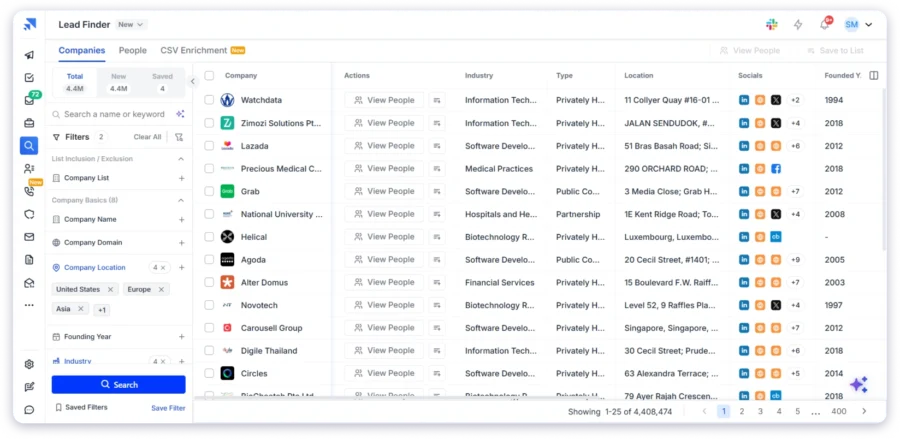
The AI Lead Search saved me the most time. I typed “procurement directors at hospitals with 500+ employees in California” and got matching verified contacts without setting a single filter manually. For niche industries where standard filters fall short, this is a real advantage.
Every contact is verified in real time through waterfall enrichment before you export. The industry email list you download is already clean. No need to run it through a separate verification tool afterward.
Saleshandy Pricing
✅ Pros
- 852M+ verified contacts across 50+ industries, the largest database on this list
- Real-time email verification included at no extra cost
- 50% unused credits roll over monthly (no competitor offers this)
- Built-in cold email software, CRM, and unified inbox in one platform
- No per-seat pricing; cost stays flat as your team grows
- 50 free credits on signup to test data quality
❌ Cons
- Dialer is only available on higher-tier plans
- Phone number credits cost extra beyond email-only reveals
- Learning curve if you only need a one-time list download
Best For:
Agencies, SDRs, founders, and B2B marketers who want industry-specific data and outreach from one platform.
2. Apollo.io
Next on my list is Apollo.io, and I included it because it gives startup outbound teams a way to test industry data quality without paying upfront. The free tier is generous enough to run a small campaign and check whether contacts in your target vertical are accurate.
When I searched for tech and SaaS contacts, Apollo returned solid results. The filters for industry, job title, company size, and location worked well, and the built-in sequencing let me move contacts straight into email campaigns.
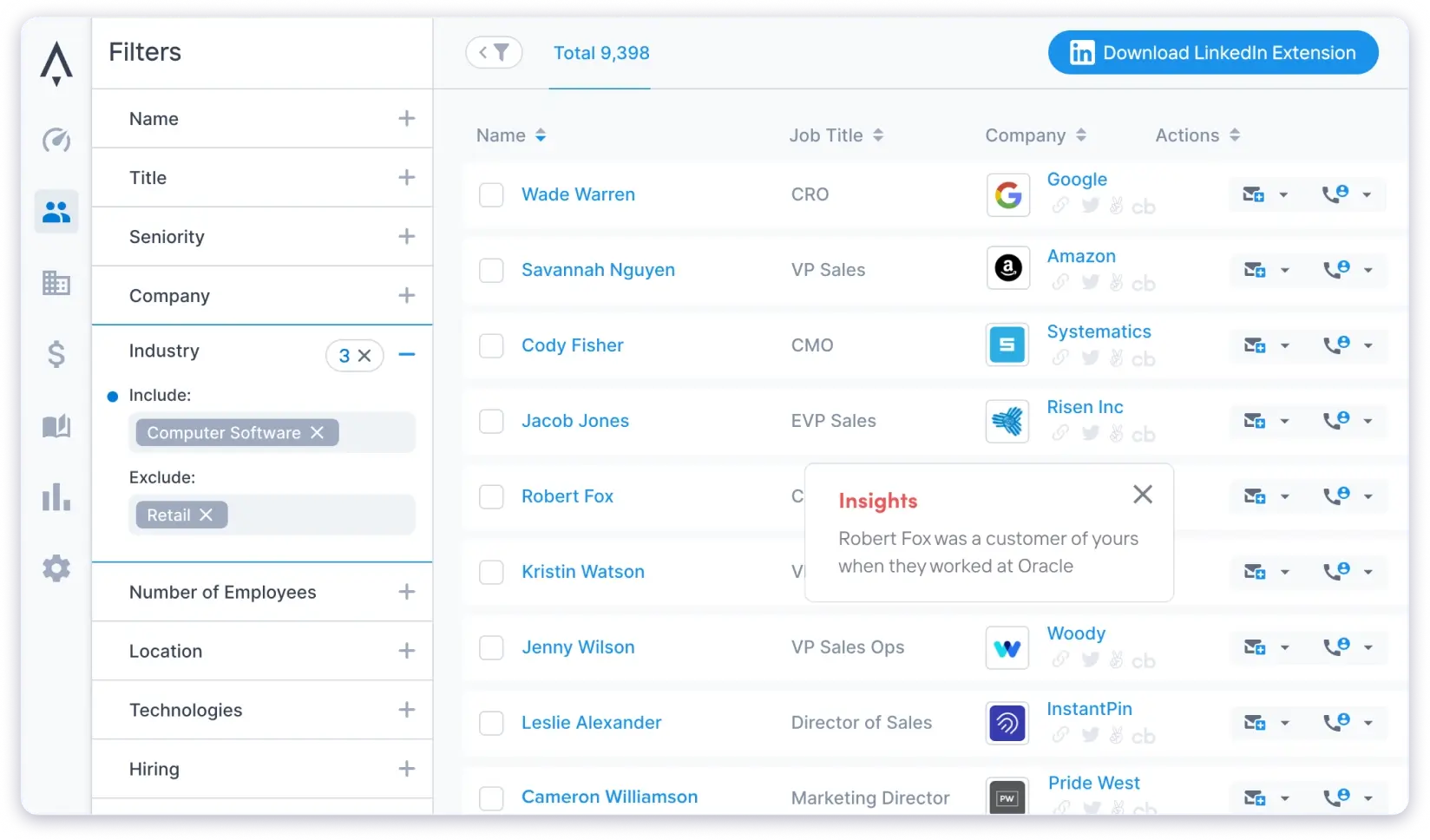
Where Apollo showed its limits was in niche industries. Healthcare administration, retail, and specialty manufacturing searches returned fewer results with lower accuracy. For broad verticals like tech, it’s reliable. For specialized industries, the data quality drops.
📘 Bonus Read: Not sure Apollo covers your industry well enough? Here are the best Apollo.io alternatives worth considering.
Apollo.io Pricing
✅ Pros
- Free tier to test data quality in your target industry before paying
- Built-in email sequences and dialer; no separate outreach tool needed
- AI lead scoring to prioritize contacts in large industry lists
- Strong Salesforce and HubSpot integrations
❌ Cons
- Data accuracy drops on niche verticals like healthcare and construction
- Per-user pricing increases costs as team size grows (unlike flat pricing models like Saleshandy)
- Credits do not roll over on most plans
- Email match rate is around 85%, lower than waterfall enrichment providers
Best For:
Startup outbound teams prospecting in tech and SaaS. Test the free tier first if your target industry is niche.
3. ZoomInfo
If budget isn’t the constraint and you need the deepest possible industry data, ZoomInfo is the platform to consider. I included it because no other tool on this list matches its depth in firmographic, technographic, and intent data layers.
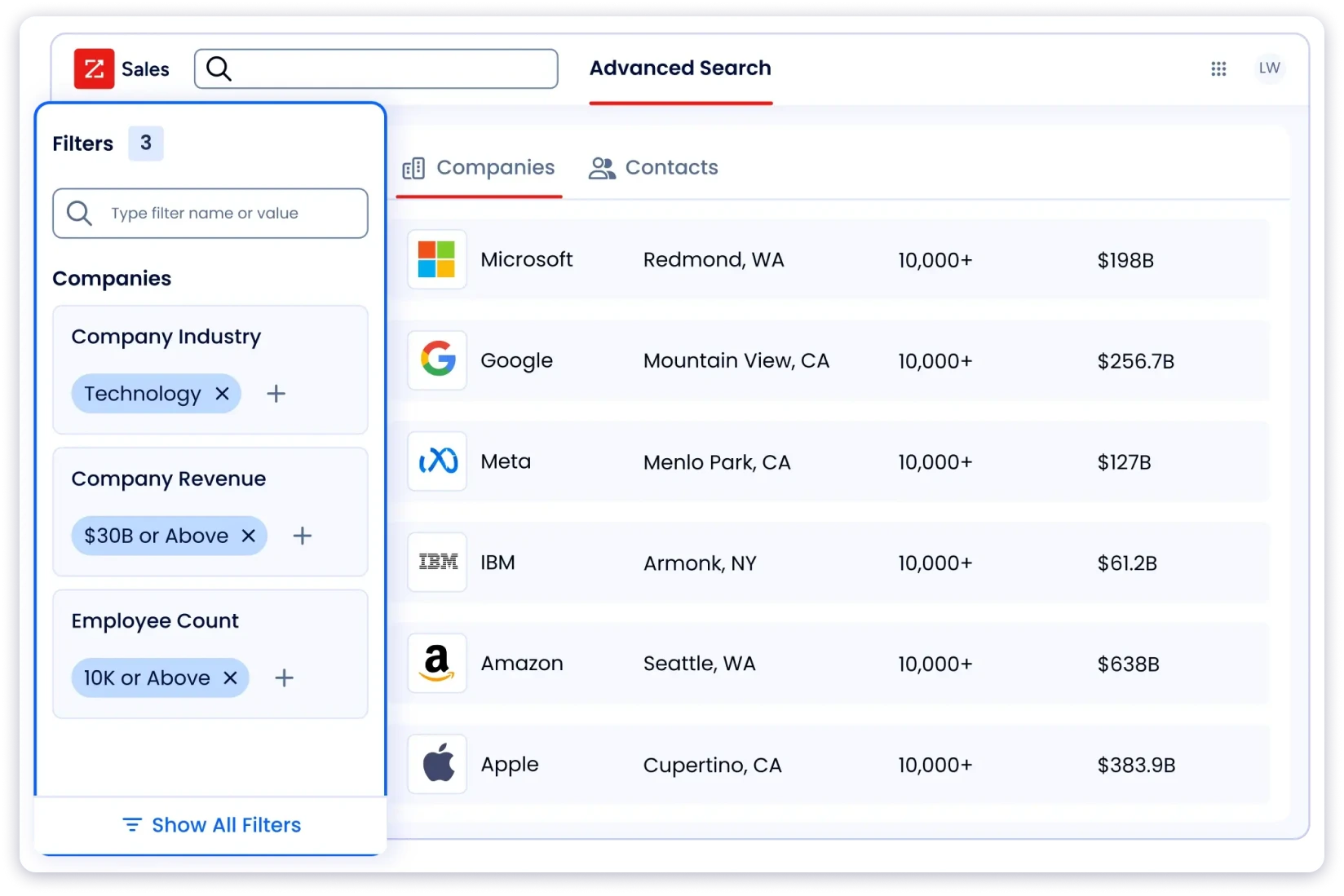
Beyond contact details, I could see org charts showing who reports to whom, technology stacks revealing what software the company runs, and Bombora-powered intent signals flagging which companies are actively researching solutions. For enterprise ABM teams working across multiple verticals, that depth changes how you prioritize outreach entirely.
📘 Bonus Read: ZoomInfo offers deep data, but it comes at a high cost. If you’re looking for similar insights without a long-term commitment, explore these top ZoomInfo alternatives.
ZoomInfo Pricing
Custom pricing only. Contact their sales team for quotes.
✅ Pros
- Deepest industry data on this list, including org charts and buying intent
- Intent signals show which accounts are actively researching your category
- Transparent data sourcing for compliance-sensitive verticals
- Native Salesforce and HubSpot workflow automation
❌ Cons
- Complex setup and onboarding process
- G2 reviews mention hidden fees and accuracy issues outside the US
Best For:
Enterprise sales teams with a budget for premium data and intent-driven account prioritization.
4. Cognism
Another industry email list provider worth looking at is Cognism, especially if your target accounts sit in European or EMEA markets. I included it because its regional coverage across Europe consistently outperformed Apollo, Saleshandy, and ZoomInfo for those geographies.
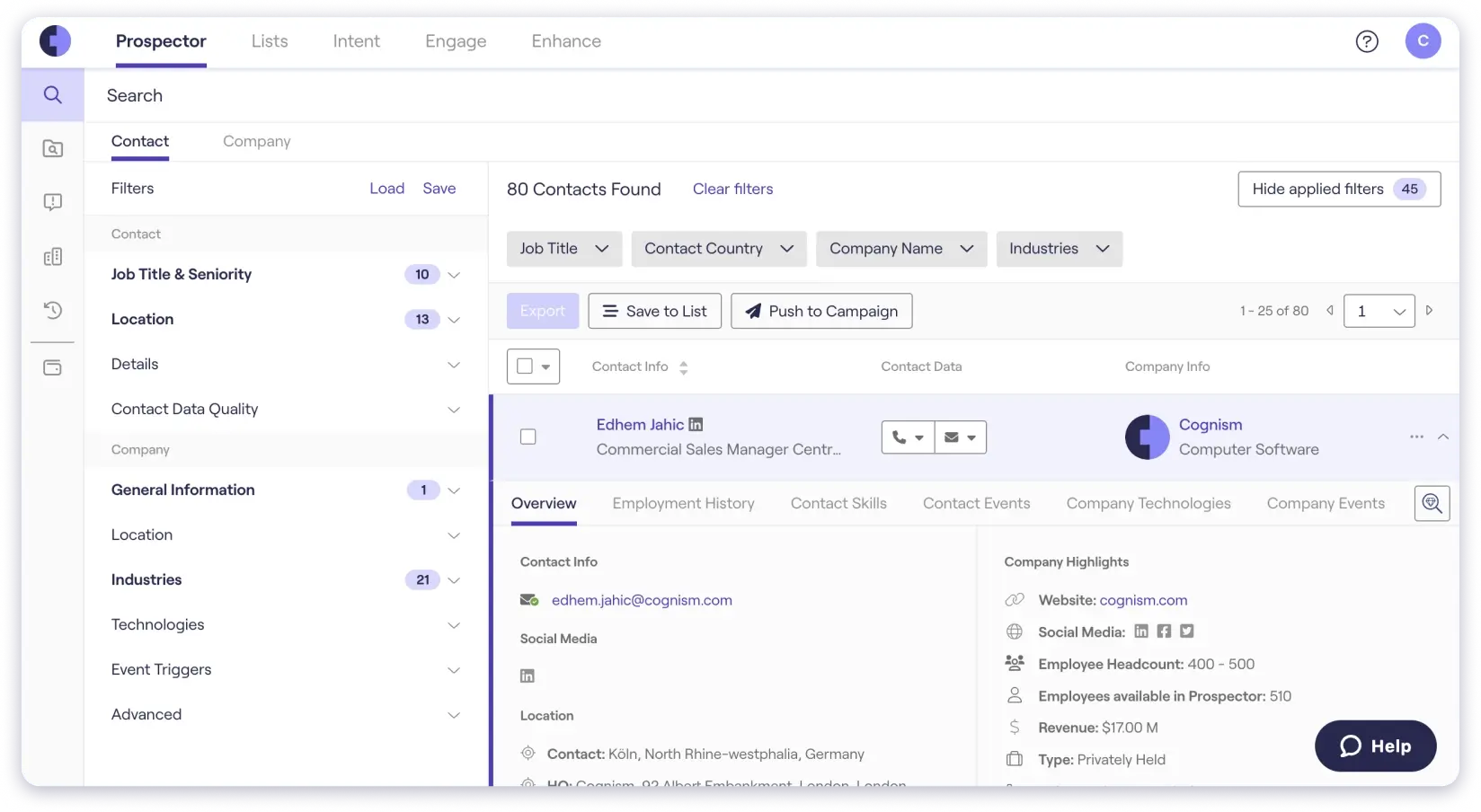
The standout is Diamond Data. These are phone numbers verified by a real person calling the number. Not automated checks. For teams doing cold calling into European verticals like financial services or healthcare, that cuts wrong-number rates significantly.
Cognism handles GDPR compliance more thoroughly than most alternatives. The limitation is US data. When I ran the same searches for US-based contacts, Saleshandy and Apollo returned better results.
📘 Bonus Read: Looking beyond Cognism for European industry data? See these best Cognism alternatives.
Cognism Pricing
Custom pricing only. Contact their sales team for quotes based on team size and data volume.
✅ Pros
- Strongest European data coverage for financial services, healthcare, and manufacturing
- Diamond Data provides phone-verified direct dials (not automated pings)
- GDPR compliance is handled more thoroughly than most US-focused providers
- Chrome extension for LinkedIn contact reveals
❌ Cons
- US coverage is weaker compared to Saleshandy (852M+) and Apollo (275M+)
- Custom pricing only; no public plans available for evaluation
- No built-in cold email sequencing
- Database size is not publicly disclosed
Best For:
Teams selling into European and EMEA markets who need GDPR-compliant, phone-verified industry contacts.
5. BookYourData
BookYourData takes a completely different approach from the other tools here. Instead of searching a live database, you buy pre-built email lists organized by industry. Healthcare, construction, manufacturing, retail, finance, and dozens more verticals are available as ready-to-download files.
I looked at their healthcare and manufacturing lists. The data was reasonably accurate, and the 97% accuracy guarantee with bounce-back credits provides a real safety net if emails don’t land.
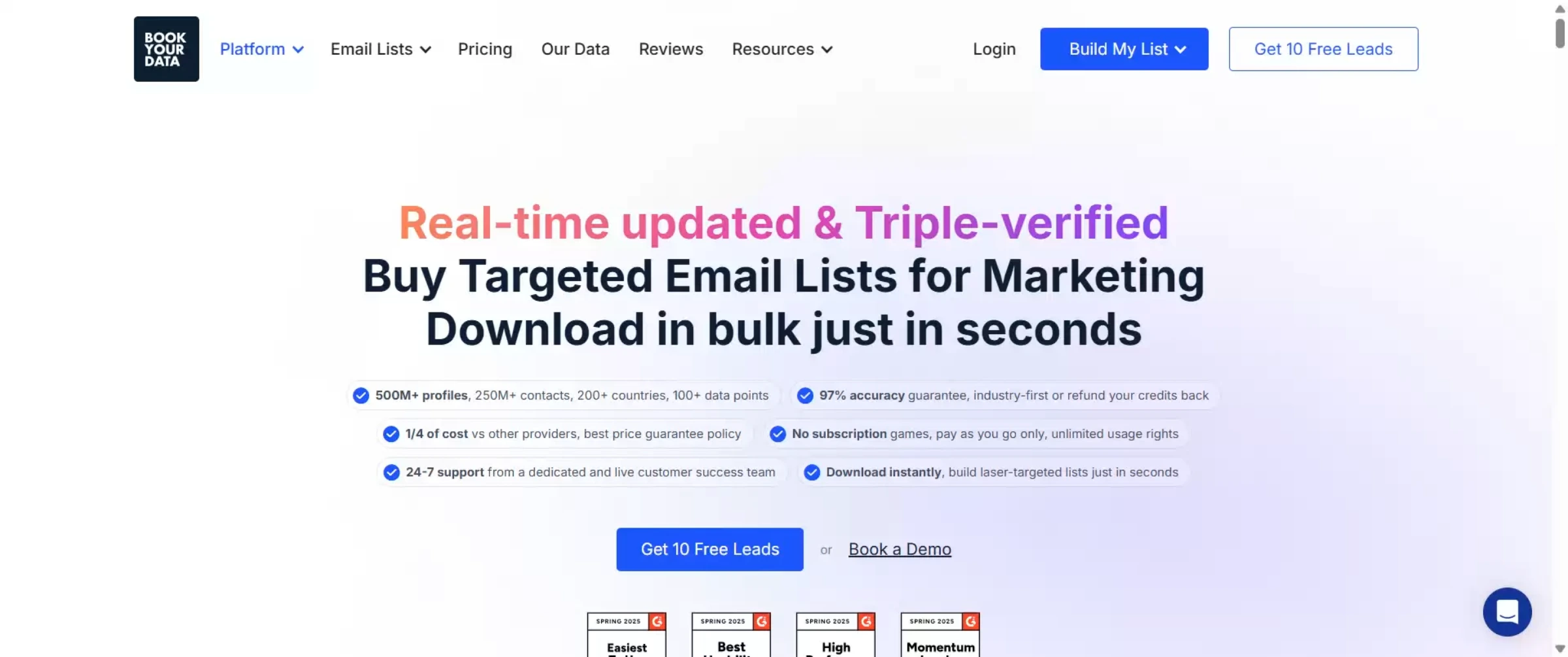
This model makes sense if you need a one-time industry list without a monthly subscription. The trade-off is that you’re downloading a static file. There’s no live database to search against, and B2B contact data decays at roughly 30% per year.
BookYourData Pricing
Pay-as-you-go. Pricing varies by list size, industry, and filters applied. No subscription or contract required.
✅ Pros
- No subscription or contract; pay only for what you download
- 97% accuracy guarantee with bounce-back credits (strongest guarantee on this list)
- Industry categorization includes dozens of sub-verticals, more detailed than most platforms
- Real-time verification at the point of export
❌ Cons
- Static lists that start decaying after download, no live refresh
- No outreach, sequencing, or CRM tools
- No live database for custom searches; pre-built lists only
- No credit rollover in pay-per-download model
Best For:
Teams that need a one-time, industry-specific contact list without ongoing subscription costs.
6. UpLead
The next industry email list provider on my list is UpLead, and it earned its spot for one reason. It verifies every email in real time at the exact moment of export. That’s different from providers that verify in batches on a schedule, where contacts go stale between checks.

On top of verification, UpLead layers in buyer intent data. You can see which accounts in your target industry are actively researching solutions in your category. That helps you focus outreach on companies showing buying behavior instead of emailing cold down a list.
The database is smaller than Saleshandy or Apollo, which means coverage gaps in niche verticals. But what UpLead delivers tends to be accurate.
UpLead Pricing
✅ Pros
- Real-time verification at export, resulting in cleaner data than batch-verified databases
- Buyer intent data flags accounts actively researching relevant solutions
- 95% accuracy guarantee
- Simple interface with almost no learning curve
❌ Cons
- Database (155M+) is significantly smaller than Saleshandy (852M+) or Apollo (275M+)
- Higher cost per credit on lower-tier plans
- No built-in cold email or CRM tools included
- Intent data quality varies by vertical
Best For:
SMBs that prioritize data accuracy and want intent signals to focus their industry prospecting.
7. Lusha
Next up is Lusha, and it made this list for a very specific use case. If your prospecting workflow is LinkedIn-first and you need quick contact reveals as you browse profiles, Lusha does that well.
I used it for about a week. The workflow is simple. Find someone on LinkedIn, click the browser extension, and get their verified email and phone number. For reps who live on LinkedIn, it removes the friction of switching between a database and their daily prospecting.

Where Lusha falls short for industry email list building is filtering. You can’t run a search like “construction project managers at companies with 200+ employees in the Midwest.” You’re limited to one-off reveals as you browse.
If your prospecting workflow is LinkedIn-first and you need quick contact reveals as you browse profiles, Lusha does that well. For a deeper look at this category, see our LinkedIn email finder guide.
Lusha Pricing
✅ Pros
- Fastest way to get contact details from LinkedIn profiles
- Solid direct dial coverage across North America and Europe
- Setup takes minutes with almost no onboarding
- CRM integrations with Salesforce, HubSpot, and Pipedrive
❌ Cons
- No filtered industry searches; contacts are revealed one by one only
- Smaller database (150M+) than Saleshandy (852M+) or Apollo (275M+)
- Credits deplete quickly at scale
- Per-user pricing increases cost as team size grows
Best For:
Individual reps who prospect on LinkedIn and need quick contact reveals. Not built for large, filtered industry lists.
8. Snov.io
Another lead finding platform on my list is Snov.io, and it’s here because it’s the most affordable combined option available. For $30 a month, you get email finding, verification, and drip campaigns in one tool.
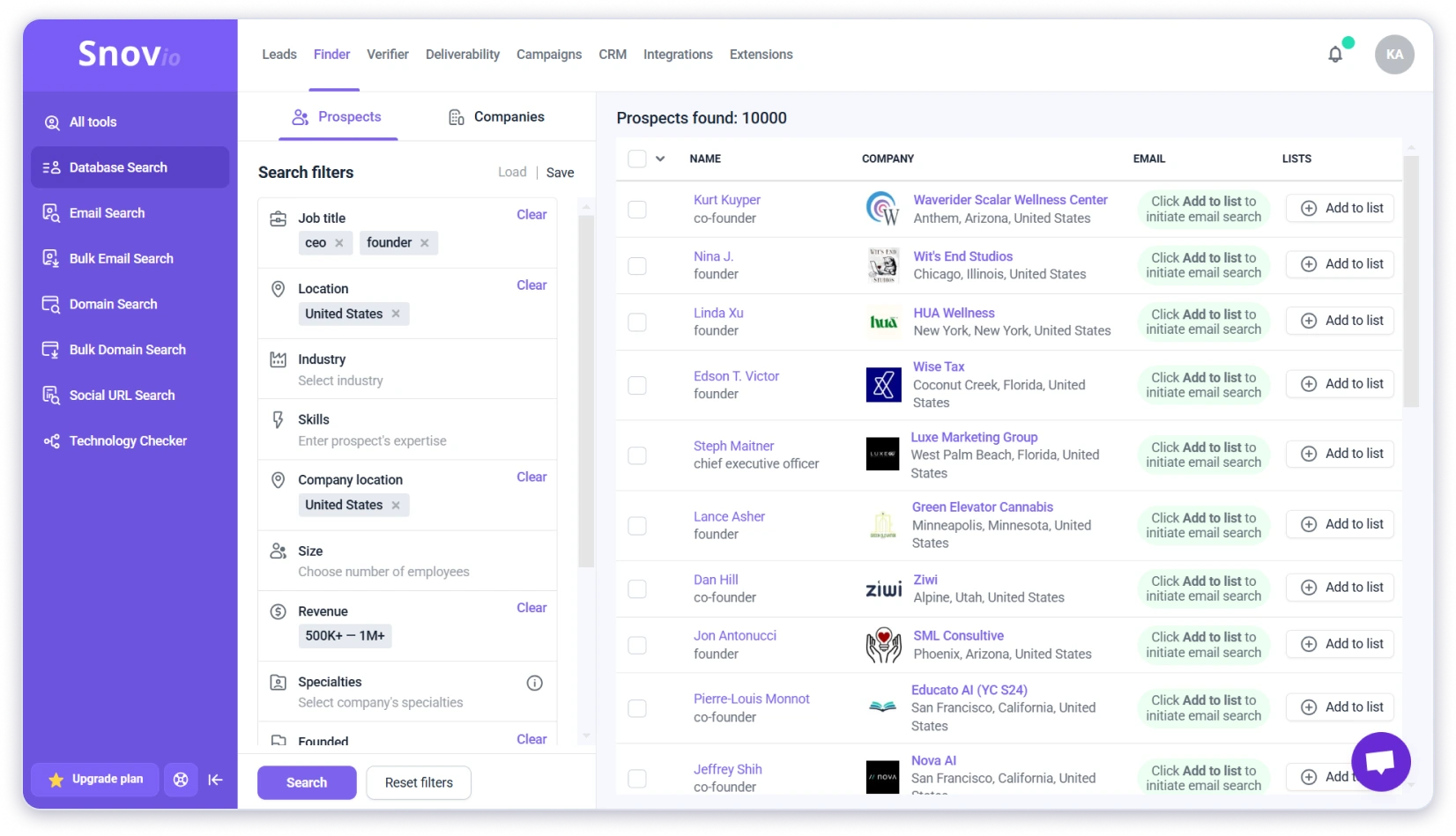
I tested it for tech and professional services contacts, and the results were acceptable for broader verticals. Where it fell short was in niche industries. Manufacturing and construction searches returned thin results with lower accuracy. The industry filtering also isn’t as granular as Saleshandy or Apollo.
Snov.io Pricing
✅ Pros
- Most affordable combined finding + outreach option at $30/month
- Built-in verification included at every pricing tier
- Drip campaigns available in all plans without upgrades
- Technology lookup filter for technographic targeting
❌ Cons
- Database is much smaller than Saleshandy, Apollo, or UpLead
- Industry filters lack depth for multi-criteria searches
- Accuracy dips in niche verticals like manufacturing and construction
- No buyer intent data
Best For:
Small teams with limited budgets who need basic industry prospecting and outreach in one tool.
9. Hunter.io
The last tool on my list is Hunter.io, and I want to be upfront about what it is and isn’t. Hunter does not have industry filters. No firmographic data. No company size or job title targeting. It finds email addresses by company domain. That’s the core function.

I used it when I already had a shortlist of target companies and just needed emails for people who work there. You type in a website, Hunter returns all associated email addresses. For that specific use case, it’s fast and clean.
But if you need to build an industry email list from scratch with filters and segmentation, Hunter can’t do that. For more ways to find email addresses, check our dedicated guide.
Hunter.io Pricing
✅ Pros
- Fastest tool for finding emails when you already know the company
- Free tier with 25 searches/month for light prospecting
- Built-in email verifier
- Bulk finder processes domain lists in one batch
❌ Cons
- Zero industry filtering or search by vertical, role, or company size
- Not a lead database and cannot discover new contacts
- Domain-based only, not a searchable contact database
- Cannot build segmented industry lists at scale
Best For:
Quick email lookups when you know the company. Not suited for industry email list building.
Best Industry Email List Providers by Industry and Use Case
Not every provider covers every vertical with the same depth. Here’s where each one performs strongest based on the industry you’re targeting.
Healthcare
Hospital administrators, CMOs, procurement officers, and physicians require a database with strong healthcare segmentation. Saleshandy covers this vertical well with filters for industry, job title, seniority, and hospital size across 852M+ contacts. BookYourData has a pre-built healthcare list for immediate download. ZoomInfo adds intent data to show which healthcare organizations are actively evaluating solutions.
Technology and SaaS
CTOs, VPs of Engineering, product leads, and startup founders are the most well-covered contacts across all providers. Apollo’s free tier is a solid starting point for testing tech data. Saleshandy’s tech stack filter helps target companies running specific software. ZoomInfo brings the deepest technographic and intent data for enterprise ABM.
Financial Services
Banking executives, insurance leaders, and fintech founders sit in tightly regulated industries where data sourcing and compliance matter. Teams targeting wealth managers and high-net-worth individual databases need providers with strong compliance certifications. Cognism is the strongest pick for European financial decision-makers because of its GDPR compliance depth. Saleshandy works for global financial prospecting.
Manufacturing
Plant managers, supply chain directors, and production leads are harder to find in most databases. This vertical gets less coverage from general-purpose providers. BookYourData has dedicated pre-built manufacturing lists. UpLead’s real-time verification helps keep bounce rates low. Saleshandy covers manufacturing contacts globally across its 42M+ company database.
Real Estate
Agents, brokers, property managers, and developers are well covered by Saleshandy and BookYourData. Lusha works surprisingly well for real estate prospecting because many professionals in this vertical are active on LinkedIn, making the browser extension a natural fit.
Construction
General contractors, project managers, and site engineers are a niche vertical with limited coverage across most platforms. BookYourData and UpLead handle construction contacts better than the broader tools. For a one-time list without a subscription, BookYourData’s pay-as-you-go model fits this vertical well.
Retail and E-Commerce
Buyers, merchandisers, and e-commerce managers are covered by BookYourData’s pre-built retail lists and Apollo’s broader database. Apollo’s free tier makes it easy to test retail data quality before committing.
Legal and Professional Services
Attorneys, CPAs, consultants, and managing partners are another niche vertical where coverage varies. BookYourData has pre-built legal lists for download. Saleshandy lets you filter by legal industry and narrow by job title and firm size.
Buying vs. Building Industry Email Lists
Both approaches work. The right choice depends on the timeline and resources.
The Smarter Way to Get Industry Email Lists
Most outbound-first teams I’ve talked to do both. They use verified industry email lists to fill the pipeline immediately and build organic lists over time through content, events, and inbound channels.
The better approach is to build your own list from a live database. You search in real time, apply industry and firmographic filters, verify contacts before export, and start outreach from the same platform.
Saleshandy Lead Finder works this way. You search 852M+ contacts by industry, job title, company size, revenue, and location. Every contact gets verified before export.
From there, you can add contacts directly into cold email sequences, manage replies in a unified inbox, and track prospect progress in the built-in CRM. Once your list is ready, grab a few proven cold email templates and start reaching out.
Instead of buying a list, you’re building one on demand from live, verified data.
How to Choose the Right Industry Email List Provider
With dozens of providers available, here’s what actually separates the good ones from the rest.
1. Data Freshness
How often the database gets updated makes a real difference. Monthly refreshes are the standard for quality providers. Quarterly is acceptable. If a provider can’t tell you when they last updated their data, that’s a signal to move on.
2. Verification Method
Real-time verification on export is the gold standard. Saleshandy and UpLead both do this, checking every email at the moment of export. Batch verification on a schedule is less reliable because contacts go stale between checks. Cognism takes a different approach with manual phone verification for direct dials.
3. Filter Depth
Can you filter by industry, job title, company size, geography, and revenue in a single search? Or are you limited to broad categories with no way to narrow further?
The deeper the filters, the more targeted the list. And a more targeted list consistently outperforms a larger, generic one. Teams targeting specific verticals can also find contacts using SIC codes for more precise filtering.
4. Compliance
GDPR and CAN-SPAM compliance should be non-negotiable. SOC 2 or ISO 27001 certifications add an extra layer of trust. If a provider can’t explain how they source their data or won’t share compliance documentation, skip them.
5. Pricing Model
Monthly subscriptions (Saleshandy, Apollo, UpLead). Pay-as-you-go (BookYourData). Enterprise contracts (ZoomInfo). The right model depends on your volume and how often you need fresh data.
If you’re unsure, start with a provider that offers free credits so you can test data quality before committing to a plan.
6. Data Only or Outreach Built In
If you already have a cold email tool and just need contacts, a data-only provider like UpLead or BookYourData works. If you want to go from finding contacts to emailing them without switching platforms, Saleshandy covers lead finding, verification, cold email sequences, and CRM in one place.
7. Red Flags to Avoid
Providers selling 100,000 contacts for under $100 are almost always working with scraped, outdated data. If they won’t offer a sample before purchase or don’t have an accuracy guarantee, move on. Cheap data costs more in the long run through bounced emails, spam complaints, and damaged sender reputation.
Final Verdict: Select the Right Industry Email List Provider in 2026
Choosing the right industry email list provider matters as much as the outreach strategy itself. The best results come from using accurate, compliant, and well-filtered industry email data while protecting your deliverability during rollout.
While organically built lists are ideal for long-term growth, purchased lists can help accelerate pipeline generation when speed is a priority.
After testing all 9 providers across multiple industries, THREE stood out.
Saleshandy Lead Finder is the best overall pick. Largest database on this list (852M+ contacts), deepest industry filters (75+), real-time verification, and built-in cold email outreach and CRM in one platform. No per-seat pricing. 50 free credits to test on your target industry before paying.
Apollo.io is the best free starting point. If you’re a startup team testing a new vertical, the free tier lets you evaluate data quality without spending anything. Best for tech and SaaS prospecting.
ZoomInfo is the best enterprise option. With custom pricing, intent data, org charts, and technographics layered on top of industry contacts, no other platform on this list goes as deep.
Frequently Asked Questions
1. What Is an Industry Email List?
An industry email list is a database of verified B2B contacts organized by business vertical, like healthcare, manufacturing, technology, finance, or real estate. Each record typically includes contact name, job title, company, email address, phone number, and firmographic details like company size, revenue, and location. These lists help sales and marketing teams reach decision-makers in specific sectors instead of sending generic outreach.
2. How Much Does an Industry Email List Cost?
Pricing varies widely. Saleshandy starts at $25/mo. UpLead starts at $99/mo. BookYourData charges per contact with no subscription. Enterprise platforms like ZoomInfo give custom pricing. The cost reflects database size, filter depth, verification quality, and whether outreach tools are included.
3. What Industries Can You Buy Email Lists For?
Most major B2B verticals are available. Healthcare, technology, manufacturing, financial services, real estate, construction, retail, education, legal, and more. Providers like Saleshandy and BookYourData cover 50+ industry categories with filters to narrow by job title, seniority, and geography.
4. How Do I Verify an Industry Email List Before Using It?
Export a small batch of 50 to 100 contacts and run them through a third-party verifier before importing them into your CRM. If the bounce rate is above 5%, the data quality is too low. Providers like Saleshandy and UpLead verify in real time before export, so you don’t need to do this manually.
5. What Is the Difference Between an Email List Provider and a Lead Database?
An email list provider typically sells static, pre-built contact lists you download as a file. A lead database gives you a searchable platform where you apply filters, build your own list, and get real-time verification before exporting. Lead databases like Saleshandy also include outreach tools so you can act on the data immediately.