


I’ll cut straight to it.
Indeed, Clay is a brilliant product. And, without a doubt, the waterfall enrichment is best-in-class. The workflow builder feels like magic once you learn it. And Claygent’s AI research agents can dig up context that would take a human rep hours to find.
But here’s a thing. On March 11, 2026, Clay overhauled its entire pricing structure. The old Starter, Explorer, and Pro plans? They’re all gone.
And they were replaced by Launch at $185/mo and Growth at $495/mo, with a brand new dual-credit system that meters Data Credits and Actions separately.
For some teams, that made Clay cheaper per lookup. For others, especially teams running heavy automations, the second billing meter caught them off guard.
I spent the last few days digging into 10 Clay alternatives to figure out which ones actually deliver, not just on paper, but in the workflows that matter: prospecting, enrichment, outreach, and scaling campaigns without burning through your budget.
Here’s everything I found.
Clay Alternatives & Competitors – TOC
TL;DR: Best Clay Alternatives in 2026 at a Glance
Clay baseline: Launch plan $185/mo, Growth $495/mo. Dual-credit billing (Data Credits + Actions). Native email via Clay Sequencer. No native calling, LinkedIn, or WhatsApp.
Top Clay Alternatives in 2026 Based on Use Cases
- Need prospecting + Multichannel outreach in one tool? Saleshandy.
- Want the closest thing to a full sales platform? Apollo.io.
- Want Clay’s workflow power at a fraction of the cost? Floqer.
- Selling into Europe and need GDPR compliance? Cognism.
- Already have a list and just need enrichment? FullEnrich.
- Enterprise team with deep pockets? ZoomInfo.
But Why Teams Are Switching From Clay in 2026
Before we get into alternatives, it’s worth understanding what’s actually pushing teams away.
In my research, three major reasons keep coming up.
1. Clay’s March 2026 Pricing So Confusing?
Clay restructured its pricing on March 11, 2026. The old four-plan setup (Starter, Explorer, Pro, Enterprise) was replaced by three plans:
- Launch ($185/mo)
- Growth ($495/mo)
- Enterprise (custom)
The bigger change is how billing works now. Clay introduced two separate meters.
- Data Credits pay for enrichment lookups.
- Actions pay for AI steps, automations, API calls, and CRM writes. These run on separate budgets.
On the surface, Clay’s pricing memo says data prices dropped 50 to 90% per lookup. That’s real. But the Actions meter is new, and it didn’t exist before. Teams running complex automations now have two cost lines instead of one.
2. Clay is Too Complex for Sales Teams
Let me be fair. Clay’s table-based workflow builder is powerful. But it’s not plug-and-play.
You’re essentially building enrichment pipelines column by column, writing formulas, chaining API calls, and configuring conditional logic.
Clay’s own documentation describes features like “HTTP API enrichment,” “webhook triggers,” and “formula columns.” And sadly, that’s not language most SDRs are comfortable with, right?
As a result, Clay has invested in reducing this friction. Claygent can handle multi-step research from natural-language prompts, and pre-built templates cover common workflows. But for custom enrichment chains, you still need someone who thinks like an engineer. 😢😢
If your team has a dedicated “Clay operator,” the tool sings. If you’re expecting your reps to build their own workflows from scratch, that’s a different story.
3. Clay Can’t Handle Multichannel Outreach
Clay launched its Sequencer in September 2026. You can buy alt domains and email inboxes directly inside Clay, warm them up, and run multi-step email campaigns without leaving the platform.
But here’s the catch. Sequencer is email-only. 🥺You won’t get native calling, LinkedIn automation, WhatsApp, or SMS.
If your outreach motion is multichannel, you’ll still need external tools for everything beyond email. And Clay’s Sequencer doesn’t offer pre-warmed inboxes. You need to warm them yourself, which adds 2 to 3 weeks before you can start sending at scale.
For teams whose primary motion is cold email and nothing else, Clay Sequencer works. For everyone else, the gap still exists.
So, How I Evaluated These Clay Alternatives
I looked at each tool across five dimensions that matter most when you’re comparing it against Clay.
1. Data Coverage: I checked how large the database is. Does the tool run waterfall enrichment across multiple providers, or is it single-source? Waterfall matters because no single provider has everyone. Sequential lookups across 9, 25, or 100+ sources catch what a single database misses.
2. Outreach Capabilities: Can you actually send emails, make calls, or run LinkedIn sequences from the tool? Or do you need to bolt on a separate platform? Every integration adds friction and cost.
3. Pricing Transparency: Is the pricing published? Are credit costs clear? Are there hidden meters? I have very little patience for tools that make me “talk to sales” just to see a number and so does the users.
Hence, pricing transparency matters the most.
4. Ease of Setup: How quickly can someone start getting value? Clay’s learning curve is measured in weeks. Some alternatives get you running in an afternoon.
5. Scalability: Does pricing blow up as your team grows? Per-seat pricing, credit caps, and feature gating all affect how well a tool scales with you.
10 Best Clay Alternatives I Tested and Ranked
So, I tested 20+ Clay alternatives, and these 10 turned out to have the features and pricing to replace Clay’s limitations.
1. Saleshandy – Best for Cold Email at Scale
If you’re reading this list because you want to find prospects and send cold emails without juggling three different subscriptions, Saleshandy is where I’d start.
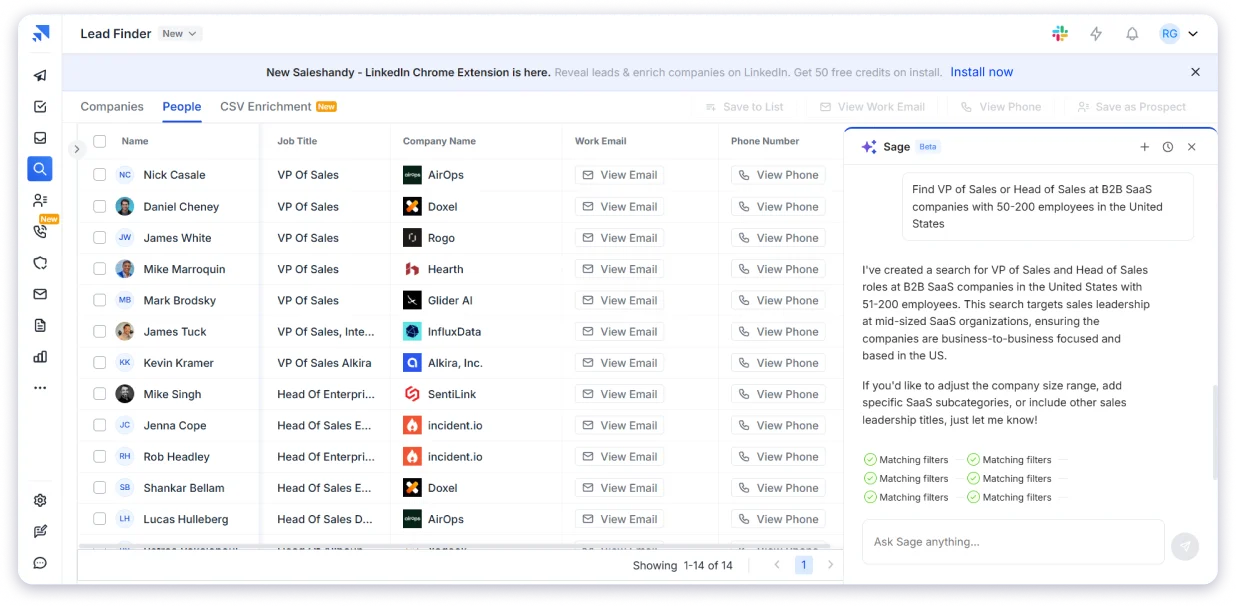
Saleshandy is a cold email outreach platform with a built-in B2B lead database.
It combines prospecting (Lead Finder with 852M+ contacts and 42M+ companies), outreach (email sequences, A-Z testing across 26 variants, sender rotation), and deliverability infrastructure (warm-up, SPF/DKIM/DMARC monitoring, bounce detection) in a single product.
I particularly liked how the 9-provider waterfall enrichment works inside Lead Finder.
Instead of relying on one database and hoping it has the contact you need, the system cascades through nine sources automatically. That catches the gaps a single-source tool would miss entirely.
The cold email infrastructure is where Saleshandy really earns its keep.
Sender rotation spreads your volume across unlimited email accounts. The built-in warm-up gradually builds sender reputation on new accounts. And the unified inbox pulls replies from every connected account into one place, so nothing falls through the cracks.
For agencies, the Scale plan ($149/mo, annual) includes unlimited users, unlimited clients, and unlimited email accounts with no per-seat fees. That’s a meaningful cost advantage when you’re managing 10+ client campaigns.
What Saleshandy doesn’t do: it’s not a workflow builder. You can’t build Clay-style enrichment pipelines with conditional logic and formula columns. And while it supports multichannel sequences (email, calls via dialer add-on, LinkedIn steps, WhatsApp), the core strength is cold email execution.
Saleshandy vs Clay
Pros:
- 852M+ contacts with 9-provider waterfall enrichment and real-time verification.
- Native cold email infrastructure with sender rotation, warm-up, and deliverability monitoring.
- A-Z testing across 26 variants is unusually deep for sequence optimization.
- Unlimited email accounts on all plans. No per-inbox fees.
- Starts at $34/mo. One of the lowest entry points for combined prospecting + sending.
- 7-day free trial with up to 50 free Lead Finder credits. No credit card required.
Cons:
- Not a workflow builder. No Clay-style enrichment pipelines or formula logic.
- 9-provider waterfall is strong but smaller than Clay’s 100+ integrations or Persana’s 100+ sources.
- Lead Finder credits are capped per plan. Heavy prospecting can burn through allocations.
Pricing (annual billing):
2. Apollo.io – Best All-in-One Sales Platform
Apollo.io is the Swiss Army knife of this list. Database, enrichment, email sequences, built-in dialer, LinkedIn task steps, and a lightweight CRM, all under one roof.
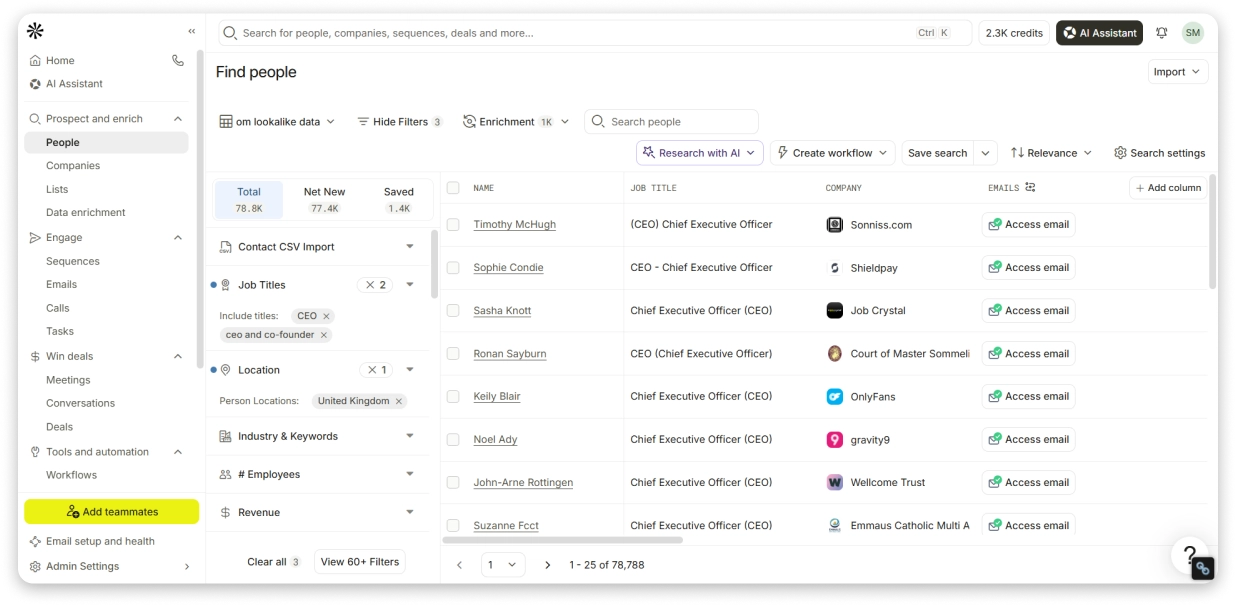
The database covers 240M+ contacts and 35M+ companies. Not the largest, but the functional breadth makes up for it.
I found the AI-assisted email writing genuinely useful for generating personalized first lines without spending 20 minutes per prospect.
The built-in dialer is what sets Apollo apart from most alternatives here. You can call directly from the platform with recording and logging built in, no separate tool needed.
LinkedIn steps are part of sequences too, though they’re manual task reminders rather than automated actions.
The catch is pricing. Apollo charges per user. At $79/user/mo (Professional), a 5-person team is paying $395/mo. That adds up fast compared to tools without per-seat models.
Apollo also uses single-source data, no waterfall enrichment. Your match rates depend entirely on Apollo’s own database. For US B2B contacts, that’s usually fine. For international data, coverage gets thinner.
Pros:
- Widest functional breadth on this list. Data + sequences + dialer + CRM in one product.
- Free tier available for individual prospecting.
- Built-in dialer with call recording.
- Active product development with frequent releases.
Cons:
- Per-user pricing compounds quickly for growing teams.
- Single-source data. No waterfall enrichment.
- LinkedIn steps are manual tasks, not automated actions.
- CRM is lightweight. Complex pipeline needs will still require Salesforce or HubSpot.
Pricing (annual billing):
- Free: Limited credits, basic sequences
- Basic: $49/user/mo
- Professional: $79/user/mo (dialer, call recording, advanced reports)
- Organization: $119/user/mo (SSO, custom reports, advanced API)
Worth reading: Not happy with Apollo? Check out the best Apollo.io alternatives for 2026.
3. Persana.ai – Best for AI-Powered Enrichment
If Clay’s enrichment depth is what drew you in but the complexity and price pushed you away, Persana.ai picks up that thread.
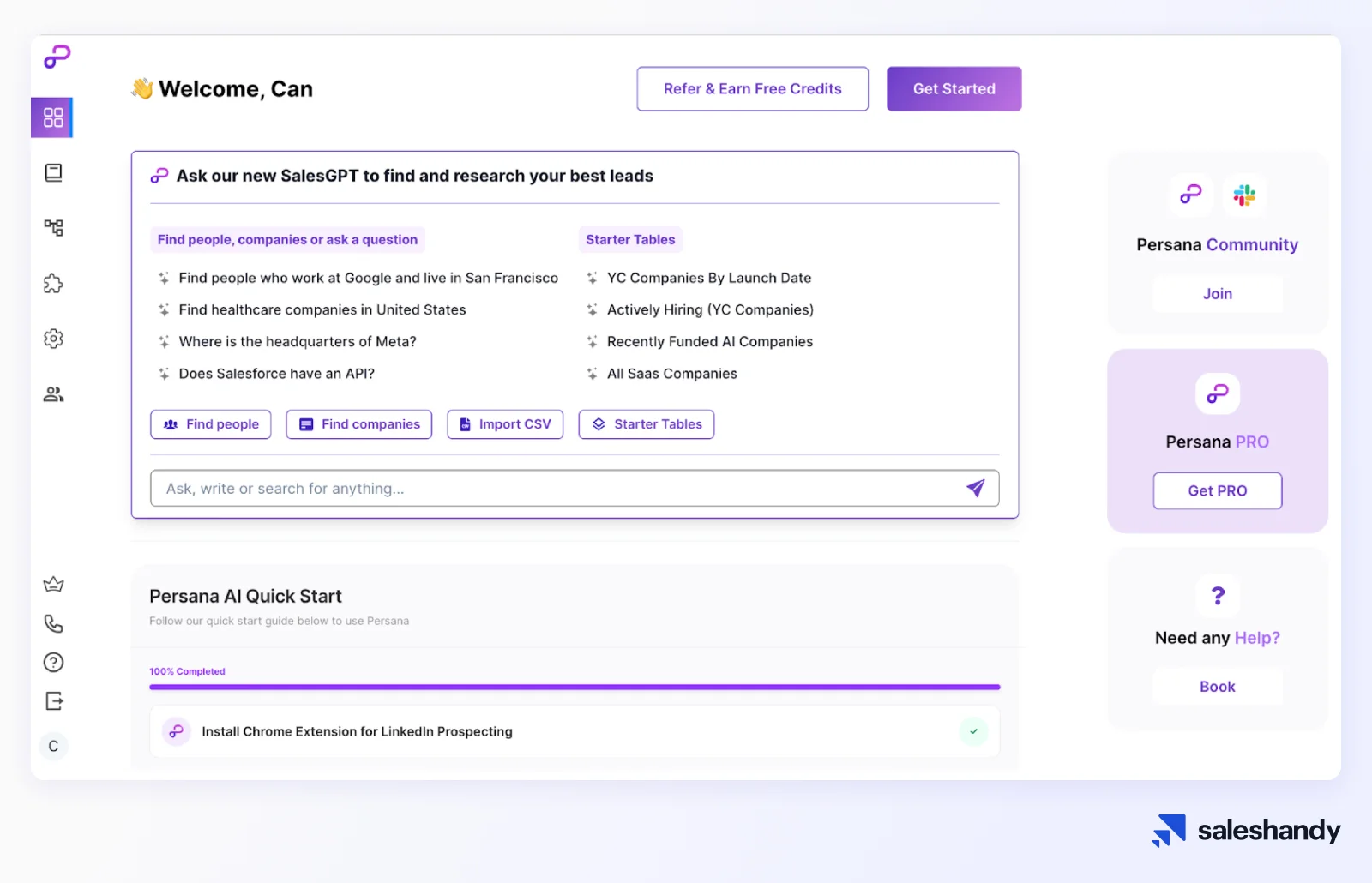
Persana.ai connects to 100+ data providers in a waterfall enrichment model. That’s on par with Clay for provider diversity. The platform covers 700M+ profiles and 200M+ companies, with AI-powered lead scoring and intent signal detection layered on top.
What caught my eye is the credit system.
- Emails cost 1 credit each.
- Phone numbers cost 10 credits.
That 10:1 ratio is important to understand before you commit. If you’re doing email lookups primarily, the economics are excellent. If you need phone numbers at volume, your credits will evaporate fast.
Persana doesn’t send emails. It’s an enrichment and intelligence layer. You’ll need a separate tool (Saleshandy, Instantly, Smartlead) for actual outreach execution.
Pros:
- 100+ data providers in waterfall enrichment, among the broadest provider networks available.
- AI-powered lead scoring and intent signals go beyond simple contact lookup.
- No per-seat pricing. Plans are by credit volume.
- Competitive entry at $68/mo for 2,000 credits.
Cons:
- No native outreach. Every email or call requires an external tool.
- Phone credits are 10x email credits. Budget carefully.
- Younger platform with less established track record than Apollo or ZoomInfo.
Pricing (annual billing):
- Starter: $68/mo (2,000 credits)
- Growth: $151/mo (5,000 credits)
- Pro: $400/mo (25,000 credits)
- Enterprise: $600/mo (80,000 credits)
4. Floqer – Closest to Clay’s Workflow Builder
If what you loved about Clay was the workflow building, and what you hated was the price tag, Floqer is the alternative that comes closest to replicating that experience.
Floqer is a visual workflow automation platform for B2B data operations. You build multi-step enrichment chains using a drag-and-drop builder, connecting 100+ data sources with conditional logic, loops, and AI steps. It’s Clay’s table-based approach, reimagined with a visual interface.
The feature that sold me: Web Agents.
These are Floqer’s answer to Claygent. They browse websites, extract specific data points, and summarize findings. Same concept, similar execution.
Floqer also has an MCP server integration for programmatic workflow control and human-in-the-loop approvals on scheduled runs. That last one is a safety net Clay doesn’t offer.
When your automated workflow is about to fire off 5,000 enrichment credits, a manual approval step can save you from an expensive mistake.
At $49/mo for the Pro plan (5,000 credits, full workflow builder, Web Agents), Floqer is 73% cheaper than Clay’s $185/mo Launch plan.
Pros:
- Closest functional analog to Clay. Visual workflows, 100+ enrichment sources, AI research agents.
- Web Agents match Claygent’s research capability.
- Human-in-the-loop approvals on scheduled runs (Clay lacks this).
- $49/mo entry is 73% cheaper than Clay’s Launch plan.
- Free tier (100 credits) for evaluation.
Cons:
- No native outreach. Requires integration with sending tools.
- Smaller company with fewer public case studies than Clay.
- No proprietary database. Dependent on third-party enrichment sources.
- Workflow building still has a learning curve for non-technical users.
Pricing:
- Free: 100 credits
- Pro: $49/mo (5,000 credits)
- Teams: $149/mo (25,000 credits)
- Enterprise: Custom
5. Lusha – Best for Quick CRM Enrichment
Sometimes you don’t need a workflow builder or an AI agent. You just need a phone number and an email, fast.
Lusha’s Chrome extension sits on top of LinkedIn and company websites. You find a prospect, click the extension, and get verified contact data. That’s it. No setup, no learning curve, no 14-step onboarding.
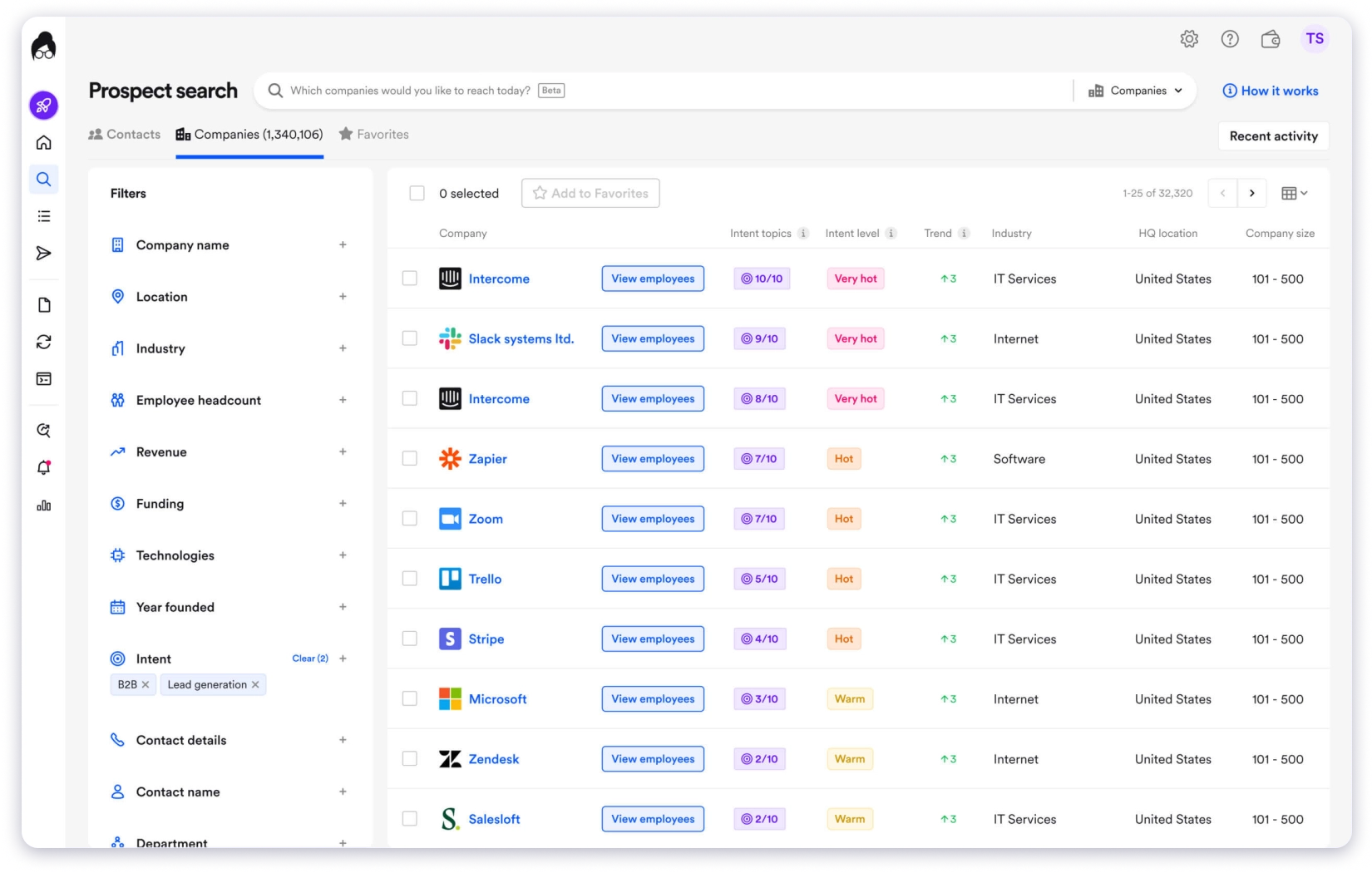
The database covers 515M+ contacts and 21M+ companies.
Lusha claims 98% email accuracy, which is among the highest stated rates I came across. There’s also a Bombora intent data integration on higher-tier plans for identifying companies actively researching relevant topics.
The CRM integrations (Salesforce, HubSpot, Pipedrive, Zoho, Bullhorn) include automatic enrichment of new records. For reps who live inside their CRM and just need data flowing in, that’s valuable.
The downside: paid plan pricing is entirely opaque. Only the free tier (40 credits/mo) is publicly listed. Everything else requires talking to sales.
Pros:
- Chrome extension makes contact reveals frictionless on LinkedIn.
- 98% claimed email accuracy.
- Free tier (40 credits/mo) for evaluation.
- Direct CRM sync with automatic record enrichment.
- Bombora intent data on higher plans.
Cons:
- No native outreach. Purely a data tool.
- Single-source data. No waterfall enrichment.
- Paid plan pricing is completely hidden.
- 40 free credits/mo is thin for team use.
Pricing:
- Free: 40 credits/mo
- Starter, Pro, Premium: Quote-based (not publicly disclosed)
Worth reading: Looking for more options? Here are the best Lusha alternatives in 2026.
6. ZoomInfo – Best for Enterprise GTM Intelligence
ZoomInfo has a bigger database (500M+ business profiles), deepest feature set, and a price tag to match.
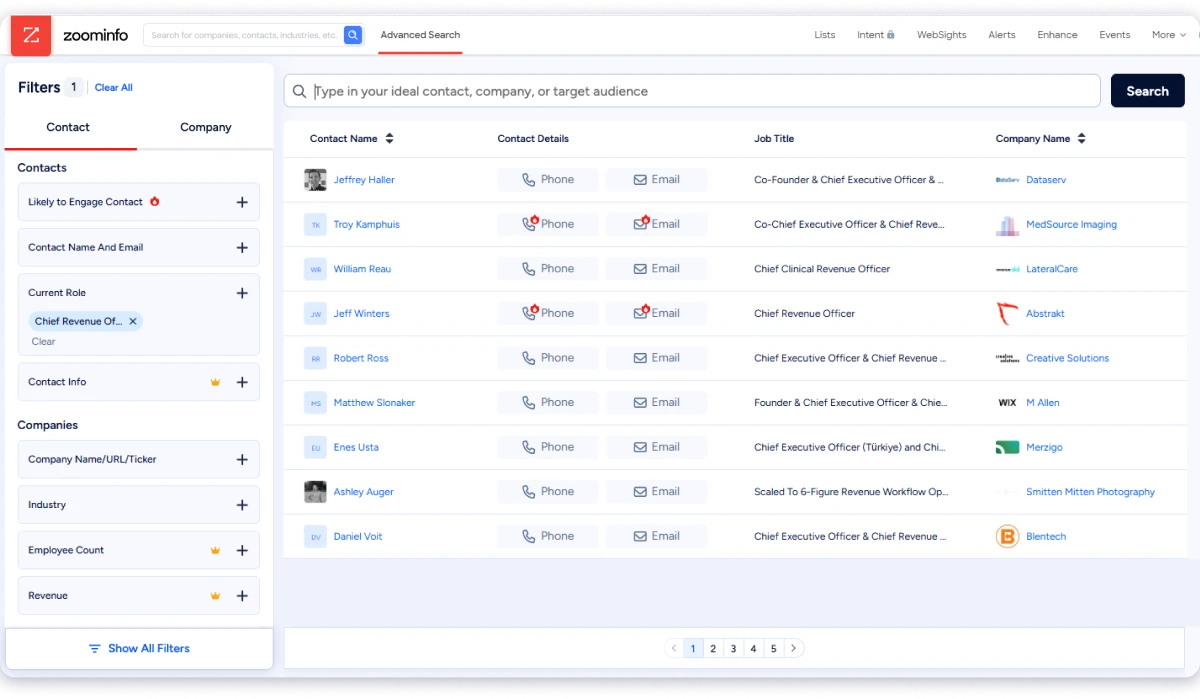
The platform was recently restructured around three products:
- GTM Workspace (prospecting and enrichment),
- GTM Studio (custom data models and automations),
- GTM Agent Teams (AI-powered autonomous workflows).
The native intent data, powered by in-house collection, is deeply woven into everything rather than being a bolt-on.
ZoomInfo Engage offers email sequences, website chat, and web forms for lead capture. It’s not as full-featured as dedicated outreach tools, but it keeps you from needing yet another vendor.
The deal-breaker for smaller teams: pricing is 100% quote-based. No plan names, no dollar amounts, no credit allocations on the website. Just a “Talk to Sales” button.
Pros:
- 500M+ profiles. Largest established B2B data platform.
- Native intent data integrated across the entire GTM suite.
- GTM Agent Teams for AI-powered autonomous prospecting.
- Enterprise-grade security and compliance.
Cons:
- Pricing is completely opaque.
- Overkill for small teams.
- Single-source data. No waterfall enrichment.
- Meaningful onboarding and training period.
Pricing: Entirely quote-based. Contact sales required.
Worth reading: Not sure about ZoomInfo? Check out these ZoomInfo alternatives for 2026.
7. Cognism – Best for European Data and Compliance
If you sell into Europe, compliance isn’t optional. It’s the law. And Cognism is built for exactly that.
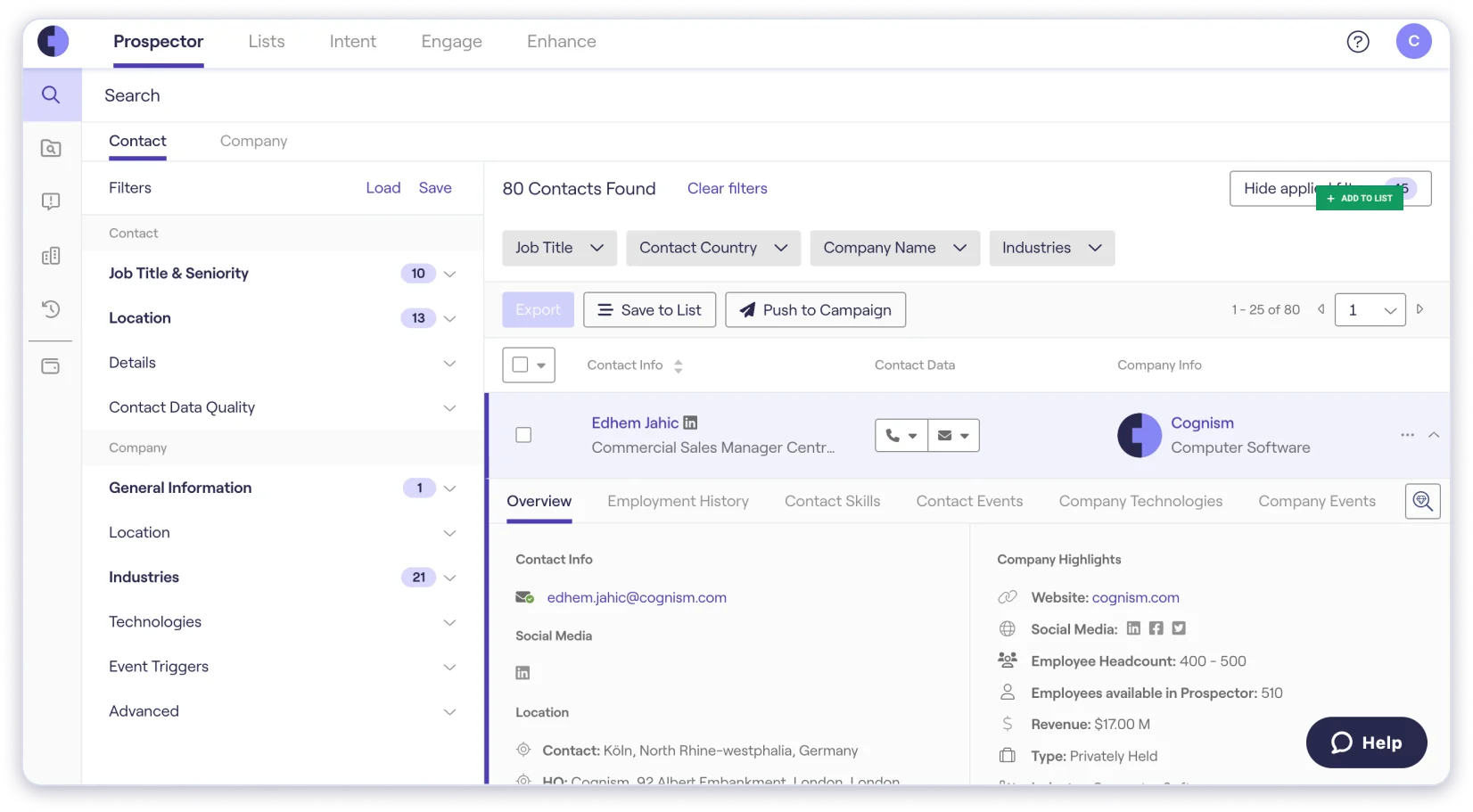
The headline feature is Diamond Data: phone-verified mobile numbers that Cognism’s research team has manually called and confirmed.
No other tool on this list does human phone verification. And that matters if your outreach motion depends on cold calling the right person on the first dial.
DNC (Do-Not-Call) list screening covers 15 countries. GDPR compliance is baked into the product, not bolted on afterward. For teams selling into regulated industries (finance, healthcare, government) across the EU, this is non-negotiable.
Cognism also offers Bombora intent data on its Pro plan, the same provider Lusha uses.
The trade-off: pricing is entirely custom, and the platform is more of a data quality layer than a full outreach suite. Cognism Prospector has basic sequence functionality, but it’s not on the level of Saleshandy or Apollo for execution.
Pros:
- Diamond Data: human-verified phone numbers. Unique on this list.
- DNC screening across 15 countries.
- GDPR-centric compliance posture.
- Strong EMEA data coverage.
- Bombora intent data on Pro plan.
Cons:
- Completely opaque pricing. No self-serve plans.
- Single-source data. No waterfall enrichment.
- Basic outreach sequences. Not a full engagement platform.
- US and APAC data coverage is weaker than EMEA.
Pricing: Custom. Quote required for both Standard and Pro plans.
8. FullEnrich – Best for Budget Waterfall Enrichment
FullEnrich does one thing: waterfall enrichment across 25+ data providers. No workflows, AI agents, or outreach. Just data enrichment done well and priced fairly.
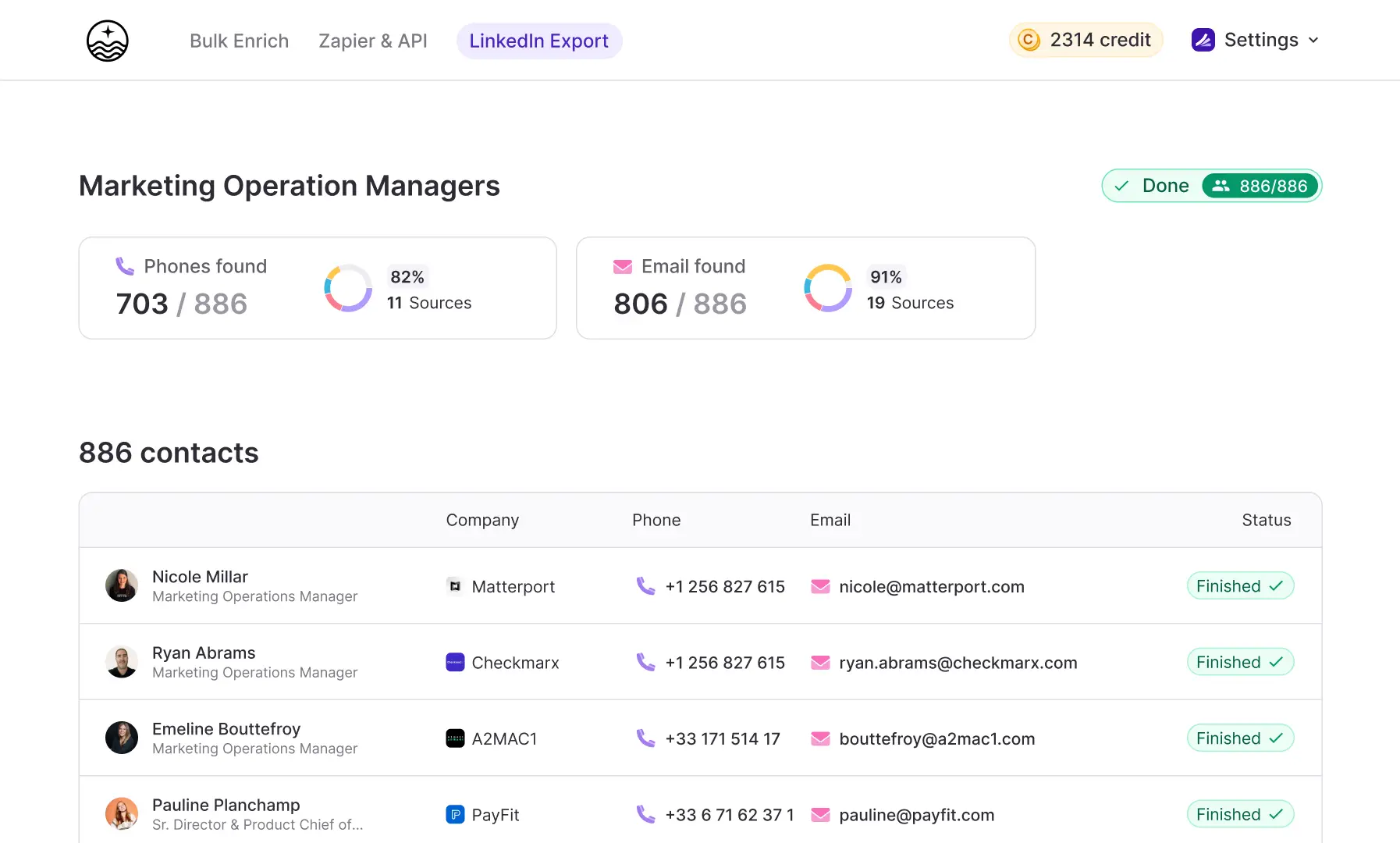
You upload a list with names and companies. FullEnrich cascades through its 25+ providers to find verified emails and phone numbers. You only pay for successful lookups. If none of the providers can find a match, you don’t burn a credit.
That “pay only for hits” model is rare. Most tools charge you regardless of whether they found anything useful.
At $29/mo for 500 credits, it’s the cheapest waterfall enrichment entry point on this list. The per-credit cost drops to $0.025 at the Business tier ($249/mo for 10,000 credits).
Pros:
- 25+ provider waterfall at the lowest entry price on this list.
- Pay only for successful enrichments. Failed lookups are free.
- Fully transparent pricing.
- Zero learning curve. Upload a list, get results.
Cons:
- Enrichment only. Nothing else.
- 25 providers is fewer than Persana (100+) or Floqer (100+).
- No proprietary database.
- You’ll need separate tools for everything beyond enrichment.
Pricing (annual billing):
- Test: $29/mo (500 credits)
- Starter: $49/mo (1,000 credits)
- Pro: $99/mo (2,500 credits)
- Business: $249/mo (10,000 credits)
9. Gumloop – Best for AI Workflow Automation (General-Purpose)
Gumloop is the wildcard on this list. It’s not a B2B sales tool. It’s a general-purpose AI workflow automation platform that can be configured for sales use cases.
The comparison to Clay arises because both let you build multi-step data workflows with AI steps. But where Clay ships with integrated enrichment providers and a B2B contact database, Gumloop ships with a blank canvas and 400+ connectors.
You build AI agents using a visual node-based interface. These agents can browse the web, scrape data, process documents, generate content, and chain API calls. It’s powerful if you’re technical enough to build what you need.
At $37/mo for the Starter plan (3,000 credits), it’s remarkably affordable for experimentation.
Pros:
- Most flexible automation platform on this list. Not limited to sales use cases.
- 400+ connectors for broad integrations.
- AI agents for web scraping, document processing, and data extraction.
- Free tier (100 credits) for evaluation.
Cons:
- No native B2B data. No contact database. No enrichment providers.
- Requires significant setup to replicate Clay-like sales workflows.
- No sales-specific templates, scoring, or intent data.
- Learning curve for complex agent builds.
Pricing:
- Free: 100 credits
- Starter: $37/mo (3,000 credits)
- Professional: $87/mo (10,000 credits)
- Enterprise: Custom
10. Seamless.AI – Best for Large-Scale Real-Time Prospecting
Seamless.AI claims the largest contact database on this list: 1.3B+ contacts. The platform uses a real-time search model, meaning data is verified at the moment you query it rather than served from a static cache.
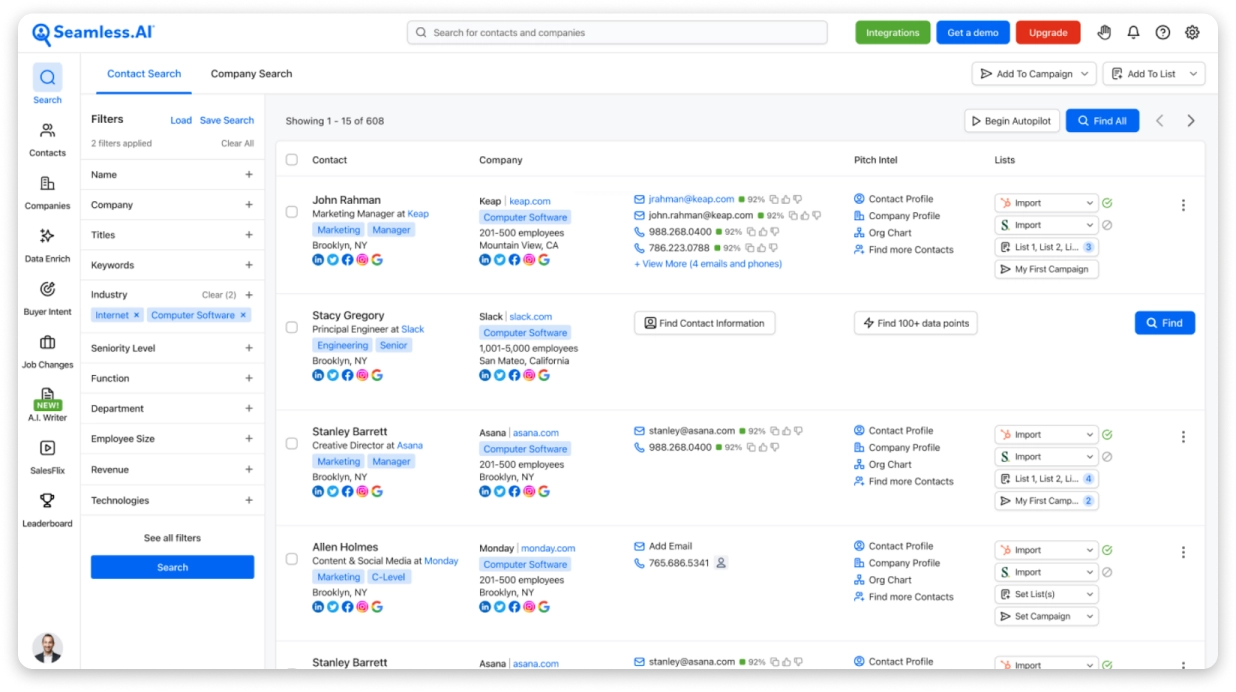
That real-time approach can reduce stale-data risk. When you search for a contact, Seamless.AI checks and verifies the information on the spot. Useful if data freshness is your top priority.
The platform includes some native outreach features (basic email sending, calling, social selling tools), though they’re less developed than dedicated platforms like Saleshandy or Apollo.
The major caveat: pricing is almost entirely opaque. Only the 50-credit free tier is publicly listed. Paid plans (Basic, Pro, Enterprise) all require contacting sales. The 1.3B+ database claim is also vendor-stated and cannot be independently verified.
Pros:
- 1.3B+ claimed contacts. Largest stated database.
- Real-time verification reduces stale-data risk.
- Some native multichannel outreach (email, calling, social).
- Bombora intent data available as an add-on.
- 50-credit free tier for evaluation.
Cons:
- Pricing is completely opaque beyond the free tier.
- Single-source data. No waterfall enrichment.
- Native outreach is basic compared to dedicated platforms.
- 1.3B+ claim cannot be independently confirmed.
- 50 free credits are quite limited for meaningful evaluation.
Pricing:
- Free: 50 credits
- Basic, Pro, Enterprise: Quote-based (not publicly disclosed)
Worth reading: Want more options? Check out the best Seamless.AI alternatives in 2026.
Which Clay Alternative Should You Pick?
Every tool on this list has a place. The right pick depends on what problem you’re actually solving.
“I need to find prospects AND send cold emails. Not juggle two tools.”
Go with Saleshandy. It’s the only tool here that combines 852M+ contacts, 9-provider waterfall enrichment, and full cold email infrastructure (sequences, warm-up, sender rotation, deliverability monitoring) starting at $34/mo. If cold email is your primary motion, this eliminates the integration overhead entirely.
“I want one platform for data, email, calls, and basic CRM.”
Apollo.io & Saleshandy have the widest functional breadth on this list. The per-user pricing hurts at scale, but for small teams that want everything in one dashboard, nothing else matches it.
“I want Clay’s workflow power without Clay’s price tag.”
Floqer. Visual workflows, 100+ enrichment sources, and Web Agents (Claygent equivalent) at $49/mo vs Clay’s $185/mo. The closest architectural match to Clay on this list.
“I already have a lead list. I just need verified emails and phones.”
Saleshandy & FullEnrich. Upload your list, pay only for successful lookups, and get results from 25+ providers at $29/mo. The simplest, cheapest enrichment option here.
“I need AI-powered enrichment with lead scoring and intent signals.”
Persana.ai. 100+ providers, AI lead scoring, and $68/mo entry. But watch the 10:1 phone credit ratio.
“I’m an agency managing multiple client campaigns.”
Saleshandy’s Scale plan ($149/mo) gives you unlimited clients, users, and email accounts. No per-seat fees. For infrastructure-first sending, Smartlead is also worth a look.
FAQs About Clay Alternatives
1. What is the best Clay alternative in 2026?
It depends on your use case. For combined prospecting and cold email, Saleshandy. For the most functional breadth (data + dialer + CRM), Apollo. For European compliance, Cognism. For pure enrichment at the lowest cost, FullEnrich. For Clay-style workflow building, Floqer.
2. What is the cheapest Clay alternative?
FullEnrich starts at $29/mo for waterfall enrichment across 25+ providers. Saleshandy starts at $34/mo and includes both prospecting (852M+ contacts) and cold email infrastructure. Clay’s cheapest paid plan (Launch) starts at $185/mo.
3. Does Clay have a free plan?
Yes. Clay offers a free tier with 100 Data Credits and 500 Actions per month, plus unlimited seats. It’s enough to test the platform but not enough for ongoing campaigns.
4. How much does Clay cost in 2026?
Clay’s self-serve plans are Free, Launch ($185/mo), and Growth ($495/mo), with Enterprise pricing on request. Clay uses a dual-credit system with Data Credits (enrichment lookups) and Actions (AI steps, automations, API calls). The actual total cost depends on workflow complexity.
5. Which Clay alternative is best for cold email outreach?
Saleshandy. It’s the most complete cold email platform on this list, with built-in sequences, sender rotation across unlimited accounts, warm-up (TrulyInbox), and deliverability monitoring. Starting at $34/mo with 852M+ contacts. Apollo is the runner-up if you also need a built-in dialer.
6. Which Clay alternative is best for agencies?
Saleshandy’s Scale plan ($149/mo) includes unlimited clients, unlimited users, and unlimited email accounts with no per-seat pricing. White-labeling is available on Enterprise.
7. Which Clay alternative includes a B2B contact database?
Saleshandy (852M+), Lusha (515M+), ZoomInfo (500M+), Apollo (210M+), and Seamless.AI (1.3B+ claimed) all have built-in databases. Clay itself does not have a proprietary database. It pulls from third-party providers using credits.
8. Can I replace Clay with Saleshandy?
If you used Clay primarily to find prospects and needed a separate tool to send cold emails, yes. Saleshandy combines Lead Finder (852M+ contacts, 75+ filters, 9-provider waterfall) with native cold email execution. You won’t need a separate sending tool. However, Saleshandy is not a workflow builder. It doesn’t have Clay’s table-based automation, formula logic, or 100+ enrichment integrations.
9. What changed in Clay’s pricing in 2026?
On March 11, 2026, Clay replaced its old Starter/Explorer/Pro/Enterprise plans with three new tiers (Launch, Growth, Enterprise). It introduced dual-credit billing: Data Credits fund enrichment lookups, and Actions fund AI steps, automations, and CRM writes. The change also moved CRM integrations, HTTP requests, and webhooks behind the Growth plan ($495/mo annual).
10. Which Clay alternative is best for non-technical teams?
Saleshandy and Lusha require the least technical skill. Saleshandy’s interface lets you search for contacts, build sequences, and launch campaigns without building workflows. Lusha’s Chrome extension reveals contact data with a single click on LinkedIn. Clay requires a technically skilled operator to build and maintain enrichment workflows.
..

 Pritesh