


 Anil Salvi
 Contents
- 1 Email Leads – TOC
- 2 TL;DR: Email Leads Simplified
- 3 What Are Email Leads?
- 4 Types of Email Leads You Should Know
- 5 Why Email Leads Matter for B2B Growth
- 6 7 Proven Ways to Get Email Leads
- 7 Comparison: Which Method Works Best for You?
- 8 How to Verify and Qualify Your Email Leads
- 9 What to Do After You Get Email Leads
- 10 Common Mistakes to Avoid with Email Leads
- 11 Key Takeaways
- 12 FAQs on Email Leads
There are two types of outbound teams.
One sends 5,000 emails and books 2 meetings. The other sends 500 and books 10.
The first team blames the copy. Rewrites the subject line. Tweaks the CTA. Adds an emoji.
Still nothing.
The second team? They never had that problem.
Because they started with email leads that were verified, targeted, and actually relevant instead of a spreadsheet.
Your outbound is not broken. Your list is.
And this guide is going to fix that with 7 ways to find email leads worth sending to, and what to do with them once you have them.
Email Leads – TOC
- TL;DR: Email Leads Simplified
- What Are Email Leads?
- Types of Email Leads You Should Know
- Why Email Leads Matter for B2B Growth
- 7 Proven Ways to Get Email Leads
- Comparison: Which Method Works Best for You?
- How to Verify and Qualify Your Email Leads
- What to Do After You Get Email Leads
- Common Mistakes to Avoid with Email Leads
- Key Takeaways
- FAQs on Email Leads
TL;DR: Email Leads Simplified
1. Email leads are contacts whose email addresses you collect through opt-ins or prospecting, and who can turn into customers.
2. You can generate them through inbound (forms, content, webinars) or outbound (B2B databases, LinkedIn, cold email).
3. B2B lead databases are the fastest way to build volume. Combine them with lead magnets and social media for long-term pipeline growth.
4. Always verify emails before outreach to protect your sender reputation and deliverability.
5. Use a CRM or pipeline tool to track stages, follow up on time, and convert leads into revenue.
What Are Email Leads?
An email lead is a person or business contact whose email address you have collected either through an opt-in form or a prospecting tool and who could potentially become a customer.
Email leads typically come from two directions:
- Inbound: Someone fills out a form, subscribes to your newsletter, or downloads a resource. They came to you.
- Outbound: You find their email through a B2B database, LinkedIn, or a prospecting tool. You go to them.
Why does this distinction matter?
Inbound leads are warmer but take time to build.
Outbound leads give you direct control over volume and targeting, but they need stronger personalization to convert.
As per the Litmus 2024 report, email marketing still delivers an average ROI of $36 for every $1 spent.
That number jumps even higher when your email leads are verified and properly targeted.
Types of Email Leads You Should Know
Not all email leads are created equal.
The type you focus on depends on your sales motion and where your team spends most of its time.
- Cold Email Leads: Prospects found via databases or tools who have not interacted with you yet.
- Warm / Inbound Leads: Contacts who opted in through a form, webinar, or content download.
- MQLs (Marketing Qualified Leads): Leads who showed engagement signals like repeated opens, clicks, or downloads.
- SQLs (Sales Qualified): Contacts ready for a sales conversation, who replied with interest or booked a call.
- B2B Email Leads: Business contacts with verified professional email addresses, typically decision-makers at target companies.
Outbound B2B teams typically focus on cold leads and B2B leads. Inbound marketers prioritize warm leads and MQLs.
Knowing the difference helps you pick the right acquisition method.
Why Email Leads Matter for B2B Growth
You searched for this, so I will keep it short. Here is why email leads are still one of the most valuable assets for B2B teams:
- Direct Access to Decision-Makers: Your email lands in their inbox, not a social media feed they scroll past.
- Scalable Pipeline Building: Email outreach scales from 100 to 10,000 contacts without a proportional cost increase.
- Measurable At Every Step: Open rates, reply rates, clicks, you always know what is working and what is not.
- Works for Both Inbound and Outbound: The same lead can be nurtured through email regardless of how they entered your pipeline.
Email remains the highest-ROI channel for B2B outreach.
If your pipeline depends on conversations with decision-makers, email leads are where it starts.
7 Proven Ways to Get Email Leads
I have tested and used most of these methods for B2B outreach. Here are the 7 that actually work, ranked by speed and reliability.
- Use a B2B Lead Database
- Build an Email List with Lead Magnets
- Use LinkedIn for Prospecting
- Run Cold Email Campaigns
- Use Website Visitor Identification Tools
- Optimize Existing Content for Lead Capture
- Use Social Media and Communities
1. Use a B2B Lead Database
Best For: Outbound sales teams, SDRs, agencies, and founders doing cold outreach at scale.
If you need email leads fast, this is where you start.
B2B databases give you access to millions of verified business email addresses that you can filter by industry, job title, company size, location, revenue, and even tech stack.
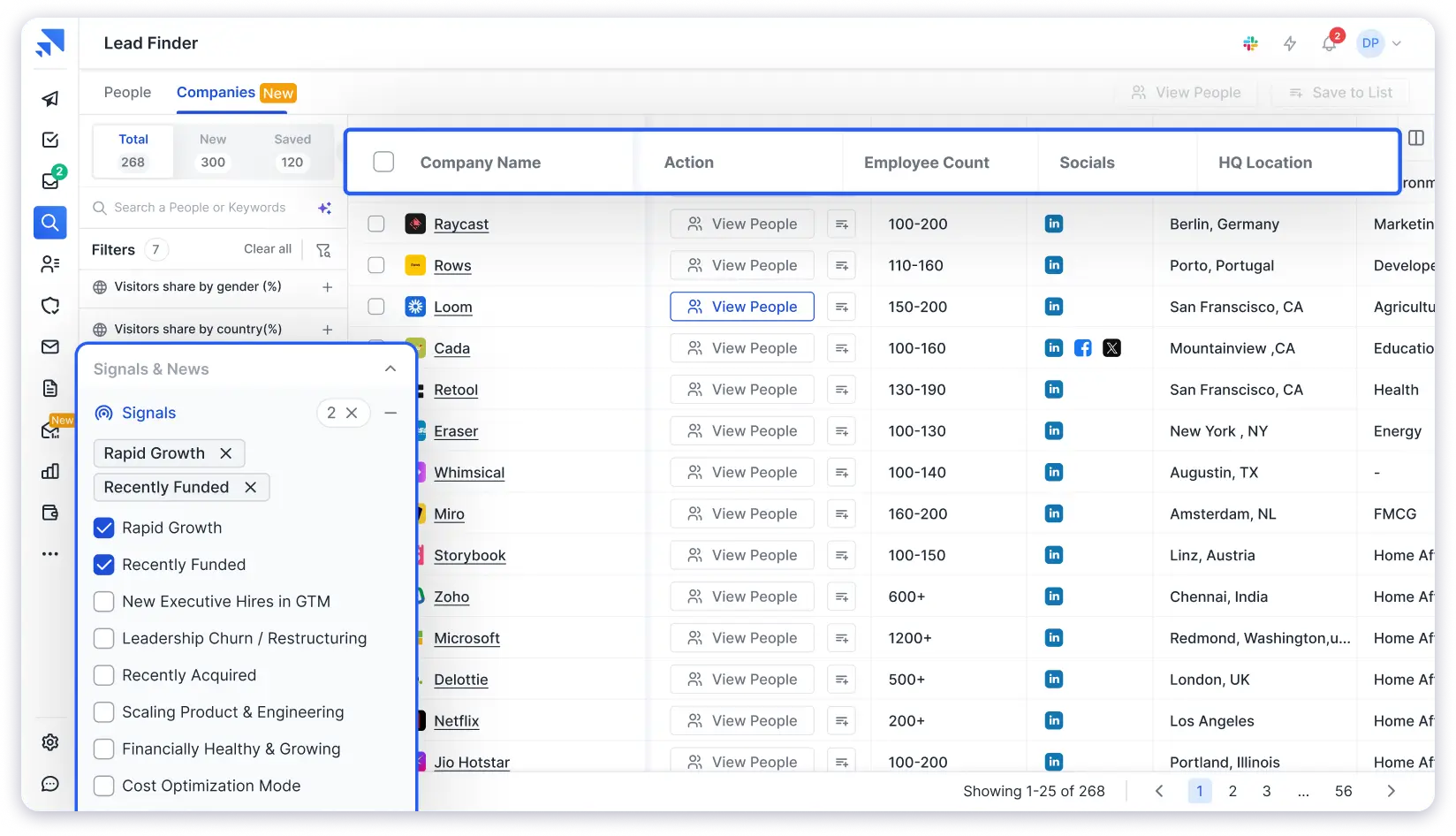
Here is How It Works:
- Define your ideal customer profile (ICP).
- Apply filters like role, industry, company size, location, and technographics.
- Export a verified email list.
- Launch your outreach directly.
I have used a few databases over the years, and the one I keep coming back to is Saleshandy Lead Finder.
- 800M+ Verified B2B Contacts: One of the largest databases available, with 60M+ company profiles covered globally.
- 75+ Advanced Filters: Narrow down by job title, industry, company size, revenue, location, technographics, and buying signals so you only pull leads that match your ICP.
- AI-Powered Lead Search: Describe your ideal prospect in plain English and let AI set the right filters for you. Instead of manually testing filter combinations, you get qualified leads in seconds.
- Company Search & Lookalike Prospecting: Search companies separately, map decision-makers within them, and find similar companies that match your ICP to build account lists faster.
- Prospect Enrichment: Already have a list? Enrich it with verified emails, phone numbers, and company data from multiple trusted providers using AI.
- Real-Time Email Verification: Every contact is verified before you use a credit. If an email does not pass, you do not get charged.
- Waterfall Enrichment: Verified emails and phone numbers sourced from 7 trusted data providers for higher accuracy than single-source databases.
- Find-to-Send in One Platform: Go from pulling a lead to sending a cold email sequence without exporting CSVs, switching tools, or losing context.
- Built-in CRM: Track every lead’s stage, conversation history, and follow-ups from the same place you found them.
- Plans Starting at $49/Month (Billed Annually): Full access to the database, filters, and outreach tools without per-user pricing. Most teams pay less than what a single seat costs on other platforms.
Most tools make you pay separately for data, outreach, and pipeline management.
Saleshandy puts all three in one place, which is why I stopped juggling multiple subscriptions.
Pros
- Fastest way to build targeted lists
- Verified emails reduce bounces
- No tool-switching needed
- Scales with your outreach volume
- Get 50 free credits to start with
Cons
- Free trial available only for 7 days
Want to learn more about the best b2b databases? Check the guide here.
2. Build an Email List with Lead Magnets
Best For: Marketing teams running inbound, SaaS companies with existing website traffic.
Offer something your target audience genuinely wants, such as an ebook, template, checklist, or free tool, in exchange for their email address.
- Create a resource your audience actually finds useful.
- Set up a landing page with an opt-in form.
- Promote it through content, social, and paid ads.
Honest take: Lead magnets work well for long-term list building, but they require traffic first.
If you need leads this week, this alone will not be enough.
Pros
- Low cost, high intent leads
- Builds trust before outreach
- Great for long-term pipeline
Cons
- Slow to generate volume
- Needs existing website traffic
Also Read: Lead Generation for Startups
3. Use LinkedIn for Prospecting
Best For: SDRs, founders doing targeted outreach, ABM teams.
LinkedIn is one of the best places to identify B2B email leads.
You can search by job title, company, and industry to find decision-makers, then use an email finder tool to get their verified email.
- Search by role, company, or industry on LinkedIn or Sales Navigator.
- Identify the right prospects.
- Use a LinkedIn email finder to pull their verified email.
- Add them to your outreach sequence.
Tools like the Saleshandy Connect Chrome Extension let you reveal verified emails directly from LinkedIn profiles without leaving the page.
One click on any profile, and you get the contact details instantly.
It comes with 50 free credits, so you can test it without committing to anything.
Pros
- Access to decision-maker profiles
- Free to start prospecting
- Great for ABM targeting
- Chrome extensions can pull verified emails without switching tabs
Cons
- Manual process without tools
- LinkedIn limits daily searches
Read this guide here to understand the best LinkedIn email extractors.
4. Run Cold Email Campaigns
Best For: B2B outbound teams, agencies, and SaaS companies doing founder-led sales.
Cold email is one of the fastest ways to generate email leads at scale.
You reach out directly to people who match your ICP without waiting for them to find you.
- Build a prospect list from a database or LinkedIn.
- Write personalized emails (no generic templates).
- Set up automated sequences with 3–5 follow-ups.
- Track opens, replies, and interest signals.
The advantage of cold email over other methods? Speed and control. You decide who to reach, when, and how many.
Pros
- Full control over targeting
- Scales quickly with automation
- Low cost per lead
Cons
- Requires good copy and personalization
- Deliverability needs active management
Also Read: Cold Email Lead Generation
5. Use Website Visitor Identification Tools
Best For: Companies with decent website traffic looking to convert anonymous visitors into leads.
These tools identify companies visiting your website, even if they never fill out a form.
You install a tracking script, and it matches visitor IP data against contact databases.
Fair warning: Most of these tools work better at the company level than the individual level.
They are most useful when combined with a B2B database to find specific contacts at the companies that visited.
Pros
- Captures anonymous website visitors
- No form submission needed
Cons
- Company-level data, not individual
- Needs decent website traffic first
6. Optimize Existing Content for Lead Capture
Best For: Teams with existing organic traffic that are not converting visitors into leads.
This is low-hanging fruit.
If you already have blog posts or pages getting organic traffic, add contextual opt-in forms, pop-ups, or inline CTAs to capture email addresses.
Identify your top-traffic pages, add a relevant lead magnet or email capture form, and start collecting leads without creating any new content.
Pros
- Zero additional content needed
- Free to implement
- Quick results from existing traffic
Cons
- Limited by the current traffic volume
- Conversion rates depend on the offer
7. Use Social Media and Communities
Best For: Founders building a personal brand, marketing teams running multi-channel lead gen.
Platforms like LinkedIn, X, Reddit, and Slack communities can be solid sources for email leads.
Share valuable content with a CTA, engage in relevant discussions, or run LinkedIn ads with gated content.
Reality check: Social takes consistency and time. It works best as a supplement to direct prospecting, not a replacement.
Pros
- Builds audience and trust simultaneously
- Free to start
Cons
- Slow and unpredictable results
- Hard to scale consistently
Comparison: Which Method Works Best for You?
Not every method works for every team.
Here is a quick comparison to help you decide where to start based on your budget, timeline, and team size.
| Method | Speed | Cost | Best For | Lead Quality |
|---|---|---|---|---|
| B2B Lead Database | Fast | Low–Medium | Outbound sales, SDRs, agencies | High (verified) |
| Lead Magnets | Slow | Low | Inbound marketing teams | Medium–High |
| LinkedIn Prospecting | Medium | Low–Medium | SDRs, ABM, founder-led sales | High |
| Cold Email Campaigns | Fast | Low | B2B outbound teams, agencies | Medium–High |
| Visitor Identification | Medium | Medium | Companies with website traffic | Medium |
| Content Optimization | Medium | Free | Teams with existing traffic | Medium |
| Social & Communities | Slow | Free–Low | Founders, multi-channel teams | Low–Medium |
How to Verify and Qualify Your Email Leads
Getting email leads is step one. Making sure they are valid and worth pursuing is step two. I have seen teams skip this and regret it fast.
1. Email Verification
Sending to unverified emails can wreck your sender reputation.
Bounces, spam traps, and invalid addresses all tell email providers that you are not a trustworthy sender.
Once your domain reputation drops, even your emails to good addresses start landing in spam.
Always run your list through an email verification tool before hitting send.
2. Lead Qualification
Not every email lead is worth pursuing. Before you add someone to a sequence, check for basic qualifications:
- ICP Fit: Do they match your target industry, company size, and role?
- Decision-Making Authority: Are they a decision-maker or at least an influencer?
- Engagement Signals: Have they opened, clicked, or replied to anything?
One thing I like about Saleshandy Lead Finder is that it gives you pre-verified contacts with real-time verification built in.
If an email does not pass verification, you do not get charged a credit.
Also Read: Email Deliverability Issues
What to Do After You Get Email Leads
This is where most guides stop and where most teams lose deals. Finding email leads is only half the job.
What you do with them after that decides whether they turn into meetings and revenue.
- Organize by Stage: Do not dump everything into a spreadsheet. Track where each lead stands as not contacted, contacted, replied, interested, or closed.
- Follow Up Consistently: Most replies happen after the 2nd or 3rd touchpoint. Without a system, follow-ups slip, and leads go cold.
- Track Engagement: Opens, clicks, replies — know which leads are warm and which need a different approach.
- Keep Full Context: Notes, conversation history, and activity timeline for every lead. Personalization gets a lot easier when you can see what happened last.
This is exactly what Saleshandy CRM is built for.
It replaces static prospect lists with a visual Kanban pipeline, so you can instantly see where every lead stands.
Each contact has a unified activity timeline, emails, replies, notes, and tasks in one place.
You can send 1:1 emails, set follow-ups, and manage custom fields without switching tools.
Everything stays connected, organized, and in context.
Common Mistakes to Avoid with Email Leads
I have seen these mistakes slow down or completely stall outbound pipelines. Most are avoidable if you know what to watch for.
- Buying Unverified Lists From Shady Vendors: Leads to bounces, spam complaints, and domain blacklisting. Always use a reputable database.
- Skipping Email Verification: Even one bad batch can tank your sender reputation for weeks.
- Sending Generic Emails to Your Entire List: Zero segmentation means low reply rates. Personalize by role, company, and pain point.
- Not Following Up: Most responses come on the 2nd or 3rd email. One email and done means you are leaving replies on the table.
- Using Spreadsheets Instead of a CRM: Works for 20 leads. At 200+, leads slip through the cracks, and follow-ups get missed.
Key Takeaways
Email leads are the starting point of any B2B outreach strategy.
If the list is strong, everything else becomes easier.
If you need a pipeline fast, use a reliable B2B database to generate verified leads at scale.
And always verify emails before you send. Skipping this step can hurt your sender reputation and lower deliverability.
Once you have the leads, organize them.
Track stages, monitor replies, and follow up consistently.
The best results come from: databases for volume, cold email for outreach, and LinkedIn for targeted prospecting.
FAQs on Email Leads
1. How do I get email leads for free?
Free methods include creating lead magnets (ebooks, templates, checklists), optimizing existing content for email capture, manual LinkedIn prospecting, and engaging in relevant online communities.
You can also try Saleshandy’s 7-day free trial, which gives you 5 free credits to test B2B lead finding.
2. Is it legal to buy email leads?
Buying pre-verified B2B contact lists from reputable databases (like Saleshandy, Apollo, or ZoomInfo) is standard practice.
Buying random consumer email lists from unknown vendors is risky and often non-compliant with GDPR or CAN-SPAM.
Always verify the source and data quality.
3. What is the best tool to find B2B email leads?
Popular options include Saleshandy Lead Finder, Apollo, ZoomInfo, and Hunter.
Saleshandy stands out for teams that want lead finding, cold email outreach, and CRM in one platform, with plans starting at $49/month for 30k leads and access to 800M+ verified contacts.
4. How do I generate email leads without a website?
Use a B2B database to find contacts directly, prospect on LinkedIn, join relevant Slack or Reddit communities, or attend virtual events.
A website helps, but outbound prospecting does not require one.
5. How many email leads should I generate per month?
It depends on your sales targets and team size. A common benchmark for B2B outbound is 500–2,000 new leads per month per SDR.
But quality always beats quantity.
100 well-targeted leads will outperform 2,000 random contacts.