
Cold email is not dead in 2026. Bad cold email strategies are.
I see people struggle with cold email all the time. Not because the channel stopped working, but because there is no clear strategy behind what they are doing.
So they keep switching tools, testing new templates, or increasing volume. The results stay inconsistent.
Cold email only works when there is the right strategy behind it.
We already know it can work. We have all seen people book meetings with cold email. But when we try to run outreach seriously, the same questions come up every time.
- Who should we actually target?
- How do we stay relevant when sending at scale?
- How do we follow up without sounding pushy or repetitive?
When there are no clear answers to these, outreach starts to feel random. Emails sound generic. Follow-ups feel forced. And when you try to scale, things usually break instead of improving.
That is why I wrote this guide.
In this article, I break down a cold email strategy that still works in 2026. I walk through prospecting, messaging, follow-ups, and execution so your outreach feels structured and intentional again.
If you want cold email to work consistently, this is where we start.
Cold Email Strategy – TOC
Do you want a quick look at the cold email strategy that will work in 2026? Check this YouTube video.

7 Best Cold Email Strategies That Are Sure Shot to Work in 2026
I created this list based on personal experience and what I have learned over time.
- Hyper-Personalized Cold Emails (Using AI Where It Helps)
- Personalized Video Outreach (Going One Step Further Than Text)
- Use a Strategic Blend of Cold Emails with Multi-Channel
- Automate Cold Emailing with an AI-Assisted Outreach Platform
- Add Social Proof in Your Cold Emails
- Micro-Segmentation of Your Lead Lists
- Your Email Shouldn’t Sound Like an Email, It Should Sound Like an Offer
1. Hyper-Personalized Cold Emails (Using AI Where It Helps)
Personalization is what separates a cold email from inbox noise. In 2025 and moving into 2026, it is the baseline.
Now, just basic personalization, like first name or company name, would not work anymore in cold emailing.
What actually moved the needle was relevance tied to business context.
When prospects felt understood, reply rates jumped from the usual 1–5% to 15–30% in well-targeted campaigns.
The goal is simple. You need to make your reader feel seen, not studied.
Personalization works best when it stays professional and value-driven.
- A job role and responsibilities
- A recent company event (funding, hiring, expansion)
- A product launch or update
- A visible challenge tied to their stage or market
- An industry shift that directly affects them
This kind of context shows intent without crossing boundaries. This level of personalization feels relevant, as you showcase that you have done research before approaching.
So, there are multiple levels of personalization. Let’s understand them.
Not every email needs maximum depth. So, what? You need to think in tiers.
Basic personalization (minimum standard)
- Name, company, role, and broad industry context.
- Works for scale, but rarely drives strong replies alone.
Deep personalization (sweet spot for most B2B)
- One specific observation about their company or role, tied to a clear business problem.
- This is where most successful campaigns live.
Hyper-personalization (high-value use only)
- Multiple custom elements tied together: role, recent event, tailored pain, and sometimes a personalized image or video.
- Best reserved for enterprise deals, ABM, or priority accounts.
The important part is finding the balance and personalization to the right relevance.
During my research on different forums and websites, here what most outreach professionals are saying.

Next, let’s understand personalization in the subject lines as well.
Personalized subject lines worked best when they were subtle.
Good Examples
- “Quick idea for {{Company}}’s {{specific goal}}”
- “{{FirstName}}, question on {{specific trigger}}”
- “Thought on {{Company}}’s {{recent event}}”
Keep these pointers in mind when writing the subject lines of your cold emails. You must keep your subject lines under 50 characters, and they should be clear.
If you are confused about how to write subject lines for your cold emails, here is a blog that has 150+ examples of subject lines.
Now, the next important thing is CTAs that convert your personalized cold emails.
Based on your email copy and content, you need to make sure that your CTAs are proper.
There is a simple rule here: high-pressure CTAs rarely worked, while low-friction tasks got far better responses.
Now, let’s see one example of a personalized cold email. Here is a template.
A Proper Hyper-Personalized Cold Email Template
Subject: Quick Idea for {{Company}}’s {{Team Or Goal}}
Hi {{First Name}},
I noticed {{Specific Trigger: Funding Round / New Hires / Product Launch}} and how {{Company}} is approaching {{Relevant Angle}}.
Teams at a similar stage often run into friction around {{Specific Pain Tied To That Trigger}}, especially as volume or complexity increases.
{{Your Product Or Service}} helps {{Role}} achieve {{Concrete Outcome}} by {{Short Mechanism}}, without {{Common Risk Or Downside}}.
Would it make sense to explore this in a quick 10–15 minute call next week to see if it’s relevant for {{Company}}?
Best,
{{Your Name}}
P.S. Helped {{Similar Company}} achieve {{Specific Result}} in {{Timeframe}}.
This works because it leads with why them, not who you are.
Still finding it difficult to write personalized cold emails? Check out this video.

2. Personalized Video Outreach (Going One Step Further Than Text)
The next step after cold emails is sending personalized video-recorded emails.
It is still cold outreach, but here you are intentionally going one level deeper.
Instead of relying only on written words, you record a short video. In that video, you talk about their pain points, challenges, or show how you can help.
Don’t believe me. People on Reddit are even advising about this technique. Read the following information from a Reddit conversation.

What do I believe? Because the video is pre-recorded, prospects can watch it at their convenience.
They can see who you are, hear your intent, and understand what you are trying to say.
That single shift changes how the message feels. In 2026, it’s now about how a person is reaching out to you.
We all know email copy has limits. No matter how good your writing is, text can only do so much.
With video, you can actually show your research.
Mention something specific about them (their role, recent funding, hiring, product update, or a visible business move).
This is where trust begins. Showing a person builds credibility.
A natural and human explanation reduces friction more than plain text alone.
That is why personalized video started working so well in 2025.
Not because it was new, but because inboxes were already exhausted with generic text.
Don’t just believe what I say, check these statistics.
Cold emails with personalized video links consistently outperformed text-only emails.
- Many teams reported 3–5× higher reply rates.
- Some shared cases of thousands of meetings booked annually.
- Open rates increased by 6–8% when video appeared with a thumbnail or GIF.
- Click-through rates jumped 2–3× in several benchmarks.
Basically, you can say that the video did not just get seen more. It got engaged with more.
What also changed is that the video started scaling better. Earlier, recording one-to-one videos for everyone was not practical.
Now, tools like Loom, Vidyard, Sendspark, and AI-assisted platforms make this manageable.
You can record once and dynamically personalize names, company details, or website screenshots.
This semi-personalized approach keeps the message human without burning time.
It works especially well for mid-to-high value accounts.
A quick point to consider before using video.
- Video is powerful, but it is not forgiving.
- Fully manual videos do not scale well for large lists.
- Low-quality or scripted videos backfire faster than bad copy.
- Anything longer than 30–60 seconds feels heavy.
- Video alone does not fix weak targeting.
- Even with video, average cold email reply rates still sit between 1%–10% overall.
It shines only when combined with relevance, value, and smart follow-ups.
Now, you know everything about creating personalization videos for outreach, but read these tips on what not to do.
Heads-up on deliverability (don’t skip this)
This part matters more than most teams expect.
- Never attach videos to emails.
- Avoid embedding videos directly inside email bodies.
- Always link to a hosted video instead.
- Unlisted YouTube links or tools like Vidyard preserve deliverability.
- They trigger familiar previews without raising spam signals.
In short, personalized video works when used with intent.
It rewards effort, relevance, and restraint. Used at the right moment, it makes cold outreach feel human and naturally connecting.
Used blindly, it becomes noise again. This is exactly why video personalization belongs in a modern cold email strategy.
3. Use a Strategic Blend of Cold Emails with Multi-Channel
Cold email should be the base of your outreach strategy.
It’s the most reliable way to reach decision-makers at scale, test your messaging, and understand what actually works.
Most B2B teams see reply rates between 2 and 6% with cold emails.
With better targeting, personalization, and follow-ups, this often goes above 5%, and strong campaigns can reach 8–15% replies.
These cold email statistics are widely observed in this industry. So yes, cold email works. But inboxes are crowded.
And that’s where multi-channel outreach helps.
If you are already doing cold email, you should use multi-channel outreach. You should start now, but in a very simple way.
The mistake most people make is overdoing it.
Multi-channel does not mean messaging people everywhere at the same time. It means giving your cold email more chances to be seen.
Cold email should always be your main channel. This is where you explain your offer, your value, and why you are reaching out.
Before you add any other channel, ask yourself:
- Is my email clear?
- Does it explain why I am reaching out?
- Does it make sense to the person reading it?
If the email is weak, multi-channel will not help. Fix the email first.
Cold email stays at the center. That’s where you explain your value and start the conversation. Other channels are used only to support that message, not replace it.
Once your email is ready, add one more channel. That’s it.
The easiest place to start is LinkedIn.
You don’t need to send messages. Just:
- View the prospect’s profile, or
- Send a connection request without pitching
Afterwards, you can write follow-up emails and send them after a few days. In some cases, a call after there’s already some awareness.
You don’t need to do everything at once. In fact, doing too much often backfires.
What works is consistent messaging across a few channels, spaced out properly.
4. Automate Cold Emailing with an AI-Assisted Outreach Platform
The next strategy is using an AI-powered cold email platform.
If you are serious about cold email as a strategy, you should not be doing it manually.
Manual outreach breaks very quickly. Follow-ups get missed, personalization drops, tracking becomes messy, and a lot of time goes into repetitive work that doesn’t move the needle.
In today’s market, this is not sustainable.
The new approach is simple: keep the strategy human, and let software handle the execution.
This is where AI-assisted cold email tools come in.
To apply this strategy properly, you need dedicated cold email platforms with AI features.
Tools like Saleshandy, Instantly, and Woodpecker are built specifically for this. Let’s understand how Saleshandy can help you.
Saleshandy is an all-in-one AI cold outreach and lead generation platform.
What makes Saleshandy stand out is that you can manage both prospecting and outreach in one place.
Instead of using separate tools, everything runs from a single platform. For most teams, this saves 2–3 hours every day.

Saleshandy is especially useful if you want to:
- Run automated cold email and multi-channel sequences
- Personalize cold emails using enriched lead data
- Maintain strong deliverability as you scale
- Track replies and campaign results clearly
It also includes built-in lead generation, which makes it easier to go from strategy to execution without switching platforms.
Let me explain its important and advanced features in detail.
Well, the very first step is finding the ideal prospects. You can use Saleshandy’s AI Lead Search.
AI Lead Finder (AI Lead Search)
This feature helps you find the right prospects quickly. Instead of using multiple filters, you describe your ideal customer in simple text, and the tool finds matching leads from its database.
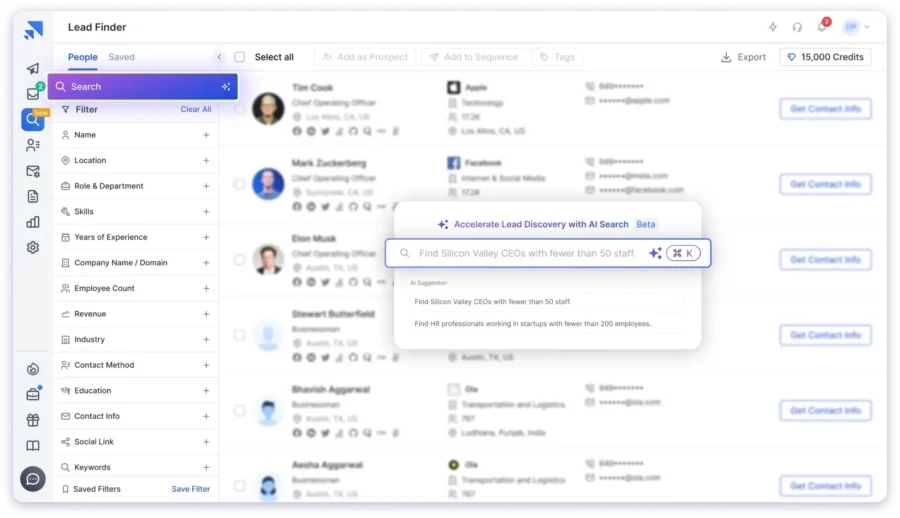
It also verifies emails in real time, so you avoid bad contacts. You can add these leads directly to your cold email campaigns without switching tools.
AI Sequence Co-pilot
This helps you create outreach sequences faster. You enter your ICP, goal, and offer, and the AI generates a complete email sequence for you.

It includes follow-ups and messaging suggestions. You can edit and adjust everything, but you do not have to start from scratch each time.
AI Prospect Enrichment
This feature helps you personalize emails at scale. The AI pulls useful context about each prospect and their company to create openers and talking points that feel relevant.

It goes beyond basic merge tags. You can preview, refine, and reuse enriched data to send more natural and personalized cold emails.
All the features and tools you need are set up, but what about deliverability? It is a critical part, right?
Saleshandy offers a complete deliverability suite designed to improve inbox placement, protect sender reputation, and support consistent outreach at scale.
Use this cold email checklist to double-check deliverability and sending best practices before launching campaigns.
Core Deliverability Capabilities
- Automated email warm-up that gradually builds and maintains sender reputation across inboxes
- Inbox placement testing that shows whether emails land in the Inbox, Promotions, or Spam
- Automatic sender rotation to spread sending volume naturally across multiple email accounts
- Sequence Score to evaluate campaigns against deliverability best practices and measure success
- Properly configured email infrastructure with authentication to support long-term deliverability
You can read here a complete review of Saleshandy.
5. Add Social Proof in Your Cold Emails
Cold emails fail because most people don’t trust them. This is where social proof helps solve that.
When someone receives a cold email, their first reaction is usually, “Why should I pay attention to this?”
Social proof gives them a quick reason to take you seriously without needing a long explanation.
A relevant proof point tells the reader:
- You have worked with people like them.
- What you are saying is not just a theory.
- Replying won’t be a waste of time.
Even a small signal can change how your email is perceived. The most common mistake is using the wrong kind of social proof.
Big brand names don’t always help. What matters more is relevance. The reader should see themselves in the example.
For example:
- A founder cares about what worked for another founder.
- A sales leader cares about what worked for another sales team.
- A small company cares more about similar-sized companies than large enterprises.
If the proof feels familiar, it feels credible.
Social proof in cold emails should be quick and concrete.
One line is usually enough. Long explanations feel like marketing copy and get skipped.
When adding social proof, you need to focus on:
- Who you helped
- What changed
- Why it matters
You don’t need exact numbers if you don’t have them. An outcome is often enough.
Social proof works best after you have stated the problem or offer.
Once the reader understands what you are talking about, the proof acts as confirmation. It supports your point instead of distracting from it.
In cold email, trust is built in seconds. Social proof helps you earn.
6. Micro-Segmentation of Your Lead Lists
Micro-segmentation is not about breaking a list into smaller pieces just for the sake of it.
It’s about reducing guesswork in your messaging.
When a cold email fails, it is due to poor email copy and a too broad angle.
Micro-segmentation resolves that by allowing you to write for one context at a time.
With micro-segmentation, you get clarity before you even write your message.
Before you write the email, follow these tips to make your email super powerful.
- What situation is this group in
- What problem are they likely facing right now
- What outcome would matter to them
If you can’t answer these, the segment is too wide. Most people stop at job titles and industries. That’s a starting point, but it’s not enough.
Better segmentation looks at context, such as:
- Company stage (early, growing, mature)
- How outbound is being used (testing vs scaling)
- Team setup (founder-run vs sales-led)
- Where things start to break (time, volume, control)
These signals tell you why someone might care about your message today.
For example, let’s say you are targeting SaaS companies.
Instead of one segment called “SaaS companies,” create this micro-segment:
SaaS teams with 10–50 employees that recently started outbound and are sending emails at scale.
From this segment alone, you can assume:
- Email volume is increasing
- Follow-ups are harder to manage
- Tracking replies across inboxes is messy
- Deliverability is becoming a concern
Now your email can speak directly to control, structure, and scale outbound without breaking inboxes.
As a result, you are not guessing anymore. You are writing for a practical situation.
When the segment is right, the email becomes easier to write and easier to read.
You don’t need long explanations or heavy personalization. The message feels relevant because it matches the reader’s context. That’s what increases replies.
This is why micro-segmentation often delivers better results than tweaking subject lines or adding more follow-ups.
Let’s say you sell a sales engagement SaaS platform.
Instead of targeting a broad group like “B2B companies,” you narrow it down to a more specific segment.
For example, B2B SaaS companies with 20 to 100 employees that recently moved from founder-led sales to a small sales team.
This is very different from a generic B2B list.
With this micro-segment, you can make a few safe assumptions:
- Sales reps are sending more emails and running their own sequences
- Messaging is inconsistent across the team
- Follow ups are either rushed or missed
- Managers struggle to see what is working and what is not
When you speak to this group, your outreach feels relevant because it connects with what they are already dealing with.
As the situation is clear, the message becomes clear too.
Your email doesn’t need to talk about “growth” or “efficiency.” It can focus directly on control, consistency, and visibility as outreach scales. That makes the message feel timely and relevant instead of generic.
This is the right purpose of micro-segmentation.
You stop guessing what might resonate and start writing for a situation you already understand.
A good test is this: If you can’t describe the segment’s main problem in one clear sentence, it’s too big.
If that sentence feels vague, narrow the segment further.
Micro-segmentation doesn’t require:
- A ton of tools
- More emails
- More personalization work
It only requires better thinking before writing.
That’s why it often delivers better results faster than rewriting copy or changing subject lines.
7. Your Email Shouldn’t Sound Like an Email, It Should Sound Like an Offer
When most people write cold emails, they write them like normal emails. They introduce themselves, explain what they do, and then ask for a call.
That’s exactly why those emails get ignored.
A cold email should not feel like a message someone has to read. It should feel like an offer someone has to evaluate.
- If your email sounds like an email, the reader thinks, “I’ll check this later.”
- If it sounds like an offer, the reader thinks, “Is this relevant to me or not?”
That difference matters.
A good cold email is not about you or your product. It’s about putting something specific in front of your prospect.
Something like:
- A clear outcome
- A clear improvement
- A clear opportunity
The reader should immediately understand what they get if this works.
Most cold emails fail because they stay vague. You are already just describing how you can help or provide value, even before explaining the offer.
When there’s no clear offer, there’s no reason to reply.
An offer-based email does three simple things:
- It makes it clear who the email is for
- It makes the result easy to understand
- It asks for a reasonable next step
So yes, you don’t need long explanations. You don’t need to describe your entire product. You just need to give the reader something concrete to react to.
Do you want to know more about the icebreakers? Check out this video.

The call-to-action matters here.
If your email doesn’t justify a call yet, don’t ask for one. Sometimes the right ask is just a reply, a yes or no, or permission to share something useful.
When the ask matches the offer, replying feels easy.
Before sending any cold email, ask yourself one simple question:
- If I received this email, would I clearly know what’s being offered?
- If the answer is no, the email sounds like an email.
- If the answer is yes, it sounds like an offer.
Cold emails don’t fail because people hate emails. Your cold email might fail because it’s not clear.
Stop writing emails that explain. Start writing emails that offer something specific.
That’s what gets replies.
What Has Changed in Cold Emailing in 2026?
Cold email is still working, but the standard has changed. Let’s have a quick glimpse of what worked in cold emailing in 2025.
What worked in 2025 slowly became normal. Things that once helped you stand out are now expected.
Teams that did not adapt started seeing fewer replies, even if they used the same tools and volume.
- In 2025, cold emails worked when it was clear why a specific person was contacted. Not because of first names or company mentions, but because the email showed context.
- Emails that referenced hiring activity, funding, role changes, launches, or visible growth outperformed those that did not because they signaled intent.
- Deliverability became part of day-to-day work. Teams that warmed inboxes slowly, kept sending consistently, and avoided sudden volume jumps stayed in the inbox.
- Broad lead lists stopped performing well. A small and focused list worked better because the message could be clearer and more direct.
- Follow-ups drove most replies. One email rarely worked on its own. Consistent follow-ups mattered more than sending more emails.
In 2026, this became the baseline.
- People decide quickly if an email is worth reading. If the message is not clear early, they move on.
- Sending more emails no longer fixes weak targeting or unclear offers. Higher volume now creates more problems than results.
- Engagement affects inbox placement directly. Low replies and ignored emails push future emails out of the inbox.
- Cold email now works only when the full setup is right. Lead quality, segmentation, message clarity, follow-ups, and inbox health all need to work together.
If you’re planning to scale your cold email strategy, make sure your secondary domains and email accounts are set up correctly.
Replace Your Old Cold Email Playbook With What Works Today
Cold email is not dead. Old playbooks are.
Sending too many emails does not work anymore. Today, people expect emails to match their situation. When emails are sent with this in mind, cold email still works.
In this guide, I shared simple strategies to help cold email work in 2026 and beyond.
Cold email is a skill. It takes time to get better at it. Keep trying, keep learning, and make small changes as you go.
If you remember nothing else, follow these rules:
- Personalize now by adding context
- Segment your lists narrowly instead of chasing volume
- Write emails that sound like proper offers
- Use follow-ups and multichannel in a proper way
- Protect deliverability as you scale by sending like a human
Do this consistently, and cold email will remain a reliable growth channel in 2026 and beyond.
FAQs About Cold Emailing
1. Does cold email still work in 2026?
Yes, cold email still works in 2026 when done correctly. Success now depends on relevance, personalization, and strong deliverability practices rather than high sending volume.
2. What is the best cold email strategy in 2026?
The best cold email strategy in 2026 focuses on micro-segmentation, personalized messaging, clear offers, strategic follow-ups, and protecting email deliverability while scaling.
3. Is cold emailing still legal in 2026?
Yes, cold emailing is legal in most regions when done correctly. You must follow local regulations such as CAN-SPAM, GDPR, or similar laws by providing clear identification and opt-out options.
4. How important is email deliverability for cold outreach?
Email deliverability is extremely important. Even strong copy will not perform if emails land in spam. Warming inboxes, controlling volume, and monitoring sender reputation are essential.
5. How many follow-ups should I send in cold email?
Most successful campaigns use three to five follow-ups. Replies often come after the second or third message, as long as follow-ups add value and are spaced out properly.
6. Does personalization improve cold email response rates?
Yes, meaningful personalization significantly improves response rates. Emails that reference a prospect’s role, timing, or situation perform much better than basic merge-tag personalization.
7. Should I use AI for cold email outreach?
AI can help with research, personalization, and sequence creation. It works best when used to support your strategy, not replace targeting decisions or message clarity.
8. Is cold email better than LinkedIn or cold calling?
Cold email works best as part of a multichannel strategy. Combining email with LinkedIn outreach or light calling often improves visibility and reply rates.