

Choosing a cold email tool today is less about features and more about reliability.
If you are comparing Saleshandy and Sparkle.io, you are probably close to making a decision. You already understand cold outreach.
What you want now is clarity on what actually works when campaigns go live.
The risk is not about choosing the wrong cold email software.
The risk is facing problems later. Burned inboxes, missed replies, weak deliverability, or workflows that fall apart as volume grows.
Both tools solve cold outreach in different ways. Saleshandy focuses on structured outbound that runs safely over time. Sparkle.io focuses more on visibility, diagnostics, and unified workflows.
This Saleshandy vs Sparkle.io comparison is based on hands-on usage, not surface-level feature lists. Each section explains how both tools behave in campaigns, so you can make a confident final choice.
Let’s start with a quick overview.
Saleshandy vs Sparkle.io – TOC
- Quick Overview of Saleshandy vs Sparkle.io
- Saleshandy vs Sparkle.io: Honest Comparison of Features & Pricing
- Saleshandy vs Sparkle.io: Pricing and Overall Value
- Advanced Features of Saleshandy Over Sparkle.io
- Final Verdict: Saleshandy Wins on Value, Scale, and Automation
- FAQs About Saleshandy vs Sparkle.io
Quick Overview of Saleshandy vs Sparkle.io
Here is a detailed comparison of Saleshandy and Sparkle, covering their features and capabilities.
| Category | Saleshandy | Sparkle.io | Winner |
|---|---|---|---|
| Sequence Automation | Advanced sequences, subsequences, intent-based logic, A–Z AI variants | Fast setup with basic engagement-based follow-ups | Saleshandy |
| AI Capabilities | AI Sequence Copilot, AI variants, AI prospect enrichment | AI personalization with liquid syntax and variables | Saleshandy |
| Personalization Depth | Context-based enrichment using AI prompts and templates | Template-driven personalization with images and landing pages | Saleshandy |
| Deliverability Approach | Preventive setup with infrastructure and pre-launch checks | Monitoring, testing, and diagnostics after launch | Saleshandy |
| Email Infrastructure | Ready-to-send domains and inboxes with SPF, DKIM, DMARC | Depends on the external domain and inbox setup | Saleshandy |
| Sender / Inbox Rotation | Sender rotation with ramp-up and daily limits | Inbox rotation to distribute volume | Tie |
| Warm-up Support | Integrated warm-up via TrulyInbox | Built-in automated warm-up engine | Tie |
| Reply Management | Unified Inbox with AI categorization and intent filters | Unified Inbox with team assignment tools | Tie |
| Integrations | Native CRM, ESP, warm-up, enrichment, video, Zapier | Broad integrations mainly around verification and monitoring | Saleshandy |
| Scalability | Designed for long-running, high-volume cold email campaigns | Scales well but depends more on setup and monitoring | Saleshandy |
| Learning Curve | Moderate, designed for structured outbound setups | Lower, quicker to start | Sparkle.io |
Saleshandy vs Sparkle.io: Honest Comparison of Features & Pricing
Now, let’s have a detailed comparison of Saleshandy vs Sparkle.io.
- Saleshandy vs Sparkle.io: Sequence Automation and Campaign Management
- Saleshandy vs Sparkle.io: Email Deliverability and Infrastructure
- Saleshandy vs Sparkle.io: Personalization and AI Capabilities
- Saleshandy vs Sparkle.io: Reply and Inbox Management
- Saleshandy vs Sparkle.io: Integrations and Workflow Fit
1. Saleshandy vs Sparkle.io: Sequence Automation and Campaign Management
Saleshandy
Saleshandy is designed for long-term cold email outreach.
When I build sequences in Saleshandy, I am always thinking about how they will behave over weeks.
The platform is designed for ongoing outreach, where consistency and control matter more than quick launches.
Once a sequence is live, I do not feel the need to constantly monitor it or fix small issues.
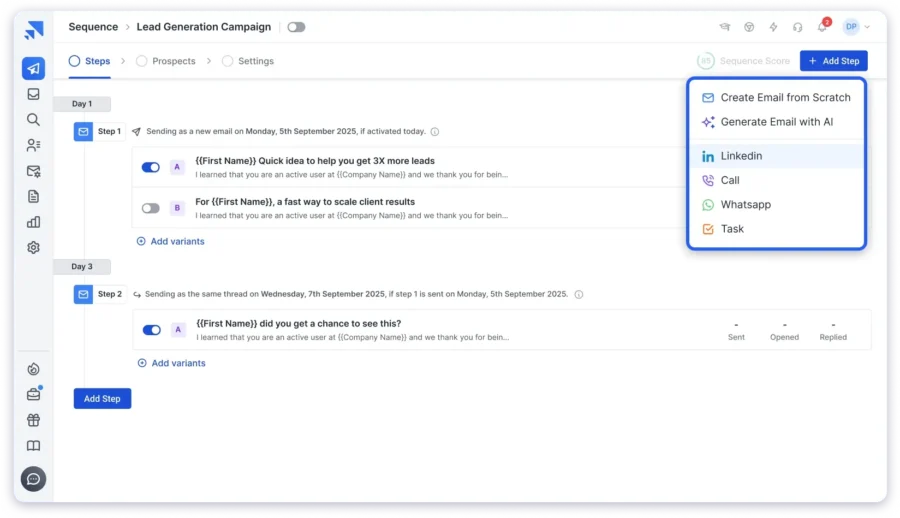
Saleshandy gives me confidence that campaigns will keep running in a stable way, even when volume increases or multiple inboxes are connected.
I can build sequences with:
- Multiple steps and controlled delays, which help avoid rushed follow-ups and keep outreach natural
- Follow-ups are triggered by engagement, such as opens, clicks, or replies, so prospects are not treated the same way blindly
- Sub-sequences that activate only when intent is shown, which means interested prospects get different messaging instead of generic nudges
- Custom sending patterns that respect prospect time zones and daily sending limits, reducing deliverability risks
One feature I rely on heavily is A–Z testing using AI variants.
Instead of testing just one or two subject lines or messages, I can test many variations safely, without rewriting everything manually. This allows me to improve performance over time while keeping campaigns stable and inbox-friendly.
Once a sequence goes live, Saleshandy needs very little supervision.
Replies stop follow-ups accurately, without delays. Sending stays balanced across inboxes, even at higher volumes. Timing remains consistent when multiple email accounts are connected.
This becomes very important when I am running several campaigns at the same time, or when campaigns are meant to run continuously rather than in short bursts.
Saleshandy feels built for that kind of workload.
Sparkle.io
Sparkle.io makes sequence creation feel easy and quick, especially at the beginning.
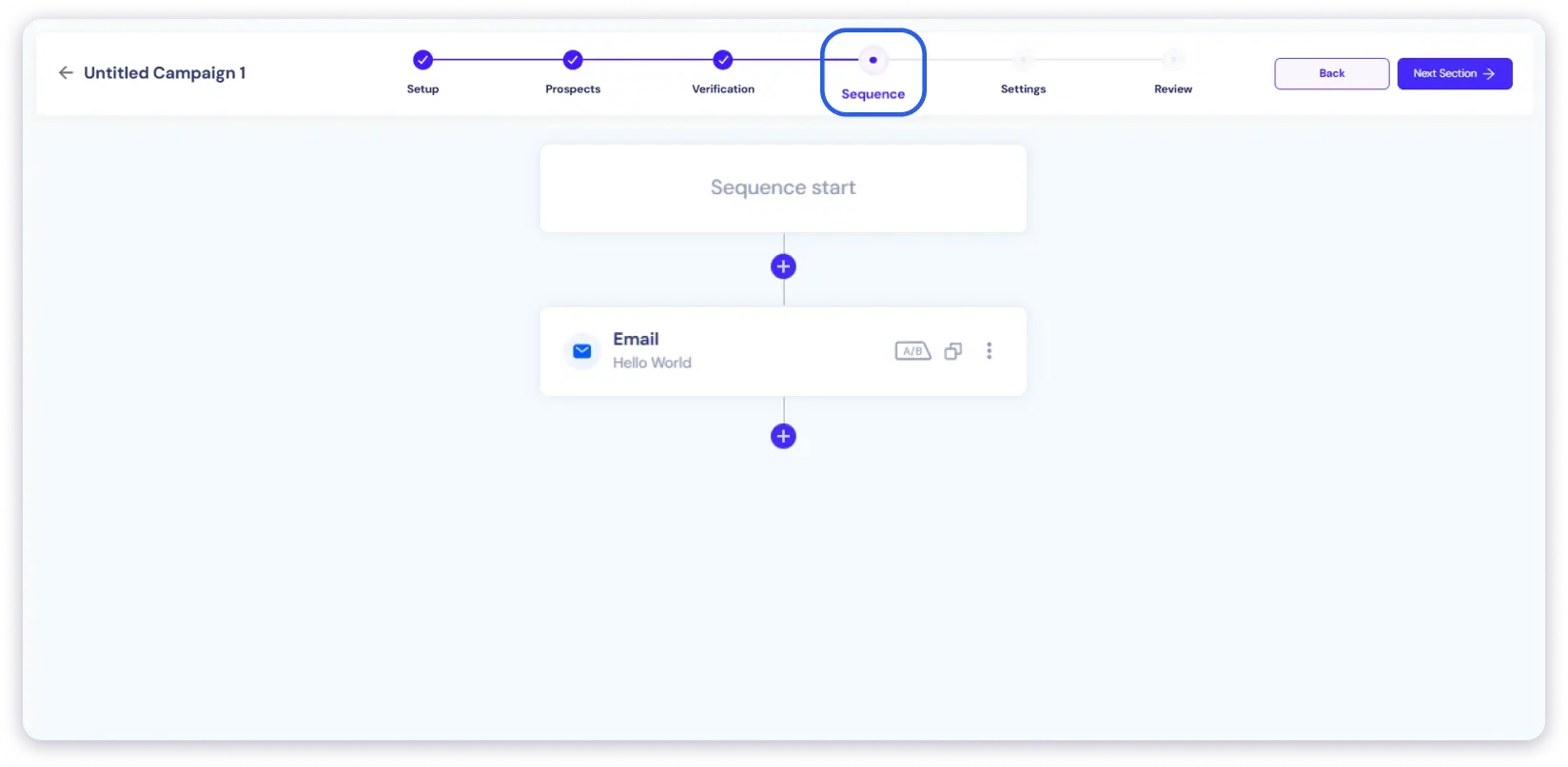
In day-to-day use, I can:
- Build multi-step sequences quickly without much setup
- Automate follow-ups based on engagement signals
- Set business hours and time zone rules easily
- Run A/B tests inside sequences without friction
- Duplicate campaigns and reuse structures quickly
For most day-to-day cold outreach, this experience feels smooth.
If the goal is to launch campaigns fast and keep workflows simple, Sparkle.io does a good job. It reduces setup friction and helps teams start sending quickly.
Where I start noticing limits is when sequences become more complex.
As I try to add deeper logic, layered conditions, or long-running behavior, control options become fewer. The platform feels more optimized for speed and simplicity than for managing complex campaign structures over time.
Which Tool Offers Better Sequence Automation Capabilities?
Winner: Saleshandy
Saleshandy, compared to Sparkle.io, offers more control and reliability for complex, long-running campaigns that need structure, adaptability, and consistency.
2. Saleshandy vs Sparkle.io: Email Deliverability and Infrastructure
Saleshandy
From my experience, Saleshandy treats deliverability as something you engineer upfront, not something you fix after campaigns start failing.
When I run cold email at scale, most deliverability issues come from three places:
- weak infrastructure setup
- poor sending behavior
- lack of early warning systems
Saleshandy addresses all three directly within the product with its inbox placement tool.
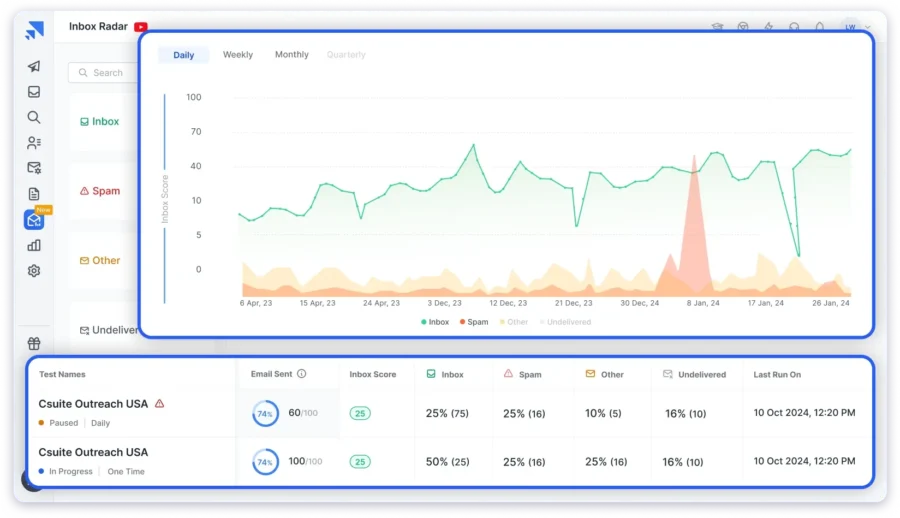
One of the biggest advantages is a ready-to-send email infrastructure. I can select and purchase secondary domains and email accounts directly from Saleshandy, without handling DNS or technical setup myself.
Each account comes with:
- SPF, DKIM, and DMARC are already configured
- Custom tracking domains set up
- US IP addresses only
- Automatic reconnects
- Bulk purchase and bulk updates
This removes a major source of deliverability risk. I am not relying on manual setups or third-party providers with inconsistent configurations.
Once accounts are live, Saleshandy focuses on safe sending behavior.
I rely on:
- Sender rotation, which distributes volume naturally across inboxes
- Daily sending limits, so no inbox gets pushed too hard
- Custom sending intervals, which keep patterns human-like
- Ramp-up controls, so new inboxes scale gradually
Another feature I love is Sequence Score.
Before launching any campaign, Saleshandy evaluates:
- Email account health
- Technical setup (SPF, DKIM, DMARC, domains)
- Sequence structure and follow-up spacing
- Daily sending quotas
- Spam word usage
- Personalization depth
- Link and tracking risk
This gives me a signal if a sequence is safe to launch or needs fixes. It removes guesswork and prevents mistakes that slowly hurt the sender’s reputation.
Saleshandy integrates with TrulyInbox for warming up domains and email accounts safely. You can warm multiple inboxes at once, ramp volume gradually, and monitor progress, reducing the risk of burning inboxes early.
Overall, Saleshandy’s deliverability setup feels built for continuous, long-term cold outreach, where inbox health matters more than short-term visibility.
Sparkle.io
Sparkle.io approaches deliverability from a different angle.
Instead of focusing primarily on infrastructure and prevention, Sparkle.io offers visibility, diagnostics, and monitoring.
From my experience and review of its tools, Sparkle.io is very good at showing what is happening with deliverability.
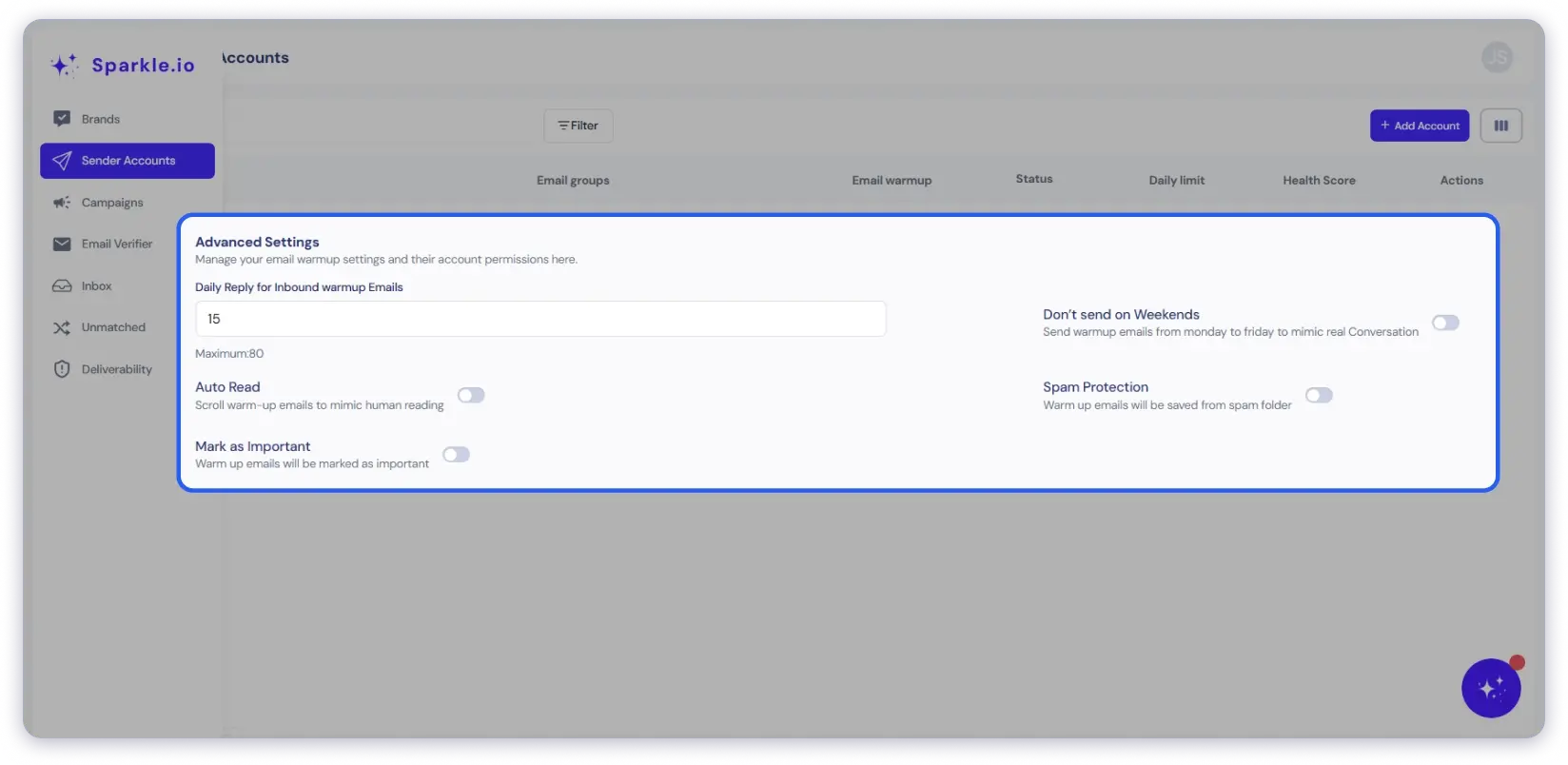
It offers:
- Inbox placement testing (inbox vs spam)
- IP address monitoring with alerts
- Domain monitoring for SPF, DKIM, and DMARC
- Blacklist monitoring across many blocklists
- Spam score analysis
- Trend tracking over time
Sparkle also provides:
- Manual inbox placement tests for quick checks
- Automated placement tests for ongoing monitoring
- ESP-specific insights to explain inconsistent results
- Clear health scores and actionable reports
On top of that, Sparkle includes a built-in email warm-up engine that is fully automated.
You can:
- Connect inboxes in minutes
- Choose a warm-up pace
- Let Sparkle simulate engagement
- Gradually build the sender’s reputation
This makes Sparkle strong for teams that want in-depth insights and early alerts on deliverability problems.
Where Sparkle feels weaker is in infrastructure ownership. It does not offer ready-to-send domains or inboxes, and deliverability safety depends on how users configure and manage external systems.
Which Tool Offers Better Email Deliverability Capabilities?
Winner: Saleshandy
Based on usage and full feature comparison, Saleshandy offers stronger email deliverability for scaled cold outreach.
Saleshandy allows for preventing deliverability issues through infrastructure, sending behavior, and pre-launch checks
However, Sparkle.io is good at diagnosing and monitoring deliverability, but Saleshandy excels at keeping campaigns stable and inbox-safe over time.
If your priority is long-term outbound scale with minimal deliverability firefighting, Saleshandy is the better choice.
3. Saleshandy vs Sparkle.io: Personalization and AI Capabilities
Saleshandy
From my experience, Saleshandy approaches personalization as a pre-send intelligence layer, not just a template feature.
The biggest difference is AI Prospect Enrichment.
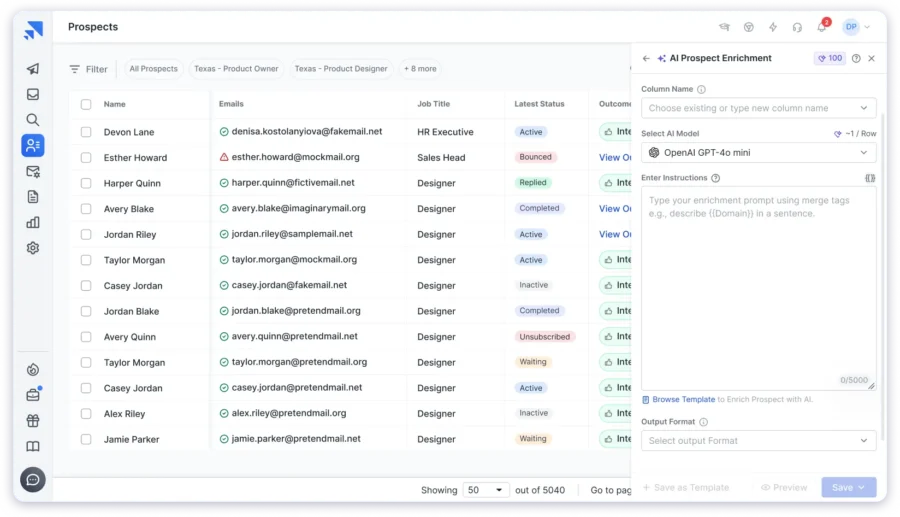
Saleshandy does not limit personalization to the data you already have. It actively enriches prospects using AI before emails are sent, and that enriched context flows directly into sequences and follow-ups.
In practice, I use AI Prospect Enrichment to:
- Generate context for subject lines and opening lines
- Create relevant icebreakers based on role, company, or public information
- Add research-driven insights without manual work
- Clean and normalize prospect data before sending
What makes this useful is control.
I can:
- Use ready-made templates or write my own prompts
- Preview enrichment output before running it at scale
- Rerun enrichment if the quality is not right
- Choose AI models based on the task
- Use enriched columns directly inside sequences
This allows me to scale personalization without sacrificing relevance. I am not guessing what the AI will produce. I can test on a few prospects, validate quality, and then roll it out confidently.
On top of enrichment, Saleshandy supports:
- Variable tags and merge tags
- Spintax for message variation
- AI-generated variants at the sequence level
- Personalization scoring and Sequence Score checks
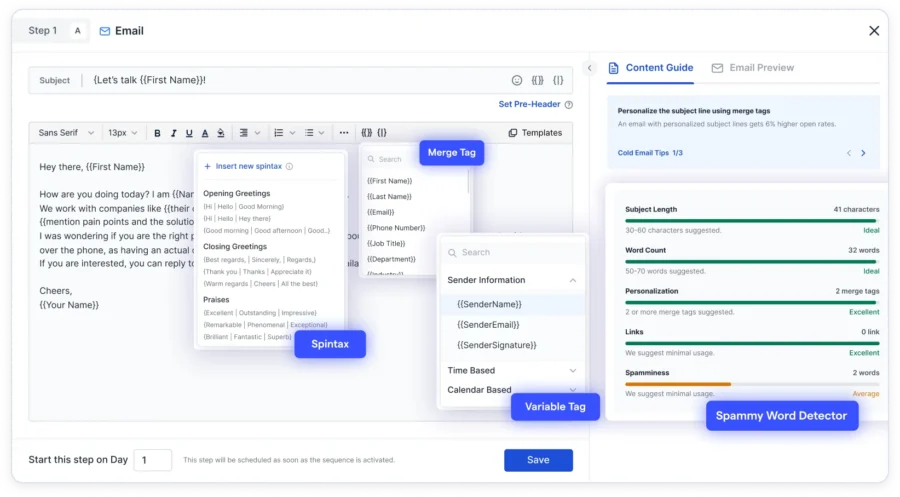
All of this works together. Enrichment improves context. Variants reduce repetition. Sequence Score ensures personalization does not hurt deliverability.
In campaigns, this helps me personalize what I say, not just how I format it.
Sparkle.io
Sparkle.io focuses on personalization inside the email template itself.
With Sparkle.io, personalization is very flexible once prospect data already exists.
In day-to-day use, Sparkle allows me to:
- Build highly personalized cold email templates beyond first name
- Use Liquid syntax to control message logic
- Personalize content based on industry, role, or behavior
- Add custom images, such as logos or screenshots
- Send prospects to custom landing pages
- Personalize both first emails and follow-ups
This makes Sparkle strong for teams that want fine-grained control over how messages look and adapt.
Liquid syntax is especially powerful when campaigns require:
- Conditional phrasing
- Advanced template logic
- Structured personalization rules
Sparkle’s personalization depth is high, but it depends heavily on existing data quality. The platform does not enrich prospects automatically at the same depth. Personalization is only as good as the inputs provided.
This means more preparation is required before campaigns go live.
Which Tool Offers Better Personalization & AI Capabilities?
Winner: Saleshandy
Based on usage, Saleshandy offers more practical power for personalization at scale.
Saleshandy personalizes before sending, using AI Prospect Enrichment and more to help decide what to say and why, guided by AI-driven context.
Sparkle helps control how messages are structured, once data exists. Saleshandy is better here.
Sparkle.io remains a solid option for teams that already have rich data and want deep template logic. But for end-to-end personalization that actually improves replies at scale, Saleshandy has the advantage.
4. Saleshandy vs Sparkle.io: Reply and Inbox Management
Saleshandy
From my experience, Saleshandy treats reply management as a conversion control layer, not just an inbox view.
When you start scaling cold outreach, the biggest risk is not sending emails. It is missing replies, misreading intent, or responding late.
Saleshandy’s Unified Inbox solves this by pulling all replies from all connected sequences and email accounts into one central place.
I no longer need to log into Gmail, Outlook, or switch between inboxes to track conversations.

In daily usage, Saleshandy’s Unified Inbox allows me to:
- View replies from multiple sequences and email accounts in one inbox
- Reply or reply-all directly from the same thread
- Automatically stop follow-ups when a prospect replies
- Maintain reply consistency by sending responses from the original sender account
- Use drafts and send-later, which helps with timing replies properly
Where Saleshandy stands out is in conversation organization.
Every reply can be categorized using predefined outcomes such as:
- Interested
- Not Interested
- Meeting Booked
- Not Now
- Do Not Contact
- Closed
Additionally, Saleshandy offers AI-based categorization.
The system scans the tone and intent of replies and automatically assigns outcomes. This saves a lot of time when reply volume increases.
I also regularly use:
- Filters by sequence, account, owner, and date range
- Bulk actions to mark, categorize, or delete conversations
- Search across subject lines and recipients
- AI intent filters to prioritize high-interest replies
For solo users, founders, and lean sales teams, this setup works extremely well. It keeps reply handling structured without adding operational complexity.
There are limitations I have noticed:
- Only sequence replies appear in the Unified Inbox
- Visibility is limited to sequence owners
- Older conversations are capped
- Starter plans restrict reply actions
Still, for managing cold email replies efficiently, Saleshandy does a strong job.
Sparkle.io
Sparkle.io approaches reply management from a team-first and scale-first perspective.
With Sparkle.io, the unified inbox is designed for environments where multiple people handle replies together.
In usage, Sparkle’s inbox gives me:
- Auto-sorted replies to reduce clutter
- Smart campaign matching using domains and keywords
- Multi-account reply detection across threads
- Advanced search and filters built for large volumes
- Team assignment tools, so replies are owned clearly
Sparkle’s inbox feels more like a shared command center.
If replies come in from different inboxes, senders, or campaigns, Sparkle does a better job of automatically connecting everything. This reduces confusion when many accounts are active at once.
Where Sparkle clearly pulls ahead is in collaboration.
When teams need:
- Reply ownership
- Faster handoffs
- Shared visibility
- No dependency on sequence ownership
Sparkle’s reply system feels more scalable and flexible.
The trade-off is that it can feel heavier for small teams or solo operators. There are more moving parts, but that complexity serves larger workflows well.
Which Tool Offers Better Reply Management Capabilities?
Verdict: It’s a tie for different reasons.
Both tools handle replies well, but they solve different reply-management problems.
Saleshandy’s Unified Inbox works best when the goal is clarity, speed, and control. It brings all sequence replies into one place, categorizes them using AI, and keeps reply handling simple and predictable.
Both tools are strong here. The better option depends on how your team handles replies, not on missing features.
5. Saleshandy vs Sparkle.io: Integrations and Workflow Fit
Saleshandy
From my experience, Saleshandy treats integrations as a core part of outbound execution.
Saleshandy integrates directly with tools that sit at the center of daily sales workflows. This includes CRMs, email service providers, enrichment tools, warm-up tools, video personalization platforms, and automation systems.
What stands out is how tightly these integrations are connected to actual outreach actions.
I can:
- Sync prospects and activities bi-directionally with CRMs like HubSpot, Salesforce, Zoho, and Pipedrive
- Send campaigns directly through Gmail or Outlook using native ESP integrations
- Push leads from enrichment tools straight into sequences without manual imports
- Warm up inboxes automatically using TrulyInbox without leaving the platform
- Add personalized videos using tools like Sendspark, Weezly, and Pitchlane
- Automate cross-tool workflows using Zapier with thousands of supported apps
The key advantage is workflow continuity.
Leads move from discovery → enrichment → outreach → replies → CRM updates without breaking context.
Saleshandy also supports API access and custom workflows, which help when teams want tighter control or internal automation.
Overall, Saleshandy fits well into sales-led outbound workflows, where integrations need to support sending, scaling, and managing cold email campaigns end to end.
Sparkle.io
Sparkle.io takes a different integration approach.
Sparkle’s integrations are focused on email verification and data hygiene, rather than full outbound execution.
It connects with a wide range of tools across:
- CRM systems
- Email marketing platforms
- ESPs
- Spreadsheets
- Marketing automation tools
- Lead generation platforms
- Form builders
- Ecommerce tools
This makes Sparkle strong when the primary goal is to validate emails wherever they are collected or stored.
For example:
- Verifying leads as they enter CRMs
- Cleaning email lists inside spreadsheets
- Preventing invalid sign-ups through forms
- Protecting sender reputation before emails reach ESPs
However, most integrations stop at verification and monitoring.
Sparkle does not deeply connect integrations to sequence logic, reply handling, or CRM-driven outbound execution in the same way Saleshandy does.
This makes Sparkle a good fit for teams that:
- Rely on multiple tools for outreach
- Want a strong verification layer across their stack
- Need clean data before running campaigns elsewhere
Which Tool Offers Better Integration Capabilities?
Winner: Saleshandy
Saleshandy offers stronger integration capabilities for outbound sales workflows.
It connects tools to:
- Sequence creation
- Campaign execution
- Deliverability management
- Reply handling
- CRM updates
Sparkle.io integrates widely, but mostly around email verification and deliverability monitoring.
Saleshandy vs Sparkle.io: Pricing and Overall Value
Now I am answering the most important question you are here for. Which cold email tool gives you better value for your money?
Let’s break it down.
Saleshandy
Saleshandy offers a 7-day free trial and includes free credits to test its Lead Finder before committing.
Its paid plans follow a four-tier pricing structure, with the entry plan starting at $25 per month.
What stands out immediately is that Saleshandy does not charge extra for scale-critical basics.
What You Get:
- Add unlimited email accounts without extra cost
- Add unlimited clients and team members
- Access automation, personalization, and deliverability tools from the base plan
- Use built-in sender rotation, warm-up, and unified inbox without add-ons
Saleshandy also separates pricing for advanced needs instead of forcing upgrades.
It has independent pricing for:
- B2B Lead Finder
- Cold Email Infrastructure
- Inbox Placement Testing
- Email Verification
- AI credits for enrichment and sequences
This makes pricing predictable. You only pay more when you actually scale usage.
You can review the full breakdown on Saleshandy’s official pricing page.
Sparkle.io
Sparkle.io offers a free plan and paid plans starting at $29 per month.
Instead of outreach-based limits, Sparkle uses a credit system called Sparkles.
Each plan gives you a fixed number of Sparkles per month, which are consumed as you:
- Verify emails
- Run campaigns
- Use personalization and monitoring features
Sparkle also provides:
- email warm-up
- inbox rotation
- AI writer
- deliverability monitoring on higher plans
However, as outreach volume increases, Sparkle usage becomes harder to forecast.
You need to actively track Sparkle consumption to avoid hitting limits or buying add-on credits.
Sparkle also offers a Managed Service plan at a much higher monthly cost, where domains, inboxes, and sourcing are handled for you. This is closer to an outsourced service than a self-serve SaaS plan.
Which Tool Gives Better Value for Money?
Saleshandy provides better value for money. Here’s why:
- Starts at $25/month, lower than Sparkle’s paid entry point
- Allows unlimited email accounts, clients, and team members without usage penalties
- Offers deliverability safeguards upfront, not as monitoring after problems appear
- Includes built-in lead sourcing and AI enrichment, instead of relying on external tools
- Keeps pricing predictable as outreach scales, without credit anxiety
Sparkle.io works well for teams that prioritize visibility and diagnostics at lighter volumes.
That difference becomes very clear once campaigns move from testing to continuous execution.
Advanced Features of Saleshandy Over Sparkle.io
Some differences only show up once you run cold outreach end-to-end. This is where Saleshandy clearly moves ahead of Sparkle.io.
Two areas stand out the most: Lead Finder and Agency Management.
1. Lead Finder
From experience, lead sourcing is where most cold email workflows slow down.
With Saleshandy Lead Finder, I do not need a separate tool to find leads, verify them, and prepare them for outreach. Everything happens inside one system.
Saleshandy gives access to a database of over 800 million contacts and 60 million companies. I can search using 25+ filters, including role, department, company size, industry, revenue, location, and experience level.
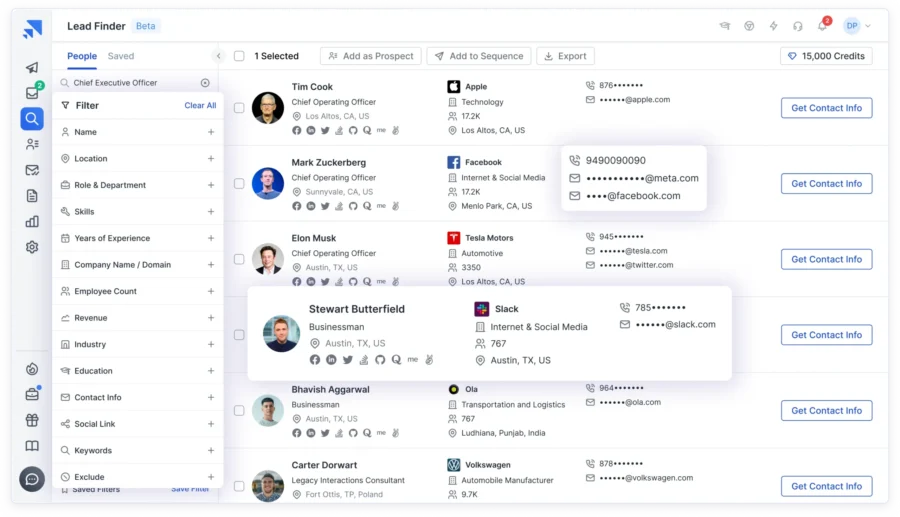
If I already know who I want, I can use an AI-powered lead search. I simply describe my ideal prospect in plain language, and Saleshandy returns relevant, verified leads. This saves a lot of manual filtering.
What matters more is data quality.
Saleshandy verifies emails in real time, so credits are used only for valid email addresses and phone numbers. This protects deliverability before campaigns even start.
Once leads are found, I can:
- export up to 10,000 leads at once
- push them directly into email sequences
- enrich them using AI Prospect Enrichment before sending
The LinkedIn Chrome extension makes this even faster. I can reveal verified emails and phone numbers directly from LinkedIn profiles and add them to sequences with one click.
Sparkle.io does not offer native lead discovery or contact databases.
It relies on external tools for sourcing leads, which means more integrations, more cost, and more chances for data mismatch.
Why this matters: Saleshandy removes friction between lead discovery and outreach. Sparkle.io assumes leads already exist with you. For teams running outbound at scale, that difference saves time and reduces risk.
2. Whitelable Solution
Agency workflows expose limits that single-team tools often hide.
Sparkle.io works well for internal sales teams, but it lacks strong agency-level controls.
There is no white-label environment, no client-specific branding, and limited flexibility around client access.
Saleshandy handles agency needs directly.
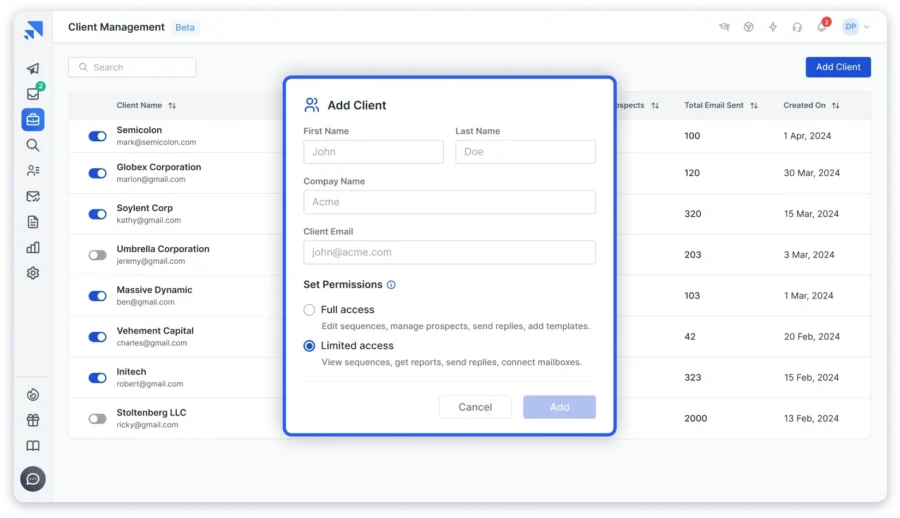
With Saleshandy’s Agency Management and Whitelabel setup, I can:
- Use my own domain, logo, and branding across the platform
- Offer clients a branded login experience instead of a third-party tool
- Send analytics reports with my agency branding
- Control client access at a granular level
- Allow clients to view or edit campaigns when required
- Share branded notifications and reports automatically
Operational limits are also removed:
- Unlimited clients
- Unlimited email accounts
- Unlimited team members
This changes how agencies position their services.
Instead of reselling access to a tool, agencies can present Saleshandy as part of their own outreach system.
Sparkle.io does not currently support this level of agency ownership or branding control.
It works best when campaigns are run internally, not when agencies manage outreach on behalf of multiple clients.
Final Verdict: Saleshandy Wins on Value, Scale, and Automation
Both Saleshandy and Sparkle.io are capable cold outreach tools.
But when you compare them feature by feature, Saleshandy clearly comes out ahead.
It offers →
- Stronger deliverability controls before campaigns go live
- Built-in lead finding and AI prospect enrichment
- Sequence automation with subsequences and AI variants
- Predictable pricing that supports scale without usage anxiety
All of this comes at a more cost-effective entry point.
Sparkle.io performs well for visibility, monitoring, and shared inbox workflows.
Saleshandy performs better when cold email is a growth engine, not an experiment.
So, if you want to scale outreach faster, automate with more control, and keep costs stable as volume grows, Saleshandy is the choice.
Try Saleshandy’s 7-day free trial and evaluate the difference in usage.
FAQs About Saleshandy vs Sparkle.io
1. Can Saleshandy Replace Sparkle.io for Cold Email Outreach?
Yes. For most cold email use cases, Saleshandy can replace Sparkle.io completely.
Saleshandy already covers:
- advanced sequence automation
- sender and inbox rotation
- email warm-up
- deliverability checks before launch
- unified inbox and reply management
- lead finding and AI enrichment
Sparkle.io adds strong monitoring and diagnostics, but those are not essential if your outreach is structured and controlled from the start.
For teams running cold email regularly, Saleshandy is enough on its own.
2. What is the Core Difference Between Saleshandy and Sparkle.io?
The core difference is how both tools approach cold email. Saleshandy is built to run and scale outbound safely. Sparkle.io is built to observe, monitor, and organize outbound activity.
Saleshandy focuses on:
- preventing deliverability issues
- controlling sending behavior
- managing infrastructure
- scaling without breaking inbox health
Sparkle.io focuses on:
- visibility
- diagnostics
- inbox monitoring
- shared workflows
- One helps you execute.
The other helps you supervise.
3. Who Should Use Saleshandy, and Who Should Choose Sparkle.io?
Choose Saleshandy if you:
- depend on cold email for pipeline
- run long-term or high-volume campaigns
- manage multiple inboxes or clients
- want predictable pricing while scaling
- need lead sourcing and outreach in one place
Choose Sparkle.io if you:
- run lighter outreach
- care more about monitoring than scale
- want unified inbox visibility for teams
- prefer diagnostics over infrastructure control